Blog Archives
The Skeleton Key (2005)
 The marketing said it was horror (voodoo, creepy kids), but it’s less a horror movie and more a Twilight Zone tale. It has its share of jump scares and tries to draw out an atmosphere of dread. You see a lot of how doors work from inside locks. The Skeleton Key tries to be overly clever despite its plot holes, but at least the film runs its course. It wasn’t trying to throw out a contrived ending. Kate Hudson needs better roles than these do-nothing parts; she’s far too cute to languish. And how many times did she inspect late-night noises in her underwear? The most entertaining aspect of The Skeleton Key may be gazing at a pre-Katrina New Orleans.
Nate’s Grade: B-
Share this:

Jarhead (2005)
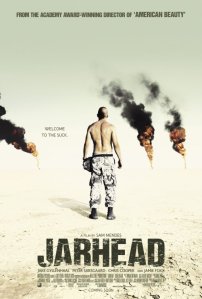 The controversy surrounding Jarhead, a hotly anticipated movie dealing with the 1991 Gulf War, seems rather misplaced. Some argued it would be anti-American, anti-war, anti-Marines, and on the other side of the coin, some even argued that it would be pro-war and pro-aggression. Now the movie seems to be taking flak for not being too political. Director Sam Mendes (American Beauty, Road to Perdition) is interested in crafting a movie about the soldiers, a true first-person war. I was actually very pleased, and somewhat relieved, that Jarhead didn’t try to bend over backwards and make any forced parallels to our current Gulf War conundrum. When you’re arguing about whether a movie leans right or left then perhaps the movie stands tall on its own, and Jarhead stands very tall indeed.
Anthony Swofford (Jake Gyllenhaal) is a “jarhead” the nickname for Marines because of what their heads resemble after their sheering, but it’s also indicative of a vessel, ready to be filled with knowledge. Swofford says he entered the corps because he “got lost on the way to college.” He’s humiliated, beaten, and looking for a way out when Staff Sergeant Sykes (Jamie Foxx) offers (more like orders him) to try out for the elite position of Marine snipers. It’s during this new training regiment that Swofford becomes “hooked” on being all he can be. He’s partnered with his barrack buddy Troy (Peter Sarsgaard), who serves as Swofford’s moral anchor. The boys get their hopes up when they catch the news that Iraq has invaded Kuwait. They’re shipped out to the action and are finally going to get a taste of combat … or so they think. They spend months in the Saudi desert amongst 114 degree heat and interminable boredom. They drink water, they play football in their gas suits for the cameras, they goof off, but mostly they wait. And wait. And wait. When the war does finally come into being, any action is short-lived: “Four days, four hours, one minute. That was my war.” Swofford, Troy, and his fellow Marines are aching for some kind of combat, any kind of violence that they’re physically and mentally breaking down in the monotony.
 Even the safety nets in previous war films, like the chickadee at home waiting for you, are ripped away in Jarhead. Usually the life at home is a source of release for movie soldiers, but in Jarhead it’s just one more source of mounting anxiety. The men have a Wall of Shame with pictures of ex-wives and girlfriends who have left them or cheated on them.
The acting on display is tremendous. Gyllenhaal (The Day After Tomorrow[) gives a sensational performance that should turn him into a bona fide, A-list leading man. All at once he can display fraternal bravado, closeted fear, confusion, and dulled horror. His show stopping moment is when he’s amidst a mental breakdown and turns a rifle on a comrade and then on himself, pleading that a shot be taken. The scene is a powder keg of intensity and Gyllenhaal is utterly captivating, startling, and horrifying with every teeth-grinding second. What?’ even better is that his performance doesn’t stop when the camera isn’t centered on his beautiful baby-eyes. He draws stronger performances out of those around him, and he does it quietly with confidence. He masks his fear and does so in fascinating, layered ways. Performances like this are what Oscars are for. And for any Jake fans out there, yes he does show a good bit of flesh in the film.
Foxx (Ray) breathes fiery life into what otherwise could have been a stock character, the tough love drill sergeant. He’s given much more screen time than I had ever thought and makes the most of it. Sarsgaard (Garden State) is a steely, dependable shoulder of support in the film, and his own big breakdown scene is amazing to witness. He?s so close to a kill but is overruled by the military brass, and Sarsgaard just lets everything go. It’s incredible. Chris Cooper (Adaptation) and even Dennis Haysbert, 24‘s president Palmer himself, have brief but very memorable small turns.
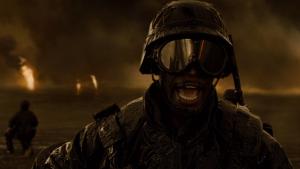 The cinematography by Roger Deakins (replacing Mendes previous Oscar-winning collaborator, the late great Conrad Hall) is gorgeous and uses light and shadow in remarkable ways to convey the turmoil of the soldiers and the other-worldliness of the desert. There are scenes amongst the lit oil fields that look like some alien world. It’s a perfect visual representation of how alone these men are and how ill-equipped they are for that scenario. The camerawork beautifully echoes the emptiness of their surroundings. Jarhead should easily score a much-deserved Oscar nomination for Deakins (House of Sand and Fog).
Jarhead is really an analysis of the psychology of what it takes to go to war. There is a transformation process, where young boys get stripped down and turned into killing machines. Jarhead poses a central question: what happens when you create the ultimate killing machine and give it nothing to do? Essentially, these men are breaking down in the tedium and many will be broken for the rest of their lives. A very poignant scene comes late in the film during their triumphant bus ride home. A Vietnam vet hops on to cheer his fellow Marines and in his hazy jingoism, you see how haunted and broken this man is from his own war experiences decades past. The future is staring them right in the face. Swofford opens and closes the film with narration explaining that once a man holds a rifle in combat, no matter what else he does in his life his hands will feel that rifle. These are men trained for war and adjusting to everyday life where the only war resides inside. Jarhead is a monstrously powerful study on the lasting effects of turning young men into monsters of combat.
Jarhead‘s inherently anticlimactic nature works against it, which will cause some level of disconnect with an audience. This is a very loosely structured flick about delayed gratification with no payoff. That’s not exactly a recipe for success. Jarhead is essentially the Waiting for Godot of war movies. The film is about monotony, about inaction, and the movie achieves a surprising yet palpable tension simply from drawing the viewer along for so far. In lesser hands a movie about boredom would still be boring, but Mendes brings an unprecedented art to it. Mendes has a confidant vision and the technical skill to bring out the drama of boredom. Jarhead has a deadpan sense of humor and some very sobering moments, like when Swofford comes across the remains of a traffic jam caught in napalm. These killing machines are getting rusty and will come back home without ever getting to pull a trigger, and what does that do to a man? These are important questions and Mendes is interested in answering them at a pace that still serves his characters. I love that Mendes has directed three films that are wildly different from one another. In my view, this guy is three-for-three.
 Jarhead is no Full Metal Jacket and yet Mendes gives passing nods to Vietnam and how our culture has shaped its history. The Marines watch Apocalypse Now and cheer as helicopters mow down villages set to a thundering soundtrack by Wagner. They’ve completely missed the point of one of the most anti-war films ever, transforming it into a bloodlust ritual. When Mendes reaches the desert then Jarhead becomes a war movie unlike any other. It’s a war movie without a war, sort of. All wee see are the results, both external and internal.
In a way, Jarhead is all about transformations and transitions, one of which is the Gulf War itself. This was arguably the first made-for-TV war and viewers were amazed at the green-tinted images of explosions and military might. War had been brought into the video game age where what once took months on the ground could be accomplished by pushing a button. Jarhead shows you the side of the Desert Shield/Storm that never made it to the cameras. The movie also presents some of the more obscured details of the war, like the care for and disposal of human waste from outhouses. That stuff never made CNN. Jarhead shows, very quietly and somberly, that sometimes the soldiers who return home have still been left behind.
Jarhead is an intense, sobering, evocative, and deeply contemplative film about the psychology of turning young men into killers and then leaving them with nothing to do. The inherent anticlimactic nature will likely push some audiences away while others will simply find it tedious. Mendes’ direction is strong and confidant and able to squeeze drama and tension from inaction, crafting an existential war movie that feels relevant and profound. Gyllenhaal is amazing and utterly captivating; you can’t take your eyes off him and, for many out there, a certain strategically located Santa hat. This movie isn’t anti-America, anti-troops, or even anti-war for that matter. Jarhead tells us that all wars are different and all wars are the same. We know war is hell, but for some, the absence of war is an even greater hell.
Nate’s Grade: B+
Share this:

Flightplan (2005)
 Anyone else tired of seeing that damn trailer for Flightplan? Ever since maybe June, I’ve been seeing Jodie Foster freak out on an airplane. The trailer also had the misfortune of revealing way too much information about the film’s plot, seriously spoiling a key moment. This got me thinking about other movie trailers that spoil the movie. The worst offender I can fathom is 1998’s The Negotiator, where Samuel L. Jackson and Kevin Spacey are pitted against each other as hostage negotiators on opposite sides. The trailer had the nerve to reveal that Spacey and Jackson team up in the end to fight The Man collectively. Why does it seem that movie trailers these days spell out film twists? Are movie audiences demanding more investment before shelling out money? Do studios just not have faith in audiences anymore? With all this in mind, I ventured into Flightplan with my family thinking there might be more to the film than one poorly spoiled twist. I was wrong.
Kyle Pratt (Foster) is a very distraught woman. She’s returning from Berlin to the United States with the casket of her dead husband aboard. To make things worse, at 30,000 feet her daughter Julia goes missing. Kyle looks around the giant aircraft that she helped design, still not finding any trace of her absent little girl. Kyle becomes more frantic the more she looks and finds nothing, troubling an air marshal (Peter Sasrgaard) and the pilot (Sean Bean). No one remembers seeing Julia on board. She believes her daughter is somewhere and someone is definitely responsible. Kyle is dealt a crushing blow when word comes from a Berlin mortician that not only is the plane carrying the body of her dead husband but also her dead daughter. Is Kyle right or is she one crazy mamma? And so the drama unfolds.
 Flightplan is a rather boring trip. Well over half of this movie is spent watching Kyle wig out and search compartments for her missing kid. She’s frantic and possessed and it’s interesting to watch a woman come undone, especially of Foster’s talent, but after several searches and little progression, the film feels like it’s going nowhere. There’s very little story for very long stretches of time. Flightplan relies on its outlandish final twists to provide a story, because without them the film would just have been 60 minutes of a mother freaking out on a plane. You can see that with home movies.
The premise is a direct homage (or rip-off) of Hitchcock’s The Lady Vanishes, but Flightplan could have been something special if it wasn’t so afraid of going against convention. The film sets up our leading lady looking for her missing child, and as the hours tick away she becomes more and more undone, practically terrorizing the other passengers. In a bit of incisive bigotry, Kyle even unfairly blames a pair of Middle Eastern passengers, who then garner everyone’s suspicious eyes. Now, with all this set up, what if Flightplan took a different path and we remained in doubt whether Kyle ever had a living daughter, and then through her grief, confusion, frustration, and misplaced anger she became a terrorist and was the cause of the plane going down. Wouldn’t that be neat? A little thought-provoking about role reversals in a post-9/11 anxiety-riddled world? It’s not like I expected a dour, Twilight Zone-esque ending, but Flightplan presents Kyle as a crazy woman with the entire world against her, and yet the movie virtually winks at you to say, “Don’t worry, this is Hollywood, no matter how outlandish the conspiracy, our heroine will always be right.” At the end, the film even has the distasteful audacity to have a scene where Kyle walks past every airline passenger, shaming them for having ever doubted a crazy loud woman who had terrified them and jeopardizing their safety. Shame on you all, passengers. Don’t you know that she’s Jodie Foster? She has TWO OSCARS! Kyle doesn’t even offer an apology to the Middle Eastern passengers, and they even carry her bags for crying out loud!
 There’s suspension of disbelief and then there’s Flightplan. The missing-daughter scheme is so ridiculous, so convoluted, so rickety, that it makes Scooby-Doo schemes look downright like Hitchcock. For those who have seen the film, or just want to know the laundry list of variables to allow this plan to work, read on (massive spoilers ahead). Apparently, the ones behind everything are the helpful air marshal and one stewardess. They want to squeeze 50 million dollars from the airline. This is the best way they propose to do so: First, they locate an airline engineer living abroad and kill her husband and make it look like suicide. Then they pay off the mortician so they can stash explosives in her husband’s security sealed coffin. Then apparently they know when Kyle will want to fly again and it also happens to be a flight that the marshal and the stewardess will be scheduled aboard. Now, once the plane is in flight, the marshal somehow manages to steal the little girl, awakening no one, takes Kyle?s boarding pass and doesn’t awaken her, and stows the little girl away without being seen. They then let Kyle go nuts looking for her missing tyke so they can, get this, have a credible hijacker that they can accuse of plotting to blow up the plane unless … she gets 50 million wired into an account. Afterwards, the marshal will somehow get the Feds to kill Kyle and he’ll slip the detonator in her cold dead hand. Oh, and the stewardess changes the flight manifest twice too. What. The. Hell? Does this sound like the easiest way to make money? This plan also involves Kyle wiggling her way into the cargo hold and manually opening her hubby’s casket with the security code so that the marshal can get a hold of the hidden explosives. This entire tortuous plan revolves around a primary assumption that NO ONE will remember or interact with Kyle’s daughter the entire time. This assumes not a single person will remember little Julia, even though mother and daughter boarded first onto an empty plane. What would happen if Julia hit the call button for a pillow? Oops. What would happen if anyone next to them just said, “Hi?” Oops. What would happen if people on the plane contacted anyone at the airport? Oops. The entire conspiracy rests on 400 people’s bad memories. Those do not seem like good odds to me, but then again I’m not a movie villain. The entire heft of Flightplan is built around the revealing of this nefarious, fool-proof plot. The movie can’t help but crash and burn with such a laughable, preposterous Big Twist to give plausibility to the proceedings.
It’s a shame because Foster gives a real nail-biting performance. She’s splendidly rattled and lets the audience see the gears of fear turn in her eyes. The acting as a whole is the lone strength of Flightplan. Foster provides entertainment just from her sheer talent to be able to make a turkey like this flick even remotely watchable. The rest of the cast is okay to good and they all deserve pilot wings for keeping straight faces.
Flightplan is a timid, tedious, tiresome, and painfully preposterous thriller. Foster’s excellent performance is wasted in a film that spins its wheels before unleashing a dreaded torrent of illogical plot twists. You may be twisting your head around just to understand how any of this deeply flawed movie could be plausible. Flightplan should appeal to people that liked 2004’s The Forgotten, a very similar child-vanishes thriller. Another thing both movies have in common is that they’re utterly terrible.
Nate’s Grade: C-
Share this:

Kinsey (2004)
 Bill Condon’s probing, fascinating biopic of Indiana University sex pioneer Kinsey (Liam Neeson) could not come out at a more important time. Kinsey lived in the Dark Ages of sexuality and fought against what he saw as “morality disguised as fact.” Kinsey broke barriers studying the science of sexuality and gathered nationwide statements to amass the first thorough book on what’s under the sun and what’s going on under the sheets. Today, we live in a splintered world where people listen to information that affirms their beliefs, and tune out contradictory evidence even if it’s fact (look at the latest report on abstinence-only programs dishing out highly erroneous information). Kinsey railed against this dangerous line of thinking. The man was no saint and had issue comprehending some of the more complicated human emotions. Kinsey is exceptionally well acted and Neeson gives a career best performance. Kinsey is fearlessly graphic in its frank discussion but also enormously intelligent. The fact that conservative groups are actually protesting it shows that Kinsey’s work is far from over.
Nate’s Grade: A-
Share this:

Garden State (2004)
 Zack Braff is best known to most as the lead doc on NBC’s hilarious Scrubs. He has razor-sharp comic timing, a goofy charisma, and a deft gift for physical comedy. So who knew that behind those bushy eyebrows and bushier hair was an aspiring writer/director? Furthermore, who would have known that there was such a talented writer/director? Garden State, Braff’s ode to his home, boasts a big name cast, deafening buzz, and perhaps, the first great steps outward for a new Hollywood voice.
Andrew Large Largeman (Braff) is an out-of-work actor living in an anti-depressant haze in LA. He heads back to his old stomping grounds in New Jersey when he learns that his mother has recently died. Andrew has to reface his psychiatrist father (Ian Holm), the source of his guilt and prescribed numbness. He has forgotten his lithium for his trip, and the consequences allow Andrew to begin to awaken as a human being once more. He meets old friends, including Mark (Peter Sarsgaard), who now digs graves for a living and robs them when he can. He parties at the mansion of a friend made rich by the invention of silent Velcro. Things really get moving when Andrew meets Sam (Natalie Portman), a free spirit who has trouble telling the truth and staying still. Their budding relationship coalesces with Andrews re-connection to friends, family, and the joys life can offer.
 Braff has a natural directors eye for visuals and how to properly use them to convey his characters feelings. A scene where Andrew wears a shirt and blends into the wall is a perfect visual note on the characters sleep-walk through life. Braff’s writing is also familiar but satisfyingly unusual, like a repackaging of old stories told with a confident voice. His characters are interesting and memorable, but dont feel uselessly quirky, unlike the creations of other first time indie writers. The melancholy coming-out of Andrew from disconnected schlub to post-pharmaceutical hero really grabs the audience and gives them a rooting point. At times, though, it seems as though Braff may be caught up trying to craft a movie that speaks to a generation, and some will see Garden State as a generation’s voice of a yearning to feel connected.
Braff deserves a medal for finally coaxing out the actress in Portman. She herself has looked like an overly medicated, numb being in several of her recent films (Star Wars prequels, Im looking in your direction), but with her plucky, whimsical role in Garden State, Portman proves that her careers acting apex wasn’t in 1994’s The Professional, when she was 12. Her winsome performance gives Garden State its spark, and the sincere romance between Sam and Andrew gives it its heart.
Sarsgaard is fast becoming one of the best young character actors out there. After solid efforts in Boys Don’t Cry and Shattered Glass, he shines as a course but affectionate grave robber that serves as Andrews motivational elbow-in-the-ribs. Only the great Holm seems to disappoint with a rare stilted and vacant performance. This can be mostly blamed on Braff’s underdevelopment of the father role. Even Method Man pops up in a very amusing cameo.
The humor in Garden State truly blossoms. There are several outrageous moments and wonderfully peculiar characters, but their interaction and friction are what provide the biggest laughs. So while Braff may shoehorn in a frisky seeing-eye canine, a knight of the breakfast table, and a keeper of an ark, the audience gets its real chuckles from the characters and not the bizarre scenarios. Garden State has several wonderfully hilarious moments, and its sharp sense of humor directly attributes to its high entertainment value. The film also has some insightful looks at family life, guilt, romance, human connection, and acceptance. Garden State can cut close like a surgeon but it’s the surprisingly elegant tenderness that will resonate most with a crowd.
 Braff’s film has a careful selection of low-key, highly emotional tunes by artists like The Shins, Coldplay, Zero 7, and Paul Simon. The closing song, the airy Let Go by Frou Frou, has been a staple on my play list after I heard it used in the commercials.
Garden State is not a flawless first entry for Braff. It really is more a string of amusing anecdotes than an actual plot. The film’s aloof charm seems to be intended to cover over the cracks in its narrative. Braff’s film never ceases to be amusing, and it does have a warm likeability to it; nevertheless, it also loses some of its visual and emotional insights by the second half. Braff spends too much time on less essential moments, like the all-day trip by Mark that ends in a heavy-handed metaphor with an abyss. The emotional confrontation between father and son feels more like a baby step than a climax. Braff’s characters also talk in a manner that less resembles reality and more resembles snappy, glib movie dialogue. It’s still fun and often funny, but the characters speak more like they’ve been saving up witty one-liners just for the occasion.
Garden State is a movie thats richly comic, sweetly post-adolescent, and defiantly different. Braff reveals himself to be a talent both behind the camera and in front of it, and possesses an every-man quality of humility, observation, and warmth that could soon shoot him to Hollywood’s A-list. His film will speak to many, and its message about experiencing lifes pleasures and pains, as long as you are experiencing life, is uplifting enough that you may leave the theater floating on air. Garden State is a breezy, heartwarming look at New York’s armpit and the spirited inhabitants that call it home. Braff delivers a blast of fresh air during the summer blahs.
Nate’s Grade: B
Share this:

K-19: The Widowmaker (2002)
 There’s a rule of thumb I’ve come to find in Hollywood, something so certain you could set your watch to it. No, not the Emmys nominating Frasier for everything. I’m talking about man-owl Larry King, who seems to dabble in the land of film reviews. Kindly readers beware, if you see an ad for a film and it has Larry King’s salivating blurb in it, run away. Run away like the plague, like Pamplona. Just run. The only films I can remember off hand (though this theory has come true every time) are 15 Minutes and Wind Talkers. And now there is the horrifically titled sub-sub movie K-19: The Widowmaker.
K-19 should not be confused with K-9, the Jim Belushi teams up with a dog to fight crime film. No this one takes place in the early 60s in the thicket of the Cold War. An opening title sequence tells us Russia has enough nuclear weapons to blow up the world two times, but the United States has enough to blow up the world six times over. Whoo! U-S-A! The maker of widows is itself a docked submarine in the Russian navy in preparation for combat. Before it even leaves the shore it is said to be cursed, having five men die already from its widow maker-y hands. Liam Neeson is the captain of K-19 and well respected and beloved by his crew. However, Neeson is willing to put the lives of his men ahead of the agenda of the state, so the Communist government places Harrison Ford on the sub and gives him the reigns of command. Ford is a rigorous taskmaster who puts his men through countless drills and does not exactly see eye-to-eye with the more empathetic Neeson.
 The story’s real turn comes about midway in, when after successfully launching a test missile above the arctic ice the nuclear core of the sub springs a leak. If something is not done to slow down the heating core the men could be vaporized in a mushroom cloud. Except that patrolling the waters nearby is a Unites States destroyer and thus would be destroyed as well, surely igniting the start of World War III. Crew members take shifts to enter the radioactive filled core area to try and do what they can. The situation gets even direr when the men come out looking like something from a George Romero film.
K-19‘s biggest fault is fictionalizing what would have been an interesting hour block on The History Channel. The Neeson and Ford characters feel like two sides of a debate, not exactly characters. The whole movie has been Americanized with heroic proportions. Instead of compelling drama were left adrift with what the studio wants as a summer movie with material that should no way be associated with it. I mean, the horribly dishonest marketing campaign actually has a crew member shout ”Torpedo headed straight for us!” then shows a torpedo surging ahead. There was never a torpedo in the entire movie or a scene where they were being attacked! Somewhere in this ho-hum story is an exciting tale of the courage these men were forced into as well as the strain of not being able to tell their friends or family about anything that happened.
Submarine movies have so many limitations to them thats its hard to make a unique one anymore. Everyone knows there’ll be a point where they go beyond THE RED AREA with the needle and hear the hull ache and creak. Everyone knows they’ll have to stop an onslaught of water leaking. Everyone knows that if you talk about writing a letter to your girlfriend at home in case you die well, the fates have it in for you. Either you love seeing these things a million times in cramped space or you grow tired of the expectations.
 Director Kathryn Bigalow (Strange Days) manages to give it the ole college try with the long camera movements inside and the close-ups of men glaring at one another. Although technically able, Bigalow doesn’t do anything to transcend the limitations she has to work with. And while she meets her mark as a director it is neither spectacular nor worthwhile.
Ford has a horrible Russian accent he likes to flirt around with through the film. I dont exactly know if people are supposed to like his character, being rigid and pragmatic at the expense of human life. Neeson, on the other hand, is quite capable and shines in his role. The rest of the crew alternates between Russian accents to even some Australian ones I heard.
K-19: The Widowmaker tells us that this story could not be told until the fall of communism, except at the end it shows a clip of the Berlin Wall coming down and the crew then gathering to finally remember their fallen comrades. Some people just don’t have their dates right, and some people just don’t know how to take an interesting unknown slice of history and tell it well. Damn you Larry King.
Nate’s Grade: C


 nathanzoebl
You must be logged in to post a comment.