Blog Archives
Blue Moon (2025)
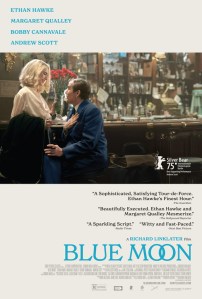 Ethan Hawke is transcendent in Richard Linklater’s Blue Moon, a glorified play set on the opening night of Rodgers and Hammerstein’s Oklahoma! on Broadway, except our star is Lorenz Hart (Hawke), the former lyricist and creative partner of twenty-five years for Rodgers (Andrew Scott). He’s nursing his gripes and hard-won insights at Sardi’s, commiserating with whomever might listen. This is a man who would talk himself hoarse. It’s a great showcase for Hart to expound upon his life, perspective, and desperation, whether it’s re-teaming with his former partner, hoping to get ahead of his alcoholism, the reason for Rodgers’ split, or the hope for love from a college girl (Maragret Qualley) who he’s so clearly projecting confused infatuation upon. Hawke is sensational as the troubled, egotistical, catty, funny, and clearly flailing musical genius who has accomplished so much but is so restless. There is so much to this performance, and each new conversation with someone at this bar feels like it’s unveiling a new dimension to our understanding of Hart, who can be convivial one moment and lacerating the next. I could listen to him prattle for hours. The subplot with the college girl infatuation has some obvious Lolita overtures, though it’s less lecherous middle-aged lust than an over-the-hill artist trying to feel important and wanted by somebody, even if he’s abusing his teacher-student relationship to achieve this (Hart was dealing with his repressed sexuality on top of everything). I found it illuminating in how someone as creative and cutting and incisive as Hart could be taken by his own self-delusions. Linklater lets the story take center stage and gives his stars the needed room to shine. This is that rare character study that finds its perfect lead and the best creative team to bring it to life. Blue Moon is one of the best movies of 2025 and I feel that Hawke’s career-best turn is the best male acting of the year.
Nate’s Grade: A-
Share this:

The Secret Agent (2025)
 The Secret Agent is a hard movie to fully categorize. It’s set in 1977 Brazil and with its title you might think it’s about some clandestine espionage operation or fighting against a corrupt government, and it does fit those descriptions but not in a traditional Hollywood way. We follow Wagner Moura (Narcos, Civil War) as a former grant-supported energy scientist who comes to clash with a powerful businessman who then hires an assassination team to kill this know-it-all. It’s also about entrenched police corruption and coverups, a found family of people seeking protection and new lives, the search for memory and proof of life, a father wanting to connect with his son in the wake of his mother’s death, and then there’s a running story about a severed leg that goes into the wildest, most unexpected places. It is a leisurely paced movie at almost two hours and forty minutes in length, but each scene is its own luxurious moment to dwell in. Take for instance the opening scene where Moura drives his car to a dusty, rural gas station and finds a dead body covered in newspaper. Nobody wants to come claim the corpse, and then the police do arrive but they take particular interest in Moura, wanting to search his car and ask him questions. Do they know something? Who is this man? A similar early scene involves the police investigating a dead shark where a severed human leg was found inside its mouth, and the way it unfolds and escalates is so naturally fascinating. The Secret Agent juggles many different tones, from nostalgic drama to crime thriller, but every scene is so expertly written and paced by writer/director Kleber Mendoca Filho (Aquarius, Pictures of Ghosts). You may grow weary by its length, but when I was in every scene, I didn’t want it to end because it feels so well-realized in its moment. There’s a subversive switch-out with its climax that reminded me of No Country for Old Men, and the ending coda ties together the flash-forwards and hits hard with the theme of uncovering and honoring the past. This is a lot of movie, much of it I admired more than I outright loved, but it’s such a fascinating balancing act that I would recommend The Secret Agent as a sprawling dive into Brazilian history, culture, and its own political reckoning.
Nate’s Grade: B+
Share this:

Hamnet (2025)
 It’s the sad Shakespeare movie, and with Paul Mescal (Gladiator II) as Will, it could just as easily be dubbed the Sad Sexy Shakespeare movie. Hamnet is a fictionalized account of Will and his wife Agnes (Jessie Buckley) processing the death of their young son, Hamnet, which we’re told in opening text is a common name transference for Hamlet. Right away, even before co-writer/director Chloe Zhao (Nomadland, Eternals) brings her usual stately somberness, you know what kind of movie you’re in for. It’s pretty (and famous) people in pain. The entire time I was watching this kid Hamnet and just waiting for the worst. It doesn’t arrive until 75 minutes into the movie, and it’s thoroughly devastating, especially the circumstances surrounding the loss. This is less a Shakespeare movie and more a Mrs. Shakespeare movie, which is more illuminating since she’s typically overshadowed by her verbose husband. She’s an intriguing figure who shares some witchy aspects, communing with nature and even foretelling her future husband’s greatness and dying with only two living children, which presents a pall when she has three eventual children. Once Will finds success as a London playwright, he feels like an absentee father and husband, briefly coming in and out of his family’s life in Stratford. However, the final act is what really doesn’t seal the movie for me. I don’t think it’s really a spoiler to admit the final 15 minutes of the movie is basically watching Hamlet performed on stage, with Agnes as the worst audience member, frequently talking through the show and loudly harassing the actors before finally succumbing to the artistry of the play and finding it a fitting outlet for her grief. In short, the movie is meant to provide more personal insight and tragedy into this famous play, asking the viewer to intuit more meaning (“Oh, Hamlet is his dead son, Hamnet! I get it”), but ultimately the ending is just watching Hamlet. I don’t feel like we get any meaningful insight into William Shakespeare as a person besides his irritation at being a Latin teacher, and frustratingly, Agnes is constrained as well, held in a narrow definition of the grieving mother. This is a shame since she showed such fire and individuality in the first half. Buckley (The Lost Daughter) is terrific, ethereal, earthy, and heartbreaking and a shoo-in for an Oscar. I found her final moments, especially reaching out to her son, so to speak, especially poignant. Hamnet is a good-looking, well-acted movie about sad famous people who then rely upon the arts to help heal their gulf of sadness. There’s not much more to Hamnet than that, but with such exceptional professionals and artists at the ready, it might be more than enough for most.
Nate’s Grade: B-
Share this:

Marty Supreme (2025)
 Marty Supreme is like the Oscar bait version of 2019’s Uncut Gems. Director/co-writer Josh Safdie, one half of the Safdie brothers that literally gave us Uncut Gems, has applied that same panic attack-inducing formula to a more broadly friendly combination of elements (example: this movie doesn’t open on a colonoscopy). Timothee Chalamet plays the titular Marty, a young man in 1952 New York City with a dream of being the best ping pong player on the world stage. He’s so supremely confident of his abilities that he never seems to plan beyond the immediacy. He’s a born hustler, and the majority of this 150-minute exercise is watching him work multiple schemes to gather the funds to secure a plane ticket to Japan. Reminiscent of Uncut Gems, it’s a movie of antic episodic events, with a charismatic but self-destructive lead spinning collapsing scheme upon collapsing scheme, one ending while another begins, and struggling to keep them all spinning and paying out. It makes for a frantic, propulsive experience, and even though there are some shady characters eventually and threats of violence, the stakes feel less dramatic and therefore more accessible to endure for so long. This is the kind of movie where, upon finally getting an item that will pay for that ticket, Marty’s own uncompromising hedonism has to be satiated in that moment of supposed triumph, all for it to get taken away again. In many ways, Marty is his own worst enemy when it comes to actually achieving his goals.
The whole thing is built upon the performance of Chalamet, who dominates the movie. There’s maybe five total minutes where Marty isn’t on screen. It’s a movie that needs a charismatic anchor. Chalamet digs in as the smooth-talking, impulsive, manipulative con man literally looking for his big ticket to stardom. It’s a brash performance of bravado, and it’s easy to get carried away by the actor, or at least intrigued to see how Marty is going to get out of all these crazy jams of his. The whole movie kind of takes a note from its lead to be bold. There’s digressions upon digressions. There’s key supporting roles for Tyler the Creator and Kevin O’Leary, yes, the bald guy from Shark Tank. There’s an opening credits sequence following sperm fertilizing an egg. The last 20 minutes is almost all ping pong action. There’s anachronistic music throughout. It’s remarkable how much of it works, but the frantic, anxious nature of the plotting covers up the hollowness of Marty. Perhaps he’s always yammering because a second of silence could force introspection. I don’t know if this man is capable of reflection, despite what the final image might infer. It’s a wild, whirling, consistently surprising movie that blends in so many characters and incidents to keep you entertained, but I don’t know if, much like Marty, there’s anything deeper under the surface of that desperation
Nate’s Grade: B
Share this:

Train Dreams (2025)
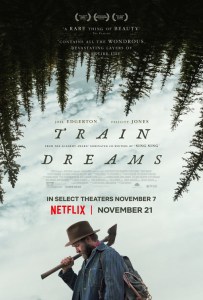 What a superb, tender, and deeply humanistic portrayal of life through the eyes of one man, Robert Granier (Joel Edgerton), a logger in Idaho in the early twentieth century. His life isn’t too different from the lives of many. He wants to spend more time with his wife (Felicity Jones) and child, less time away for months on end for logging, and he has difficulty making friends in his profession of hard work and inherent transience. He feels more connection to the natural world, of which he is felling one tree at a time. The nature of the script, adapted from the 2011 novella by author Denis Johnson, is episodic, people coming in and out of this man’s personal life. The narrative feels like a collection of memories, jumping back and forth in time, connected by ideas and imagery like we do in our minds, and providing a sum total for a life lived. There’s an inherent solemnity and awe to the movie, whether it’s about the transcendence of man’s place in the world, the march of progress, or merely the pull of tragedy and love that seeps into our core being. There is a personal tragedy that defines Robert, and it is devastating to experience and process with him. Director/co-writer Clint Bentley (one half of the same creative team behind last year’s Sing Sing, one of the best movies of 2024) uses this character to represent the totality of the human experience, making the movie feel deeply felt and empathetic even decades removed from its subject. That’s because logging isn’t the movie. It’s about the people, places, and experiences that define us. William H. Macy hasn’t been this good in years. You give me a wise, elegiac narrator in the spirit of Assassination of Jesse James by the Coward Robert Ford, with such pristine details readily supplied, and I’m already a sucker for your movie. The only thing holding back Train Dreams for me was that post-tragedy doesn’t get the attention I think it deserves. You’d expect the second half of the movie would be the process of grieving and coming to terms, and in essence it is, but the movie is far less direct about its processing, which I felt was a minor misstep for an overall great movie.
Nate’’s Grade: A-
Share this:

The Alto Knights (2025)
 The Alto Knights, from the creative team behind famous mafia movies like Bugsy and Goodfellas, feels like a dozen mob movies thrown into a blender: recognizable elements mashed together but lacking a cohesive vision and distinction. There’s also a major creative choice that makes little sense, mainly Robert De Niro plays two different roles. I assumed they would be twins or at the least brothers but no they are actually two different, unrelated people, Frank Costello and Vito Genovese. Why? I understand the appeal to De Niro fro an acting standpoint, as well as the potential marketing hook, but what about this makes sense for the viewer? What about this movie made it better by having one actor portray the two main characters? It made it harder for me to keep track, and that’s before there’s flash-forward interviews from an older Frank as well. The story is mostly set n the 1950s New York following the rivalry of two childhood friends-turned-mafia bosses but it feels so haphazard and jumbled, with story events crashing into one another but minus a clear sense of progression and consequence. It’s a strange experience to watch a movie with murders and marriages and the dissolution of personal relationships through paranoia and greed, and yet The Alto Knights lacks energy and direction. It’s hard to follow why these two guys are worthy of their own movie or even what their role in the larger mob ecosystem was, so watching scene after scene creates a “So what?” question. Unless you’re a non-discriminating fan of all mafia movies, The Alto Knights is the disappointing residue at the bottom of the mob blender. But hey you got extra De Niro!
Nate’s Grade: C
Share this:

Frankenstein (2025)
 One of the reasons Mary Shelley’s novel Frankenstein has been so richly relevant two hundred years later is because of her thought-provoking themes and concepts, which still prove potent with each new malleable reinterpretation from the newest creative caretaker. It’s the “be careful what you wish for” adage combined with man’s hubris and our self-destructive impulses to play with things we don’t fully understand. It’s also a monster story that asks us to reconsider the perception of who the monster may truly be, and under writer/director Guillermo del Toro, the answer is always and forever man himself. This isn’t a surprise from the same filmmaker who gave us Hellboy and The Shape of Water. The man identifies with the monsters more than other people. The man turned his astounding stop-motion animated Pinocchio movie into a deft Frankenstein allegory, so the famous story has been on his mind for quite some time. It’s been an obvious influence, and now that he’s gotten his chance on his own imprint, it’s hard not to see elements of del Toro’s other movies everywhere. It creates this bizarre echo chamber of creative influence where the movie can feel derivative at times even though the source material was an influence on those other del Toro works. It’s just the nature of finally tackling the influence later in his career. It reminds me of 2012’s John Carter, based on Edgar Rice Burroughs’ highly influential sci-fi series, and yet because it took 100 years to leap to the big screen, it couldn’t help but seem derivative of the same popular movies that were inspired by it. This is a convoluted way of saying del Toro’s Frankenstein is a much better Guillermo del Toro movie than a Frankenstein adaptation.
You probably know the story well enough to recite it yourself. Victor Frankenstein (Oscar Isaac) is obsessed with conquering death after his own mother’s demise in childbirth. He gathers the parts of criminals and dead soldiers to reanimate into a new being, a Creature (Jacob Elordi) of superhuman strength and regeneration who cannot die. Victor’s cruelty punishes the Creature and disowns it, setting the stage for a showdown between dysfunctional father and son and the havoc caused by recklessly playing God.
 There are deliberate decisions that mitigate some of the more compelling characterization of the novel. With del Toro’s version, Victor is the clear-cut villain. There’s some setup given to his strict childhood where his domineering father (Charles Dance) would quiz him and physically abuse Victor if he failed to recite the correct answers to his medical questions. Dear bad dad was doing this, you see, out of a belief that good doctors need to know intuitively because any hesitation could cost lives. When we witness Victor abusing the Creature in the same manner, we’re meant to see the connection between abusive fathers confusing disappointment with defiance. In the original story, Victor abandons the Creature on the night of its birth and then it’s gone. In this version, Victor imprisons the Creature, keeps him chained, attempts to train him, grows frustrated, and then tries to destroy the evidence. That’s a little more diabolical than simple morning-after regrets. This Victor can also be viewed as a forefather of incels the way he projects his romantic feelings onto Elizabeth (Mia Goth) and then gets huffy when she doesn’t return them. There are other deaths later in the story that are directly attributed to the Creature that are now Victor’s doing, which continues to squeeze out moral ambiguity from Shelley’s novel. If the Creature is purely innocent and Victor is purely villainous, that makes the relationship between father and son, Creator and Creature, far less meaningful and layered. It’s so obvious that another character, in their literal dying words, says to Victor, “You are the real monster.” It all becomes an ongoing cycle of bad fathers and the Creature ultimately trying to reach forgiveness. Even if the Creature ultimately finds that, is this Victor even worthy of redemption?
Another significant feature of del Toro’s retelling is, how do I put this delicately, the inherent magnetism of the Creature, a.k.a. Sexy Frankenstein. Elordi (Saltburn) is a tall, lithe actor to begin with with classical Hollywood features, but there was a conscious choice to portray this figure in a certain light, a sexy light. You might find parts of you that are suddenly alive while watching the character onscreen. That’s why even though he’s a literal assembly of corpses the makeup effects are very minimal and less intentionally grotesque or monstrous. The delicate lines around his body make me think of a cross between the Engineers in Prometheus and the body paint of that Gotye music video “Somebody I Used to Know.” The gentle makeup is meant to further convey the Creature as a sensitive figure; granted, he’s also capable of ripping the jaw off a wolf. By swerving away from the Creature’s physical deformities, the movie is also inadvertently downplaying the isolation that he felt that led to such rage and resentment. Is this man that hideous that some good woman couldn’t love him as is? The movie is already presenting Elizabeth as someone who sees through to his gentle nature, and she certainly also seems more than a little attracted to what he’s got going on. This Sexy Frankenstein reconfirms del Toro’s penchant for identifying with the monster, the outcasts, the underdogs. However, Sexy Frankenstein also takes something away from the horror and cost of the creation if he’s just going to be another brooding, misunderstood Byronic hero. Still, there are definitely worse pieces of meat you could be watching, so enjoy monster sweethearts.
 With all that being said, del Toro’s Frankenstein is still a sumptuously made and entertaining Gothic spectacle. The production design is immense and immersive with del Toro’s knack for perfect details to create such a lived-in sense of mood (never enough giant stone face edifices). I loved Victor’s models of human torsos that looked almost like ballet dancers at rest; granted, ballet dancers having their skin peeled back by dozens of hooks. I just wanted to spend as much time as possible soaking up these sets and this heightened Gothic realm. It’s the kind of world where Victor’s laboratory needs to be an opulent abandoned castle complete with a pit in the middle of the floor plan that goes through several floors to a sewar/aqueduct basement level. There’s even what appears to be a water slide out of the estate, and the Creature gets to escape it in the most fun way. The movie is gorgeous with del Toro’s signature orange/green color palette bathing his universe. Even if the story isn’t quite reaching the heights it could, the visuals are always sterling and inviting. There’s also a surprising amount of gore, which maybe shouldn’t have been that surprising. I don’t know if we needed as much of the Arctic framing device, which itself was structured as a series of letters in the novel. It’s a platform for del Toro to demonstrate the Creature’s physical prowess and get some quality big-screen bloodshed flowing. I don’t know if we needed to keep cutting back throughout the whole running time like it’s a Christopher Nolan movie. Regardless, if you’re a general fan of monster movies, there’s going to be plenty here to proverbially sink your teeth into and savor on that super Netflix budget.
Mary Shelley’s Frankenstein gave birth to science fiction in 1818 and the James Whale movies from the 1930s gave birth to some of cinema’s most iconic and lasting images and influences. There’s quite a legacy for anyone who wants to put their own stamp on the material, so it helps that Guillermo del Toro has quite a legacy himself, a career built upon the dark recesses of a verdant imagination (I’ll always lament what could have been his version of The Hobbit movies, alas). His Frankenstein has all the hallmarks of a classic del Toro film experience, from the impeccable technical qualities, to the celebration of the mythic and Gothic, to the sympathetic portrayal of the outsiders condemned by a society too square to accept them, and an unironic emotional undercurrent that can approach self-parody. It’s a little long, a little ungainly in its shape, and a little too simplistic with its themes and characterization, but it can also be fittingly transporting and romantic and easy to feel that swell even if it’s all too familiar. For my money, the best Frankenstein adaptation is still the 1994 Kenneth Branagh version, flaws and all.
Nate’s Grade: B
Share this:

Freaky Tales (2025)
 Watching Freaky Tales, an ode to 1980s Oakland California, punk, rap music, and grindhouse cinema, is like washing in someone else’s nostalgia. It’s a fun throwback experience but it doesn’t amount to much more than transitional diversions that won’t have the same appeal. This is an anthology movie following the events of a few nights in 1987 Oakland with criss-crossing characters told out of order. Given the abbreviated nature of the stories, you either have to make a strong impression with the characters, have memorable and surprising adventures, or have an intricate connection to the different stories that allows the narrative to keep reforming. Otherwise it’s a collection of shorts that don’t really add up to much else. While entertaining in spurts, there isn’t much more to Freaky Tales. The first story involves a punk rock club defending themselves against neo-Nazi bullies. It centers on a budding romance and works well with an exuberant, youthful energy and the theme of a vulnerable community standing together against hate is easy to root for especially when it results in bloody and maimed Nazis. The second story is the weakest and follows a female rap act trying to make the most of a stage show. The third story involves a mob enforcer (Pedro Pascal) trying to make a clean break and coming to terms with his past after a tragedy. It’s a story more memorable for some unexpected cameos and turns rather than supplying an antihero worthy of Pascal. The final story involves a professional basketball player seeking vengeance against the men who killed his family in a burglary-gone-wrong. It’s the most entertaining and ridiculous segment, especially as the pro player reveals the extent of his martial arts and mind powers. While each segment doesn’t quite overstay its welcome, none of the segments feel essential or cleverly integrated with the rest of the tales. As a result, Freaky Tales feels like gonzo campfire stories that don’t exactly go anywhere; pleasantly silly but missing out on greater fun.
Nate’s Grade: B-
Share this:

A Complete Unknown (2024)

I’m not really a Bob Dylan fan. While I can appreciate several of his songs, it’s his voice that has always put me off. An entire movie about the mystique of Dylan and his rise through the 1960s folk scene was never going to be too appealing for me. So keep all of that in mind as I tell you that A Complete Unknown is a thoroughly fine movie with the not-so grand insight that this famous troubadour might just be a talented prick. The end. Director/co-writer James Mangold returns to the musical biopic sub-genre almost twenty years after his Walk the Line (a non-Joaquin Phoenix Johnny Cash has a cameo in this movie too, securing the Boomer Music Cinematic Universe). It all feels very stately and staid and reverent and, especially during its climax, hopelessly quaint. The conclusion is over whether or not Dylan will play music at the Newport Folk Festival that the fuddy-duddy programmers demand. Will he go electric? Will he play traditional folk? Will you care? I suppose it’s about people trying to control and define this idiosyncratic artist who wants to be himself, whatever that may be, whatever feathers may be ruffled by the traditionalist gatekeepers of the folk music scene. This celebration of artistic integrity and creative revolution would mean a little more if I got a better understanding of Dylan as a person. Blessed with audience foreknowledge, we already know he’s going to be successful and that his creative impulses will be rewarded. Timothee Chalamet does a fine Dylan impression and recreates the famous songs with an impeccable nasally impersonation. For my money, I’d rather this have been a Pete Seger (Edward Norton) movie about his passing of the torch from one generation of folk artists to another and recognizing that the culture and peace movement were moving beyond him. Regardless, if you’re a Bob Dylan fan, there’s plenty to like, especially many extended jam sessions. If you’re looking for more than a handsomely recreated Best Of album, you might need to read a book instead.
Nate’s Grade: C+
Share this:

Y2K (2024)

The premise for Y2K is ripe for fun. It’s a nostalgic retelling of that turn-of-the-millenium anxiety over computers getting confused, and the movie says what if technology had turned on humans at the stroke of midnight that fateful New Year? Add the lo-fi chintzy, quirky style of co-writer/director Kyle Mooney (Brigsby Bear) and it’s a setup for some strange and amusing techno-horror. It’s structured like a teen party movie with our group of high schoolers (Jaeden Martell, Julien Dennison, Rachel Zegler) trying to step out of their comfort zones and live their best lives… around machines trying to eviscerate them. The tonally messy movie lacks the heart and specific world-building weirdness of Brigsby Bear, instead relying upon the genre cliches of the high school movie, including the unrequited nerd crush and the pretty popular girl who’s more than what she seems. While watching Y2K, I kept getting the nagging feeling that this movie should be more: more funny, more imaginative, more weird. It’s quite uneven and veers wildly from set piece to set piece for fleeting entertainment. I chuckled occasionally but that was it. I enjoyed the villainous robot assembling itself with assorted junk available, and it’s hard not to see this as a general statement about the movie as a whole. It’s a bit lumbering, a bit underdeveloped, a bit formless, blindly swiping nostalgia and junk to build some form of an identity that never materializes beyond its parts. Y2K won’t make me bail on Mooney as a filmmaker but it’s a party worth missing.
Nate’s Grade: C


 nathanzoebl
You must be logged in to post a comment.