Blog Archives
CODA (2021)
 Ruby Rossi (Emilia Jones) falls under the category of CODA, a Child Of a Deaf Adult. Her mother (Marlee Matlin) and father (Tony Kotsur) and her older brother (Daniel Durant) are all deaf, and she is the only member of her household with the ability to hear. She’s balancing working for her family on their fishing trawler, maintaining good grades in school, and possibly pursuing scholarships to enroll at a music and fine arts college for singing. Ruby’s music teacher agrees to train her because he believes in her potential, but Ruby has to worry that her dream is something that cannot be shared with the people she loves most, and how would they all get on without her?
The framework of CODA is familiar to anyone who has watched a coming-of-age story or family drama, but it’s the conviction and strength of character and sheer force of empathy that makes this movie a standout film for 2021. It’s based upon a 2014 French film, The Family Beller, and follows many of the same beats from other sentimental family dramas about sticking out in your family and society, chasing your dream, often in conflict with your family’s expectations, gaining that sense of inner strength and resolve, and mending differences in perspective with hard-fought and well-earned wisdom. It’s familiar, but that doesn’t mean under the right set of hands that it cannot still be resonant and emotionally gratifying. I do not hold the familiar formula against CODA, even as the family’s goal and her personal goal come into direct conflict in sometimes forced manners. That’s because the movie does an excellent job of establishing these people as characters, establishing the family dynamic as fraught but loving, and establishing a conflict that is direct and clear as far a major point of separation.
 Ruby isn’t just the only member of her family who can hear, she’s also their vital lifeline to the outside world. She’s looked upon as the family interpreter, a position they cannot afford to pay for someone else’s services so the duties and responsibilities fall upon her. That’s so much pressure to bear for one teenage girl, knowing that she’s the link between her family’s poverty-treading existence and possibly breaking free into a larger hearing community. She feels ostracized and awkward within her own family and outside of her own family. To the rest of the school, she’s that “deaf family girl,” and it’s remarked that when she began high school she had an accent reminiscent of what deaf people can sound like, a point that her peers cruelly imitate. She worries she will forever be defined by her family’s disability even if she doesn’t share it. However, within her family, she feels ostracized because she’s different. She wonders if her mother wishes that she too were deaf, and during a heartfelt late-night talk, mom actually admits that upon her daughter’s birth she did feel disappointment when Ruby had hearing. While she knows sign language and has grown up with these loving figures, she’ll still always be the one who’s different, the one who hears the insults her family cannot.
The film does a remarkable effort about contextualizing Ruby’s fears and frustrations of being held captive in two different worlds, neither feeling fully accepted or whole, and that’s why her embarking on a personal dream that her family can never fully appreciate feels so significant. Part of Ruby might feel that singing is selfish, especially if it means limiting her family’s upward mobility by eliminating their unpaid interpreter, but it’s the thing that makes her most happy, a special gift that her family will be excluded from. There’s a wonderful moment toward the end of the movie where Ruby’s father asks her to sing to him, and he puts his hands along her shoulders and neck to feel the vibrations, and his awed and tear-stricken face is so moving, as he so desperately wants to indulge too in the beauty of his daughter’s voice. While occasionally the film goes overboard pounding these two conflicting paths into forced collision (family vs. self), the movie is personal with its big problems and personal with its big triumphs, making it transcend the trappings of formula.
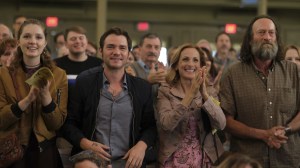 Writer/director Sian Heder got her start on Orange is the New Black, and that TV series’ hallmark has been its enormous sense of empathy for its diverse characters. This is evident in Heder’s screenplay and her observational, detail-rich simple storytelling that immerses you in this world, so even while you recognize more familiar made-for-TV plot turns, the genuine authenticity makes the movie feel like its own unique story. Heder’s direction is delicate and places the attention squarely on her performers. There is one stylistic move late in the film when Ruby’s family comes to her choir recital in support. They look around for cues when to applaud, and their minds wander as they sign about other menial topics like grocery lists, and you understand why once Heder drops you into their perspective. For a minute, the sound disappears, and you’re left studying facial expressions for cues like them. While we can imagine being deaf, it’s another matter to experience it and try and understand.
The acting is another laudable merit for CODA. I personally want three Oscar nominations for this clan, Jones (Locke & Key) for Best Actress, Matlin (Children of a Lesser God) for Best Supporting Actress, and Kotsur (Wild Prairie Rose) for Best Supporting Actor. Over the course of nine months, Jones learned American Sign Language and how to sing, which is surprising because I would have said she has a natural talent with singing. Her performance, as well as Matlin and Kotsur, feel so real, so nuanced, and so natural, like we’ve plucked these people from real life and given them this platform. It’s the best credit you can give an actor, when they seemingly disappear into the character, and the character feels like a fully breathing, flesh-and-blood person. Even the small supporting roles are well cast, well acted, and contribute to the overall authenticity of the movie. Unlike the 2014 French original movie, all of the deaf members of the family are portrayed by actual deaf actors as well.
CODA was a sensation at the 2021 Sundance Film Festival, with Apple Films buying the rights for $25 million dollars, and it’s easy to see why because it’s such a satisfying, enriching crowd-pleaser and legit tear-jerker. There were several points that had me tearing up, and then fully crying, because I was so emotionally engaged with the family, their struggles, and their triumphs and outpouring of love. You might be able to see where the movie is headed because its template is familiar and formulaic, but it’s the execution, the attention to detail, and the level of observational attention that elevates CODA and makes it so winning and so heartwarming.
Nate’s Grade: A
Share this:

Monster’s Ball (2001) [Review Re-View]
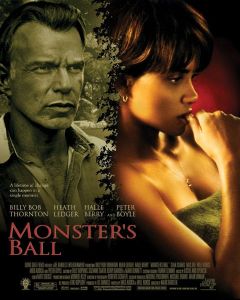 Originally released December 26, 2001:
Monster’s Ball has already garnered two Oscar nominations, including one for the lovely Halle Berry for Best Actress, and received numerous end of the year accolades. Is Monster’s Ball the startling ruminations on race that you’re being told? Well… yes and no.
Set in the South, Hank Grotowski (Billy Bob Thornton) and his son Sonny (Heath Ledger) are prison guards at the state penitentiary and preparing for an execution. The man to die is Lawrence Musgrove (Sean Combs) who will be leaving behind an young son and making a widow out of Leticia (Halle Berry). The tension in the Grotowski home escalates especially as Hank has chosen to care for his own ailing father (Peter Boyle), who still finds the time to spout out racist rhetoric through an oxygen mask. One last confrontation leaves a permanent mark of emptiness on the family.
 Leticia is struggling to just make ends meet and fight an impending eviction. Her car keeps breaking down on her, she’s been let go from her job as a waitress and she has to raise a son by herself all the while trying to encourage him to lose weight. Leticia is breaking down and her world around her is crumbling. One night Leticia gets into an accident walking home along the roadside and needs assistance badly. The one who pulls the car aside to help is actually Hank. As time goes by he helps Leticia however he can whether its giving her a ride home from the diner or just staying with her so she won’t be alone.
Hank and Leticia come together out of mutual need and grief. They are two people entirely wrong for each other that kindle a passion that seems to transcend race. Leticia needs someone to take care of her, after having a husband on death row and fighting to stay above the poverty line. Hank needs someone to take care of, out of a mixture of compounded loneliness and grief.
Thornton reprises the repressed protagonist of The Man Who Wasn’t There with his portrayal of Hank. His lips are pursed, looking a tad like Mr. Limpet, and he expresses more with a furrowed brow and stare than words could manage. Thornton’s performance is good, and the audience does really end up rooting for Hank, but the performance doesn’t resonate, possibly because of the writing for the character. I guess one could say Monster’s Ball is Halle Berry’s legitimization as an actress. Berry gives the performance of her career and has moments where she’s on the verge of ripping your heart out.
Monster’s Ball is not exactly the scorching portrait of race relations that it has been hyped to be. It’s really more of a story about two characters with race being underscored except for a convenient occasion where it can become the catalyst to a fight.
The film also takes some of its metaphors rather simply. The connection between father and son includes Hank and Sonny using the same prostitute. Hank eats every night in the same diner and always orders a bowl of chocolate ice cream (get it?) and black coffee (get it?).
 All the ballyhoo over the explicit sex scene (thank you so much news-fluff) is undeserving. The sex scene is no different than a hundred seen before and many on Showtime during the late hours. The scene serves its purpose thematically in the story for its characters but it really isn’t “hot and steamy” as it’s been dubbed to be. Move along, folks.
Besides the acting Monster’s Ball has some other accomplishments up its sleeve. The cinematography is gorgeous and uses lights and darks to an incredibly effective degree. There are many scenes where you might be paying more attention to how the scene looks than the scene itself. The music is also commendable for the simple task of not becoming intrusive and actually enhancing the story. This is what scores are intended to do.
Monster’s Ball may be the biggest suck-in-air-uncomfortably movie to come out in a long time. I found myself enacting this measure every time someone did something horrible, said something racist or surprisingly died. This may be because I had the entire theater to myself for my own amusement. Monster’s Ball is certainly a well-written and well-acted film. It’s just not up to snuff when it comes to Best Picture speculation.
Nate’s Grade: B
——————————————————
WRITER REFLECTIONS 20 YEARS LATER

Monster’s Ball was Lee Daniels’ first movie as a producer and years before his first directing effort, 2005’s Shadowboxer, but it’s clear as ever in 2021 that his influence is all over this movie. The elements that would come to define Daniels’ later movies, like Precious and The Paperboy and The United States vs. Billie Holiday, are here, and that’s the awkward and sometimes jarring discordant elements of the serious and the soapy, of camp and sincerity (the movies are also so unabashedly horny). A Lee Daniels’ movie is trying to say something, sometimes poorly, often too many things and too spread out, and Monster’s Ball is one of those statement movies, or at least it was upon release. It was a screenplay developed in the mid 1990s by actors Milo Aaddica and Will Rokos, and while it attracted talent at points it didn’t really gain traction until Daniels came onboard as its shepherd. You can see what would be so attractive to Daniels, with the mixture of odd elements as its own eclectic brew. It’s a romance that should not work. It’s life lessons about racism that seem heavy-handed. It’s a thrust-heavy sex scene that goes on for four uncomfortable minutes. I think there’s a recognizable argument to be had that this romance doesn’t quite work. It’s more out of necessity than connection, but maybe that’s even the point. These are two wounded people finding solace in one another, and maybe that’s enough in a world of pain and uncertainty, just finding someone who, in Leticia’s words, “makes you feel good.” Monster’s Ball isn’t as wild and campy as other Daniels’ joints, but you can see the DNA of his other movies, the seeds of artistic flowers that would bloom into his style. It’s got a bit more of an arty, indie sheen here, but Monster’s Ball might as well be Lee Daniels’ Monster’s Ball as far as its key influence, certainly more than director Marc Forster.
Re-watching this movie many years later, it’s clear to me that it is not a movie about race relations, though this is an implicit subject as well, but much more an examination on generational toxic masculinity. This makes much more sense for me with the prominence given to Hank’s (Billy Bob Thornton) perspective over Leticia (Halle Berry). It’s about him learning to break free of his racial prejudices, yes, but that’s more one sign of him learning to break free of the tyranny of his father’s influence, and his father (Peter Boyle) is an infirm cartoon of toxic masculinity. This is a man who brags about his wife dying and how many women he cheated on her with. This is a man who calls his grandson Sonny (Heath Ledger) weak because he displayed empathy for an inmate on death row. It’s his close-minded, harmful definition of what constitutes a “real man” that has become the lingering poison infecting the Grotowski family tree. It’s not subtle in the slightest, but Monster’s Ball is effective in communicating cycles of abuse. Hank carries many of his father’s tendencies and views his own son with contempt for not being able to meet these same restrictive definitions of manliness that his father imposed on him. When his son needs him the most, in his cry for help, is where Hank fails him, telling him he does in fact hate him, and that’s when he loses him forever. The rest of the movie is tracing Hank’s journey to breaking free from the vile influence of a decrepit old man.
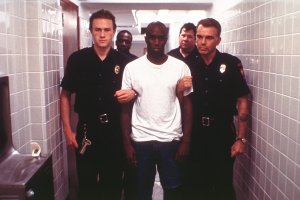 To that end, the story structure of Monster’s Ball works better. In the span of 110 minutes, Hank has to reflect on what the negative influences of his life are and to break free of them. When he finally decides to put his father in a nursing home, the lady in charge smiles and says, “You must love your father.” Hank is quick to reply, “No, I don’t. But he’s my father.” There is no love between these men because love was most likely viewed as weakness. It’s the last thing Sonny says before killing himself, after his father says he hates him: “Well I’ve always loved you.” When Leticia looks at a picture of Sonny, something that Hank doesn’t share until late in the film, she remarks that Sonny doesn’t look like Hank. He replies that Sonny has his mother in him, implying the things that made him better came from her. This is a character journey that literally culminates in a man performing oral sex on a woman as a sign of his personal growth. Taken by itself, it sounds laughable, but it mostly works in the context of the movie. Surely his father would view the giving of pleasure to another as a waste of energy and time, so his desire to give rather than receive ends up being his character’s defining push away from the negativity of his father.
My issue is that Leticia feels less like a fully-fleshed out person and more like an infantilized victim. She’s a single mother struggling to keep her job, keep her home, and keep her son’s weight in check. Her husband is on death row. She’s got a lot of opportunities to be given dimension and insight. However, the movie never seems to deem her ready for that attention until the very very end, literally the last scene of the movie. Beforehand, she’s more a prop to the development of others, someone to gauge Hank’s personal growth and someone to be inflicted with all manners of indignities and abuses. When she interacts with Hank’s father, and he’s as awful as you would expect, her residual pain and outrage is the final straw for Hank who then moves the old man out. Her entire relationship with her son feels awkwardly handled. Fiction can illuminate the lives of complicated people, people with flaws that don’t always make the best decisions, but her single-minded obsession with her son’s weight, and her subsequent beating of him, feels like another chain of abuse but without the explanation. Otherwise, it’s just a woman in pain berating her son, and then the boy has to die, and it feels excessive. I know that Hank and Leticia bond over their mutual grief over having lost a son, but it feels like Leticia is more a martyr for Hank’s growth. During their protracted sex scene, her voice cracks and sounds uncomfortably childish. At the end, she asks Hank to take care of her because she needs it. She comes across like an infantilized version of a woman who is there to cry and be pretty.
 That’s why the final moment of the movie rings so curious for me. After Hank puts his father away, what is the conflict here? Leticia agrees to move in with Hank after being evicted, and it all seems to be going well. Then while he’s out retrieving his favorite ice cream, she discovers that Hank has drawings by her late husband, reshaping her understanding of Hank. But what is that reshaping? Before he was a guy she served at a diner who happened to help her during the most trying time in her life. Does she think he was seeking her out to take advantage of her? How? She got the diner job because she lost her previous job, and it’s not like he sought her out, but she might not be privy to any of that context. It feels like an artificial conflict that’s meant to boil over and possibly spell doom between these two. Can this budding relationship survive this revelation? But I’m still unclear what exactly the revelation is. He worked at the prison? He was involved in the execution of her husband in a way, walking him to the chair? This seems artificially inflated to me. And yet it is only here that the movie gives her the final say, allowing Berry to wordlessly process this new information and whether or not it dramatically changes anything between her and Hank. She never comments to him about it. You just have to study her face, and it’s here where the movie at long last treats Leticia with the courtesy of nuance.
Monster’s Ball was made famous for two reasons: the extended sex scene between Berry and Thornton and her Best Actress Oscar victory, the first ever for a woman of color (and still the only one twenty years later). Let’s start with Berry’s performance, which was definitely a leap above what she had been demonstrating with trashy thrillers and lame comedies. Berry is good here but the Lee Daniels of it all makes it feel like her performance is being pulled into less subtle, more overtly soapy directions against her better judgements. When she gets into a whiny space, I kind of winced, not because her character was undeserving of complaint, but because the movie was shifting her into that infantilized victim box. Berry is good here, but after re-watching Sissy Spacek’s In the Bedroom performance and Nicole Kidman’s Moulin Rouge! performance, I’d rate her third of the chief 2001 Best Actress nominees. Berry is an actress I had mixed feelings about early in my critical career (2004’s Catwoman did not help), but I’ve come around to appreciate her more. I greatly enjoyed her varied performances in 2012’s Cloud Atlas. She recently directed her first movie where she plays a middle-aged kick boxer, and that sounds punishing and possibly eye-opening.
I’m not the only one that seems to come back to the infamous sex scene; it constitutes almost all of the trivia about the film on IMDB (interesting not-sex-scene fact: Wes Bentley was going to play Sonny but mysteriously dropped out –he admitted to struggling with heroin addiction later– and the studio gave the production 48 hours to find a replacement, and that’s how Heath Ledger got it). Also, I had to revise this paragraph several times to remove any phrases that might come across as unintended innuendos. You could argue the sex scene is a turning point. It happens at the halfway point of Monster’s Ball and beforehand Leticia and Hank have expressed no romantic interest. Afterwards, it becomes about their possible odd-couple romance, if that’s what it can even be called. The scene is played raw and desperate, which is why it made me feel uncomfortable. It wasn’t because I was watching two actors pretend to physically go at it for an extended period, it’s because these characters were so sad and reaching out in desperation to feel anything fleeting. The attention given to the scene just feels thematically wrong. It’s not offensively gross but it feels a little too prurient, a little too salacious for what the characters are going through emotionally. Thornton has even said in interviews that this movie might have contributed to his eventual divorce from Angelina Jolie, which seems strange to me considering she was also filming steamy scenes with Antonio Banderas at about the same time (2001’s Original Sin).
 Director Marc Forster has had an interesting career since helming this four-million dollar indie. He’s done Oscar-bait dramas (Finding Neverland, The Kite Runner) and quirky indies (Stranger Than Fiction, Stay) and big Hollywood action movies (Quantum of Solace, World War Z). He was hand-selected by producer Brad Pitt to direct World War Z. Forster has no distinct, visible style to him but effectively alters to the genre and story he’s directing. In some ways, this is what a director should be, and yet Forster has never gotten credit for his versatility. Nobody is going to say Quantum of Solace is their favorite James Bond movie, or even the best of Daniel Craig’s run, but it’s not really Forster’s fault that movie didn’t work. His last two movies were smaller dramas, 2016’s All I See is You and 2018’s misguided Christopher Robin, and he’s attached to movies about the Holocaust, a downed World War II pilot, the formation of Greenpeace, and Thomas the Tank Engine, so the man’s versatility continues to go undervalued.
This is my final re-review of the 2001 film slate, and my original review I think mostly holds up. I was thinking the same thing about lazy metaphors and lacking substantial racial commentary, but I better appreciated the scope of the movie not on race but on the effects of toxic masculinity. I think I was more dazzled by the photography in 2001 (or 2002 when it was made available to us in central Ohio) than in 2021. Monster’s Ball is a clumsy but well-intentioned movie that has some pristine elements to it but I don’t quite know if it ever coalesces into the important movie it desires. It’s an interesting artifact of Lee Daniels before he became an industry unto himself, and with Berry showcasing just what she was capable of if given the right opportunity. This began a run of “pretty actress goes drab” of Oscar winners (2002’s Nicole Kidman, 2003’s Charlize Theron, 2004’s Hilary Swank), and so the biggest lesson of Monster’s Ball after all might have been providing a successful template for future actresses to follow a path to Oscar gold.
Re-View Grade: B-
Share this:

The Power of the Dog (2021)
 Every year, it seems that Netflix’s crown jewel for their big Oscar hopes ends up getting marvelous critical acclaim, and then when I finally watch it I am left disappointed. It happened in 2018 with Roma. It happened in 2019 with The Irishman. And it happened in 2020 with Mank. I haven’t disliked any of those movies, but I was unable to see the highly laudable merits as other critics. Now here comes their big Oscar play for 2021, Jane Campion’s The Power of the Dog, a Western that has been gracing the top of more critics lists than any other American film this year (I’ll be getting to you soon enough, Drive My Car). As I burned through awards movie after awards movie to assess, I held back from The Power of the Dog for a time. I just didn’t want to find that once again I was disappointed with the latest Netflix Oscar contender. I’m still chewing over my feelings with The Power of the Dog, which has a lot going on under the surface and a palpable tension that you’re unsure of how and when it will erupt. It’s also a movie that touches upon repression, toxic masculinity, manifest destiny, grooming, emotional and physical manipulation, and the danger of unstable men who are unable to process who they really are.
Set in 1925 Montana, Phil (Benedict Cumberbatch) and his brother George (Jessie Plemons) own and operate a cattle ranch. George marries a widow, Rose (Kirsten Dunst), and brings his new wife and her teenage son, Peter (Kodi Smit-McPhee) to live at the ranch. Phil resents his new sister-in-law, looks down on her son, and torments both repeatedly. Rose sees Phil as an enemy, someone who will not stop until he forces her out, and his target becomes her son, Peter.
 This is less a traditional Western in several respects and more a tight character study that happens to be set at the conclusion of a Western fantasy for America, transitioning to modernity. It goes against our preconceived notions of a Western, not in a deliberately deconstructive way like 1992’s brilliant Best Picture, Unforgiven, but more in providing contrary thematic details that often get squeezed out. I was expecting the movie to take place maybe during the 1870s or 1880s, but the fact that it’s taking place five years removed from the Great Depression offers different story opportunities and larger reflection. There’s a reason this story is told well after the halcyon days of the Old Wild West. The movie is about certain characters holding onto an exclusive past that has eclipsed them and others ready to move forward by shuttling over their past and the obstacles standing in the way of personal progress.
There are thematic layers expertly braided together that touch upon the larger question over what it means to be a man in society. Each of the primary male characters (Phil, George, Peter) is an outsider to some degree, someone who doesn’t neatly fit into what constitutes a conventional man of the times. George is soft, empathetic, meek yet in a position of power from his family’s status; Peter is rail-thin, academic, odd, effeminate at turns, a dandy presented for ridicule; Phil is the one who presents as a “man’s man,” a hard-driving, hard-drinking man of the land who imposes his will on others. However, deep down, Phil is hiding a key part of himself that would conflict with his society’s view of masculinity. Each man bounces around points of conflict and connection with one another, familial bonds fraying, and a slow-burning battle for supremacy escalating.
 The movie could have also been charitably nick-named “Benedict Cumberbatch is a jerk to everyone,” as this is much of what Campion’s script, based upon the 1957 novel by Thomas Savage consists of. The movie is absent a primary perspective. We drift from person to person in the small-scale ensemble, elevating this next character and their views and worries and priorities. Phil could be deemed the primary protagonist and antagonist, especially the latter. He’s a mean man. Phil is a man who likes to make others uncomfortable, who needles them, and he takes great interest in targeting Rose, partly because he doesn’t like the influence she has on his only brother, and partly because he can get away with it. When he sets his sights on Peter, you don’t quite know what this hostile man will do to get his way. Will he manipulate Peter to turn him from his mother? Will he endanger Peter as a threat to Rose? Will he go further and possibly kill Peter? Or, as becomes more evident, does he see Peter in a very different light, a special kinship that had defined Phil’s own secretive past.
I suppose it’s a spoiler to go further so if you want to, dear reader, then go ahead and skip to the next paragraph. Phil reveres “Bronco Henry,” a deceased rancher that taught him many things when he was younger. The movie heavily, heavily implies that this long-departed older man had a romantic relationship with Phil when he was much younger, something the grown Phil cherishes, caressing himself in private with a scrap of fabric belonging to Henry. The lazy characterization would be, “Oh, Phil is homophobic because he’s really gay, and he’s angry because he cannot accept himself.” With Campion, Phil could be viewed as a victim too. He was likely groomed by an older man, and maybe that relationship was viewed by Phil as more romantic and consensual than it was, but it’s the lingering nostalgic memory of the intimate happiness that he holds onto, afraid to move on because of the danger of letting go and the danger of possibly reaching out, being vulnerable again. Yes, dear reader, this is more a gay cowboy movie than Brokeback Mountain (which, to be fair, were sheep herders). Savage himself was also gay. As Phil takes Peter under his wing, you don’t know whether this man is going to kill or kiss him, and the tension is ripe enough that either way it can ties you up into anxious knots.
The acting is extremely polished all around, with each performer having layers of subtext to shield their true intentions. Cumberbatch (Spider-Man: No Way Home) is a thorn in so many sides and it isn’t until much later that the veil begins to drop, ever so slightly, allowing you to finally see extra dimension with what appears to be a bully character for so long. He might just be too impenetrable for too long for some viewers to develop any empathy. Plemons (Jungle Cruise) and Dunst (Melancholia) are sweet together, and I enjoyed how each one leans upon the other for support. Rose is the butt of much of Phil’s torment and teasing, so we watch Dunst break down under the constant abuse of her berating brother-in-law. When her character sees a way to gain an upper hand, it becomes like a light in the darkness for her momentary relief. I felt heartbroken for Rose as she studied a piano tune for weeks to impress esteemed guests of her husband’s, only to succumb to her nerves and insist she couldn’t play because she didn’t think she could be good enough. Then to watch Phil cruelly needle her further about her disappointment by whistling that same tune is even worse. This is the best acting of Smit-McPhee (Let Me In) since he was vying with Asa Butterfield (Hugo, Ender’s Game) for every preteen lead in big studio features. There’s a deliberate standoffish quality to the character, to Peter’s way of viewing others. It’s like he’s part alien, studying the things that make people tick. Like Cumberbatch, there are multiple layers to this performance because his intentions are equally if not more guarded. You almost need to watch the movie a second time to better identify what Smith-McPhee is doing in scene after scene.
 The Power of the Dog is a terrific looking and sounding movie. The photography is beautiful, the New Zealand landscapes are awe-inspiring, the production design is handsome, the musical score by Johnny Greenwood (There Will Be Blood) is discordant strings that enhances the tension permeating through the movie. Campion hasn’t directed a movie in over ten years, and this is only her second movie since 2003’s misbegotten erotic thriller, In the Cut, starring an against-type Meg Ryan. It feels like she’s had no time away with how controlled and resonant her directing plays. I wish her script was less ambiguous to a fault; it errs somewhat I believe by holding out key revelations about Phil for too long, leaving us with the man being an unrepentant bully for too long. There are significant turns in the concluding minutes that will reorient your interpretation of the entire film, and I have every reason to believe that when I watch The Power of the Dog another time it will be even more impressive.
Congratulations, Netflix, on breaking your streak of disappointing me with your prized awards contenders. I’ve included many Netflix movies in my best lists, and worst lists, over the years, as that is the lot when you have such an enormous library in the prestige streaming arms race. The Power of the Dog is an intimate and occasionally even sensual Western that pushes its put-upon characters to their breaking point, and perhaps the audience, while rewarding the patient and observant viewer. There’s gnawing, uneasy tension that gets to be overwhelming, but the movie benefits from the unexpected destination for where that tension will lead. Will it be violence? Will it be passion? Will it be a crime of passion? The acting is great, the artistic quality of the movie is high, and each scene has much to unpack, allowing for further rewarding examination. I wish there was more of the last half hour when things better come into sharper focus, and I wish the movie was a little less ambiguous for so long, but this is one of the better films of 2021 and Campion’s best movie since 1993’s The Piano (I fully expect her to become the first female director nominated twice for the Best Director Oscar). The Power of the Dog is a lyrical, surprising drama, a sneaky character study, and proof that my Netflix overrated front-runner curse has been lifted (for now).
Nate’s Grade: A-
Share this:

Petite Maman (2021)
 There are two things to know about the deeply heartfelt new French movie, Petite Maman. The first is that it’s the follow-up by Celine Sciamma, the writer and director of one of 2019’s absolute best movies, the sumptuously romantic, Portrait of a Lady on Fire. That was reason enough to watch this relatively short movie. The next is a twist that I’ll save for the body of this review but that makes this childhood examination on loss, grief, and the future far more compelling and emotionally striking. It’s further proof to me that Sciamma is one of the best filmmakers out there and that her devotion to story and human emotion is paramount; just as I was enveloped in the romantic swell of Portrait, I was charmed and enchanted by this wholesome movie that’s so winsome that you could watch with the whole family, that is, if you can convince children to watch a 75-minute French drama with you, and if so, congrats.
Nelly (Joséphine Sanz) is mourning the recent loss of her grandmother. She and her mother and father have camped to grandma’s old home to pack it up. Everyone is sad and one day Nelly’s mother leaves without warning. She doesn’t know when mom is coming back. In the meantime, Nelly makes a friend with a neighbor girl, Marion (Gabrielle Sanz). She’s living with her mother and nervous about an upcoming operation to fix a genetic malady. However, in the meantime, these two little girls find solace in playing with one another, building a fort in the woods, and creating role play scenarios that allow each to hone their acting skills. Over the course of a few days, Nelly learns to understand her family more while learning to say goodbye on her own terms.
 I’ll save the spoilers for the next paragraph because I feel like they are unavoidable to truly get at what makes this movie special. One non-spoiler merit of this movie is how persuasively it is told from the perspective of childhood. Our little eight-year-old heroine is the protagonist, and we see the world from her understanding. That doesn’t mean the movie ever leans on narration or a reality-bending imaginative framework; it’s simply told with the understanding of what it’s like to be a child with questions and emotions that you don’t quite know how to handle. There’s a beguiling innocence with the movie that makes it so wholesome and sweet. As an adult, it’s not too difficult to remember your understanding of the world as a child, let alone family relationships, especially in the aftermath of bereavement. Nelly is forlorn because she didn’t know her last exchange with her grandmother would be their final interaction, and that ache is relatable no matter the age. Nobody knows when their last interaction with a loved one could be, so it’s easy to feel that same lament that more wasn’t made to achieve a better sense of closure. There’s a sweet moment between Nelly and her mother where they role play what that final exchange could have been, and all Nelly wishes is to say goodbye one more time but with more forceful feelings behind the words, and it was a moment so pure and innocent. The entire movie is like this moment, a lingering earnest sensation that is universal and expertly delicate.
Here comes the spoilers, so dear reader be aware if you still want to remain as pure as this movie, although I would argue knowing this spoiler ahead of time will improve your movie-going experience by giving you a necessary part of the puzzle. Petite Maman translates to “Little Mother” and it’s more than simply little kids pretending to be adults. It turns out that Marion is actually the eight-year-old version of Nelly’s mother, and her house they retreat to after playing in the woods is an older version of Nelly’s grandmother’s home. There are clues early, like the same distinct wallpaper and interior design of the house, but you might be able to dismiss that as maybe there are just similar houses being built in this neighborhood. After a while, though, you start to realize there’s more going on here, and the movie doesn’t treat you like an idiot. Nelly flat out tells Marion that she is her child from a future. From there, the movie becomes a fully felt inter-generational bonding experience, where daughter gets to talk to her mother on her own level, answer questions for her curious young mother, and they talk about dealing with sadness as they know it. When Marion asks if Nelly was planned, she says yes, and Marion says, “That makes sense. I can’t stop thinking about you already,” and tears come to my eyes even typing the words. This twist brings so much more meaning to everyday activities; instead of Nelly staying one last night to make pancakes with her new friend, now it’s Nelly having only one more opportunity to bond with her mother when they’re both at the same age, saying goodbye while telling her how much she loves her, not knowing if when they part that she may even see her adult mother again. Wow, that is so much going on. Nelly even gets another shot to find that closure with her grandmother.
 The two young actresses are twin sisters, and both are terrific. Given the gentle nature of the movie, neither is given any great moment where they tearfully break down, shout their feelings, or chew the scenery in general. These feel like real kids dealing with real emotions under some unique circumstances. Each of the Sanz sisters is a delight and realistically subdued and not just poor actors incapable of effectively showing emotion. When Nelly and Marion are play acting a scene, with one pretending to be an investigator interrogating the other as a suspect, they both have a twinkle to them as they admire each other’s acting ability, saying they should become an actress. It’s a nice moment for each of the Sanz sisters because they’re living their own dreams in the scene.
Petite Maman is a special movie and one that doesn’t feel like a frame is wasted. Even at only 75 minutes in length, its compassion and sweetness are eminently felt and appreciated. My only regret is that we could have had more time together with these two and to develop even more, but it almost seems like its own commentary on life and our relationships itself. We always are left wanting more, never knowing when one last hug or joke will be the last, and so savor the human experiences we have, the cherished memories earned, the gamut of emotions shared, and enjoy what we have.
Nate’s Grade: A-
Share this:

Belfast (2021)
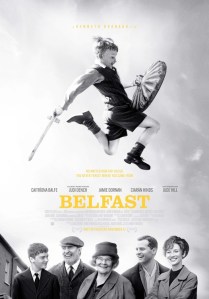
Kenneth Branagh returns to his boyhood home with Belfast, a coming of age story set during the Troubles in 1969 where Protestant mobs were targeting Irish Catholics. The movie is partly autobiographical as we follow young Buddy (newcomer Jude Hill) and his parents (Jamie Dornan, Caitriona Balfe) and grandparents (Cirian Hinds, Judi Dench) dealing with life as their neighborhood block more resembles a war zone. There are dangerous influences and dark intentions on the peripheral, but we’re mostly at kid level, where his days are preoccupied with sitting closer to his crush in school and wanting to impress his older cousin and be accepted. The parental perspective is kept to offhand whsipers and weighty conversations about moving away or staying behind. The black and white photography is gorgeous and exquisitely composed, looking like old family photos come to rich life. The actors are charming and heartfelt, and when called upon deliver emotional fury. The problem with Belfast, and it feels mean to even cite it as such, is that everything is just a little too nice, a little too clean, a little too safe. The childhood perspective doesn’t quite jibe with the political instability at hand. It’s not a Jojo Rabbit where that disconnect is the point for reflection. It’s clearly Branagh’s love letter to his family and native land. It feels like entire scenes have been plucked directly from Branagh’s nostalgic memories. It also feels like the characters are more sweet-smiling composites than real people. It’s all been romanticized with Branagh’s personal nostalgia, reshaping the odd angles and dangling conflicts into something more sentimentally safe, easy, and inoffensively digestible. Belfast is a perfectly enjoyable movie but it feels like a simple TV movie-of-the-week, crowd-pleasing version of a complex story worthy of greater nuance and scrutiny.
Nate’s Grade: B
Share this:

The Lost Daughter (2021)
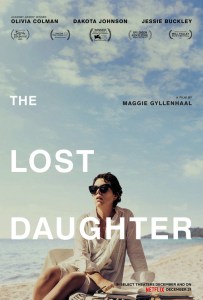 As a film critic part of a credited organization, I’m used to getting goodies in what I call “screener season,” the months of October to December when studios want to court critical favor for year-end consideration of their assorted movies for awards and titles. Netflix has sent me enough heavy coffee table books that I could, in Cosmo Kramer-style, fashion a literal coffee table made from them. For The Lost Daughter, Netflix sent me quite a bundle, including the film’s source material, a 110-page novella written by Italian author Elena Ferrante (My Brilliant Friend), which I read, and an actual bottle of sauvignon blanc wine. This was the first time a movie studio had sent me alcohol (my girlfriend drank a glass and did not like it, so thanks anyway, Netflix, but we dumped the bottle). I found the novella to be well written with plenty of poetic insights and turns of phrase, but I didn’t see the movie there. After sitting down and watching the two-hour feature film, I still don’t quite see the movie in this story.
Leda (Olivia Colman) is 48 years old, a literary professor, and vacationing on a small villa in Greece. Her time away is disrupted by a large, boisterous family sharing her resort. Leda is intrigued by a mother, Nina (Dakota Johnson), and her young daughter, Elena. It makes her reflective of her own time as a mother (played in flashback by Betty Buckley) to her two daughters, now both in their early twenties and having little to do with their mother. One day, Leda picks up Elena’s forgotten doll from the beach with the intention of returning her to the child, and then she simply does not do this. Leda grows closer to Nina, disapproving of her arrogant husband, her boorish relatives, and some of her risky personal choices, and we’re left to question whether she’s relating to this young, besieged mother or judging her from afar.
 This is one of those character study films that will ebb and flow on the level of the performers, and the actors elevate the material beyond what is present on the page. There are several intriguing conversations that shed light on characters and their view of parenthood, like Leda explaining how she feels that she gave the best of herself to her daughters when they were born, and now what she’s left with are the scraps. It’s not breaking new ground to view motherhood in non-glamorous terms. I thought 2018’s Tully did this with great observational detail, unsparing honesty, and great empathy. The Lost Daughter is not exactly Tully, which explored the hardships of motherhood with a put-upon woman who was valiantly struggling to keep her head above water, but it was a woman who wanted to be in the fight. With this movie, you never quite get a clear sense of Leda’s relationship with her two children, who are mostly kept to flashbacks when they are very young. Writer/director Maggie Gyllenhaal (yes, that Maggie Gyllenhaal) employs a non-linear plot to better inform the interior thinking of Leda, so we’ll have past and present juxtaposed for our ongoing evaluation. This is a smart way to follow the imprecise nature of hazy memory. There will be moments that will cause you discomfort, like when one of Leda’s young children is pleading through tears for her mother to kiss her wounded finger, and Leda withholds doing this as a power play, as an act of spite, as a knowing punishment for her wailing child. It’s also potentially relatable for others out there who too have, at the apex of their frustrations and exhaustion, lashed out at children and regretted it later, acknowledging that every parent will fail at some point over the long journey of time and to only attempt to minimize the inherent damage that will be left.
The Lost Daughter becomes an exercise in how long you want to spend with a pleasantly unpleasant woman. Leda is complicated, yes, but she’s also admittedly cruel and selfish, and the movie is trying to make her a case study, to shed our moral judgements and acknowledge that parenthood can be a draining experience. I understand the intention for embarking on empathy for unsympathetic characters; hundreds of movies have invited us into the minds of unlikable and downright psychopathic characters. I’ve always said that I need not like a character, I only need to find them interesting to keep me watching. Leda is an interesting woman because of where she veers from common practice. Most of us would return a missing doll to her rightful owner, especially as that child is grief-stricken and her wave of terror is affecting everyone in her family. Most of us would recognize others suffering and our ability to ease this, to absolve that suffering in an instant, and we would do so. Then the question becomes why isn’t Leda returning this doll to this child? The movie is an elusive attempt to answer, and each person’s interpretation will undoubtedly be different. I don’t know if this doll, perhaps the “lost daughter” of the film’s title, is Leda attempting to hold onto her own daughters, reclaim a version of motherhood that suits her, that doesn’t require of her. Or maybe she views the doll with derision. Whatever the case may be, have at it, dear reader, and enjoy not getting this question resolved.
 I completely understand viewers growing frustrated with watching two hours of a middle-aged woman holding onto a child’s doll and refusing to return it. It’s spiteful, and maybe that’s the point. Maybe Leda wants to impart the same lessons of hardship she endured as a struggling mother at her wits end. Maybe it’s her way of trying to shake Nina to re-examine whether being a mother is a role she is cut out for. Maybe it’s simply the continuation of a sadistic rationalization, “I had to suffer through this, so then you should have to suffer too” that props up whenever sociopolitical reforms and progress are met with generational push-back. By the end of the movie, I don’t know if Leda has seriously changed her outlook or sense of self. I don’t know if anything has really changed, and I don’t know if we’ve gotten to understanding her any better. Again, maybe that’s the point; people are complicated and possibly unknowable. But as a filmmaker showing us a character’s interior life and flashbacks, maybe you should try.
There is a late revelation in the movie that is going to be a deal-breaker for many. I won’t spoil it, though I will say that this reveal is covered in the first chapter of the novella, providing you this key piece of info as a prism for your early assessment. It explains why Leda has a strained relationship with her adult daughters and why thinking back about her perceived parenting failures causes her shivers of grief and guilt. At the same time, there are plenty of feminist stories about women shirking societal demands, so others could perceivablly view this revelation as an act of empowerment or self-determination, and others may just find it as the final straw in giving up in trying to sympathize with an already difficult person.
Fortunately, if you’re going to build a movie around a challenging character, Colman (The Father) and Buckley (I’m Thinking of Ending Things) are two of the most compelling actors for the cause. Much of their performances is naturally guarded, requiring each actress to hold back and utilize more subtle acting muscles. Colman’s middle-aged Leda is more set in her perception of self, more settled though not quite self-assured, so her performance seems more like cracking through a veneer and pushing back, trying to find the real Leda’s feelings about her life and the people she is socializing with. Colman is mesmerizing as always. Buckley’s young Leda is the version that is fraught with being an attentive mother as well as a burgeoning literary academic. Hers is the role of frustration, of shutting down, of desiring an escape hatch from the perils of motherhood. When young Leda is away on an academic retreat, she’s like a completely different person, and Buckley makes it clear that she covets this version of herself. Both women are gifted actresses and provide lifelines for the viewer to better analyze and unpack Leda as a puzzle.
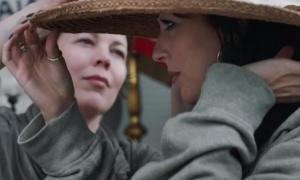 Gyllenhaal makes an impressively natural debut as a director. Her camera is usually very closely tied to her actors, bobbing to catch up and keep them in frame, afraid of leaving their sights. Her attention to detail is solid and her command of the actors is strong across the board. Her adaptation makes smart choices to better visualize the drama. After I read the novella, I genuinely wondered how the movie could even convey the material. It was so insular, so personal, and again, much of the onscreen drama was a woman hiding a doll from a child. I was worried the movie might become a ridiculous thriller of waiting for Leda to be caught, how she had to go to greater lengths to keep her secret, and thankfully that is not the case.
I can easily foresee The Last Daughter becoming a polarizing movie upon its Netflix streaming release at the end of the month. Some will hail it for being challenging and thorny, an indictment on the expectations of motherhood from a society that sets ambitious women up to fail. Some, and I predict the majority of viewers, will find the movie to be an insufferable character study of a misanthropic protagonist. I know the movie wasn’t trying to make an audience like its lead character, but I don’t know if by the end we are better at understanding her and her choices. It leads to a sort of, “That’s all there is?” ending that will frustrate many. The acting is strong to excellent overall and Gyllenhaal has a bright future ahead as a director, but The Lost Daughter might be too lost for too many to care. Just give the kid back her doll already, lady!
Nate’s Grade: B-
Share this:

The Tragedy of Macbeth (2021)
 At this point, William Shakespeare’s tragedy of witchy regicide has been adapted into over 30 movies, most recently in 2015 with Michael Fassbender and Marion Cotilard, so with any new Macbeth the question arises: what will this one offer? The pedigree behind this 2021 film is mesmerizing: Denzel Washington, Frances McDormand, and director Joel Coen. That’s enough reason to see another rendition of the Bard, although the best acting comes from a surprise, theater vet Kathryn Hunter who portrays all the witches as one person (plus more). She’s captivating and haunting and the highlight of the movie. This is the most, for lack of a better term, ordinary film in Coen’s quirky career and his first without brother/collaborator Ethan. It finds a dreamy middle ground between film and theater, utilizing imposing and stark sound stages and striking chiaroscuro black and white photography to feel otherworldly. The eerie, shifting imagery and alien presentation makes the movie feel like a transporting dream oiled by the lugubriousness of Shakespeare’s brilliant words. This version also demonstrates some of the more violent actions typically reserved for offstage implications (poor Macduff son). This Macbeth is also shockingly fast-paced, barely clocking in at 105 minutes, about half of the running time for the unabridged stage play. The acting is uniformly good but I was slightly let down by the leads. I guess I was expecting more indulgence in the sheer thespian feast and was surprised they made more of a tiny meal of things. If you’re familiar with the source material, there should be enough here to appeal to you, though I still hold the Patrick Stewart BBC production as the best film adaptation yet. Go into The Tragedy of Macbeth expecting good, not transcendentally great, and lean back and enjoy the aural pleasures of theater.
Nate’s Grade: B
Share this:

West Side Story (2021)
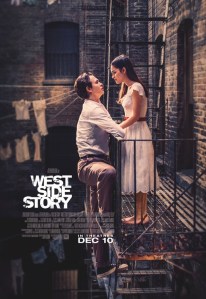 Steven Spielberg, now approaching seventy-five years of age, has experienced such rarefied success as a film director that the man can do whatever he wants. It just so happens he wanted to tackle his first big screen musical, something he’s a little late on considering peers like Martin Scorsese (1977’s New York, New York) and Francis Ford Coppola (1982’s One from the Heart) beat him to the musical punch early. The question isn’t why direct a musical at this stage of his glorious career, it’s why direct a remake of 1961’s Best Picture-winning West Side Story? We already have a perfectly good and revered movie version, and there are other musicals that haven’t even gotten their first big shining moment on the silver screen, so why go back to this particular show a second time?
Once again, we’re following the two New York City street gangs, the Jets, who are made up of Italian and Irish white kids, and the Sharks, made up of Puerto Ricans. Tony (Ansel Elgort) is trying to reform his ways after spending a year in prison for gang violence. The Jets are pleading with him to get back involved, to push back against the Sharks encroaching on their territory. He meets Maria (Rachel Ziegler) at a dance and the two fall instantly in love. The problem is that Maria is Puerto Rican, her brother is the leader of the Sharks, and this relationship would be forbidden and dangerous. Tony and Maria plan to run away together and escape the conflicts of this tragic turf war.
 I’ll risk musical theater heresy and admit outright that Spielberg’s West Side Story actually improves on the much-hallowed 1961 original in several ways. The most immediate and obvious is that we have Hispanic actors playing Hispanic characters. No regrettable brown face including the actual Hispanic actors this time (it’s just humiliating to watch Rita Moreno, in her Oscar-winning role, have to be darkened up to be “more Puerto Rican”). That’s a pretty good improvement already, though it’s not unexpected; 1961 was also the year Breakfast at Tiffany’s was released with its notorious Mickey Rooney performance in jaw-dropping yellow face. Granted, jaw-dropping today, not so back then. 1961 was still only a few years removed from John Wayne taping his eyelids back to portray Genghis Khan. This was the unfortunate norm.
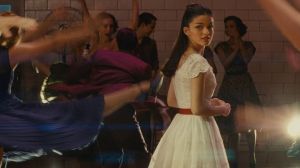
Another immediate improvement is the visual dynamism of 60 years of technical filmmaking advancement. I recently re-watched the 1961 original, a film I haven’t watched since probably the 1990s as a teenager, and it’s a relatively good movie but it’s also a good movie of its time, and by that I mean there are limitations to the presentation. One of the most appealing aspects of movie musicals is how they expand upon our humdrum reality, the splashes of color and synchronicity and bold imagination. I’m not saying the movie musicals of the 1960s were particularly lacking, as there are many classics and favorites, but because of filmmaking practicalities and predilections, movies could only go so far at the time. With 60 years of technological advancements, today’s movie musicals, when under the right guidance, can expand the world of song-and-dance fantasy like few of the past. You need only compare the showstopper “America” in both films, the dancing high-point of either film. The original is on a rooftop for its entire duration. The new version is all over the city block, finally culminating on a crossroads and bringing the denizens of the town out in girl power empowerment. It’s such a high-energy and celebratory sequence and the scale and variance really make it feel so much more joyous and exciting. The choreography is also an improvement. Again, not a slight against the 1961 original, but in the ensuing 60 years we’ve also advanced in the technical precision and creativity of dancers. The 2021 West Side Story is impressive top to bottom with the dancing of all the performers, and with Spielberg as director, he wants you to best appreciate their talents while also making the movie as visually dynamic as he can.
 Spielberg proves an absolute natural at helming a big movie musical. Nothing against Robert Wise, the 1961 director who helmed plenty of influential Hollywood titles like The Sound of Music, The Day the Earth Stood Still, I Want to Live, and Star Trek: The Motion Picture. He was also the editor on Citizen Kane. The man clearly knew how to tell a big screen story across multiple genres. It’s not a shame to say his visual prowess doesn’t quite stack up to a Steven Spielberg, who just happens to be one of the most popular and versatile filmmakers of all time. Spielberg’s camera is much more active than the original movie, and he’s consistently bringing us into the scene, having characters duck in and out of frame, and circling around, always interacting with the world. It makes the movie much more visually immersive and exciting, enlivening an already lively number like the dance hall rivalry between the Jets and the Sharks where each side crowds the edges. The movie operates on a high level of visual pleasure because Spielberg knows exactly how to play to the strengths of the musical genre. Spielberg incorporates the location in each setting and has fun visual flourishes, clearly having given great thought how to visualize every line in each song. The opening of “America” involves women placing clothes on a line, and as the clothes move, it reveals our newest chorus member giving voice to the continuing song. The way the camera moves through the neighborhood to note the encroachment of gentrification. The way he frames the faces of our young lovers. The way he uses shadows as menace. The way he makes every space feel like it’s perfectly utilized for the best shots and edits. Now that Spielberg has proven so adept at handling musicals, somebody please give this man another for our collective benefit.
The top actors are not the leads but two very mesmerizing supporting players. Ariana DeBose, previously seen as one of the ensemble members in 2020’s Hamilton, is pure dynamite as Anita. She explodes with verve and personality and attitude and vibrant life, and the camera loves every second she’s on screen. She gets the bigger emotional arc than Maria. She gets the jubilant song, the aforementioned “America,” and gets her crushing moments of heartache as well. DeBose is phenomenal, and likewise so is Mike Faist (Panic) as the leader of the Jets. Like Anita, this character is brimming with anger and attitude and the movie does a much better job than the 1961 film of presenting him with a point of view that can develop some empathy. Faist is lanky yet so smooth in his movements, and he gets more dancing than just about anyone. He’s balletic in his dancing while still upholding his spiky attitude. Both of these actors are so self-assured in their roles, so vulnerable behind the surface, and so accomplished with their dancing and singing that one wishes the movie would devote more time to both of them.
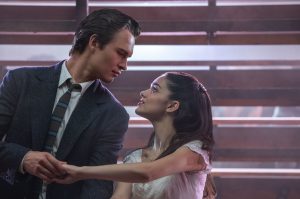 As for our leads, Ziegler and Elgort (Baby Driver) are good but unexceptional as our naifs in love. Ziegler can sing beautifully and definitely has a natural innocence to her appearance. Her eyes are so large and glassy that she reminded me of an animated character at points. Elgort is solid in his singing but I can’t help but feel that he’s been lapped by his co-stars. There is a comic relief musical number, “Gee Officer Krupke,” where the various Jets have fun imitating the nay-saying adults who hastily cast judgement upon these juvenile delinquents. It’s a silly number about guys goofing around and could easily be the first on the chopping block to be cut for time. However, over the course of this fun diversion, I realized that person-to-person in the Jets crew, the same guys that just appeared as background players to fill out a scene previously, how good every person is, and how much more time I wish they had gotten than Elgort. Part of this is that the romance aspect of West Side Story has always been the weakest part of the show. It’s based upon Romeo and Juliet and tied to those tragic plot events, but when both Maria and Tony are ready to run away and marry one another after a single night, and especially after the fateful rumble where Maria is so astonishingly quick to forgiveness (and horniess), the romance plays so incredulously. As a result, the two lovers are essential to the story but also the most boring characters too.
I think the adaptation by Spielberg screenwriting stalwart Tony Kushner (Munich, Lincoln) has smartly updated plenty of political elements, amplifying racial tensions but looking at it over a broader scope. Giving Tony a mentor figure in an older woman who runs her drug store shop, played by Moreno, is a great choice, especially as she represents a medium between the two sides as she is Puerto Rican but her deceased husband was white. It’s smart to have someone from the community and so wise to try and impart lessons to Tony, especially as he wants to change for the better. One update from Kushner didn’t quite jibe for me and felt like token-ism. The youngest member of the Jets, a prepubescent pipsqueak, has been replaced with a trans man fighting for membership. I understand the basic character arc is the same, the outsider trying to be accepted by the group, but the consideration of trans acceptance in the 1960s wasn’t exactly enlightening. The other Jets tease and question the gender identity of the trans man, but this perspective never feels well integrated into the play’s prejudicial world. I suppose more could have been done like having the Sharks harass this character, belittling them over their identity, and then the Jets feeling like one of their own had been attacked and in that they would finally be accepted. Except this inclusion would be around the degradation and potential assault of a trans person, which itself is not the best reason to include a trans character if you’re just setting them up for trauma. I don’t know. This character could have easily been removed if this was all there was.
 One other aspect I found cumbersome was the creative decision to not include English subtitles during the Spanish-speaking portions of the movie. I cannot understand the artistic rationale for this at all. Sure, Spanish-speaking viewers will be fine, and I could piece enough together with context clues and my rudimentary understanding of like 75 Spanish words, but what are we accomplishing here? It just feels alienating, and it inadvertently likens the viewing experience to what the Jets are going through, feeling like they cannot fully understand their new neighbors. I doubt that Spielberg and company wanted to reinforce the perspective of xenophobia, but purposely removing a key portion of your movie from the majority audience in the U.S. seems so strange to me. If it was just scant conversations or moments, I’d excuse it, but the untitled Spanish accounts for like ten percent of the whole movie. Imagine watching any foreign movie without the subtitles on screen. How much meaning are you able to devise on your own?
West Side Story 2021 is a good time for fans of musical theater and a testament that just because something is old and beloved doesn’t mean it can’t even be improved upon with the right people and goals. Both movies are about the same length, 150 minutes, which seems the de facto standard for movies this holiday season, and you’d have a good time with either. I think the updated version adds more visual creativity, impressive choreography, and remodeled racial and political considerations to make it land better for modern audiences. It might not have been needed but I’m glad all the same we now have two West Side Story movie musicals to cheerfully tap along to.
Nate’s Grade: B+
Share this:

Being the Ricardos (2021)
 Have you ever wondered what a week in the production of the I Love Lucy show would be like? Have you ever wondered about Lucille Ball and Desi Arnaz’s marriage? Have you ever wondered if Ball was secretly a communist? Well worry no longer, because Being the Ricardos is writer/director Aaron Sorkin’s ode to early television, the creative process, and recapturing something he was trying to articulate in his failed TV series, Studio 60 on the Sunset Strip. Yes, this feels like an especially long edition of that old show, with too many plotlines vying for attention like B-stories and C-stories for an episode of television, and several of them have curious conclusions. The storyline given such outward significance, whether or not Ball will be shunned as a possible communist in her youth, is wrapped up so anticlimactically and easily, and the storyline given such minimal coverage, Desi’s possible infidelity, is then given an ending that doesn’t feel nearly as setup to have its proper impact. The acting is another issue. Everyone is mostly good, but Kidman is no Lucille Ball, and while she doesn’t attempt a direct impression it’s still not a favorable comparison. Bardem is better as Arnaz but you can’t help but feel both actors are miscast. The supporting players, like J.K. Simmons as William Frawley, Nina Arianda as Vivian Vance, and Tony Hale as show creator Jess Oppenheimer, offer the more entertaining and insightful positions from the wings. Being the Ricardos feels like Sorkin trying to work his signature rat-a-tat snappy dialogue but missing a few rhythms, and part of that might be Sorkin serving as his own director for the third time. Director Sorkin plays everything too stately and serious, so even when the script is telling us these comedy writers are making a comedy show, the flow is off and everything is a little too self-important and reaching for culture war symbolic terms, reminiscent of, you guessed it, Studio 60 on the Sunset Strip. I guess my disappointment was not really getting to know more about Ball besides her perfectionism and underrated comedy savvy. This movie is just too busy with narrative devices; there are documentary-esque interviews with aged crew members in the future, a present-day storyline about workshopping one episode through a week’s schedule, and intermittent flashbacks to Lucy and Desi that can be confusing when past and present swap. Then there’s the black and white interludes of the show which are Lucy’s imagination of what may be? It’s a cluttered mess with pacing issues. You also get to watch Lucy and Desi have sex, which is like walking in on your parents. Being the Ricardos feels like an overly serious TV movie that’s too busy and scattered to remind itself that funny people can also be fun people.
Nate’s Grade: B-
Share this:

In the Bedroom (2001) [Review Re-View]
 Originally released November 23, 2001:
In the Bedroom hits all the right notes of agonizing pain, devastation and loss. The heart of the film is on the grief encompassing Matt and Ruth Fowler (Tom Wilkinson and Sissy Spacek) over the loss of their son. The Fowlers are well regarded in their cozy New England town. Matt is a flourishing local doctor and Ruth teaches a chorus of local high school girls.
In the Bedroom opens with Frank Fowler (Nick Stahl) chasing his older girlfriend Natalie (Marisa Tomei) across an open grassy field. Frank is a budding architecture student home for the summer and thinking of prolonging his time so he can stay together with Natalie. Frank and Natalie have a distinct age divide but also seem to have been given different lots in life. She has a pair of boys from her abusive husband Richard (William Mapother) that she is finalizing a divorce from. Richard is hopeful he can reconcile with Natalie if he just gets another chance, but Natalie is stern in her refusal.
 Ruth sees the relationship as a detriment to her son’s future. She’s even more upset that Matt is so casual with their son dating an older, working-class mother. Frank rushes over to calm Natalie after another of Richard’s outbursts of violence has left her house in shambles. She rushes her children upstairs just as Richard returns back. He manages to sneak in through a back door and confronts Frank in their kitchen, shooting and killing him. What should seem like a clear-cut case begins to unspool. Natalie admits she didn’t actually see the gun fire and the charges are dropped from murder to manslaughter. Richard is released on bail and free to stroll around occasionally bumping into the grieving and outraged Fowlers.
The majority of the film is the aftermath of the murder and the strain it puts upon Matt and Ruth and their marriage. Beforehand jealousy, anger, and bitterness would simply sit but slowly the tension begins to bubble to the surface. Ruth holds resentment and blames the leniency of Matt for the death of their son. Matt tries to get out of the house as much as possible, even if it means sitting in his car in their driveway at night.
One of the most harrowing scenes of In the Bedroom is also its emotional and acting centerpiece. After the mounting frustration with justice, Ruth and Matt explode into an argument that had slowly been building long before their son’s death. This is the first time they have truly talked about the whole situation and accusations fly like bullets in their first emotional confrontation. In the Bedroom could have easily fallen into the area of sticky made-for-TV land, but the exceptional performances all around by the cast and the deft and studied direction never allow it to falter.
Spacek (Carrie, Coal Miner’s Daughter) can begin writing her Oscar acceptance speech right now. Her portrayal of Ruth displays the pride and seething anger, but keeps her human throughout. She exhibits pure, raw emotion that strikes directly inside you leaving a knot in your stomach and in your throat. Her performance is truly breathtaking and so emotionally visceral to watch. Wilkinson (The Full Monty) plays Matt with passive-aggressive doubt and repression. He dominates in any scene he is in and takes the audience on a wide range of emotions. He has a commanding presence and compliments Spacek’s Ruth nicely. Perhaps the greatest thing Tomei (My Cousin Vinny, Slums of Beverly Hills) was known for was miraculously winning an Oscar and dumbfounding a nation. With In the Bedroom she is given the ubiquitous “And” credit at the end of the opening cast list. She has less to work with and less screen time to work it, fully earning the “And”‘ credit she has.
 Todd Field is an actor-turned-director and has appeared in such a wide array of films from Twister to Eyes Wide Shut. Field has layered his film with rich symbolism and an intelligent, patient pace. Most of the action in movies is centered on what is going on in a scene, but the most telling moments of In the Bedroom are what are not going on in the scenes. Field creates such an intimate portrait that the camera almost turns into another character, catching the lingering silences and the burgeoning inner turmoil. Field also adapted the screenplay from a short story by Andre Dubus, whom he dedicates the film to.
In the Bedroom is not going to be for everyone. Some will find it slow and some might even find it boring. As it stands, it is a powerful film on the study of loss that grips you and refuses to let go. You will feel all the blame, jealousy, anger, and pain of this family and for such emotions to resonate from the screen to the audience is a great achievement.
Nate’s Grade: A
——————————————————
WRITER REFLECTIONS 20 YEARS LATER

Twenty years later and it seems like nobody really talks about Todd Field’s In the Bedroom any longer, which is a crying shame. The movie was hailed by critics upon its release in late 2001 and earned five Academy Award nominations including Best Actor, Best Actress, Best Supporting Actress, and Best Picture. Field would then adapt Tom Perotta’s novel Little Children and direct its 2006 adaptation, again earning favorable reviews and multiple Oscar nominations, revitalizing the career of Jackie Earl Haley. And then Field seemed to vanish from view. There are a few dropped projects and a potential upcoming series with Daniel Craig, but Field has been too quiet as a director for over 15 years, and that’s far too long for a man that showcased such immediate natural talent from his very first opportunity in the director’s chair. In the Bedroom was a movie that I wasn’t exactly excited to come back to on my list of 2001 re-watches; it’s a heavy drama about grief and suffering and that’s not exactly the best entertainment remedy during the holidays. I’m happy to have gone back to the movie, as well as cross it off my list, because this return reaffirmed for me just how great Field is as a director, and a screenwriter, and just how vital this indie film feels. It’s the real deal when it comes to authenticity and emotional power, and watching this as a 39-year-old rather than a 19-year-old gave the enduring two hours added heft for its family tragedy.
The plot centers on the spiraling consequences of one death. Frank Fowler (Nick Stahl) is the 18-year-old son of Ruth (Sissy Spacek) and Matt (Tom Wilkinson), upper-middle class and pleasant but pointed. Frank is dating Natalie Strout (Marissa Tomei), an older woman and the ex-wife (though not yet legally divorced) of Richard Trout (William Mapother), a violent and unstable man and also heir to the local canning company. One fateful day, Richard angrily confronts Frank, a gunshot is heard, and Frank is dead. Richard swears it was self-defense, but Natalie is convinced her jealous ex was finishing the threats he had been making about her ever leaving him. The murder happens at the 40-minute mark, and from there the movie becomes a long examination on grief and guilt and blame, where characters drift from scene to scene like ghosts, some avoiding the painful realities of their enormous grief, finding hobbies or distractions, but most unable to fully articulate the resounding pain and emotions brimming under the surface.
 Under Field’s attentive care, there is a palpable dread hanging over every scene. The script allows different bereft perspectives, each person wrestling with feelings of personal guilt. Natalie blames herself for holding onto the relationship, bringing him into her world. Matt blames himself for not calling the police after an earlier fight between Frank and Richard, and he doubts whether he should have pushed harder on his feelings of reservation about the relationship with Natalie. Ruth has escaped into her insurmountable anger and uses it as the fuel to keep her going. The friends and neighbors do their best to be supportive but every conversation or poker game has the danger of veering too close to The Topic, and the awkward but well-meaning silences permeate and become more awkward. It’s a movie about people trying to get on with their lives but not knowing how to reassemble the broken pieces. By itself, that is enough meaty drama worthy of examination by top-notch actors and considerate screenwriting that allows us to really dwell in the beautiful discomfort. Field adds extra degrees of turmoil from the possibility that Richard will be given a slap on the wrists by the indifferent legal system. Richard posts bail thanks to his family’s wealth and even casually strolls through the town like nothing happened, making appearances while Ruth is shopping like her living in an inescapable nightmare. The Fowlers are consistently having their pain poked and prodded and reopened. One friend suggests if Matt has contemplated moving, and he admits he’s considered it, but it wouldn’t change what happened or lessen the pain of having their son’s killer protected by his status.
As you can imagine with that kind of material, In the Bedroom is an actor’s showcase. Wilkinson is the more featured role, and he’s the more laid back one, the one trying to make sense of things as best he can and failing. Wilkinson is terrific in the role and his hangdog expression from scene to scene denotes so much unspoken pain he’s grappling with behind his placid veneer. Just watching this man try and keep his life together is worthy of study. The weariness is harder to note with his performance but more rewarding to watch. Spacek is great herself but playing a role with less dimension. She is the stern voice of outrage and blame, the one who never liked Natalie and always suspected the worst. She has her signature blowup scene that serves as a long-in-the-making emotional confrontation with her husband, who she accuses of hiding from his grief rather than embracing it. However, her character is also painted in an unflattering and I would say unfair characterization. In the heat of their fight, Matt accuses his wife of being so controlling, so unforgiving that her son had no choice but to run away from her. While the character has been presented as cold and disapproving, she’s a victim too. This was Tomei’s confirmation as an actress that her surprise 1993 Oscar victory was no accident. She’s strong in her brief moments, especially when she’s recounting Frank’s murder under oath and realizes her inability to help the case with her conflicting witness testimony. It’s devastating to watch as she processes in the moment the doubt and then utter terror as she realizes that her next words, of honest yet painful reflection, will undermine the case she so desperately needs. I know the slap between Spacek and Tomei got more attention, but this is her clincher.
 All of this well-wrought examination of grief and guilt is sturdily handled, and it effectively sets up the last fifteen minutes of the movie into its own indie thriller. Finally pushed far enough, Matt takes matters into his own hands to find justice. The entire sequence is played out so deliberately that you might not breathe from the protracted suspense. Field and co-screenwriter Robert Festinger (Trust) have patiently built up these characters and their conflicts with such precision that they have developed genuine emotional stakes and uncertainty for the end. For first-time viewers, I imagine there will be legitimate doubt how the final events will play out. Is Matt being honest with his offer to have Richard run away from town? Is he making his stand in secret to absolve his wife of more pain and to rise to her verbal challenges of being too timid, or is she in collusion and possibly the Lady Macbeth from the bedroom shadows? It’s a long, taut sequence that feels like a fitting culmination of the many little details that have been set up, from character dimensions and motivations to small details that come together so smoothly, like a bridge worker or a friend’s large estate. It’s been twenty years since I’ve seen the movie and it still had my heart elevated, and I knew the ending.
Where In the Bedroom separates itself from the dramatic pack, and where it’s deserving of more attention and notoriety in retrospect, is how remarkably considered and assured this movie is about assembling its details and atmosphere. This is a deeply felt and deeply authentic movie that fills out the innumerable edges of this small coastal town with colorful characters that feel genuine, lives that feel lived-in, details that feel authentic without being obvious, and all without losing focus on the central performers as they struggle with their consuming grief. There are great artistic touches too for emphasis, like when Matt seeks out his lawyer to question points of strategy, and when the officious man retreats back to polite deferrals that fall back on the limits of the judicial system, the camera focuses on tight edits, first the man’s mustachioed mouth, then his fiddling hand in his pocket jangling his keys, a sound that intensifies into that of a jackhammer. It’s a clever and effective means of conveying the fractured, infuriating, dismayed response of Matt. However, most of the movie avoids flashy style that calls attention to itself. The very framing of the characters in the shots is so elegantly composed, making fine use of spaces and windows to help convey extra layers. This is a movie that does not feel like a first-time filmmaker or screenwriter. This same measured assurance can be seen in 2006’s Little Children, an equally well-observed, detail-rich, non-judgmental slice-of-life of small-town ennui. We need more Todd Field movies considering he’s two-for-two with literary adaptations.
 My original review in 2001 has some sentimental value for me. It was one of the first reviews I ever wrote for my college newspaper, The Chimes, in the position of film critic, an official role I held for five straight semesters (2002-2004). It was a goal of mine arriving at school and I saw it through, and this first review reminds me of the next stage of my career in film criticism and of my good times in small-scale publishing. My 2001 review gets some things right but I cringe at how awkwardly it’s trying to grasp for further meaning without understanding how to clarify my explanations. Maybe I was more taken with writing to my college-aged audience, hence why I devote a paragraph to explaining the use of the “And” credit in movie casting. There are some good points here and there, and the distillation of the plot and conflicts is solid, but as I’ve noticed with more than a few of my earlier reviews, the depth of critical analysis is shallower than I would prefer. Also, my hasty prediction that Spacek should “begin writing her Oscar acceptance speech now” was short-sighted, as she lost Best Actress to Halle Berry for Monster’s Ball (see you next in December, movie). In the Bedroom is a movie worthy of your time and a cultural re-examination.
Nate’s Grade: A


 nathanzoebl
You must be logged in to post a comment.