Blog Archives
Richard Jewell (2019)
 As I was watching Richard Jewell, a shocking realization began to form in my mind, something I had not anticipated from an awards-friendly venture from the likes of director Clint Eastwood – I was watching a strange secular version of a Kirk Cameron movie. Suddenly it all made sense where I had experienced this exact feeling before while watching a movie I knew wasn’t working. For those who have never watched the low-budget Christian indie dramas starring Cameron, such as Fireproof or the hilariously titled Kirk Cameron Saves Christmas (spoiler: he encourages materialism), they aren’t so much movies as they are filmed sermons, morals that have been given lackluster attention to turn into actual stories with actual characters. They don’t quite exist in a recognizably human reality, so they are often heavy-handed, tone deaf, and very very clunky, and sadly I can ascribe those very same qualities to the movie Richard Jewell.
Jewell (Paul Walter Hauser) is an eager, kind, awkward man who desperately wants to become a police officer and serve the public. His experience with law enforcement hasn’t quite worked out, so he’s currently serving as a security guard during the time of the 1996 Atlanta summer Olympics. He spots a suspicious bag during a concert in Centennial Park, follows protocol alerting others, and in doing so saves lives as it turns out to be a homemade bomb. At first Jewell is a national hero, and the everyman is on talk shows, thanked by strangers, and has a potential book deal in the works. Then the FBI, led by Agent Tom Shaw (Jon Hamm), and the media, represented by Atlanta journalist Kathy Scruggs (Olivia Wilde), turn the scrutiny onto Jewell himself. Suddenly the narrative twists and Jewell is believed to have planted the bomb to become the hero. Jewell is harassed by law enforcement, media speculation, and the pressure of trying to clear his name. He reaches out to an old colleague, rascally lawyer Watson Bryant (Sam Rockwell), to launch a defense and fight back against the Powers That Be.
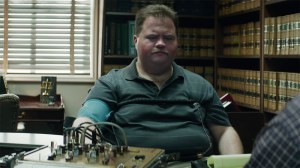 This is the passion play of Richard Jewell but nobody actually feels like a human being, let alone the person at the center of attention. There isn’t a single person onscreen that feels like a person, though the closest is the lawyer, Bryant. Jewell’s mother, Bobi (Kathy Bates), serves no other purpose but to act as her son’s cheerleader through good times and bad. When she has her teary media speech late in the film, I was relatively unmoved, because she was a figurehead. Everyone in the movie represents an idea or an organization, thus serving them up for double duty. Much like a passion play, we’re just here to watch the suffering and scold the abusers. It’s a movie meant to get our blood boiling, but other movies have been made to provoke outrage, especially highlighting past injustices under-reported through history. There’s nothing wrong with a movie that is made with the direct purpose of provoking anger at the mistreatment of others. The key is to make that central story relatable, otherwise the main figure is simply a one-dimensional martyr who only has the emotion of suffering. Without careful plotting and characterization, it can become an empty spectacle. With Richard Jewell, the main character is simply too boring as presented to be the lead. He’s an ordinary guy, but rarely do we see him in moments that provide layers or depth to him. And maybe that’s who he was, a transparent, average man who was too trusting of authority figures and a fair system of justice. Still, it’s the filmmakers’ responsibilities to make Richard Jewell feel like a compelling and multi-dimensional character in a movie literally called Richard Jewell. Even if the character arc is this poor sap starts to stand up for himself, this is severely underplayed. I sympathized with him but he felt more like a Saturday morning children’s mascot. He doesn’t feel like a person, let alone an interesting person, and that’s a big problem when he’s the closest thing the movie offers as a character and not a figurehead.
By far the worst character is Wilde’s media stand-in, a character so abrasively tone deaf and odious that when the bombing happens, she prays that she will be the one to get a scoop. The Evil Media Lady, which is what I’m renaming her because that’s all she serves in the story, is an awful amalgamation of the worst critiques people have with the media: rushing to judgment, callous indifference, and naked self-serving greed. The fact that she’s an invented character means she’s meant to represent the whole of the media, and yes, the media is one of the bad guys in the Richard Jewell story. They deserve ample criticism and condemnation, but when you serve them up in this careless, over-the-top manner, the vilification becomes more apparent than their culpability. Evil Media Lady literally sleeps with an FBI agent to get her scoops, scoops that end up being wrong, because she’s so devious and doesn’t care about The Truth. There is literally a dialogue exchange where she says, “I print the facts,” and another character retorts, “What about the truth, huh?” And wouldn’t you know, by the end, when Jewell’s mother gives her speech, who is listening and having a completely out-of-character turnaround but Evil Media Lady. I texted my friend Joe Marino as this was happening: “The power of her old white lady sad is making EVIL MEDIA LADY sad too, which means old white lady sad is the most powerful sad on Earth.”
 The FBI are also portrayed as a group of conniving snakes who must have thought Jewell was the dumbest human being on the planet the way they interacted with him. When the FBI sets its sights on Jewell as the prime suspect, they bring him in under the guise that they’re filming a training video and he needs help them with some role-playing scenarios. It’s so obvious that it feels fake, and yet my pal Joe Marino replied that this was a real moment, that the FBI had such a low opinion of Jewell that they could get him to sign away his confession through trickery: “We’re going to… pretend… see, that we brought you in as a suspect… and pretend we read you your rights… and you’re going to… pretend… you’re the bomber. Now please actually sign this… pretend form and do not ask for a real lawyer.” I almost need a Big Short-style fourth-wall break where somebody turns to the camera and says, “This really happened.” In fact, a Big Short mixture of documentary, drama, and education would have served this movie well. Here’s the problem with serving up the media and FBI in this manner. They deserve scorn and scrutiny, but when you turn them into exaggerated cartoons of villainy, then it colors the moments onscreen when they’re actually doing the things that they did in real life. This is mitigating the movie’s level of realism as well as the emotional impact. It’s not a person versus a system but rather a martyr versus a series of cartoonish cretins all trying to punish this good Christian man.
The shame of the matter is that Jewell was done great harm for acting courageously, and there is definitely a movie in his tale, but I think the way to go would have been making his lawyer the main focal point. That way there’s more of a dynamic character arc of a man putting it all on the line to defend a media pariah, it could open up to the doubts the lawyer has early on, especially as Jewell is aloof or cagey about certain damaging info (he didn’t pay taxes for years?), eventually coming to realize the quality of man he was defending. Jewell, as a character, is static and stays the same throughout despite his great emotional upheaval. A story benefits from its protagonist changing through the story’s circumstances, and that’s where Rockwell’s character could come into view. He’s also by far the most engaging person and he has enough savvy to be able to fight back in the courts and court of public opinion, becoming an effective ally for a desperate man. That way it’s a story of trust and friendship and righting a wrong rather than a good-if-misunderstood man being martyred.
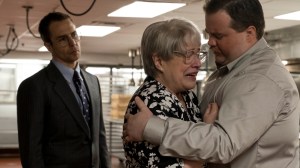 Throughout the two hours, Richard Jewell kept adding more and more examples of being a clunky and heavy-handed exercise. It would have been better for the bombing to be the inciting incident rather than the Act One break, sparing us so many scenes that do little and could be referenced rather than witnessed. Do we need to actually see Jewell getting fired from jobs to feel for him? There’s a reoccurring motif of Jewell bringing Snickers candy bars to Bryant as a friendly gift, and it’s so clumsy and weird. I started wondering if maybe Mars, Incorporated had paid for the bizarre product placement (“When you definitely did not plant a bomb in Centennial Park, break into a Snickers!”). There’s a dramatic beat where Jewell is trying to coax his distraught mother on the other side of a closed door. He just keeps repeatedly saying, “Momma please,” over and over while the music builds, and I guess the magic number was 17, and after that iteration she opens the door and they hug. It’s such an amazingly awkward scene. The dialogue has that same unreality as the rest of the movie, trying too hard to be declarative or leading, giving us lines like, “I’d rather be crazy than wrong,” and, “A little power can make a man into a monster.” It’s the kind of portentous, inauthentic dialogue exchanges I see in those Kirk Cameron movies. I wouldn’t have been that shocked if, by the end, the patriarch of Duck Dynasty showed up, running over the Evil Media Lady, and then they held a benefit concert for the persecution of white Christian males. I’m being a bit facetious here but Richard Jewell shouldn’t remind me of the derelict storytelling and characterization in hammy message-driven religious panoplies.
I was honestly shocked by Richard Jewell. I was expecting far more given the caliber of talent involved in the project as well as the inherent injustice in Jewell’s plight. Eastwood’s modern passion play feels too insufficient in passion. It’s an awkward movie that doesn’t give us a real character at its center, and it plays like every other human being in the universe is a representative of some storytelling function to service that empty center. There were lines of dialogue I just had to scoff over. There were moments that made me roll my eyes. I just couldn’t believe something this clunky could be designed for a late run for awards. The acting is all suitable, and Hauser does fine work as a mild-mannered everyman in a crucible, though I think he showed more adept skill in the enormously compelling I, Tonya. In fact, that 2017 movie could have been a lesson in how to tackle the filmic story of Richard Jewell, mixing in non-fiction elements to retell a story from multiple, fractured, contentious points of view that leapt off the pages. It feels there are many steps that should have been taken instead. Richard Jewell isn’t an awful or irredeemable movie, even though Eastwood’s typically plain shooting style feels even more strained and bland. It’s a movie I could see a contingent of the public genuinely enjoying, especially those already with a healthy mistrust of the FBI and media (you know who you are). But for me, it felt like I was watching the awards-friendly version of Kirk Cameron’s Christians are People Too. And again, Jewell deserves a major expose to chronicle his real injustices. He also deserves better than this.
Nate’s Grade: C
Share this:

Marriage Story (2019)
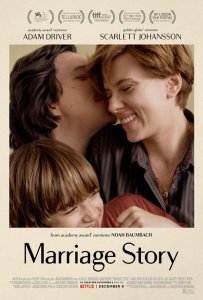 Noah Baumbach is a writer and director most known for acerbic dramas with a very dark, pessimistic viewpoint. That changed somewhat once he began a filmmaking partnership with actress Greta Gerwig that began with 2013’s Frances Ha. Gerwig has since gone on to become an accomplished filmmaker in her own right with 2017’s Lady Bird, which earned her Oscar nominations for writing and directing. The partnership seemed to bring out a softer side for Baumbach and they became a romantic couple who had a child earlier in 2019. Hell, Gerwig and Baumbach are even circling writing a Barbie movie together. This is a changed filmmaker and he brings that changed perspective to Marriage Story. It’s very different from Baumbach’s other movie about divorce, 2005’s The Squid and the Whale. I found that movie difficult, detached, and hard to emotionally engage with. Marriage Story, on the other hand, is a deeply felt, deeply observed, and deeply moving film experience that counts as one of the finest films of 2019.
Charlie (Adam Driver) and Nicole (Scarlett Johansson) are heading for divorce. He’s a successful theater director. She was a successful movie actress who relocated to New York City and has gotten an offer to shoot a pilot in L.A. Both say they want what’s best for their young son Henry (Azhy Robertson) but this will be tested as Charlie and Nicole push one another for what they feel is their best version of their family.
 The observational detail in Marriage Story is awe inspiring. I was floored by how involved I got and how quickly, and that’s because Baumbach has achieved what few filmmakers are able to, namely present a world of startling authenticity. There is a richness in the details, small and large, that makes the entire story feel like you’ve captured real life and thrown it onscreen. I wouldn’t pry but Baumbach himself went through divorce around the time he was writing this, and I have to think some of those feelings and details seeped into this screenplay. Baumbach’s direction favors clarity and giving his actors wide berths to unleash meaty monologues or dynamic dialogue exchanges. The writing is sensational and every character is given a point of view that feels well realized. Even the combative lawyers (Laura Dern, Ray Liotta) have perspectives you can see why they’re fighting for what they believe is right. But it’s watching Charlie and Nicole together that brings the most excitement. Watching the both of them onscreen allows for so much study of the little histories behind their words, their gestures, their impulses, and they feel like a great mystery to unpack. It feels like a real relationship you’ve been dropped into and left to pick up the histories and contradictions and all the rest that make people who they are.
It’s very easy and understandable for divorce dramas to essentially pick sides, to present a clearly defined protagonist and antagonist, like 1979’s Kramer vs. Kramer. It’s easier for an audience to have a clear side to root for and a clear villain to root against, someone who they can see is more responsible for this breakdown of the family unit or for the infliction of emotional pain. What Baumbach does is something rare and exceedingly compassionate; he makes us like these two people as a couple in the opening ten minutes so that we can see how they could have shared a loving relationship for so long. The opening is mirrored voice over where each spouse narrates what they love or admire about the other person, and by doing this it’s like we too get to see these people in this adoring light. It’s like a ten-minute love letter and then it gets ripped away. However, by starting with this foundation, Baumbach has invested the audience immediately. We care about both of these people because we’ve seen them at their best, and now as things get more acrimonious and harder, it hurts us too because of that emotional investment. Marriage Story does not adopt a side or ask its audience to choose. It presents both parties as essentially good people but with their flaws and combustibility that point to them being likely better apart. That doesn’t mean they don’t still care for one another or have essential elements of friendship. A simple shoelace tying at the very end of the movie nearly had me in tears because of its everyday act of kindness. These are complex human beings with needs, desires, egos, pressure points, and we watch both of them struggle through a stressful process where they’re trying to do right but that definition keeps morphing with every next step. If there are villains, it’s the lawyers, but even they are given degrees of explanation and perspectives to explain why they fight as hard as they do.
 I have read several reviews that disagree with my “no sides” assessment, citing how the movie presents more of Charlie’s perspective during Act Two, and this is true. The extra time onscreen, however, doesn’t erase his faults as a husband. The transition to this handover is Nicole unburdening herself to her lawyer (Dern) in a gorgeous seven-minute monologue. It’s a thrilling moment for Johansson as the character begins guarded and afraid of saying anything too harsh, and then as she starts talking it’s like you watch layer after layer get pulled free, allowing this woman to open up about her untended wants and desires and to legitimately be heard in perhaps the first time in a decade, and it’s so powerful and sympathetic and natural. To then think that Baumbach intends to portray this same woman as a villain seems like a misreading. The second act does involve Charlie being more reactive to the new obstacles of divorce, like being forced to hire a lawyer to officially respond, to start a residence in L.A., and to eventually be observed by an evaluator of the court. He holds to the belief that he and Nicole don’t need the acrimony, don’t need the pain, and that they can be adults when it comes to deciding their end. Whether this is naivety will depend on your own worldview, but holding to this belief gets Charlie playing catch-up a lot and having to roll with changes for fear of being seen as an uncooperative parent, like when Nicole’s friends don’t want to go trick-or-treating with Charlie present so he’s forced into a second later more pathetic outing. We do get to see Charlie beset with challenges but that doesn’t erase Nicole’s challenges too.
For a movie as deeply human as this one, it’s also disarming just how funny it can be. The humor is never cheap or distracting but just another element that makes Marriage Story so adept. While the movie has its lows, it can also find delicate and absurd humor in the moment, reminding the audience that life isn’t always doom and gloom even when things are going poorly. The sequence where Nicole and her sister (Merritt Weaver, wonderful) are bickering over the exact steps to legally serve Charlie divorce papers reminded me of a screwball comedy, how the nerves and fumbles of the characters were elevating the experience into touching the absurd. Nicole’s entire family is a great comedic array of characters including her mother (Julie Hagerty) who says she has her own personal relationship with her daughter’s ex-husband that she wishes to maintain. They even have pet names for one another (this brought back memories for me as I’ve had mothers of ex-girlfriends still want to talk with me weeks after their daughter dumped me). The legal asides are also filled with absurdist moments of comedy about double-speak and the arcane or idiosyncratic rules of divorce and representation in the courts. The sequence of Charlie being watched by the deadpanned court evaluator (Martha Kelley, TV’s Baskets) is a terrific example of cringe comedy. He’s trying to impress her but she’s generally unflappable, to hilarious degree, and it only leads to more miscues that Charlie tries to ignore or downplay to win her favor.
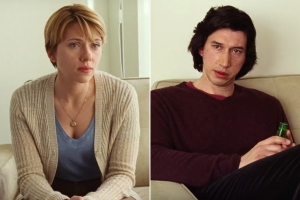 Make no mistake, Marriage Story is also one of the hardest hitting dramas of the year. Because we like both participants, because there is something at stake, watching them tear each other apart is a painful and revelatory experience. There is one gigantic confrontation that, like Nicole’s first confession, begins small and cordial and builds and builds in intensity, to the point where walls are punched, threats are unleashed, and both parties end in tears. It’s a thrilling sequence that feels akin to watching the defusing of a bomb ready to explode. Baumbach never feels the need to artificially inflate his drama, so we stick with that observational and compassionate ethos that has guided the entire film, even during the ugly moments. These are two people with pain and frustrations who both feel they have been wronged and are in the right. They’re both entitled to their pain, they’re both at fault for letting things get to this precipice, and they can both acknowledge that as well. Because even at their worst, Nicole and Charlie are still portrayed as human beings and human beings worthy of our empathy. They aren’t heroes or villains, they’re simply real people trying to navigate a hard time with conflicting feelings and needs.
The acting is outstanding. Driver (BlackkKlansman) is sensational and goes through an emotional wringer to portray Charlie, trying to stay above it all for so long and losing parts of himself along the way. His outbursts are raw and cut right through, but it’s also his smaller moments of ignorance, dismissiveness, or tenderness that linger, providing a fuller picture of who Charlie is, why one could fall in love with him and why one could fall out of love. I fully expect Driver to be the front-runner for the Best Actor Oscar. He even gets to sing a Sondheim tune and uses it as a reflection point. A late moment, when he’s reading a particular letter, drew tears and got me choked up. He’s always been such a visceral actor, a man with a magnetic charisma and animalistic sense of energy that draws your attention. He’s finally found a role that showcases how brilliant an actor Driver can be. This is also easily the best work of Johansson’s (Avengers: Endgame) career. Let there be no doubt – this woman can be a tremendous actress with the right material. She’s struggling with her sense of identity, being tied to Charlie for so long, and “wanting my own Earth” for so long that the dissolution process is both tumultuous but also exciting for what it promises. Nicole can take those chances, her Hollywood viability still alive, and strike out doing the things she’s wanted to do, like direct. Her character has felt like a supportive prisoner for so long and now she gets to make a jailbreak. Johansson is an equal partner onscreen to Driver, trading the tenderness and hostility moment-for-moment.
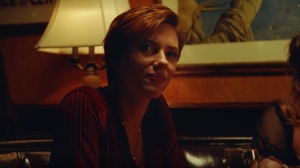 This is Noah Baumbach’s finest film to date, and I adored Frances Ha. I was expecting a degree of bitterness from the normally prickly filmmaker, and that’s to be had considering the subject matter of divorce. What I wasn’t expecting was the depth of feeling and compassion that flows from this movie’s very steady beating heart. It feels real and honest in a way that a movie simply about the horrors of divorce and breakups and custody battles could not. Baumbach’s characters aren’t just meant to suffer and inflict pain, they’re meant to come through the other side with something still intact. I’d argue that Marriage Story, even with its suffering, is ultimately a hopeful movie. It shows how two people can navigate the pain they’ve caused one another and still find an understanding on the other side. Driver and Johansson are fantastic and deliver two of the finest acting performances of this year. Baumbach’s incredible level of detail makes the movie feel instantly authentic, lived-in, and resonant. I was hooked early, pulling for both characters, and spellbound by the complexity and development. There isn’t a false note in the entire two-plus hours onscreen. It feels like you’re watching real people. Marriage Story is a wonderful movie and I hope people won’t be scared off by its subject matter. It’s funny, empathetic, and resoundingly humane, gifting audiences with a rich portrait. It should be arriving to Netflix streaming by December 6, so fire up your queue and have the tissues at the ready.
Nate’s Grade: A
Share this:

Ford vs. Ferrari (2019)
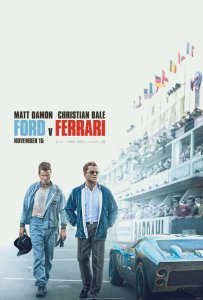 I don’t care one lick about cars and I was greatly entertained by Ford vs. Ferrari, a thrilling look back where the gear-heads at Ford wanted to build a new model of racing car that could challenge the seemingly unbeatable Italians at the Le Mans raceway. The smartest move the movie makes is placing this as a character-driven story with a group of big personalities solving a puzzle and trying to prove the arrogant suits wrong. It has such winning elements that it’s got crowd-pleaser DNA all over it, even if you’ll likely predict every step of the story. Even if you know nothing about the history of racing and motor vehicles, you can suspect that designer Carroll Shelby (Matt Damon) and driver Ken Miles (Christian Bale) will, through grit and confidence and outside-the-box thinking, overcome their obstacles to win the 1966 Le Mans race. The movie even realizes this, and that’s why the climax of the movie isn’t whether or not Ford will triumph but on a very personal dilemma and choice. It’s less about the mechanics of cars and more about simply solving problems with innovative solutions, and there’s a great satisfaction in watching characters we care about get closer to solving a puzzle that has outwitted the masses. As the characters get excited, we get excited because the personal is what is felt most. Miles is an arrogant, disgraced driver that Ford doesn’t want being the face of anything for the company. Shelby is trying to transition from being in a car to the head of a company, and he’s the heat shield for his team, taking the corporate ire and laying more and more on the line for their experiments. Damon is great, and sounds uncannily like Tommy Lee Jones, but this is chiefly Bale’s movie and he is fantastic. He once again just disappears into a character, this time the lanky, cocky, hard-driving family man, and the scenes with Miles’ wife and son actually provide important dimension to all the participants. They aren’t simply there to express concern or admiration. The screenplay by the Butterworth brothers (Edge of Tomorrow) and Jason Keller (Machine Gun Preacher) have opened up these characters, their fear, anxieties, hopes, and dreams in a way that feels genuine and considerate. They hook us in with the characters early, so that the rest of the film serves as a series of payoffs for our investment. The racing sequences are thrilling as director James Mangold (Logan) has his camera career around the cars, placing the audience in the middle of the RPMs and feeling that immersive sense of speed. I never knew that the Le Mans race is 24 hours long, and the scene of these 1960s cars, with 1960s windshield wiper technology, driving in the rain and dark at 200 miles-per-hour is starkly terrifying. I still don’t care much about cars or their history, but you present me engaging characters and Oscar-caliber performances to boot, and I’ll watch those people anywhere. Ford vs. Ferrari is a bit long (150 minutes) but a well-crafted, potent crowd-pleaser with exhilarating racing and strong characters worthy of cheering.
Nate’s Grade: B+
Share this:

The Irishman (2019)
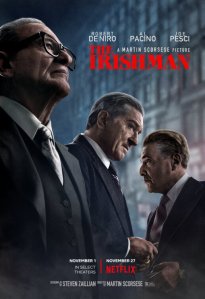 In 2018, Netflix crashed through Oscar biases with Alfonso Cuaron’s personal epic Roma and this year they have their sights set on even bigger prizes. The streaming service has built an empire of original content (and debt) and put up the $150 million budget for Martin Scorsese’s decades-spanning crime drama, The Irishman. It’s a fitting reunion for Joe Pesci, Robert De Niro, and Scorsese, and then to add Al Pacino on top, well it all makes for one supremely entertaining and occasionally striking movie experience. However, I think some critics are getting a bit too carried away with their plaudits. While entertaining throughout its mammoth 3.5 hours, this is much more Casino than Goodfellas.
We follow the life of Frank Sheeran (De Niro), a Philadelphia-based truck driver who rose to be a Teamster union rep and, reportedly, a prolific hired gun for the local mob, headed by Russell Bufalino (Pesci). Sheeran is tasked with helping Jimmy Hoffa (Pacino) with his business, which helps the larger contingent of organized crime that used the Teamsters multi-million-dollar pension as their own slush fund to pay for projects and schemes. After he loses his leadership position, Hoffa begins to think of himself on the same level as the tough guys and just as protected. Sheeran tries to turn his friend back from the self-destructive path he seems destined for, and ultimately, it’s Frank Sheeran who says he pulled the trigger killing Hoffa (is this a spoiler?).
 There are moments that just sing in this movie, buoyed by a wonderful film alchemy of the actors, the storytelling, the skill of Scorsese and his longtime collaborators like editor Thelma Schoonmaker, and it can feel exhilarating. There’s a rich world of day-to-day detail from the character interactions and mob politics, and once Hoffa comes onscreen the movie becomes something more and better. It’s just as much Jimmy Hoffa’s movie as it is Frank Sheeran’s. Here is a live-wire character bursting with unpredictability, later to his great deficit, and who pushes the other characters around in a way that creates instant tension and realignment. Considering the selling point of the movie is its perspective from the claimed killer of Hoffa, it only makes sense that these moments are allowed the most attention. Hoffa sees himself as a champion of the little guy, as an ideologue trying to make life better, never mind his own extravagance, ego, and inability to let go of grievances. Hoffa was the head of the Teamsters union for twenty years and was a well-known public figure, somebody people like Peggy Sheeran (Anna Paquin) could idolize unlike her father and his other cohorts she despised. He’s a larger-than-life figure and those theatrics find a perfect match with Pacino and his bombastic nature. It’s no wonder he steals the movie. Pacino is terrific and has the clearest arc of any character onscreen, a meaty role that gives Pacino new life. I predict he’s the front-runner for supporting Oscar gold. I was transfixed by the amount of details that Scorsese and screenwriter Steve Zallian (The Girl with the Dragon Tattoo) imbue in every scene, propelled by Frank’s narration and a dark sense of humor. It’s very easy to get immersed in this criminal underworld and its many machinations, which provides a steady stream of information points to tantalize. If one scene isn’t working, just give the movie a few minutes and another avenue might open to prove newly fascinating. It makes a difference on its running time, making 3.5 hours feel more mercifully like 2.5 hours. Of course, once it’s released onto Netflix, I feel like its size and scope will become less unwieldy for viewers.
Because of that surfeit of detail, I think The Irishman would have better benefited from being adapted into a miniseries than as a single movie that happens to be 15 minutes longer than Titanic. The finished film feels rather episodic, like three movies attached into one; the introduction into a life of crime and rising in the mob, the friendship and fall of Hoffa, and the finale as an old man. All of these segments have genuine interest and compelling drama but I think they would have been even more compelling with a larger narrative canvas to play out upon. That way each episode could have its own beginning/middle/end and play its part adding to the larger whole, which is essentially what scenes should be doing anyway for a story. The problem is that The Irishman gets a little lost in its own minutia in the middle and the plot stalls. It feels a little too taken with itself. It feels like we’re experiencing the same information just in more settings. How many moments do we need to show Hoffa pushing away sound advice, making enemies of allies, and dooming himself? Admittedly, the Hoffa portion of the movie is the most compelling, and longest, segment of the movie. It’s the best because of Pacino’s spotlight and from the personal involvement in Sheeran, pushing his loyalties to the test when he genuinely grows close to Hoffa and realizes he’ll be the one that has to eliminate his friend. It’s the most dramatic and harrowing and most interesting part of the movie (and no, not the somber final 30 minutes). I think it would have had even more punch over the course of multiple episodes of material and momentum. By going the miniseries route, the film could have also stripped its second and entirely unnecessary framing device, having the men drive their wives across the Midwest to attend Bill Bufalino’s (Ray Romano) wedding. The short scenes fail to lead to any import until it’s revealed late what also happened during this fateful weekend. It’s a long wait to justify its placement, and even after that it doesn’t feel like the occasional road trip updates were worthwhile.
 Much has been made from several dazzled film critics and online pundits about the movie’s concluding half hour, which follows the “after” of a mafioso’s life. We got a taste of this in the conclusion of Goodfellas after Henry Hill and family were relocated to schlubby mundanity through witness protection, implying the boring life that awaited, but The Irishman dedicates its conclusion to demystifying these mob men. Few of them live to old age, so already Sheeran is the exception (he died at age 83 in 2003) but he’s also incapable of introspection. That gives the final half hour a change of pace and an air of contemplation but it’s stagnated. Frank’s family wants nothing to do with him, everyone from his earlier life has passed away, and he shows little regret for his life’s actions, shocking a priest, his only regular visitor. I suppose one could surmise the self-deluded and sad existence of this man who refuses to accept accountability, but I found this final thirty minutes to be interesting, yes, but far from revelatory. I think critics are doing a fair amount of projection by searching for some kind of tidy, accumulative meaning, as if Scorsese is providing some wise, decades-earned statement on his own famed works highlighting the flashy lives of very bad people doing very bad things. People are a little too desperate for The Irishman to provide that neat hook, that definitive statement, and it’s just not there. It may have been too “movie land convenient” but I was begging for a final confrontation from Peggy.
The de-aging CGI is the source of much of the film’s gargantuan budget, which was why studios balked before Netflix welcomed Scorsese with eager arms. The first display of the de-aging effect is jarring and jarringly bad. We see Pesci and De Niro as 40-year-old men and it’s initially horrifying. The effect looks wrong, like somebody drew over their faces to provide some degree of cell-shaded dimension (think of the video game Borderlands). There are also elements that will just never look right, namely the elasticity of the skin, which looks overly smooth and polished, reminding me of the doll faces of the stop-motion film, Anomalisa. It gets better from there. Interiors and lower-light environments are better at masking the unreality. After a while you simply grow accustomed to it and the characters are aging anyway, which means the effect is rarely used after the first half of The Irishman. It’s impressive at parts but even with the digital facelift, these are still 70-year-old men moving their 70-year-old bodies with new shiny faces. There’s a moment when a younger Sheeran beats and stomps on a grocer and it reminded me of professional wrestling with the stiff movements of one participant followed by the extravagant physical overreaction of the recipient. Captain Marvel is still the champ at actor de-aging.
 There’s also the fairly strong possibility that Sheeran made all of this up. Well into his twilight years, he reportedly recounted his amazing tale to a medical malpractice lawyer before he died, and that became the 2003 book, I Heard You Paint Houses. An August 2019 article by Slate.com writer Bill Tonelli (“The Lies of the Irishman”) gives a pretty thorough rundown of the facts of the case, which align in one direction. All of the FBI agents during Sheeran’s time, as well as the local officials, and surviving criminal actors, all come to the same conclusion that Sheeran has grossly overstated his role in mob matters and outright fabricated his most sensational claims. According to Tonelli: “Most amazingly, Sheeran did all that without ever being arrested, charged, or even suspected of those crimes by any law enforcement agency, even though officials were presumably watching him for most of his adult life. To call him the Forrest Gump of organized crime scarcely does him justice. In all the history of the mafia in America or anywhere else, really, nobody even comes close.” It does seem far-fetched, but the next question is whether the enjoyment of the movie matters at all if the story it’s based upon is ninety-nine percent hooey? While I think the impact of the movie is slightly blunted with a fictional account, it plays larger into a self-aggrandizing theme and the first framing device of the movie, having Sheeran narrate his life experiences as an old man, left to rot in a nursing home. Perhaps he’s exaggerating to make himself feel more important and grant himself something of a legacy that is denied to him by a lifetime of self-serving choices that have left him abandoned by family. In this regard, there’s a strange meta-textual level that even helps support the larger tragedy and loneliness of these men, in case you needed it underlined.
There’s a delightful feeling of getting the gang back together for Scorsese’s massive, ambitious, and thrilling return to the world of gangster cinema. There are so many characters that it can be hard to keep things straight as we zip through decades, de-aging, framing devices, Boardwalk Empire supporting actors, prison time, nursing homes, and Jim Norton as a young Don Rickles. I wish the story had been parlayed into an epic miniseries rather than a movie. The finished film is certainly long and imposing but also compelling and entertaining. The personalities don’t have quite the pop as Pacino, a rollicking screen presence relishing the spotlight, but the rock star bravado has been replaced with a somber reality of self-cultivated isolation. Pesci is terrific in what might be his most nuanced, insular, and quiet role of his career. I wish he would continue acting. De Niro is suitably gruff and has a few scenes of trying to hold back a cascade of emotions, but he’s more our impassive face into a world of crime and vengeance. I don’t think the final conclusion has the power that others have claimed and is a result of projection. The Irishman is an entertaining deep dive that I only wish could have gone even deeper.
Nate’s Grade: B+
Share this:

Jojo Rabbit (2019)
 Writer/director Taika Waititi has played a vampire, an intergalactic rock monster, and now perhaps the most challenging role of his career, Adolf Hitler. Coming off his meteoric success with the MCU, Waititi is using the time in between mega-budget Thor sequels to write/direct/produce/co-star in a smaller daring indie comedy. Jojo Rabbit follows a young German boy, Jojo (Roman Griffin Dais), during the last year of World War Two. He fantasizes about having an imaginary Hitler (Waititi) as the voice over his shoulder, reinforcing the teachings of adults and authority figures. His worldview is challenged when he discovers a teenager hiding in the family’s walls who just happens to be Jewish. Jojo doesn’t know what to make of Elsa (Thomasin McKenzie), nor does she know what to make of him, and Jojo decides to keep her presence a secret to spare his doting and put-upon mother (Scarlet Johansson). Jojo tries interrogating this wily girl but ends up learning more than he ever imagined.
Given the subject matter, setting, and overall tone, it’s a wonder how well Jojo Rabbit works. I was worried about what kind of tone the movie would be striving for given the delicacy of its subject matter, not that other filmmakers have shied away from incorporating comedy into Holocaust settings. I don’t mean this to be overly flippant but for portions of the movie I felt like I was watching “Wes Anderson’s Nazi Germany.” The entire Act One camp sequence feels like a warped deleted scene from Moonrise Kingdom. I was genuinely surprised how often I was laughing with Jojo Rabbit. Waititi can be hysterical as a bratty, temperamental version of the Fuhrer, but there are moments where he gets caught up in the oratory of his hateful rhetoric that serve as a reminder that even for Jojo, he realizes this man isn’t exactly best friend material. The Hitler imaginary friend goes away for long stretches in the second half as the film emphasizes more drama, which is the right choice as Jojo is coming to doubt what he has been taught from that imaginary friend. The portrayal of Hitler might be offensive to some viewers but I feel like Waititi walks a fine line to root it from the perspective of childhood fantasy. It’s taking the figure on TV and adapting it to suit the needs of a lonely kid wanting to belong. Of course he’d want Hitler to select him as the best little young Aryan that Germany has going. It’s not dismissing the evil of the man but instead serving him up through a specific prism that allows laughter not necessarily even at Hitler himself but at a youthful and immature understanding of something far more complex.
 I was also worried that the comedy might dampen some of the more dramatic turns coming, and this was so not the case. There are dramatic moments hiding under the surface thanks to seeing them from Jojo’s naïve perspective, but then there also big obvious dramatic moments of suffering that hit. As much as the whimsy prevails early, the dramatic moments are delivered in tasteful ways that do not detract from the feelings being felt by the characters as well as the willing viewers. There are a few gut punches that remind you that even with the whimsy of childhood naivete, real people are dying in awful ways because of those complicit in racist genocidal policies. The relationship between Jojo and his mother is the second most significant one, after he and Elsa, but it’s this central focus where we see the starting point of his character arc. His mother tries to shield her child from the larger terrors of their society but that’s increasingly difficult when people are being hanged in the street for helping Jews. She’s hoping to simply play her part in public, get through this terrible time, and finally have the son back that she knows, hoping he will eventually shake free from the propaganda. It’s a role that requires Johansson to play like another cartoonish adult, all bubbling energy and quirky nonchalance, while burying her increasing concern. Part of me almost wishes that she was a co-equal protagonist so we could get an even richer perspective to contrast more fully.
There’s a sprightly whimsy to the proceedings that comes from being locked into the perspective of an imaginative child. It’s not that the world is 100 percent his vision, it’s more that we know that the representation of what we’re seeing might not be a completely objective reflection of the reality Jojo is encountering. This especially includes the portrayal of many adults involved in various levels of the Nazi party. They play out like cartoons and buffoons but are still dangerous cartoons and buffoons. When Jojo’s childhood friend Yorki is talking about fighting on the front and we see him handling a rocket launcher, this is clearly an exaggeration of the desperation of the moment and a young boy’s eagerness to be involved. This creative approach allows Waititi to dabble in the fantastic and keep his audience alert, allowing them to second-guess what we’re seeing on screen and look for the reality in hiding. I laughed pretty consistently at the intended humor and incredulous nature of the adults trying to pass off wrongheaded insights and suggestions as scientific fact or common sense. It’s a movie where you laugh at the ridiculous idiots while hoping that the idiots won’t get the people we care about killed.
 The acting is very strong overall. Newcomer Roman Griffin Davis is exuberant and relatable without coming across as overly cloying or mannered, which can be a rarity for child actors. He has a very difficult role to play from a tone and perspective standpoint, and he succeeds. Another great child actor is Thomasin McKenzie (Leave No Trace) as Elsa, a young girl in an extremely vulnerable position who looks upon this new boy with equal amounts fear, disdain, and pity. She cannot be herself and must choose her words and responses carefully, so it’s a guarded performance of restraint but McKenzie is fabulous in quieter, subtler shifts. The adults are all enjoyable as broadly comical cartoons, with Stephen Merchant (Logan) earning considerable unease as an S.S. officer leading a team sweeping for Jews in hiding. Johansson (Avengers: Endgame) seems a little too eager, a little too antic, but this may pertain to her character’s nerves and desperation, trying to overcompensate her anxiety. Rockwell (Vice) gets the biggest adult role as a disenchanted military vet who sees the writing on the wall. At first his detached nihilism is a source of dark comedy and later he becomes an unexpected father figure for Jojo. I don’t quite know if his hero moments have the desired impact but he’s still an amusing presence.
However, there are also some drawbacks to being a fable, namely a lack of larger specific substance beyond general lessons and general characterization. Jojo Rabbit is being billed as an “anti-hate satire” and I definitely think that summary fits the intent, but “anti-hate” sounds like such a nebulous buzzword that seems more meaningful at first glance and less upon reflection. I would assume every responsible story set during the era of the Holocaust would adopt an “anti-hate” sensibility, because the alternative would be championing the foundations of Nazism. It’s hard for me to imagine any movie desiring a public release being anything other than “anti-hate.” Essentially, we have a character coming to see through the propaganda of the era, judging people as people rather than scary caricatures, and start to reject the teachings of manipulative authority figures. This isn’t a new formula for coming-of-age stories or tales set during times of great strife. It’s a lesson in empathy and rejecting dogma on its face. When it comes to Nazism, that should be the easy part, facilitated by any prolonged exposure to anyone previously deemed an undesirable.
My nagging issue with Jojo Rabbit is that for all its impish whimsy with such a serious historical subject, it ultimately plays things pretty safe. That’s fine, it doesn’t have to a revolutionary film, but it does dull the message a bit when the ultimate lasting takeaway is “hate is bad, Jews are people too.” It’s a bit pat, a bit simple, and a bit too easy. The characterization can also be hampered by this same ethos. The characters are pretty much exactly what you see at first blush. The only character who changes or has room to explore is Jojo. Even Elsie feels more like a stagnant person despite her unique circumstances. This may be because she’s more change agent than character, a figure for Jojo to be horrified by, then entranced with, and finally see as a friend. I still felt moments of genuine emotion for characters onscreen and for Jojo’s journey of self. The movie still works well with its stated goals and direction, it’s just a bit limited because of the simplicity of its message and the lack of greater substance for its many characters.
 The Jojo Rabbit novel was written before the rise of Donald Trump but Waititi has said that when they were filming that America’s current political climate was on his mind, and it’s not hard to make a few adaptations to apply this for the modern era. Perhaps a young boy sees Donald Trump as his imaginary friend and together they’re both all-in on trying to “make America great again” by first and foremost reporting any immigrant they see as illegal. Then later in the story he discovers his family is willfully hiding an undocumented child from being deported after they were stripped from their parents who were then deported. Now our naïve protagonist must reconcile the harsh rhetoric he has been taught with the growing empathy of connecting with another human being who doesn’t seem as dangerous or as sub-human as others claim. If you wanted to even make this parallel, it’s there, though I think that diminishes the setting. We shouldn’t need to tell movies during the Holocaust as metaphors for our modern struggles. I suppose this is another scenario where if you want to Inuit more of a relevant modern message, you can.
Jojo Rabbit (a nickname that seems forgotten after its christening) is a coming-of-age fable with equal parts charm and horror. Waititi takes a serious subject and doesn’t mitigate the evils of Nazism with his portrayal of a daffy imaginary Hitler. The production has an admirable swagger to it as it charts its own course, tackling serious subjects and young whimsy to portray a poignant story about childhood, loss, and growing up. It’s an amusing and heartfelt enterprise that I can’t help but feel could have done more than settling for some pretty safe messages and limited characterization. There wasn’t a moment with Jojo Rabbit where I wasn’t entertained, but I do wish the movie had more on its mind that reminding everyone that hate is bad.
Nate’s Grade: B
Share this:

Parasite (2019)
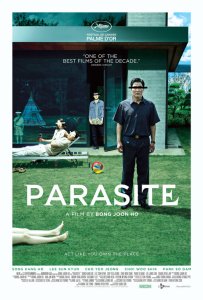 Parasite is the latest from award-winning South Korean filmmaker Bong Joon-ho (Snowpiercer, The Host, Okja) and it won the prestigious Palm D’or at the Cannes Film Festival. The filmmaker has never settled down in any genre and often goes for broke when it comes to embracing whatever genre he is dabbling in and then subverting, accelerating, and broadening that territory to show an audience what a master can do with these storytelling parameters. No movie under Bong Joon-ho’s guidance is ever limited by its genre. Needless to say, I’ve been highly anticipating Parasite, even more so since the critics started bandying about terms like “masterpiece.” Simply put, Parasite is a miraculous movie.
We follow the Kim family who live in a scummy basement apartment on a filthy street known for public urination. They scam free wi-fi off their neighbor and badly fold pizza boxes for little money. They’re barely hanging by on the outer edges of society when opportunity comes knocking. A rich family, the Parks, is in need of a new English tutor for their teenage daughter, and Ki-woo Kim (Choi Woo-sik) has the connection. He will pose as a college-educated English teacher, recommended from his friend, the departing tutor. He gets the job and sees further opportunity, eventually scheming to get each member of his family hired; sister Ki-jung Kim (Park So-dam) as an art therapist for the Park’s troubled son, father Ki-taek Kim (Song Kang-ho) as the personal driver to the family, and mother Shung-sook Kim (Jang Hye-jin) as the housekeeper and personal assistant for the family. The Kim family gains further leverage as they worm their way inside this house, but there are secrets that will force them to readjust how far they are willing to go to service this bourgeois family and keep their good lies rolling.
 Parasite just unfurls with such natural ease, building and developing outward, building its characters, their problems and deceptions, and then, like that, it effortlessly turns gears toward another tone, and you weren’t even aware it was happening until after the fact. Bong Joon-ho’s film is so exact and impeccable and calculated that the pieces are move in tandem like a well-oiled machine. The synchronicity is so amazing that I often had to acknowledge how effectively the movie had surprised or satisfied me. There isn’t a wasted moment in the 130 minutes here, which begins as a fun con game between one family of shady grifters working their way inside a rich family’s trust. From there, the movie gets even darker, more mysterious, outlandish, and even more mournful and delightful. There are moments of slapstick comedy that had me howling, divine sequences of tension that felt ready to explode, and regular emotional punches to the system that reminded you that despite everything these are still people capable of great suffering and great feeling. Parasite is a rare movie that works on near every level, each facet of filmmaking operating at such precision that it blends together to create a masterwork of tone and tenor that is universally accessible, brimming with menace and glee.
There’s a simple pleasure to be had watching a con artist at play, so there’s even more amusement when we’re watching a family of con artists all spinning lies in tandem. The process of escalation is so clean and believable in the world’s universe, with the first family member using their position of influence to manipulative the family into hiring the next family member, even if that means scheming to get rid of the Park family servant already occupying that desired position. The Park family matriarch is all about personal recommendations and using a tight circle of trust; however, the Kim family exploits the obvious loophole of what if the initial link in that chain is untrustworthy him or herself? Initially I thought the movie was going to be watching this one family worm their way into the lives of the rich and powerful and take over, and while that is true to a certain extent, the movie is thankfully even more than that. Still, the con aspect alone is highly entertaining and so naturally plotted, with each new addition feeling organic from the last. There are natural complications that provide new challenges for the family of con artists to maintain their shifting covers and having to think on their feet, and there isn’t a moment relating to these antics where Parasite is not completely compelling and darkly funny even as it veers into extremes.
 If you’re thinking that the Kim family is the obvious target of the movie’s parasitic titular allusion, slow down, my friend. While the Kim family is more obvious about their deceptions, the Park family too is filled with the deception of civility, kindness, and graciousness. At first, we laugh at them because of a general naivete that allows the Kims to flourish. As the Kims successfully roust different servants, they are routinely dismissed without much thought. Some of these people have been with the family for years and otherwise have spotless records, but all it takes is one whiff of impropriety and the Parks are already scrambling to cut them loose, usually very unceremoniously and immediately, with the misplaced idea that this will somehow be the “nice” and “respectful” way of handling a dismissal. They’re so quick to turn on people they feel are disloyal or incompetent, but really, it’s the disloyal aspect, that they can be manipulated so easily by the Kim family’s suggestions and assertions. Never once do Mr. and Mrs. Park ask for their servants’ side of the story; they accept the accusations with minimal evidence are gung-ho about removing their formally trusted help as if they have been waiting for these moments.
The movie becomes a parable of exploitation and the consequences of avarice, and I’m going to do my best to dance around some significant spoilers that reshape the film in its second half. At one point the Kims have all made themselves at home in the luxury of the Park estate while the family is away on a camping trip. It’s carefree wish fulfillment, lapping in the excess, and then over a drunken family dinner, Mrs. Kim says that if she had this kind of money that she would be as nice as Mrs. Park (appears). For her, money is like an iron and irons out all the problems of life, and as a family that has constantly been hustling for their next dollar, to be free of cares and worries would be the ultimate luxury. However, there is naturally more to this estate and the Park family, and the movie takes some dark turns into a battle over status and how far people will go to protect what they feel belongs to them. This is acted out in very personal ways and also in larger metaphorical waves, which adds to the overall class warfare satire. What starts off as a spiky little con comedy becomes something deeper and more challenging, expanding its targets to indict everyone jockeying for position in a system that seems corrupted to a fault.
 Even as the Kim family is scheming and conniving, there are still moments that remind you that they aren’t these smooth, amoral con men of the movies and are real human beings with real feelings and real insecurities. There’s one moment Mr. Kim overhears his boss casually talking about him, and it’s very complimentary except for one admission. Apparently, Mr. Kim has an odor to him that the rich man finds to be rather unpleasant (he describes it like an old radish). No matter the suits he puts on, no matter the politeness and charm he manifests, no matter his skills when it comes to being a dutiful driver, no matter the gaps that Mr. Kim feels he is surpassing, there will always be something innate to him that stops him from being accepted and integrated in this cherished, cordoned-off land of the rich. His very smell is offensive to the noses of the rich, and this is something so personal, so nasty, that it genuinely wounds the man and we feel for him. Bong Joon-ho asks his audience to embrace all sorts of uncomfortable positions, taking characters you found despicable and asking to see them as real human beings capable of great loss and shame. It stops the movie from feeling like it’s treading into cartoon territory even as its violence and physical comedy ramps up in the second half. It never loses a sense of its soul.
Ki-woo Kim asks his father, after several setbacks, what their plan is next, how they will persevere against the latest setback. Mr. Kim answers that his trick is to never have a plan, because plans will inevitably fail. This is a nice character moment but also an insight into a perspective that leads to what I would argue is the emotional climax of the movie, where Ki-woo pledges to save someone through an elaborate and years-in-the-making plan. In that moment, is he rejecting his father’s philosophy and driving forward on what will be at minimum years of hard work to reach his goal, which is motivated through reclamation and salvation rather than personal gain? Or is the very fact that he is committing such an elaborate plan an act of folly he knows will never materialize because that is the nature of plans? I love that the film leaves you, the viewer, to determine whether this assertion is optimistic or pessimistic and how that paints the film’s message.
 From a technical standpoint, the movie is another showcase of how Bong Joon-ho is brilliant at visually communicating his wonderful stories. The editing is so tightly precise to maximize tension and comedy, and sometimes both simultaneously. The photography is gorgeously composed with the use of space in the frame excellently communicating character relationships. The geography of the home is nicely utilized to ratchet up the tension of escaping around corners and hiding around furniture. There are moments that just made me want to applaud the filmmakers for their top-level craft.
Parasite is an effortlessly impressive movie that blends tones, insights, and entertainment to create one of the more unique and pleasing film experiences of the year. Bong Joon-ho once again shown himself to be a masterclass filmmaker who can tackle just about any subject and any genre and make it sing. I’d advise to avoid specific spoilers to maintain the surprise factor; however, this movie is so well executed, so astonishingly developed with precision and attention given to each of the characters and their individual whims and problems, that even knowing every single plot beat in this movie will not diminish the enjoyment factor. That’s because Parasite is a rare movie that is so sumptuously put together, so seamlessly calibrated, that to watch the movie is to simply sit in awe of how talented the filmmakers are at weaving their tale. Parasite is definitely one of the best films of 2019 and worth tracking down where able.
Nate’s Grade: A
Share this:

Joker (2019)
 There has been a lot of discussion over Joker, a new dark R-rated spinoff unrelated to other comic book movies and directed by the man who gave the world The Hangover films. Director/co-writer Todd Phillips desired to tell a character-driven drama that explored how Batman’s most notorious villain, and perhaps the most widely known villain of all pop culture, became exactly the clown he is. Some people said the Joker didn’t need a back-story, others said that Phillips had no place dabbling into the realm of superhero cinema, and there were plenty of others who expressed unease that the movie might inadvertently serve as an inspiration for disaffected loners looking for encouragement to make others feel their pain and suffering. After all those think pieces and cultural hand-wringing, Joker, as the actual movie, isn’t quite the transgressive experience that others feared and that the movie very much wants you to believe.
Arthur Fleck (Joaquin Phoenix) is a quiet, pathetic man who is being ground down by the forces in his life. He has a unique medical condition that causes him to break out in hysterical laughter when he’s nervous or upset, which only makes others feel nervous and upset. It’s hard for him to keep his job as a for-hire clown and his therapy and medicine are being eliminated thanks to budget cuts. He cares for his elderly mother (Frances Conroy), crushes on an attractive neighbor (Zazie Beetz), and dreams of being a stand-up comic who will one day grace the set of his favorite late-night talk show host, Murray Franklin (Robert De Niro). Arthur’s life changes from one night of extreme violence and how it shapes his concept of himself and society. He’s tired of feeling bad for who he is and he’s going to realize his true potential on the biggest stage.
 There’s something, excuse the modern parlance, quite “edgelord” about the film and its artistic approach. It’s very eager to be dangerous, edgy, disturbing, and there are certainly extended moments where it achieves these goals, notably thanks to Phoenix’s performance. However, I was cognizant of how eager the film was to be gritty, and dark, and different, to the point that it felt like the whole enterprise wasn’t just trying too hard to be different but wanted you to know it was trying. After a while, you just have to shrug and say, “Hey, movie, I get it.” This guy’s life ain’t too hot. The first 45 minutes could probably be condensed in half. The first two acts feel redundant as they establish the many trials and tribulations of this man on the edge of a broken society that has abandoned him. Because of this, Joker can be an entertaining experiment in solo superhero stories but there is a critical absence of depth that keeps the film from going beyond a stellar lead performance. It’s a Martin Scorsese hodgepodge, a cover song for a famous villain.
This is the kind of movie where subtlety is rarely used, which increases the sensation that it’s trying too hard because it seems like it’s saying all of its points with exclamation marks. Even in the opening minutes, while Arthur is applying his clownish makeup, we hear a voice over narration from a TV newscaster who is essentially screaming to the audience all of the important social contexts for the setting (Things are bad! People are mean! The economy is bad! People are getting desperate! What has the world come to?!). There’s a fantasy experience where the characters are just openly explaining their desires. The visual metaphors are pretty simple, like the idea of hiding behind a mask (don’t we all wear masks, man?) and the intimidating set of stairs ascending to Arthur’s apartment that he must climb. So many supporting characters act like mouthpieces for larger collective groups, like a paid therapist who tells Arthur that the people with money don’t care about her or Arthur, the little people caught in the machinery of runaway capitalism, or Thomas Wayne as the callous and cold business elite who seems disdainful about any sort of empathy for others that challenge his responsibility to a larger society. De Niro’s talk show host feels like an amalgamation of a lot of different themes, like daddy issues, the media, but also the representation of ridicule as comedy and mass entertainment. There aren’t so much supporting characters as there are ideas, and in a weird way this could have worked, as if each figure represents some different level of psychosis for Arthur, almost as if it was repeating the 2003 movie Identity and everyone really is a reflection of Arthur’s damaged personality. The inclusion of Beetz (Deadpool 2) is more a plot device meant to humanize Arthur, but the entire premise feels like it’s missing development to make it believable, and ultimately this is the point of her character but it’s a long wait for a reveal for a character that is superfluous at her core. It’s the kind of movie that thinks we need to yet again see the definitive formative act of every Batman movie.
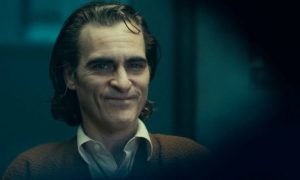 The movie does pick up a momentum when Arthur starts to get set on his way toward becoming the clown prince of crime. When the Joker gets his first taste of violence, in self-defense, the clown vigilante becomes a symbol for a reactionary contingent of Gotham’s lower classes. The groundswell of support provides a welcomed sense of community for a man who has been secluded for his idiosyncrasies, but it’s a celebration of a loss of morality, and so to fully embrace this tide of supporters he must give away the last of vestiges of his soul. This downfall allows for the movie to feel like it’s finally committed to something, where the setups are finally starting to coalesce around a character who is now driving his story rather than being the recipient of misfortune. The violence becomes more shocking and Arthur stops caring about hiding who he really is, and that’s when the movie becomes the full force it had been promising. I was tapping nervously throughout the final thirty minutes because I was anticipating bad things for anybody on screen. Phillips can use this anxious anticipation for unexpected comedy too, like where a character was trapped due to their unique circumstances and whether they too were in mortal peril. I wish Phillips had pulled back because there’s a perfect visual to conclude his movie, that brings the entire self-actualization and loss of morality full circle, and yet the movie gives us another two-minute coda.
Joker certainly feels like Phillips’ version of a Scorsese movie, for better and for worse. If you’re going to imitate anyone, it might as well be one of the greatest living filmmakers whose crime dramas have reshaped the very language of the movies and how we view violent crooks. The go-to response I’ve seen is that Joker is a combination of Taxi Driver and The King of Comedy. I’ll readily agree with the Taxi Driver comparisons. It’s everywhere. We have a disaffected loner who is turning sour on an increasingly hostile and unstable society he views as beyond repair. Even the shot selections, camera movements, and 1970s era set design evoke that influence. The King of Comedy is more a facile comparison, as Arthur is a disturbed man trying his luck at standup comedy, failing, and becoming more unhinged. The real reason reviewers seem to be making this connection is the inclusion of Robert De Niro, and it feels like that is the only reason he’s actually involved, to ping back to King of Comedy. The idea of a stiff actor like De Niro being a glib talk show host, even in the 1970s, seems like a bad fit. The other real film influence I don’t see getting as much recognition is Network. This is a tale of one man tapping into a vent of anger and starting a movement that ripples out beyond them into something uncontrollable.
 Phillips is best known for his comedy work but I could feel his leaning to do a straight genre picture. In other reviews, I’ve cited Phillips’ keen eye for noir-flavored visuals (think of the car traveling across the desert as seen through the reflection of sunglasses in The Hangover). He had the chops to tell a straight genre crime thriller, so it’s not surprising that Joker is a slickly made, unsettling, and effective movie when it counts. This is a grimy-looking New York City, I mean Gotham City, where the garbage piles high (another not so subtle visual metaphor) and the city feels like a maze all its own crushing our main character. The cinematography is great with several strong moments that amplify the mood of unrest and distaste. The crafty costumes by Mark Bridges (Phantom Thread) lend to the overall authenticity of the period. The cello-heavy score by Hidur Guonadottir (HBO’s Chernobyl) is very evocative and ominously conveys the turmoil bubbling below the surface in a manner that doesn’t feel like pandering. This is a good-looking production made by talented technicians and Phillips has enough skill to pull it all together, even if that aim is really to recreate a style of another filmmaker and the time and place of his films.
I’ve purposely saved the best for last, and that’s Phoenix as the titular character. He is mesmerizing as a broken man trying to find his place in society and flailing wildly. His uncontrollable cackling is so unsettling that when he broke into laughing fits, I could feel myself getting more and more unnerved. At first it was the awkward sympathy of watching a man struggle to get through his disability, trying to compose himself, and embarrassed for the discomfort he was projecting. The very sound of the cackling trying to be contained, as a friend and co-worker Jason credited, watching the laughter catch in his throat, it had such an immediate, almost physical reaction in me. Later in the movie, I cringed because it made me worry what was going to happen next because I know it’s a precursor to bad feelings. When he’s becoming more comfortable with his impulses and dark thoughts, you notice the cackling starts to ebb away. There’s a small moment that I loved where after he flees from his first murder he runs into a bathroom, and once his breathing calms, it’s almost like his body is commanded by some spiritual serenity as he begins to dance. Phillips allows the scene to breathe and play out, to invite the audience to join. This little motif probably appears a few too many times, but it’s a beautiful little moment of physicality that expresses the chaos becoming harmony within a man. Phoenix lost 50 pounds for the role and his gaunt, haunted frame reminds you how much of a shell of a human being this character feels like. He even tells his therapist that he questioned whether he was even a person or not. Phoenix burrows deep into the character and unleashes a committed intensity that is impressively communicated through his sad, reedy, sing-songy voice, his slippery stances and body language, and the madness that seems to resonate from his bulging eyes. Even when the movie is repeating its steps and tricks, it’s Phoenix that constantly gives back to the audience. It’s a performance certainly worthy of Oscar attention and plaudits, though in my mind it’s still a step or two below the instantly iconic, and Oscar-winning, performance from Heath Ledger.
 Joker is a movie and should not be held responsible for the actions of others and what they may read from the film. I don’t sense Phillips and his team condoning their protagonist’s lawless actions, and the violence is often undercut so that it feels more disturbing than triumphant and exhilarating. When Arthur does get his first kill, the audience has likely been silently rooting for him to fight back, to punish the wrongdoers, but the movie draws out the scene in a manner that’s akin to a wounded animal panicking as it scrambles for its life and a cold execution. It’s not meant to be cool. Phoenix’s performance elevates the entire enterprise and will unnerve as much as it ensnares. It’s not a subtle movie at all, and it hugs the works of Scorsese a little too closely, both in tone as well as visual symmetry. It’s trying very hard to be nihilistic, edgy, and provocative (this isn’t your “normal comic book movie” it wants to scream with every frame). Arthur just wanted to make people laugh, the movie tells us, but the joke was on him after all (subtlety). If anyone is inspired from this movie, I hope it’s to seek out other Scorsese movies.
Nate’s Grade: B
Share this:

Judy (2019)
 The real reason to watch Judy is the triumphant, blazing return of Renee Zellweger as the talent we’ve known her to be as an actress. She’s faded from the spotlight over the last decade, gotten a controversial face lift, and spent over a year prepping to play the role of the legendary Judy Garland during a 1969 British tour, what would prove to be the last months of her life. Zellweger disappears into the character, astonishingly recreating the mannerisms, posture, and vocal cadences of the famous Old Hollywood Wizard of Oz star. She’s tremendous and while clearly troubled and weathered, the film takes a remarkably sympathetic approach to its subject. Garland’s present-day alcoholism, pill popping, and narcissism can trace their roots to her young days as a teenage studio star where the powers that be, namely studio honcho Louis B. Mayer, would bully her, harass her, and molest her. The exploitation mechanisms of Old Hollywood made me wish that Judy was a more unconventional biopic, blending the past and present into a daring, metaphorical journey over the rainbow of a woman in the spotlight her entire life. Instead, we’re watching Garland stumble onto the stage, struggle to sleep and perform, and live a sad existence where she can be reminded, just every so often, the impact she can have, like a sweet impromptu home visit with a gay couple that is a miracle of tiny kindnesses. There’s not much plot here as the film, too, stumbles and shambles to its finale, with very little attention given to the supporting characters. Her whirlwind romance with a younger man (Finn Wittrock) fails to ignite much insight, and he’s named Mickey, so I was confusing him as an adult Mickey Rooney, who appears onscreen in flashbacks and was Judy’s first love (she asked if they were dating and Rooney said he would have to check with Mayer — every woman’s dream). Watching the movie made me feel like there was a stronger version of this story begging to be told. Regardless, Judy is a well made if conventional biopic with a real razzle-dazzle performance from Zellweger, who stunned me with her final singing number and the longing, remorseful, melancholy emotions she was able to dredge. Judy will be best remembered for her performance alone and that’s perfectly right.
Nate’s Grade: B
Share this:

Once Upon a Time… in Hollywood (2019)

Quentin Tarantino has been playing in the realm of genre filmmaking for much of the last twenty years. He’s made highly artful, Oscar-winning variations on B-movies and grindhouse exploitation pictures. There are some film fans that wished he would return to the time of the 90s where he was telling more personal, grounded stories. His ninth movie, Once Upon a Time… in Hollywood, is Tarantino returning to the landscape of his youth, the Hollywood back lots and television serials that gave birth to his budding imagination. Tarantino has said this is his most personal film and it’s easy to see as a love letter to his influences. It’s going to be a divisive movie with likely as many moviegoers finding it boring as others find it spellbinding.
In February 1969, actor Rick Dalton (Leonardo DiCaprio) is struggling to recapture his past glory as a popular TV star from a decade prior. Cliff Booth (Brad Pitt) is Rick’s longtime stuntman, personal driver, and possibly only real friend. Rick’s next-door neighbor happens to be Sharon Tate (Margot Robbie), a rising star and the wife to famed director Roman Polanski. All three are on a collision course with the Manson family.
 The thing you must know before embarking into a theater to see all of the 160 minutes of Tarantino’s latest opus is that it’s the least plot-driven of all his movies, and it’s also in the least hurry. This feels like a hang-out movie through Tarantino’s memories of an older Hollywood that he grew up relishing. It’s very much a loving homage to the people who filled his head with dreams, with specific affection given to the life of an actor. Tarantino is exploring three different points of an actor’s journey through fame; Sharon Tate is the in-bloom star highly in demand, Rick Dalton is the one who has tasted fame but is hanging on as tightly as he can to his past image and wondering if he’s hit has-been status, and then there’s Cliff Booth who was a never-was, a replaceable man happy to be behind the scenes and who has met his lot in life with a Zen-like acceptance. Each character is at a different stage of the rise-and-fall trajectory of Hollywood fame and yet they remain there. This isn’t a movie where Rick starts in the dumps and turns his life around, or even where it goes from worse to worse. Each character kind of remains in a stasis, which will likely drive many people mad. It will feel like nothing of import is happening and that Once Upon a Time… in Hollywood is more a collection of scenes than a whole.
What elevated the film was how much I enjoyed hanging out with these characters. Tarantino is such a strong storyteller that even when he’s just noodling around there are pleasures to be had. Tarantino movies have always favored a vignette approach, unwieldy scenes that serve as little mini movies with their own beginnings, middles, and often violently climactic ends. An excellent example of this is 2009’s Inglourious Basterds where the moments are brilliantly staged and developed while also serving to push the larger narrative forward. That’s missing with Hollywood, the sense of momentum with the characters. We’re spending time and getting to know them, watching them through various tasks and adventures over the course of two days on sets, at home, and on a former film set-turned-ranch for a strange commune. If you’re not enjoying the characters, there won’t be as much for you as a viewer, and I accept that. None of the central trio will crack Tarantino’s list for top characters, but each provides a different viewpoint in a different facet of the industry, though Sharon Tate is underutilized (more on that below). It’s a bit of glorified navel-gazing for Tarantino’s ode to Hollywood nostalgia. There are several inserts that simply exist to serve as silly inclusions that seem to be scratching a personal itch for the director, less the story. I was smiling at most and enjoyed the time because it felt like Tarantino’s affection translated from the screen. I enjoyed hanging out with these people as they explored the Hollywood of yesteryear.
 DiCaprio hasn’t been in a movie since winning an Oscar for 2015’s The Revenant and he has been missed. His character is in a very vulnerable place as he’s slipping from the radars of producers and casting agents, filling a string of TV guest appearances as heavies to be bested by the new hero. He’s self-loathing, insecure, boastful, and struggling to reconcile what he may have permanently lost. Has he missed his moment? Is his time in the spotlight eclipsed? There’s a new breed of actors emerging, typified by a little girl who chooses to stay in character in between filming. Everything is about status, gaining it or losing it, and Rick is desperate. There’s a terrific stretch where he’s playing another heavy on another TV Western and you get the highs and lows, from him struggling to remember his lines and being ashamed by the embarrassment of his shaky professionalism, to showing off the talent he still has, if only given the right opportunity. DiCaprio is highly entertaining as he sputters and soars.
The real star of the film is Pitt (The Big Short) playing a man who seems at supernatural ease no matter the circumstance. He’s got that unforced swagger of a man content with his life. He enjoys driving Rick around and providing support to his longtime friend and collaborator. He has a shady past where he may or may not have killed his wife on purpose, but regardless apparently he “got away with it.” This sinister back-story doesn’t seem to jibe with the persona we see onscreen, and maybe that’s the point, or maybe it’s merely a means to rouse suspicion whether he may become persuaded by the Manson family he visits later in the movie dropping off a hitchhiker he’s encountered all day long. The role of Cliff seems to coast on movie star cool. There is supreme enjoyment just watching Pitt be. Watch him feed his dog to a trained routine, watch him fix a broken TV antenna and show off his ageless abs, and watch him navigate trepidatious new territory even as others are trying to intimidate him. It’s Pitt’s movie as far as I’m concerned. He was the only character I felt nervous about when minimal danger presented itself. There’s something to be said that the best character is the unsung one meant to take the falls for others, the kind of back-breaking work that often goes unnoticed and unheralded to keep the movie illusion alive.
There aren’t that many surprises with Once Upon a Time… in Hollywood as it moseys at its own loping pace. It reminded me of a Robert Altman movie or even a Richard Linklater film. It’s definitely different from Tarantino’s more genre-fed excursions of the twenty-first century. It’s a softer movie without the undercurrent of malice and looming violence. There is the Manson family and Tarantino knows our knowledge of the Manson family so we’re waiting for their return and that fateful night in August, 1969 like a ticking clock. It wouldn’t be a Tarantino movie without an explosion of bloody violence as its climax, and he delivers again, but I was shocked how uproariously funny I found the ending. I laughed throughout but as the movie reached its conclusion I was doubled over with laughter and clapping along. There’s a flashback where Cliff and a young Bruce Lee challenge each other to a fight, and it’s so richly entertaining. The phony film clips are also a consistent hoot, especially when Rick goes to Italy. It’s a funnier movie than advertised and, despite its ending, a far less violent movie than his reputation.
 As Tarantino’s memory collection, the level of loving homage can start to eat the narrative, and this is most noticeable with the handling of Sharon Tate. The initial worries that Tarantino would exploit the horrendous Manson murders for his own neo-pop pulp was unfounded. Tate is portrayed with empathy and compassion, and as played by Robbie she nearly glides through the film as if she were an angel gracing the rest of us unfortunate specimens. She has a great moment where she enters a movie theater playing a comedy she is a supporting player in. The camera focuses on Robbie’s (I,Tonya) face as an array of micro expressions flash as she takes in the approving laughter of the crowd. It’s a heartwarming moment. But all of that doesn’t make Tate a character. She’s more a symbol of promise, a young starlet with the world at her fingertips, the beginning phase of fame. Even the Manson clan doesn’t play much significance until the final act. Charles Manson is only witnessed in one fleeting scene. I thought Tarantino was including Tate in order to right a historical wrong and empower a victim into a champion, and that doesn’t quite happen. I won’t say further than that though her narrative significance is anticlimactic. You could have easily cut Sharon Tate completely out of this movie and not affected it much at all. In fact, given the 160-minute running time, that might have been a good idea. The movie never really comes to much of something, whether it’s a statement, whether it’s a definitive end, it just feels like we’ve run out of stories rather than crafted an ending that was fated to arrive given the preceding events.
The Tarantino foot fetish joke has long been an obvious and hacky criticism that I find too many people reach for to seem edgy or clever, so I haven’t mentioned it in other reviews. He does feature feet in his films but they’ve had purpose before, from arguing over the exact implications of a foot rub in Pulp Fiction to Uma Thurman commanding her big toe to wiggle and break years of entropy in Kill Bill. However, with Hollywood, it feels like Tarantino is now trolling his detractors. There are three separate sequences featuring women’s feet, two of which just casually place them right in the camera lens. At this point in his career, I know he knows this lame critique, and I feel like this is his response. It’s facetious feet displays.
 When it comes to Once Upon a Time… in Hollywood, if you’re not digging the vibe, man, then there’s less to latch onto as an audience member. It’s a definite hang-out movie reminiscent of Altman or Linklater where we watch characters go about their lives, providing peaks into a different world. It’s a movie about meandering but I always found it interesting or had faith that was rewarded by Tarantino. It doesn’t just feel like empty nostalgia masquerading as a movie. It’s funnier and more appealing than I thought it would be, and even though it’s 160 minutes it didn’t feel long. The acting by DiCaprio and Pitt is great, as is the general large ensemble featuring lots of familiar faces from Tarantino’s catalogue. I do think the inclusion of Sharon Tate serves more of a symbolic purpose than a narrative purpose and wish the movie had given her more to do or even illuminated her more as a character. However, the buddy film we get between DiCaprio and Pitt is plenty entertaining. It might not be as narratively ambitious or intricate or even as satisfying as Tarantino’s other works, but Once Upon a Time… in Hollywood is a fable for a Hollywood that may have only existed in Tarantino’s mind, but he’s recreated it with uncompromising affection.
Nate’s Grade: B+
Share this:

Never Look Away (2018)
 This is only the second film for writer/director Florian Henckel von Donnersmarck since his 2006 Oscar-winning masterpiece, The Lives of Others. Seeing his name attached to any movie was enough to secure my ticket. Going back to his native language, the director traces the life of a young, daring Dresden artist, loosely based on Gerhard Richter, trying to find his sense of self and truth from the reign of the Nazis to the GDR under Soviet influence. It’s a sprawling yet intimate human drama that has a full range of emotions, from the swooping romance to the heartbreak. It balances many emotions and tones as it presents a rich portrait of a young man’s life set across a fascinating backdrop. His free-spirited aunt, an inspirational figure, is abducted due to her schizophrenia and ultimately sentenced to death by an SS-enabling doctor (Sebastian Koch). This gets even more complicated when he goes to college and starts secretly dating the daughter… of that very same doctor, now being protected by a high-ranking Soviet official he aided. The simple strokes of a love story, or the disapproving father trying to destroy their love story, or the efforts of the family post-war to find some foothold in a new East Germany, it all adds up to a deeply felt and deeply alluring human drama with plenty of breathing room. The length (3 hours 8 minutes) gets to be unwieldy, especially during the third hour when we visit our second art school education. It’s just less generally captivating to watch a guy try and find his artistic voice when his life has all this other potent drama afoot, and that’s even after the lingering fallout from a forced abortion and hidden Nazi searches. Never Look Away is compelling, compassionate, thoughtful, and a tad too long for its own good. Hopefully the director doesn’t take another long eight years for a follow-up (please!).
Nate’s Grade: B+


 nathanzoebl
You must be logged in to post a comment.