Blog Archives
The Ice Harvest (2005)
 Imagine my surprise when I found out that a small crime novel I read years ago was getting the big Hollywood treatment. I read Scott Phillips’ The Ice Storm in one sitting back in 2003 during a plane trip from Ohio to San Diego. It was deliciously dark down to the very last page and I loved it, but then I am a sucker for a good crime story (check out Jason Starr’s Tough Luck and Hard Feelings if you are the same). The movie looked to be on the right track with names like John Cusack to star and Harold Ramis to direct. Ramis is responsible for starring, writing, or acting in or directing some of the most beloved comedies of the last 25 years including Ghostbusters, Groundhog Day, Stripes, and National Lampoon’s Vacation. That’s one illustrious comedic pedigree. So how could the movie go wrong?
It’s Christmas Eve and Charlie Arglist (John Cusack) is a self-loathing attorney that works for some of the shadiest folks in Wichita, Kansas. One of those bad customers is mob boss Bill Guerrard (Randy Quaid) whom Charlie and his partner Vic (Billy Bob Thornton) have just swindled over $2 million from. Unfortunately for them, Wichita is hit by an ice storm that makes the roads haphazard to travel. The two will wait until the morning thaw and then hit the road with their booty. Vic reassures Charlie to just, “act normal.” This means many ventures to some of Wichita’s finest strip clubs with alluring names like Sweet Cage and Tease-O-Rama. Charlie has a sweet spot for Renatta (Connie Nielsen), a bombshell and the operator of the Sweet Cage. He’ll also have to drive his plastered friend Phil (Oliver Platt) around, who is regretting having married Charlie’s cold ex-wife. Charlie would love to sail off into the sunset with Renatta by his side but first he’ll have to survive the night and a mob enforcer (Mike Starr) is already on his trail.
 The Ice Harvest feels like an episodic collection of ideas, too many of which have too little significance. The titular ice storm seems all but forgotten, only serving as a cheap plot device to keep our characters bottled up in the city. It has no bearing elsewhere on the plot. The reoccurring “As Wichita falls” passage has no payoff. The nosy police officer plotline looks like it might be building to something important but then is quickly disposed of. The Christmas setting has little impact except for giving the strippers something to complain about. The Ice Harvest wants to benefit from the juxtaposition of Christmas cheer with all these tawdry, violent asides and it just seems small and shallow. The movie also shifts the story’s time from 1979 to modern day one suspects just for the cheap out of cell phones.
Credit goes to Cusack for making his character as likable as he is. His character is a mob lawyer, a deadbeat dad, an increasingly drunk driver, and a man with his nose in whole lot of sleazy ventures, and yet you still pull for him to somehow succeed. Cusack, forever youthful, seems overly numb to all the horror around him and downplays the danger to a negative degree. Charlie seems like he’s in the wrong movie. Thornton plays yet another hedonistic louse and is quite good though not at his Bad Santa apex. He seems the most at ease with the physical comedy. Nielsen plays your typical femme fatale with a Veronica Lake haircut and breezy voice, which should both be instant red flags for students of film noir. The two men that steal the show are Platt and Quaid. Platt gives a brilliant uninhibited performance as quite possibly the drunkest man in movie history. Quaid is an honest surprise as a menacing mobster ruing the day he chose a criminal enterprise in Kansas. He chomps scenery with a violent exasperation that truly seems larger than life. This is a bad guy to fear and Quaid makes the most of his very limited screen time.
Ramis is out of his league here. The man cannot competently direct tension or action. Ramis doesn’t let the audience build suspicion because he’d much rather have characters just point-blank say, “Don’t trust this person” instead. He doesn’t give us time to piece clues of betrayal together so instead characters just keep running forward until they get smacked in the face by something made obvious. Ramis’ mishandling of tone really sinks the movie. The Ice Harvest doesn’t know whether it wants to be a thriller of a dark comedy and therefore just really sputters at both. The comedic elements and the thriller elements butt heads; because of the comedy the character never feel in danger, and because of the thriller/noir elements the characters and their situations never really seem funny. The Ice Harvest turns into some kind of two-headed beast that snaps at itself. I think maybe Ramis was watching Blood Simple and taking notes and then he accidentally taped over it with a Charles in Charge marathon and was at a loss.
P art of this problem is that the screenwriters don’t fully commit to the nastiness. Phillips’ novel is unrelentingly dark, cynical, and unsentimental and doesn’t give a damn if you like its characters. The movie, on the other hand, wants to get its hands dirty but is more interested in playing it safe. The film seriously reminded me of last year’s Surviving Christmas, another movie that wanted to be sweet and nasty and wound up just being really bad. You can feel The Ice Harvest reeling back several times to set up Charlie as a likable lad in over his head, going so far as a slightly contrived yet predictable finale. At least Bad Santa had the gusto to approach a happy ending on its own crude, unsentimental terms. Ramis needs to stick to broad comedies and leave the bleak neo-noir humor to the Coen brothers.
There are some plot elements from the book that just don?t work with this half-hearted adaptation. (Spoilers to follow for paragraph) At the very end of the movie Charlie has left the city with all the money and stops along the road to help a stalled camper. In the book, the camper backs up over him and kills him, thus ending with the ringing endorsement that crime doesn’t pay. It made sense, especially for a book that was dark to the very end. In the movie, the camper backs up and knocks him to the ground but doesn’t run him over. Charlie dusts himself off and that’s that. The scene feels pointless without fulfilling the end of the book. It doesn’t provide any last-second tension. Charlie just hops back in his car, dear hung over Phil pops up, and the two are set for one most excellent adventure. Unearned and misplaced happy ending? No thank you.
The Ice Harvest is only a mere 88 minutes long and yet the film still feels padded and draggy. The drunken Oliver Platt-heavy middle is a generously paced muddle, and though it’s rather funny it’s also rather extraneous. The Ice Harvest is really a handful of great moments that don?t add up to a satisfying whole. The movie is really episodic and too many of those episodes have little bearing on the plot. Character betrayals are spelled out to us and Ramis seems to lose interest in his own film as it slides further and further into dangerous territory. The Ice Harvest can’t commit to whatever it wants to be and the audience is the one to suffer. Read the book instead. It’s only 224 pages.
Nate’s Grade: C
Share this:

Derailed (2005)
 The Chicago train company featured in Derailed is regretting their involvement. It seems that this year a Metro train did in fact derail and a number of people died and scores more were injured. I suppose this would be akin to Enron being featured in a movie called Big Fat Lying Energy Thieves. Then again, maybe one of the company’s execs took a look at the script.
Charles (Clive Owen) is an ad ex who feels crushed by his life. His marriage is deteriorating, his adolescent daughter has a severe case of diabetes and is in need of a new kidney, and he’s been booted from a project at work. All he needs now is the film favorite car to drive in front of him and splash water. On a train ride to work, he’s helped by Lucinda (Jennifer Aniston), a dark beauty Charles can’t seem to resist. They share pictures of their kids, accounts of their spouses, and their saliva with some open-mouthed kissing. Both are conflicted about following through with an affair, but finally decide to act. They get a room at a motel, roll around on the bed, but are interrupted by a French intruder named Laroce (Vincent Cassel). He robs them, beats Charles into submission, and rapes Lucinda. She doesn’t want to go the cops and just wants the nightmare to end. If her husband ever finds out about the almost-affair she’ll never see her kid again. Charles adjusts but is now getting threatening phone calls, asking for increasingly large sums of money or else his wife will know the truth.
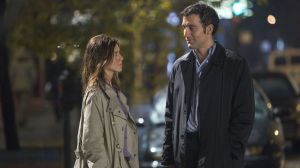 This is your prototypical thriller that survives due to the stupidity of its characters. Only in your rote thriller would characters ever dare to go about their infidelity in a seedy motel, leave the door unlocked, and then after being beaten, robbed, and raped, not go to the police. Only in your by-the-book thriller would the assailant return to implausibly blackmail our leads for money under the threat of exposing their affair. Only in your standard thriller would a character actually say, “It’s all over now. We’re safe. Everything’s fine,” without a hint of irony. It’s like these people had never seen a movie before. The villains are not exempt either. They repeat their scam at the exact same locations in the exact same manner, meaning anyone with a decent memory could trip up this criminal masterwork. (Spoilers follow) Like the preposterous Flightplan, this elaborate scheme to make money hinges on some pretty big assumptions: 1) that Charles will never go to the police at any turn, even when the other option involves draining $100,000 out of his own kid’s kidney fund, and 2) that Charles would never drop by Lucinda’s work and talk to anyone who remotely knew her. I just thought of another one: 3) that Charles would never question why they’re only blackmailing him for money when Lucinda has a higher paying job and much more at stake to lose (end spoilers). Derailed is too true of a title when it comes to the movie’s process of logic. Then again, thrillers typically spit in the face of logic and this is no different.
Derailed would like to strike the same vein that Fatal Attraction hit so well; in fact, there’s a scene in the middle that’s a direct rip-off where Charles rushes home to find his wife chatting with his antagonist. The first half-hour of Derailed is well done and pretty interesting, but the film really goes off the tracks when the blackmail plot starts mounting ridiculous, implausible plot turns. This film would have been so much better as a straightforward drama than a dime-a-dozen thriller. As a drama we’d witness Charles wrestle with guilt, the decision of whether not to tell his wife, and the moral quandary of wondering if their attack was somehow justified as a punishment (no, rape is NEVER justified). It could be a really strong character study. Derailed goes the far more conventional route and brings in an outside force of antagonism and some foreseeable twists.
Clive Owen is wasted in a role that mostly requires that he get his ass handed to him. He’s a fantastic actor, a natural badass, and he just smolders with charisma, menace, and intensity. He was one of the highlights of a stellar cast in Sin City and was my top candidate for the new James Bond. That’s why it’s so frustrating to see him beaten and bullied for almost the entire duration of the movie. For crying out loud, even a cop bullies him into paying a hooker he had nothing to do with. It reminds me of 2002’s Enough where Jennifer Lopez was beaten and antagonized for so long that the audience was practically feasting for blood. This might explain Derailed‘s tacked-on epilogue. Owen still gives a credible performance even though his accent slips from time to time.
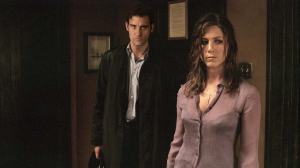 Despite what the marketing folks may have you believe, Jennifer Aniston is really a minor character in the film. I’m not that particularly taken with Aniston as an actress; I thought 2002’s The Good Girl could have been The Great Girl, or at least The Better Girl with a stronger lead. In Derailed you can tell she’s playing against type because her hair is darker. Aniston is effective at turns in Derailed, but really “at turns” is all she’s given to work with. This is Clive Owen’s movie.
Casell (Ocean’s Twelve) really relishes his creepy villain and can make your hair stand on edge. Xzibit pimps no rides but also does little to pimp his role, becoming nothing more than a gruff thug. Fellow rapper RZA (is it possible to spell that wrong?), in comparison, imbues Winston with a stronger personality than the meager role deserved. It’s also very convenient for a bourgeoisie white male to have a black mail room friend (with a criminal record, of course Hollywood) to fall back on when trouble strikes. Fans of TV’s Alias will recognize Owen’s wife played by Melissa George and instantly hate her. I should know, I watched Derailed with an Alias fan and she still hasn’t forgiven George for coming between Sydney and Vaughn.
It’s not that Derailed is particularly terrible, it’s just rather ordinary, predictable, and at turns lurid and trashy. Owen is wasted as a wimpy man with a guilty conscience that gets beaten and bullied for ¾ of a movie. There are worse ways to spend an afternoon at the movies and fans of the thriller genre should be relatively satisfied. Derailed isn’t a movie you’ll hate yourself in the morning over seeing, but then again it’s nothing too special. You could probably turn on TV right now and catch 3 or 4 thrillers with the same plot and similar twists. You could also watch Friends. Just go watch TV instead of seeing Derailed. Something’s got to be on. In a couple years it’ll be Derailed.
Nate’s Grade: C
Share this:

Kiss Kiss, Bang Bang (2005)
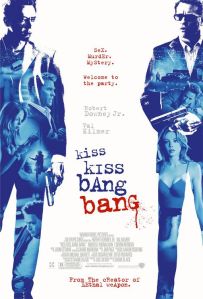 Shane Black was a Hollywood icon by the time he was in his early 20s. In 1987 he sold a script called Lethal Weapon to producer Joel Silver that put a jolt back into action flicks and gave the template for all buddy-cop comedies to come. He earned a then-record $1.7 million for his script, The Last Boy Scout, topped later by the $2 million paycheck he got for The Long Kiss Goodnight. It’s a shame both scripts were marginalized by their film directors. Black went underground for a long time, nursing his wounds over what had happened to his screenplays. Then in 2004, Black began his comeback vehicle, a modern day detective story that also lampooned Hollywood, and this time he’d direct his own material. The final product is called Kiss Kiss, Bang Bang, and Black’s comeback film is nothing short of a cinematic knockout and the most refreshingly entertaining movie of all 2005.
Harry Lockhart (Robert Downey Jr.) is a small-time crook on the run from the cops when he stumbles into an acting audition. They hand him a script, tell him his partner’s dead, and are so impressed with his “acting” that he’s immediately flown to Hollywood. Harry is teamed up with Gay Perry (Val Kilmer), a cop who does advisory work and just happens to be gay. During a house party, Harry reunites with a childhood friend, Harmony Faith Lane (Michelle Monaghan). They reminisce about their childhoods in Indiana and their fascination with the Johnny Gossamer detective novels, but she has much more on her mind: her sister’s gone missing and she needs Harry to find her. Trouble is Harry hasn’t told her he’s not a real detective. He’s gone from crook to pretend actor to pretend detective, and before Christmas is over he’ll be up to his neck in bodies, intrigue, double-crosses and all the stuff that would make for a rip-roaring Johnny Gossamer book.
 First and foremost, Kiss Kiss, Bang Bang is one deliriously fun party. The film moves at breakneck speed through its smart, cheeky gags. Black’s dialogue is hilarious and feels so effortlessly natural coming from Downey Jr. and Kilmer, like he’s got their speech patterns tattooed in his brain. In fact, the dialogue feels so robust and natural, never glib and self-conscious, that it almost comes across as feeling like a heavy improv session between two immensely talented actors. Kiss Kiss, Bang Bang, Black’s opus to the hard-boiled detective genre, has more twists and turns than a seizure patient doing the Hokey Pokey. You never know where this movie will head next or what joke will topple you over with unexpected laughter, and that’s what makes Kiss Kiss, Bang Bang so unabashedly thrilling to watch. Even when the movie does start to veer into more conventional material, Downey Jr. is there as our narrator to point out what we’re all thinking and to make fun of the expected. Kiss Kiss, Bang Bang can get jubilantly perverse at parts (a corpse getting a golden shower), but the macabre touches never deflect from the film’s boundless, inconsumable energy. Everyone is having the time of their lives in Black’s comic caper, and it shows.
Seriously, this movie is the definition of a laugh riot. It’s like a carnival ride through a gag factory (that sounds kind of spooky, actually), and Black has such an assured confidence to his writing, evidenced in his set-ups, reversals, and the insightful tweaking of Hollywood that could only come from one of its own (Harry laments that the nation turned over and shook and all the normal girls hung on while the crazies landed in L.A.). Here’s a conversation between Harmony and Harry about a promiscuous actress:
Harmony: Well, for starters, she’s been f***ed more times than she’s had a hot meal.
Harry: Yeah, I heard about that. It was neck-and-neck and then she skipped lunch.
Just re-reading it makes me laugh. How many comedies make you laugh just thinking about them in retrospect? Kiss Kiss, Bang Bang is one of those oh so rare delights. It even has a talking bear in it!
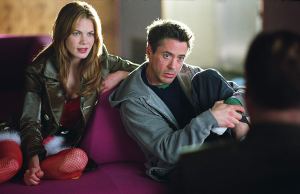 The lone detraction for Kiss Kiss, Bang Bang is the movie’s overall lack of substance. It doesn’t reach for anything more than bold entertainment, and to that end it succeeds in spades. Some may argue the movie is spinning so fast to try and distract you from its empty center, but I say enjoy the ride while it lasts. I only wish this movie was longer, like Lord of the Rings-long. I did not want to leave this world and these characters. My claw marks might still be visible on the armrests where they had to throw me out.
Black also proves to be a very slick director with a natural eye for camera placement. His photography is very pleasing, relying on different light placements to add surreal touches that accentuate the narrative. Black keeps his movie at a breathless pace and knows how to handle his actors. His narrative side-steps enliven the film and grab our attention, and Harry’s voice over is never overused to explain the minutia the script cannot. The only drawback for Black might be that his film could be too smart for its own good. I mean, most of the movie going public will be stooped by a joke about adverbs. Black has an obvious love for detective yarns and film noir, that’s evident with the film’s style and the fact that chapter titles are Raymond Chandler novels, but some familiarity with this world will sharpen your experience. Kiss Kiss, Bang Bang never panders to its audience, and that may hurt Black as far as making a movie that will reach out to Middle America (Perry apologizes to the Midwest for using the “f-bomb” as often as they do).
The chemistry between Downey Jr. and Kilmer is incredible, positioning them as one of the finest comic pairings in recent cinema history. Their indelible camaraderie is the true heart of Kiss Kiss, Bang Bang. They bat insults and injuries with comic aplomb. Both characters are unapologetic, Harry as a nattering criminal screw-up way in over his head, and Perry as gay man who’s fine with that and will rip your testicles off just the same if you cross him. He’s not stereotypical swishy or flamboyant, but he’s very enjoyably dry and sarcastic. Both actors have a history of being troublesome to work with, but Downey Jr. and Kilmer have been two of our most amazingly talented actors … when they want to be. Kilmer is the coolest customer in the film, being nonchalantly badass even when he’s about to blow his top (this is NOT a gay joke, by the way). Downey Jr. is his usual charming, amiable, fast-talking self, but even his tiniest details speak comedic volumes, like his reactions and general awkward physicality. I cannot imagine anyone else doing as excellent a job in these roles, especially Harrison Ford who was sought by producers for the Gay Perry part (feel free to shudder at what might have been Hollywood Homicide 2.
 Monaghan is a break-out actress that could have been even more break-out-er by this time. She’s mostly had small unmemorable roles in films like Unfaithful and The Bourne Supremacy, but 2005 was set to be her year. She had roles in Constantine, Mr. and Mrs. Smith, and Syriana. Unfortunately, her scenes were cut from Syriana and Constantine, and her role was drastically pared down in Mr. and Mrs. Smith. The only thing Monaghan has to show for 2005 is Kiss Kiss, Bang Bang, and that’s all she’ll need. She’s bright and pretty, but she also gives Harmony a great sense of being run down, another girl getting off the bus to Hollywood with stars in her eyes only to find out the harsh reality. Her combative relationship with Harry as they reconnect and try and wonder how they went astray is another film high point. She’s a comedic asset and should be on Hollywood’s speed dial if they need a charming, funny, capable actress.
Kiss Kiss, Bang Bang is a wicked good time. It’s complex, twisting, riveting, unique, hilarious, and just about every synonym you can think for the word “awesome.” Black’s comeback may be too smart for its own good, and having a general understanding of film noir will enhance your experience, but this is one comic caper that’s so much fun, so stylish, so damned entertaining, who cares if it lacks substance? Kiss Kiss, Bang Bang is a refreshing blast of fresh air and should please anyone looking for a smart Hollywood film mixed with doses of their familiar sex and violence. But that’s what makes Kiss Kiss, Bang Bang so exhilarating, nothing about it could be classified as familiar. Seeing this flick is like being invited to the party of the year. Just make sure to head to your theater before your invitation gets lost in the mail.
Nate’s Grade: A
Share this:

Sin City (2005)
 Like film noir on steroids. Director Robert Rodriguez has made the most faithful comics adaptation ever; giving life to Frank Miller’s striking black and white art. The visuals are sumptuous but the storytelling is just as involving, a perfect mix of noir/detective elements and subversive, highly memorable characters. Sin City may be the most violent studio film … ever, but the over-the-top tone keeps the proceedings from becoming too nauseating, even after limbs are lost, heads roll (and talk), and dogs pick away at living bodies. This is a very ball-unfriendly movie; lots of castrations. The blood even looks like fluorescent bird crap. The stories become somewhat repetitious (anti-hero saves distressed woman), but Miller and Rodriguez keep their tales tight, pulpy, comic, and unpredictable. My friend turned to me after it was done and said, “That was a great movie.” I could not argue.
Nate’s Grade: B+
Share this:

The Man Who Wasn’t There (2001)
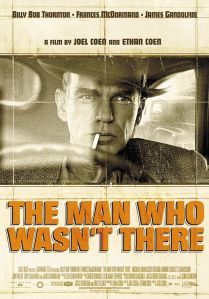 The Coen brothers dark, twisty entry to the world of film noir looks mind-blowing with its black and white lensing. And the story is great too. Billy Bob Thronton plays a barber who gives new definition to the word passive. One day a customer lets him in on an up-and-coming financial project and if Thronton were to provide some dough then surely he would rake it in. As with most film noir, the normal man is thus pulled into the web of intrigue and crime. The ball gets rolling after Thornton blackmails his wife’s tryst (James Gandolfini), who also happens to be her boss and his friend. Things get far more complicated from there and nothing seems to go right as Thornton makes one bad decision after another. The Man Who Wasn’t There is an engaging and smart drama with game bits of comedy strewn at key moments. The Coen brothers are a pair not very easily topped when it comes to excellence in films, and this latest entry is a wonderful addition to their resume.
Nate’s Grade: A-
Share this:

Mulholland Drive (2001)
 Mulholland Dr. has had a long and winding path to get to the state it is presented today. In the beginning it was 120 minutes of a pilot for ABC, though it was skimmed to 90 for the insertion of commercials. But ABC just didn’t seem to get it and declined to pick up David Lynch’s bizarre pilot. Contacted by the French producers of Lynch’s last film, The Straight Story, it was then financed to be a feature film. Lynch went about regathering his cast and filming an additional twenty minutes of material to be added to the 120-minute pilot. And now Mulholland Dr. has gone on to win the Best Director award at Cannes and Best Picture by the New York Film Critics Association.
Laura Harring plays a woman who survives a car crash one night. It appears just before a speeding car full of reckless teens collided into her limo she was intended to be bumped off. She stumbles across the dark streets of Hollywood and finds shelter in an empty apartment where she rests. Betty Elms (Naomi Watts) is a young girl that just got off the bus to sunny California with aspirations of being a big time movie star. She enters her aunt’s apartment to find a nude woman (Harring) in the shower. She tells Betty her name is Rita after glancing at a hanging poster of Rita Hayworth. Rita is suffering from amnesia and has no idea who she is, or for that fact, why her purse is full of thousands of dollars. Betty eagerly wants to help Rita discover who she is and they set off trying to unravel this mystery.
 Across town, young hotshot director Adam Kesher (Justin Theroux) is getting ready to go into production for his new film. He angers his mob producers by refusing to cast their chosen girl for his movie. After some harassment, threats, and a visit by an eyebrow-less cowboy assassin (God bless you David Lynch), he relents.
In the meanwhile, people are tracking the streets looking for Rita. Betty and Rita do some detective work and begin amassing clues to her true identify. As they plunge further into their investigation the two also plunge into the roles of lovers. Rita discovers a mysterious blue box and key in her possession. After a night out with Betty she decides to open it, and just when she does and the audience thinks it has a hold on the film, the camera zooms into the abyss of the box and our whole world is turned upside down.
David Lynch has made a meditation on dreams, for that is at the heart of Mulholland Dr. His direction is swift and careful and his writing is just as precise. The noir archetypes are doing battle with noir expectations. The lesbian love scenes could have been handled to look like late night Cinemax fluff, but instead Lynch’s finesse pays off in creating some truly erotic moments. Despite the population of espresso despising mobsters, wheelchair bound dwarfs, and role-reversal lesbians, the audience knows that it is in hands that they can trust. It’s Lynch back to his glorious incomprehensible roots.
Watts is the true breakthrough of Lynch’s casting and she will surely be seen in more films. Watts has to play many facets of possibly the same character, from starry-eyed perky Nancy Drew to a forceful and embittered lesbian lover.
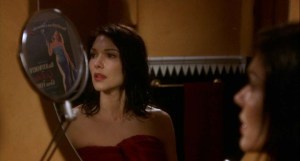 One scene stands out as a perfect example of the talent Watts possesses. Betty has just been shuffled off to an audition for a film and rehearsing with Rita all morning. She’s introduced to her leathery co-star and the directors await her to play out the audition scene of two kids and their forbidden love. As soon as the scene begins Betty vanishes and is totally inhabited by the spirit of her character. She speaks her lines in a breathy, yet whisper-like, voice running over with sensuality but also elements of power. In this moment the characters know, as the audience does, that Betty and Naomi Watts are born movie stars.
It’s not too difficult for a viewer to figure out what portions of the film are from the pilot and what were shot afterwards. I truly doubt if ABC’s standards and practices allows for lesbian sex. The pilot parts seem to have more sheen to them and simpler camera moves, nothing too fancy. The additional footage seems completely opposite and to great effect. Mulholland Dr. has many plot threads that go nowhere or are never touched upon again, most likely parts that were going to be reincorporated with the series.
The truly weirdest part of Mulholland Drive is that the film seems to be working best when it actually is still the pilot. The story is intriguing and one that earns its suspense, mystery, and humor that oozes from this noir heavy dreamscape. The additional twenty minutes of story could be successfully argued one of two ways. It could be said it’s there just to confound an audience and self-indulgent to the good story it abandons. It could also be argued that the ending is meticulously thought out and accentuates the 120 minutes before it with more thought and understanding.
Mulholland Dr. is a tale that would have made an intriguing ongoing television series complete with ripe characters and drama. However, as a movie it still exceeds in entertainment but seems more promising in a different venue.
Nate’s Grade: B
Reviewed 20 years later as part of the “Reviews Re-View: 2001” article.
Share this:

Memento (2001)
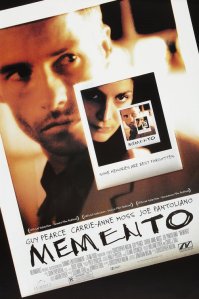 A film is taking the nation by storm and it isn’t anything from a big studio. In fact it’s the first release of a new indie production house called New Market, and these people have lassoed a real winner. Memento is a murder mystery bubbling with perfect elements of noir, suspense, and trickery. Memento is the tale of Leonard Shelby (Guy Pearce) who is searching desperately for John G., the culprit he believes that raped and murdered his wife. Along the way Leonard gets assistance from his friend Teddy (Joe Pantoliano) and Natalie (Carrie Anne-Moss), a down on her luck bartender.
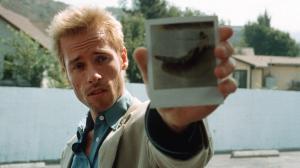 Except Leonard has a peculiar problem plaguing his one-man investigation for justice. After the attack on his wife the assailant knocked him out, and Leonard was left with no short-term memory whatsoever. Leonard cannot develop new memories. So if something happens to him, he is liable to immediately forget it within five minutes. To aid himself he write on small post-its telling him which car is his, what hotel he’s at, etc. all over his body are tattoos of clues he has amassed. He takes Polaroids of people and writes their names on them to remind him of the faces he sees that he won’t remember. Leonard’s investigation is about what his notes tell him. He doesn’t know whom he can trust and whom he cannot.
If this wasn’t enough to make Memento interesting the entire tale is told out of sequence and run from end to beginning. The entire film is told backwards. This action robs the audience of the same information that escapes Leonard. We too know neither who to trust. The effect could fall into gimmick territory but makes the movie fresh and adds for some great comic situations as well, like when Leonard awakens with a bottle of champagne in his hand and tells himself he doesn’t feel drunk.
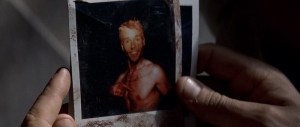 Pearce is gripping as the emotionally shattered and fractured Leonard. He is a man that can trust nothing and must live from repetition, but is intent on bringing his wife’s killer to bloody justice. Pantoliano and Moss provide good support as the weary characters that weave into Leonard’s plight. The acting it excellent all around. They leave us guessing and reassembling our perceptions as more of the puzzle unravels.
Memento is top-notch film noir. It’s a breathless thriller of a first rate caliber. The direction given by Christopher Nolan from his screenplay is tight and highly effective. The character of Leonard is fleshed out in all his paranoia, pain, and frustration. Nolan has delivered a gift to movie audiences always hungry for fresh material. One has to see the film a second time just to see how well the segments play together.
Memento is the coolest movie around. Rush out and see it, then see it again, and then again. It’s the best movie of 2001 by far as of now and has the Best Original Screenplay Oscar locked [Editor’s note: it lost to Gosford Park of all things.] It’s destined to be a cinematic classic people will talk about for years.
Nate’s Grade: A
Reviewed 20 years later as part of the “Reviews Re-View: 2001” article.


 nathanzoebl
You must be logged in to post a comment.