Blog Archives
Unknown (2011)
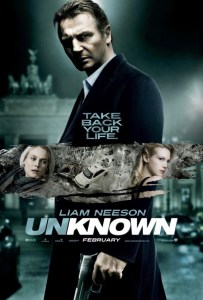 With Liam Neeson kicking ass in a European country, fighting a nefarious conspiracy, and trying to reclaim what has been taken from him, you’d be excused for thinking that Unknown is a sequel to the highly popular Taken. And the films do share plenty in common. Both involve Neeson trying to regain his life against a ludicrous conspiracy, and both are equally ludicrous in their action sequences, and yet both are fun, passably diversionary entertainment. Neeson gets into a car accident to find that his wife (January Jones, blankly Betty Drapier wherever she goes) doesn’t recognize him and enjoys the company of another man asserting the identity of Neeson. Is he really crazy? That idea lasts about ten minutes before the bad guys and their bad guy accents come to kill Neeson and tie up a loose end. The action is swift, well edited, and fairly exciting, a highpoint being a thrilling car chase through the streets of Berlin. The movie has enough clues and questions to string along an audience, though by film’s end you wish you got more scenes with Neeson in full-on attack mode, as seen in Taken from start to finish. What is it about losing one’s memory that always turns men and women into better people? Perhaps prison rehabilitation should consist of a Flinstones-esque treatment of knocks to the head to adjust moral consciousness for the better.
Nate’s Grade: B
Share this:

The Girl Who Kicked the Hornet’s Nest (2010)
 The worldwide publishing phenomenon comes to a close with the third and final film, The Girl Who Kicked the Hornet’s Nest. In the span of nine months, all three Swedish films, based on the late Stieg Larsson’s best-selling books, have been released stateside. Hollywood is already filming the first of three remakes directed by David Fincher (Fight Club), with Fincher’s Social Network star Rooney Mara in Lisbeth’s chunky shoes. Releasing three films in one year, mere months apart, has given the series the feeling of an event. The Girl Who Played with Fire left a lot to tie up, but audiences steeped in the Larsson’s sordid particulars should find something rewarding, albeit unspectacular, in this final chapter.
The third film picks up immediately after events from the previous story. Lisbeth Salander (Noomi Rapace), punky computer hacker and international badass, is being airlifted to a hospital. She is recovering from a brawl with her father that left her with a bullet in her skull and him with an axe lodged in his (surprisingly, both live. Credit Swedish healthcare). Her father, Zalachenko (Georgi Staykov), was a Soviet spy that defected to Sweden in the 1970s. He is a high-value informant, which means that anyone who would compromise or expose Zalachenko needs to be dealt with. And if Zalachenko is going to speak his mind, perhaps he needs to be silenced as well. Mikael Blomkvist (Michael Nyqvist), muckraking journalist and Lisbeth’s staunch ally, is trying to protect his friend and one-time lover by exposing the corrupt and powerful. Lisbeth is trying to be silenced, and if assassins don’t work then the state will try her for attempted murder and lock her away in a mental institution, the same institution that Lisbeth was committed to at 12 when she tried to save her mother by setting her abusive father ablaze. The sinister Dr. Teleborian (Anders Ahlbom) admitted Lisbeth when she was a child and is eager to have her back in his clutches. He and the other crooked government officials will stop at nothing to put her away and stop Mikael from publishing the truth.
 So at the axe-swingin’ conclusion of Girl Who Played with Fire, I felt that some of my conclusion had to be put on hold until I could see the third film, the conclusion to what seemed like one larger film. For Fire I wrote: “As such, it’s hard to fully analyze certain storylines at play. I imagine that the sex trafficking storyline will carry on with the third film because of the tease that high-profile figures in government and police offices were involved. It already establishes a conflict and a set of antagonists ready for the third film. Then again, I may be too hopeful and the storylines of interest in Part Two may be completely dropped or mishandled by Part Three (see: Matrix sequels, Pirates of the Caribbean sequels).” Guess what happened? Dropped storylines abound as well as a lack of follow-through on most everything but the major storylines involving Lisbeth’s tortured personal history.
Now that we can all witness how Lisbeth and Mikael have walked off into that Swedish sunset, I can finally and conclusively say that the second film is incomplete and will never be complete. The loose ends abound and characters are completely forgotten, like Lisbeth’s Asian friend/sometime-lover and her boxing pal who took a beating. Apparently their narrative purpose was to take Lisbeth’s licks (could this be the greatest double entendre in the history of film criticism? Yes). The brute that dished out those bruises is a blonde baddie named Neidermann who looks like he was ripped from a bad James Bond flick. He is a straggling loose end that circles the narrative like a lost child in a supermarket (“Are you my mother?”). The high-reaching sex trafficking ring featured in Fire has a tenuous connection to Hornet’s Nest; in Fire we talk about an Evil Shadowy Government and in Hornet’s Nest we see the faces of that Evil Shadowy Government Agents.
If the first film was a slow-burning and lurid thriller, the second film a preposterous action film, then the third film falls clearly into the genre of legal thriller. The majority of the plot revolves around the People vs. Lisbeth Salander. The sluggish opening gives way to a sluggish series of pre-trial preparations. Mikael assigns his sister to serve as Lisbeth’s attorney, and thus we see the behind-the-scenes arrangements as far as gathering evidence, building a case, plotting arguments and counter-arguments, preparing Lisbeth to confront the men who have caused her such suffering and anguish. And being a courtroom thriller, we also get a heavy dose of new characters, almost all of them elderly and somewhat menacing (a guy with cancer even becomes a hired gun for One Last Job). There are a lot of liver-spotted faces to try and sort through, so it helps when the filmmakers add touches to set them apart (one of them wears a bow tie, another has glasses). Given the lethargic nature of assembling a court case, the pacing can get pretty slack. Then there’s the issue of Lisbeth. She spends almost the entire movie in police custody and the first hour or so confined to a hospital bed. It doesn’t make for pulse-pounding stuff. Lisbeth is a willful, defiant, quick-witted creature so it feels like she’s like a caged bird in this third and final film.
 Rapace is starting to catch serious Hollywood heat and deservedly so because once again she commands the screen. At first when the series began I was unsure of her acting abilities considering her mysterious character is forced to respond through a prism of emotional reserve. She doesn’t speak much but her intense, cold stares speak volumes to the turmoil she has bubbling under the surface. Restrained to a hospital bed or a jail cell, Rapace is given even less to work with. The part is nearly mute for long stretches of plot. Yet Rapace finds new and interesting ways to channel her character’s intensity and allow the audience to view her thought process. It’s a sign of a talented actor when a character’s internal thinking can become transparent without the need for hyperactive expressions. Lisbeth Salander is a complicated character and the audience deserves to have such an intriguing presence fleshed out into three dimensions. I wrote about the disappointing downgrade of Lisbeth’s character in Fire: “We project the interest we felt for her from the first film to the Salander stand-in represented in the second film. She’s still a resourceful, loyal, and cavalier presence, but the plot corners her into being a creature of action. She becomes the fantasy bisexual ass-kicking protagonist that was merely hinted at previously. That sounds like a good thing, but trust me, it does the audience a disservice to box in such a fascinating character.” With Hornet’s Nest, we discover the extent of how men have damaged her, which focuses more attention on the person of Lisbeth rather than the Gothic aesthetics. It’s a return to form even if Lisbeth is still remote.
Luckily, The Girl Who Kicked the Hornet’s Nest does manage to offer a satisfying sense of closure. The series has several bad men doing bad things, so it’s rewarding that after sitting through close to seven hours of material yields some long-awaited justice for Lisbeth Salander. We yearn desperately for this pint-sized gal to get her vengeance and for the powerful to find their comeuppance. Watching the antagonists fall would be more fulfilling if they weren’t only introduced a mere hour ago in this movie. Salander doesn’t get to put on her Gothic war paint until her first court appearance. It feels like a triumphant return, complete with a towering and imposing mohawk. Blomkvist’s storylines will always be the movie’s weak point considering he has to compete with the likes of the audacious Salander. In Hornet’s Nest, his magazine team is threatened but you never really take any of it seriously, because of course the crusading journalist will stick by Lisbeth. The ending is less than desired and tries to recycle some of the same action tropes that lead Girl Who Played with Fire astray. The final scene leaves you with a sense of, “Oh, so that really is it? Better get my coat then.”
 The Girl Who Kicked the Hornet’s Nest works as a mostly fitting capper to a long-standing mystery series. The bad guys are punished, the good guys prevail, there’s an open-ended resolution that leaves you squirming for more, especially now that Lisbeth is a free woman. At a bloated 145 minutes, Hornet’s Nest can often feel like an overextended Swedish episode of Law and Order. There’s a good 45 minutes that probably could have been left on the cutting room floor. At times the movie feels like it’s lurching along, caught up in the mountain of details. But then it generally finds a way to regain momentum and head to a satisfying close. Still, it’s disappointing that for the majority of the two sequels Lisbeth and Blomkvist have rarely been onscreen together. They worked so well as a team in the original Girl with the Dragon Tattoo. I never would have thought that the sequels would take that concept and keep them apart for as long as possible. Too bad author Stieg Larsson isn’t around to write new adventures for his characters, though there are rumors about an unfinished fourth manuscript left on Larsson’s laptop. Until that gets sorted out between Larsson’s widow and his family in Swedish court, I guess the world will have to settle for the forthcoming Hollywood remakes.
Nate’s Grade: B-
Share this:

Shutter Island (2010)
 This was a pulpy B-movie put together with A-movie artistry. In a year that had some artistically polished genre movies, Shutter Island was Martin Scorsese’s return to genre filmmaking and he brought with him an entire team of experts and professionals. The movie is playful and intriguing, engaging the mind enough for a crime thriller that appears to be a straight-forward mystery but then shows flashes of being about something more, something darker. And when you’re dealing with a movie with Holocaust flashbacks, dead kids, Nazi doctors, mental asylums, well you know you’re not going to be reaching subtlety even with a stick. But the way Scorsese orchestrates all these foreboding elements, tying together various plotlines, and working at different levels to satisfy the informed and uninformed, right before delivering a dynamite twist that calls for further investigation and rewatching, well it’s nothing short of masterful. Shutter Island may not be anything more than a souped-up B-movie, but with this level of artistry, it’s also one of the most entertaining films of the year.
Nate’s Grade: A-
Share this:

Catfish (2010)
 Catfish is a slippery pseudo-documentary that seeks to explore the idea of human connection in the digital age. What does it mean when people’s friends originate from a glowing box?
The film chronicles the online relationship of Yaniv “Nev” Schulman. He’s a twenty-something New York City photographer who gets a painting in the mail one day. It’s a painting based upon one of his pictures published in a New York magazine. A 12-year-old girl saw the photo and was inspired to paint. She keeps sending more and more paintings to Nev in New York. He researches the 12-year-old, her family, and eyes pictures of Megan, her older sister. Megan is a strikingly good-looking model who also dances, plays the cello, writes songs, and raises horses. Nev and Megan have several conversations via phone, texting, online chatting, e-mail, and Facebook postings. It’s a relationship completely dependent on thumbs. Then Nev, along with his filmmaking friends Henry Joost and Nev’s brother, Ariel Schulman, start noticing peculiarities. Why does Megan pass off other people’s songs as her own? Why does she never seem to be around when other family members are? Is Megan really Megan? The guys start investigating and deconstructing this online romantic fable. Nev’s friends prod him into making an unexpected road trip to Megan’s family home in Ishpeming, Michigan. They’re excited and morbidly curious about what awaits them.
 I suppose your ultimate feelings about this movie will depend upon whether you view Catfish as a work of fiction or non-fiction. In either case, there’s a lot of manipulation and exploitation. Even if you do some half-hearted Internet research, you can find real-life events mentioned in the film that actually happened. A real-life special needs child died in the town of Ishpeming, as described in the closing text of the film. That means that a character we see late in the film is either the genuine special needs child or was a stand-in for one and the filmmakers took advantage of a community’s loss for “authenticity.” Which is more manipulative? Nev and his pals want to expose this scheming family, broadcasting private messages and intruding upon their lives with cameras to document their foibles. From my assessment, the film felt staged from start to finish. What luck they had cameras rolling for all these important moments of inquiry. But does that mean that the film is any less believable? The movie examines how easy it is not just to create a different persona, or new friends via the Internet; it showcases how the Internet allows people to create their own world. People lose themselves in alternate online realities, not just social-networking sites like Facebook but The Sims, Second Life, World of Warcraft, and all sorts of other avatar-based sites. The Internet allows us to fashion our own worlds, our own escape door from reality. Our grasp on reality has become subjective, which is further evidence that the truthfulness of the film is a moot point (a fictional non-fiction film about people posing as fictional versions of who they want to be online?). What does identity mean in an age of ever-increasing fiction?
As a film, Catfish is a mess of digital images. We see Facebook posts and text messages, scrutinize images posted Online, scroll through Google and YouTube for damming evidence of a con, and the guys make extensive use of Google Earth to showcase their cross-country travels. The visual do-it-yourself aesthetic contributes to the stab at authenticity as well as amateur journalism. The framing of the shots, however, is another point that tips Catfish into being a likely work of fiction. Whatever the case may be, the filmmakers and the subjects aren’t speaking one way or another.
 Those snookered by Catfish’s sensational trailer (there will be many) are likely in for a crushing disappointment. Catfish begins as a slightly intriguing mystery as Nev and his buddies uncover the irregularities and discrepancies of Megan. Then when the trio actually arrives in Ishpeming in the dead of night, there’s about a ten-minute stretch of “don’t go in there!” cinema. Nev’s filmmaking pals egg it on with self-aware comments about how scared they are or how creepy the situation is becoming. Then again, who exactly peaks into an abandoned horse farm in the dead of night? At this point, goaded by the trailer, you’re expecting Catfish to go down the grisly horror path. You expect they will discover some terrifying secret like that Megan is apart of a family of grifters that lure unsuspecting men from the Internet to be butchered and have their organs sold. Catfish does not go down that path. It actually pretty much goes the way you’d expect in real life. It actually turns out to be a fairly normal, mundane story, something that would have made an interesting one-hour TV special (“To Catch an Internet Poser”? It would run for decades). Catfish begins as a warning about how well we can truly know someone in the digital age, but then it concludes as a thoughtful character-piece about the steps people take to alleviate the disappointments and hardships of life.
Catfish has some moments of intrigue and tension, but at most the film is a mildly interesting experiment. It straddles many creative lines. It’s both fiction and non-fiction, humane and exploitative, probing and lethargic, a fitting contradistinction about a world that full of them. It’s a mostly well-crafted movie but what do you do with it after you know all its secrets? Nev and his crew are on a crusade for the truth, but whose truth? If you’re looking for a true stimulating experience exploring life in the Internet age, check out The Social Network again. Talking and analyzing Catfish is more intriguing than actually viewing the film.
Nate’s Grade: B-
Share this:

Surrogates (2009)
 Surrogates feels either like an early first draft or maybe one half of a discarded final draft; this half-baked, shrift movie is not complete by any means. It’s too streamlined following the most obvious plot beats imaginable and adding nothing new to the sci-fi genre. In the future, people don’t go out, they just sit back and experience the world through the eyes of their surrogate robotic person. This plot device is ripe for social commentary but instead it just becomes the starting point for a snoozy detective story destined to climax in “My God, what have we done?” territory. There is too many interesting avenues the story could have gone but it doggedly sticks to the well-tread main road of sci-fi: technology will turn against us. The movie comes across like one long allegorical jab against people devoted to technology, namely the Internet, and the end might as well carry big flashing letters that spell, “Got outside and play, you nerds!” The action and special effects are listless, and director Jonathon Mostow (Terminator 3) waited so long to make this movie but you never feel his interest in a single frame. I suppose, in the end, there is no surrogate for good writing.
Nate’s Grade: C
Share this:

The Girl with the Dragon Tattoo (2010)
 Heating up the art house cinemas, The Girl with the Dragon Tattoo is two and a half hours, Swedish, in subtitles, and is absent any familiar faces, and audiences can’t seem to get enough. Based on the international best-selling novel, this independent thriller was the highest grossing European film for 2009 and deceased author Stieg Larsson’s two sequels, The Girl Who Played with Fire and The Girl Who Kicked the Hornet’s Nest (sounds like a lot of risky behavior for this girl) have also been made into movies with the same cast. So now that America is caught in the midst of Dragon mania, we all won’t have to wait long for the ongoing adventures of the journalist and the Gothic investigator. Both sequels are planned for release this summer, meaning that the entire trilogy will unwind in theaters over the course of only a few brief months. That’s one thing that has to please American audiences — instant gratification. For those unhip to the world of Lisbeth Salander, get ready to take notes because she’s likely to become an indie film icon, at least for an older, well-read demographic (think: your parents).
Mikael Blomkvist (Michael Nyqvist) is an investigative journalist sentenced to jail for 6 months after losing a libel case against a large shady corporation. Before he serves his prison sentence, Mikael is approached by a wealthy businessman, Henrik Vagner (Sven-Bertil Taube), convinced that his niece, Harriet, was murdered and her murderer is still taunting him 40 years later. Henrik Vagner lives with various other family members on a remote island. The mysterious clan has some serious skeletons in their closet, and Henrik believes ones of his family members, apart of the powerful Vagner Group, is guilty. Mikael takes refuge on the island and begins to comb over old police documents looking for any overlooked clues. Meanwhile, Lisbeth Salander (Noomi Rapace) inserts herself into the case. She’s an expert computer hacker and hired by Henrik Vagner to compile a background check of Mikael. But her interest did not end with her assignment. She has hacked into Mikael’s computer and furtively spies on Mikael’s progress. She e-mails him some key breaks in the case and joins Mikael on the island. Together they make rapid progress finding out what happened to Harriet all those years ago, and a serial killer makes note of their encroaching progress.
 Thankfully, The Girl with the Dragon Tattoo is a thriller that respects its audience’s intellect by not having to spell out every damn detail, and people, there are a lot of damn details. While the movie feels complete, it still leaves much to the imagination to fill in character back-stories, connect the plot dots, and interpret all those silent glances and meditative stares (granted, it might all get filled in following two sequels). A prime example is when Mikael covets Lisbeth’s photographic memory, telling her what a terrific advantage that must be, and a small pensive look from Lisbeth says all we need. It’s enough to make us re-examine what we think we know concerning her background, and the rest of the movie follows this model. I also appreciated that every break in the case came from good detective work and not some swishy super computer stuff. Though Lisbeth is an expert hacker, nothing these characters do is out of the realm of reality unlike other tech-heavy detectives. The plot is tied in knots and we have all sorts of various suspects and angles. The central mystery needs to be interesting for this movie to work, and it is … after it gets into a second gear. A girl’s disappearance 40 years ago isn’t enough to grab you until the more sinister and sordid elements come out into the fray. It also hurts that there’s a clear disparity when it comes to character interest. Mikael isn’t a blah character by any means but he seems to serve as an expository device, the guy who uncovers the secrets and gets to be the helpless foil to Lisbeth. I suppose for maximum narrative effect a straight man would be required to be paired with Lisbeth.
Lisbeth is an unorthodox choice for a researcher given the fact that she’s pierced, punky, and full of attitude and ink, including a certain titular dragon tattoo. But she’s also fiercely intelligent, resourceful, intuitive, and wounded, which makes her a fairly fascinating character. She’s an exciting mystery of a character. She’s wounded and defensive but cavalier and intentionally confrontational at the same time, an exciting conflict. Her attitude is roughly, “So what if I dress as I do? So what if I have a healthy sexual appetite? So what if I am a woman? I demand to be treated with respect.” Lisbeth commands attention even though she feels uncomfortable being gazed at. She’s more than some female fantasy protagonist, though a punky, bisexual ass-kicking gal will fit the bill for some, she is a full-bodied character and a terrific break from the traditional investigative heroes of mysteries.
 I asked myself midway through if the aesthetics were standing in for character; if you stripped away all that punk rock glamour and the shock value of a “Goth PI” than would there be anything compelling left (I was sort of thinking of the Gothic lab tech on America’s quizzically #1 TV show of the moment, the alphabet soup-friendly NCIS)? The answer, I found, was a resounding yes. There’s much more to this girl than a dragon tattoo and a spiked collar. Rapace doesn’t let the outfits overwhelm her. There’s a certain joyful recklessness to her character hidden beneath a veneer of steely coolness. Rapace has to play many different elements through a specific prism of emotional reserve, which makes her character, and her performance, less showy. It makes for a very good performance but ultimately leaves the final judgment of Rapace in question. Despite the international acclaim, Lisbeth isn’t exactly a star-making role. Yet, at least.
The story is awash in details, which is both a positive and negative reflection of the screenplay. There’s likely too many plot details for one screenplay and several elements feel like they may be integral when they really turn out to be incidental, like Nazi ancestry and the lone bridge off the island. Don’t get me all excited with Nazi ancestry and then have it become incidental to the plot. Nonetheless, it takes a good deal of time to process and familiarize all the numerous expository groundwork of the case, and time is what The Girl with the Dragon Tattoo has to offer. At 150 minutes, the movie follows a pretty languid pace and doesn’t get moving until an hour in when our two leads join forces. Echoing that deliberate sense of pacing are the sparse and snowy landscapes of Sweden communicating isolation and looming danger. I can pretty much guarantee that the Hollywood adaptation in the works will not be nearly as leisurely with its pacing. The film’s resolution is very drawn out but that’s due to the many niggling plot threads that need to be attended to. It makes for a satisfying albeit mildly exhausting conclusion.
 The book’s original title was “Men Who Hate Women” and that seems apt given what occurs on screen. Sure there’s a serial murderer on the loose but that’s par for the course. Even the grisly ritualistic killing stuff. But Lisbeth encounters a lot of malice and hostile male aggression, some of it very sickening. There’s a startlingly extended rape sequence, followed by some sadistic, if justifiable, revenge. It all contributes to an overall tone of queasy misogyny that seems to waver between intentional and unintentional. I’m not sure tone-wise whether the movie ever creeps into unsettling voyeurism at the behest of women in explicit sexual peril, but it certainly is a distraction. It can get pretty hard to watch at times in this disturbing Swedish thriller. I hope the eventual sequels don’t follow this same queasy, upsetting tone but I also worry that this may be unfortunately part of the books/movies appeal.
The Girl with the Dragon Tattoo is an arresting and entertaining thriller that occasionally ducks a little too low into the gutter for my tastes (I’m really taken aback at how rape-heavy it is). The mystery works, though it’s more complicated thanks to an excess of detail and not necessarily a complex narrative. The characters, in particular Lisbeth Salander, are what make this movie work. Lisbeth is a captivating lead character and only promises to get more interesting in those future sequels. In many ways, this is a mystery for grown-ups, not just in content but also in approach, with the relaxed pace, subtlety, and moral ambiguity. Having never read the books, I can now see what all the fuss is about, and most of it is warranted. Still, I’m holding out my final judgment until those other two editions of the Adventures of Lisbeth and Crew hit theaters. The movie adaptation of The Girl with the Dragon Tattoo is an exciting opening entry into the world of Lisbeth Salander, international woman of extreme ass kicking in fine fashion to boot.
Nate’s Grade: B+
Share this:

Sherlock Holmes (2009)
 Sherlock Holmes as a gritty pub-brawler? Before you dismiss the big-budget Hollywood retooling of the literary detective, look back at author Arthur Conan Doyle’s source material. Appearing in over 50 stories, Holmes was a bit of a rude rapscallion who would get into brawls and recreationally use cocaine. It was only until Dr. Watson stepped into his life that Holmes cleaned up and became a proper, respectable gentleman and the figure we know. With stylish director Guy Ritchie (RocknRolla) attached, it appears that this Holmes for a new generation is actually a throwback to his roots.
Famous detective Sherlock Holmes (Robert Downey Jr.) and his assistant, Dr. Watson (Jude Law), are at an impasse. Watson wishes to leave Holmes establishment and start a new life with a woman he loves. Holmes is also threatened by Lord Blackwood (Mark Strong), an aristocrat in prison for killing women in ritualistic manners of the dark arts. He’s about to be executed when Lord Blackwood promises he will return from the dead, and his murders will continue. Sure enough, after Blackwood is hung by the neck and pronounced dead by Watson, the murders resume and the dead man himself is seen walking among the living. Holmes is on the trail of his resurrected foe when he meets Adler (Rachel McAdams), the woman who broke his heart. She’s employed by a mysterious stranger and becomes mixed up in the deadly hunt to stop Lord Blackwood.
 As is quickly becoming commonplace, Downey is the best part of the movie. His combative relationship with Law makes the movie worthwhile. They have a feisty, squabbling chemistry that generates a lot of humor, and they interact like a 1980s buddy cop movie. Their verbal jousting practically saves the movie from collapsing due to the overwrought plot. At its best moments, Sherlock Holmes feels like a buddy cop movie transplanted to Victorian England. Downey is having a hoot as the character and brings a vibrant energy to his role, turning Holmes into an eccentric who gets buggy if he cannot obsess over a case, taking several cues from the Monk playbook of eccentric detective genius. Downey is cocksure and a charming cad, enjoying every moment he can outsmart the competition. Law is more equal than sidekick and plays the straight man to Downey’s neurotic detective. I’m not usually one to bemoan foreign accents, but this is one movie that would benefit from subtitles. The actors don’t necessarily talk in thick accents but they speak so fast that it begins to sound like an unintelligible mumble.
The romantic subplot is a non-starter as Holmes reunites with both The One That Got Away and his Crafty Equal. McAdams is a fine actress with a luminescent smile, but her involvement is really an afterthought. She’s the old flame that always re-enters in those 1980s buddy cop movies. She stays long enough to rekindle some old feelings and provide a figure in need of rescuing. Her storyline is one of several that could have been completely eliminated. The same could be said for Watson’s girlfriend, the steamboat accomplice, the put-upon maid, and many of the conspirators.
The plot for Sherlock Holmes feels like three screenplays were crudely sewn together. There are so many junky side stories and characters that need to be eliminated. It’s just far too busy without anything making real traction. The story is weighed down with expository dialogue and mounting subplots. There are a few sequences that jump forward in time but don’t inform the audience, so we’re left a tad discombobulated. The film jumps immediately into the fray without any pertinent flashbacks or setup, daring the audience to pay attention. At some point in the middle I gave up, having disengaged from the plot and determined to simply wait it out for Holmes to explain what I was missing. I think at one point I was even starting to nod off to sleep, which is a deadly sign for an action movie. The central occult conspiracy has a lot of men in cloaks but no discernible outcome. The movie is littered with conspirators and locations and details that all seem meaningless until Holmes can tie all the jangled pieces together. The script is overloaded and half-cocked and bides its time waiting for Holmes to provide relative clarity. It gets old after a while when only Holmes knows the clues and he won’t share.
 You don’t usually think of the intellectual detective in the deerstalker cap as a man of action, but this brash reinterpretation would be acceptable if Holmes found himself in some action sequences that would befit his legendary stature. Ritchie?s hyperbolic shooting style makes for a lot of fast whooshing and quick spinning but it doesn’t add up to many satisfying sequences; the best is probably a battle with Holmes and a giant that destroys a shipyard plank by plank. Ritchie introduces an intriguing action device for this beefed-up Holmes; he mentally envisions the steps of his attack, going from punch to counter punch. This technique is a fun peek into the mind of Holmes and it makes the action easier to follow for the audience. The fact that this narrative action device is used twice in the 30 minutes made me alert. Surely this cool little stylish flourish would come into play during a climactic moment. Nope. This visual quirk is done twice and then curiously never resurfaces. Instead, the movie ends in a climax dotted with the tired routine of atop high places. The showdown is rather weak. Watching Holmes and Watson beat their way through thugs has its meta-literary appeal but Ritchie and his screenwriters fail to summon entertainment amidst the cluttered chaos.
I am a self-described Ritchie fan, though he hasn’t made a good movie since 2001’s Snatch. He lathers on the style right from the opening studio titles being integrated into the cobblestone streets of London. The production design is impressive and the actors seem to be having a game go with the literary legend, but it all comes back to the murky story. Sherlock Holmes could have succeeded on a crackerjack story or on being an entertaining thrill-ride, but it fails in both areas. The nonsensical conspiracy plot feels like a leftover from a bad Dan Brown novel (redundant?) with secret societies and mystic orders and blah blah blah. The characters feel less than real because they aren’t given time to be fleshed out, so they resort to being stock archetypes locked into well-defined place by the fact that the plot gallops from the start. The action is uninspired and occasionally incoherent. Sherlock Holmes as a man of action is an acceptable premise but he needs to be placed in strongly constructed, inventive action sequences. I like Downey and Law, and I especially like their time together, but the movie lets them down. Maybe I was just holding out hope that Holmes would come back and explain the whole movie, providing compelling evidence for mass entertainment that I had been missing. It was never to be.
Nate’s Grade: C+
Share this:

Tell No One (2008)
 Now this is a thriller made with surgical precision. This French film traces a doctor trying to uncover the mysterious murder of his wife, who may be alive after all. The doc needs to stay one step ahead of the police, who still think he’s responsible for his wife’s murder, and he has to also watch out for other shady figures who may be responsible for his wife’s disappearance. This engrossing thriller is character-based and while the twists and turns could induce whiplash, nothing feels totally out of place or unbelievable. This is a movie that holds up upon reflection. All the pieces fit together. Tell No One is exciting, intellectually stimulating, and it keeps you guessing, and yet the movie has a deep emotional core and resonates with palpable feeling. This is a terrific movie that should appeal to just about everybody with a pulse.
Nate’s Grade: A
Share this:

The Hangover (2009)
 The Hangover is the breakout hit of the summer. It’s a simple concept that’s fully executed by Old School director Todd Phillips, the biggest name in the movie is Mike Tyson, and the people are lapping it up. It’s going to become the first comedy to pass the $200 million mark since 2005’s Wedding Crashers. Is it that good? The studio was already planning a sequel before The Hangover was ever released.
Doug (Justin Bartha) is getting married and thus must embark on that last passage of manhood — the bachelor party. Doug and his groomsmen are headed out to Las Vegas for a wild night. Phil (Bradley Cooper) is a handsome science teacher ready to cut loose. Stu (Ed Helms) is a nerdy dentist completely at the command of his icy, domineering girlfriend (Rachael Harris). And then there’s Alan (Zach Galifianakis), Doug’s prospective brother-in-law. Alan is clueless to the point that he asks a hotel clerk if Caesar’s Palace was at one point the emperor’s actual residence. He’s also desperate for some friends and he wants this Vegas trip to be unforgettable. Cut to the next morning and the boys awake to discover their hotel suite in shambles, a tiger in the bedroom, a crying baby on the floor, and Doug is nowhere. Phil, Stu, and Alan have to retrace their steps and fill in the holes of their collective memories.
 The central mystery provides surprisingly intriguing glue for all the gags. The idea of Vegas-laden debauchery is practically a cliché of a cliché at this point, especially with how Vegas has been somewhat morphed into a family-friendly Disney Land theme park for adults compared to its mob origins. With that said, the movie hits all the regular Vegas bender exploits you would think it would, which includes, speedy marriage ceremonies, strippers, drugs, gambling. Several of the jokes themselves are somewhat on the cheap side; however, their laugh quotient is elevated by spontaneity and the comic abilities of the cast. The plot to The Hangover is cleverly constructed so that the audience is trying to figure out the latest clues just like the main characters. The movie trades heavily in raunch and crudeness, but this is a comedy that never gets too dark or too mean-spirited; there’s always a playful bemusement at the “What did we do last night?” revelations. Screenwriters Jon Lucas and Scott Moore (Ghosts of Girlfriends Past) are silly about their naughtiness. It doesn’t go to the limits of good taste like Peter Berg’s pitch-black bachelor party gone wrong comedy, Very Bad Things. That movie, which is a guilty pleasure heavy on the guilt, really looked at the hedonist philosophy about “whatever happens in Vegas, stays in Vegas” — including murdered hookers buried in the desert. The Hangover actually comes across like some absurdist film noir, and Phillips shoots the movie like it is a film noir. The cinematography even includes watching a car drive into the desert via the reflection of a man’s sunglasses. The movie looks like a serious film noir, a caper filmed in the rarely seen daylight of Vegas, which only makes everything that happens even funnier.
The Hangover is consistently funny once the boys get to Vegas. Beforehand it’s all setup, and generally setups are not that funny because they lay ground for the punchlines to come later. There are well-executed running gags and then there are also missed opportunities, like the baby and the surprise wedding. Certainly a newly discovered baby offers better gags than miming the little fella masturbating. The jokes themselves aren’t terribly sophisticated (hence: male nudity = laughs, taser to the balls = bigger laughs) and plot revelations, like how Stu lost his tooth, can be letdowns. The screenplay speeds through its comic setups too quickly, briskly running to the next and leaving little room to settle. A healthy dose of the adolescent humor is unmemorable from other crass-fests, but the setups allow the actors to bounce off each other for better jokes. The best laughs come from the threesome of dudes just ping-ponging back and forth in the moment. The end credits finally reveal what really happened that debased night, and the montage of pictures serves as a meaty, satisfying payoff to 90 minutes of sophomoric setup. It’s a terrific way to get the audience laughing all the way to the parking lot.
The humor is mostly situation based. The characters all fall under comedy archetypes (henpecked husband, loudmouth, socially inept doofus) but it’s the interaction and male camaraderie between the actors that made me smile the most. Cooper (He’s Just Not That Into You) is full of smarm but he comes across like a less manic, still self-absorbed and obnoxious version of his jerky character from Wedding Crashers. His main job is to center the other two actors. Galifianakis (The Comedians of Comedy) is the go-to source for the screenplay’s laughs and his role makes good use of his talents. He plays a buffoon without an ounce of self-awareness, which gives the character a touch of sweetness even as he bumbles in total social awkwardness. He plays the character straight and innocent, which makes his moony behavior more unnerving and yet acceptable at the same time. But for me, this is Helms’ movie. The supporting actor from TV’s The Office has honed comedic chops, which explains how he can find the perfect tone for an uptight, hopeless, delusional dentist to be sympathetic and not overly pathetic. He comes completely undone over the course of the film’s events and Helms bounces off the walls in hysterics.
 Like other Phillips movies, specifically Old School, the women not only get shortchanged as comedy characters but they are presented in an unflattering light. Essentially, the women are either vicious, soul-sucking shrews or exploitative whores. It’s not exactly an enlightened atmosphere but then again The Hangover is a vulgar comedy set in Sin City. The nicest female character is portrayed by Heather Graham (Boogie Nights) as a breastfeeding prostitute (“I’m a stripper. Well, I’m an escort but stripping is a great way to meet the clients.”). I’m not asking for every comedy to be written from a feminist standpoint, but it’s disconcerting when the women in a comedy only get to be the jokes instead of being in on the jokes. The extremely flamboyant, overripe gay Asian mobster (Ken Jeong of Role Models) ensures that women aren’t alone in getting marginalized for giggles.
Let’s face it; once you know the solution to the mystery and all the surprises, will this movie still play out as funny? I think perhaps Phillips has crafted a comedic version of The Game, David Fincher’s 1997 thriller that plucked Michael Douglas into a crazy “what the hell is going on?” trip down the rabbit hole. But once you knew who was behind what, and how the whole game was staged and operated, could you even watch the movie a second time? Would it still work now that a repeat viewer knew all the secrets? Does this comedy have a built-in expiration date? I think The Hangover will lose some of its appeal once the surprises are all out in the open, but I think the chemistry of the cast and some of the riffs on Vegas will still earn chuckles even on multiple viewings. This isn’t the instant classic that its rapid grosses and frothing word-of-mouth might have you believe, but The Hangover is an enjoyable guys-gone-wild trip down the empty road of Vegas hedonism.
Nate’s Grade: B
Share this:

The X-Files: I Want to Believe (2008)
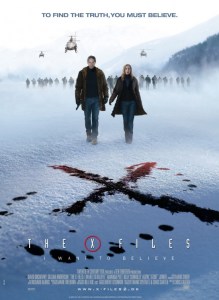 To all fellow X-Files fans out there, the movie is not nearly as bad as you may have been lead to believe. That said, it’s pretty much a so-so standalone episode of the TV show needlessly expanded. And yes, for all concerned fans, Mulder (David Duchovny) and Scully (Gillian Anderson) kiss on more than one occasion. The plot that reunites the characters is fairly mediocre, something about a ring of mad scientists that want to be a modern-day Dr. Frankenstein. You don’t need a two-headed attack dog to know that plot is way too hokey. The most intriguing aspect of the film is a priest (Billy Connolly) who also receives psychic visions, cries tears of blood, and, oh yeah, is a convicted pedophile. Could God be responsible for his special abilities as well as the abhorrent sexual urges? There is so much great conflict and human drama in this character worth examining, so it’s a pitiful shame that he just gets shoved off so the third act can concentrate on the lame mad scientists. A majority of the flick occurs in snowy West Virginia, which doesn’t translate into anything too special to look at. I’ll admit, my rating is inflated because I was an ardent fan of the TV show until the last years when it felt like they weren’t even trying any more. If you stripped away my allegiance, I’d say that the second X-Files movie serves little purpose other than to add a tiny coda to a TV show that went off the air in 2002. The characters are worth revisiting, just not in this tepid tale.
Nate’s Grade: C+


 nathanzoebl
You must be logged in to post a comment.