Blog Archives
Across the Universe (2007)
 Julie Taymor is a one-of-a-kind artist. She made her name developing Disney’s The Lion King for the theater with highly elaborate and inventive costuming and staging. She then turned her vision to film and directed two strange yet visually splendid entires, 1999’s Titus and 2002’s Frida. Her latest is Across the Universe, a film constructed around actors singing Beatles songs. Hey, everyone likes the Beatles, so what could go wrong?
It’s the late 1960s and Jude (Jim Sturgess) has traveled from Liverpool (where else?) to Princeton to find his father. He makes friends with troublemaker Max (Joe Anderson) and they elect to travel to New York City and find their voice in these tumultuous times. They get a rather spacious apartment and their landlady, Sadie (Dana Fuchs), is a redheaded rock singer. Joe’s little sister, Lucy (Evan Rachel Wood) who just lost her boyfriend in the Vietnam War. JoJo (Martin Luther) and Prudence (T.V. Carpio) find their way to this apartment and into the increasing group of young, music-minded kids in the midst of a social revolution. Lucy fall hard for one another but their relationship is strained because Max has been shipped off to fight in Vietnam and Lucy is joining an increasingly violent radical resistance group.
 I can’t decide whether it is clever of simply lazy to structure a whole screenplay around 30-some songs by one band. Many of the tunes are used for pointless reasons like “Dear Prudence” is reduced to coaxing a character out of a closet literally, though she is gay so perhaps there’s a double-meaning there, but it’s still lame. In fact, the entire character of Prudence is pointless and grafted onto the story with no real care or precision. She disappears and then miraculously pops up again, with happy girlfriend in tow, and then that’s it. But what really chafes is that when Taymor uses the Beatles’ songs to tell the bulk of her story that means that little feels authentic. Lucy and Jude spout their love songs so quickly after their first encounter. Their romance doesn’t feel believable and, more importantly, it doesn’t feel worthy of our time and interest.
Across the Universe is dripping with Baby Boomer nostalgia and the film leaves no cliché left unturned in its account of history. This jumbled melting pot of every late 1960s cultural event feels as shallow as a junior high report on the subject. Everything from the Watts riots, to the assassination of Martin Luther King Jr., to the Columbia protests and LSD activist Ken Kesey and his colorful bus are elbowed into a story that feels empty and crowded at the same time. Across the Universe is a tad overextended and even goes to the trouble of climaxing with a rooftop jam similar to the Beatles’ last public performance together.
Taymor is a talented visionary but sometimes she lets her creative impulses take over her better judgment. The movie ultimately feels like 30-some music videos strung together by a flimsy boy-meets-girl story that will sink or swim depending upon the song-by-song visual follies. Sometimes Taymor excels with the sublimely surreal like some underwater canoodling to “Something,” Uncle Sam reaching out from a recruitment poster to the tune of “I Want You (She’s So Heavy),” and a spectacular rendition of “Happiness is a Warm Gun” where Max and other war vets cope with their trauma while multiple Salma Hayeks tempt them in sexy nurse outfits. But then Taymor gets a little too carried away with her runaway train of an imagination and her visuals can become simplistic (splattering strawberries = blood shed) or just way too funky, like a truly awful animated excursion where the wonderful Eddie Izzard speak-sings “For the Benefit of Mr. Kite” as a creepy circus ringleader. What does “Come Together” have to do with pimps and prostitutes and Joe Cocker as a bum? The worst moment may be when Taymor decides to visualize the parenthetical of “I Want You (She’s So Heavy)” by having underwear-clad soldiers hauling the Statue of Liberty over the jungles of Vietnam while they sing, “She’s so heavy.” I’m also uncertain about the flagrant jumps into theatricality like the synchronized acrobatic dancing; it’s a bit jarring at times.
 The cast is rather strong from a vocal standpoint and they recorded their performances live instead of within the confines of a recording studio. Wood has a particularly pure voice. Sturgess and his throaty pipes remind me of Ewan McGreggor in Moulin Rouge. Fuchs gives a favorable impression of Janis Joplin. Bono is great in his limited time on screen and hums one dandy version of “I Am the Walrus.” There isn’t a weak singer in the bunch and simply listening to them is one of the highlights of the film, but then I could accomplish this by plugging in the soundtrack. The new arrangements of the Beatles songs are a bit lackluster; they seem too bare and stripped down into vanilla ballads. “Something” sounds exactly note-for-note like how the Elliott Smith version sounded that hauntingly played over the closing credits of American Beauty. I seriously thought that Across the Universe just lifted Smith’s version.
Inherently goofy and occasionally garish, Across the Universe is a misguided trip through the back catalogue of the Beatles. There is a moderate level of fun with the concept and the quirky visuals, but the film plods on and on and eventually the appeal of the gimmick is long exhausted. The singing is strong and the visuals have a sense of whimsy when they work, but in the end the Beatles already had one failed movie constructed entirely from their songs (1978’s Sgt. Pepper’s Lonely Hearts Club Band starring Peter Frampton and the Bee Gees) and now they have one more for a new generation of fans.
Nate’s Grade: C
Share this:

Once (2007)
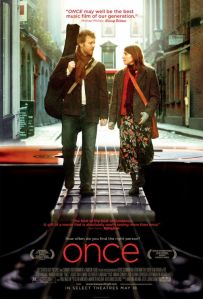 Once is the perfect antidote to noisy summer blockbusters assaulting the theaters. It’s a small, hardscrabble indie that’s completely unpretentious, unassuming, and sweetly divine. Once is not mawkish, nor overly sentimental, but it does leave you with the sensation that you’ve just had your best hopes about love reaffirmed, no small feat. This is a movie for people that love music and the innate power it can unleash.
A Dublin street singer (Glen Hansard) works in his father’s shop and fixes vacuums by day, while he sings his heart out in public at night. Then one day he meets a Czech immigrant (Markéta Irglová) who becomes his biggest fan. They start seeing more of each other and share their joint passion for music. It’s through the music that the beginning of a special relationship forms between them, however each has their own baggage. He’s nursing a broken heart after his girlfriend cheated on him and then moved to London. She lives with her mother and works several jobs to take care of her young child. Her husband left the family but there’s a chance he may return. Together, they write enough songs and raise enough money to record an actual album in a studio, something that can stand the test of time.
 When you boil it down the story is very simple. Boy meets girl. They run into each other some more. They help each other write music, ending with the accomplishment of a studio-produced album. Then they part. That’s it from a synopsis point of view, but Once is far more than that. This is an honest to God real-life musical, where the songs advance the storyline and the lyrics express the emotional desires and changing moods of our leads. People don’t break out into choreographed song and dance numbers; no, this is set in a modern and realistic world. Once could be described as a musical for people that hate traditional musicals but I think that sells the film too short on its merits. Once is a very stripped down but enormously romantic love letter to music and human connection. Watching the movie is akin to be serenaded by a soulful crooner that clearly wears its idealistic heart on its sleeve. There’s something undeniably magical about watching Once; you feel transported by the sheer exuberance of feeling and emotion. The openness may seem awkward or a bit cheesy to a more cynical lot. The story is a rather bare-bones affair (no pun intended), but that’s where the film takes the opportunity to explore the burgeoning relationship between our leads in their short yet important time together.
Of course it helps a musical if the music is something worthy of listening. I’ll say this: Once is the first movie since 1999’s Run Lola Run that I immediately went out and got the soundtrack for after watching. Unfortunately, as Once is still expanding most large retail stores do not carry it just yet. I guarantee by the end of the summer that every one of them will have it well stocked. The songs are largely acoustic guitar and piano arrangements, and the heartfelt, slightly biting yet optimistic lyrics are reminiscent of acts like Bright Eyes and The Shins. The music is softly beautiful and lilting and a great showcase for Hansard’s sensitive yet powerfully evocative vocals. Irglova is a classically trained Czech pianist and sings with a breathy Bjork-like style that blends well with Hansard’s graceful and rich tenor.
The music is a big reason for the film’s success as a sweeping romance and human drama. The standout track is “Falling Slowly,” which is a stunning turning point for the film and for the characters. In the film, they assemble in a piano shop and put together an impromptu duet. The song builds, and our singers coalesce smoothly, and the soothing sounds stir something inside them as well as the audience. Both characters are realizing that they can make beautiful music together, and they’re exploring one another’s desires and intentions. They definitely sense something new; the music is what binds them, but the music is also their most lucid platform for expressing their escalating feelings.
 Writer/director John Carney, who used to be a bassist in Hansard’s band The Frames, gives the movie a fly-on-the-wall viewpoint, probably more due to a limited budget of around $150,000. In fact, the home movies footage Hansard watches of his former flame looks identical to the rest of the movie. The performances are naturalistic if a bit amateurish, but this also works with the realistic tone of the film. Much of the 85-minute movie consists of full-length songs and performances, so any audience that isn’t really jazzed by the music may grow restless.
The MPAA, in its irritating wisdom, has decided that Once should be rated R, thus distancing it from an armada of impressionable youth. Once has a handful of F-bombs, though you could argue their inclusion is diminished because of the occasional indecipherable nature of heavy Irish accents. The restricted rating is a shame because this movie doesn’t have a profane bone in its body. Teenagers, people who are struggling for meaning and acceptance, and re-configuring their musical tastes, should see this movie. I think they would relate to the personal struggles and the romanticism. Hansard may populate many a teen girl’s bedroom in poster form soon enough.
Once is a lovely and charming modern musical. I suppose the music is really going to be the breaking point for people; either you enjoy its sweet harmonies and light acoustic arrangements, or, um, you don’t. I adored the music and was transported by the deeply romantic current running through the film. Once is a small movie with a big heart and some wonderful music. In between pirates, robots, super heroes, and wizards, I think there’s plenty time to squeeze in a beguiling and earnest musical.
Nate’s Grade: A
Share this:

Dreamgirls (2006)
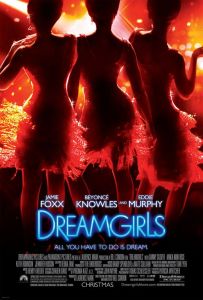 When the smoke cleared after the 2006 Academy Award nominations, there were some media members in disbelief. How could Dreamgirls, an expensive, glitzy musical that many perceived as the front-runner for Best Picture, fail to even get nominated in the Best Picture category? Theories abounded; the mostly white Academy couldn’t acknowledge a movie steeped in black culture, the film fell prey to backlash against a momentous hype machine that rubbed people the wrong way, or even that it was unfairly judged against recent musicals, like 2002’s Best Picture winner Chicago, instead of being judged on its own merits. After having now seen the film, I have an altogether simple explanation: the Academy thought there were better movies and I couldn’t agree more. Here are five reasons why Dreamgirls just didn’t cut it.
1) The film just falls apart after the halfway mark. The focus is on the rise of the all girl group the Dreamettes in the 1960s Detroit music scene. Effie (Oscar-winner Jennifer Hudson) is the strong-willed lead singer with big curves and a big voice. She’s pushed out of the way by her band mates so pretty face Deena (Beyonce Knowles) can front and sell records. Effie is our star and she doesn’t take the news well, and explodes in an emotional fury that results in the film’s true showstopper song, “And I Am Telling You I Am Not Going.” Trouble is, there’s still an hour of movie left. The second hour of Dreamgirls feels like a plot layover, as our characters don’t do much more than stuff their hands in their pockets and grumble. It’s astonishing how deflating the second hour to this movie is, and the film cannot sustain a viable interest or energy, leaving the audience to tap their toes to songs that already ended an hour prior. It’s a troubling sign when a film peaks at the halfway point and seems to only stall and sputter after.
 2) The songs are not that special. Dreamgirls would have been far more entertaining if what we got was some honest, soulful, groove-inducing Motown music. Instead, what we get is the same pop filler that the characters bemoan what commercialism has transformed their music into. None of these ditzy ditties are very memorable and many of them start to just blend together, thanks in part to montage-obsessed editing. The other focus of Dreamgirls is on the rise of Motown, how a very Berry Gordy-like figure, played by Jamie Foxx, patterned black music and made it hit for white listeners. I think this was the most depressing part of the film for me, the fact that I could have done without the music in a musical.
3) The tone lacks clarity and can be grating. For about 80% of the movie when the characters sing it’s on stage as performance. Then two characters sing their displeasure with each other and the audience is like, “What the hell?” I accept the laws that govern musicals, and people spontaneously bursting into song and choreographed hoofing does not bother me, but whatever the choice it needs to be consistent. When the audience is used to seeing the singing contained to the stage, it becomes jarring when it transpires in reality. Director Bill Condon (Kinsey, Gods and Monsters) cleverly worked around this problem in his screenplay for Chicago by placing all the song-and-dance moments as glimpses into one woman?s musical-obsessed psyche. It seems so careless and easily remedied, so what were they thinking?
4) Dreamgirls is desperate for Oscar attention. At the end of the movie, after an awfully messy run to the finish line, come the end credits, however they aren’t so much as end credits as they are “for your consideration” ads. When the director of photography credit appears you see a man in a camera crane. When the costume designer is credited we see her sketches and the real outfits side-by-side. Some of it is silly, like when the casting director is listed and we see, no kidding, a checkerboard of faces, like the movie is saying, “This is what a casting director does, look.” The sequence is moderately annoying and a little patronizing, but it is a splendid example of the filmmaking ethos. It feels like the over zealous studios thought that by throwing together a bunch of musical staples and covering it with fancy decoration that they could fool audiences into thinking they saw a full-blooded story.
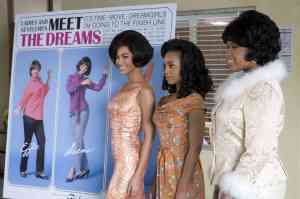 5) You fail to feel for any of the characters. In the rush of production numbers and period detail, the characters all suffer horrendously. The Dreamettes are obviously a take on the Supremes, and Deena is obviously supposed to be Diana Ross; they even recreate iconic Diana Ross pictures with her. By this token, it seems like the filmmakers felt they could slack off on characterization and just banish their actors to the ghettos of genre archetypes. I didn’t feel for anyone, even Effie once she got her walking papers for being essentially fussy, overweight, and sticking with her integrity. She tries to pick up the pieces of her life but even she seems disinterested once the stage lights no longer shine upon her. The characters have about a dewdrop of depth to them and can be summarized each by one sentence. Shallow characters and a less-than-compelling second half doom the movie.
There are enjoyable aspects to Dreamgirls, notably the performances from the supporting players. Eddie Murphy experiences nothing short of a career resurgence playing Jimmy Earl Haley, a groundbreaking soul singer with a fiery stage presence. Murphy puts his all into the performance and is such a live wire that Dreamgirls seems downright downtrodden without him. Former American Idol contestant Hudson has been collecting accolades for her diva-like performance, and while her singing is full of bluster and verve, I cannot say the same for her acting. She gives a solid overall performance but doesn’t try hard to hide her inexperience with acting. I wouldn’t have given Hudson an Oscar, but then I wouldn’t have given Oscars to a lot of the eventual winners (Julia Roberts, your hardware rightly belongs to Ellen Burstyn).
Film critic David Poland was nearly beside himself with Dreamgirls‘ omission from the Best Picture contenders. He argued that had it been nominated it would have won (I’m not sure how that logic works, but I do have a bridge I’d like to sell Poland). Dreamgirls is not bereft of technical charms and entertainment, but to posit this as anything above a mediocre musical is just plain madness. The characters barely leave an impact, the music is the same pop pap it laments, and the movie just simply peaks too soon. There’s nothing daring or innovative with this song and dance revue, and for long periods it feels like a pandering exercise in dress-up and nostalgia. I suppose in the end the Academy just thought there were five better movies than Dreamgirls, and, for once, I agree with them.
Nate’s Grade: C+
Share this:

Corpse Bride (2005)
 Not as good as Nightmare Before Christmas, but really, what can be? Tim Burton second stop-motion animated film is beautifully crafted and emotionally involving. It’s interesting because all three characters in the movie’s love triangle have really done nothing wrong, and our sympathies are stretched to all three. The contrast of the world of the living (drab, formal) and the dead (colorful, lively) is stark, and death in Corpse Bride is presented as simply another stage of living. Therefore, you don’t have to worry about scaring the kids with this one. The ending is a bit too conventional and the songs are all lackluster, nothing ever as remotely hum-able as Danny Elfman’s masterpieces in Nightmare Before Christmas. Despite the unfair comparisons, Corpse Bride is easy on the eyes, amusing, and nicely romantic.
Nate’s Grade: B
Share this:

Walk the Line (2005)
 I found this movie enjoyable but full of your standard, by-the-book biopic moments (rise/fall, addiction, famous faces, losing a brother at young age); still the performances were what the film hinged on and they were fantastic, especially with the added pressure of singing in their own voices. Walk the Line was good but didn’t really connect for me, and I think part of that is because the plot revolves around June Carter refusing to “be” with the Man in Black for 10 years. Yes they were each married to other people and their time on stage was like a forbidden courtship all its own, but it’s just not that compelling of a conflict, to me at least.
Nate’s Grade: B
Share this:

Rent (2005)
 Rent is one of Broadway’s biggest sensations in the last decade and has become a cultural cornerstone for many. Jonathan Larson updated Puchini’s famous opera La Boheme, transplanting the setting to East Village New York, swapping TB for AIDS, and turning his characters into struggling bohemians fighting for their voices to be heard and love to be kindled. The musical also has an added sense of tragedy. Larson suddenly died on an aneurysm during the final dress rehearsal, sadly never getting to see his finished creation. Rent went on to win Tonys (including Best Musical), a Pulitzer Prize, and damn near the heart of every girl I went to college with. To say it’s been a smash is an understatement. And where ever there’s money and an insatiable audience, there will be Hollywood’s eyes. Now comes time for the Hollywood gloss with director Chris Columbus (Home Alone, Stepmom) and when Rent ditches the intimate confines of theater and hits the big screen, it’s much harder to hide its flaws.
The story takes place within the span of one year (or 525,600 minutes as you’ll be told repeatedly in song), covering Christmases from 1989 to 1990. Mark (Anthony Rapp, Dazed and Confused) and Roger (Adam Pascal) are roommates trying to keep warm during the winter in their giant New York loft. They’re flat broke and their former friend and current landlord Benny (Taye Diggs) expects a full year’s rent to be paid pronto. Roger is racking his brain trying to write that one perfect song; he’s also HIV positive, the unfortunate side effect of a relationship with a junkie. Mark is an aspiring filmmaker and has also recently been dumped by the impetuous performance artist Maureen (Idina Menzel) for … another woman, Joanne (Tracie Thoms), a lawyer. It must be noted that all three of these characters do not have HIV/AIDS; they’re in the minority. Tom Collins (Jesse L. Martin, Law and Order), a gay school teacher, is visiting Mark and Roger when he gets mugged in an alleyway. Angel (Wilson Jermaine Heredia), a drag queen with a heart of gold comes to his rescue. Both men have HIV but won’t let their shortened time stop them from falling in love with one another. Mimi (Rosario Dawson) lives below Roger and Mark and works as an exotic dancer down the street. She too has HIV from a nasty smack habit. She also has her heart set on Roger but he needs a little motivation. For a year these characters will interact and live, love, die, and sing a whole lot.
 The villain of the piece seems to be Benny by default (unless you count AIDS, poverty, and ignorance). Our unemployed band of heroes is upset because dear Benny expects them to, gasp, pay their rent. The scoundrel! Here’s what I don’t get; clearly Benny has a dream for a business and the other artists denounce this artistic dream because it involves money exchanging hands. Benny’s passionate about his dream and actually does something productive like make friends and influences with the business establishment, people with capital to bankroll an entrepreneur’s dream. It’s like everyone’s mad at Benny because he put a suit and tie on and got a job.
Besides, there is something inherently pretentious about Rent’s anthems of sticking it to the man and brash commercialism. Guess what, after 9 years Rent is a franchise. You can get Rent T-shirts, coffee cups, soundtracks, and practically anything that can be merchandised and marketed to the disenfranchised youth with disposable incomes. A musical about the soullessness of commercialism is itself a cash cow, so it rings a little hollow when the deadbeats thumb their noses at the evils of capitalism. Seriously, Mark just about gets hives at the thought of being a cameraman for a TV news show (he calls it “selling out”). In the end he quits his job so he can make his masterpiece … cobbling together home movie footage.
The film version of Rent is populated with 6/8 of the original Broadway cast (Dawson and Thoms are the only fresh faces). This is a well-intention move by Columbus but it backfires. It’s one thing to listen to 20-something bohemians fight for their artistic integrity and worry about food, shelter, rent. It’s quite another thing when the majority of your cast is in their late 30s. You’ve gone from a bohemian to a potential bum. I’m not condemning the pursuit of your artistic ideals and making your name in the world, but not at the price of food and shelter. I’m reminded of a line from The Big Lewbowski: “Your revolution is over! The bums lost. The bums will always lose!”
 It’s hard to feel for some of these characters, who come across as whiny, pretentious, or just plain misguided. Maureen is irritated that her life partner is upset that she was flirting during their engagement party. I mean, really, what’s to get upset about? It’s pretty bad when Rent kills off one of its main characters in a musical montage. A MONTAGE! Afterwards all the characters eulogize what made this person so great. Hey, all that character stuff would have been handier before the death, and then I would have felt something.
Some of these same problems exist with the original stage version, but Rent the movie, and especially Columbus as director, make some bad additions. The original stage version of Rent took place in modern day when it opened. Here, Columbus has dialed back the timeframe and set his story from 1989-1990 (someone forgot that a song references Thelma and Louise, which came out in 1991, but oh well). What makes this time jump shaky is that the film also adds a scene of the happy families championing each other over their racially mixed lesbian daughters’ engagement. They moved time backwards but people’s tolerance was moved forward. That’s not all. It’s bad enough that Roger has a Bon Jovi haircut for the entire film, but then Columbus adds scenes of his escape to New Mexico and we, the audience, are treated to Roger belting his heart out to nature on top of a desert gorge … just like in Bon Jovi’s “Blaze of Glory” music video. Maybe this finally explains why they transported the film to the 1980s.
Where the musical does strain credibility is its fear of fulfilling the dark end of Puccini’s opera. Moulin Rouge! is also based on Puccini’s tragedy and it had the guts and the ambition to end on a tragic note. I‘ve cried at the end of Moulin Rouge!, but I didn’t feel like misting up during Rent. (Spoilers) It’s rather terrible that Mimi can be brought back from the dead by the power of a cheesy rock ballad, and if this holds true, then Bon Jovi is wanted to the E.R., stat! The cheap fake-out ending for Rent is just the nail in the coffin. Everyone has AIDS and thus on borrowed time and yet we can’t have an adult ending dealing with tragedy.
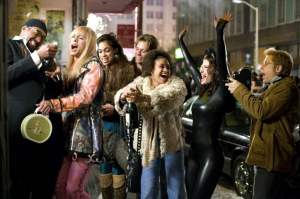 With all this in mind, some things in Rent really do work. The songs are catchy, somewhat fun, and the splashy lyrics follow suit. The cast collectively are entertaining and sing well, though Dawson can get a bit monotone at times. Some of the dance numbers are exciting and amusing, like the “Maureen: Tango” between Joanne and Mark chatting about the spotty behavior of their former and current lover. At one point we flash to them in full classic dress buffeted by a chorus line of fellow tango-ers. “La vie Boheme” is the sassiest and most electric song, finally piecing Larson’s sardonic, witty pop culture lyrics with a lively image. This is a musical that’s got clever lyrics, good singing, and catchy pop rock songs.
For many, especially the Rent heads, a movie version of their favorite musical will be bulletproof. They’ll be thrilled to enjoy an afternoon with their best friends on the silver screen singing their favorite harmonies. I’m sure fans of Rent and fans of broad musical theater will be pleased. For me, the movie falls apart when you pay attention to the story, the characters, the drama, and then the choices in adapting it to film. I just didn’t care for most of the characters and found the story dated, pretentious, and overly romantic, even if the majority of the characters do have HIV and/or AIDS. Columbus’ poor decision making turn Larson’s rock-opera into a movie that wants points for being different when everything about it has practically become marketable and cliché. I’d recommend buying the soundtrack instead of seeing the movie, because at least then you can turn it off when you reach your breaking point.
Share this:

Team America: World Police (2004)
 The MPAA is mad, plain and simple. It’s an organization intended to rate movies so our wee ones don’t stumble into something not intended for their virgin eyes. They also have a long history of haggling with filmmakers over ratings and the necessary cuts to ensure a commercial rating. And, in their eyes, puppet sex was deemed too indecent. You see, the MPAA initially gave the all-puppet action movie Team America: World Police, the new film from South Park creators Trey Parker and Matt Stone, an NC-17 for an extended scene of two marionettes engaging in enough sexual positions to make a G.I Joe blush. However, we’re talking about puppets, people! Puppets! They’re not even anatomically correct. Does anyone find it crazy that a governing board says watching two dolls bang together in “simulated sex” (is there any other kind with puppets?) is inappropriate for all ages under 17? Surely, if the MPAA is to be eventually reformed, this will be Exhibit A.
 Team America is an elite team that fights terrorists and police the globe in red, white, and blue helicopters, jets, and flying limos (the team logo is a bald eagle with the earth in its beak). The team leader Spottswoode recruits Broadway actor Gary, star of the musical Lease (key song: “Everyone has AIDS”), because they need someone to pretend to be a terrorist and flush out their secret plan. Gary is reluctant at first but agrees to join the team.
Team America flies to Paris and Cairo to battle terrorists. They snuff the terrorists, but world monuments like the Eiffel Tower and Sphinx get lost among the collateral damage. Things look promising for Team America, and Gary expresses feelings for Lisa, a blonde psychologist haunted by the loss of a teammate and a lover.
Terrorists strike the Panama Canal in retaliation, and a group of celebrities led by Alec Baldwin condemn Team America. Michael Moore, with hotdog in each hand, protests outside Team America’s headquarters. In these moments of disarray, we learn the true source of the Weapons of Mass Destruction and brains behind the attacks is North Korean dictator Kim Jon Il, who has a plan for “9/11 times 2,358.”
While not reaching the satiric highs of the South Park movie, Team America is a political movie that lambastes both sides of the coin. This has been a very heavy year for political films, from leftist documentaries like Fahrenheit 9/11, The Hunting of a President and Going Upriver: The Long War of John Kerry, to more subtle jabs at the current administration (the very Cheney-like VP of The Day After Tomorrow), to more obvious indictments (the stuttering, axiom-loving dumbbell candidate in John Sayles’ Silver City). So in a year bursting to the seams with political screeds, it’s quite refreshing to have a movie that lampoons both the Right and the Left.
Team America satirizes the arrogant, shoot first ask later, cavalier foreign policy America has been accused of (“We’re going to bring democracy to you if it kills you.”). The film also criticizes Hollywood celebrities who feel that their uninformed, unsolicited opinions are germane to the political process. In the end, it’s the celebrities who get the worst of the beating (Matt Damon appears to be, um, challenged). Parker and Stone shrewdly satirize pretentiousness and ego, no matter which side it falls upon. They lose their focus as the film enters its final gory act, instead resorting to garish ways of killing puppets.
 Team America has a good one-two combination with its political punch, but where it really shines is the knockout it delivers to bombastic Jerry Bruckheimer action films. This is a delirious send-up of a wide array of action movie clichés, including team members and their secret crushes as well as their hidden traumas. Characters will fight or die in slow-motion for dramatic effect. Characters will all have some special talent that will come into play at an important moment. Kim Jon Il has a typical villain lair, including large shark tanks and trap doors. When a character dies in the opening sequence he mutters the line, “I feel so… cold[.” Hilarious! There’s even an entire training montage set to a song called, “Montage” (sample lyric: “Show a lot of things happening at once, remind everyone of what’s going on!/ And with every shot show just a little improvement – to show it all would take too long!/ That’s called a montage!/ MONTAGE!/ Even Rocky had a montage!/ MONTAGE! “). There’s also a love song all about Pearl Harbor sucking as a movie.
Like all the other films by Parker and Stone, Team America is a robust musical. The songs aren’t as sharp as the ditties from the South Park movie, but they’re still quite amusing. The Team America theme is a rousing anthem called “America, Fuck Yeah!” which is a perfect example of the film’s simultaneous mixture of the profane and the brilliant. Later in the film, when Team America is taking a public backlash, there’s a somber remix of the theme that’s even funnier.
Some things are just funnier because of the limitations of puppets. Watching two marionettes try to fight is hilarious, because they really do nothing but kick their legs and limply slap each other. Before Team America, I never realized how funny it was just to watch marionettes walk. They’re so awkward and jumpy, that just seeing them step from side to side can put a smile on your face. When the music of Kill Bill comes onscreen, and the puppets walk in slow dramatic fashion, it’s even more absurd and funny.
 Parker and Stone also have fun with self-awareness, like when they take Gary on a tour of the sights of Washington D.C. and he stands next to an actual tombstone at Arlington National Cemetery. There’s also a Matrix parody that actually comes off as fresh. There’s a giddiness to watching puppets swear, fight, vomit, stagger drunk, and even do the nasty. It’s a gimmick that doesn’t get old.
This is also one terrific looking movie. The sets are massively intricate and the photography by Bill Pope (who did shoot the Matrix films) bathes the proceedings in beautiful mixtures of light and dark. There may be moments you forget that what you’re watching are miniatures. It is filmed to look like a typical action movie. The music is a spot-on parody of action films, with its heaviness on flutes when the villain is around, to the foreign lady mournfully singing during scenes of tragedy. There’s fantastic craft and detail worked into Team America that I can unequivocally say Team America: World Police is the best looking, R-rated all-marionette musical action movie… ever.
Team America may be the funniest film of the year. There are some moments of drag, and sometimes less profanity would make certain punch lines better (unfunny homophobic jokes like the acronym F.A.G.), but the movie is a comedy that’s pee-your-pants funny. Team America is definitely not for kids (what kind of irresponsible parent assumes “puppets = for kids” and ignores an R-rating?). Because of the equal opportunity satire, this may end up being a movie that conservatives and liberals both claim to be their own. For fans of erudite satire, crude humor, and puppet sex, Team America will be a blast. Make sure to stay throughout the end credits to hear a special closing song not in the film.
Nate’s Grade: B
Share this:

School of Rock (2003)
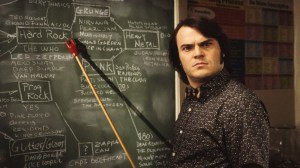
 School is now in session. Jack Black has long been a Hollywood oddity. He’s a whirlwind of manic energy but it can be accurately placed (his breakthrough in High Fidelity), or misused on hollow roles (Saving Silverman). Black is also a credited musician with his band, Tenacious D. Writer and sometime actor Mike White is a friend of Black’s and said he wrote the lead in School of Rock specifically for him. Will Black measure up with his first lead role, or will he be held back?
Jack Black plays Dewey Finn, a thirty-something lead guitarist who takes rambling guitar solos and crowd surfs even when theres no one to catch him. His band mates fire Dewey from the group for his outlandish behavior. Dewey’s roommate (Mike White), and especially his harpy girlfriend (Sarah Silverman, generally wasted here) urge him to find a job and start pulling his weight. A call comes in for Dewey’s roommate to substitute teach at a prep school. Dewey poses as his pal and enters the ranks of academia. When he finds out that his class plays instruments he organizes them into a band as a class project. When someone questions what they’re learning, Dewey shouts that they’re learning rock ‘n roll, which he says, ”Will test your head, and your mind, and your brain too.”
 Black has showed scene-stealing ability in other films, but School of Rock gives Black the role he was born to play. His character isn’t some high-minded jerk that learns the errors of his ways by having his rough exterior melted by the compassion of children. Heck no. Black’s character remains rocks willing soldier from beginning to end, but School of Rock gives him the chance to share his passion and instill it in the youth. Black’s circus of eye bulging, energetic gyrations, and infectious excitement make a vibrant lead that can make us laugh at a moment’s notice. It’s a marvelous performance full of rock bliss.
Non-professional actors play the prep school kids that populate School of Rock. They smartly decided to have the kids played by real musical prodigies, so when they get jamming thats real ten-year-olds and eleven-year-olds putting people to shame with their musical ability.
The film isn’t anything new exactly. Its story is somewhat familiar, but it’s got an attitude all its own. School of Rock uses familiar elements and comforts the viewer, but its madcap energy, touching moments of heart, and ambitious belief that music can change lives will leave the viewer smiling from beginning to end. There wasn’t a second I wasn’t smiling or laughing while watching School of Rock.
School of Rock is a joyous movie that excels with sweetness. Lets just get down to it and say the flick is monstrously funny, heartwarming, inspired, charming, entertaining and certifiably rockin’ enough to blow you and your neighbors socks off. Dont be fooled by the PG-13 label (which I’m still scratching my head over), because School of Rock is the perfect film for families of all ages. Its got a genuine tenderness most comedies lack, and it also has a consistently cheery sense of humor that never resorts to inane gross-out gags like so many current comedies. This is one to take the kids and grandma too.
 In lesser hands this film could have been a disaster. The kids would come off as cloying, Blacks character would come off as a crude loaf, Joan Cusack’s (a wonderful performance, by the way) principal character would just be an uptight bitch, and the familiar story would seem syrupy, like a Dead Poets Society with guitars instead of suicide. Under the smooth direction of Richard Linklater (Dazed and Confused, Waking Life), one of the stalwarts of the 90s independent film renaissance, School of Rock strikes the right balance between warmth and Blacks uncaged craziness. Linklater has taken his indie sensibilities and assuredly given the film a heart that beats to the rhythm of rock n roll, that also never falters into sticky sentimentality.
School of Rock is an exuberant comedy, sharply written, with confident direction, cute kids, and the dynamic performance of Black. The movie will appeal to families, fans of Black, and people tired of feel-good formula films or those looking for a feel-good film. School of Rock will lift up your spirits and make you want to dance in your seat. I raise my goblet of rock and salute you, makers of School of Rock, for the greatest 108 minutes of fun I’ve had this year.
Nate’s Grade: A
Share this:

Chicago (2002)
January at the theaters is a tale of two kinds of films. One type are the studio bombs (take Just Married and Darkness Falls, please take them far away). The other type are the prestige pictures expanding their releases in hopes of garnering some of that Oscar magic. A lot of prestige films were released around the holidays and though not every one could be a winner, they were all better than Kangaroo Jack. Well, except for The Hours.
 Chicago (2002)
Premise: Roxie Hart (Renee Zellweger), hungry for fame, finally grasps it when she kills her lover and is put on trial. Silver-tongue lawyer Billy Flynn (Richard Gere) stirs up the media in her defense, as well as for another starlet killer, Velma Kelly (Catherine Zeta-Jones).
Results: A song-and-dance picture thats quite toe-tappin with imaginative numbers, even if I can only remember like two songs. A surprisingly steady Zeta-Jones really shines and Gere can cut a rug. Chicago is just lively fun. Blink and youll miss Lucy Liu in it.
Nate’s Grade: B
Share this:

Crossroads (2002)
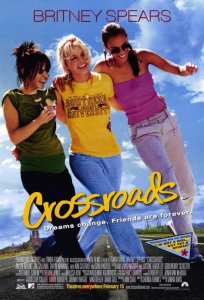 When informed that her feature film debut was receiving shrieks of laughter during advanced screenings for critics, Britney Spears said she was glad because she never likes the same films the critics do. Well Ms. Not That Innocent, the truth hurts; you’re not a girl, not yet an actress. Crossroads is really the filmic adventures of Britney Spears and her ever-present navel. The navel should get second billing, but alas, we do not live in a society of equality for navels.
The film opens up with three 10-year-old best friends burying a box of wishes and dreams and promising to be bestest friends forever and ever. They make a pact to come back and dig up the box on the night of their high school graduation. Flash to the present and the word “bestest” isn’t what it used to be. Lucy (Britney Spears) has become the virginal nerd preparing to give her speech as valedictorian. Kit (Zoe Saldana) has become the haughty popular snob, obsessed over getting married ever since she got her first Bridal Barbie. Mimi (Taryn Manning) is pregnant and become the trailer trash girl that everyone sees fit to remind her of. Despite their growth apart they all do come together to reopen their box of dreams. Mimi informs the others that she plans to head to California to audition for a record deal in an open contest. Kit decides to use this opportunity to check up on her boyfriend at UCLA who has been strangely evasive. Lucy complains that by having her nose in a book her entire high school experience she never got to go to a football game or even “hang out.” Somewhere a small violin is playing. She decides to jump at this chance and possibly see her mother in Arizona, who ran out on Lucy and her father (Dan Akroyd) when she was only three. The wheels of their adventure are provided by guitar-playing mystery Ben (Anson Mount). He pilots them on their travels to the Pacific coast, though the girls think he might have killed someone, but oh well.
 Crossroads is filled to the brim with every imaginable road trip cliché. The girls “open up” after getting drunk, have a scuffle in a bar, reap in the sights of nature, and perhaps create some sparks of romance with their hunky heartthrob of a driver. The car also inevitably breaks down and the girls have to find a way to scrape some quick cash together. They enter in a karaoke contest and Britney proceeds to sing Joan Jett’s “I Love Rock and Roll” with her two gal pals providing backup. But no, this isn’t the last time you’ll hear Ms. Brit sing. In an effort to pad as well as become a showcase for its star, Crossroads gives us many scenes of the girls just singing to the radio. Besides Jett, Shania Twain’s “Man I Feel Like a Woman” and Sheryl Crow’s “If It Makes You Happy” are also on the chopping block. You’ll also be accosted by the movie’s single “Not a Girl, Not Yet a Woman” several times, including one scene where Poet Britney is asked to share her poem and it ends up being the song’s lyrics.
Saldana (Center Stage) is not given much, as the attention is always centered on Britney, so she merely comes off like a token conceited character. Only Taryn Manning (crazy/beautiful) comes away with a little dignity. She gives Mimi a lot more heart than should be there and shows some honest reflections for her character. She also, coincidentally enough, looks like a dead ringer for Joan Jett with her black bangs.
Crossroads is nothing but a star vanity project for Spears, with some not-so-subliminal Pepsi product placement here and there. This was not a script looking for a lead; this was something Britney’s management team suited for her, and Crossroads is perfectly suited for Britney. It allows for many ogling periods of booty shaking. The majority of the film’s drama doesn’t even concern her, and when she does have to act her scenes are cut short to help her when the real drama unfolds. The movie’s true intentions are revealed when Britney is shown in her pink underwear twice in the first 15 minutes.
 Crossroads moves along on gratuitous skin shots of Spears half-naked body every 20 minutes until it reaches its torture chamber of a final act. In this very melodramatic period we get abandonment, date rape, infidelity, and even a miscarriage in one of the film’s most shameless plot devices. Of course none of these horrors matter, especially a psychologically damaging miscarriage, because Britney has to get to her BIG audition in order to perform, yep you guessed it, “I’m Not a Girl, Not Yet a Woman.” She also has to wear what looks like kitchen drapes while she sings.
You’ll walk out of the theater wondering many things. Why does Britney wear pink in EVERY single scene she’s in? There’s even one scene where she changes from a pink top to another pink top and is FOLDING a third pink top into a suitcase. Are we to believe that Akroyd and Spears share some kind of genetics? In what high school would Britney be considered a nerd?
Hopefully Crossroads will be the pop princess’ last foray into film, but I strongly doubt this is the last we’ve seen of Britney Spears. Crossroads is a terrible girl-power trip. Only Spears’ target demographic will enjoy this melodramatic mess. Truly, the two largest groups that will see this film are adolescent girls and creepy older men who fawn after adolescent girls. Crossroads is exactly everything you’d expect.
Nate’s Grade: F


 nathanzoebl
You must be logged in to post a comment.