Blog Archives
Inside Llewyn Davis (2013)
 “There’s no success like failure. And failure’s no success at all,” Bob Dylan wrote. He could have been talking about any number of characters in the oeuvre of master filmmakers Joel and Ethan Coen. Losers and has-beens and could-have-beens fascinate the brothers, and their newest film certainly follows this model. Llewyn Davis (Oscar Isaac) is a struggling musician in the 1961 Greenwich Village, New York folk scene. He rotates crashing with various friends, unable to scrounge up enough money to ever pay his own way. His musical partner recently killed himself and Llewyn has been trying to get traction with his first solo record. His world gets even more complicated when Jean (Carey Mulligan) reveals that she’s pregnant; the baby’s father may be Llewyn or Jean’s husband and fellow performer, Jim (Justin Timberlake). Llewyn can’t catch a break.
Inside Llewyn Davis is a classic Coen creation, a character study of a misanthropic loser trying to find direction in a comical universe of indifference. I greatly look forward to every Coen picture and that’s because nobody writes characters like they do. There are no throwaway characters in a Coen universe. Even minor characters like the elevator Attendant or Manager’s Secretary are given sparks of personality, each fully formed figure creating a richer canvas. There is great pleasure in just listening to their characters speak, in natural cadences yet elevated with grace. Inside Llewyn Davis is no exception. Their storytelling is always rife with wonderful comic surprises and pit stops. The Coens are such brilliant technical craftsmen, that every shot is gorgeously composed, even without longtime cinematographer Roger Deakens (to give you an idea how old this movie was, Deakens was busy filming Skyfall). The music, supervised by O Brother maestro T. Bone Burnett, is impeccably performed and quite lovely to the ear, if you’re into folk music arrangements. If you’re not, well, it’s going to be a long movie experience.
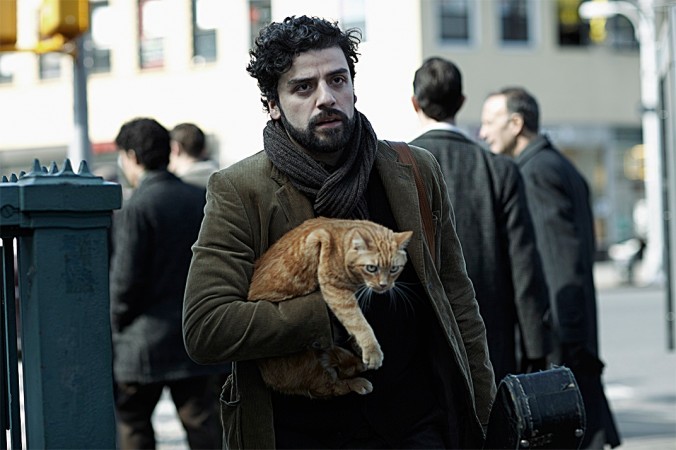 But here’s the problem with Inside Llewyn Davis: the film will likely turn off most people. It’s not a comforting movie by any means. We’re stuck following a self-destructive struggling musician bounce around couch-to-couch, chasing dreams that will never seem in reach. And Llewyn is a tough character to love. He’s surly, careless, selfish, egotistical, and also jaded. And he’s just about the only character in the movie. Most of the other famous faces are fleeting supporting players. Only Mulligan (The Great Gatsby) is given a plurality of scenes to expand her perturbed character, and even those may not be enough. Much like Llewyn’s musical direction, this is a one-man show, and he’s not cuddly. But an unlikable protagonist is not uncommon. The Coens tease so many different directions for Llewyn to go that it’s likely that audiences will feel some degree of disappointment where the film does end up. It’s a circuitous path, proving Llewyn is the architect of his own fate, but at that point audiences may not care. They may just be happy to watch Llewyn punched in the face. The plot is pretty light, running into a series of various self-contained scenes, and there isn’t much in the way of closure. I’ve watched the film twice and while I appreciate it more I’m certain that Llewyn Davis will leave a majority of people feeling cold, more so than even A Serious Man.
Unlike former Coen creations, notably in A Serious Man and Barton Fink, our titular character is the architect of his own misery. He is a musician that identifies with an older class of folk artists, something that strikes him as genuine and touching the soul. He cannot stand artistic compromise. He won’t even accept a winter coat from his music manager. He wants no handouts. He chastises Jean about her and Jim’s attitudes toward the business, calling them “careerist” and “a little bit square.” To Llewyn, to sell out is the worst crime. Jean says that they’re just doing what they can to raise up the musical ranks, and maybe the songs aren’t top-notch, like a catchy but instantly dated novelty song about the Space Race (the sure-to-be Oscar-nominated “Please Mr. Kennedy”), but they’re commercial, they’re finding an audience, they’re making inroads, partially as a husband/wife act and partially due to their own physically attractive appearances, and it frustrates Llewyn greatly. A great example is early in the film a young Army vet on leave performs a wonderfully pure song with a beautiful voice. Llewyn scoffs at the mawkish nature of the tune. “He’s a great performer,” Jim advises. Llewyn takes umbrage at the distinction; a performer is not the same as a musician. The people getting ahead are the performers, the sellouts. One of Jean and Jim’s rising hits, “500 Miles,” lyrically suggests it was an old slave song that has been repackaged and homogenized for safe consumption. Llewyn is going to stick to his guns and make it on his own terms, with expected results. Late in the movie, after Llewyn performs before a record exec (F. Murray Abraham), so aching and affecting as he puts it all into the song, the exec simply responds: “I don’t see a lot of money here.” However, the exec offers Llewyn a chance to be in a trio he’s putting together, if he cleans up and knows how to keep to the background. It’s a real opportunity. Just not for Llewyn.
It all comes down to legacy and Llewyn contemplating what his will be. His singing partner is now defined by his death, finding cruel irony in their song, “If I Had Wings.” His father is known for his long dedication to the Navy, but now he sits alone in a nursing home, a prisoner to his own infirmary and defeated mind. A road trip partner, the pompous jazz musician Roland Turner (a royally hilarious John Goodman), seems like a Ghost of Christmas Future visit from a possible future Llewyn, the artist who’s an iconoclast only in his own mind. Throughout the film, Llewyn is beset with choices, different options he could take, one in particular stemming from a revelation involving an old girlfriend. And yet, much like the thematic nature of folks songs, we’re told, Llewyn looks for something new with something old, be they routines, goals, or occupations. The folk music scene is on the cusp of change with a more commercialized pendulum swing, as evidenced by a surprise new performer at the Gaslight in the closing minutes. Llewyn is contemplating his life beyond the world of show business and where he goes next.
 And if there is a sad aspect to the Coens’ tale, it’s that Llewyn really is a talented musician. This is a breakout role for Isaac (Drive, Robin Hood) especially when you consider that he did all his own singing and guitar playing. It’s one of the most astonishing musical performances by an actor I’ve ever seen in a movie. The level of craft at command, the different slivers of passion he carefully puts into the performances, the trembling emotion, the merging of himself with the song. There’s a reason the Coens open the movie with Isaac performing the full rendition of “Hang Me, Oh Hang Me.” It crystallizes right away where the man’s talent level is, both the character and the actor. We’re left to then wonder why he hasn’t found his place in the industry, and the rest of the film is the explanation. This is the first film since perhaps 2007’s Once where full-length performances of songs really do move the story forward (I’m obviously excluding traditional musicals). Some have labeled the heavy use of song as lazy, distracting from an undercooked narrative, but I can literally go through every song in the film and justify its existence. Each tune, and the performance and performers, gives insight to character, plot, and state of mind.
Inside Llewyn Davis is an easy movie to admire but a harder one to love, unless you’re a fan of the Coen brothers or folk music in general. The protagonist is unlikable, his struggles his own doing either by hubris or integrity, the plot is rather loose with scattered supporting characters, and the film ends on a somewhat lackluster note that feels inconclusive. But then I keep going back to the richness of this world, the pop of the characters, the lyrical beauty to the unvarnished songs, and the concept of folk music as its own sense of purgatory (here me out, folk fans), the idea that we seek something new with something old, and so we follow in circles, like Llewyn’s onscreen journey. Isaac gives such a strong performance that you almost wish his character could catch a break. Almost. This is another technical marvel from the Coens, filled with their dark humor and their sense of cosmic melancholy, but Inside Llewyn Davis may ultimately find some strange sense of uplift as Llewyn continues to hold to his ambitions even as the world around him is changing, losing sight of artists like him. As long as we have the Coens, the Llewyn Davis’s of this world will get their due in one form or another.
Nate’s Grade: A-
Share this:

Frozen (2013)
 Enough time has passed that a revival of the 1990s Broadway formula that Disney stuck so aggressively to for so long is actually a welcome treat, especially when Frozen is this good of a movie. An extremely loose retelling of Hans Christian Anderson’s The Snow Queen, we follow two sisters and princesses, one of whom, Elsa, is gifted with magic powers controlling ice. She’s lived a life of solitude out of fear and penance for endangering her sister when they were kids. Ana has no idea, having her memory wiped through magic, and so she desperately wonders why big sis gives her the cold shoulder. After another accident, Elsa lets her powers loose, refusing to try and fit into the confines of society no longer. Ana is the only one who can save her and the town. Did you read any mention of a man in that plot breakdown? While there are significant male characters, including romantic suitors, Frozen is the story of a different kind of love, a familial love between sisters. It also generously pokes fun at Disney’s admittedly spotty record of heroines giving up their dreams for the first man they meet. Even the comedic side characters work wonderfully. Josh Gad (Jobs) as a magic snowman had me cracking up throughout with his dopey line reading and enthusiastic inflections. Idina Menzel (Rent) as the voice of Elsa is enthralling, and she gets the film’s “Defying Gravity”-esque showstopper, “Let it Go.” Kristen Bell (TV’s Veronica Mars) is terrific as the voice of Ana, vulnerable, heartfelt, and a little bit goofy, and she sings great. All the actors sing great (look what happens when you hire musical theater alums). Even better, the songs are catchy, well composed, and critical to the plot, short of a silly troll tune that should have been cut. The movie also looks gorgeous, which is surprising considering I thought the color palate would be limited with the film mostly taking place in the snow. But what makes the movie truly enjoyable is how emotionally engaging it is, the somber opening twenty minutes setting up just how much tragedy and misunderstanding there is between Ana and Elsa (the melancholy end to their song killed me). Their eventual reconciliation and the selfless acts of bravery might just make you misty. Frozen is a holiday treat for families, animation aficionados, and those hoping Disney could make a film with positive messages for young girls. In a weak year for animation, this rockets to the top of 2013. Just make sure you get the Disney version for your family and not, you know, the horror movie of the same name about people stranded on a ski lift. Though that’s a pretty good survival thriller itself, so, your call.
Nate’s Grade: A-
Share this:

Pitch Perfect (2012)
 Take the plot of Bring it On, add remixes and mash-ups of popular music thrown through the Glee grinder, Rebel Wilson’s adlibbed one-liners, and shake, and you have Pitch Perfect, an a cappella singing comedy that was a sleeper hit last fall. My female friends raved about it. It’s from a 30 Rock writer. It’s from the director of the irreverent musical Avenue Q. I like Wilson and the movie’s star, Anna Kendrick (Up in the Air). I wanted to like it, and while I found most of it passably cute, I could not get too attached and the chief reason was Kendrick’s character. She’s so surly and standoffish and just plain bratty, and for no good reason. It gets really annoying. Her rote romance with a bland hunky guy is made even more incredulous because Kendrick, get this, hates movies. Not certain kinds of movies or movies with certain actors, just the entire medium. Who is like this? That’s like disliking all of music entirely. The overall comedic spirit of the movie is amiable with a few oddball touches that keep things interesting, notably one girl who talks very quietly and says outrageous confessions. Listen well. The performance segments are impressive in their own right enough so that I wish there were more of them. There’s also a level of reality to projectile vomit that I was not prepared for. Overall, Pitch Perfect is a fitfully amusing comedy that never really settles down a functional tone, and Kendrick’s bratty character drags the movie down. It’s far from perfect but depending upon your love of a cappella, it could be good enough.
Nate’s Grade: B-
Share this:

Les Miserables (2012)/ Rock of Ages (2012)
 I have no qualms with my heterosexual nature to make the following statement: I love a good musical. Why shouldn’t I? None other than Martin Scorsese said any true film lover is a fan of horror movies and musicals, two genres uniquely suited to the visual flourishes of cinema. My tastes tend to run toward the more offbeat, like Avenue Q and Hedwig and the Angry Inch and Sweeney Todd and Dancer in the Dark. My favorite movie musical of all time is 1952’s Singin’ in the Rain, but that’s probably because I’m a movie lover first and foremost. A well-done movie musical can sweep you off your feet. The polarizing Moulin Rouge! is still my favorite film of 2001; I love every messy, ambitious, transporting second of it. And that’s what the best musicals and, in general, best films achieve: they transport us to another realm. Since the success of 2002’s Chicago, there’s been a run of hit-or-miss movie musicals proliferating the big screen. It’s hard to think of any longstanding Broadway hits that have yet to make the leap (you’ll get your turn, Book of Mormon). Of course it also works the other way, with plenty of movies being adapted into Broadway musicals, like Shrek, Elf, Ghost, Catch Me if You Can, Newsies, A Christmas Story, Sister Act, Legally Blonde, Bring it On, and Tony-winner for Best Musical, Once. Then you get movies turned into musicals and back into movie musicals, like The Producers and Hairspray. It seems like Broadway and Hollywood are stuck in a loop, feeding off one another’s spoils.
In 2012, two high-profile musicals got the big screen treatment: Rock of Ages and Les Miserables. The former is from 2009 whereas the latter is one of the most successful Broadway shows of all time, beginning in 1980 and spanning continents. Rock of Ages was savaged by critics and bombed at the box-office, whereas Les Miz is soaring this holiday season and is seen as a major Oscar contender. Of course one of these films is about the outrage of the lower classes being exploited by an unfair system that benefits the rich, and the other has Tom Cruise and a monkey named “Hey Man.” Having seen both films recently, and Les Miserables more than once, I think they present an interesting discussion on the pitfalls of adapting a popular theatrical show to film. You won’t have to wait long to figure out which movie succeeds and which falters badly.
 Les Miserables, based on Victor Hugo’s novel, is set in early 19th century France. Prisoner Jean Valjean (Hugh Jackman) is nearing the end of his twenty-year sentence for stealing a loaf of bread. Inspector Javert (Russell Crowe) is convinced Valjean will never reform and go back to a life of crime. After help from a kindly bishop, Valjean flees his parole and sets up a new life as a businessman. Fantine (Anne Hathaway), one of Valjean’s workers, gets thrown out and tumbles down a chain of regrettable circumstances. She becomes a prostitute to support her young daughter, Cosette. Valjean recognizes poor Fantine on the street and, horrified at his own neglect leading her to this path, takes it upon himself to care for her and her daughter. Years later, the teenaged Cosette (Amanda Seyfried) has fallen for the young revolutionary Marius (Eddie Redmayne). Marius enlists his good friend Eponine (Samantha Barks) to help find out who Cosette is, all the while ignorant that Eponine is clearly in love with him. The young people of France are riled up about class abuses and exploitation, and the spirit of revolution is in the air. Javert is also becoming suspicious of Valjean’s true identity, so Valjean feels the need to flee once again. However, Cosette’s love and the bravery of the young revolutionaries makes Valjean decide to stop running from his past.
Oscar-winning director Tom Hooper (The King’s Speech) made the ballsy but ultimately brilliant decision to have his performers sing live. Every line, every note, every performance is captured in the moment; there is nary a second of lip-synching. I cannot overstate how blessed this decision was. It places the emphasis on the performances, and that’s exactly what something as big and deeply felt as Les Miserables required for the big screen. Look, Hollywood actors are never going to be able to outdo trained and professional theatrical singers. What I expect from movie stars is movie-star level performances, and Hooper understands this. These actors aren’t playing to the cheap seats, belting the tunes with power and over exaggerated dramatics (note: there is absolutely nothing wrong with this style given the theatrical setting). In many ways, this is a more intimate Les Miserables, and it still maintains its charms and magic. There is no choreography, short of perhaps the more jovial “Master of the House” number, and Hooper puts us right in the muck of life in a 19th century impoverished slum. This is one dirty movie with lots of grimy period details, creating a reality that can only be implied on stage. The more visceral version of Les Miserables demands performances that are more naturalistic and less bombastic, to a degree. I am a cinephile first but I genuinely prefer my musicals with trained actors to trained singers. A great actor can add so much inflection and personality through the prism of song, whereas a great singer is concentrating on the notes first and foremost. I value performance over nailing the mechanics, and more movie musicals should follow Hooper’s path. This, ladies and gentlemen, is how to do the movie musical experience right.
 I don’t know if Hooper was exactly the right man for the job but he certainly does the beloved stage show justice. Hooper’s visual tics are still present. The man loves to film in close-ups and at all sorts of tilted Dutch angles; he also loves filming a conversation between two people where neither one will be in the same shot. It’s a peculiarity that I never really warmed up to. However, Hooper generally has the best interests of his movie at stake, capitalizing on the large outpouring of feeling. This is a Big Musical with big emotions, and it’s easy to be swept up in its exuberant earnestness and humanism. It even has a famous concluding line, “To love another person is to see the face of God.” It’s the kind of stuff you roll your eyes at under lesser circumstances. Now, thinking back, you’ll realize that many of these people were simply painfully naïve and that there was a slew of death for no good reason. Purists may chafe at some altered lyrics and truncated songs, but really this is pretty much the closest version of the famous stage show you’ll ever see adapted. Not one of the songs has been cut (in fact a new one was written for the film by the original composers), and at a lengthy 157 minutes, it’s practically as long as the stage show, and just about sung through every moment. There are probably ten total lines that are merely spoken. I predict hardcore Les Miz fans will lap up every second.
Les Miserables also boasts some fortuitous casting (Taylor Swift at one point was rumored to be up for a role… shudder), none more than Anne Hathaway (The Dark Knight Rises). She is nothing less than perfect as Fantine. There isn’t a false note during any of her acting. Her performance of “I Dreamed a Dream” is so powerful, so breathtaking, so intensely felt, that it ranks up there with some of the best moments in all of 2012 movies. And oh can this woman sing her ass off too. You feel every flicker of anger and devastation, the grain in her voice, on the verge of tears and fury. This woman deserves every accolade they can come up with this year. This woman is a total lock for Best Supporting Actress. She’s wonderful during every moment of her screen time and the lengths and emotional ferocity of her performance, and subsequent pitfalls the character endures, left me reaching for the tissues at several points.
The other standout amidst a pretty stellar cast is Barks. This is her first film work though she has plenty of experience with her character, portraying Eponine in the 25th anniversary run of Les Miserables. Her singing is terrific, as you’d imagine, but her acting is just as strong. Her rendition of “On My Own” is a showstopper of a number. Barks naturally transitions to the demands of film. I was completely on Team Eponine and found her to be an infinitely better catch than Cosette. After people get a glimpse of this woman, she is going to get plenty more acting offers, and a few concerned inquiries into the size of her waist, which at times looks like it might be the size of The Rock’s neck. Hooper also has the good sense to film both “I Dreamed a Dream” and “On My Own” in unbroken takes; focus tightly pinned on our outstanding actresses, letting the skill of their performances sell the big emotions.
 Of course the crux of the tale rests on two men, Valjean and Javert, and the rest of the cast does kind of get saddled in underdeveloped roles made more apparent as a movie. It seems blasphemous to say I was a little disappointed with both lead actors. Crowe (Robin Hood) is easily the weakest singer of the cast but that doesn’t mean he’s bad. He has a lower register and sings his parts like a rock musician rather than a Broadway player. Fans of the stage show will have to adjust their expectations for a more subdued Javert. Still, having an actor of Crowe’s talents is definitely a plus even if his singing is adequate. Jackman (Real Steel) is a Tony-winning thespian, so I held him to a higher standard. He’s got a lot of heavy lifting to do as Jean Valjean, and Jackman does an admittedly fine job with the bigger emotional parts. I just expected more from his vocal abilities but it’s not a major detraction. As my mother noted, it’s not too difficult to spot the classically trained singers in the cast. Also, for eagle-eyed Les Miz fans, look for the original Jean Valjean, Colm Wilkinson, as the Bishop in this movie.
There is the tricky nature of translating a Broadway production into some variance of period reality. There’s plenty of relevance with the class struggle illustrated in the second half of the movie (Bane would approve). It’s an obvious statement but film is a different medium than the theater and affords different opportunities. The depressing reality of lower class life and the vultures that preyed on others is striking, yes, but sort of conflicts with the comic relief characters represented by the scheming Thenadiers (Sacha Baron Cohen, Helena Bonham Carter). When the seriousness of the period is inflated, they feel like they sort of belong in a different movie. Then there’s just the conflict between stage reality and film reality. On the stage we’ll accept Marius falling madly in love with Cosette at first sight. When it’s on film, the guy comes across as a callous chump, oblivious to Eponine’s pining. He ignores the friend he’s had for years for some blonde in a bonnet. And the final number, reuniting all the dead cast members, works better as a curtain call than a finale to a film. These are just the quirks of theater one must just accept. I wouldn’t say the songs and music is in the same category as Sondheim or Webber, but there are definitely some hummable tunes here made all the more swooning. You’ll have a fine pick of songs to get stuck in your head for days (mine: “Look Down”).
 Earlier this year, Rock of Ages came and quickly left the box-office, failing to make a splash with the American public despite a healthy enough run on Broadway and touring the country. The stage show is a jukebox musical set to the head-banging tunes of 1980s hair metal. Adam Shankman, the director behind the bouncy and thoroughly entertaining 2007 Hairspray movie musical, was tasked with bringing Rock of Ages to the screen with the same finesse. Cherie (Julianne Hough) a hopeful singer just off the bus from Oklahoma, meets up with Drew (Diego Boneta), a nice kid who gets her a job at The Bourbon Room, a rock club running afoul with the mayor (Bryan Cranston) and his moral crusading wife (Catherine Zeta-Jones). The club owners (Alec Baldwin, Russell Brand) are relying on fickle, burned-out, taciturn, and overall mysterious rock legend Stacy Jaxx (Tom Cruise) to save their club from financial ruin. Along the way, Cherie and Drew look for their big breaks, fall in love, get pulled apart, and reunite in time for one final sendoff to leave the audience tapping their toes.
 Allow me to elucidate on my main problem with the rise in jukebox musicals: I find them to be, with rare exception, exceedingly lazy. The musical number is meant to advance the narrative and give insights into character and situation, just like any other aspect of plot. You’ll find great original tunes that do this. When you’re dealing with pop songs that the public is well familiar with, then your job becomes even harder, and I find many are just not up to the task. Too often jukebox musicals are designed to merely string together a pre-packaged and time-tested number of hit songs, utilizing the faintest of narrative threads to get from one song to the next. The appeal of jukebox musicals lies not with the story or characters but waiting for the next recognizable song and wondering how it will, poorly, fit into this new context. You’ll notice that these jukebox musicals seem to have twice as many song numbers. They know their selling point, and more singing means less time spent developing characters and story. And so my impression of the jukebox musical is one of a cynical cash grab following the bare minimum of narratives to achieve the status of musical so it can be resold with low risk. I’m simplifying things in my ire, yes, but there’s a definite reason that jukebox musicals have sprouted like mad in the past few years. They don’t require as much work and the audience seems to hold them to a lesser standard. Much like the worst of Friedberg and Seltzer (Disaster Movie, Meet the Spartans), it seems just recognizing the familiar has become the core draw of entertainment.
And this is one of the main problems with Rock of Ages. I’ve never seen the stage show, but my God for something that purports to live the rock and roll lifestyle, it’s certainly so tame and scrubbed clean of anything dangerous. This feels like your grandparents’ idea of what “modern” rock music is. After a cursory search online, I’ve found that the movie makes some significant changes to convert a story about rock and roll hedonism into sanitized family friendly fare (spoilers to follow, theatergoers): apparently in the stage version, Cherie and Jaxx had sex, Jaxx remains a creep and flees the country on statutory rape charges, though before that he and Cherie share a lap dance/duet to “Rock Me Like a Hurricane,” the family values crusader characters were new inventions, the Rolling Stone reporter (Malin Akerman, the best singer in the film) is considerably beefed up to provide Jaxx his happy ending, and they don’t even use the song “Oh Cherie.” I’m not a stickler for adaptation changes, but clearly it feels like Rock of Ages had every edge carefully sanded down to reach out to the widest array of mainstream filmgoers (Shankman says he cut Cherie’s lap dance number because it tested poorly with mothers). The funny part is that the movie lambastes a slimy manager (Paul Giamatti) for playing to demo numbers, shooting for pandering mass appeal rather than the art, man. Feel the hypocrisy.
 The first hour of Rock of Ages is mildly passable mostly because of the goofy supporting cast, but then the movie just keeps going, getting more and more tedious with every protracted minute. The second half involves Cherie and Drew apart and finding new lows; for him it’s selling his soul to join in a boy band, and for her it’s selling herself, working as a stripper. Let’s look back at that sentence. One of those life choices is not nearly as upsetting as the other. Nothing against the hard-working strippers in this country, but Cherie taking to the pole is definitely more of a moral compromise for the character than whatever the hell Drew endures. It’s this leaden second hour that made me lose faith that Rock of Ages would even provide a morsel of cheesy entertainment. It has the misfortune of two of the blandest leads I’ve ever seen in a musical. Hogue (Footloose) and Boneta (Mean Girls 2) are both physically blessed specimens of human genetics, but oh are these kids boring boring boring. Their love story is completely malnourished and you couldn’t scrape together one interesting thing about them combined. The fact that Rock of Ages further strips away any interesting personality from Cherie (see above) makes them even more disastrously boring. To be stuck with these two for another hour of vapid griping, only to magically get back together, is interminable. Thank God they pumped up the side characters because that is the only time when Rock of Ages even challenges for your attention. Cruise isn’t the best singer but he’s pretty good belting out 80s rock hits, and the man has his natural charisma and stage presence to spare.
So I guess where Rock of Ages goes wrong, and where Les Miserables succeeds, is thinking of how best to translate the experience of the stage to the medium of film. Shankman does a pitiful job staging his musical numbers, with lackluster choreography that rarely takes advantage of the sets and characters. Worse, Shankman feels like he strays from the tone and angle of the stage show, sanitizing the rock and roll lifestyle and looking for ways to squeeze in bland happy endings. In other words, he doesn’t capture enough of the essence of the original stage show to please neophytes and fans of the Broadway show. With Les Miserables, I think most fans of the stage show, and they are legion, will walk away feeling satisfied with the results, content that real artists treated the long-running musical with justice. Hooper opens up the world of the stage show, utilizing the parameters of film, and the emphasis on performance over singing mechanics maximizes the unique power of film. Les Miserables is a grand movie musical smartly adapted to the opportunities of film. Rock of Ages is a sloppy, neutered, criminally boring mess poorly developed and poorly translated to the silver screen. Let this be an educational resource for future generations. Take note, producers, and learn from the mistakes of Rock of Ages and the accomplishments of Les Miserables. Oh, and guys, if you see Les Miserables, it will get you super laid with your girlfriend (I have anecdotal evidence).
Nate’s Grades:
Les Miserables: B+
Rock of Ages: C-
Share this:

The Lorax (2012)
 Colorful, energetic, and with a nice message about conservation, The Lorax is an amusing film that is pleasant enough but with little else to recommend it. The visuals are terrific and the Dr. Suess-level of imagination is nicely incorporated in weird ways. The story is about a boy (voiced by Zac Efron) trying to impress a girl (Taylor Swift), but really it’s the story of the Once-ler (Ed Helms) and his destruction of the forest for the sake of making money. The Lorax (Danny DeVito) is an orange, mustachioed creature who “speaks for the trees,” and conflicts with the Once-ler. The framing devices of the young starlets feel unnecessary, and the movie descends into a series of wacky chase scenes. The humor stays around family-friendly slapstick and a few knowing winks for the adults. The songs are amiable and witty but fairly forgettable. I’m having a hard time even summoning a single melody hours after seeing the movie. The rest of the movie is kind of the same way. It’s pleasant and nice enough while watching, but afterwards it evaporates from your memory, leaving only the faint reminiscence of colorful imagery. It’s from the makers of Despicable Me but lacks that movie’s heart. The environmental message will drive some blowhards nuts, but the same activist message existed in Suess’ original book. Anyway, I think The Lorax is a bit too busy and yet simplistic to be anything other than a pleasant diversion. The story just can’t match the greatness of the animation.
Nate’s Grade: B-
Share this:

The Muppets (2011)
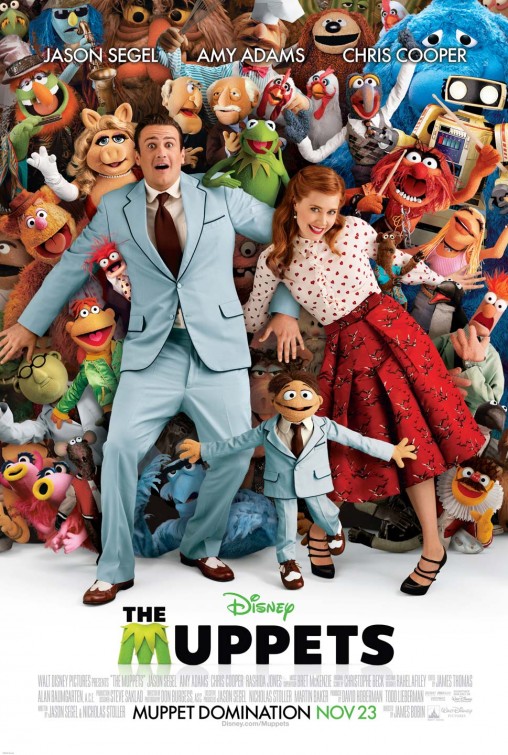 You’d hardly expect the duo behind the raunchy, R-rated comedy Forgetting Sarah Marshall to be the saviors of the Muppets, the famous puppet crew that has been languishing since their last big screen outing, 1999’s underwhelming Muppets in Space. Actor Jason Segel took a meeting with Disney after the Jim Henson Company did some puppet work for Sarah Marshall. He just point-blank asked them what their plans were after acquiring the Muppets. They had nothing. Segel and Nicholas Stoller (Get Him to the Greek) put together a script and, lo and behold, the two self-described Muppet enthusiasts were given the opportunity to bring new life to the classic creatures. The Muppets is just about everything a Muppet lover could ask for and will be sure to entertain a new, younger generation of fans with the Muppets core brand of silliness and sweetness.
Set in the town of Anywhere, Gary (Segel) and his girlfriend Mary (Amy Adams) are planning a trip to Los Angeles. She’s hoping that he’ll finally propose to her in the scenic city of angels. There’s one catch: Gary’s brother Walter is coming along too. Oh, and Walter is a Muppet. Walter is obsessed with the Muppets ever since he watched their TV show in the 1980s. The show was an escape for a kid who felt… different. Walter is anxious to visit the Muppet studios, but the studio is in disarray and the Muppets have all gone their separate ways. Tex Richman (Chris Cooper), what else but an evil oil barren, plans to buy the Muppet studio and tear it down. Walter, Gary, and Mary must seek out the Muppets to rescue the old studio, and the only way to raise enough money in time is to put on one more rendition of The Muppet Show.
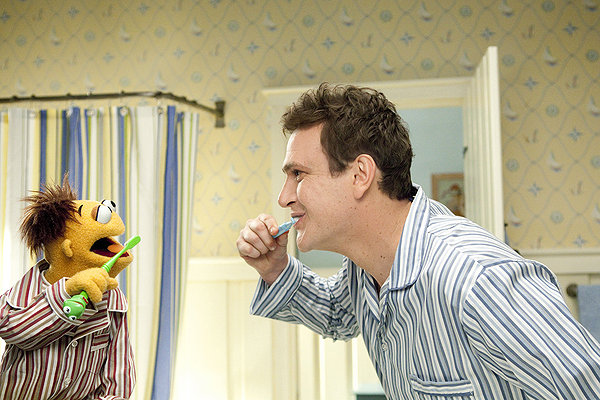 The Muppets is a refreshingly retro and charming vehicle that reminds you of all those warm and fuzzy feelings you had for this crew. It’s unironic, innocent, sweet and wholesome in a way that doesn’t make you gag but self-aware and silly enough to continuously be clever. When a big song-and-dance number breaks out in the town of Anywhere, once the stars have left the townspeople collapse in exhaustion. The gang decides it’ll be quicker to “travel by map,” so we cut to a map and see a red line charting onward. Muppets will regularly break down the fourth wall, with Fozzie commenting on a sudden explosion, “Wow, I didn’t think we had that in the budget.” Tex Richman actually verbally articulates “maniacal laugh.” The group gathering is sped up when the character 80s Robot suggests streamlining the rest in a montage. It’s not the kind of jokes that will make your sides ache with laughter but it pins a smile to your face from beginning to end, although Chris Cooper’s out-of-nowhere rap number left me in stitches. The very question of whether the Muppets can fit into our snarky, over-caffeinated, self-indulgent culture is addressed. Segel and Stoller have found a way to reenergize the Muppets for a new generation while staying true to what makes them special. My friend Eric Muller said watching The Muppets was like “getting an oil change for your soul.” He couldn’t be more right.
Watching the movie, I’m awash in feelings of nostalgia for Jim Henson’s finest creations. Segel is an unabashed Muppets fan and the movie is a celebration of the TV show that inspired him; the TV show is lionized for its inspiration to children. Because of that heavy helping of nostalgia, Muppet fans will feel like their spirits have been lifted. Those who had a mild curiosity about the Muppets will probably just scratch their head and call the film pleasant. The movie’s goal is rather huge: to make the Muppets relevant again. However, the vehicle for this goal, the old puttin’ on a show routine (Mickey Rooney has a cameo!), can feel slight. Also, the Disney product placement can be a bit annoying at times. Really, thanks for reminding us once again about how poor Cars 2 was thanks to a billboard advertisement. The movie isn’t in the same league as Henson’s troika of Muppet movies from the 1970/80s, but Segel and Stoller’s efforts should be a delight for Muppet fans waiting for the triumphant return of their favorite characters. You may find yourself unconsciously singing along to “Rainbow Connection” at the close of the film.
One aspect that is never spoken openly about is the fact that Gary and Walter are brothers, a human and a Muppet. I was expecting some throwaway reference to Walter being adopted, or maybe there could even be a funny sit-down where Walter is given the devastating familial news. We see a montage of the two brothers growing up, and while Gary shoots up like a weed Walter remains at the same height through the years. Does this mean that Muppets attain maturity at a faster rate? That Muppets are fully formed at birth? The mysteries of the universe are left undisturbed.
The music is cheerful and eminently hummable. Recent Muppet outings in the 1990s tried to keep the musical comedy formula going, but the result was some rather tin-eared musical numbers. I challenge anyone to be able to recite more than a few bars from Muppet Treasure Island (my favorite of the three), Muppet Christmas Carol, or Muppets from Space. To everyone’s good fortune, this newest Muppet incarnation has Bret McKenzie, one half of the daffy Flight of the Conchords, supervising the songs. You can instantly tell the musicianship has been raised considerably. The opening number “Sing a Happy Song” is a catchy and bouncy track, putting the audience in the right kind of upbeat mood. “Man or Muppet” is a ballad where Gary and Walter must confront their identity crises. It’s played completely straight, which makes the song even funnier as it builds into a crescendo of self-actualization: “If I’m a man that makes me a Muppet of a man.” There’s also a G-rated performance of Cee-Lo Green’s famous f-bomb kiss-off song, this time performed entirely by chickens. And the aforementioned rap by Chris Cooper is just astoundingly random, and not that bad either. The funny and cheerful music greatly adds to the overall enjoyment of the film.
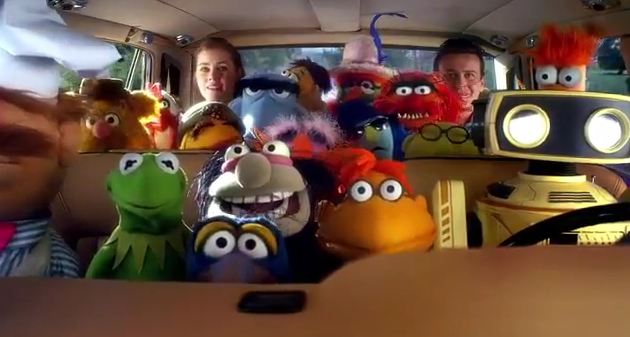 Segel (I Love You, Man) is pretty much a big goofy human version of a Muppet. He’s a winning presence, much like Adams, who slides right back into her adorable Enchanted-flavored M.O. The two actors are a near perfect union of humans who capture the ineffable “Muppetness.” The multitude of celebrity cameos makes for some fun sightseeing (Jack Black has the most extended stay, not by choice). “Hobo Joe” might be my favorite of the cameos. But while the new characters are the initial focus, the emphasis on the film is rightly placed upon the classic Muppets. Kermit and Miss Piggy and the gang are back and the film’s entire plot is essentially their reunion. That means we get wonderful sequences rediscovering the Muppet team, like getting the gang together for a heist. These characters need one another; the bonds are undeniable. It’s actually touching when the Muppets speak candidly about how much they need one another. Fozzie has fallen on hard times especially. Kermit’s mournful song about losing touch with his old pals includes the line, “Was there more I could have said?/ Now they’re just pictures in my head.” While the film’s goal is to really just gather the Muppets back together, you’ll be glad that this goal is accomplished. You will be amazed how much you feel for felt.
The Muppets is a triumphant return to form and rekindles the fondness fans have felt for Jim Henson’s lovable creations. Thanks to Segel and Stoller, and the whimsical direction of Flight of the Conchords director James Bobin, the Muppets is a delightful, charming, and heartfelt family film that will give you a serious case of the warm fuzzies. The songs are catchy, the jokes are amusing, the pacing is swift, and the movie is fun from the start. As a Muppet fan, it left me with a smile pinned to my face the whole time. Like the big screen Simpsons movie, the universe of the Muppets is too big for 90 minutes, so naturally some favorites will be shortchanged when it comes to screen time. Since Disney paid half a billion dollars for the Muppets, I’d expect they plan on making use of the property. After this splendid relaunch, one can only hope that we won’t have to wait too long for the next Muppet movie.
Nate’s Grade: A-
Share this:

The Runaways (2010)
 This fizzy 1970s glam rock biopic on the teen girl rock group The Runaways is a fairly shallow tale elevated by a handful of strong performances. All but completely ignoring the other members of the famous girl group, the movie focuses on lead singer Cherie Currie (Dakota Fanning) and guitarist Joan Jett (Kristen Stewart). Both actresses slip under the skin of their real-life figures, imbuing the anger, desperation, and sheer nerve of pubescent rock stars being exploited. Watching Stewart’s attitude-filled strut, or how Fanning transforms from any other California girl into a slinking rock goddess igniting a Tokyo stage, is downright exciting to behold. But the chief reason to watch this film is Michael Shannon (Revolutionary Road) as the group’s flamboyant, lewd manager who put the girls together. Shannon is his typical bug-eyed sensational self, but the profane tirades he unleashes are downright poetic. He gives the movie a desperately needed pulse, and thus when he leaves the screen he also takes most of our interest. The biggest issue The Runaways has is that writer/director Floria Sigismondi doesn’t convince us why any of this matters. We watch the girls get together, play their first gigs, improve musically, and then all of a sudden they’re famous thanks to a magazine headline montage. Then they’re broken up. You neither feel the rise nor the fall, nor do you ever truly get a good feel for any of the characters. The Runaways spends too much time posing and trying to look fierce when it should have spent more attention on a decent script.
Nate’s Grade: C
Share this:

This Is It (2009)
 More like a DVD behind-the-scenes feature that never materialized, This Is It is a documentary following Michel Jackson’s rehearsal for his comeback concerts that never were to be. The entire film feels more like a memorial service than an actual movie. It feels like a supplement. In between teary interviews where performers express how Jackson inspired others, we do experience some key moments where Jackson reminds us about his brilliance as a performer. The man is relentlessly dedicated to perfecting his vision, and he isn’t afraid to push others. But overall, This Is It is mostly a boring enterprise that ultimately alternates between feeling like a reverent memorial and a crass cash-grab. Unless you’re a Jackson fanatic, there really is no reason to watch this film. It provides no insights into Jackson’s final days, his state of mind, or even the events that lead to his death. I was morbidly searching for any little clues but the movie seems to skip over anything that doesn’t portray the King of Pop as a saint. There will be many documentaries and TV specials in the future that examine the life and impact of Jackson, as well as his bizarre and damages personality, but this isn’t it.
Nate’s Grade: C
Share this:

The Princess and the Frog (2009)
 It’s taken this long to get an African-American leading lady/princess in a Disney animated film, and she gets to spend the majority of the flick as a slimy frog? This return to traditional 2-D animation for Disney is less than a triumph due to a pretty dull storyline. All the familiar elements are there, but the characters just fill voids rather than tell a story. There’s the downtrodden heroine with her dream, the arrogant prince who learns to value others, the comical talking animal sidekicks, and get ready for a slew of songs you will instantly forget despite the added gumbo flavor. Set in 1920s New Orleans, the film has plenty of ravishing visuals to get you through the formulaic plot. It’s a nice return to Disney’s bread and butter before the 3-D animation craze took off, and I pray that there will be plenty more traditional 2-D animation on the horizon from the Mouse House, but this isn’t the best film to reestablish the glory of traditional animation, racial politics aside.
Nate’s Grade: B-
Share this:

Nine (2009)
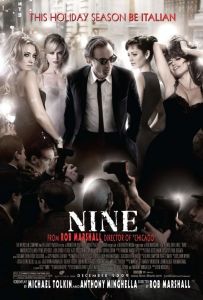 Filled with beautiful stars, beautiful Italian scenery, and beautiful cinematography, Nine has some significant sure-fire flash, but it’s missing the dazzle (or is it razzle?). The movie based on the 1980s Broadway musical based upon the Fellini movie, 8 1/2, is a pretty hollow enterprise. It’s all about writer’s block, and unless you’re the Coen brothers this is not a very interesting conflict to watch on screen. Daniel Day-Lewis plays Guido, a famous Italian director feeling overwhelmed by the impending start of his ninth movie, a movie he hasn’t written a script for yet. He tries to find inspiration from his wife (Marion Cotillard), his mistress (Penelope Cruz), his muse/lead actress (Nicole Kidman), his dead mother (Sophia Loren), a magazine journalist (Kate Hudson), and just about anybody else. The film is structured much like director Rob Marshall’s Oscar-winning musical Chicago, where the song-and-dance numbers are little mental asides inside the characters’ minds. So most actresses get one big number and then it’s arevaderche. Day-Lewis is good but his character is hard to emphasize with, especially as he bounces from woman to woman, whining about the duress of creativity while anybody minus a Y chromosome (and who isn’t Judi Dench) throw themselves at the guy. Despite the lackluster story and characters, Nine still could have succeeded from its musical numbers. Too bad then that the songs are instantly forgettable. Seriously, if you put a gun to my head mere minutes after I heard these tunes I wouldn’t be able to hum a bar. The dancing is lively, and Cruz and Cotillard prove to be infinitely and tantalizingly flexible, but the songs are truly unimpressive. I never would have guessed that in a movie filled with so many Oscar-winners that Fergie would be the highpoint. She plays a lustful figure of Day-Lewis’ youth, and her number exudes a vivacious sensuality. The playful choreography incorporates sand on the stage, which makes for several great images and dance moves. The song is also by far the catchiest, “Be Italian,” and the only thing worth remembering. The trouble for Nine is that there’s another hour left after this peak. I’m astounded that people thought, at one time, that Nine was going to be a serious awards contender. This has the “parts” of an awards movie but no vision or verve to assemble them.
Nate’s Grade: C


 nathanzoebl
You must be logged in to post a comment.