Blog Archives
Everybody’s Talking About Jamie (2021)
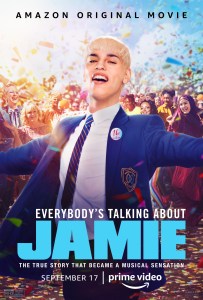 What a jubilant, heartwarming, and celebratory musical to lift up your spirits and evoke a few happy tears, especially in the wake of trying to comprehend the mystifying ongoing appeal of another high-profile musical, Dear Evan Hansen. I wish every person chose to watch this Amazon Prime original movie versus that other musical that made me deeply uncomfortable and angry. This is based on the London stage show, and adapted and directed by the original creators, we follow the true-story of a 16-year-old Jamie (Max Harwood) who dreams of embracing his inner drag queen. His conservative father (Ralph Ineson) doesn’t approve and has left him and his working-class mum (Sarah Lancashire) behind to start a new family. Jamie is working on finding his voice and confidence. He comes under the tutelage of an aging former drag queen (Richard E. Grant) who encouraged and educates Jamie in the ways of showbiz and style (“A boy in a dress is someone that can be laughed at, but a drag queen is someone to be feared!”). Right away, I felt like this was what The Prom was aiming for, a big LGBTQ+ musical bursting with empathetic feeling and anthemic empowerment. The musical numbers are fun and frothy when they want to be, taking playful advantage of the expanded visual space of film. However, when the film wants you to feel emotions, it can hit you hard, and I was tearing up as Grant’s character poignantly sings about the heyday of 80/90s drag scene with the AIDS crisis taking its tragic toll. I don’t mean to keep harping on this, but I felt more genuine emotion in that one moment than throughout the entirety of Dear Evan Hansen. The movie is more considerate with its supporting players and finds moments of grace and compassion for just about every player, and with thrumming harmonies and feel-good lyrics. It’s a charming, funny, and definitely worth remembering. Everybody should be talking about Everybody’s Talking About Jamie.
Nate’s Grade: B+
Share this:

Dear Evan Hansen (2021)
 If you’re unfamiliar with Dear Evan Hansen or do not consider yourself among the fandom of the Tony-wining Broadway musical, then I would highly recommend watching a 2009 movie called World’s Greatest Dad, a film I will be referring to later in this review. It’s a smaller indie starring Robin Williams and written and directed by actor-turned-director Bobcat Goldthwait. It also has a very similar premise of a character exploiting the grief of others to try and better their own personal standing by fabricating an introspective life for a high school student who recently took their own life. The exception is that World’s Greatest Dad played its heavy content for dark comedy and stinging satire and it never excused the behavior of its lead character as he manipulated the collective sympathies of others for personal gain. As I kept watching Dear Evan Hansen, I kept feeling like someone had attempted to make World’s Greatest Dad but played straight and absent the satire, and that was a very bad decision.
Evan Hansen (Ben Platt) is a high school senior and has more anxiety disorders than friends. He starts the school year with cast on his arm, the result of “falling” from a tree. Evan writes motivational letters to himself as a therapeutic exercise for his counselor, but Conner (Colton Ryan) steals the paper at school and freaks out when Evan expresses interest in Conner’s younger sister, Zoe (Kaitlyn Dever). Conner’s only two appearances on screen both involve him shoving, yelling, and threatening Evan. Days later, Conner has taken his life and the only letter his family has found was the “Dear Evan Hansen” paper he snatched away. Conner’s parents (Amy Adams, Danny Pino) are eager to know anything about their emotionally troubled and secretive son. They didn’t know he had any friends let alone one he would compose his suicide note for. Evan doesn’t come clean and instead plays along, happy to provide a false version of their son, one who was bristling with thoughts and compassion he could never properly express. Evan spends more and more time with Zoe, trying to share his own romantic feelings, and getting deeper into his lies.
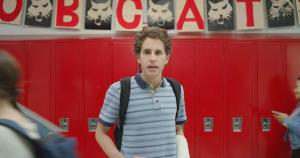 This was a deeply uncomfortable experience for me, and I don’t quite understand how fans of the theater show were so moved and uplifted and, frankly, entertained. Maybe all this drama plays better on the stage, though I think many of the same issues I would have with the story would be evidently present for the stage productions as well. The main character is presented as lonely and anxious and depressed and longing to make connections, and this is meant to serve as the emotional explanation for why he leaps at a chance to insert himself into another family and manufacture a false identity about their dead son to score with the girl he’s been crushing on from afar for an indeterminate amount of time. Evan Hansen is, quite simply, a monster of a human being. Through tortured coincidence, he is believed to be Connor’s only friend, and Evan can at any point clarify this mistake and explain the truth. But he chooses instead to supply a fictional version of Connor that he feels every member of his family needs to hear to feel better about themselves. Evan justifies his actions as kind lies, as helping those in mourning by telling them what they want to hear, what he feels like they need. It’s not his place to decide what people need to better grieve, and Evan uses his newly favored position as the rare Rosetta Stone to Conner, the keeper of his secret internal life, to manipulate everyone to like him more.
I felt increasingly uncomfortable and upset the longer Dear Evan Hansen progressed with its treacly story, especially as Evan sets his sights on Zoe. It’s not as if over the course of his mounting lies that he organically grew closer to this woman who had been a stranger; he has been crushing on her and uses fake emails written by her brother to express his unrequited feelings for her in a song that DEFINITELY does not feel like it was written from a brother to a sister unless we’re talking like Game of Thrones territory (“There’s nothing like your smile / Sort of subtle and perfect and real”). Both of those scenarios are bad, but one of them is so much worse, and that’s the route Dear Evan Hansen goes. The romance is gross, and I knew that the movie was going to let Evan off the hook by the end. Once the truth, the real truth comes out, no one should want anything to do with this person. He says he meant well but he’s also the kind of guy who literally uses the fake suicide note, which all the characters believe to be legit, as an emotional cudgel to quiet and shame his biggest doubter as she starts to pick apart his lies. When that moment happened, I wanted to strongly yell at the screen, “Dear Evan Hansen, you dearly suck.”
 There’s a worthy message buried somewhere in this movie about reaching out to people who are struggling in the shadows, that mental illness can affect anyone, and that often those who look like they live perfect lives on the surface might just be better at hiding their pain. This is best exemplified in the supporting character of Alana (Amandla Stenberg), the school president who has a raft of anxieties that she keeps to herself. Her moments of vulnerability feel the most honest in the entire movie, and she’s trying to allow Conner’s death to reach others who might also be struggling, to inspire and save lives through their fledgling organization, The Conner Project. She’s the one who is putting in the actual work, both physical and emotional labor, and she’s the one who Evan shames with the mistaken suicide note toward the end of the movie. The tone of this movie is amiss from early on, and there’s a jaunty musical number where Evan and his one friend comically write fake emails between Evan and Conner. It’s played so light and breezy that you’ll have to recall this is Evan manufacturing the evidence of his fabrications. Why is this played so flippantly and like we’re in on the goofy gag? It’s mishandled. The good intentions Evan Hansen the movie, much like the potential good intentions of Evan Hansen the character, are clouded and ultimately sabotaged by its misguided solipsistic approach to grief.
And it’s taken me this long to talk about another key hindrance and that’s the casting of Platt in the title role. Platt originated the role on Broadway in 2015, and yes he wouldn’t be the first actor in history playing a high schooler who was clearly older, but they have made a gigantic miscalculation in trying to make Platt appear as a youthful 18-year-old (for the record, he was playing a college student almost a decade ago in 2012’s Pitch Perfect). It hit me immediately that Platt does not look right for this role. Immediately. In the awkward attempts to make him more youthful, they have made him look like a shifty undercover cop at a school (“Are you a cop, dear Evan Hansen? You have to tell me if you’re a cop.”). His pasty skin is so smoothed out as to appear like a shiny mask. His hair is oily, stringy, and looks like a terrible wig, except I have read that it is unfortunately real. Evan Hansen looks like he’s wearing a bad hair piece. Platt’s performance also left me cold. His mannered, affectless delivery gave me the impression of a sterile serial killer with every fifth line. This may sound overly harsh, but the presence of Platt and his performance dooms this movie’s bid for believability. I understand wanting to reach out to the man who left his mark on the role early, but there is a reason that Lin-Manuel Miranda played an older supporting role and not the headstrong young lead for the In the Heights movie adaptation earlier this year. Let the movie be its own thing from the stage show. Then again, there’s a rubbernecking fascination with Platt in place, magnifying all the other sins. If there was going to be a bad movie for Dear Evan Hansen, and I question if a good movie was at all possible, then why not go for broke with misapplied creative decisions that make it worse?
 A lone saving grace for this movie is that the music is actually pretty solid. Justin Paul and Benj Pasek, the Oscar-winning team behind La La Land and The Greatest Showman, can craft some catchy melodies with soaring choruses. If you only listen to the music you might come away with a different opinion of this show and movie. However, the context of what these songs are meant to serve in the larger story besmirches the good feelings you may derive from them. I suggest casually listening to the soundtrack and forgetting the icky context of every tune. Julianne Moore, as Evan’s overworked, stressed-out mother, has a nice song toward the very end that feels more honest and pared down than much of the drama allows.
I was re-reading my review of World’s Greatest Dad, an underrated movie that managed to make my top ten of that year. It reads so closely to this movie but also how this story needs to be told: “The movie satirizes grief culture with sharp acuity… Suddenly their fallen peer has transformed from the kid nobody liked into the wounded soul that touched all their lives. Bullies reexamine their behavior, girls that never would have given him the time of day now immortalize Kyle, and the faculty that wanted to expel him now wishes to rename the library in his lasting memory. This warm, fuzzy gauze of grief is Goldthwait’s target. He is satirizing how people turn tragedy into hypocritical attitude shifts. He ridicules the easy revision of history under the guise of collective sympathy. Not every youth is necessarily taken before their time. Not everyone was going to grow up to contribute selflessly to society, making the world a better place to live. Not every youth is deserving of canonization. Some people are just jerks from beginning to end, and Goldthwait proposes we do a disservice when we whitewash reality in the name of kindness and good taste.” That sounds like the better version of Dear Evan Hansen to me, except that’s not exactly the kind of musical that people hug over and buy a T-shirt or hat to adorn on the drive home.
 If you’re among the fandom for Dear Evan Hansen, I’m sure you’ll find enough to enjoy with director Stephen Chbosky’s big screen adaptation. I don’t want this to sound condescending, but you’ve likely already built the excuses for the characters and the story and made peace with whatever ethical foibles persist, so whether it’s on the stage or on the screen matters little. For those unfamiliar with the popular stage show, I don’t know what your takeaway will be but I’m positive this is not the best introduction. Again, Dear Evan Hansen is not the first musical to deal with complicated ethical scenarios and with morally compromised characters trying to do their best with the hands that fate has dealt them. Empathy is a powerful tool for storytelling, and that’s what Evan Hansen weaponizes for his own personal gain. I found this movie to be uncomfortable, misguided, and emotionally exploitative just like its hero. If the movie was critical of Evan’s bad behavior, then maybe this would be a different matter. It wants you to understand that Evan is hurting and therefore complicated. Well, Evan Hansen, there’s a lot of people in this world that are struggling with mental health issues, and suicide ideation, but they don’t manipulate and exploit those they deem are most important to them. Sorry Evan, and sorry Dear Evan Hansen, but you can stay waving behind a window for all that I care.
Nate’s Grade: D+
Share this:

Glitter (2001) [Review Re-View]

Originally released September 21, 2001:
It must be seen to be believed. A new college crap-fest drinking game has begun. Begin the Glitter midnight shows! A new age is upon us! Here are a few handful of Glitter‘s bon-mots it serves up to its audience:
-Mariah Carey is shown leaving her real mom at age 8 with her kitten. Somewhere through Glitter she has a fight with her boyfriend and takes her cat (yes the very same immortal cat that must have been pushing 20) and leaves.
-She has a fight with said boyfriend and they both try and write a love song to show their remorse. Except they BOTH come up with the EXACT same song word for word, note for note, and NO ONE thinks this is the creepiest thing ever.
-The movie freakin’ ends with Carey’s boyfriend getting shot and killed. Yes, this is truly how the thing ends. Oh, like any of you cared about plot spoilers anyway.
-Da Brat is in it for “comic relief.”
-The movie is inexplicably set in the 1980s for no reason.
Anyone would have to be crazy thinking Glitter ever remotely resembled art. It’s so bad it’s awesome to watch. Bring some friends over, open up some alcohol, and let the fun times begin.
Nate’s Grade: F, like it matters though
——————————————————
WRITER REFLECTIONS 20 YEARS LATER
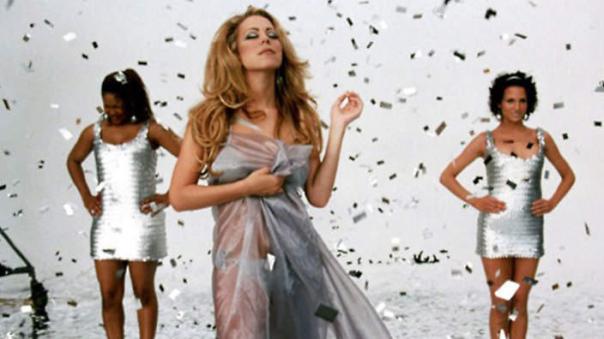
Apologies to Mariah Carey, but it’s impossible for me to think about Glitter without thinking about 9/11. I’m not intending to make some snide, crass joke about Carey’s film debut/vanity project bombing so spectacularly considering the tragic terrorist attack that changed everything occurred the week prior to its release. 9/11 was the seminal event of the twenty-first century and a “where were you on that day?” question for Millennials and older generations. As we approach twenty years since that fateful day, it’s hard not to reminisce and pontificate about tragedy, art, and possible catharsis, and yes, eventually Glitter will factor into this prosaic essay too.
Every person has a story. I was a sophomore in college, walking to the campus center to collect a copy of The New York Times, a subscription had been a requirement of my Political Science 101 class. I grabbed my day’s edition and another student said, “Hey, did you hear? Planes hit the World Trade Center.” I remember it not really processing for me and wondering what he was talking about. I went back to my dorm, turned on the news, and was quickly dumbstruck. I eventually wandered into my friend Amanda Hickey’s dorm and we stared glued at the TV as the towers fell and I remember the news people trying to square what was happening. It wasn’t just the south wall coming down, it was the entire building. As the day continued, and more attacks commenced, I remember one girl shaking saying she had just been to the Trade Center (over six months ago, so not exactly like a near miss), and another girl scared that our Jewish-heavy suburb could be the next target. To be fair, it was an alarming time, and nobody quite knew how many more potential planes were to be hijacked next. Nobody quite knew how many potential targets there would be. The federal buildings across the country were shut down. Parents pulled their kids out of school. We all felt vulnerable. Some of us more than others. I had a friend at school, Gavin, who was from New York and whose mother worked in the Trade Center. He was wrecked trying to get a hold of her, and fortunately she did make it out of the second tower and survived. I remember the numbness and feeling like you were watching a movie, like it wasn’t really happening, it was only special effects. It couldn’t possibly be real.

In the weeks and months to come from 9/11, America was looking for an outlet, looking for some kind of unifying force to heal, and that reluctant recipient ended up being Glitter. The movie was clearly intended to be a vehicle for Carey to stretch herself as an actress. It didn’t turn out that way for her though Carey did a more measured (and less glamorous! they always wanted us to know for publicity) supporting turn later in 2009’s Precious. Glitter was a project Carey had been working towards for years. At the start of 2001, Carey signed a $100-million-dollar contract for five albums for Virgin Records. She left her first husband, the controlling music exec Tommy Mottola, in 1998, left Columbia Records, and felt the pressure to deliver. She was one of the best-selling, most successful artists of the 1990s and was declared Billboard’s Artist of the Decade. From July 2001, Carey began behaving erratically. In promotion on MTV’s Total Request Live, she appeared with an ice cream cart, performed an awkward strip tease, and was shortly after hospitalized for a breakdown. On her website she posted: “I’m trying to understand things in life right now and so I really don’t feel that I should be doing music right now… All I really want is [to] just be me and that’s what I should have done in the first place … I don’t say this much but guess what, I don’t take care of myself.” She did not promote Glitter. The soundtrack was released on… September 11 and was also Carey’s lowest-selling album of her career. The movie was released on September 21 and grossed only four million. In 2002, Virgin bought out her $100-million contract for only $28 million.
With the wounds of 9/11 so fresh, it was easy to pile onto Glitter, the first new Hollywood release, as the bad movie that the nation needed right now to hate watch to feel better about itself. The New York Times said it was “an unintentionally hilarious compendium of time-tested cinematic cliches.” Variety said, “as phony a vehicle as one could concoct for a wannabe movie star.” The Village Voice said, “A heart-wrenching debacle from the start of the gun.” The Miami Herald said, “The kind of movie only 11-year-old girls who dot their I’s with hearts would find bearable.” Roger Ebert said the film lacked joy. The New York Daily News said it was “the worst performance by a pop star in a dramatic role since Madonna suited up for Shanghai Surprise.” The Washington Post said the movie was more a showcase for Carey’s breasts. The film appeared on numerous Worst of the Year lists and was nominated for 6 Razzies including Worst Film, with Carey winning the ignoble Worst Actress Award (over fellow nominees, and future Academy nominees, Penelope Cruz, Charlize Theron, and Angelina Jolie).
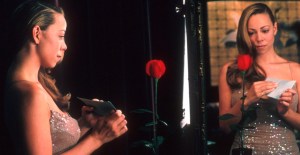
My review was among that throng so eager to find an outlet for our pain, a needed distraction from the harsh reality of wall-to-wall news. I gave the movie a failing grade and declared, “It must be seen to be believed. A new college crap-fest drinking game has begun. Begin the Glitter midnight shows! A new age is upon us!” Suffice to say, Glitter never entered the holy circuit of so-bad-it’s-good movies. I’ve never watched it again in the ensuring twenty years, and upon finally coming back to Glitter in 2021, I have concluded that it’s just thoroughly mediocre and dull. It’s not a good movie. It’s a limp retelling of A Star is Born with a weak romance between Carey’s character Billie Frank and her music producer boyfriend Julian who eventually dies, killed by none other than Terrence Howard (Iron Man), playing a scornful competing music producer who demanded money for “leasing” Billie from his employ as a backup singer. It’s just so thoroughly dull. It’s filled with listless songs from Carey, tracks she had reportedly been working on for years beforehand, and the rise to stardom is absent anything engaging. There are a handful of quirks, like the fact that Billie’s cat seems to be immortal and that she and her boyfriend, separated after a fight, both pen the exact same makeup song. These are fleeting moments but only moments of bizarre fascination. The movie is just an earnest, cloying, and altogether boring retelling of a formula you’ve seen in a thousand other dull movies. It’s not even great at being bad. Everything about Glitter is dull, middling, and not worth your time. Freddy Got Fingered was clearly the worst film of 2001 and still resonates as one of the worst films.
So why did everyone delight in ripping apart this mediocre movie from a troubled pop star? Maybe some were looking for a scapegoat for derision, something to feel superior to at a time where political upheaval made many of us feel like we were plummeting and lost. Maybe it was simply a distraction at a point of feeling overwhelmed by the elevated seriousness of the world, of the news, of our post-9/11 reality and its implications. In some way, Glitter was the first step in the process of art as processing for trauma. I’m not being hyperbolic. We needed Glitter.
In the years to come, a question emerged whether American audiences would want to see movies examining 9/11 and the subsequent War in Iraq. In 2006, Paul Greengrass directed a stirring recreation of the events of Flight 93 on 9/11, the one plane that crashed before its intended target, believed to be the U.S. Capitol. It was my top film of 2006, and Greengrass was nominated for Best Director at the Academy Awards. I remember a conversation where the other person argued it was “too soon” for these kinds of movies. That was the criticism you heard repeated, “too soon,” though that determination will always be different for everyone. Some may find the act of viewership with drama as a therapeutic exercise that can help process complex feelings from trauma. Storytelling can lead people to potential catharsis, a release of heavy emotions, and maybe even a sense of clarity or closure. I remember being an emotional wreck during my 2006 screening and listening to the handful of other people in the theater openly sob. How does one eat a bucket of popcorn to such a movie? The same could be said of a movie about the Holocaust, or slavery, or any of the horrors of history depicted on screen. Storytelling is how we process, learn, and relate to history and its numerous dicey moments. With art, we can possibly achieve catharsis through recognition. Again, not everyone will follow the same therapeutic path. I can completely understand if a person declares they never need to see a movie about the Holocaust, but I would lament that they will miss out on some of cinema’s masterpieces of drama. Art allows us to better know ourselves and to heal and better ourselves under the right context.

If Glitter had come out in 2002, I doubt it would have received the intensity of the critical drubbing it did in the week after 9/11. It’s not a good movie today. It will never be a good movie, but it’s not one of the worst movies of all time, or even of 2001, and the community went overboard because we needed an escape and a collective joke that we could all be amused from amidst the grind of tragedy and tumult. I think even the scathing and sexist critiques of Carey at the time would be pulled back for sensitivity of a woman clearly going through mental health issues. The Razzies nominated Carey’s breasts for Worst Onscreen Pair, a strange and icky joke that I still don’t even know is intended to be defamatory or gross admiration. With twenty years of hindsight, as we approach the anniversary of 9/11, I’ve become less hostile to Glitter. It came out during a time of national psychological need and served a purpose, entertainment even if it was misidentified as so-bad-it’s-good in the zeal to find a powerful escape. The history of Glitter will always be tied to a national tragedy but, oddly enough, its legacy shouldn’t be about Carey’s faulty acting career, or personal troubles, but as the healing nature of art itself. Take that for what it’s worth as you’re doing the math to figure out how old Billie’s cat is.
Re-Review Grade: C-
Share this:

Cinderella (2021)
 Do we need another rendition of good ole’ Cinderella, especially only a few years after the Disney live-action version? The new Cinderella starring pop star Camila Cabello is a surprise jukebox musical, and it’s irreverent where it should be and progressive where social critiques are warranted with the source and historical context. In short, it’s a fleeting but fun experience that’s a winning 100 minutes for families with young children and adults who enjoy a peppy, self-referential musical. Written and directed by Kay Cannon (Pitch Perfect), this movie is packed with singing and dancing to the point that the talking only makes up perhaps twenty percent of the movie. This choice proves to be a durable source of energy and keeps the pacing running smooth. It’s also convenient because we don’t need extra time explaining the setup and character dynamics that we’re all so familiar with at this point thanks to the umpteenth renditions. The mash-up of popular songs kept me amused and guessing what would appear next, and the original songs contributed by Cabello have a nice soaring uplift to them as well as memorable hooks. There’s a “What a Man”/”Seven Nation Army” mashup at a ball that gave me strong Moulin Rouge vibes, especially with all that chaotic sashaying petticoat editing. The movie is also funnier than I expected, with consistent wise-cracking and one-liners that had me laughing and critiques about the patriarchal system from a progressive, feminist perspective. The evil stepmother, played by Idina Menzel (Frozen), is even given her own song detailing her tragic history of being a musical prodigy who had to give it all up in a society that only valued her as marriage material. Even she gets consideration and empathy. The winking feminist criticisms won’t be new to anyone over the age of twelve, but it’s still welcomed even as the film skates over the discordant plot elements to keep things light. The film delivers some bon mots of political thought to go along with its sugary sweetness of a contemporary sing-a-long musical that is easy to digest. Cabello has a natural charisma to her and is surprisingly adept with comedy, able to turn on a dime and deliver a hilarious self-effacing remark. She’s far better at acting than you might believe. If you have no interest in another version of Cinderella, I understand the fatigue with the property. However, this Cinderella understands your fatigue, provides something light and airy, with actors who seem to be legitimately having fun, and it’s got a consistent feminist perspective that chides the prevalent problems with the source material. It works as a family film and even as a diverting jukebox musical for adults whose tastes run a little sweet and a little tart.
Nate’s Grade: B
Share this:

In the Heights (2021)
 Weeks ago, I listened to the original Tony Award-winning 2008 Broadway recording for In the Heights, the first major musical by multi-hyphenate artistic virtuoso, Lin-Manuel Miranda. I had never heard the music before and I found that, over the course of a couple hours, little of it stuck with me. There were a handful of tracks where I thought it was nice but nothing grabbed me the way that Hamilton’s soundtrack did from the very start. Because of that musical dip, my expectations lowered slightly for the long-anticipated movie musical of In the Heights. Well, dear reader, let me say what a monumental world of difference seeing the songs in their proper context, with character relationships, and the able performances of the actors can do for making the music come alive. In the Heights is an exuberantly joyous experience, one brimming with energy and good vibes and a warm-hearted welcome that serves as the best argument movie theaters can have to come back and experience the pleasures of the big screen with your friends and family.
Usnavi (Anthony Ramos) is a twenty-something bodega owner in New York City’s Washington Heights neighborhood and dreaming about returning to his home in the Dominican Republic. His young cousin Sonny (Gregory Diaz IV) helps him stock the shelves and keep the family business going. We follow the many faces of the neighborhood, like Abuela (Olga Merediz), who has helped raise everyone as a sweetly matronly figure, Nina (Leslie Grace), returning home from her first year at Stanford as the “girl who made something of herself,” Benny (Corey Hawkins) who was in a relationship with Nina and is looking to work his way up as a cab dispatcher, Daniella (Daphne Rubin-Vega) who is moving her popular salon into another neighborhood, and Vanessa (Melissa Barrera), an aspiring fashion designer who dreams of relocating into Manhattan’s fashion district. Usnavi has been nursing a crush over Vanessa for ages, but will he finally make a move before leaving the country for good to return to the Caribbean?
 This is such a positive and overwhelmingly optimistic story that it becomes infectious, a pleasing balm to sooth all that ails you. It’s very easy to get swept away in the enthusiasm and energy of the movie, enough so that after the exemplary opening number setting up our characters, our setting, and our relationships and goals, people in my theater actually clapped, and I almost felt like joining them. In the Heights succeeds through how relatable and specific it comes across, lovingly showcasing the diverse population of Washington Heights and the community that feels at home here. It’s built upon the celebration of its specific, Latin-American heritage and culture but the movie is also constructed to be so accessible and welcoming to others to learn and join in. The themes and conflicts of these people have specific touchstones to their community, like the threat of deportation and the encroachment of gentrification taking away their neighborhood, but the inner conflicts like feeling the pressure to succeed and questioning whether your dreams are practical are worries that anyone regardless of ethnic background can relate to. In the Heights finds that sweet spot where it’s reverential to its own cultural background and open for anyone.
Naturally, in a musical, much of the appeal will live or die depending upon the quality of the music and the vitality of the performances. With In the Heights, the music and lyrics are quite good and the presentation is phenomenal. If you’re a fan of Hamilton, and if you have ears I assume you would be, it’s fun to listen to the early seeds that would become the signature sound for Lin-Manuel Miranda. There are similar salsa/merengue melodies and hip-hop-infused syncopations that will be familiar to the legions of Hamilton fans, including some rhymes (“Eyes on the horizon” among others). In many ways it’s like watching a junior thesis project of a genius. The opening number does a fantastic job of table setting as well as bringing the audience into this world and getting us excited for more. Usnavi, and Ramos especially, takes full control of our attention and command of the world with fast-paced delivery and extra charisma. There are more bouncy, humorous tunes like “No Me Diga” set in a salon replete with literal bobbing weaves, more traditional Broadway ballads like “Breathe” about a character expressing her doubts and guilt, and the Cole Porter-esque smooth jazz of our young lovers dancing and declaring their affection for one another like “When the Sun Goes Down.”
 But the best moments are the ones that open up the big space and bring the whole community of Washington Heights into the mix. The electricity of the opening number is rekindled in “96,000” where a trip to the local pool turns into a jumping jamboree where everyone dreams about what they would do with a winning lottery ticket sold at Usnavi’s bodega. It allows each character an opportunity to share their dream and what is important to them, providing each person a platform to be more defined. It also taps into that bubbling optimism that permeates the entire movie. The grand finale also has the same effect as characters sing their hearts out about lessons learned and wisdom gained and, thanks to the medium of film, it provides a happy ever after resolution that was unavailable on stage. Miranda is excellent at weaving musical themes to come back into multi-harmonic convergences and crescendos, and it all comes to a rousing and uplifting conclusion.
Another concern about big screen musicals is whether they can translate to the visual landscape of cinema, whether they can escape the trappings of the stage, and In the Heights is exactly how musicals should be filmed. Director John M. Chu (Crazy Rich Asians) got his filmmaking start with the Step Up dance franchise and knows, whatever the film, how to keep things moving swiftly and full of vivacious energy. Even at nearly two-and-a-half hours long, In the Heights doesn’t feel like it has any noticeable down time. The filmmaking choices adapt with the needs and intents of the songs, so when we have a fast-paced multi-part song and dance, the editing adopts this speed, and when we have large ensembles the cinematography widens to take in the expansive group choreography. When things need to slow down and become more intimate, Chu’s camera adopts to this and relies on longer tracking shots and close to medium shots. The pool choreography in “96,000” is splashy fun and lively and very colorful, and the quick visual cues and edits of “In the Heights” incorporates the neighborhood into the music to make New York City feel like a living participant. Chu’s direction takes full advantage of what film can offer but still makes the viewer feel the same intimacy and vibrancy of live theater.
 There are two standout movie moments. The first is the song “Paciencia Y Fe” that does so much symbolic heavy lifting about the immigrant experience, discrimination, and the long struggle for personal dignity, that it made me tear up by the end for a character that, only moments before the empathetic expose, was a nominally nice old lady. The other is “When the Sun Goes Down” between Benny and Nina, which begins with them gazing out a fire escape and takes a magical turn into dancing along the walls of their building like Spider-Man. That transitional moment, from the ordinary to the extraordinary, is the only real magical realism in the show, so Chu has been saving it up for his big moment. The dance is beautiful to behold, and the perspective has an Inception-style spin that alters their balance and perspective of what is up. It’s a beautiful movie moment, captured in long takes, and reminiscent of Fred Astaire’s fanciful fantasias.
Ramos (A Star is Born) played John Laurens in the initial stage show of Hamilton, and its filmed production on Disney Plus, and now he gets his own starring vehicle. He is tremendous as Usnavi, convincingly laid back and charming while also being amusingly anxious around his crush. The awkward romantic fumbles are adorable. Ramos’ singing and skill with the flow of rap lyrics is impressive, but he’s also providing a performance first and worrying about the singing second, not that he should be worried on that front. Hawkins (Straight Outta Compton) surprised me with the range of his singing, and he’s such a pleasant presence to have along. Gregory Diaz IV (Vampires vs. the Bronx) is hilarious at times, like when he’s adopting a macho voice to ask Vanessa adult questions, but he can also break your heart like when he reveals his own legal vulnerability. His poolside solo is also a delightful interjection about what his own rap skills comprise. Merediz (Godmothered) is the only holdover from the original stage show and she is so captivating in her signature number that it’s easy to understand why she was nominated for a Tony Award. There are so many amusing and enjoyable supporting characters populated by familiar faces, like the women of the salon (Rent’s Ruben-Vega, Brooklyn 99’s Stephanie Beatriz, and Orange is the New Black’s Dascha Polanco) providing comic relief and a playful attitude, Jimmy Smits as the noble father giving of himself for his daughter’s future, and Miranda and Hamilton’s Christopher Jackson as dueling sweet treat vendors vying for summer supremacy. You’ll enjoy your time in Washington Heights thanks to these fine folks.
It’s unfair to directly compare In the Heights to Hamilton, like looking at an artist’s portfolio and complaining it isn’t quite up to the standards of Da Vinci, but one area where In the Heights does come up short is the depth of its characterization. The film exudes good vibes as it skips over topical and important political issues with an optimism that might, arguably, borderline on naivete. This feels almost like the opposite-minded compliment to Spike Lee’s Do the Right Thing, another tale of a New York City block one very hot day. The characters are kept at a genial level of interest that makes them enough to feel for and root for, but they’re not exactly deep portrayals with complex conflicts. All the characters have a singularly defined personal conflict that can be resolved by the end, and the lessons about learning to listen to others, appreciate family and self, and find home where you feel it are not exactly revolutionary or complex. Again, this stuff works, and I understand why the story needs characters that have lesser complexity and definition to fulfill the different levels of life. It’s just when compared to the depth of the real people of Hamilton where you realize that maybe the colorful characters of Washington Heights are held to a lesser standard and simply not as multi-dimensional.
 In the Heights is a joyous experience that I think I’ll enjoy more upon re-watching and listening to the soundtrack over the summer months. I can completely understand why people fell in love with this musical upon its initial release and touring, and I can also acknowledge that it’s clearly an earlier artistic steppingstone to greater later achievements for Miranda. That’s not to take anything away from the pleasures of this particular story, these particular characters, and especially these particular songs. In the Heights is a lively and welcoming musical experience that carries a deep affection for its cultural roots and invitation for others to join that celebration. It’s powerfully optimistic that it’s so easy to be swept away and smile with its charms and uplift. In the Heights takes advantage of its cinematic opportunities, the charisma and energy of the talented cast, and the soaring and lovely melodies and catchy rhymes from Miranda. In the Heights is a great way to kick off a return to a summer season at the movies.
Nate’s Grade: A-
Share this:

Moulin Rouge! (2001) [Review Re-View]

Released May 17, 2001:
Director Baz Luhrmann’s last project was the MTV-friendly William Shakespeare’s Romeo + Juliet (like someone else has a Romeo and Juliet) which was adored by the under 15 set that now buy N*SYNC merchandise. Luhrmann waited a long time for his follow up with Moulin Rogue, a manic musical that seems like candy for the eyes. It may have been a long time but it was well worth the wait.
The sparkling world of Moulin Rogue is around turn of the century France. Christian (Ewan McGregor), an aspiring writer, has traveled to this place against his father’s wishes. Christian believes in the beauty of love and the pull of the heart. Within minutes of setting foot in France he gets wrapped up into a production by a dwarf (John Leguizamo) and his cadre of assistants. Christian is sent to the most provocative club in town, the Moulin Rogue. Here he attempts to persuade the most famous showgirl Satine (Nicole Kidman) to help push for their musical to get financial backing. Satine inadvertently confuses Christian for the man she is supposed to seduce for a large some of money, the Duke (Richard Roxburgh). And thus the merry band of misfits get their play the backing while Christian blossoms a love for Satine. But their love must remain hidden for the Duke is led to believe that Satine is his and his alone.

Kidman owns this movie, plain and simple. From her first shattering entrance being lowered from the ceiling to the last scene, she is absolutely magnificent. McGregor gives a nice performance as the dough-eyed lover. Jim Broadbent plays the Moulin Rogue’s owner, Zidler with howling delight in all his manic expressions. Even Roxburgh gives an underwritten antagonist the right amount of weasely twitch.
One of the more surprising features is how well the two leads can actually sing. Kidman gives a soft and sexy take on “Diamonds are a Girl’s Best Friend” and McGregor can belt out a tune with some admirably throaty pipes. As these two veer in and out of songs it’s a pleasure to watch and hear.
Luhrmann has crafted a musical with ADD, but I say this as a compliment. Moulin Rogue‘s pace is fast and pounding. People twirl above the sky, the camera zooms wildly through town streets, and dump trucks worth of confetti fly through the air. Moulin Rouge is exploding with glitz and never lets up. The editing and visual artistry is stirring. By about ten minutes into the proceedings when a green fairy starts singing a seductive version of “The Hills Are Alive” you know you are in for something else. And what a something else the film delivers. There was not a moment I didn’t have a smile glued to my stupid face.

Moulin Rogue could be described as a musical for people who dislike traditional musicals. In traditional musicals people go along stuffy formula, then break out into great choreography song-and-dance. With Lurhmann’s musical is a breakneck of pomp where the characters zip around to exaggerated Hanna-Barbara sound effects and start chiming away with 70s and 80s pop songs that we all know. After the initial shock/humor of hearing characters belt out renditions of “Roxanne” and “Like A Virgin,” a familiarity sets in and it blends in to produce a surprising artistic addition.
The story of the movie is nothing new or extraordinary; it’s well worn territory. But where Moulin Rouge breaks apart and shines are with its style and exposure. The visuals are astoundingly lush and lively, the music is game and pumping, and the movie is just screaming to be seen. This was a true work of love.
The movie is bursting to the seams with life. I loved every single second, every single frame, every single moment of Moulin Rouge. I can’t wait to go see it again.
Nate’s Grade: A
——————————————————
WRITER REFLECTIONS 20 YEARS LATER

This was a movie I was looking forward to revisiting and was partly dreading. With the movies that I loved in my past, there is more at stake revisiting them and finding that some of the luster, some of that original magic that enchanted me twenty years hence might be missing. Nothing is lost by re-learning that something like Freddy Got Fingered is still as awful today as it was in 2001. I had this same nagging concern with several of my favorites of 1999 and 2000, and not all of them held up (these re-reviews cannot help being partly biographical). Moulin Rouge wasn’t even a movie I had much interest in seeing back in 2001. I went at the behest of my friend Kevin Lowe and I remember my expectations being low, or maybe I wasn’t in the greatest mood, but within ten minutes that all changed. Moulin Rouge is a movie I unabashedly loved at 19 years old and watched repeatedly through my early 20s and consider a personal favorite. I was caught up in the razzle, the dazzle (especially the dazzle), but the sumptuous and crazed artistry of it all, where it could simultaneously be nostalgic and modern, irreverent and deeply serious, hopelessly romantic in the squarest of terms while being so quizzically weird. It could have been a spectacular disaster but it ended up being a spectacular spectacular. I’m happy to report that Moulin Rouge retains its charm and soaring passion even twenty toe-tapping years later.

This has and will always be a love-it-or-hate-it film. I don’t think there are many people who can watch this movie and remark, “Eh, it was okay I guess.” The opening act is relentlessly paced, anarchic and antic, bouncing all over the place, exploding with information, humor, colors, and bawdy and bizarre imagery, intending to shake you from your doldrums of what a modern big screen musical experience can entail. Under the mad genius of co-writer/director Baz Luhrmann, the movie is bracingly transporting and takes you for an immediate rush, and just as it slows down, you’re hooked. Or, if you’re in the hate-it camp, you’ve found the movie to be a scattershot, self-indulgent, ADD-addled, exhausting ride you’re eager to depart. An amusement park ride is a fine analogy for Moulin Rouge, a movie reverberating with energy and movement; it really does feel like it can’t possibly stand still. There’s a seductive green fairy line dancing, and a singing moon performing opera, and a narcoleptic Argentinian, and John Leguizamo as a dwarf, and plenty of ribald sexual humor and goofy slapstick comedy. It is, to put it lightly, a lot to handle.
With apologies to modern poets, for most of us, the poetry of our modern culture is the songs that have shaped us and our biographical experiences, the soaring ballads, the friendly singalongs, the bangers to shout at the top of your lungs, the love songs to swoon along to and melt away. Moulin Rouge is a major musical that only has one original song, the modern wedding staple “Come What May,” which was actually written for Luhrmann’s prior movie, 1995’s Romeo and Juliet, and thus declared ineligible for the Academy Award for Original Song (sorry Randy Newman, but your Monster’s Inc. song cannot compete). It is a musical composed of renditions and snippets of hit music, cementing its amalgamation as a pop-culture chimera. In many ways it previews the viral Glee music mashups and remixes, the effortless blending of one song into another, the melodies gliding like dancers and then becoming something excitingly new. It’s a different kind of creativity because it’s one thing just to hit “play” on some Greatest Hits CD and it’s another to make sure the songs track the emotional journeys and perspectives of its primary players. Early on, as Christian (Ewen McGregor) belts tunes from The Sound of Music, captivating his peers with his apparent genius, we immediately understand the instant appeal this man would have, seeming like a musical prophet to those lucky enough to listen in 1899 Paris. It’s a clever shorthand and another reflection that modern music has enough vitality and depth to serve as the romantic poetry of our age. Moulin Rouge also predates the sharp rise in jukebox musicals, using the songs of the past, usually limited to one artist, as part of the infectious fun.

The singing and song renditions are luscious and odd and beautifully re-calibrated. The introduction of Satine (Nicole Kidman) is a bold move, lowered on trapeze, her pale skin practically glowing, as she breathily sings “Diamonds Are a Girl’s Best Friend.” It’s like the movie perceives Satine as an angel being lowered to the mores of man. A male duet of “Like a Virgin” between club owner Harold Zidler (Jim Broadbent) and the villainous, twitchy, possessive and foppish Duke (Richard Roxburgh) is hilarious and at points unfathomably creepy. Watching “Roxanne” performed as a sultry tango is so good that you’ll never want to hear it any other way. The singing by the famous stars is remarkably polished and without the advent of Autotune, especially from McGregor who belts his tunes with impressive range. The blending of this sonic soundscape, especially McGregor inter-cutting with that “Roxanne” number, can be overwhelming to fully process, like the movie is trying to reach you on a pure emotional, elemental level where you feel it before you can fully process it intellectually. I think that sums up the movie and its lasting appeal well, because I can logically pick apart certain artistic choices, like the exaggerated cartoon sound effects that could have been pared back, but the movie is a messy, joyously messy, exuberant love letter to big messy emotions and cheesy romanticism even to the point of mockery. This is a big screen musical for our modern age, and it’s meant to tap the right combination of buttons to make you fall in love, and I do every time.
It’s amazing to me how Moulin Rouge feels like a crossroads of the old and new, reaching back to the big movie musicals of old but with the hyper-kinetic style of modern music videos. It’s immediately fresh but also familiar, and that clever construction most notably extends to its very specific use of music. It’s not trying to erase the old school musical but drag it into a new century, drafting off of modern music hits to reach a new audience waiting to feel that same heightened reality that those old musicals might not capture for a younger generation. The movie also begat a resurgence of big screen musicals like 2002’s Chicago, 2004’s Phantom of the Opera, 2005’s Rent and The Producers (also co-starring Kidman), 2006’s Dreamgirls, 2007’s Sweeney Todd and Hairspray, and on and on to recent musicals like 2019’s Rocketman (jukebox musical) and 2020’s The Prom (also co-starring Kidman). Everything Chicago did, I felt like Moulin Rouge did better the year before, and I’m convinced Kidman’s Best Actress Oscar for The Hours was a makeup award for being overlooked for her superior performance in Moulin Rouge a year prior. I don’t know if Kidman was ever better than she was here at this moment in her career, fresh off her divorce from Tom Cruise. I feel strongly that Broadbent should have won his 2001 Best Supporting Actor Oscar for this and not Iris. The movie was nominated for eight Oscars and justly won two for Best Art Direction and Costumes, both going to Luhrmann’s wife, Catherine Martin, who would also win two Oscars for her husband’s equally lush and anachronistic 2013 adaptation of The Great Gatsby. The electric editing, glittering cinematography, and all the bravura technical elements blend into a rare artistic vision so complete and so extravagantly bold at this budget level.

It should also be noted that Moulin Rouge was adapted into a Broadway stage musical in 2019, updating with more twenty-first century hits like “Crazy in Love” and “Firework” and “Toxic” and “Bad Romance” among others. Its stage run was postponed because of COVID although a national tour is planned for 2022.
From my original review back in 2001, many of my same points still hold up and it was difficult to perfectly capture the spell this movie can have, the same difficulty I’m running into today in 2021 to try and convey its unique hold on me. Regrettably, it’s another review that I felt I needed to take a potshot on “teenyboppers” from my oh so dismissive position as critic. It’s nice when I find myself agreeing with my twenty years younger self. I especially agree with this one summative statement: “There was not a moment I didn’t have a smile glued to my stupid face.” Moulin Rouge is one of my happy movies and twenty years later my stupid face is still smiling.
Re-Review Grade: A
Share this:

Barb and Star Go to Vista Del Mar (2021)
 A straight shot of infectious silliness, Barb and Star is a delightfully daffy comedy that is so pleasant and knowingly goofy, without being annoyingly self-conscious, that it flies by on that elevated level of artistic irony that few films seem capable of mastering. Written by its lead actresses, Kristen Wiig and Annie Mumolo, the movie follows two talky and cheerful best friends traveling to Florida for fun and frivolity and finding themselves in the middle of a ridiculous spy adventure with a James Bond-level villain and scheme. Barb and Star is ridiculous from beginning to end and also ridiculously funny. I was laughing consistently and had a smile plastered on my face for the majority of the running time. It’s so unabashedly silly and light-hearted and while it doesn’t talk down to its audience it also never takes itself too serious either. It’s high-grade fluff, but if you’re a fan of the sublimely silly kind of comedy from the likes of David Wain (Wet Hot American Summer, They Came Together) then you’ll find plenty to enjoy. The consistency of this very narrow and congenial tone, while maintaining an ironic wavelength that is so specific, and so easy to miss, is just an impressive comedy accomplishment. I was tickled by a plurality of musical numbers, including one by Jamie Dornan (Fifty Shades of Grey) pining for his supervillain boss (also played by Wiig) who is clearly just not into him. Barb and Star Go to Vista Del Mar is colorful, cheerful, and unabashedly goofy and so finely executed that I never needed it to be anything more.
Nate’s Grade: B+
Share this:

Music (2021)
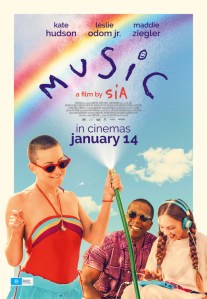 I didn’t even know Music existed until a couple weeks ago. The musical was nominated for two Golden Globes, including Best Comedy or Musical, and a passion project for the pop singer Sia. She wrote, directed, and cast her music video muse, Maddie Ziegler, as the titular figure Music and filmed back in 2017. Then I read about the backlash from the autism community for the film’s portrayal of autism and I became more intrigued. Currently, Music rates even lower on Rotten Tomatoes than Cats, and the reviews have been equally as baffling and unkind. Sia has responded defensively on social media to her film’s critics, and the brewing controversy has given the movie a fascinating rubberneck quality of, “You have to see this.” It is with that morbid curiosity that I sat and watched Sia’s Music, a movie awash in misguided decisions.
Music (Ziegler) is a teenager living in Los Angeles who is severely autistic and in need of care. She needs eggs in the morning, insists on a walk around the neighborhood, loves dogs, and has her headphones on to shield her from being overwhelmed by exterior noise. Music escapes into elaborate fantasies where she dances along to soaring pop songs. Her grandmother dies early and the only living relative is Zu (Kate Hudson), a recovering drug addict who doesn’t want to play mom to her demanding younger sister. Eventually, Zu begins to see her sister differently and bonds with her neighbor, Ebo (Leslie Odom Jr.), who teaches boxing classes to the neighborhood youth. Zu is getting her life straightened out and learning responsibility, though she might ultimately still decide Music is too much for even her.
 Let’s tackle the biggest issue of contention, the film’s portrayal of autism. Ziegler is not autistic or, to my knowledge, neurodivergent. This fact alone doesn’t necessarily mean the movie was doomed to insincere failure. It may well become the norm that neurodivergent actors play neurodivergent characters, much as it seems has happened with trans characters and firmly established for ethnicity. However, I think much of the response to a person outside of a community portraying that community comes from the intent and the depiction. Are they coming from a good place? Are they trying to portray this life in an honest fashion? And is the portrayal harmful, derogatory, or trading in negative stereotypes? With Music, I have no doubt that Sia was coming from a good place. She has spoken about the autobiographical elements of the movie and basing the character of Music on someone that she knew personally. I know there are people like Music on the autism spectrum. It’s a spectrum for a reason. The problem comes with the depiction of a person this severely autistic from an outsider. I’ll explain in a comparison.
In 2001’s I Am Sam, Sean Penn played a mentally challenged man fighting for custody rights. He was nominated for a Best Actor Oscar. In the film, Sam had a group of friends, all of whom were similarly mentally challenged, and some of them were played by actors who were genuinely living with that same condition and others were played by actors only pretending. It was very apparent who was who, and it made the entire movie feel uncomfortable because it felt like the real people were being caricatured in literal proximity. It didn’t feel right, and I can’t imagine twenty years later that filmmakers would make that same choice. On the other hand, with the Netflix series Atypical, the lead character is played by a neurotypical actor but the portrayal of a character on the spectrum is done with great empathy and consideration, with an outreach toward those within the autism community. Intent and depiction are the keys.
The onscreen depiction of autism in Music is pretty galling and potentially harmful for those within the community. It’s all negative stereotypes. Ziegler is constantly contorting her body, making silly putty faces, side-eye glances, hitting herself in the head, and playing to the most abrasive and controversial cliches of those living with autism. She can barely mutter more than a few words, usually in imitation. Because this is the depiction of the character, having a neurotypical actor in this role can feel plenty insulting to many viewers. Music is less a character and presented more as a burden because of her needs and challenges. She gets Zu into trouble and lashes out in public. At no point does Music come across as more than an assembly of tics and ugly stereotypes.
 It’s not just that the depiction in unflattering, as all characters do not need to be unerring shining examples for their individual communities, it’s that the movie doesn’t bother to give her any inner life. There are a few of passing comments about how Music sees the world, like a savant too pure to take in all the majesty at once, but these are merely gestures. The biggest opportunity into the mind of the character would have been through the numerous musical numbers but these are, by far, the most confusing artistic choice by Sia. I was expecting the musical numbers to provide insight with Music, to give voice to a character who has trouble communicating. Someone would ask how she was feeling and we’d zoom into her mind and the singing would be her way of expressing that answer or her complicated emotions about any topic. The use of singing and music would be her voice. Alas, this doesn’t happen at all. Like at all. This is shocking to me and the movie never really recovers from this misstep. The musicals are confusing because they often seem to be from the perspective of Zu instead and communicating her own struggles. Is Music just imagining her own sister’s inner turmoil through dance? There are also musical numbers devoted to exploring Ebo’s inner turmoil. That means two other characters are given primacy over Music in her own personal imaginary musical interludes.
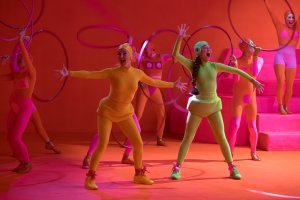
What is the point of the musical numbers then, besides squeezing in ten or so Sia music videos into a dramatic narrative that doesn’t appear to be connected to them? The music videos themselves are very reminiscent of Sia’s recent output, largely single takes and bursting with bright pastel colors and goofy costumes that look like a children’s TV show. The dancing is interpretative, which means a lot of emphasis through the body movement and facial expressions, and you may find it slightly lacking or perhaps too goofy that it takes away from the emotional content or attempted investment. I enjoy musicals and I even like the approach, in theory, that Sia would have been articulating, shedding light on a personal experience that re-sees the world as a more whimsical, wholesome, and friendly environment. This approach succeeded in Lars von Trier’s 2000 film Dancer in the Dark, where Bjork’s love of old musicals shaped the way she chose to escape from the world and highlighted the discrepancies between fantasy and reality. That’s not what Music does or even attempts to do. You could remove the musical numbers completely or just serve them on their own. The only direct story connection comes with a side character, a Chinese teenager who is pushed into being a boxer by his belligerent father. He secretly wants to be a dancer. In his lone appearance in the musical numbers, he gets to indulge in his dream and dance and sing (or lip synch) and it has emotional resonance because it’s an expression of his inner desires and the longing is felt. Why is this one supporting character, who could have easily been removed entirely from the narrative, the only one that fits with the approach to the musical interludes providing actual insight? As far as the quality of music, it sounds very much like Sia’s pop ditties and there are a couple winners. “Together” has a buoyant bounce and swooping, cheerful melodic hook that is hard to resist.
 Hudson (Bride Wars) is the real main character of the movie and her struggle with responsibility is a familiar arc, from screw-up on the margins to matured adult with goals and a found family. She’s an trying to stay clean though she’s really just looking to skip out on life and enjoy a permanent vacation in Costa Rica. This is even her stated goal after inheriting the guardianship over Music. There are plans late to transfer her sister into a group home but this deliberation isn’t really given the attention it’s due, in fact I don’t think I can recall even the mention of it prior to the potential move-in day. The character of Zu is completely stock, a neo-hippie wild child that needs to learn to slow down and accept responsibility. I don’t know what that looks like because for most of the movie she’s just having her sister tag along while Ebo explains things about autism in a delicate fashion (including physical restraints, which have met with plenty of disagreements from the autism community who cite the danger they pose). You would think Zu might have a better handle on this stuff, or that her grandmother would have been more helpful with that instruction book she left behind for the care of Music. This is more a movie about a recovering addict getting her life together and bearing with her burdensome younger sister. Seriously, the character of Music could have been a coat rack for all the impact and agency displayed. Hudson does an admirable job with what she’s given even if grungy and strung out are hard for such a naturally sunny and charming actress more prone to breezy rom-coms. Odom Jr. (One Night in Miami) is wasted as the kindly neighbor harboring a secret and mending a broken heart. At least he gets to sing too.
While watching Music, I kept thinking of an obvious creative choice that would have sidestepped a majority of the mushrooming controversy and spared Sia. Why not just make the character of Music someone with a different condition? Why not make her suffer from post-traumatic stress, or an anxiety disorder, something keeping her form living the life she desires and communicating all that goes on inside her person? Automatically, it eliminates the controversy over the negative depiction of autistic stereotypes from a neurotypical actress and it makes the character more a central figure in her own story that can be developed and examined. Frankly, in 2021, we don’t need portrayals like Music to better understand life with autism. This kind of movie might have been met more charitably in the 1990s but now it’s instantly problematic, and I feel like much could have been avoided by removing the autistic aspect to Music’s character, especially since it does so little to the story other than create havoc and challenge. Beyond that, Music falters because the many musical sequences fail to tie back to the characters in meaningful ways. I’m confused over the shifting perspective as well. From a technical standpoint, the movie looks and sounds like a professional movie with a polished Sia soundtrack. However, it’s the poor thinking behind these decisions that dooms the project. While it’s no Cats-level disaster, at least nobody was living with human-feline creatures at home. Music is not a good movie but it’s the kind of rare artistic flop that might be worth viewing just for its audacious missteps, like 2018’s Welcome to Marwen. I don’t think we’ll be getting a second feature film from Sia any time soon.
Nate’s Grade: C
Share this:

The Prom (2020)
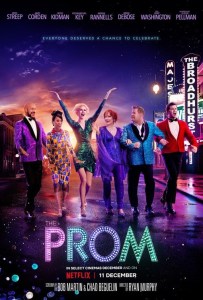 It’s full of big feelings, declarations of self-identity, an unabashed love of the transformative power of theater, and its power of positivity can be a balm to many during this holiday season. The Prom is based on a short-lived Broadway musical about a girl in Indiana who wants to bring her girlfriend to the school prom and the ensuing media controversy that erupts. A team of out-of-work theater actors (Meryl Streep, Anthony Rannels, Nicole Kidman, James Corden) see publicity value in rallying to her cause, so they decamp to Indiana and challenge the homophobic PTA leader (Kerry Washington) who refuses to hold an inclusive prom. Director Ryan Murphy’s style and sensibilities work well within the realm of musical theater; a decade of television curation for FX and now Netflix has made him an expert on camp and flash. The man loves applying slick gloss to trash. His camera is constantly, uncontrollably moving during the numerous musical numbers, attempting to compensate for the generic quality of the majority of them. There are two standouts. The first is when Corden’s character takes our lesbian teen to the mall for a makeover. It’s got a catchy hook and one that becomes a reoccurring theme for the show. The second is when Rannels’ character is pointing out the hypocrisy of local Christians decrying homosexuality but falling short of other Biblical teachings. The story is sweet but un-challenging. The plot exhausts so quickly that I was amazed at one point to discover there was still an hour left in the over two-hour production. Each member of the squad gets a signature number to varying degree of success. The happy ending is affirming and heartfelt but also quite easy and kind of unearned. The amount of catharsis and reconciliation doesn’t gel with the emotional investment and development of these characters. They’re nice but relatively dull, and the industry satire only goes so far to chide the out-of-touch Broadway elites for their own prejudices of Midwest life. The Prom is disposable fluff that will pacify an afternoon.
Nate’s Grade: C+
Share this:

Moondance (2020)

I didn’t even plan on writing this review. I knew of the indie musical Moondance because I was familiar with several crew members who worked on the $500,000 project and watching their pictures on social media, but when I discovered it had been filmed entirely outside the state of Ohio, primarily in Kalamazoo, Michigan, I decided to exclude it from my mission to professionally review Ohio-made indies. As of this writing, it was available on the website Tubi for free with ads, so I started it on a whim to show my girlfriend what I had intended to watch, and then I kept watching, and then I didn’t want to continue but I felt compelled to, and now I feel compelled to dissect this movie as best as I can, even with its tangential connection to the Ohio indie film scene. Moondance is a confounding experience for a lover of big screen musicals because it’s a musical that doesn’t really want to be a musical, a comedy that doesn’t know how to do comedy, and a drifting drama bereft of characters to root for and reasons to cheer.
The story is familiar. We have our boy, in this instance Oscar (Jonah Robinson), a composer suffering writer’s block, and he meets our girl, Abby (Carolyn Rabbers), a dancer. Oscar is instantly smitten and tries tracking Abby down, while his “best friend” Pat (Sam Jones) schemes with his very David Rose-esque assistant Sean (Brandon Stewart) to have her for his own. In between these shenanigans, Cooper Flannigan (credited as “Self”) appears to be a hipster friend of Oscar but also the god of this universe as he routinely breaks the fourth wall and is played by the actual writer/director.

I have to give credit for anyone having the gumption to try and create a low-budget musical. That’s a tall creative order and unfortunately Moondance can’t quite match its toe-tapping ambitions. There are only four songs in the entire musical before the end credits (I’ll get to those later). By the 45-minute mark, I had only experienced one legitimate song-and-dance number and I was wondering if the reality of this movie had simply abandoned being a musical. There are a couple additional dance numbers as one would expect with Abby being a dancer, some set to performances from musicians, but for the first hour there are only two honest-to-goodness moments where characters break out into song. Why is there no opening musical number that introduces the different characters and their different perspectives, stations, plights, goals? That would be an economical way to establish the world and its players. There seems to be real hesitancy onscreen with embracing its musical identity. The musical numbers are meant to give us insight into the characters who can’t help but blurt out their feelings, and yet during the requisite boy-and-girl-on-the-outs part, there is no musical number. There isn’t even a musical number for their growing affection for one another. We’re missing a love theme, and for a romance-heavy musical that’s meant to evoke the feeling of Old Hollywood, that seems like a massive oversight.
The staging and performance of the musical numbers, when they do appear, can also be underwhelming and counter-productive. From a choreography standpoint, much more emphasis is placed on the background players including a superfluous “intermission” dance. There is one number where the key characters do little more than literally ride a bicycle in a circle, and I would argue this is the best number in the film. There is more dancing than singing and that seems the primary reason why Rabbers was chosen as the lead female role. She certainly has talent as a dancer. As a singer is another matter. I feel unkind even articulating this but for a musical it needs to be said: Moondance would have been better off dubbing Rabbers. Her singing voice is just not there. I don’t see any harm to the production if the filmmakers had dubbed her singing. Another issue is that Abby’s dancing feels a bit too chaotic and chaotically edited. There’s a moment of sorrow where she dances out her feelings, but the choreography isn’t conveying the emotions of the scene any differently than a previous dance for us to compare with, and the editing isn’t helping, until it concludes with her pounding a wall in frustration and falling into a crumple on the floor. The camera could have locked onto her face, so as she moved and performed the emphasis was on her emotional state and what the dancing signifies. Whether it’s the lackluster songs, singing, and the nascent choreography that needs to communicate more personality for the big players, Moondance stumbles as a musical.

From a comedy standpoint, let me focus on one small scene that I think exemplifies the pitfalls of comedy construction that Moondance suffers from throughout. We start a scene with Oscar and Cooper at an ice-skating rink watching a curling team practice. Oscar opens the scene by declaring, “22 dance studios!” to tell us he has struck out trying to find Abby, and then for good measure he repeats the line to better establish his bafflement. “What am I supposed to do now?” he asks Cooper, who asks whether Oscar has considered the possibility his dream girl doesn’t exist. “No, I haven’t considered the possibility she doesn’t exist,” Oscar replies, weirdly echoing the exact wording just to hammer this home for the audience. He sees Cooper distracted, sighs, and says, “I’m going to go to the bathroom, or the parking lot or… something.” He then leaves and then Cooper addresses the camera and informs us on the mechanics of the sport of curling. This will never come up again in the entire movie. So, dear reader, let’s deconstruct this scene. It begins with Oscar stating his futility. He repeats his line twice. His friend offers no help, makes a reference to Oscar’s mental state, not a joke but a reference, to which Oscar simply repeats the assertion rather than supply a joke response or anything that can be constituted a response. Because of this, Cooper has nothing funny to build off from, so he asks a simple “what next” and rather than supply a joke that showcases Oscar’s pitiful state, he offers two suggestions, neither of them funny, then doesn’t even provide a third suggestion, instead giving up and not even following the age-old comedy rule of three. From there, Cooper informs us about something that will not matter and is not funny. Why does this scene even need to exist if even the characters can’t be bothered to come up with jokes?
I was dumbstruck by the ineffectual comedy throughout Moondance. This is the kind of movie that has characters devise a stakeout and disguise themselves in bear costumes for no reason. Do they do anything in these costumes? No. The joke, I assume, is that they’re in funny costumes. This is akin to a character walking into a room with a silly hat, and the director saying, “Hey you, look at this comical hat being worn. Isn’t it so unlike normal hats? A normal person would never wear a hat like this. What a cut-up to wear this hat. Are they going to do anything differently because of this hat? Well, no, but what a silly hat, right? Please laugh.” Just stopping at this conception and doing nothing else is not comedy. There need to be setups, payoffs, subversion, running jokes, subversion of running jokes, something, anything. There is a stark sense of desperation throughout Moondance when it comes to its sense of humor. Take for instance a dinner where the group is hob-knobbing but then the girls meet below the table to share their real thoughts under the excuse of retrieving a fallen fork. Why not repeat this setup, making it more outlandish and obvious as you go? Why not present one perception, above table, of the girls, and one below where they are their true selves and confessing distaste? There are moments where it feels like the writer/director just had little grasp on humor and lost track of opportunities. The jokes are rarely accessible; it feels like you’ve entered into a private conversation and are left to put the pieces together. Sean is definitely slotted as “comic relief” but he feels overexposed. I was confused what his relationship was supposed to be with Pat. Is he the assistant, lover, or friend? Eventually I learned that he was Pat’s brother, but why did I have to fight so hard to understand this fact? The writing doesn’t make it easy for the audience to follow along, and this extends to its comedy writing. The fourth wall breaks are tone-breaking but, again, not funny. They feel included just as a fun way to include the crew in the movie, which, again, feels like a private party indulgence. The comedy of Moondance is primarily dormant. It’s over-compensating a lack of funny on the page by asking its actors to dial up their performances, so all the unfunny dialogue and antics now just seem like they’re being performed by crazy people on illicit substances.

If this movie was going for satire, I think it missed it by a wide margin. I don’t know why we have a character with godlike powers and this is treated like a lame party trick. Why not refocus the entire movie from this perspective and have Cooper be the god of a rom-com musical universe, and he’s the only one who knows he’s in a movie, and he’s pulling out every stop to get his chosen guy and chosen girl to get their big happy ending. That way it would play upon our knowledge of genre tropes and bring something fresh, while utilizing the fourth wall breaks as essentially strategy planning and introducing a team of helpers that would see through his efforts. Instead, we get the jovial character of Cooper who strolls around and offers few insights into the nature of romance or the nature of romance movies and our association of them. He feels like a magic hobo. I sense the homage to the Old Hollywood musicals and the big band accompaniment for all those jazz hands and hoofing, but it’s more intention than actuality. It’s going through the motions, and without enjoyable characters and an engaging story, it’s an homage that ends up empty.
My final criticism might be the one that made it the hardest for me to embrace Moondance, and this is how aggressively unlikable nearly all of the characters come across. In a romantic musical, you can have less than stellar singing, dancing, and even songs but your audience needs to care about the people onscreen. You need to feel the desire for them to get together, find their happiness, and at a basic level, you have to enjoy spending time with your core group of characters. Otherwise you’re stuck, and dear reader, stuck is what I felt with these people. I never cared about Abby and Oscar getting together because I never found them to be remotely interesting. Oscar is a bland protagonist. The only thing we know about him is that he writes symphonies. He immediately becomes obsessed with Abby to the point that, even before he ever speaks his first word to her, he declares Abby “his girl” in a creepy act of possession. He’s in love with her but cannot explain why. Would have been perfect for a song there to articulate his new feelings, right? We know even less about Abby. She’s a dancer and wants to save an old dance studio, but anything else? Well during a scene where she lunches with a friend, she has a giant burger as her meal. Does she eat it? No, but just being seen with this pound-plus of beef is meant to do the work the screenplay hasn’t and imbue useful characterization. She’s not some prim “just east a salad” kind of girl, oh no, give her a honking burger. To my best estimation, Abby and Oscar go on two dates (one of which she apparently has harassed a waiter, and this is supposed to be endearing?) so when they part ways before Act Three, this short-lived breakup doesn’t exactly feel as earth-shattering as the characters try to convince us. We’re simply not invested. Rabbers and Robinson (Jack Jonah) don’t have strong chemistry together but it’s not their fault. The script gave them nothing to work with and no points of characterization to better define them as people or make either of them interesting to watch.

The character of Pat is pompous and entitled and I don’t know how anyone would remotely take his involvement in what is angled as a love triangle with any seriousness. He is a terrible character and a terrible person and he just seems to exist in a daydream of privilege. What does he do all day? He buys expensive paintings for his… Rubens parties (again, another point of accessibility made challenging for the audience when this is referenced without context and it took my third stab at understanding what it meant to gain clarity). Later in the film, he monologues to his paintings before setting them ablaze, and it’s played like the mental break of a serial killer, and it’s so tonally off to induce whiplash. Pat’s the cartoonish fop character that would be presented as the rich buffoonish bad boyfriend in any other movie, and yet here he’s supposed to be the best friend to Oscar, yet we see no behavior that communicates their close personal relationship. This is a trenchant problem throughout Moondance, the screenplay constantly having to tell you of something rather than show you. It’s like watching characters thrown into an improv game and grasp for any fragile means of escape from scene to scene.
With all of these words spent in constructive critique, it might seem like Moondance is without notable artistic merit and that is not the case. The photography by Greg Kraus (The Curse of Lilith Ratchet) is well lit and at its best when it has plenty of movement to give a sense of energy that is usually flagging from the page and performances. The smoky jazz number makes fun interplay with shadow to better establish an evocative mood. The musical productions are heavy with big band sounds and brass instruments, enough so that I started wondering if anyone has done a ska indie original musical. The opening segment involves a band performing in a studio space and it was a pleasant experience to set a tone. The musical performances are solid. The musical compositions are competent if unmemorable. I don’t know why the production didn’t just fully go the jukebox musical route with local artists if we were only getting four original songs (though the titular “Moondance” song lyrics were a bit childish, reminding me of the Hokey Pokey). Hey, they got TV’s Adam Conover (Adam Ruins Everything) to be a brief narrator, a role that seems even less necessary when Cooper is breaking the fourth wall repeatedly as a would-be guide for the audience since he’s already our stand-in god.

Moondance ends on a two musical numbers, the first a kind of curtain call on a theater stage that allows every character, including the dry cleaner guy, to get a sendoff and also break the fourth wall. Afterwards, Cooper addresses the audience and acts as emcee through the various departments and crew members who worked on the movie, with the camera moving in and out of rooms with an impressively agile tracking shot, and ending on several spirited dances, one of which serves as the still image on the Tubi page. The problem is that this is, easily, the most involved musical number and it’s reserved for the end credits. I can imagine Cooper and the filmmakers thought they were ending on a high note to say a fun goodbye to their audience, but by reserving it for the end credits that roll over the scene, it makes it harder to read the credits that are spaced so far apart and it makes it harder to pay attention to the song and dance because of the rolling credits. Why not go split-screen? For me, this sums up the misapplied application of Moondance and its throwback ambitions. It’s not whimsical. It’s not charming. It’s not funny at all. There aren’t characters to care about. The musical numbers are too few and far between. The potential hook to separate this, its satirical behind-the-scenes god at play in a musical world, is not incorporated in a vital and clever manner. Moondance is a strange passion project because it’s hard to feel any passion for this story and characters. It pains me to be as blunt as I am but there are too many issues to go ignored. I wish everyone with the production good luck in the future. This will stand as an artifact of bewilderment for me. See it for yourself on Tubi and whether it casts a bewitching spell on you, dear reader, or leaves you just as confused and disappointed.
Nate’s Grade: D+


 nathanzoebl
You must be logged in to post a comment.