Blog Archives
Beetlejuice Beetlejuice (2024)
 Usually sequels over thirty years later reek of desperation, trying to rekindle the past while usually only hoping to tickle people’s fading sense of nostalgia. Rare is the 30-year-plus sequel that excels by breaking free of its imitator and making us see the original in a new light. It helps to keep your expectations in check, especially for a project that is so miraculous as the original 1988 Beetlejuice. What a wild movie that was, an introduction to horror comedy for a generation, and a near-perfect balance of creepy, silly, and imaginative. From director Tim Burton’s career-launching sense of style, to Michael Keaton’s electric comedic performance, to Danny Elfman’s outstanding score, to the stop-motion visuals, fun and freaky makeup effects, and you had a madcap movie that felt like a unique discovery. Recreating that is near impossible, but if Beetlejuice Beetlejuice can recreate some of the elements and feelings that made the original what it was, then it can be considered a modestly successful late-stage sequel.
Lyrdia Deetz (Wynona Ryder) has become a long-running host of a paranormal TV talk show connecting people with messages from loved ones from beyond the grave. Her teenage daughter, Astrid (Jenna Ortega), is moody and embarrassed by her mother, feeling that she “sold out.” Mother and daughter return back to Connecticut to attend the funeral of Charles Deetz, Lyrdia’s father. Her pretentious and snippy stepmother, Delia (Catherine O’Hara), is trying to better commune with his spirit, and the entire town has become famous for its spooky seasonal history. Meanwhile, Beetlejuice (Keaton) is trying to avoid his former wife, Delores (Monica Bellucci), who naturally is seeking to obliterate him to ectoplasm. He’s still got his sights set on Lydia, who spurned his marriage hopes, and might be able to manipulate the Deetz family back into his control.
 Beetlejuice Beetlejuice gets the closest to rekindling that lightning-in-a-bottle alchemy from the 1988 original, serving as an appealing and enjoyable sequel. Nothing will ever be as original and wild and such a discovery as that first movie, which serves as a point of entry for many a Millennial fan who discovered that irresistible Tim Burton Neo-Gothic aesthetic. However, it recreates enough of the qualities that stood out about the original. The skewed sense of humor and surreal visuals, as well as goofy slapstick and vibrant imagination about life after death, it’s all such a fertile playground for Burton’s visual charms. The genius of the original was telling a ghost story from the ghost perspective as they learned about how to be better ghosts to try and scare their new living owners away. Given the world of the dead, there’s such tremendous storytelling and world-building possibilities here, explored richly in the animated 90s series for kids. Further stories in this universe have an automatically appealing power, and it’s just nice to watch Burton apply his specific aesthetic again, something fans haven’t really seen since 2007’s Sweeney Todd. I appreciated the weird morbid details and the practical production values; the Alice in Wonderland movies have shown that the “Burton look” isn’t best complimented by massive green screen sets. Having Burton, the “Burton look,” the original actors, with some exceptions (more on that later), and enough of that offbeat, chaotic, morbid tone return is a victory.
Beetlejuice Beetlejuice doesn’t so much alter our understanding of the world of the dead as established; it doesn’t radically rethink the landscape but it doesn’t repeat the same plot events either. I really liked the evolution of the adult Lydia as a jaded TV host. There’s a real dramatic punch to the reality that she sees the dead but has yet to see her deceased husband. She is incapable of reuniting with the man she misses the most, and she doesn’t know why. That yearning, paired with a lingering thematic mystery, can be a palpable storyline to explore. Pair that with some three generations of Deetz women trying to understand one another and work through personal resentments and we have fertile narrative ground. The three women were my favorite part of the movie, and their interactions and reflections on parenting and the challenges of trying to better understand one another are the foundation of the movie’s sense of heart. I really enjoyed the dynamic between the three, significantly upping Delia’s screen time and finding room to give her more dimension, an artist struggling in the wake of her grief. I’m a bit surprised that Ortega’s character isn’t more central to the drama. For all intents and purposes, she’s Lydia 2.0, so butting heads with Lydia 1.0 I guess feels redundant, so the story sends her off to find a cute boy in town and use that as an excuse for several unexpected needle-drop song use. There’s something inherently wrong watching a Tim Burton movie and hearing contemporary music. Imagine the Beetlejuice “Day-O” singalong but to, say, Sabrina Carpenter instead. No.
 Beetlejuice, as a character, is such an exciting agent of chaos, a horny ghost who operates on the same tonal wavelength as a Looney Tunes cartoon character. Even though the original movie is named after the guy, he’s only in the film for approximately twenty percent. Keaton was absolutely incredible in his comedic bravado, creating much of the character through his ad-libs and hair and makeup choices. Keaton is still fantastic in this go-for-broke sort of performance, a performance we’ve seen far less as he’s settled into a respectable dramatic acting career. It’s hard to remember, dear reader, but when Keaton was initially cast for Burton’s Batman, the fan base at the time was up in arms, considering Keaton more of an un-serious funnyman. It would have been easy to have Beetlejuice front and center for the movie, so it’s admirable that Burton and Keaton decided to keep his on-screen appearances short, leaving people wanting more. There’s a late turn of events that pairs Lydia and Beetlejuice together, and I wish this fractious pairing had been the bulk of the movie. The whole enemies-to-uneasy-allies would have put much more emphasis on their character dynamic and the comic combustibility. Still, seeing these characters come back and retain their appeal and personality without obnoxious pandering is welcomed.
The screenwriters find a clever solution for the Jeffrey Jones Dilemma. For those unaware, Jones, who portrayed Lydia’s father in the original, and best known for pugnacious supporting roles in movies like Ferris Bueller’s Day Off, Howard the Duck, and HBO’s Deadwood, was charged with soliciting a child for sexual exploitation. The movie continues with the character of Charles Deetz but without the involvement of Jones. The character gets his top eaten by a shark, so for the rest of the movie he’s a walking half of a corpse with a mumbly voice. It’s a clever way to include the character without the need for the actor.
With that decision to limit the Beetlejuice quotient of Beetlejuice Beetlejuice, it makes for a sloppier movie juggling a few underwritten subplots and side characters. The biggest non-factor is the return of Mrs. Beetlejuice. Here is a powerful antagonist who has the literal ability to suck out the souls of the recently dead and turn them into shriveled husks. She’s seeking vengeance against her ex and tracking him down through the netherworld. And yet, she could be completely eliminated from the movie without really affecting the other storylines. The whole Mrs. Beetlejuice/vengeful ex-wife character feels like a holdover from a different sequel script, clumsily grafted onto this other project, a vestigial artifact of another path not taken. There’s plenty of potential with the concept of the past victims of Beetlejuice coming back to seek retribution, and especially a trail of angry former lovers. It would explore the character’s history more meaningfully than an albeit amusing silent film interlude about how he married her during the era of the Bubonic Plague. We see how he died as a human, but there’s hundreds of years that can be illuminated from his failed schemes and odd jobs. Certainly there could be a whole club of ax-grinding malcontents sharing their mutual hatred of the Ghost with the Most. This character should better reflect Beetlejuice, and instead she’s just a monster on the prowl that eventually gets indifferently cast aside. It feels like Burton was looking for something for Bellucci to portray (Burton and Bellucci have officially been dating since 2023).
 She’s not alone as an antagonistic villain that pops up to provide momentary danger but is also hastily resolved to the point that it raises the question why they were even involved. There are three antagonists, not counting Beetlejuice, that appear throughout to threaten our Deetz family members in Act Three, each of them individually interesting and targeting a different member of the family for ill-gotten gain. Yet each one of these characters is conquered so easily that it nullifies their importance and overall threat. If Beetlejuice could, at any moment, just open a trapdoor to hellfire at a moment’s notice, what danger does any other character pose then? If a sand worm can just appear from nowhere and consume our pesky antagonist, then why can’t this be a convenient solution earlier? The defeats feel arbitrary, which make the antagonists feel arbitrary, which is disappointing considering that we have the full supernatural arsenal of undead possibilities to tap into. I enjoyed these characters for the most part, but it’s hard not to feel like they’re tacked-on and underwritten. The same can be said about Willem Dafoe’s police chief, a former actor who played a chief on TV and now tries to fill the role for real after death. I’m always glad to have more Dafoe in my movies (woefully underrepresented in rom-coms, you cowards!) but he’s just mugging in the corner, waiting for some greater significance or, at minimum, more memorably morbid oddity to perform.
Beetlejuice Beetlejuice is better than a desperate sequel cash-grab, though there are elements, ideas, characters, and jokes that could have been smoothed out, better incorporated, and developed to maximize the potential of the undead setting. It’s an enjoyable throwback for the fans of the original that does manage to tap into enough of those potent elements that made the original so memorable. It’s definitely less edgy and transgressive, maybe even a little too safe given the territory of spooky specters; the entire Soul Train bit felt like a bad Saturday Night Live sketch from the 1980. However, it’s still got enough of the charm and silliness to leave fans, old and new, smiling and wondering where it might go next in its wild world.
Nate’s Grade: B
Share this:

The Passion of the Christ (2004) [Review Re-View]

Originally released February 25, 2004:
The Passion of the Christ is a retelling of the last 12 hours of Jesus Christ’s life (perhaps you’ve heard of him?). In these final hours we witness his betrayal at the hands of Judas, his trial by Jewish leaders, his sentencing by Pontius Pilate, his subsequent whippings and torture and finally his crucifixion. Throughout the film Jesus is tempted by Satan, who is pictured as a pasty figure in a black hood (kind of resembling Jeremy Irons from The Time Machine if anyone can remember). The Passion spares no expense to stage the most authentic portrayal of what Jesus of Nazareth endured in his final 12 hours of life.
For all the hullabaloo about being the most controversial film in years (and forgive me for even using the term “hullabaloo”), I can’t help but feel a smidgen of disappointment about the final product. The Passion is aptly passionate and full of striking images, beautiful photography and production values, and stirring performances all set to a rousing score. But what makes The Passion disappointing to me is the characters. You see, Mel Gibson’s epic does not devote any time to fleshing out the central characters. They are merely ciphers and the audience is expected to plug their feelings and opinions into these walking, bleeding symbols to give them life. Now, you could argue this is what religion is all about, but as far as a movie’s story goes it is weak. The Passion turns into a well-meaning and slick spectacle where character is not an issue. And as a spectacle The Passion is first-rate; the production is amazing and the violence is graphic and gasp-inducing. Do I think the majority of people will leave the theater moved and satisfied? Yes I do. But I can’t stop this nagging concern that The Passion was devoid of character and tried covering it up with enough violence to possibly twist its message into a Sunday school snuff film.

For my money, the best Biblical film is Martin Scorsese’s 1987 The Last Temptation of Christ (also a film mired in controversy). Last Temptation, unlike Gibson’s spectacle, was all about Jesus as a character and not simply as a physical martyr. Scorsese’s film dealt with a Christ consumed by doubt and fear and the frailties of being human. But the best part is the final 20 minutes when Jesus is tempted, by Satan, to step down from the cross and live out a normal life. Jesus walks away from the cross, marries Mary Magdalene, fathers children (this is where the controversy stemmed from but they were married) and dies at an old age. Jesus is then confronted by his aging apostles who chastise him for not living up to what he was supposed to do to save mankind. Jesus wakes up from the illusion and fulfills his mission and dies on the cross. Now, with the story of Last Temptation an audience has a greater appreciation for the sacrifice of Jesus because they witness his fears and they witness the normal life he forgoes to die for man’s sins. There is a sense of gravity about what Jesus is sacrificing.
With The Passion Gibson figures if he can build a sense of grand sacrifice by gruesomely portraying the tortures Jesus endured. Even if it is Jesus, and this may sound blasphemous, torturing a character to create sympathy and likeability is the weakest writing trick you can do. Yes Jesus suffered a lot, yes we should all be horrified and grateful, and yes people will likely be moved at the unrelenting violence he endured, but in regards to telling a story, I cannot feel as much for characters whose only characterization is their suffering. Sure, The Passion flashes back to some happier moments of Jesus’ life, which I like to call the Jesus Greatest Hits collection, but the movie does not show us who Jesus was, what he felt (beyond agonizing pain) or the turmoil he went through in finally deciding to give up his own life for people that despised him. The Passion is not about character but about spectacle.
So let’s talk about the violence now, shall we? Gibson’s camera lovingly lingers on the gut-churning, harrowing, merciless level of violence. But this is his only message. It’s like Gibson is standing behind the camera and saying to the audience, “You see what Jesus suffered? Do you feel bad now? FLAY HIM MORE! How about now?” What was only three sentences of description in the Gospels takes up ten minutes of flogging screen time. Mad Mel has the urge to scourge. After an insane amount of time spent watching Jesus get flayed and beaten the violence starts to not just kill whatever spiritual message Gibson may have had in mind, but the violence becomes the message. The Passion does give an audience a fair understanding of the physical torture Jesus was subjected to, but the movie does not display Christ as fully human, enjoying life and love, or fully divine. The only thing The Passion shows us about Jesus is that the son of God sure knew how to take a whuppin’. For Gibson, the violence is the message and the point is to witness what Jesus endured. Some would call that sadistic.

The actors all do a fine job and it’s impressive that everyones’ lines is in two dead languages (Latin and Aramaic, though for the life of me I can’t tell them apart). But the acting is limited because of the nature of the film. Had there been more moments of character the acting would come across better. As it stands, the acting in The Passion is relegated to looks of anguish or looks of horror, interspersed with weeping. Monica Bellucci (The Matrix sequels) really has nothing to do as Mary Magdalene but run around in the background a lot. Jim Caviezel (Frequency, Angel Eyes) gives everything he has in the mighty big shoes he tries to fill. It’s too bad that his Jesus spends most of the screen time being beaten, which kind of hampers his acting range.
Now let’s address the anti-Semitic concerns. The Passion does portray a handful of Jewish religious leaders as instigators for Jesus’ eventual crucifixion, but there are also Jewish leaders who denounce their actions and just as many people bemoaning the torture of Jesus as there are calling for it. Who really comes off looking bad are the Romans. Excluding the efforts to make Pilate look apprehensive, the Roman soldiers are always seen kicking, punching, whipping, spitting on Jesus and laughing manically with their yellow teeth.
And like I said before, most people will be extremely satisfied with the film because it’s hard to find a person who doesn’t have an opinion on Jesus. Gibson is counting on audiences to walk in and fill in the holes of the character so that The Passion is more affecting. Gibson’s film is worthy spectacle, and despite the vacuum of character I did get choked up four separate times, mostly involving Jesus and his mother. The Passion is a well-made and well-intentioned film that will hit the right notes for many. I just wish there were more to it than spectacle. I really do.
Nate’s Grade: C
——————————————————
WRITER REFLECTIONS 20 YEARS LATER

In 2004, Mel Gibson made an R-rated foreign film that was two hours of savage brutality against Jesus, and it wound up being one of the biggest box-office hits of the decade and forged a trail for other Hollywood execs to chase after a “faith-based audience.” It could be said that this grisly movie gave the people what they wanted, and apparently what they wanted was to watch their messiah suffer physical feats that should have killed any mortal five times over. Twenty years later, The Passion of the Christ is still a curiosity, a movie with so much technical quality and devotion to a specific purpose, but that purpose is so narrow: make people feel bad. If you were being charitable, you could argue that the sacrifice of Jesus is felt stronger when every whipping, beating, scourging, and blood-letting is endured from the audience. Except I don’t believe this, because that assumes that more time spent on visual carnage equals more appreciation earned, as if our empathy has an equation. The emphasis on the death of Jesus feels like a telling insight into certain elements within mainstream American religious culture, where the focus is on violence and loss and less so the resurrection of Jesus, wherein the man conquers death and preaches forgiveness of sin for all mankind. It’s the preoccupation with grievance and brutish power over the helping of others different and less fortunate from ourselves. I’m not going to say the hard-core fans of The Passion of the Christ are valuing the wrong spiritual ideals, but it was this Jesus guy who did say everyone should love thy neighbor as thyself.

This is going to be a rarity for my twenty-year re-review series, but I agree almost one hundred percent with everything I wrote in 2004. I can’t really improve upon that analysis and my explanation for the faults of the movie and its spiritual shortcomings. Some of these lines are still terrific: “…Twist its message into a Sunday school snuff film,” “The only thing The Passion shows us about the Son of God is that he sure knew how to take a whippin’,” and, “Mad Mel has the urge to scourge.” More time is spent obsessing over the blood of Jesus than any of his words. I’m still debating the exact legacy of this movie besides as a harbinger of a wider Christian marketplace as well as Jim Caviezel’s own god complex. Gibson only directed two other movies after, 2006’s Apocalypto and 2016’s Hacksaw Ridge. His personal failings also became hard for many to ignore after his anti-semetic drunken ramblings and allegations of abuse, relegating him chiefly to direct-to-streaming (13 films from 2020-2023). In many ways, The Passion of the Christ represents Gibson at his height of powers within Hollywood, and it was accomplished outside the studio system who thought he was crazy, though he proved them right for different reasons.
Some strange Passion facts lost to history. 1) This movie actually killed a viewer. During the crucifixion scene, a man suffered a fatal heart attack and later died. Sure, the man’s genetics and life-style choices are more likely at fault here, but had this man not seen Gibson’s movie he might have survived or at least been in a better capacity to deal with his eventual heart attack symptoms. 2) Gibson attempted to re-edit the movie for a PG-13 theatrical re-release in 2005, trimming five minutes of some of the more gruesome violence, yet the MPAA still said the movie was keeping its R-rating. 3) During filming, Caviezel was literally struck by lightning. 4) A sequel has been in development for almost twenty years, confirmed by Gibson’s Braveheart screenwriter Randall Wallace in 2016. In 2023, Gibson revealed he has multiple versions of the sequel script in the works, including one that visits hell. Caveizel has predicted the possible sequel would be the “biggest film in history,” but this is the same guy who declared Donald Trump as the modern-day Noah, so maybe let’s not regard this guy too credibly with his opinions.

The challenge with any on-screen depiction of Jesus is fleshing him out as man and god. Only focusing on one obscures the complexity of characterization, denying filmgoers a more engaging examination of the key figure of Christianity. I’d still advise everyone to watch Martin Scorsese’s The Last Temptation of Christ for all the important elements that The Passion of the Christ lacks. This is a movie designed only for brutal spectacle and nothing more, and it’s just as tedious and empty now as it was twenty years ago. Apparently, Scorsese feels like he still has more to say on the subject and is planning another Jesus movie based on a 2016 book by Shūsaku Endō, the same author of the source material for Silence. While I would maintain that Scorsese has already made the greatest movie about Jesus, as well as the greatest movie about the exploration and challenge of reckoning with faith (2016’s Silence), who am I to deny one of our living legends another bite from the apple? It’ll certainly be more spiritually meaningful than watching an execution of Jesus for two miserable hours designed as enlightenment.
Re-Review Grade: C-
Share this:

The Brothers Grimm (2005)
 Director Terry Gilliam is one of the true artists working today in movies. His manic, off kilter, visually grand imagination has crafted wonderfully vivid fantasias, but it also has given Gilliam a reputation for being the captain of a sinking ship. The Adventures of Baron Munchausen is regarded as one of Hollywood’s bigger failures, unfairly I might add. A fascinating 2003 documentary called Lost in La Mancha detailed the bizarre circumstances and implosions that forced Gilliam to shut down production of his pride and joy, a film about Don Quixote. We’re talking things as out of control and unlucky as acts of God conspiring to doom this project. But then, Gilliam has always been fighting someone or something his whole film career. The studio refused Gilliam’s cut of Brazil so he sneaked out a print, showed it to the Los Angeles film community, and they dubbed it the best film of that year. Gilliam is a man governed by his idiosyncrasies. He’s blessed with a unique voice but cursed with the prospects of not having anywhere to say something (would he not make simply the most divine Harry Potter film yet?). And so Gilliam strikes his hands at something a bit more commercially minded with the action/comic fable, The Brothers Grimm.
Will (Matt Damon) and Jakob (Heath Ledger) Grimm are nineteenth century ghostbusters, so to speak. They travel from town to town ridding the villagers of evil spirits, witches, and all sorts of demonic creatures. Trouble is it’s all a lie. The Grimm brothers and their pals set up the spooks and rob the town blind. Will enjoys the fame, and especially the women, but Jakob feels apprehensive. It?s the Napoleonic wars, and the French have occupied the Germanic lands. A snooty general (Jonathan Pryce) plans to behead the two Grimm brothers unless they solve a strange case in a rural town. A slapsticky, torture-loving commander (Peter Storemare) is sent to watch over the “Grimmies.” At the village, Will and Jakob discover the town has had 10 of its daughters kidnapped with little explanation. With the help of a free-spirited woman (Lena Headey), the brothers encounter giant wolves, moving trees, lickable frogs, and the giant tower of the Mirror Queen (Monica Bellucci). The Queen was given eternal life but not eternal youth. In order to gain eternal youth, the Queen needs to take the lives of 12 hearty girls, and only the bumbling Grimm brothers stand in her way.
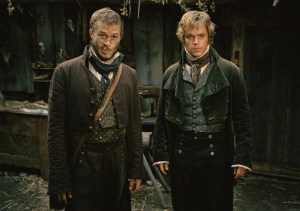 The acting is an example of the film’s messy feel. Ledger talks with marbles in his mouth. He’s putting more detail into the character than it deserves. Damon seems like he’s sleepwalking through the film, and his accent fluctuates wildly. He’s sort of a grinning straight man to Ledger’s tic-heavy daydream believer. Belluci is a ravishing beauty and proof positive for Hollywood that women over 40 don’t need to be put out to pasture. Too bad all she’s expected to do is look pretty and seductive in The Brothers Grimm. Pryce plays his role like a cartoon caricature. Stormare has already given one crazy performance this year (Constantine), and his frenzied, nearly indecipherable performance seems to be the closest to Gilliam’s whacked-out wavelength. Stormare is entertaining in every scene he’s in but can be found guilty of chewing scenery like it was a delicious candy house.
The Brothers Grimm is a gorgeous looking film. The sets are massive and greatly detailed. The location shoots in Prague seem like the perfect environment for Gilliam’s beyond-this-world landscapes. Gilliam experiments with advanced computer graphics for the first time and adds his oddball touches. A child has her eyes taken by a glob of mud, and then the mud reshapes itself into a lumbering gingerbread man. A horse spits out a spiderweb and ensnares a child. And it looks really freaking creepy. The Mirror Queen’s defeat is another standout effect as she breaks apart like shattered glass. The look of The Brothers Grimm is outstanding, but it’s what takes place inside those pretty pictures that dooms the film to mediocrity.
 The Brothers Grimm is an unfocused mess. It has disjointed subplots and several story elements that just don’t fit. The wacky French occupation feels like a leftover from a different movie. It just doesn’t work and grinds the movie to a screeching halt with every resurfacing. The Brothers Grimm will routinely work its way into a narrative corner and then use a “magic” cheat to escape (magic axe, magic mirror, magic kiss). Gilliam has always been a master maestro of chaos and visual oddities, but this time he’s tackled a film with a very weak script by Ehren Kruger (Ring Two). Kruger doesn’t bother laying the groundwork of his magical world or establish the rules. Therefore anything can happen and rarely feels satisfying. The characters are one-note, each given a single character trait to play with (skeptic, believer, idiot, etc.). The pacing is pretty sluggish. The first act takes an eternity to set up the film’s characters, plot, and yet it still feels sloppy. The twists and turns are easily telegraphed and unexpectedly boring. The plot is frustrating, shortsighted in scope, and far too conventional for Gilliam’s tastes. When The Brothers Grimm reaches its happy ending you’ll swear you can hear Gilliam gagging somewhere.
Gilliam adds a worthy macabre tone to the film. There will be touches that you know are pure Gilliam, like a woman skinning a rabbit as she talks, or a cat flying into the blades or a torture device. In fact, The Brothers Grimm has a lot of humor involving the comic demise of animals. This isn’t exactly a film appropriate for young children despite the appeal of a fairy tale background. The film wants to tweak fairy tale legends like the two Shreks, but Gilliam wants to make them disturbing nightmares, not something of irreverence. This puts the film’s tone at odds. One minute you’ll have a scene that?s morbid, darkly funny, and unconventional, and then the next minute you’ll have a scene that’s cliché, dull, and whimsically misplaced.
The Brothers Grimm feels like a Terry Gilliam film under glass. The script is weak and plodding, the characters barely leave a dent, and the tone is uneven. The plot is pulled in too many directions and lacks momentum. There are a handful of fun comic diversions but the movie feels like a loose collection of disjointed story elements. There are flashes of grim humor and visual elegance but more often than not the film is just stupendously boring. The Brothers Grimm feels the same way the Coen brothers’ Intolerable Cruelty felt: a unique vision compromised and downsized by studio conformity. You can see the indie spirit but the heart just isn’t beating. The Brothers Grimm is mediocre at best. How very grim indeed.
Nate’s Grade: C
Share this:

The Passion of the Christ (2004)
The Passion of the Christ is a retelling of the last 12 hours of Jesus Christ’s life (perhaps you’ve heard of him?). In these final hours we witness his betrayal at the hands of Judas, his trial by Jewish leaders, his sentencing by Pontius Pilate, his subsequent whippings and torture and finally his crucifixion. Throughout the film Jesus is tempted by Satan, who is pictured as a pasty figure in a black hood (kind of resembling Jeremy Irons from The Time Machine if anyone can remember). The Passion spares no expense to stage the most authentic portrayal of what Jesus of Nazareth endured in his final 12 hours of life.
For all the hullabaloo about being the most controversial film in years (and forgive me for even using the term “hullabaloo”), I can’t help but feel a smidgen of disappointment about the final product. The Passion is aptly passionate and full of striking images, beautiful photography and production values, and stirring performances all set to a rousing score. But what makes The Passion disappointing to me is the characters. You see, Mel Gibson’s epic does not devote any time to fleshing out the central characters. They are merely ciphers and the audience is expected to plug their feelings and opinions into these walking, bleeding symbols to give them life. Now, you could argue this is what religion is all about, but as far as a movie’s story goes it is weak. The Passion turns into a well-meaning and slick spectacle where character is not an issue. And as a spectacle The Passion is first-rate; the production is amazing and the violence is graphic and gasp-inducing. Do I think the majority of people will leave the theater moved and satisfied? Yes I do. But I can’t stop this nagging concern that The Passion was devoid of character and tried covering it up with enough violence to possibly twist its message into a Sunday school snuff film.
For my money, the best Biblical film is Martin Scorsese’s 1987 The Last Temptation of Christ (also a film mired in controversy). Last Temptation, unlike Gibson’s spectacle, was all about Jesus as a character and not simply as a physical martyr. Scorsese’s film dealt with a Christ consumed by doubt and fear and the frailties of being human. But the best part is the final 20 minutes when Jesus is tempted, by Satan, to step down from the cross and live out a normal life. Jesus walks away from the cross, marries Mary Magdalene, fathers children (this is where the controversy stemmed from but they were married) and dies at an old age. Jesus is then confronted by his aging apostles who chastise him for not living up to what he was supposed to do to save mankind. Jesus wakes up from the illusion and fulfills his mission and dies on the cross. Now, with the story of Last Temptation an audience has a greater appreciation for the sacrifice of Jesus because they witness his fears and they witness the normal life he forgoes to die for man’s sins. There is a sense of gravity about what Jesus is sacrificing.
With The Passion Gibson figures if he can build a sense of grand sacrifice by gruesomely portraying the tortures Jesus endured. Even if it is Jesus, and this may sound blasphemous, torturing a character to create sympathy and likeability is the weakest writing trick you can do. Yes Jesus suffered a lot, yes we should all be horrified and grateful, and yes people will likely be moved at the unrelenting violence he endured, but in regards to telling a story, I cannot feel as much for characters whose only characterization is their suffering. Sure, The Passion flashes back to some happier moments of Jesus’ life, which I like to call the Jesus Greatest Hits collection, but the movie does not show us who Jesus was, what he felt (beyond agonizing pain) or the turmoil he went through in finally deciding to give up his own life for people that despised him. The Passion is not about character but about spectacle.
So let’s talk about the violence now, shall we? Gibson’s camera lovingly lingers on the gut-churning, harrowing, merciless level of violence. But this is his only message. It’s like Gibson is standing behind the camera and saying to the audience, “You see what Jesus suffered? Do you feel bad now? FLAY HIM MORE! How about now?” What was only three sentences of description in the Gospels takes up ten minutes of flogging screen time. Mad Mel has the urge to scourge. After an insane amount of time spent watching Jesus get flayed and beaten the violence starts to not just kill whatever spiritual message Gibson may have had in mind, but the violence becomes the message. The Passion does give an audience a fair understanding of the physical torture Jesus was subjected to, but the movie does not display Christ as fully human, enjoying life and love, or fully divine. The only thing The Passion shows us about Jesus is that the son of God sure knew how to take a whuppin’. For Gibson, the violence is the message and the point is to witness what Jesus endured. Some would call that sadistic.
The actors all do a fine job and it’s impressive that everyones’ lines is in two dead languages (Latin and Aramaic, though for the life of me I can’t tell them apart). But the acting is limited because of the nature of the film. Had there been more moments of character the acting would come across better. As it stands, the acting in The Passion is relegated to looks of aguish or looks of horror, interspersed with weeping. Monica Bellucci (The Matrix sequels) really has nothing to do as Mary Magdalene but run around in the background a lot. Jim Caviezel (Frequency, Angel Eyes) gives everything he has in the mighty big shoes he tries to fill. It’s too bad that his Jesus spends most of the screen time being beaten, which kind of hampers his acting range.
Now let’s address the anti-Semitic concerns. Let’s face facts; you are not going to have a film about the crucifixion of Jesus and have some Jews coming off in a good light. Just as you would not have a film about the Holocaust and have some Germans coming off in a good light. It is unavoidable. The Passion does portray a handful of Jewish religious leaders as instigators for Jesus’ eventual crucifixion, but there are also Jewish leaders who denounce their actions and just as many people bemoaning the torture of Jesus as there are calling for it. Who really comes off looking bad are the Romans. Excluding the efforts to make Pilate look apprehensive, the Roman soldiers are always seen kicking, punching, whipping, spitting on Jesus and laughing manically with their yellow teeth. How anyone could watch The Passion and come away anti-Semitic and not anti-Italian is beyond me.
And like I said before, most people will be extremely satisfied with the film because it’s hard to find a person who doesn’t have an opinion on Jesus. Gibson is counting on audiences to walk in and fill in the holes of the character so that The Passion is more affecting. Gibson’s film is worthy spectacle, and despite the vacuum of character I did get choked up four separate times, mostly involving Jesus and his mother. The Passion is a well-made and well-intentioned film that will hit the right notes for many. I just wish there were more to it than spectacle. I really do.
Nate’s Grade: C
Share this:

The Matrix Reloaded (2003)
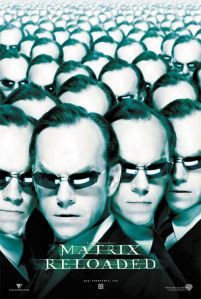 Imagine my disappointment as I viewed the highly anticipated sequel to 1999s sci-fi smash The Matrix and learned that the writing and directing team of the Wachowski brothers had taken a page from good ole George Lucas on how to make sequels: the bigger is better and more is more approach. Like the first two Star Wars prequels, the second Matrix movie is overstuffed and unfocused. Unlike the Star Wars prequels, it’s also extremely talky when it comes to psycho-babble that would only impress the bong-carrying peanut gallery.
Reloaded picks up sometime after the first. Morpheus (Lawrence Fishburne), Neo (Keanu Reeves), and Trinity (Carrie-Anne Moss) are late for a pow-wow with other leaders including Morpheus former flame, Niobe (Jada Pinkett Smith). In this meeting, which is within the Matrix, we learn that the humans have discovered that the machines are drilling at an incredible speed and will reach Zion, the last human city far beneath the Earth, in a matter of days. Add this to the bad dreams Neo keeps having where Trinity falls out of a building and gets shot by an Agent, and things are not looking good for our heroes from the first film.
At Zion, Morpheus stokes up the crowd who already believe that Neo is The One in the prophecy of the Oracle (Gloria Foster). They believe he is the one who will lead them to topple the machines. Morpheus informs the many citizens of Zion (okay, the last battalion of the human race lives in caves under the surface and people are STILL wearing sunglasses all the time? Watch your heads.) that the machines are digging to a town near you, and they have 250,000 Sentinels to wipe out what remains of humanity.
 So what do people do next; what would your standard response be? Apparently, in Zion, it involves a massive spontaneous, sex-charged rave. The multitudes of Zion start grinding and sweatily dancing to electronic beats. And curiously, as youll notice with the slow camera movement in the scene, NO ONE in the future wears a bra. Perhaps the machines got those too. So after a tremendously long span of raving with nipples, intercut with Neo and Trinity knockin boots (though could you imagine zero-gravity sex in the Matrix?), the heroes set off to find the Oracle once more. Zion is preparing to mount a counterstrike against the burrowing machines and is hopeful that it will buy them some time. They plan on sending the entire fleet out, save Morpheus ship and one or two to aid him in his quest.
Neo finally regroups with the Oracle along a park bench inside the Matrix. She puts forth more psychological babble about choice and how choices are already made before you make them. You may start zoning out and wondering when people are gonna start punching people again, because it takes a good 45-50 minutes to get into this movie. The Oracle does have an interesting tidbit of information however. She reveals that the Matrix if just chock full of rogue programs living out their days in the confines of this virtual reality. Included in this group are werewolves, vampires, ghosts, angels which are all programming errors that walk among the Matrix. So, wouldn’t it be kind of neat to see Neo fight the monsters from Universal Studios (Hey Frankenstein monster … I know kung-fu Fire baaaaaaaaaad!)?
The supreme drawback of Reloaded is that it introduces us to a plethora of new characters, all with minimal screen time and even more minimal plot impact, and then fails to advance the story. Niobe is pointless except for the old action picture adage of being at the right place at the right time to rescue our seemingly doomed heroes. A rogue program that calls himself The Merovingian (Lambert Wilson), who decides on being a European playboy with an accent that renders all speech useless, snoots and huffs his way around. Monica Bellucci plays his wife. This Italian actress can be enthralling, and not just on the eyes, but she also serves minimal purpose other than some heaving chest shots. Then theres the Keymaker, who will somehow lead Neo to his destiny or whatever. Theres about fifteen or so new characters and hardly any of them matter. The coolest additions are the twins, a pair of pasty dreadlocked fighters who can go through walls and parry any enemy assault. More time is needed for these two before they turn into another wasted villain, like Star Wars‘ Darth Maul.
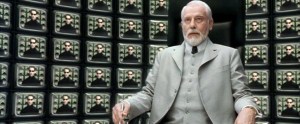 All of this criticism is moot, of course, because the center of The Matrix is on inventive and pulse-pounding action, right? Well I’d say that is so with the 1999 film but its sequel suffers when its action sequences drone on and become repetitious and dull. Neo fighting twenty or so replicates of Agent Smith (Hugo Weaving) is interesting and fun, but when ninety more show up and its painfully and slightly embarrassing when the people fighting are CGI, then the fun level drops with the film. Neo ends the big brawl by flying away. My friend next to me whispered in my ear once this scene concluded, If he could fly, why didn’t he fly away at the beginning? My response: That would be using your brain. Seriously, this action sequence is nifty and all but it serves no purpose, just like much of the first half of the film.
The freeway chase scene seems to already be famous and with due cause. Trinity and Morpheus zooming through traffic, fighting Agents and the twins, is a fantastic set piece that is reminiscent of the inventive action the first Matrix gave us. When Trinity zooms through oncoming traffic on her motorcycle the film comes alive and my attention was certainly front and center. The scene does fizzle a bit as it segues into Morpheus fighting an Agent atop a speeding semi. Again, the CGI rotoscoping of the landscape and the people is painfully obvious and detracts from the enjoyment.
What ultimately kills The Matrix sequel is that no one had the heart to question if maybe more wasn’t better. Sure the Wachowski brothers had all the riches unto Caesar to make this movie, but what perplexes me is that once we do get much more it only feels like more of the same, and disappointment sets in. Agent Smith is shoved to the side of the film and pops up here and there to glare. He’s more or less just repackaged with nothing new and no personality, like much of the film. The purposely perplexing psycho-babble does not help. Im sure hundreds of websites will dissect the exact philosophical links the movie presents, but man, all this talking about stuff thats shutting down my brain is getting in the way of ass-kicking. I felt bloodlust the more I heard people, usually some old fruitcake, endlessly blab about causality and choice. When it comes to action-packed sequels from 2003, I’ll take X2 any day over Reloaded.
 This is not to say that Reloaded is a bad film because it does have some nice special effects, cinematography, and some cool action sequences. These points of interest do not, however, justify its bloated running time. Some things were better left to the imagination, like the city of Zion, which looks about as dreary and dull as you might expect the last bastion of human civilization to look like in a ruined world, but this is science-fiction. Where’s the fun in dreary and dull? Again, whereas the first Matrix took place mainly in the false virtual reality where we could watch fantastic feats defying the laws of physics, Reloaded spends half its time running around the dank real world.
Some moments did have me giggling, like the Merovingian’s joyous creation — an orgasm cake. A woman has a piece of cake and her temperature rises. Finally the camera zooms into her vagina (its in computer-code so its all columns of sexy green numbers) and we see an explosion of light. Very interesting indeed. Essentially, this is a key metaphor for the film itself: an attempt to have its cake and eat it too.
The Matrix: Reloaded is an occasionally entertaining and often mind-numbingly talky summer entry. Youll get some thrills, maybe the philosophy will connect more for some (even though to me, at the heart, they say very little very eloquently), but because The Matrix is a colossal franchise that will make a gazillion dollars and then some, the power of editing has been kicked to the curb. If that power had been present perhaps someone could have trimmed a few of the many peripheral characters, kicked the pace up a few notches, reworked the fight scenes to advance the plot and stopped events from being so repetitive, and while they were at it maybe they could have done away with all the philosophy and stilted love dialogue. As it stands, The Matrix sequel has lost a lot of edge and this is because of the initial success of the first film. Sure, you might have an intermittently good time, but you should have had a great time. The Wachowski brothers had every tool at their fingertips but they became so enamored with fame and fortune that their work of creativity and genius has morphed into a self-indulgent, adolescent (with its hormone driven sexual events and its stoner philosophy), cash cow.
Nate’s Grade: C+
Share this:

Tears of the Sun (2003)
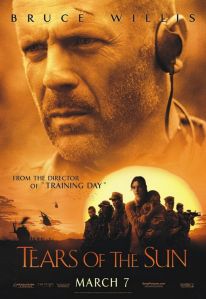 Bruce Willis is an ARMY squad leader called in to rescue a doctor (the sultry Monica Belucci) at a missionary in Nigeria. The country is in great turmoil after very very evil rebels have assassinated the entire royal family. Oh, but the good and very hot doctor refuses to leave without Willis’ squad taking the refugees out of the missionary with them. He begrudgingly accepts and they as a group travel through the countryside of Nigeria, all the while the very rebels are not far behind.
The film takes a tonal shift when Willis’ men come to the choice of staying with the refugees and trying to save them all, or following their mission protocol and getting the hot doctor onto an ARMY helicopter and shipped out ASAP, with no regards to the refugees. The shift in morality isn’t as smooth as Three Kings but now the film tries to place an emphasis on the human scale of genocide (even though ALL of these refugees who have lived in squalor have sterling white teeth, go fig). The weight of the topic easily alludes what is little more than a by-the-numbers action film.
With action films there will always be gaps of logic. However, there was one monumentally glaring miscalculation of forward thinking that prevented me from getting into the film again (*Spoilers ahead, big angry spoilers*).
 Okay, so African Rebels are chasing Willis and his team and the refugees. Got it. But then we find out later that one of the refugees is actually the, wait for it, heir to the throne of the country! All right, sounds hokey and more than a little culturally pretentious but I can follow. Hold on a second then. This heir to the country, who is obviously so important that people would risk their lives and safety for his own, why did these people not put him on the ARMY helicopters earlier that flew a handful of refugees out and to the safety of a U.S. air craft carrier. It makes no freaking sense whatsoever to have this golden opportunity that would 100% ensure the safety and longevity of THE HEIR TO THE KINGDOM and say, “Nah, you know what? Well catch the next ARMY helicopter guaranteeing safety to the man who would be king. Well sweat it out and have the rebels chase us, we could use the exercise anyway.” What has just happened to this movie?! After this, it was never the same for me; not that it was anything special to begin with.
Tears of the Sun is an action movie that attempts to be an action flick with a heart and a social conscious. There is a segment of the film where Willis and his cadre stumble onto ANOTHER batch of DIFFERENT but still very EVIL rebels assaulting a town, you know, rape and pillage and the like. Willis and company essentially save these people from the rebel tyranny but at this point the films core message has been well lodged into your gray matter: Africa needs the white man’s saving. More than a little arrogant and a tad racist, don’t you think? I mean not every country can wait patiently for Willis to liberate them.
Tears of the Sun does have some lovely examples of cinematography and some competent pieces of action here and there. In the end the film is an overblown and culturally insulting entry into the genre of people shooting and people falling down.
Nate’s Grade: C


 nathanzoebl
You must be logged in to post a comment.