Blog Archives
Scream 4 (2011)
 What do you do when your satiric self-aware take on pop culture becomes the MO for a generation? Back in 1996, Scream was a breath of fresh air by sending up dusty horror staples and having highly literate characters, with exceptional vocabularies, deconstruct genre elements while ironically falling victim to them as well. In 2011, Scream 4, an obvious paycheck grab, is showing its age. After a rather nifty series of opening fake-outs, which gave me hope that returning writer Kevin Williamson was going to finely skewer the conventions of horror since Scream last went dormant in 2000, but sadly this is not the case. “New decade, new rules,” one character says, but it’s all so much of the same. People run, they get stabbed, only the locations are truly different. There are a few witty jabs about the obsession with reboots and remakes, and Williamson does secretly work a crafty symmetry to the first film as far as characters go. The body count is much higher but the scare quotient is low. And then brining back the original cast (Neve Campbell, David Arquette, Courtney Cox) seems like a waste if they cede almost all screen time to a bunch of fresh-faced high school kids who were learning to walk when Campbell was learning to run for her life. The satirical elements feel so lazy; if you’re going to introduce technology-obsessed characters and the narcissism of social media, then do something with it. Don’t introduce an element like a webcam and then barely use it. The scares are about as flimsy as the commentary. The reveal of the killer(s) is stupid enough, as is the cracked motivation, but the ending just piles one absurdity onto another. It doesn’t know when to stop, and Scream 4 flirts with some daring possibilities to wrap up its bloodshed. Scream 4 is a drifting vehicle, wasting potential at every opportunity. The weight of all those red herrings, genre riffs, ironic twists, and self-aware characters has gotten to be too much. The Scream franchise has morphed into what it once parodied.
Nate’s Grade: C
Share this:

Hobo with a Shotgun (2011)
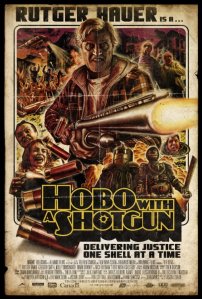 Consider the ultraviolet, gleefully vulgar movie Hobo with a Shotgun is the SECOND feature-length film that began life as a fake trailer for the 2007 exploitation opus, Grindhouse. Except this film began as a fan-made trailer to win a Grindhouse contest. Director and co-writer Jason Eisener’s winning entry followed a homeless defender of the streets, a hobo who found himself thrust into greatness thanks to oen fortunate shotgun. The two-minute fake trailer became a viral hit, was even attached to Canadian prints of Grindhouse, and Eisener was asked to extend his bloody trailer into an actual movie. He scored Rutger Hauer (Bladerunner, The Hitcher) as the star. finally, an actor from the 1980s who begs for change – on purpose! Hauer’s hobo rides the rails into a very Canadian city (the hookers say “aboot” – it’s cute) discovering an urban landscape overrun by scum. Drug dealers, gangs, pedophiles, crooked cops, all under the thumb of crime boss, the Drake (Brian Downey) and his two sons, Slick and Ivan (Nick Bateman and Gregory Smith). Can one hobo, shotgun in hand, inspire a city to stand up?
Hobo with a Shotgun is a movie that lives up to its very title. It’s a gleeful, jubilantly violent, colorfully over-the-top genre exercise that doesn’t push your nose in its campy excesses. But it is excessive, and to what effect? If you stop to catch your breath, you’ll start to realize that there isn’t a whole lot holding the film together. It barely covers 80 minutes and that’s with a lot of wheezing to get to the finish. The plot is mostly a series of beheadings, stabbings, and, of course, gunshots. Sure it’s a fun throwback and meant to be entertaining due to its homage to awful exploitation films, but it’s a one-joke movie that’s pretty hollow at its center. He’s a hobo, he’s dispensing justice (“one shell at a time” a newscaster reports), that’s about all there is, not that I expect a film with a title like Hobo with a Shotgun to tackle weight philosophical topics (the titular hero seems like a figure that would give Ayn Rand fits). If somebody wants to go to the effort of making the hobo some metaphorical everyman, lashing out at a society he feels impotent and angrily displaced by, then by all means. This is not a film with commentary in its blood. It lacks the creative consistency of a Black Dynamite or the narrative pulse of a Planet Terror, or the genre-rattling re-purposing of a Tarantino effort (have your pick). But the violence is often brutal and sickeningly clever, sating base appetites.
 This is a movie chiefly about grotesque characters, grotesque violence, and grotesquely dark and demented laughs. Luckily, the film has a finely attuned sense of humor that elevates what otherwise might be static genre exercises. The film is fully aware of its outrageousness. One of the Drake’s thuggish sons literally walks around with ice skates on before confronting the hobo of fame. He declares somebody’s going to be “skate raped.” He then uses these unorthodox shoes as an unorthodox weapon. A hooker (Molly Dunsworth) with a heart of gold saves the hobo. He remarks, without a hint of irony: “You’re smart. You should be a teacher.” He then refers to her as a teacher for the rest of the film. They develop a bizarre relationship that involves the shared desire to see a bear in a zoo (no joke). A cop reasons, “Well at least he’s only shooting the dirty cops,” in reference to the hobo, to which the chief responds, irony-free, “We’re all dirty cops!” A pedophile is dressed up as Santa Claus and abducts children, including one who bangs on the back windshield of a car as it drives by our hobo. The fact that it happens not a second later than two or three other incidents of crime, creating a melange of overrun criminality, made me giggle. And some of the jokes in this movie are dark; I’m talking scorched earth dark, but I was howling throughout. Now you know where my sense of humor lies. The newspaper headlines decrying the vigilante uprising have a frenzied penchant for rhyme and overly serious statements that are often hilarious (“Hobo Refuses Money, Demands Change”).
Eisener takes care to make his film look like a relic from the 1970s, from the low-budget mayhem, to the ominous synth-laden score, to the highly saturated film colors that advertise being phony “Technicolor.” His camera is antic, constantly swooping to find its intended target, and the cinematography feels grimy, constantly lit by strong neon colors like Joel Schumacher was a paid consultant. Eisener would do best to settle down a bit at times. His direction is a little too erratic, a little too antsy, like he’s constantly afraid that his audience will turn on him. Hobo with a Shotgun is a loving yet messy and uneven homage to the schlock movies of old, and your enjoyment level of this flick will depend greatly on whether or not you appreciate movies aim low on purpose. The crazy nature of the film, its frenetic pacing, and its strong sense of humor will delight fans of trashy cinema. The rest of the audience will probably just view it as trash.
 Hauer is a classic movie tough that actually has a bit of a soul inside those steely blue eyes. He’s an actor that’s been giving small, quietly menacing performances over the last decade. He plays the character completely straight, which makes him far funnier and even somewhat surprisingly sympathetic and less sociopath than a Travis Bickle-esque figure that wants to cleanse society through blood. His dream is to own a lawnmower, which he loftily dreams of opening his own lawn care company. He’s spat on, beaten, and treated without a shred of respect. To many, the hobo is just a nuisance at best and a subhuman lecher at worst. Hauer doesn’t even have to say a word, just hang onto his weary grimace and it says enough about the character. The hobo character makes for an interesting dispenser of justice, though the character is little more than a concept with legs. However, Hauer makes this hobo one for the ages. Way better than the creepy magic hobo from The Polar Express.
The movie is more fun than it should be and at the same time the movie is nothing more than the power of its admittedly awesome title. This seedy, blood-soaked is destined to be an acquired taste for a select few, however, I doubt anyone will randomly stumble into something as provocatively titled as Hobo with a Shotgun. This is a self-aware B-movie celebration of the grindhouse canon while giving is a gentle parody nudge; enough to capture a wink without going into camp. It has enough of a chaotic energy and cracked sense of humor to make up for its narrative deficiencies. Hauer somehow finds a soul inside his cartoon hobo, which is more than I can say about any of the other actors. But when you’re in a movie with burning school children, pedophilic Santas, oddball lines like, “When life gives you razors… make a baseball bat filled with razors,” and a hero who dreams of owning a push mower, well, you’re not expecting Shakespeare.
Nate’s Grade: B
Share this:

Exit Through the Gift Shop (2010)
 This twisty documentary begins as a chronicle of guerilla street art and then flips the script. Its star subject, mysterious British artist Bansky, becomes the director, cutting down Thierry Guetta’s massive amount of footage into a workable frame. The subject becomes the filmmaker and the filmmaker becomes the subject. Exit Through the Gift Shop is a canny film that questions the nature of art, good and bad, the documentary format, and even our perspectives on reality (what is real when seen through a lens?), all with prankish humor and an anarchist’s eye. The film starts as an introduction to street art and famous underground street artists. Initially wary, they come to trust Guetta’s ever-present camera and then wish they hadn’t. At the end, when Guetta becomes a multi-million dollar street artist under the guise Mr. Brainwash, you’re not quite certain whether everything you’ve just witnessed is one elaborate put-on, a master practical joke on the commercialization of art and style. This is far more than a look at ordinary graffiti artists. These cultural satirists question the very idea of what constitutes art, who owns it or deserves to, and the overwhelming power of self-manufactured hype to hoodwink. You get to watch the birth of an underground art form and then watch its commercialization. We’re probably only minutes away from knock-off Bansky-like tote purses. See Exit Through the Gift Shop and watch the stylistic birth and near death of an art form you never knew existed.
Nate’s Grade: B+
Share this:

Machete (2010)
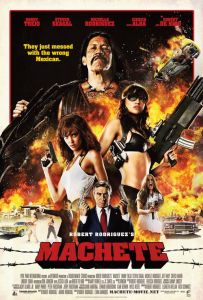 Based on a fake Grindhouse trailer comes a tasty Tex-Mex exploitation film that manages to be an incendiary political statement wrapped in the flour tortilla of silly, bloody, and redeemably entertaining B-movie schlock. Only occasionally will the pacing slack, and co-director Robert Rodriguez’s film actually desires to become another trashy B-movie rather than sending them up with a wink, which was also an issue with his half of Grindhouse. All credit must go to the towering lead played by 66-year-old tough guy Danny Trejo. The man is unmistakable with an appearance like he was carved out of wood. His stoic, humorless main character (“Machete don’t text”) that becomes a superhuman enforcer for the rights of illegal immigrants. Machete satirizes xenophobic politics and race-baiting politicians (“If we don’t do something, Texas will become Mexico… again”) with aplomb, notably thanks to Robert DeNiro’s slimy state senator. The film slices up opponents of immigration as outsized zealots abusing immigrants for cheap labor and railing against them for cheap political points. I actually read that some conservative pundits were concerned that Machete would incite a race war, as if any movie had that kind of power today. The reason this movie works and The Expendables doesn’t is all tone. Machete never tries to be a straight movie from the opening seconds. Stuffed with over-the-top violence, slapstick comedy, bodacious babes (Michelle Rodriguez with an eye-patch has never looked more yummy), and Steven Seagal and his hair plugs as a Mexican drug lord, Machete is trashy fun but exceedingly trashy and exceedingly fun.
Nate’s Grade: B
Share this:

Scott Pilgrim vs. the World (2010)
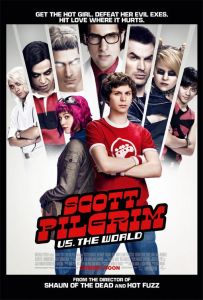 What happens when the millennial generation gets its own (attempted) seminal movie? It stays home and plays video games, letting the film, Scott Pilgrim vs. the World, languish at the box-office. I guess that’s what happens when you finance a movie whose target demographic will just as readily download the movie for free off the Internet.
Scott Pilgrim (Michael Cera) is a 22-year-old Toronto slacker. He?s the bass player for the band Sex Bob-Omb, along with lead singer Stephen Stills (Mark Webber) and acerbic drummer Kim (Alison Pill), a former ex-girlfriend of Scott’s from high school. The band’s biggest fan is 17-year-old Knives Chau (Ellen Wong), who also happens to be Scott?s new girlfriend. The world of Scott Pilgrim is abuzz with this scandal, especially Scott’s gay roommate Wallace (Kieran Culkin) and Scott?s younger sister (Anna Kendrick). Scott insists it’s all on the level and he has no ulterior motives for dating a high schooler. Then he sees the mysterious and alluring Ramona Flowers (Mary Elizabeth Winstead) who?s new to the area and American. Scott rabidly pursues her in what could best be described as stalking, eventually getting her to agree to date him. Trouble is, he hasn’t broken up with Knives just yet before starting this new venture. Scott is then confronted at the Battle of the Bands concert by a man who comes bursting out from the ceiling. He is the first of Ramona’s seven evil exes and Scott must defeat them all in order to earn the right to the violet-haired beauty. “Everybody has baggage,” Ramona says. “Yeah, but my baggage doesn’t try and kill me,” Scott wearily replies.
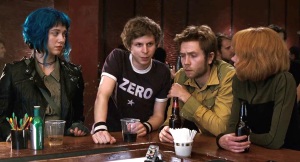 Visually, this movie showcases director Edgar Wright (Hot Fuzz, Shaun of the Dead) using every crayon in the Crayola box. This is a visually resplendent film where every scene seems crammed with details to delight the eyes and light up the senses. It’s a rush to watch the kaleidoscope of colors and motions. The Scott Pilgrim universe clearly differs from our own. This is a realm that borrows heavily from old school video games, where people burst into coins when vanquished, where life-decisions are met with “leveling up,” where people have onscreen pee bars that will deplete after a trip to a urinal. Sound effects will routinely be verbalized on screen, everything from a “RIIIIIIIIIIING” of a telephone to the “Ding Dong” of a door. It’s amusing, though also easily overused. Jobs and stuff like that are for the real world, hence too square to be depicted. It’s this entire idiosyncratic comic book world treated like everyday reality.
The enormous display of style is impossible to ignore. Scott Pilgrim is a slick, flashy piece of entertainment that is riddled with nostalgic references for a select crowd. I appreciated how a nice walk was accompanied by the theme song from The Legend of Zelda, or that sound effects and onscreen graphics echoed the fights from Street Fighter II (don’t ask me which of the 800 versions). Scott Pilgrim is an excellent pop pastiche of a specific culture, namely a slacker, hipster, amiable, comics and gamer group. I myself was an avid Nintendo gamer back in my day, but I admit to waning interest when the games got too complicated and grisly (“Back in my day we had two buttons to push, one to jump and the other to shoot, and that’s how we liked it!”). The movie is an explosion of color, light, and (lo-fi garage rock) sound, which also might sound like the description of a seizure or a stroke to some. Like those ailments, Scott Pilgrim will be seen by some as an infliction. It’s hyperactivity and eagerness to please via nostalgic reference points will be what drives people to this film and what drives them away in equal measure.
The Scott Pilgrim graphic novels total six volumes and approximately 1200 pages, which means it?s not the easiest fit for a two-hour window. It also hurts that the Pilgrim books have a wide supporting cast of characters to tussle with, plus there?s the whole seven deadly exes thing which means the movie has to provide about a solid 20 minutes of set-up before finding enough time for seven antagonists (or boss battles, following gamer parlance) and a reasonable amount of resolution. Add on top of this the fact that Wright keeps the movie moving at an outrageous, ADD-addled pace, like the plot conveyor belt lever got broken and the scenes speed one after another. Everything about this movie feels fast and over caffeinated. The editing in particular has characters holding conversations where every line is in a new location, implying an added sense of movement. So you shouldn’t be too surprised when the Scott Pilgrim film feels like a whole lot of a little; it’s moving at the speed of light to entertain.
 Because of the plot mechanics and oversized cast of characters, Pilgrim can give off the impression of shallowness. It seems like all style and little substance and that’s because the movie attempts to cram an entire series of stories, back-stories, and conflict into two hours. The film version only has enough time to attempt to give Scott and Ramona characterization, though both come across as weak-willed, tentative, and less than charismatic, wondering if either party is worth the trouble. The movie tries to paint over these differences through distraction and force of will. The large cast of supporting players all elbows each other just to be mouthpieces for one-liners. Knives actually comes across as the most complete character, consumed by her infatuation, heartbreak, and then quest for misguided vengeance. She’s somewhat dismissed and yet she is the most developed person on screen thanks to Wong’s endearing and relatable performance. The entire experience of Scott Pilgrim vs. the World can be somewhat fatiguing when there’s little evidence presented for emotional investment. The books supplied the reasons for caring besides the whole underdog angle.
The movie aims to be a battle over love, but it’s not entirely convincing. Scott appreciates Knives because she’s simple, a relationship he doesn’t have to invest much within, something casual and enjoyable while it lasts or until it becomes too taxing. Then he goes ga-ga for Ramona and stalks her, wearing down her defenses. He’s purely smitten with her and willing to do whatever it takes to earn her affections, though he can?t explain why he feels this way. Here’s a note to screenwriters: when characters are asked why they love somebody, do not have them say, “I don’t know.” But for Ramona, Scott is her Knives. He’s something easy that won?t break her heart, an escape from the jerks she’s been dating before. He?s low maintenance. He’s something to pass the time. There’s an interesting dynamic here, made even more complicated by the fact that Scott’s time with Knives blended with his time with Ramona. There was not a clear end point. The movie takes a literal approach to the idea of love being a destructive force of nature. Scott is punished throughout because of his infatuation with Ramona, but he persists despite the bruises. And he doesn’t even really know much about her. There’s an interesting statement somewhere there about the punishment we endure, sometimes foolishly, over the affections of people we may love, or convince ourselves of, but not even like.
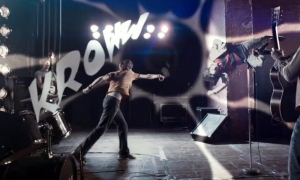 It may sound peculiar but I’m paying Michael Cera a compliment by saying his performance in Scott Pilgrim is the least Michael Cera the actor has ever been on screen. Gone is his gawky, awkward, ironic shtick that has fast become the Cera persona in films like Superbad and Year One. Scott is unjustifiably confident in his life’s pursuits, and Cera gets to act cocky and quippy, even if it?s done with a wink. He?s an unlikely kung-fu star but then again he?s also an unlikely leading man. Winstead (Live Free or Die Hard) is cute but plays her part a bit too toned down, like Ramona’s still searching for the right medication combination. Culkin and Pill are both scene-stealers of the first order, doing so with unabashed and flippant sarcasm. Every scene is made better by their presence. Among the evil exes, Brandon Routh (Superman Returns) has plenty of fun as a dim-witted super-powered Vegan bassist (“Vegans are just better than other people”), and Jason Schwartzman epitomizes hipster snark with such relish. The film is exceedingly well cast from top to bottom.
I’ve read some reviews positing that Scott Pilgrim vs. the World is an elaborate fantasy taking place in the mind of its titular hero, that he blends his knowledge of comics and video games to help make sense of the troubled waters of relationships and lingering hurt from the demise of love. I think that’s a nice explanation but perhaps trying too hard to frame this film as some form of psychoanalytical commentary on modern youth’s interpersonal relationships and the value of love. Scott Pilgrim vs. the World is really just a spastic, hip, clever wank that, as presented, gives little room or emotional investment. It?s a blurry, messy, prankish good time at the cinema that doesn’t translate into much more than the equivalent of sensory button mashing (video game reference). It’s fun while it lasts but it doesn’t have much beyond those astounding visuals to make it feel lasting, and I say this as a genuine fan of the graphic novels by Bryan Lee O’Malley. Alas, heavier discussions about the thorny, maddening issues of love are better left to more dramatic, and romantic, movies like Brokeback Mountain, Eternal Sunshine of the Spotless Mind, and even WALL-E. This movie is more preoccupied with spinning as fast as it can and then vomiting.
Nate’s Grade: B
Share this:

The Other Guys (2010)
 Surprisingly consistent in its belly laughs, The Other Guys proves that Will Ferrell is at his best when he re-teams with his greatest collaborator, co-writer and director Adam McKay (Anchorman, Step Brothers). The duo takes on the cop genre with a loving parody that manages to send up the genre while celebrating its excesses. Ferrell and his partner (Mark Wahlberg) stumble onto a mostly convoluted financial scam with banks, traders, and the police. The movie takes scene after scene and gives it a little twist for the self-aware characters to comment, usually to great comedic effect. There were some stretches that I was near tears from laughing so hard (the tuna vs. lion argument is an instant classic). I expected to be amused by the movie since nobody does silly smarter than Ferrell with McKay, but I was not prepared for how much I genuinely liked this movie. From scene to scene, I found something different to laugh at. There’s an undercurrent of rage from McKay concerning the economic stickup Wall Street got away with in 2008. The end credits are an animated statistics presentation on how large Wall Street firms screwed over the American public and are still profiting off of pubic misery. It’s a bit odd tonally to cover at the end of the film, like McKay wanted his legions of fans to get some morsel of education by the end of a film with goofy action and juvenile sex gags. The joke is on us all.
Nate’s Grade: B+
Share this:

Stranger than Fiction (2006)
 Ever think your life would make for a good story? Be careful what you wish for. Harold Crick (Will Ferrell) is hearing voices. They aren’t telling him to kill or do anything subversive. In fact it’s just one voice, an English woman, and she isn’t instructing Crick to do anything. No, she’s more so just… narrating. She comes in and out and expresses the doldrums of Crick?s life. He’s an IRS agent whose life revolves around order, repetition, and numbers. We can even see his inner tabulations thanks to some snazzy onscreen visual effects. Crick is sent to audit Anna (Maggie Gyllenhaal), a baker with a disdain for civil servants and authority. Crick is stricken by this shrewd beauty and finds himself wanting her, something the Narrator affirms for him. Crick’s life takes a dour turn when the Narrator lets on that Harold Crick had set in motion his “imminent death.” Crick is confused and seeks advice from Professor Hilbert (Dustin Hoffman) an expert on literature. Then they figure out the Narrator is Kay Eiffel (Emma Thompson), a famous writer who has the unfortunate habit of bumping off every one of her main characters.
Make no mistake, Stranger than Fiction is funny, but it’s a different kind of funny than most people are accustomed to with Ferrell. In my theater, I kept an eye on a gaggle of teenagers sitting several rows in front of me. I just wanted to observe their body language and what I saw was a lot of fidgeting, getting up for trips to bathrooms and popcorn, and lots of whispery talk. I can only imagine the disappointment of those teenagers expecting Ferrell to rip his clothes off and run around like a buffoon. They were likely busily thumbing away at their ever-present cell phones, text messaging their friends. People that are looking for a wild, sidesplitting, slapstick comedy are going to shaking their head. Stranger than Fiction is funny, but it’s in a very dry, witty way, much like British humor; it’s a humor you can admire for being clever but might not make you roll in any aisle.
 The biggest fans of Stranger than Fiction will be bookworms. This is a very literate movie that works better for those with an appreciation or outright love of literature and storytelling. Professor Hilbert doesn’t initially believe Crick until he learns that Crick’s narrator said, “Little did he know.” That, ladies and gents, is all a professor of literature needs. He has to rule out what kind of story Crick may be apart of, so he subjects Crick to a series of hilarious questions along the lines of treasure-inheriting, nemesis-making, and magical-creature befriending. Crick keeps a notebook to tally examples in his life that may point to whether he is part of a Comedy or a Tragedy. Professor Hilton even explains the difference: in grand Shakespearean tradition, a comedy ends with people getting hitched and a tragedy ends with people getting snuffed. This is all fabulously witty and extremely fun, but I can think you’ll see why hard-core fans of Old School and Talladega Nights might be heading for the exits.
Writer Zach Helm has created a wonderfully whimsical tale that’s trippy but manages to still have warmth and a firm heart. It’s far more embraceable a movie than, say, Adaptation, and less smug. He has a smart sense of humor and loves deconstructing literature, like the Jasper Fforde (The Thursday Next books) of screenwriting. We are really sucked into the movie from the moment we can hear Thompson. The story has an innocence to it and this existential comedy feels out there but still grounded; it’s surprisingly poignant and full of dramatic revelations. Even better, Helm has done something that few have achieved: he wrote a story-within-a-story that works. Kay’s narrative voice is highly droll in her observations on Harold Crick’s life. It sounds like a genuine novel, and on top of that, a novel I would enjoy reading. Stranger than Fiction is all the proof I need that Helm is a talent to keep track of.
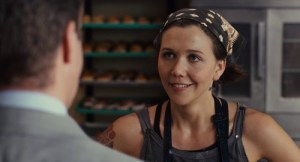 The performers all seem to have the same affection for the material. Ferrell is making that leap from funnyman into leading man, the same dramatic territory Robin Williams first tiptoed in Good Morning Vietnam and, likewise, Jim Carrey approached in The Truman Show. Ferrell won’t turn any heads but he underplays his performance maturely, playing a sad but sweet drone of a human being finally taking charge of his life under very insane circumstances. There’s a quiet moment toward the end where Ferrell is told he must accept his fate and he sits, shell-shocked, tearing up, his voice getting softer with every word. It’s only a moment but it piques my interest in what Ferrell may have in the tank. The comedy he can do in spades, including a desperate moment when he tries narrating his own life to coax his Narrator out of hiding.
Who will turn heads, however, is Gyllenhaal. I can already see a nation of teen boys falling in love with her tattooed, punky baker. To them I say, get in line pals, Gyllenhaal has made me dot my I’s with hearts ever since her star-making performance in 2002’s kinky romantic comedy, Secretary. She’s easy to fall in love with and expresses a fragile compassion to her role. The romance between Anna and Crick is unexpected but these two people need each other, and you feel that need as you watch their eyes light up as their relationship blossoms. Late moments between them add to the tenderness of the film and you will be on your knees pleading Crick is spared so he can return to loving Anna. I think Wreckless Eric’s “Whole Wide World” will become a potential staple on romantic teenage mix CDs sent to their sweethearts from now on.
Thompson and Hoffman have appealing supporting performances. Thompson has marvelous fun thinking of different grisly outcomes in store for Crick. Her interaction with the hospital staff to see the “not gonna make it people” is a howl. But Thompson is too good of an actress to play it straight. Once she discovers the life-altering implications of her writing she is crushed by guilt, obsessed over killing good people cruelly. Frankly, if I had anyone narrating my life, Thompson’s voice would definitely rank high. Hoffman plays a dedicated literary professor like a straight man, and everything seems on the level for him, even the fantastic. It’s a nice touch for a film that doesn’t require broad strokes.
 The movie doesn’t have the depth of feeling or dark turnarounds that I know Charlie Kaufman would have done. Stranger than Fiction has a lot of fun with a very ripe premise, and is very intellectually stimulating, but you do feel like it could have gone further, exploring the reaches and implications of its metaphysical setup. What if someone who read Kay’s manuscript thought it was such a masterpiece, a shining light of literature that could move mountains, that they knew Crick must die, and that they must kill him to make certain of it. Or what about the relationship between author and character, and the role each has over the other and perhaps a battle over the future, a typewriter, and a happy ending at the end of a tunnel. However, while all of these options would further explore the novel premise, it would betray the movie’s whimsical tone. This isn’t a very dark movie. It has an authentic sweetness to it, and Crick is a gentle and kind man, and to do anything too heavy would work against the film’s tone. The movie explores existential queries and the topics can be grim, but ultimately Stranger than Fiction is life affirming.
Stranger than fiction also has a buoyant, unexpectedly pleasing romance to it. Again, it doesn’t show the depth of love and human feeling that Kaufman’s Eternal Sunshine could, but this is an unfair comparison. This romance is more a subplot that carries increasing weight thanks to heartwarming performances and the winsomely adorable Gyllenhaal. The romance in Eternal Sunshine was the story, and everything else was outside variable coming into contact. It might sound dismissive to call Stranger than Fiction as decaf Charlie Kaufman, but it really is a compliment. Kaufman is the most exciting, brilliant, creative, insightful, and whacked out screenwriter working today. I would give one of my kidneys to write even one story that could be described as decaf Kaufman. Stranger than Fiction may not examine as many themes, conflicts, or relationships as Kaufman might with the material, but this movie is a sweet fable that floats by like a fluffy cloud on a sunny day. It’s just so damn pleasant you sort of soak it in and fall in love, not wanting to leave.
Stranger than Fiction is strange, all right, but gloriously so. Scribe Zach Helm has concocted an existential fairy tale aimed for bookworms and outsiders. The premise is clever but the film doesn’t stop there, and Helm explores the implications of his premise with whimsy, charm, and a sweetness that is hard to rebuke. The wacky story seems reminiscent of Kaufman’s works, but it has a more heartwarming and embraceable appeal. Great performances from a game cast help to push the material even further into excellence. It has a small handful of flaws, perhaps a too limited scope, but that doesn’t stop Stranger than Fiction from being one of the best stories of 2006 and one of the best movies too.
Nate?s Grade: A-
Share this:

Snakes on a Plane (2006)
 Snakes on a Plane. It’s a title, it’s a catch phrase, it’s a way of life. For a tiny horror movie with a blunt title, this flick has caught the imagination of Internet geeks everywhere, myself included. I couldn’t believe the movie was real at first, but then I slowly got onto its weird wavelength and brought my friends along too. For the past year buzz and hype’s been building, fans have made their own songs, T-shirts, trailers, and potential sequel titles (the equation is [animal] + [location]). Due to such unexpected rabid fan support New Line Cinema spent 5 days shooting additional scenes of gore and nudity to bump Snakes from a PG-13 to an R-rating. It’s hard to squeeze in a lot of nudity into a movie predominantly set on a plane not owned by Hugh Heffner. But has Snakes on a Plane run the danger of peaking before the movie ever opened?
FBI Agent Flynn (Samuel L. Jackson) is transporting a witness to a murder. The big bad Hawaiian gangster doesn’t want the witness to testify against him. His solution is elegant in its ludicrousness: the gangster has stashed a hidden supply of various poison snakes in the plane’s cargo hold. A timed release sets the snakes free to slither around the flight and bite as many passengers as possible. Flynn reports to his base, “You know all those scenarios we counted for, well I’m smack dab in one we didn?t count on.” You see, no one suspects snakes on a plane.
 The big question is whether Snakes on a Plane is just another bad B-movie that will line a video store shelf or a truly So Bad It’s Good Movie. In the accompanying months, this movie has caught on like wildfire by hipsters looking for grand, ridiculously stupid entertainment with a wink. Snakes on a Plane is indeed ridiculously stupid but it does so without the wink. The movie never steers for camp, which is sad. This is more like the silly trifles that routinely air on the Sci-Fi Channel (in anticipation, the network aired a whole night of cheesy direct-to-video reptile thrillers). There’s nothing wrong with those dumb escapist flicks, but then again there?s nothing essentially special or memorable about them.
The real funny thing is that if you haven?t seen Snakes on a Plane already, you’ve probably missed the best reason to go see it. This is the type of So Bad It’s Good movie that needs to be seen in a theater with a rowdy crowd, ready to hoot and holler at the mass stupidity on display on the big screen. This is an experience that demands to be shared with like-minded individuals in shared derision. I doubt it will translate as well on DVD. Something will be lost if you ever watch this movie by yourself (even more will be lost if you’re sober).
Without the rowdy viewing atmosphere, the movie itself sort of sucks. The acting is all over the place, the CGI is at times painfully fake like they had a rushed deadline, and the action gets a tad repetitious. You can only watch snakes bite people for so long before it all gets old. People get bit in the face, eye, tongue, neck, ass, breast, and, in one very unfortunate circumstance, the male member itself. Some of the gore effects are grossly fun. The opening pre-snake 20-minutes of the film feels like a lame episode of Hawaii 5-O complete with lame villain. I don’t know how in the world the bad guys found this witness so quickly when they didn’t see his face, license plate, or any identifying characteristics. Every time the movie cuts away from the plane to a handful of subplots on the mainland it loses its flow, and it takes a long while to get things back.
The sheer nakedness of the film’s conception is amazing. We’re all aware that movie studios can create their product in the most artistically void way possible. Snakes on a Plane was cobbled together by an exec?s idea of combining aviophobia (fear of flying) with another common public fear, ophidiophobia (fear of snakes). The absurdity of the entire premise is on full display while watching the movie. If you allow the images to sink in, especially panicked passengers swatting at the reptiles, you will be seized by uncontrollable laughter. Who really would ever have thought of snakes being on a plane? I love that the evil gangster confesses that “he exhausted every other option.” I would have loved to be in that meeting room just to see all the plans that didn’t cut it compared to “poisonous snakes drop into cabin.” If this movie ever catches fire it could spawn a whole new wave of horror films that are mash-ups of common fears. So keep your eyes peeled next summer for Snakes on a Public Speaking Venture (“Oh no, there are snakes everywhere, and I have to speak in public about it!”).
 Snakes on a Plane, unbelievably, tries to play it too straight and serious. There are so many improbabilities and inaccuracies in the film. It has snakes springing like rockets and moving as if they had 1,000 legs, and yet the film won’t fully commit to camp. After a year of hype and a lightning rod of a title, it’s hard not to be disappointed that Snakes on a Plane isn’t something more than… well, snakes on a plane. But then again maybe the simplicity is the whole genius. Maybe there’s still another layer of satire I have yet to penetrate, but I think I’m grasping out of hope for something more that just isn’t there. The movie is entertainingly bad but it doesn’t ever reach the stratosphere of bad, a world inhabited by the likes of Manos, The Land of Faraway, Showgirls, Glitter, and Bulletproof Monk, to name but a few.
There’s plenty of clichés and stereotypes galore. A stewardess, Claire (Julianna Margulies), is on her last flight before retirement. Flynn’s police partner bites it. A novice needs to be talked through landing the plane. The elitist blowhard gets his. There is a flaming gay male flight attendant that’s supposed to be funny. There’s even a laugh-out-loud moment where Flynn hugs Claire and says, “I need you to be strong for me.” Is the movie making fun of these clichés or just relying on them for a story? Does a difference even matter?
I will say that I was waiting in great anticipation for THE line of the summer: “I’m tired of these…” Once it came I couldn’t help but recite it along with Jackson.
Snakes on a Plane is a victim of a year’s worth of hype. It’s ridiculous, stupid, terrible, but then we all knew that when we bought a ticket. What we hoped for is that this blunt horror flick would be a campy send-up of B-movie silliness. Snakes on a Plane is less a canny parody of stupid thrillers than another example of them. The movie’s most ludicrous decision is trying to play this mess as serious material. If the flick had been a little more open to self-analysis then it could have been a real fun ride. Snakes on a Plane is bad, but after the absurdity of its premise dies down it’s never really that entertaining. It’s more mediocre. If you’re late to the Snakes on a Plane phenomenon then you’ve already missed its glory days.
Nate’s Grade: C
Share this:

Kiss Kiss, Bang Bang (2005)
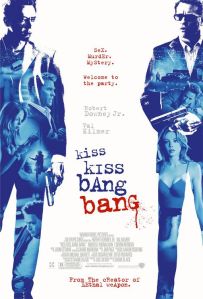 Shane Black was a Hollywood icon by the time he was in his early 20s. In 1987 he sold a script called Lethal Weapon to producer Joel Silver that put a jolt back into action flicks and gave the template for all buddy-cop comedies to come. He earned a then-record $1.7 million for his script, The Last Boy Scout, topped later by the $2 million paycheck he got for The Long Kiss Goodnight. It’s a shame both scripts were marginalized by their film directors. Black went underground for a long time, nursing his wounds over what had happened to his screenplays. Then in 2004, Black began his comeback vehicle, a modern day detective story that also lampooned Hollywood, and this time he’d direct his own material. The final product is called Kiss Kiss, Bang Bang, and Black’s comeback film is nothing short of a cinematic knockout and the most refreshingly entertaining movie of all 2005.
Harry Lockhart (Robert Downey Jr.) is a small-time crook on the run from the cops when he stumbles into an acting audition. They hand him a script, tell him his partner’s dead, and are so impressed with his “acting” that he’s immediately flown to Hollywood. Harry is teamed up with Gay Perry (Val Kilmer), a cop who does advisory work and just happens to be gay. During a house party, Harry reunites with a childhood friend, Harmony Faith Lane (Michelle Monaghan). They reminisce about their childhoods in Indiana and their fascination with the Johnny Gossamer detective novels, but she has much more on her mind: her sister’s gone missing and she needs Harry to find her. Trouble is Harry hasn’t told her he’s not a real detective. He’s gone from crook to pretend actor to pretend detective, and before Christmas is over he’ll be up to his neck in bodies, intrigue, double-crosses and all the stuff that would make for a rip-roaring Johnny Gossamer book.
 First and foremost, Kiss Kiss, Bang Bang is one deliriously fun party. The film moves at breakneck speed through its smart, cheeky gags. Black’s dialogue is hilarious and feels so effortlessly natural coming from Downey Jr. and Kilmer, like he’s got their speech patterns tattooed in his brain. In fact, the dialogue feels so robust and natural, never glib and self-conscious, that it almost comes across as feeling like a heavy improv session between two immensely talented actors. Kiss Kiss, Bang Bang, Black’s opus to the hard-boiled detective genre, has more twists and turns than a seizure patient doing the Hokey Pokey. You never know where this movie will head next or what joke will topple you over with unexpected laughter, and that’s what makes Kiss Kiss, Bang Bang so unabashedly thrilling to watch. Even when the movie does start to veer into more conventional material, Downey Jr. is there as our narrator to point out what we’re all thinking and to make fun of the expected. Kiss Kiss, Bang Bang can get jubilantly perverse at parts (a corpse getting a golden shower), but the macabre touches never deflect from the film’s boundless, inconsumable energy. Everyone is having the time of their lives in Black’s comic caper, and it shows.
Seriously, this movie is the definition of a laugh riot. It’s like a carnival ride through a gag factory (that sounds kind of spooky, actually), and Black has such an assured confidence to his writing, evidenced in his set-ups, reversals, and the insightful tweaking of Hollywood that could only come from one of its own (Harry laments that the nation turned over and shook and all the normal girls hung on while the crazies landed in L.A.). Here’s a conversation between Harmony and Harry about a promiscuous actress:
Harmony: Well, for starters, she’s been f***ed more times than she’s had a hot meal.
Harry: Yeah, I heard about that. It was neck-and-neck and then she skipped lunch.
Just re-reading it makes me laugh. How many comedies make you laugh just thinking about them in retrospect? Kiss Kiss, Bang Bang is one of those oh so rare delights. It even has a talking bear in it!
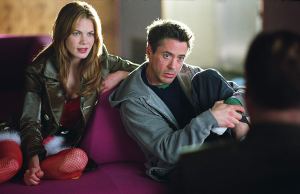 The lone detraction for Kiss Kiss, Bang Bang is the movie’s overall lack of substance. It doesn’t reach for anything more than bold entertainment, and to that end it succeeds in spades. Some may argue the movie is spinning so fast to try and distract you from its empty center, but I say enjoy the ride while it lasts. I only wish this movie was longer, like Lord of the Rings-long. I did not want to leave this world and these characters. My claw marks might still be visible on the armrests where they had to throw me out.
Black also proves to be a very slick director with a natural eye for camera placement. His photography is very pleasing, relying on different light placements to add surreal touches that accentuate the narrative. Black keeps his movie at a breathless pace and knows how to handle his actors. His narrative side-steps enliven the film and grab our attention, and Harry’s voice over is never overused to explain the minutia the script cannot. The only drawback for Black might be that his film could be too smart for its own good. I mean, most of the movie going public will be stooped by a joke about adverbs. Black has an obvious love for detective yarns and film noir, that’s evident with the film’s style and the fact that chapter titles are Raymond Chandler novels, but some familiarity with this world will sharpen your experience. Kiss Kiss, Bang Bang never panders to its audience, and that may hurt Black as far as making a movie that will reach out to Middle America (Perry apologizes to the Midwest for using the “f-bomb” as often as they do).
The chemistry between Downey Jr. and Kilmer is incredible, positioning them as one of the finest comic pairings in recent cinema history. Their indelible camaraderie is the true heart of Kiss Kiss, Bang Bang. They bat insults and injuries with comic aplomb. Both characters are unapologetic, Harry as a nattering criminal screw-up way in over his head, and Perry as gay man who’s fine with that and will rip your testicles off just the same if you cross him. He’s not stereotypical swishy or flamboyant, but he’s very enjoyably dry and sarcastic. Both actors have a history of being troublesome to work with, but Downey Jr. and Kilmer have been two of our most amazingly talented actors … when they want to be. Kilmer is the coolest customer in the film, being nonchalantly badass even when he’s about to blow his top (this is NOT a gay joke, by the way). Downey Jr. is his usual charming, amiable, fast-talking self, but even his tiniest details speak comedic volumes, like his reactions and general awkward physicality. I cannot imagine anyone else doing as excellent a job in these roles, especially Harrison Ford who was sought by producers for the Gay Perry part (feel free to shudder at what might have been Hollywood Homicide 2.
 Monaghan is a break-out actress that could have been even more break-out-er by this time. She’s mostly had small unmemorable roles in films like Unfaithful and The Bourne Supremacy, but 2005 was set to be her year. She had roles in Constantine, Mr. and Mrs. Smith, and Syriana. Unfortunately, her scenes were cut from Syriana and Constantine, and her role was drastically pared down in Mr. and Mrs. Smith. The only thing Monaghan has to show for 2005 is Kiss Kiss, Bang Bang, and that’s all she’ll need. She’s bright and pretty, but she also gives Harmony a great sense of being run down, another girl getting off the bus to Hollywood with stars in her eyes only to find out the harsh reality. Her combative relationship with Harry as they reconnect and try and wonder how they went astray is another film high point. She’s a comedic asset and should be on Hollywood’s speed dial if they need a charming, funny, capable actress.
Kiss Kiss, Bang Bang is a wicked good time. It’s complex, twisting, riveting, unique, hilarious, and just about every synonym you can think for the word “awesome.” Black’s comeback may be too smart for its own good, and having a general understanding of film noir will enhance your experience, but this is one comic caper that’s so much fun, so stylish, so damned entertaining, who cares if it lacks substance? Kiss Kiss, Bang Bang is a refreshing blast of fresh air and should please anyone looking for a smart Hollywood film mixed with doses of their familiar sex and violence. But that’s what makes Kiss Kiss, Bang Bang so exhilarating, nothing about it could be classified as familiar. Seeing this flick is like being invited to the party of the year. Just make sure to head to your theater before your invitation gets lost in the mail.
Nate’s Grade: A
Share this:

Man on the Moon (1999)
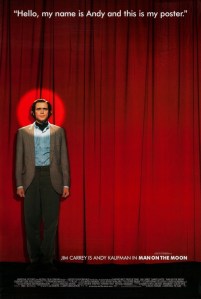 After many years the big screen biopic of one of comedy’s greatest figures of recent finally emerges to the awaiting public. Many never knew what to make of Kaufman or what he was attempting to do, and the movie displays this attitude to its core.
First things first, there is no Jim Carrey in this picture, only Andy. Carrey’s performance is pitch-perfect and swarming and enthralling that he becomes the glue of an otherwise sticky movie. Carrey IS Andy Kaufman, it’s like seeing dear Andy alive and well back on screen still terrorizing the easily duped. It almost brought a tear to my eye. Carrey takes the sheep skin and pulls off an incredible career best performance that demands attention come award time.
But without Carrey’s masterful performance Man on the Moon is not worth venturing out of the home for. The movie never delves beneath the surface to discover who the true Andy Kaufman was or why he did the things he did. And if the point is that there was no true Kaufman but merely a stage character then fine, but did we need a movie? Without any inner depth the flick becomes a shapeless reassembling of TV stints and clips Andy pulled. If I wanted to see this I’d watch Comedy Central at odd hours of the night.
Courtney Love pops her head in late into the running time to establish herself as the love interest, but her character like everyone else, is never fleshed out. Love just becomes a hollow foil to Kaufman’s antics in some vain attempt to add heart to the madness. The most lingering problem is that of the relationship between Kaufman friend and co-conspirator Bob Zmuda never being shown beyond communal frat brothers. Man on the Moon gives the reigns of the picture to Carrey, and rightfully so, but then seems to believe Carrey as Kaufman is the only substantial character in the story.
Man on the Moon is for the most part an entertaining retelling of the rise and fall of Kaufman, and his indifference all the way. Director Milos Foreman and his two Larry Flint scribes try their hand at uncovering the man behind the curtain, but stumble along the way. Maybe this is the film Kaufman would have wished, one that doesn’t answer any questions or is forced to entertain its patrons. But me thinks that the Hollywood version of Andy stays true to his stubborn nature, but trips its feet towing the mystery that was one of comedy’s most peculiar influences.
Nate’s Grade: C+


 nathanzoebl
You must be logged in to post a comment.