Blog Archives
Spy (2015)
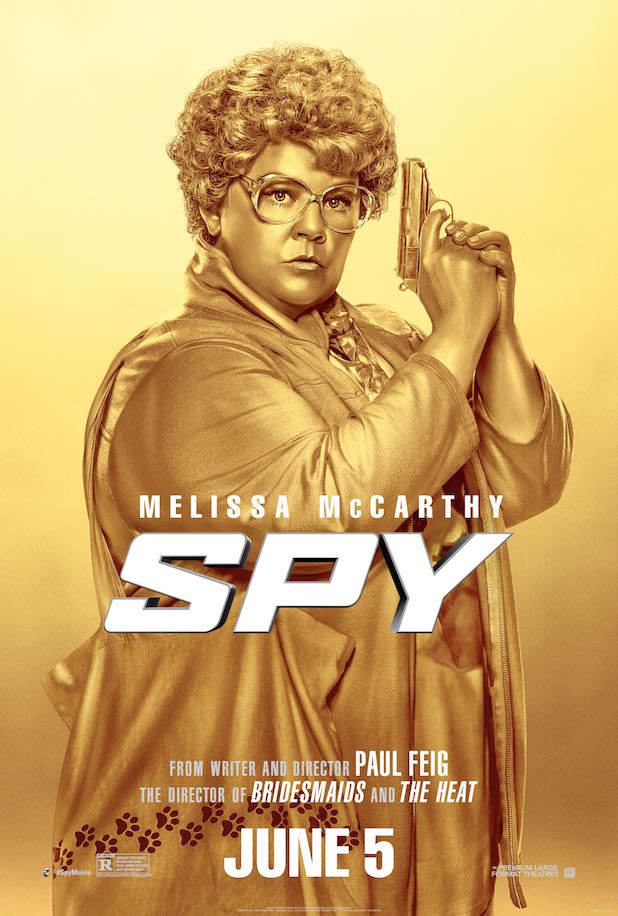 Melissa McCarthy’s meteoric comedic rise hasn’t been without its missteps, mainly the complaint that she seems stuck in a rut playing aggressively weird and foul-mouthed characters that are growing tiresome. McCarthy is never better than when teamed with her Bridesmaids’ director Paul Feig, and Spy is a welcomed return to form for a great comic actress who relishes being outlandish. The best part of the film is that it’s a character-centric comedy, with McCarthy as Susan Cooper, a CIA agent who works as a handler, the voice on the other end of the earpiece, guiding her partner the handsome Agent Bradley Fine (Jude Law). When Fine is compromised on a mission, Susan unexpectedly finds herself in the field to track down some very bad people. McCarthy does get to be vulgar, but fortunately it’s only one persona she adopts as a mask, and it’s cleverly utilized. Feig’s screenplay makes sure to find different comic beats as it goes, rarely repeating itself and, like any good action movie, finding twists to further develop conflicts. Part of what’s so enjoyable about Spy is how comic scenarios will evolve while staying true to the characters and the central conflict. Also, Feig acquits himself more than well with the film’s semi-slick action photography. The supporting cast is nicely tied into the story and matter and each actor has material to cut loose, none more than Jason Statham (The Expendables) as a hilariously boastful and incredulous agent. His boisterous chest-beating about his past deeds are some of the film’s funniest moments. Consistently funny, witty, and mildly progressive with its heroine, Spy is a vehicle that makes perfect use of McCarthy’s talents and then some.
Nate’s Grade: B+
Share this:

The Heat (2013)
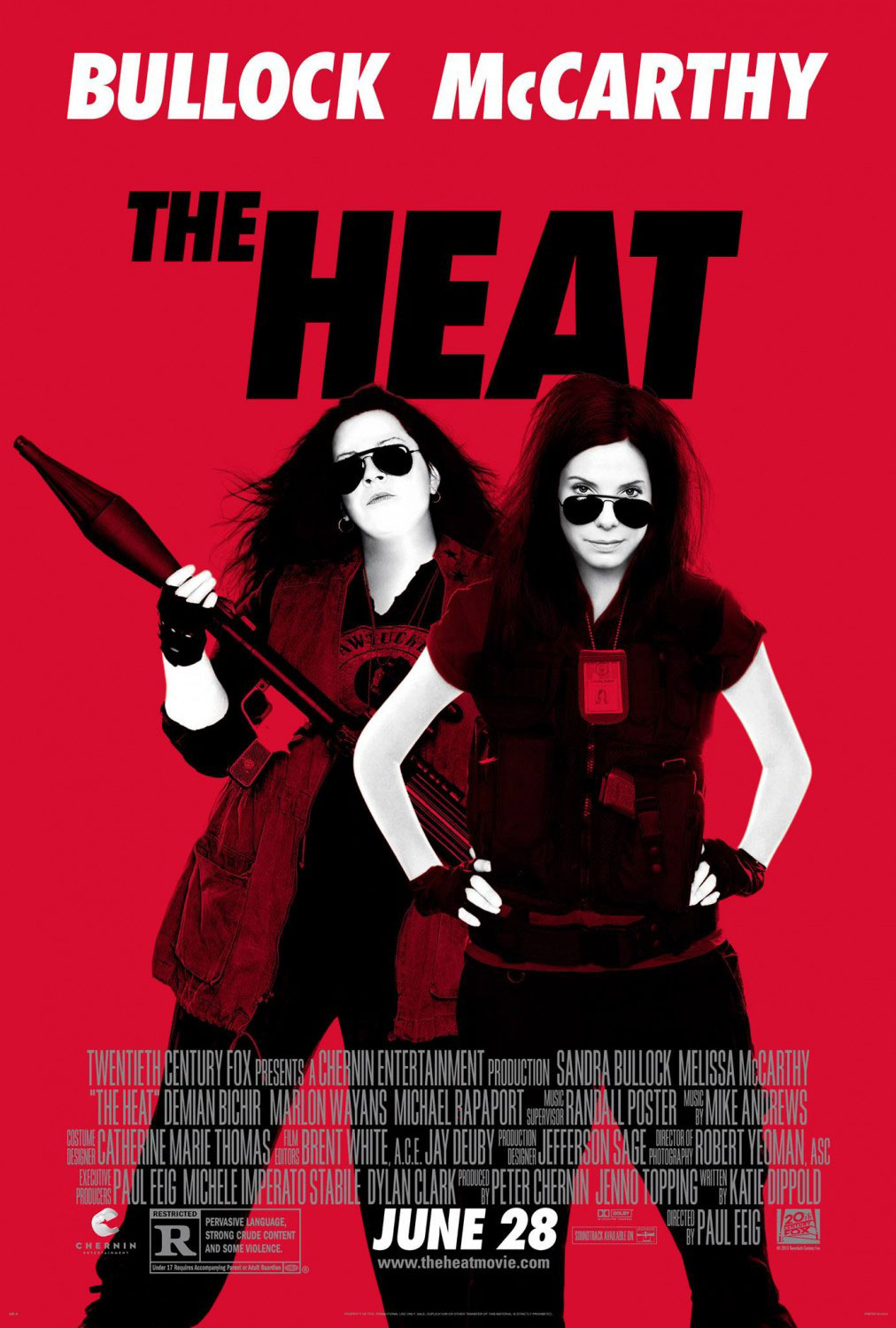 Essentially a buddy cop movie with the typically macho roles swapped out to women, The Heat is an intermittently enjoyable action comedy thanks to the chemistry between Sandra Bullock and Melissa McCarthy. The joke ratio of hits to misses has a lot of whiffs but I laughed solidly every ten minutes or so, some of the comedic set pieces were well developed, and McCarthy’s strong ability to improv saved many flailing scenes. I enjoyed that these two women were seen as professionals and didn’t need to be bogged down with the kind of plot elements you’d find in your standard Katherine Heigl vehicle. There isn’t a romantic interest nor a love story; in fact, various guys come up to McCarthy throughout asking why she hadn’t called them back after a one-night stand. It’s a little thing but it establishes that a woman like McCarthy’s can have a fruitful love life and have it be no big deal. The overall plot about a dangerous drug baron with a mole inside the government is given more complexity than necessary, and I’m not sure the action bits feel well integrated into the movie as a whole. Part of this may just be because director Paul Feig (Bridesmaids) seems much more interested in grounded, human comedy, but I think it’s mostly because we’d rather be spending more time with our leads arguing. Bullock and McCarthy are an engaging team, their comedic styles nicely ping-ponging off one another, and there are enough ribald gags to justify watching it. The Heat isn’t revolutionary by any sort but maybe, in the end, that’s the point. Also it’s got Dan Bakkeddahl (TV’s Veep) as an albino DEA agent. So there’s that too.
Nate’s Grade: C+
Share this:

The Hangover Part III (2013)
 I was no huge fan of the first Hangover movie and I cited its 2011 sequel, a carbon copy of the original, as one of the worst films of the year. The supposed final chapter ditches the blackout formula, which on its face seems like a step in the right direction, but now we have a Hangover movie with no titular hangover and at heart this is a movie for no one, even hardcore Hangover fans. I became quite cognizant how little I was laughing, not just because the jokes were badly misfiring, which they were, but also because there were so few jokes. You’d be hard-pressed to label this a comedy. It’s really more of an action thriller. What humor does arise is usually mean-spirited, curdled, or just off-putting, particular the reoccurring theme of animal cruelty (maybe opening your film with a decapitated giraffe is not the best idea). The other major hurdle is that annoying supporting characters played by Ken Jeong and Zach Galifianakis are elevated to co-leads. Both of these characters are best when reacting to others rather than being the main actors in the story. This movie is so abysmal as a comedy that you start to think director Todd Phillips should try his hand at a straight action thriller; the guy has a strong eye for visual composition. The actors all look extremely bored. Could Justin Bartha, the character who always gets sidelined, just get murdered and they have to hide his body? Oh no, I think I just came up with The Hangover 4. I apologize already.
Nate’s Grade: D
Share this:

This is 40 (2012)
 In the five years since 2007’s comedy smash, Knocked Up, writer/director Judd Apatow has ascended to heights in Hollywood that few ever achieve. And while his disappointing 2009 film Funny People may have been an example of the man flying too close to the sun (let’s mix metaphors, why not?), he’s had a stable career guiding mostly hit comedies to big numbers, particularly last year’s Bridesmaids. For Apatow’s next directing effort, he picks up a handful of supporting characters from Knocked Up and gives them their own spotlight. This is 40 is Apatow’s “sort-of sequel.” It may seem familiar in tone and style to his previous efforts, but there’s one big difference between this film and Apatow’s previous works. This movie never feels like it goes anywhere. Even Funny People went somewhere even if I disliked it.
Five years after the events of Knocked Up, Peter (Paul Rudd) and Debbie (Leslie Mann) are struggling to keep their household afloat and sane. Their daughters, Sadie and Charlotte, (played by Apatow’s real daughters, Maude and Iris), are constantly fighting, Debbie’s worried one of her employees is stealing from her business, and Pete’s trying to save his record company without alerting his family to his panic. Pete has put all his efforts into promoting a new album from 1970s rocker Graham Parker, but really he’s fighting a losing battle against mainstream taste. Pete has also been secretly loaning out money to his no-good father (Albert Brooks), while Debbie has been trying to reconnect with her distant biological father (John Lithgow). Weirdly enough, both fathers have started secondary families and have broods of young children. As Debbie and Pete both approach the big 4-0, both of them make resolutions to better themselves, renew their family bonding, and reignite the spark in their romance. Of course, after two kids and several years of marriage tallied, it’s easier said than done.
 The Apatow films have always had their own loping rhythm to them, an easygoing quality that isn’t as directed by plot as character. So when I say that This is 40 feels rather aimless, I want readers to recognize that this goes beyond the normal loosely plotted Apatow affairs. Usually his movies have defined events to direct the overall trajectory of the plot; a baby on the way, losing one’s virginity, etc. I’m hard pressed to say what exactly is the direction of This is 40. It’s about the ups and downs of a married couple, but there isn’t necessarily any definable conflict. They’re sort of in a malaise and internalizing their unhappiness, but the movie is the sum total of many small conflicts that never seem to congeal. As a result, the movie feels like it’s often coasting, going beat-for-beat until something new takes it on a mild diversion. It’s a movie of diversions without a unifying path. Sure the couple becomes, presumably, stronger by the end of the film, but I can’t say what’s taken place to explain this progression. The movie plays out like a series of loosely connected scenes. I enjoyed myself, and found the movie often amusing, but I kept wondering what it was amounting to. It was never enough of a niggling concern to stop from being entertaining, but when it was done, I thought to myself that I just watched Apatow’s friends hang out for two hours and call it a movie.
There’s also the issue of indicating this is a sequel to Knocked Up or at least exists within the same universe. There’s very little continuity between the two films other than Pete and Debbie’s family. Jason Segel (The Muppets) and Charlyne Yi (Paper Heart) make reappearances playing characters with the same names, but they don’t seem like the same characters (though the gyno doc is the same – hooray). My major sticking point is the complete absence of the stars of Knocked Up, Ben (Seth Rogen) and Alison (Katherine Heigl). Now I wasn’t expecting a drawn out cameo from these two, especially after Heigl publicly badmouthed Apatow and the movie that made her a star. I did expect some passing reference, even something as small as, “Ben and Alison are looking at schools for their daughter.” I just wanted something to feel satisfied. Where this becomes a problem is that I’m fairly certain that Ben and Alison would be attending several of these major social events for their family members. They make a big deal about Pete’s 40th birthday party, so why wouldn’t Ben and Alison be there? And with her litany of marital woes, wouldn’t Debbie seek out, you know, her sister to talk with, the same sister she hung out with all the time in Knocked Up? Apatow might as well have just given everyone a new name if this was as sequel-y as This is 40 was daring to go.
Part of my lukewarm reception to the film is likely my lack of empathy with the problems of the main characters. Good storytelling should allow anyone to be able to empathize with characters dissimilar to themselves. I found many of the problems in This is 40 to be the stuff of rich fantasy. Pete is worried his record company, that he started, might not make it. He’s also been secretly giving his mooch of a father $80,000 (!) over the years. Maybe these people could stand to cut back and live within their means. Their house is huge, downright opulent, and it seems like Pete has wasted plenty of money on needless expenditures, which his own employees eventually point out at work. Did they need a big 40th birthday bash? Do their kids need every expensive gadget? When they take a vacation, does it need to be in a lavish hotel along the beach? I found too many of these complaints to be whiny and indulgent. That’s not to say that there aren’t serious relationship problems that are given thoughtful attention. This is 40 is arguably Apatow’s most mature and reflective film yet, though that might be faint praise to some. I would rather the movie spent more time focusing on the relatable concerns of a relationship crumbling rather than the stress of possibly having to move from a super-rich house to a merely somewhat rich house.
And yet the movie is routinely funny and charming, thanks to the Apatow standards of cast camaraderie, character, and the mixture of raunch with sweetness. I like these characters and so I enjoy spending time with them, and even if I feel like we’re not going anywhere fast, I don’t mind that much. I’ll gladly spend two plus hours with these funny people and their mid-life crises comic follies, at least once. The characters are well drawn and played by capable comic players that can do their Apatow jazz deal, finding peculiar riffs to work and squeeze out mirth. I thought a discussion over the appeal of being a widower and the fantasy of a spouse’s untimely demise to be quite funny as well as a topic generally unspoken (“This is the mother of your children we’re talking about. You want her to go peacefully.”). Rudd (Wanderlust) and Mann (The Change-Up) are terrific together and entirely convincing as a longstanding couple, people who know the ins and outs of one another. It’s fascinating just to watch the nuts and bolts of a relationship that is still a battle; it also helps when you like both participants and find that they each have valid points. Though I cannot fathom how hiding impending financial doom is a smart move.
 Apatow does a fine job of making sure the dramatic parts do not overweigh the film, usually settling things with a nicely punctuated joke or pop-culture critique (oddly enough, TV’s LOST becomes a major reoccurring gag, though you expect a bit more of a comedic payoff when they get to the controversial finale). I’m not sure that many people are going to know who Graham Parker is, but here he is folks. There are a lot of Apatow players peopled throughout, like Chris O’Dowd (Bridesmaids), Lena Dunham (TV’s Girls), and Melissa McCarthy (Bridesmaids), making fine work with minimal screen time. You’ll recognize other familiar faces as well. Occasionally the jokes feel like they go on too long, catching the downward slope of an overstayed improv riff, but I was laughing throughout and enjoyed the unpredictable nature scene to scene. You’ll likely predict the outcomes for certain storylines and conflicts, since Apatow is a sucker for the squishy ending, but you’ll feel like it got there on its own relative terms. It’s not exactly a happy ending but it’s a less unhappy ending.
There are plenty of supporting actors that shine in this movie, though I feel that I need to single out the great Albert Brooks (Drive). He plays such a passive-aggressive, manipulative, mooch of a father, but he does it in a way that almost wins you over, how straightforward he is with his bad behavior. When Pete tells him he cannot loan any more money, Brooks blithely, almost cheerily, theorizes that murdering some of his recent kids can solve this problem. He marches out, gets a hose, and asks the kids to volunteer who wants to be murdered. It’s scenes like this that manage to be funny but also cutting to a dramatic truth that the film hovers around, occasionally hitting the bullseye. Megan Fox (Transformers) is also enjoyable as a, what else, vivacious employee men are falling all over themselves for. And even Apatow’s own kids give rather strong performances, now playing actual characters rather than scene-stealers. Maude, the oldest, has a lot of dramatic scenes as the teenager daughter coming to grips with hormones and her crazy parents. The Apatow clan might just get some outside work after people see dad’s movie.
While I doubt Apatow has made any sort of definitive statement on what it means to approach four decades worth of life (and poop jokes), This is 40 is a perceptive and enjoyable movie even if it feels like a collection of scenes. Good thing I like these characters and enjoy spending time with them, otherwise I might find this whole film to be a bit aimless and self-indulgent. Seriously, how many scenes are there going to be of people singing along to music? This is 40 has enough going for it, be it comedy or some insightful dramatic moments, though it keeps an audience a bit removed due to the unrelatable nature of their posh problems. If there’s a This is 50 in the works, next time get me some more Rogen time. I’d rather watch him deal with raising a teenage girl in the age of social media. You don’t have to know anything about Knocked Up to follow along with This is 40, but then again, if you haven’t seen Knocked Up, just go watch that movie instead. Trust me.
Nate’s Grade: B
Share this:

Bridesmaids (2011)
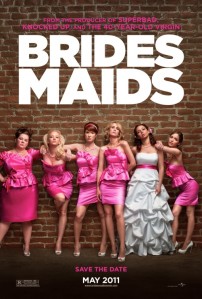 To refer to the bawdy new comedy Bridesmaids as a “female Hangover” seems disingenuous and a facile comparison cooked up in some marketing laboratory. This is nothing like The Hangover, a conceptual comedy that, can we all agree, was a funny movie but not the funniest movie of all time? Bridesmaids is a byproduct of the Judd Apatow comedy factory, and that’s what it feels like. This is no mere concept comedy built around a madcap premise. This is a magnificent character-based comedy that lets the women finally be in on the joke rather than the butt of it. Bridesmaids proves that the ladies can do everything their gender counterparts can do and better.
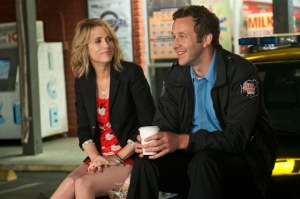
Annie (Kristen Wiig, who co-wrote the screenplay) is a woman down in the dumps. She lost her bakery due to the crummy economy, she lives with a pair of cretin roommates, and she’s a sleazy creep’s (Jon Hamm, wonderfully douchey) number three choice whenever he needs some casual sex. Her lifelong best friend, Lillian (Maya Rudolph), has just gotten engaged and asked Annie to be her Maid of Honor. Annie is threatened by Helen (Rose Byrne), a rich socialite who has grown close to Lillian in Annie’s absence. Helen is also apart of the bridal party and is always at the ready with a classy alternative when Annie stumbles. Annie gets pulled over by state patrol Officer Rhodes (Chris O’Dowd) who takes pity on her but warns her to get her taillights fixed. She continues to meet Rhodes at different spots and the two seem to be circling something romantic. Annie’s life seems to be unraveling just as Lillian’s is coming together.
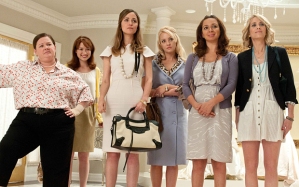 Apatow himself has been accused of making overly guy-centric comedies about rude adolescent man-children (I wouldn’t agree fully with that statement), and people have been rightfully asking when do the girls get a chance? When will the ladies be able to be something other than “love interest” or “device that triggers male character’s metamorphosis into maturity” (Forgetting Sarah Marshall, even from a clear male POV, was rather charitable and empathetic with its feminine characterizations). Well here it is, folks. Bridesmaids let’s the ladies are just as rude, crude, crass, and sexual as the men in the comedy universe. Bridesmaids is a terrific gross-out adult comedy told from a distinct feminine point of view. They can be just as crude as the dudes. But what really sets it apart is that it’s even more so a story about the dynamics of female friendship and the pain of growing apart due to the circumstances of life. Much like the joyous male camaraderie as one of the hallmarks of an Apatow film, we get to witness an entirely female dynamic that feels authentic. These women, their troubles, their friendships, all feel real and deeply felt. Even the supporting characters get a chance to be fleshed out with added dimension rarely seen in mainstream comedies, like Becca (Elli Kemper) and Rita (Wendi McLendon-Covey) confiding in each other about their disappointments with married sex. In other movies these ladies would just be “Bridesmaid #3” or “One-note Bridesmaid,” and while Becca and Rita could both be designated as types, they transcend classification when the script allows them to become rounded out as people. Another hallmark of an Apatow production, this is a true ensemble work.
You really do care for these people because of how relatable they are. I’ve never been the operator of a uterus, but that doesn’t stop me from being able to greatly relate to the anxieties of the female characters on screen. I know how significant female friendships are, and that is the central focus of the movie. You buy the relationship between Lillian and Annie, the comfort level they have with one another, the importance, the history, and you feel the pains of Annie’s plight. You feel like the entire bridal party could actually be a group of friends instead of a collection of wacky caricatures. These feel like real people, and people you want to see experience good times. Even the treatment of Helen feels thoughtful. She’s not this shrewish antagonist, but a trophy wife trying to impress the one person she could call a friend in her own life. For Helen, her friendship with Lillian means the world to her. She comes across as another real person, albeit a fabulously looking one. Annie’s romance with Officer Rhodes is indelibly cute and the duo has a warm, charming interaction. You pull for their union. Their relationship spawns a very funny sequence where Annie tries an assortment of illegal driving activities to get his attention. A romantic subplot is expected but that doesn’t mean it has to feel like rote, and in Bridesmaids the romance feels just as authentic and charming as the female friendships.
But don’t let my adoration with its character-work fool you into thinking this is some sort of “chick flick,” a divisive term tragically slapped onto anything female-centric or female-led. Just because there is rarely a Y chromosome on screen does not mean that this is some frilly, frothy sentimental fantasy replete with a “trying on clothes” montage and some sequence where the main characters break out into song in a bar. A wedding central to the plot should hopefully not be disqualifying for male audiences (men don’t get married too?). This is not a story about a crazed, jealous woman who wants to shiv another pretty lady in her pretty lady ribs because she stole her Maid of Honor duties. The cinema is littered with plenty of awful movies that revolve around women battling over petty squabbles. This is not that movie. It is not about who wields the title of Maid of Honor. It is a tale about your friends making new friends, entering new phases of their lives and possibly leaving you behind in the process. It’s about insecurity and holding onto those important people in your life, despite a gradual pulling apart. Relationships change over time, and it’s terrifying to have to adjust to the people closest to you taking lesser stations. It’s terrifying to feel like you’re being pushed out by new people. That sounds fairly universal to me, not some chick flick pabulum.
 There were several spots where I laughed so hard I was crying; the film kept me in fits of laughter throughout. The fact that a great majority of the comedy is character-based and not situation-based makes the jokes richer and more satisfying. Even a hard-to-top gross-out sequence where the girls are trying on bridal dresses at a chic store and all start losing control over their bodies due to food poisoning is related to character. Annie took the bridal party to a cheap restaurant to save money, because she’s too proud to admit her own penniless nature and too stubborn to allow Helen to swoop in and claim another victory. So the women all get terrible bouts of food poisoning, which causes them to spew vomit and forces Megan to make one very unfortunate decision with a sink (“Don’t look at me!” she bellows). The movie doesn’t shy away from the gross-out goods but doesn’t overly rely upon them for surefire gags.
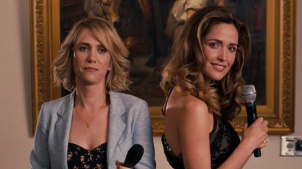
The film has several terrific comedic set pieces that connect back to the fractious relationship between Annie and Helen. The two get into a competition when it comes to party toasts. They must upstage the other, asserting who has the closest relationship with Lillian. Just when you think it’s done, one of them grabs the mic again and takes it to another level. Bridesmaids has several comic set pieces that carry on longer than you would expect for a comedy. Director Paul Feig (director of episodes of Arrested Development, The Office, and co-creator with Apatow of Freaks and Geeks) has the resolve to keep the situation alive, steadily building the comic momentum as situations get more and more out of hand, but pulling back before we reach farce levels. The movie goes one step further, convinced that the audience would be there to follow. The movie expertly lays out setups, finds satisfying payoffs, and ties up its storylines in worthwhile ways.
The dialogue is sharp and jokes work on a very fundamental level of context and defying expectation. Annie is terribly nervous to fly. She sits next to a passenger (Wiig’s co-screenwriter, Annie Mumolo) who is also deadly afraid of flying. “I had a dream last night. This plane went down,” she sys. “You were there.” That last part just turns an okay joke into a great joke. There’s a great visual gag where people keep assuming that the unkempt men standing behind Annie at a party is her husband or boyfriend. And then there’s a conversation between Annie and Officer Rhodes about being born for a profession. He encourages her to get back to baking, relating that if he were not a police officer he would still “patrol the streets and… shoot people.” These are just a few small examples I wanted to share that illustrate that, to its core, Bridesmaids is a funny story and knows the fundamentals of comedy.
Wiig has been a comic that I have found grating due to her ever-present dominance of Saturday Night Live. Her stable of wacky characters grew tiresome, but now she gets to play someone who has three dimensions. Annie is often as big an antagonist in the story as Helen. She can be self-destructive and stubborn and when she finally decides to stop being quiet is when people get hurt in her wake. You give her some latitude because, like many comedies, Annie begins as a put-upon character and has to regain her dignity and put her life together. Her life hasn’t turned out as she’s hoped, and how relatable is that? Wiig is a tremendous center for the film. Her rapid-fire eyes communicate so much nervousness and indecision, as well as her crinkly defensive smiles. But she’s also funny, tremendously funny as she loosens up and becomes more aggressive. The film is impeccably cast from top to bottom, another Apatow hallmark.
 What Melissa McCarthy does in this movie is incredible. You’ve never seen a person steal a movie at this high degree of theft. McCarthy, best known from the TV show Gilmore Girls, is Megan, the sister of the groom and an unapologetically brash woman with limitless confidence. She’s built like a linebacker but, thankfully, no attention is made to the fact that McCarthy is an overweight woman. That’s not significant to her character, though it does provide for a nice character moment as she confides to Annie late about the horror of being fat in high school. It’s not funny because she’s overweight; she’s just a brash woman without a filter who happens to be overweight. The fact that nobody cracks a joke at her expense or even comments on her weight is refreshing, and a reminder that character is not confined to outward appearance. With all that said, McCarthy is flatly hilarious. There won’t be a scene that McCarthy doesn’t get in one solid belly laugh out of. She is consistently funny from scene to scene, but stays true to her character at the same time. I would love for Megan to have her own spin-off movie much like what Russell Brand earned after his scene-stealing work in Sarah Marshall.
Bridesmaids is a comedy and it is one hell of a comedy. It may no be the best movie under the ever-expanding Apatow banner, but it is easily the funniest film yet. Yes, I said it. Bridesmaids is funnier than Knocked Up, The 40-Year Old Virgin, Superbad, and all the rest. Wiig deserves to become a star and so does McCarthy. This movie left me sore from laughing and giddy with happiness. It’s funny, touching, and genuinely entertaining, and destined to become a modern classic worth revisiting. I foresee this becoming a word-of-mouth sensation this summer, particularly from appreciative female ticket-buyers who feel like they finally have a worthy, relatable, very funny comedy that they can call their own. It’s kind of like the old slogan for female deodorant: strong enough for a man, made for a woman. That may sound too flippant, so I’ll just put it like this: do yourself a favor and RSVP ASAP for the funniest film of 2011 and one destined to charm members of both genders.
Nate’s Grade: A
Share this:

Go (1999)
 The sophomore outing of director Doug Liman, the man who put the swinger in Swingers baby, is far from any slump – no it’s more like an achievement. Liman is a man that knows what he wants and an excellent visual artist. Go is a spinning tour-de-force joyride of energetic fun. The movie is down right infectious. It stays in your system for many days, no weeks, after viewing. Consult your physician for proper treatment.
Born in the shadow of Pulp Fiction with the disjointed narrative structure, interlocking plots, retelling of events through different perspectives, and out-of-place editing, Go is the first movie to deserve having the comparisons to Tarantino’s masterpiece of blood and violence. It’s like a child of Fiction, with teens as the main stars and doing some awfully idiotic things mainly because… they’re teenagers. The story of Go is bursting to the seams with clever and embraceable characters, witty and hilarious dialogue, and enough plot twists to keep any viewer frothing at the mouth for more. Again, consult your physician.
The movie reminds me in a way as a American Graffitti or Fast Times at Ridgemont High for the fresh stable load of young talent displayed. Everyone fits nicely and performs excellently, like Timothy Olyphant’s devilishly charming and dangerous turn as a drug dealer, and Taye Diggs who helped get Stella’s groove back and is now the too cool for words friend of a grocery clerk on their trip to Vegas which turns into a comedy of errors. But the standout amongst all the talent is that little delectable Canadian bundle of joy known as Sarah Polley. Playing one of the chief protagonists, she is fascinating and compelling. She takes the role and shines the brightest in a movie filled with equally bright stars. I look forward to seeing what she does in the future.
Set against the L.A. rave scene Go tells the story circling around a 24-hour period of tantric sex, drug deals, a police sting, a lap dance, gay soap stars, and good ole’ chew-able aspirin. The movie is driven by an awesome soundtrack of techno and rock that seems to act like the narrator of our little tale. Go is brisk, breathless, rigorously hip and smart. Finally an INTELLIGENT teen movie. Too bad not too many teens went to see it at the theaters judging from box office scores. I guess they all wanted to see Ryan Phillipe’s ass one more time in Cruel Intentions. But Go is a fascinating trip you’ll want to take over and over and wish the sun would never come back up. Do not pass Go.
Nate’s Grade: A


 nathanzoebl
You must be logged in to post a comment.