Blog Archives
The Last Airbender (2010)
 Let The Last Airbender be a shining example of how NOT to adapt a children’s fantasy series into a standalone 90-minute movie. M. Night Shyamalan was hired to write and direct the popular Nickelodeon cartoon into a major movie with a major budget. It’s astounding how poorly made on every front this movie is. Seriously, people should be taking notes because Shyamalan has given a blueprint of blunders to avoid. The first blunder, and perhaps the source of all the others: hiring Shyamalan to begin with.
The film takes place in a fantasy realm where human beings are divided into four different nations based on the natural elements: earth, fire, wind, and water. Each nation has a special select group of people that can control that element. These people are known as benders. The one figure who can control all four elements is referred to as the Avatar, and this figure is reincarnated into a different nation each generation. In the absence of the last Avatar, the fie nation has invaded the other nations. Prince Zuko (Dev Patel) has dishonored his father, leader of the fire nation, and been banished. He seeks redemption by attacking the water nation, where siblings Katara (Nicola Peltz) and Sokka (Jackson Rathbone) live. They discover hidden among the ice a small bald child named Aang (Noah Ringer). This kid is the last of the airbenders and is believed to be the last reincarnation of the Avatar. For obvious reasons, Prince Zuko is after the Avatar to regain his father’s acceptance.
 At one point christened with the moniker of “the next Spielberg,” the writer/director has been slipping and sliding down into the pits of his self-deluded grandeur and stubbornness. After Lady in the Water and The Happening, who in their right minds would give this guy $150 million to direct a special effects-driven summer action movie AND let him adapt the show too? Even if you somehow managed to convince yourself that Shyamalan sitting in the director’s chair was a feasible solution, why on Earth would you let this man near the screenplay? I must repeat: did people see Lady in the Water and The Happening (this is a rhetorical question, because nobody wants to remember seeing them)? The Airbender series is a very well regarded television show that has appealed to audiences of all ages, including those old enough to buy their own beer, thank you very much. What purpose does it serve to ditch the show’s creators and longtime show runners in place of giving the responsibilities for coming up with plot, characterization, and God help us, dialogue, to the man that last gave the world The Happening? The Happening, people! What did you think was going to happen? Even with the lowest of expectations, The Last Airbender will still confound with its dead-on-arrival acting, zero character development, and overly serious spiritual mumbo jumbo. Who at the studio read Shyamaln’s adaptation and thought it was ready to move forward?
The Last Airbender begins with an opening scrawl informing the audience of the four different nations and the significance of the Avatar. Then it sprints forward without ever establishing context. Spending time to explain the rule and makeup of a new world is essential to the fantasy genre; we need to be able to know the rules of this universe and the dramatic stakes. Shyamalan establishes his villains via a lame text crawl. How hard would it have been to open the movie by showcasing the Fire Nation being big and bad? Most films open by establishing the bad guys in true villainous form. This movie would have started out so much better by establishing the villains, their mission, why they’re so bad, and introducing the general audience to the family of bad guys. That way our first introduction to them isn’t so perfunctory. In the film as it is, Shyamalan just sort of slides his characters into the plot in the most bumbling, awkward fashion. We don’t even learn about Prince Zuko’s banishment firsthand. In grand Shyamalan style, characters explain to the audience at every opportunity. Because why would you rather watch Zuko try to impress his father, fail and become scared, and have his father banish him from his nationality, promising to return and win back his father’s approval… when you could just listen to a character recite what took place? Isn’t that way better than watching something in a visual medium? There are a terrible amount of moments that feel clumsily strung together, like several important scenes were taken out at the last minute.
 This is emblematic of the entire movie because unless you’re well versed in the Airbender story, you will be as clueless as I was. I had no idea what was going on for most of the movie. Suddenly characters appear. Suddenly they can do some magical ability. Suddenly they can’t. Suddenly they’re gone. Suddenly we’re somewhere new. Suddenly this character’s dead/ Suddenly the Earthbenders are all kept together in a prison that lies atop plenty of bendable earth. Where’s the correctional planning on that one? I couldn’t explain why anything was all of a sudden happening, or what the exact rules were that helped or hindered characters, and I was left grasping for any sort of workable motivation among all the ridiculous and reflexive New Age spiritualism. Shyamalan and the film’s producers do not set up a damn thing. The film operates on a false assumption that the audience is already familiar with the source material, so it never stoops to setup plot or explain characters and events. That would be a waste of time when they have more substandard water effects to show. Because why would you want to spend $150 million on a movie that appeals to people outside a narrow margin of fans? And when you try and try and cannot understand what’s happening on screen, it’s only natural to lose interest. When the film is as dopey as The Last Airbender it only speeds up the process. I was deeply apathetic all the way through this ungainly mess.
I don’t think there’s anything that irritates me more in a fantasy film than when characters treat everything with such general indifference: “Ho hum, we just found a bald kid and his flying buffalo in a block of ice. Ho hum, he can master all the elements. Whatever. What’s on TV?” If the characters can’t be bothered to care then why should I?
I don’t know what this movie spent on special effects but whatever it was it clearly wasn’t enough. Last Airbender has some of the worst special effects I’ve ever seen in a major Hollywood summer release. Did the ILM gurus pass along their effects work to their interns? The green screen work, featured early with Katara and Sokka in some Icelandic realm, is ridiculously shoddy. People look like they have halos as they stand out against the all-too fake backdrops. The special effects in general are missing a polish and resonance that helps to disguise the illusion. I have to admit that it gets pretty boring watching one character hurl blue water orbs while another hurls red fire orbs. You would hope that a movie where people can control natural elements for combat they could do something more imaginative than fling different colored blobby orbs at each other. You have the power to control fire, the power to command the oceans or the wind, why must you low-ball it? I saw infinitely better choreographed elemental fighting on old episodes of Captain Planet and the Planeteers.
 Once again Shyamalan completely betrays the trust of his actors (don’t think Zooey Deschanel can give an awful performance? See The Happening). He gets lost in the whirlwind of special effects and fantasy worlds, so his actors get short shrift when it comes to direction. Ringer look the part and can perform the tricky martial arts moves with ease, but is that the best reason to hire an actor? Can’t makeup take care of perfecting a look? Can’t a stunt double fill in for the more challenging physical stunts? I’d rather have somebody who can act rather than just look like the human form of an animated character. Ringer is an annoying messianic figure to have at the center of your franchise. His counterparts don’t fare much better. Peltz (Deck the Halls) is impassive and routinely hits the wrong note for a scene, and Rathbone (Eclipse, New Moon) is fairly wooden and plays too many scenes like he was given one note (“bigger eyes”). Patel (Slumdog Millionaire) gets to glower and his voice kicks up in volume at weird intervals. It’s another example of unmoored actors struggling for direction. But the worst offender in the film is Aasif Mandvi, though through no real fault of his own. He is dreadfully miscast as the movie’s chief villain, and wickedness is not in Mandvi’s repertoire. He’s a cutup on TV’s The Daily Show but here Mandvi couldn’t seriously menace anyone. His tone, demeanor, and even very look lack intimidation. He has a glint of mischief that you can’t take seriously. I’m usually not one to point and shout “racism,” but the fact that Shyamlan and the producers have whitewashed the film’s casting is troublesome. Caucasian actors have filled in for the series’ predominantly Asian characters, and all the villains happen to be transformed into dark-skinned figures played by Indian actors.
I can’t explain most of M. Night Shyamalan’s thinking when it comes to the finished product. The Last Airbender seems intended solely for fans given how forgetful it is when it comes to plot setup and explanations and back-stories. Why should an audience be able to follow along? Comprehension is overrated (David Lynch being a lone exception). At the same time, Shyamalan gives nothing back to those fans who have looked forward to a big-budget realization of the popular TV fantasy series. Shyamalan even seems downright disdainful, again falling victim to his own ever-swelling hubris. Why shouldn’t he write the script? Why would the creators have any clue about how to condense their mythological dense show into a satisfying two-hour taste? If you’ve never watched the TV show, you’ll leave the theater wondering why the hell anybody would give a crap about all this junk. The movie presumptuously sets itself up for a series of sequels that I doubt we’ll ever see, certainly not with Shyamalan’s involvement at the least. Shyamlan once again defies his critics and lives on to make yet another artistic disaster. If three straight duds couldn’t detract somebody from throwing $150 million and artistic license his way, then I don’t know if this man and his ego will ever be humbled or tamed.
Nate’s Grade: D
Share this:

Street Fighter: The Legend of Chun-Li (2009)
 It’s not every day that Jean Claude Van Damme gets some marginal level of redemption. The original 1994 Street Fighter film took the classic arcade fighting game and took it as seriously as possible, which meant it was incredibly silly. Van Damme was Colonel Guile and entrusted to rescue hostages from the evil dictator, Bison (Raul Julia). The big screen adaptation rewrote entire characters but managed to keep the stuff fans really care about, like catchphrases, costumes, and super moves. God forbid that audiences see Cammy (Kylie Minogue, yes that Kylie Minogue) make the wrong victory pose. It’s always the unimportant things that somehow matter the most to execs. Street Fighter is a campy blast. How could you despise a movie that has its villain say, “For you, the day Bison graced your village was the most important day of your life. But for me… it was Tuesday.” Though the movie does have the depressing distinction of being Julia’s last film before he died. Let this be a lesson to all actors looking to take a paycheck role. Years later, in the wake of a writer’s strike, the execs at Fox thought they could pump new blood into a Street Fighter franchise. Street Fighter: The Legend of Chun-Li purports to tell the back-story of one of its most popular fighters, the diminutive fireball-tossing lass with Princess Leia’s haircut. This movie proves that you don’t need a Van Damme to make a boring and mediocre action movie.
Chun-Li (Kristin Kreuk) is trained to be a master pianist and also a master martial arts warrior. You don’t realize the kinds of dangers classical pianists constantly run into. Her father is kidnapped by the crime lord Bison (Neal McDonough) for some reason or other. Three years later, a mysterious scroll falls into her possession. She travels to Bangkok to find her father. Bison has the ingenious plan of buying waterfront property, introduce high levels of crime, and then making money on lowered property values, which is simultaneously confusing and stupid. Bison has a few evil henchmen, notably the giant boxer Balrog (Michael Clarke Duncan) and the masked warrior Vega (Taboo from the Black Eye Peas), who help wipe out his criminal competition. In Bangkok, Chun-Li is mentored by Gen (Robin Shou, who played Liu Kang in two Mortal Kombat movies) and together they attempt to thwart Bison and his dastardly real estate scheme.
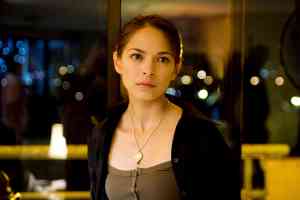 For a movie about streets and fighting, well there’s a clear shortage of the latter. Much of the movie is structured around Chun-Li conducting her own private investigation and achieving some level of inner peace. She decides to try and make it on the streets of Bangkok. There are forgettable training exercises with forgettable platitudes disguised as wisdom (“You’re hurting me,” “No, you’re hurting yourself”). There are a handful of lackluster fights and chases, some of them through streets even, but the movie has a scarce amount of action until it revs up for a climactic showdown. The action is also poorly shot and poorly edited, distracting the senses and making it downright impossible to understand. The choreography is nothing special. When the movie suddenly introduces a supernatural element the other characters don’t even bat an eye. Screenwriting neophyte Justin Marks has too much revenge-seeking father drama and real estate scheming and not enough brawling. The Legend of Chun-Li has zero respect for the intelligence of its audience. It has flashbacks to flashbacks that just aired minutes earlier. How hard would it have been to just actually base a Street Fighter movie on a fighting tournament?
Director Andrzej Bartkowiak (Doom, Romeo Must Die) shoots the movie in such a dull manner that the fight sequences fail to even elicit any interest. There’s one scene in the middle of the film that serves as a testament to the lack of care put into this movie. Chun-Li has battled a Bison henchwoman in a women’s bathroom. The bathroom set design includes partition walls with portholes. Chun-Li is on one side and the henchwoman tries to punch her through the porthole. Chun-Li grabs the woman’s arm and squeezes. The camera angle is from the side of the actresses, so it would make the most sense to have the henchwoman’s right arm caught, that way her expression could be seen. Nope. Chun-Li is gripping the woman’s left arm, meaning that her raised arm and shoulder block any view of the woman’s face, and yet she talks through this scene. How difficult would it have been to just switch arms? Why purposely obscure an actor’s face, especially in a scene that doesn’t require a stunt double?
 Here’s a curious item. Chun-Li has always been a full-blooded Chinese woman in the history of the video game. When we see her as a child, baby Chun-Li and child Chun-Li are very obviously Chinese in features. Flash forward a few years and she’s transformed into looking like Kreuk, who is half-Chinese. Apparently, one of the less common side effects of trauma is becoming less Chinese looking as you age. Along these same strange ethnic lines, we’re told that Bison was the child of Irish missionaries and was left behind in Bangkok. And yet, the child grown up completely in Southeast Asia manages to sport an Irish accent. Anybody want to explain that particular linguistic loophole?
Kreuk (TV’s Smallville) is one of the film’s biggest handicaps. The script saddles her with great amounts of pointless voice over, to the point that half of her performance is listlessly explaining what is literally happening on screen. Kreuk is a dead-eyed robot in this movie; she displays some glimpses of human emotion, like sadness and rage, but they never feel remotely credible, like someone who only knows the definitions of emotions and not proper application. Her lesbian seduction dance is a small moment of absurdity. She thrashes on the dance floor and her “dancing” reminded me more of a bird’s mating dance without the excessive plumage displaying. Kreuk can run and flex well enough, which is also a nice benefit for a martial arts action flick.
The acting is terrible but there is one bright spot in a most unexpected location. Ladies and gentlemen, I present to you the best worst performance of the year, brought to you by Chris Klein (American Pie). Klein plays Interpol agent Charlie Nash who is conducting a parallel investigation into Bison’s Bangkok activities. He’s partnered up with a local gangland homicide detective (Moon Bloodgood) who takes extra care to showcase her cleavage thanks to work outfits with plunging necklines. Klein is awful to a powerful degree but here’s the thing — I’m fairly certain it’s one hundred percent intentional. Being a conosoire of trashy cinema, I feel that I’ve adopted the skill of being able to deduce when an actor is hopelessly serious or just goofing off. Klein comes across like a self-aware man; he knows this is a crummy movie with crummy dialogue, so he’s going to have as much fun as possible. His performance is all forced swagger, from the way he constantly swivels his head to the way he cannot purposely walk in a straight line. He overemphasizes lines, chewing over the faux hard boiled detective talk and spitting it out in a singsong delivery. He grimaces and furrows his brow, widens his eyes to comical levels, and when he crouches in a gunfight the man spreads his legs as far apart so that he looks like he could have effectively doubled as a backup dancer in an MC Hammer music video. It’s obvious that Klein has given a staggering performance, but the observant will note that this is not an inept performance. This man knows exactly the kind of movie he’s in. I always tabbed Klein as a wooden actor that came across like Diet Keanu Reeves, but I must credit him for making a bold acting choice to knowingly dig deeper when it comes to being bad.
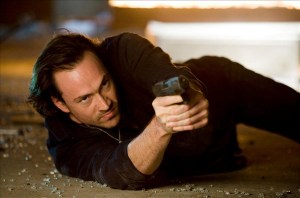
Hero of this movie, Chris Klein.
Readers know that I am skeptical and dismissive about the prospect of a good movie ever being born from a video game adaptation. Games call for interactivity and movies passivity. But if you’re going to make a movie called Street Fighter than stick to the script. This borefest wants to be a gangland drama with a tacked-on buddy cop side plot. Street Fighter: The Legend of Chun-Li is an awful work partially redeemed from the sheer amount of unintentional hilarity. Kreuk is extremely miscast as a warrior woman. The acting is bad, the direction is bad, the writing is bad, and Chris Klein tries to outdo them all in badness, and I admire the chap for trying something different in an admittedly abysmal movie. To be fair, I was never a big fan of the original video game. The special moves always seemed much more tricky to pull off. How many different incarnations of Street Fighter II were there before they eventually mastered basic math and released Street Fighter III? These are the things I was thinking about wistfully whenever Klein or Bloodgood wasn’t on screen.
Nate’s Grade: D
Share this:

Kill Bill Vol. 2 (2004)
 When last we left The Bride (Uma Thurman), she had reawakened from years of coma, traveled to Japan to acquire the finest sword ever created, and crossed off two names from her list of those marked for death in the name of bittersweet vengeance. O-Ren Ishii (Lucy Lui) and Vernita Green (Vivica A. Fox) fell under the hand of The Bride in Kill Bill, Vol. 1. Now, the only members left of the Deadly Viper Assassination Squad (DiVAS), the group our heroine was once a part of, are the one-eyed Elle Driver (Daryl Hannah), Budd (Michael Madsen), and the titular ringleader, Bill (David Carradine).
Kill Bill, Vol. 2 takes a very sharp tonal shift from the previous film. Kill Bill, Vol. 1 was a head-spinning orgy of blood and stylized carnage, and it could be argued that its actual plot was wafer-thin. But it seems with Kill Bill, Vol. 2 that Tarantino had answered every critical concern about the first film before they were even brought to his attention as the two films were shot and cut in one grand effort. This film has a much more genial sense of pacing and numerous moments of drawn-out monologues, a far cry from the breakneck pace and terse dialogue of its forerunner. Fans of the relentless hack-and-slash of Kill Bill, Vol. 1 may be disappointed that this film lacks the chopped limbs, geysers of blood, and senseless, yet immeasurably thrilling, slaughter. In fact, whereas the body count for a lone sequence of Kill Bill, Vol. 1 may be in the fifties, Kill Bill, Vol. 2 has three total murders. It is the quieter, more adult half of this revenge opus. Kill Bill, Vol. 1 was an homage to chop-socky grindhouse Japanese films. Kill Bill, Vol. 2 is Tarantinos homage to spaghetti Westerns and their languid pacing and showdowns.
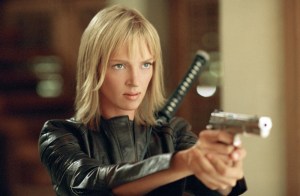 The acting is superior to what you would expect from a revenge movie.
Thurman has always been as good as her director, and under the hands of a master like Tarantino she excels. In Kill Bill, Vol. 1 she was a hurricane of rage and an unstoppable warrior. Here we see the human being inside the warrior’s armor, and she performs with amazing assurance and a ragged, raw delivery. When she’s crying on the floor, face and body red and strained, aching, you believe everything this woman does and is capable of doing.
Carradine, with his gaunt features and face like leather, gives the standout performance of the film. Whereas Bill was an unseen menace in Kill Bill, Vol. 1, with the final installment he becomes fully realized as both a figure of terror but also one of great tenderness. He has a lengthy speech about Superman, masks, and the mythology of comic books that is spellbinding. Madsen gives a fine performance steeped with surprising pathos. He’s the only former DiVAS member who feels remorse for his actions at the Two Pines Wedding Chapel that triggered The Bride’s rampage. A large subplot displays Budd’s current life slumming it as a bouncer at a sleazy strip club and getting verbally berated by people he could easily kill. You come away with the idea that its Budds version of penance.Madsen mixes his remorse with sadistic grit, like when he gives The Bride a choice between a flashlight or a can of mace, and this is before he buries her alive.
Hannah seems to relish every moment as the one-eyed right hand to Bill. There’s a scene where a character is suffering from venomous snakebites thanks to her and she sits down and reads a list of Discovery Channel-esque information she looked up on the Internet about the snake and painstakingly copied onto a notepad. She performs with such gleeful insincerity that it is hard not to start to like her for being so good at being so bad.
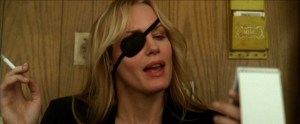 Perhaps the person that steals the movie though is Gordon Lui, who plays the cruel master Pai Mei that teaches Thurman all her moves. He has eyebrows like cotton balls and a long, whispery beard he loves to flick around. Its a shame that this hilarious character is not in the film longer. Kill Bill, Vol. 2 also boasts one of the greatest child performances I have ever seen. The actress that plays the daughter of Bill and The Bride has such a natural quality to her acting that it is amazing she isn’t coming up with her lines, reactions, and movements on the spot.
So does a longer, slower, talkier concluding half mean that Kill Bill, Vol. 2 plays it too safe or loses any of its steam? Hell no. Tarantino fills in all the rough spots and unanswered questions from the first film, and the result is drawing the audience further into the story.
We open the film with another perspective of the events that took place at the Two Pines Wedding Chapel that left a wedding party dead, and a bloodied, pregnant Bride shot in the head. We also discover how The Bride became the deadly warrior she is, why she chose to leave the business of hired killing, why Bill reacted in the extreme manner he did, and we even learn to our delight how Elle Driver lost her eye. The result of knowing the full story are characters, which in Kill Bill, Vol. 1 were more archetypal than living and breathing, that have become fully fleshed out, rounded, and incredibly complex figures full of remorse and vulnerability. The Bride and Bill transcend their descriptions as adversaries, and their relationship becomes more intensely complicated when mommy returns home to find her daughter still alive.
Despite all this fancy talk about character building, Kill Bill, Vol. 2 does not disappoint in action and thrills. A fight between The Bride and Elle inside a cramped trailer may be the most brutal, bone-crushing fight sequence I have ever seen between two women. Every strike that connects breaks something, be it furniture or bones. The final showdown between Bill and The Bride is a fitting and satisfying end for both warriors.
Tarantino’s concluding half of this story long in gestation is a highly entertaining, stylish, thrilling, engrossing, eye-plucking good time. There is so much to talk about. This is the first film since, perhaps, Gladiator that I have seen at the full-price theaters three times. In total, I have seen the Kill Bill saga five times in theaters, and I find something new and rewarding every time. Tarantino has given the masses a masterpiece and everyone should take the opportunity to see it.
Nate’s Grade: A
Share this:

Bulletproof Monk (2003)

This is one of the dumbest movies you will ever see. I don’t mean to sound overly sensational or alarmist, but this is the honest truth if you sit and watch all of Bulletproof Monk. Item #1: The bad guys in the film are –get this– the grandchildren of Nazis. Yes, that’s right, Nazis. We had to have Nazis as the bad guys. There’s actually a scene where a blonde-haired blue-eyed granddaughter wheels her decrepit Nazi grandpa around. Oh yeah, and one of the Nazis runs the –get this– Museum of Tolerance. Oh stop it, you’re killing me. Item #2: The titular monk (Chow-Yun Fat, pray for him) recruits pick-pocket Kar (Seann William Scott) to be his apprentice. Kar is an idiot. The Monk doesn’t help. His big mystery is –get this– why hot dogs and hot dog buns come in different numbers? Man, haven’t heard that one since the third grade. That would heartily explain why a character is called “Mr. Funktastic.” Item 3#: The monk teaches in stupid opposite talk (“You cannot be free until you have been taken. You cannot be cold until you are hot. You cannot die until you have lived,” you try some). One of the monk’s lessons is that the laws of physics, mind you the LAWS of physics, can be bent just by putting your mind to it. He says gravity can be overcome if you just don’t believe in it. This is insane. At least in The Matrix it had some plausibility. Item #4: The movie is a complete rip-off of The Matrix. I’m not just talking style, no, I’m talking everything. There is a scene where the monk and Kar run through a street and building, defying gravity, being chased by men in suits and sunglasses, and they get to a roof where they must combat a helicopter. What movie does this sound like, hmmm? Item #5: The visual effects are done by –get this– Burt Ward’s effects house. Yes, that’s right, the guy who played Robin on the campy 60s Batman show has an effects company. And they did the horrible work on Bulletproof Monk. This movie is so terrible at every level of filmmaking that it becomes enjoyable to watch, in the same vein as 2001’s stinker Dungeons and Dragons. I defy anyone to find merit in any of it. Sometimes you have to wonder what Hollywood was thinking.
Nate’s Grade: F
Share this:

Kiss of the Dragon (2001)
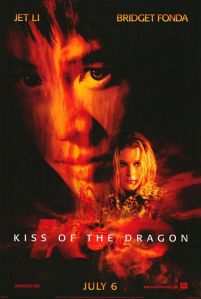 Jet Li is a man with fantastic martial arts skills and splendor. I have no doubt in my mind that if this man were given a proper American vehicle he could knock ’em dead. Romeo Must Die was too tired and the fight scenes were too cramped (not to mention the hilarious spine flashing kick at the end). Li takes off this time as a Chinese intelligent officer who travels to France to unwittingly become the center of corrupt cops’ ire. Li dispatches people in some unintentionally uproarious manners like the use of chopsticks or acupuncture. The story is meaningless and just a door to the action sequences to show off the muscle of Li.
The biggest detriment of Kiss of the Dragon happens to be in the area of why the audience is forking over their green – action. The action scenes in Dragon are horribly choreographed and edited together. Nothing astounds the eye or makes the pulse race; it only annoys and agitates. The audience is coming to see some awesome kung fu delivered by its maestro Li, but what they end up getting is dull fight sequences horrendously spliced together. No sense of time or geography comes from these edits, which means there might be stuff happening but you don’t know what and to whom. If you’re going to showcase Li at least give the man a workable stage for his talents.
The story of Dragon is laughably bad with some perfect forehead slapping moments, like when Li is running from the bad guys and ducks into a martial arts class where everyone then takes him on. Bridget Fonda hits a career low as a woman forced into prostitution so she can retrieve her little girl again. The entire supporting cast is about as animated and well put together at the atrocious fight sequences. Only true die-hard fans of Li or kung fu should go see Kiss of the Dragon. The rest of the public should just hide their chopsticks when Li comes for dinner.
Nate’s Grade: C-
Share this:

Crouching Tiger Hidden Dragon (2000)
 Ang Lee’s mythical tale of ancient… (Taiwan?) is full of visual marvels and plenty of moments of awe that make the audience believe in the power of cinema to transport once again. However, upon further viewings and more butt pain because of the large length, the film is not “one of the best ever made” as has been praised. When you get down to it and think the film really isn’t about anything but retrieving a sword and feminist roles. The visuals are striking poetry and the action is exciting and top-notch and that’s what really counts in the end.
Nate’s Grade: B
Share this:

Blade (1998)
 You know when you’re watching a flick and you see former porn actress Traci Lords sucking someone’s fluids… well you’re in for a treat. Enter Blade, the latest installment into the vampire chronicles of celluloid. But this one is such an energetic rush that even author Anne Rice hawked up on crank couldn’t churn this one out.
I will confess right now that I am most partial to vampire movies. It’s a guilty pleasure I’m not embarrassed of. What other genres out there could you expect to find titles from Abbot and Costello meet Dracula to Blackula? Not in any period piece I’ll tell you that. So I’m strangely drawn to vampire flicks, and this one quenches your thirst.
Wesley Snipes surmises the role of Blade, the half-human, half-vampire, all ass-kicker with great enthusiasm. Most of his lines are either snarled or more snarled, but what are you gonna’ do when you work the midnight shift? The story is pretty hokey but provides just enough moments for some intense action sequences. And that’s what keeps this movie together. The glue of this foundation are the adrenaline pumping action sequences with Snipes just flying around and turning anxiously aggressive vampires into annoying CGI particles. At times the movie can drag because you’re waiting for another action sequence in between the spillings of blood and gore.
The biggest problem in Blade is the wimpy villain. I have nothing against Stephen Dorff but he’s the most non-frightening and ineffectual villain since Colonel Clink tried halting Hogan’s Heroes. He comes off as a skinny kid trying to push around the big guys. I never bought anything from him. I can’t see how he’s an adversary to Snipes’ brooding and stoic hero. Wesley could push the kid down with one arm and twist it around his back ’til he cried “mercy.”
The best comic book transition to movie since 1989’s Batman. Thank God New Line didn’t try and hound a franchise out of this like they did to ruin Spawn and Lost in Space, of course the hellaciously bad writing might have to do with their failures as well. But Blade gets the most from every drop of blood and every electronic beat on the techno enriched soundtrack. A hip and entertaining vampire action flick.
Nate’s Grade: B


 nathanzoebl
You must be logged in to post a comment.