Blog Archives
The Long Walk (2025)

The quality of Stephen King adaptations may be the scariest legacy for publishing’s Master of Horror. The best-selling author has given us many modern horror classics but the good King movies are more a minority to what has become a graveyard of schlocky productions. Everyone has their own top-tier but I think most would agree that for such a prolific author, you can probably count on two hands the “good to great” King movies and have a few fingers to spare. 2025 is a bountiful year for King fans, with the critically-acclaimed The Life of Chuck, the remake of The Monkey, the upcoming remake of The Running Man, which was originally set in a nightmarish future world of… 2025, and now The Long Walk. Interestingly, two of these films are adaptations from King’s Richard Bauchman books, the pseudonym he adopted to release more novels without “diluting the King brand,” or whatever his publisher believed. The Long Walk exists in an alternative America where teen boys compete to see who can last the longest in a walking contest. If they drop below three miles per hour, they die. If they step off the paved path, they die. If they stop too often, they die. There is no finish line. The game continues until only one boy is left.

The Long Walk is juiced with tension. It’s like The Hunger Games on tour. (director Francis Lawrence has directed four Hunger Games movies) I was shocked at how emotional I got so early in the movie, and that’s a testament to the stirring concept and the development that wrings the most dread and anxiety from each moment. Just watching a teary-eyed Judy Greer say a very likely final goodbye to her teenage son Ray (Cooper Hoffman), contemplating what those final words might be if he never returns to her, which is statistically unlikely since he’s one of 50 competitors. How do you comprise a lifetime of feeling, hope, and love into a scant few seconds? It’s an emotionally fraught opening that only paves the way for a consistently emotionally fraught journey. In essence, you’re going along on this ride knowing that 49 of these boys are going to be killed over the course of two hours, and yet when the first execution actually takes place, it is jarring and horrifying. The violence is painful. From there, we know the cruel fate that awaits any boy that cannot follow the limited rules of the contest. The first dozen or so executions are given brutish violent showcases, but as the film progresses and we become more attached to the ever-dwindling number of walkers, the majority of the final executions happen in the distance, out of focus, but are just as hard-hitting because of the investment. Every time someone drops, your mind soon pivots to who will be next, and if you’re like me, there’s a heartbreak that goes with each loss. From there, it becomes a series of goodbyes, and it’s much like that super-charged opening between mother and son. Each person dropping out becomes another chance to try and summarize a lifetime, to communicate their worth in a society that literally sees them as disposable marketing tools. I was genuinely moved at many points, especially as Ray takes it upon himself to let the guys know they had friends, they will be remembered, and that they too mattered. I had tears in my eyes at several points. The Long Walk is a grueling experience but it has defiant glimmers of humanity to challenge the prevailing darkness.
I appreciated that thought has been taken to deal with the natural questions that would arise from an all-day all-night walkathon. What happens when you have to poop? What happens when you have to sleep? The screenplay finds little concise examples of different walkers having to deal with these different plights (it seems especially undignified for so many to be killed as a result of uncontrollable defecation). There’s a late-night jaunt with a steep incline, which feels like a nasty trap considering how sleep-deprived many will be to keep the minimal speed requirement. That’s an organic complication related to specific geography. It’s moments like this that prove how much thought was given to making this premise as well-developed as possible, really thinking through different complications. I’m surprised more boys don’t drop dead from sheer exhaustion walking over 300 miles without rest over multiple days. I am surprised though that after they drop rules about leaving the pavement equals disqualification and death that this doesn’t really arise. I was envisioning some angry walker shoving another boy off the path to sabotage him and get him eliminated. This kind of duplicitous betrayal never actually happens.

There’s certainly room for larger social commentary on the outskirts of this alternative world. King wrote the short story as a response to what he felt was the senseless slaughter of the Vietnam War. In this quasi-1970s America, a fascist government has determined that its workforce is just too lazy, and so the Long Walk contest is meant as an inspiration to the labor to work harder. I suppose the argument is that if these young boys can go day and night while walking with the omnipresent threat of death, then I guess you can work your factory shift and stop complaining, you commie scum. The solution of more dead young men will solve what ails the country can clearly still resonate even though we’re now four decades removed from the generational mistakes of the Vietnam War. The senselessness of the brutality is the point, meant to confront a populace growing weary with The Way Things Are, and as such, it’s a malleable condemnation on any authority that looks to operate by fear and brutality to keep their people compliant. There are some passing moments of commentary, like when the occasional onlooker is sitting and watching the walkers, drawing the ire of Ray who considers these rubberneckers to a public execution. They’re here for the blood, for the sacrifices, for the thrill. It’s risible but the movie doesn’t really explore this mentality except for some glancing shots and as a tool to reveal different perspectives.
Let’s talk about those leads because that’s really the heart of the movie, the growing friendship and even love between Ray and Pete (David Jonsson). They attach themselves early to one another and form a real sense of brotherhood, even dubbing each other the brother they’ve never had before. They’re the best realized characters in the movie and each has competing reasons for wanting to win. For Ray, it’s about a sense of misplaced righteousness and vengeance. For Pete, it’s about trying to do something better with society. His whole philosophy is about finding the light in the darkness but he is very clear how hard living this out can be on a daily basis. It’s a conscious choice that requires work but a bleak universe needs its points of light. Of course, as these gents grow closer to one another, saving each other at different points, the realization sets in that only one of these guys is going to make it across the proverbial finish line. We’re going to have to say goodbye to one of them, and that adds such a potent melancholy to their growing friendship, that it’s a relationship destined to be meaningful but transitional, a mere moment but a lifetime condensed into that moment. It’s easy to make the connection between this shared camaraderie built from overwhelming danger to soldiers being willing to die for their brothers in arms. Hoffman (Licorice Pizza) and Jonsson (Alien: Romulus) are both so immediately compelling, rounding out their characters, so much so that the whole movie could have been a 90-minute Richard Linklater-style unbroken conversation between the great actors and I would’ve been content.

My one reservation concerns the ending and, naturally, in order to discuss this I’ll be dealing with significant spoilers. If you wish to remain pure, dear reader, skip to the final paragraph ahead. It should be no real surprise who our final two contestants are because the filmmakers want us to really agonize over which of these two men will die for the other. Since we begin with Ray being dropped off, we’re already assuming he’s going to be the eventual winner. He’s got the motivation to seek vengeance against the evil Major who killed his father for sedition by educating Ray about banned art. He’s also been elevated to our lead. Even Pete has a monologue criticizing his friend for ever getting involved when he still has family. Pete has no family left and he has ideals to change the system. The screenplay seems to be setting us up for Pete being a change agent that forces Ray to recognize his initial winning wish of vengeance is selfish and myopic for all the bad out there in this warped society. It seems like Pete is being set up to influence Ray to think of the big picture and perhaps enact meaningful change with his winning wish. There’s even a couple of moments in the movie Pete directly saves Ray, going so far as to purposely kneel to allow Ray the opportunity to win. There’s also the Hollywood meta-textual familiarity of the noble black character serving as guide for the white lead to undergo meaningful change. It all feels thoroughly fated.
Then in a surprise, Ray pulls the same stunt and purposely stops so his buddy can win by default. As Ray dies, he admits that he thinks Pete was the best equipped to bring about that new world they were talking about. He dies sacrificing his own vengeance for something larger and more relevant to the masses. And then Pete, as per his winning wish, asks for a rifle, shoots and kills the Major, thus fulfilling Ray’s vendetta, and walks off. The end. The theme of thinking about something beyond personal grievance to help the masses, to enact possible change, is thrown away. So what was it all about? The carnage continues? It seems like thematic malpractice to me that the movie is setting up its two main characters at philosophical odds, with one preaching the value of forgoing selfish wish-fulfillment for actual change. The character arc of Ray is about coming to terms not just with the inevitability of his death but the acceptance of it because he knows that Pete will be the best person to see a better world. The fact that Pete immediately seeks bloody retribution feels out of character. The Long Walk didn’t feel like a story about a guy learning the opposite lesson, that he should be more selfish and myopic. It mitigates the value of the sacrifice if this is all there is. Furthermore, it’s strange that the bylaws of this whole contest allow a winner to murder one of the high-ranking government officials. Even The Purge had rules against government officials and emergency medical technicians being targeted (not that people followed those rules to the letter). Still, it calls into question the reality of this deadly contest and its open-ended rewards. If a winner demanded to go to Mars, would the nation be indebted to see this through no matter the cost? Suddenly contestant wishes like “sleep with ten women” seem not just banal but a derelict of imagination.

Affecting and routinely nerve-racking, The Long Walk is an intense and intensely felt movie. I was overwhelmed by tension at different points as well as being moved to tears at other points. While its dystopian world-building might be hazy, the human drama at its center is rife with spirit and life, allowing the audience to effortlessly attach themselves to these characters and their suffering. I feel strongly that the very end is a misstep that jettisons pertinent themes the rest of the movie had been building, but it’s not enough to jettison the power and poignancy of what transpires before that climactic moment. The Long Walk has earned its rightful place in the top-tier of Stephen King adaptations.
Nate’s Grade: B+
Share this:

Jay and Silent Bob Strike Back (2001) [Review Re-View]
 Originally released August 22, 2001:
Kevin Smith returns back to his comedy roots. No more movies with a message (Chasing Amy and Dogma) it’s back to good ole’ snowballing and stink palming. His latest, Jay and Silent Bob Strike Back, is like a giant thank-you card to all his fans that have made the man who he is today. It ties up the entire View Askew universe so Kevin can drift off into uncharted ventures of film making and not have to keep referencing the same damn characters. Plus there’s plenty of good-natured vulgarity to go around.
 The plot of Jay and Silent Bob is nothing too heavy but seems to keep the film on a continuous pace, unlike the sometimes stagnant feel Mallrats had (what, they’re in one location for 90 minutes). It seems that after getting a restraining order at the Quick Stop on them, Jay and Silent Bob learn that Miramax is making a movie from a comic book that is in fact based off of them. Learned of the riches they could make they seek out the comic’s author Holden McNeil (Ben Affleck’s first appearance in the film) and demand a piece of the pie. Holden tells them that he long ago sold his right to his partner Banky Edwards (Jason Lee, in his second appearance in the film) and that there’s nothing they can do to stop the film. Jay suddenly gets the idea that if they stop the movie from ever getting made then they don’t have to worry. So off go our stoner duo on a mission to sabotage and satirize Hollywood.
Along the way are a hitch-hiker (George Carlin) advising the best way to get a ride is to go down in your morals, a confused nun (Carrie Fisher), the cast of Scooby Doo offering a ride (which will be 100x funnier than the feature film coming out next summer), a beautiful band of international diamond thieves (Eliza Dusku, Ali Larter, Jennifer Swalbach-Smith, Shannon Elizabeth), a rescued chimpanzee, a dogged Wildlife agent (Will Ferrell), and a full barrage of hilarity once Hollywood is finally hit.
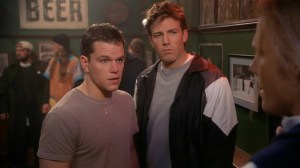
 The best barbs are laid out by Ben Affleck and Matt Damon bickering about the other’s film choices on the set of Good Will Hunting 2: Hunting Season. This moment is truly inspired and full of great humor from Gus van Sant too busy counting his money to yell action to Damon turning into a vigilante hero. I almost fell on the floor laughing during this sequence.
When Jay and Silent Bob hit Hollywood is when the comedy starts hitting its stride as this Jersey Greek chorus interacts with the Hollywood life and encounters many a celebrity. The jokes are usually right on target except for Chris Rock’s performance of a racism obsessed film director. Rock’s portrayal becomes grating to the moviegoer far before it’s over, though he does get a few choice lines.
Smith as a director has finally elevated his visual art into something that can sustain itself instead of his earlier just-hold-the-camera-and-shoot movies. There are pans, zooms, quick cuts, cranes, action sequences, and even CGI. Smith is evolving as an artist but still staying his “dick and fart joke” self, and Jay and Silent Bob Strike Back is evidence. And that’s fine by me.
Nate’s Grade: B
——————————————————
WRITER REFLECTIONS 20 YEARS LATER
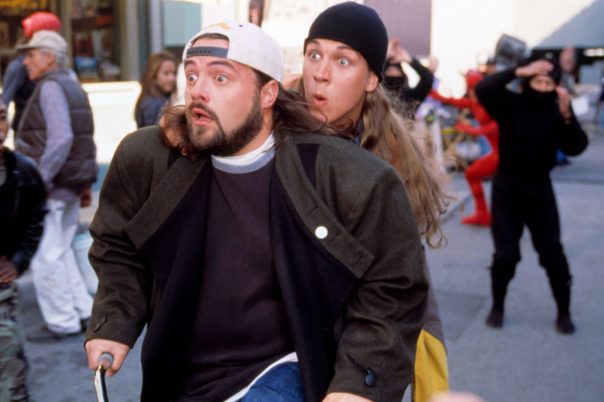
This was the one movie I was dreading more than any others on my 2001 re-watch. I’ve been a Kevin Smith fan since my teenage years and the man’s brilliantly vulgar movies had a formative effect on shaping my love of comedy, cinema, and even language itself. I don’t know if I can say I’ve been a fan of Smith as a filmmaker for some time. He took a more schlocky genre-based turn the last decade to diminished results; I enjoyed the change of pace from 2011’s Red State but found my interest deflating with 2014’s Tusk and 2016’s Yoga Hosiers. It wasn’t until 2019’s Jay and Silent Bob Reboot that my worry was unable to be suppressed. Had the filmmaker stopped growing or had I simply outgrown the filmmaker? The old jokes and self-serving references felt too labored, too stagnant, and like an old man repeating the hits for the same group of fans to laugh at the same recognizable and tired punchlines. By nature, comedy has the shortest shelf life of entertainment, and I was dreading that the original Jay and Silent Bob big screen adventure was going to feel so outdated and pitiful, especially since it’s the least substantial of all of Smith’s early films and was intended as a silly crowd-pleasing romp for his fandom. In 2001, I was a big participant of that group. In 2021, I don’t know if I still am.
This 2001 movie was always intended to be rather insular, pitched to the diehards who would understand references to chocolate-covered pretzels and the backseats of Volkswagens, but the star-studded affair was also intended to close the book on the View Askewniverse, the interconnected world comprising the first five films of Smith’s career. Smith had intended to move on and tell new stories unbound by the confines of his continuity and the demands fans would have that the new stuff tonally aligned with the old stuff. This never really happened. Smith tried something different with 2004’s father/daughter dramedy Jersey Girl and upon its theatrical demise retreated back to the safety of his View Askew universe. To be fair, he has branched out with bold experiments in horror, some of them rather successful, but it always feels like Smith is too afraid to move too far ahead of the fandom he credits so much for his success. Hey, people go to concerts and they want to hear the hits. I understand the appeal. I chuckled at points of familiarity in Jay and Silent Bob Reboot, and also Strike Back upon re-watch, but when you’re talking storytelling and comedy, stagnation isn’t growth. It’s a self-imposed ceiling.
 It was very early that my sinking feeling for Strike Back became my default setting. The characters of Jay and Silent Bob are not built to carry an entire movie, especially when one of them is mostly mute. It becomes the Jay (Jason Mewes) show and he overstays his welcome. There are definite limitations to these two stoners being the primary characters, and that’s why Jay seems to vary from scene-to-scene for the sake of comedy. In some scenes he’ll be clever, in others powerfully stupid, and in others so specific, like when he’s referencing Prince Valiant or rhapsodizing a Planet of the Apes apocalyptic fantasy that is too involved to come from the mind of this dumb stoner. This is the same guy who didn’t know you had to pay to ride a bus. The character unpredictability would be more acceptable if those leaps lead to worthwhile comedy bits that couldn’t otherwise be bridged by the operating persona of the long-haired foul-mouthed horndog. Therein lies the issue. The humor of Strike Back is too scattershot and too obvious to really land consistently. The fourth-wall breaks are painful and plentiful. The constant exclamation of “bong” is never funny. The random inclusion of the Mystery Machine, with a Velma openly lusting after women, is lazy. The fact that people are fighting with bong lightsabers and dildos is lazy. The joke that everyone on the Internet complaining about pop culture is just a teen dweeb is lazy and almost Aaron Sorkin-esque in its snide broad-brush painting of technology and youth. As I said in my review of Reboot: “Smith has never been one to hinge on set pieces and more on character interactions, usually profane conversations with the occasional slapstick element. This is one reason why the original Jay and Silent Bob Strikes Back suffers in comparison to his more character-driven comedies.” This movie is wall-to-wall wacky slapstick and road trip pieces that fail to transcend their cultural references.
And the comedy aspect that has aged the worse, by far, is the rampant gay jokes. At the time of its theatrical release, G.L.A.A.D. was openly decrying the film for its copious jokes at the expense of being mistaken as gay. I’m all but certain that 2001 me would have voiced the opinion that this was absurd, that of course Smith isn’t a homophobe, and he’s merely satirizing homophobia. The problem is that being gay is such a repeated joke of derision and hysteria. Wildlife Marshal Willenholly (Will Ferrell, one of the better reasons to still watch) admits he’s only a man on the outside, and I guess that’s a joke? Gay jokes are definitely one of the kinds of comedy that has aged the worst in the ensuing twenty years. Think back to 2005’s extended riff-fest between Seth Rogen and Paul Rudd in The 40-Year-Old Virgin where they try to top one another how they know the other is really gay. That would never happen in a studio comedy today. Times change and so do the mores of comedy. Things we thought were funny decades ago we might not feel the same way. That’s the nature of comedy. The overall comedy of Jay and Silent Bob Strike Back feels tacky and dated, so the onslaught of gay panic and derision only makes the rest of the comedy feel just as sad and pitiful.
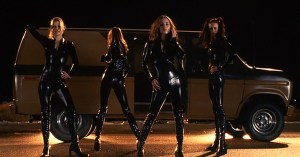
 There are two hooks to this movie, the relationship that forms between Jay and Justice (Shannon Elizabeth), one of the members of a girl gang of jewel thieves, and the havoc and industry satire of the guys running through the Miramax studio lot. Heather Graham reportedly turned down the role of Justice because she could not understand what woman would fall in love with Jay, and she’s completely right. The girl gang seems included because it felt like the hot thing to do at the time after Charlie’s Angels, to include some sexy ladies in cat suits, give them slow-motion scenes where they wink at the camera about how sexy they must look in magazine cover poses, and seem to be in on the joke while just objectifying these one-note characters with air quotes. Just because Smith later has the girl gang underline their cliché nature doesn’t make them any less of a cliché, and their entire inclusion feels like fulfilling a personal demand for Smith rather than satirizing the shallow depiction of “strong action heroine” in Hollywood blockbusters. The other hook is the actual industry satire, strictly under the guidance of lampooning Miramax and their hits and indie darling culture, all of which has the pall of Harvey Weinstein cast over it. The industry jokes aren’t exactly very cutting. It’s difficult to even label this as satire. It’s more a madcap chase that resembles a crude version of Pee Wee Herman’s studio escapades. It too feels predicated on fulfilling personal demands for Smith, like literally fighting Luke Skywalker in a lightsaber duel. I’ll agree with my 2001 self that the comedy is on stronger footing during this final act, but that’s not exactly a ringing endorsement for the rest of the movie. Strike Back doesn’t strike hard enough.
There is one reason to watch this movie and it has always been the unique fascination of Jason Mewes as a performer. He was not even an actor when Smith put him in his indie breakout film, 1994’s Clerks. He has such an unpolished appeal and there were several line readings where he took a bizarre, immediately intriguing angle, something that made the line funny because of his delivery and conviction. Mewes is a genuinely underrated comic actor. He was also battling heroin withdrawal throughout the production and turned to getting drunk as a backup coping mechanism. As soon as filming was done, he began using drugs again and eventually Smith would drive his buddy to rehab and offer a place in his home if it meant he had someone to make sure he stayed sober. The friendship between Mewes and Smith, and the hell they’ve gone through together from his addiction, is truly heartwarming and would genuinely make an interesting movie all its own.
 I come back to my review for Jay and Silent Bob Reboot because I wrestled with these same feelings back then, and re-watching Strike Back only provided disappointing confirmation. As I said in 2019, “The highly verbose filmmaker has been a favorite of mine since I discovered a VHS copy of Clerks in the late 90s. I will always have a special place reserved for the man and see any of his movies, even if I’m discovering that maybe some of the appeal is starting to fade… As a storyteller, I’ll always be front and center for this gregarious and generous man. As a filmmaker, I’ll always be thankful for his impact he had on my fledgling ideas of indie cinema and comedy, even if that means an inevitable parting of ways as he charts a well-trod familiar path.” Going back to the crude comedies of Kevin Smith feels like meeting old friends and realizing how little you might have in common now, and that’s okay. They still were important, they won’t be forgotten, but some things just aren’t built to last, especially comedy. I guess don’t be sad because it’s over but smile because it happened, including the many, many dick and fart jokes.
Re-View Grade: C
Share this:

Brigsby Bear (2017)/ Dave Made a Maze (2017)
 One way to stand out in a crowded marketplace is to differentiate your movie by making it weird and whimsical. Just being different can grab your attention, and Brigsby Bear and Dave Made a Maze are definitely different. Both of these indie films attracted attention for their unusual concepts and lo-fi designs, banking on a sense of nostalgia for a homemade style of art that’s a little rough around the edges. These might be two of the strangest films that will be released in 2017.
James (Saturday Night Live’s Kyle Mooney) is living underground with his parents, April (Jane Adams) and Ted (Mark Hamil). He does his homework, listens to his parents about never going outside, and anxiously waits every new episode of Brigsby Bear, a children’s fantasy TV show starring a Teddy Ruxbin-looking bear that teaches life lessons. Eventually we discover that April and Ted are not, in fact, James’ parents. They abducted him when he was a baby. The FBI raids their compound and returns James to his biological family, the Popes (Matt Walsh and Michaela Watkins as mom and dad, Ryan Simpkins as younger sis). James just wants to know when the next episode of Brigsby will come out. Unfortunately for James, Brigsby isn’t real. Ted produced the show on a nearby sound stage. He’d even occasionally hire other actors. James is the world’s most knowledgeable fan of a TV show no other person knows one iota about. He’s determined to give it a proper ending and recruits family, friends, and neighbors to make the ultimate Brigsby movie.
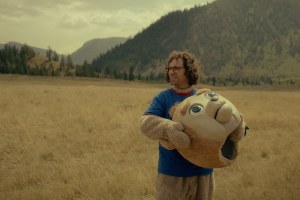 I was pleasantly surprised at how effectively Brigsby Bear was at being cheery and sincere. I was expecting, given the premise, an ironic riff on nerd culture or obsessive fandom, and Mooney and company instead decided to play things very seriously. They take a fantastic premise that seems begging for derisive commentary and choose to find a human story within the absurd. That’s much more commendable and harder to achieve. As I’m aging, I’m becoming more and more appreciative of sincerity over irony (part of this is also that our modern age is inundated with irony). I was reminded of last year’s Swiss Army Man, an alarmingly strange movie with Harry Potter’s farting corpse and went for sincerity without any whiff of detached irony. Brigsby Bear isn’t at the same level of artistic accomplishment and lasting power as Swiss Army Man, but it’s an unconventional and touching movie that earns its quirky-yet-feel-good emotions.
It’s easy to see where this story could have exclusively dwelt in psychological darkness. James was abducted as a child and raised in a strange environment that makes him emotionally stunted and grossly ill prepared for the real world outside his reclusive safe space. The movie could have understandably dealt with James’ crippling sense of loneliness, betrayal, and inability to assimilate since his sense of self were cultivated by a fake children’s TV show. He could have easily been the creepy oddball who makes people uncomfortable. Instead, they made him the goofy oddball who makes people smile. His childlike sense of wonder is in tact and frees him from self-doubt. James is remarkably cheery for having his world turned upside down, and the movie follows his lead. This movie could have been another perplexing Dogtooth and instead it’s more accurately reminiscent of those old Mickey Rooney “we’re putting on a show” pictures. I was waiting for a moment of artificial conflict, a darker plot turn late into the film where perhaps it’s revealed that Ted was a molester. There’s 700 episodes of Brigsby Bear so I figured a few of them would reveal disturbing clues about something even worse. The film never does take that darker turn and instead stays upbeat to the very end.
 As he adjusts to his new home, the movie serves as both a delayed coming-of-age movie and a love letter to the power of creativity and how it can build community. With James transported into the outside world, much is made over his awkwardness with human interactions and his complete lack of guile. He gets his first kiss with a girl, and shortly after his first handjob, and wonders if that means they have to get married. It’s a sweetly naïve reflection. We watch the growing pains of James as he starts to make friends and become more confident in himself, which is a surefire way to win over an audience. James isn’t held up for ridicule. People want to be part of his project. He’s overcoming adversity and triumphing through the transformative power of art. There’s a joy in watching characters find themselves anew, and James serves as the catalyst. This person knows how to do special effects. This person used to act when they were in college. In his heartfelt attempt to provide closure to the Brigsby series, and possibly a chapter in his life, James’ project takes on a life of its own that brings people together. It shows how the community of art can be an empowering venture that can freely inspire the best in others.
The movie doesn’t become overly reliant upon nostalgia either. I figured it would be an ode to 80s television and culture but it really just uses that as backdrop. The world building of the show of Brigsby is bizarre and entertaining every time it’s included, especially when you comprehend the propaganda messages that Ted is sneaking in like, “Curiosity is an unnatural emotion.” The sense of wonder and whimsy doesn’t overwhelm the movie and its poignancy. Director Dave McCary (Saturday Night Live) makes the most of the retro pastiches while still serving the story. James could just have easily been obsessed with any show or ongoing work of art. The content of the show is unimportant. It’s about facilitating his growth into a person comfortable and confident with whom they are. By the end of the film, I was fighting back tears as the full assembly of characters watches the finished product of their labor. You watch them smile, laugh, take a sense of pride in their communal efforts, and they can see the world as James does. It’s a whole-heartedly pleasurable movie with surprising currents of emotional uplift.
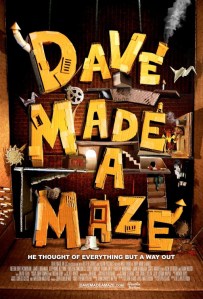 With Dave Made a Maze, the titular Dave (a beardless Nick Thune) is lost in a maze that he built in the apartment he shares with his beleaguered girlfriend, Annie (Meera Rohit Kumbhani). This maze consists of a cluster of cardboard boxes taped together. In time, a group of their friends and even strangers have assembled to admire the maze. Dave warns them not to enter but they do so anyway, and once inside they realize that the maze is considerably bigger and byzantine, and everyone expectedly gets lost. Annie and a documentary crew travel (lead by James Urbaniak) deep into the maze to rescue Dave. They all must confront booby traps, a Minotaur, thirty-something existential ennui, and the unsettling realization that the maze is expanding all on its own.
The real star of Dave Made a Maze is the fantastical environment inside the maze. The resourcefulness, imagination, and implementation of such a bizarre vision on such a limited budget is incredible. Each new room offers a new opportunity for the surreal. The characters stumble from room to room in mixtures of awe and bemusement, and the audience will feel the exact same way. Production designers Trisha Gum and John Sunner, and Art Director Jeff White, come from a world of animation, and they’re meticulous attention to detail pays off to an astonishing degree. In a just world, they would be nominated for an Oscar. There’s a DIY inventiveness that carries an irresistible charm with it, re-purposing everyday items to create a unique and whimsical world. Even when people are being gored to death and dismembered it adheres to the whimsical tone. The blood is replaced by red yarn, confetti, and silly string. The movie smartly underplays the lack of consistent logic within the world of the maze, and so weird things can just happen at a moment’s notice, like the main characters turning into puppet versions of themselves made out of paper lunch bags. There’s even a half-finished maze within the maze, which draws derision from the tired and frustrated people just seeking a way out. Some of the weirdness feels too half-formed and self-conscious, but the movie has an Eternal Sunshine quality where each new location provides another enjoyable opportunity for potential discovery.
 Where Dave Made a Maze runs into problems is when you realize there isn’t anything beyond that sense of invention. There isn’t a larger thematic core to this movie and the characters remain, at best, background players elevated to starting status. Most of these characters are jokes but they don’t even supply much in the way of jokes. The closet to a substantive theme is simply an arrested development fable where the man-child is struggling to finish a laboring artistic accomplishment, he feels humbled and humiliated, and his strained relationship with his accommodating girlfriend will always come together in the clincher. Dave lashes out that he didn’t feel like an adult at 30, so maybe he retreated to the halcyon days of childhood, or maybe it was a nostalgic retreat. Whatever the case may be, the movie suffers from an inevitable lull once the giddy novelty of its DIY fantasy starts to wear off. There’s one sequence where Dave and Annie have a circular conversation that just keeps going, and I’m sure if the filmmakers weren’t so desperate for material that it would have been trimmed down significantly.
Even at 76 minutes before credits, this is a movie that feels stretched beyond the limit because it’s lacking greater consideration to story. There are jokes that feel like they should be funnier too, like a latecomer to the maze who sets off the traps that Dave warns about earlier. This should be a fun structural payoff, allowing us to see both sides of the rooms. It doesn’t really work out that way, and the bumbling latecomer becomes another relatively unmemorable and undeveloped body on screen taking up space. The documentary crew conveys some mild satire as the crew leader keeps prodding others into saying what he needs for his movie, but even this inclusion feels more like a transparent device to get the characters to talk through plot points. Another misfire is the curious lack of stakes. The movie has a light-hearted charm but then doesn’t ever quite make up its mind on the danger being confronted. Real friends die for real. By the end of the movie, they do not come back even after the maze is kaput. They are really dead. Yet the film plays the stakes at a low simmer and the survivors just sort of shrug and move on. The film gives me little reason to be attached to any of these people, alive or dead.
 Whimsy is a fleeting feeling that’s hard to conceive and harder to hold onto. Both movies take whimsical premises that cater to the peculiar but only one delivers something of lasting substance. Brigsby Bear is a charming, heartfelt, and exceedingly sincere movie about an oddball finding his place in the world through the power of the creative process. He is transformed through his love of art and how that serves as the foundation for community. Whereas Dave Made a Maze is a lo-fi curio that I can admire more than enjoy. It’s missing crucial elements that make its journey worth the effort, beside its imaginative and scrappy production design. Both movies are charged by the power of the imagination to transport the ordinary into the extraordinary. Brigsby remembers to use its flights of imagination and whimsy to tell an engaging and ultimately touching story. Dave Made a Maze has cool sets and some infectious silliness. If you see one story of a man-child escaping into a world of nostalgic imagination and inviting friends to tag along, make it Brigsby, a film that uses whimsy to still tell compelling human stories.
Nate’s Grades:
Brigsby Bear: A-
Dave Made a Maze: C+
Share this:

Jay and Silent Bob Strike Back (2001)
Kevin Smith returns back to his comedy roots. No more movies with a message (Chasing Amy and Dogma) it’s back to good ole’ snowballing and stink palming. His latest, Jay and Silent Bob Strike Back, is like a giant thank-you card to all his fans that have made the man who he is today. It ties up the entire View Askew universe so Kevin can drift off into uncharted ventures of film making and not have to keep referencing the same damn characters. Plus there’s plenty of good-natured vulgarity to go around.
The plot of Jay and Silent Bob is nothing too heavy but seems to keep the film on a continuous pace, unlike the sometimes stagnant feel Mallrats had (what, they’re in one location for 90 minutes). It seems that after getting a restraining order at the Quick Stop on them, Jay and Silent Bob learn that Miramax is making a movie from a comic book that is in fact based off of them. Learned of the riches they could make they seek out the comic’s author Holden McNeil (Ben Affleck’s first appearance in the film) and demand a piece of the pie. Holden tells them that he long ago sold his right to his partner Banky Edwards (Jason Lee, in his second appearance in the film) and that there’s nothing they can do to stop the film. Jay suddenly gets the idea that if they stop the movie from ever getting made then they don’t have to worry. So off go our stoner duo on a mission to sabotage and satirize Hollywood.
Along the way are a hitch-hiker (George Carlin) advising the best way to get a ride is to go down in your morals, a confused nun (Carrie Fisher), the cast of Scooby Doo offering a ride (which will be 100x funnier than the feature film coming out this summer), a beautiful band of international diamond thieves (Eliza Dusku, Ali Larter, Jennifer Swalbach-Smith, Shannon Elizabeth), a rescued chimpanzee, a dogged Wildlife agent (Will Ferrell), and a full barrage of hilarity once Hollywood is finally hit.
The best barbs are laid out by Ben Affleck and Matt Damon bickering about the other’s film choices on the set of Good Will Hunting 2: Hunting Season. This moment is truly inspired and full of great humor from Gus van Sant too busy counting his money to yell action to Damon turning into a vigilante hero. I almost fell on the floor laughing during this sequence.
When Jay and Silent Bob hit Hollywood is when the comedy starts hitting its stride as this Jersey Greek chorus interacts with the Hollywood life and encounters many a celebrity. The jokes are usually right on target except for Chris Rock’s performance of a racism obsessed film director. Rock’s portrayal becomes grating to the moviegoer far before it’s over, though he does get a few choice lines.
Smith as a director has finally elevated his visual art into something that can sustain itself instead of his earlier just-hold-the-camera-and-shoot movies. There are pans, zooms, quick cuts, cranes, action sequences, and even CGI. Smith is evolving as an artist but still staying his “dick and fart joke” self, and Jay and Silent Bob Strike Back is evidence. And that’s fine by me.
Nate’s Grade: B
Reviewed 20 years later as part of the “Reviews Re-View: 2001” article.


 nathanzoebl
You must be logged in to post a comment.