Blog Archives
The Illusionist (2006)
 The Illusionist is a satisfying, well-staged period piece con game. It’s set in 1900 Vienna (though everyone’s accents sound British to me) and revolves around Eisenheim (Edward Norton), a magician that truly dazzles the crowds and leaves his skeptics guessing. He becomes a monstrous hit with tricks like making an orange tree grow from a seed and having butterflies carry handkerchiefs. The city’s Chief Inspector (Paul Giamatti) is a fan but also inquiring on counts of fraud. Prince Leopold (Rufus Sewell) is planning to marry the beautiful duchess Sophie (Jessica Biel). Little does the prince know that Eisenheim and Sophie were childhood friends forbidden to see each other because of class differences. It’s been 15 years since they last saw one another but they’re making up for lost time. The Prince sets the Inspector to ensnare the lovers and shut down Eisenheim.
The movie has a very interesting character relationship between Eisenheim and the Chief Inspector. They have a friendly, respectful relationship, with the Inspector pleading with Eisenheim not to force his hand. The Inspector enjoys magic and showmanship, but he also knows what backs he has to scratch to keep his title. I found the frustrating friendship and admiration between Eisenheim and the Inspector to be meatier than the forbidden love angle that drives the story. The Illusionist has the air of a historical romance, but it’s really more about these two men and their bond.
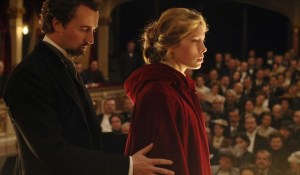 Giamatti has a very strong role and plays all the different shades of his well-trodden man who still keeps hold of his ethics when he’s told to look the other way. He’s just as an important a character and Giamatti has completely wiped my memory of Lady in Water (not that he had to atone for it). Norton is easily one of our greatest actors, but in The Illusionist he underplays too much, slightly smiling his way through an altogether stale performance. I know part of his acting requires a reserved knowledge, since he is setting up those around him. I just felt that anyone else could have played the role the same, with or without a teenage goatee. Biel holds her own, which is something I never would have thought possible amongst celebrated Oscar-nominees. Her role is pivotal but small and doesn’t require much speaking, but all things considered she does pleasantly surprise. Maybe there is an actress somewhere in that pinup body.
The Illusionist, like its title practitioner, knows that an audience loves to be fooled, but only for so long. A magician is the perfect profession to showcase a con game, and writer/director Neil Burger crafts an intriguingly enjoyable tale where we do want to know how they did it. Burger knows how to misdirect but also how to stretch a small budget to create a rich dramatic environment. I don’t know if the explain-a-lot-in-a-minute ending does a disservice to the film or not, but I was happy to get some answers even if they were a tad predictable. That’s the whole thing with magic — we want to know but we love being confounded.
This is an extremely well made indie period film. The production design is astute and often times foreboding, like the Prince’s hallway completely filled with deer heads whose antlers form a really creepy canopy. The special effects are used judiciously and have more impact than the mega budget Hollywood summer spectacles. The Illusionist is a nice example of a character driven mystery that seems to be overlooked all too often today. This is an engaging, satisfying, and handsome movie that entertains by hooking into our curiosity to know how the trick is done.
Nate’s Grade: B+
Share this:

Harry Potter and the Goblet of Fire (2005)
 I’m really liking how much more mature this series gets as it goes. I’m also enjoying the fact that they’ve had two talented directors in a row with, surprise, artistic vision. Harry Potter 4 isn’t the best film as far as plot is concerned (if they needed Potter’s blood could they not have done this at any time?). It is, however, the best as far as character, turning near every scene into an awkward coming of age moment. The movie is far more comical than the rest; seriously, nearly every scene has some comedic underpinning. The emergence of the Dark Lord (a nasally-challenged Ralph Fiennes) is creepy, and the series gets better as its outlook gets darker.
Nate’s Grade: B
Share this:

Harry Potter and the Prisoner of Azkaban (2004)
 The first two film adaptations were huge hits, but were derided by some as being too loyal to the books that it stifled the creativity. Now, Harry Potter and the Prisoner of Azkaban is out and its the first film to deviate from the books. How will Potter nation take the news?
Harry Potter (Daniel Radcliffe) is entering his third year at Hogwart’s School of Witchcraft and Wizardry. Harry is also getting older, getting angrier, and learning more and more about his parents. Hes on alert that the murderer, Sirius Black (played the fabulous Gary Oldman), has escaped from Azkaban prison and is out to get Harry. Black had a hand in the deaths of Harrys parents, and now it seems hes looking to finish what he started as a follower of Lord Voldemort. Harry relies on his friends, Ron (Rupert Grint), Hermione (Emma Watson), and a kindly new Defense Against the Dark Arts teacher named Lupin (David Thewlis) to conquer his fears, his burgeoning hormones, and to face Black when the time comes.
The best decision the Harry Potter producers made for this chapter of the series was in getting a new director. Alfonso Cuaron finally infuses the Potter series with a sense of visual life. Instead of Chris Columbus’ stubborn admiration of his fake opulent world, Cuaron keeps things fluid with a constantly roving camera and long takes. For the first time in the series, you can argue that this Harry Potter film looks and feels like its own actual movie. Gone is Columbus annoying penchant for displaying everything in close-ups. The film also benefits from some new realistic exteriors and dressed-down attire, ditching the school uniforms. Theres also a new cinematographer, so instead of Columbus dull amber glow, the series takes a gratifying turn toward the menacing, with an emphasis on dreary blacks and silvers.
 The best improvement of all, however, was in getting away from the apparent slavish loyalty to the books. The third book is the longest of the three but the third film is the shortest; 15 minutes shorter than Sorcerer’s Stone, and 25 minutes shorter than Chamber of Secrets. Thank God. At the rate they were going I thought the next book, Goblet of Fire (700-some pages), was going to be like 9 hours.
So, under Cuaron’s guidance, Prisoner of Azkaban eschews the unnecessary plot elements and details fans will grumble over but moviegoers couldnt care less over (Quidditch?). Cuaron’s film may be heavy with exposition, but it never talks down to its audience. The result is a movie trying to be a movie and not trying to cram in as many details of the world as possible so fans wont have their feathers ruffled.
The young actors of Hogwarts have definitely been struck by puberty, and it has done their acting a world of good. Radcliffe will never be an exceptional actor but here he presents new and interesting dimensions to Harry demonstrating his arrogance and tempestuous anger. Tom Felton, who plays the snarky blonde-haired Draco Malfoy, appears to be maturing into a ganglier Macaulay Culkin. The one actor that truly seems to have a bright future, though, is Emma Watson. You cannot help but love her whenever she’s on screen and she seems to be developing into a fine actress.
The most notable addition to the adult staff in the film is Michael Gambon, replacing the late Richard Harris as Hogwarts headmaster, Dumbledore. Gambon turns the character from a kind-hearted grandfather type to more of an aging hippie but it works. Emma Thomson also appears as some sort of psychic professor, teaching students to read tea leaves; however, her entire role seems superfluous unless it impacts future installments (I have not read a single book). Once again, Alan Rickman rules all and needs to get more time in these movies. I don’t know how, but it needs to happen. Thewlis is the most welcomed addition in his pivotal role as Professor Lupin and delivers some of the more dramatic scenes of the film with radiance and ease. He creates a lovely father-son relationship with Harry that supplies Azkaban with a nice sense of compassion. Oldman is similarly great but unfortunately he shows up so late into the film that he seems terribly underused. There is a scene late into the film, where Thewlis, Oldman, Rickman, and the great character actor Timothy Spall share a scene. I never thought it would be a children’s fantasy series that would finally unite all these talented British stage actors but I’m thankful for it nonetheless.
 Prisoner of Azkaban is the darkest tale yet, and Harry Potter works best when things get scary. The nightmarish element design creates a wonderful sense of dread, and Cuaron deftly handles his young characters dealing with rage and death and, scariest of all, budding hormones. Theres even a sly nod to Cuaron’s steamy coming-of-age film, Y Tu Mama Tambien (it involves a three-way hug between our trio of kids).
he effects of the film are beautiful and greatly add to the entertainment value of the film. The Dementors, cloaked flying guards of Azkaban prison, are terrifying to look at, and their leitmotif of chilling the air when they are near makes for some great visuals and ominous moments. I got actual goosebumps the first time they arrived on-screen, and then when I saw this film a second time, fully knowing the story, my skin still crawled when they arrived. Perhaps the greatest addition to Harry Potter‘s special effects bestiary is the Hippogriff, which resembles a combination between an eagle and a horse. It is a gorgeous creation and worlds better looking than the three-headed dog from the original film. It also provides one of the more breath-taking moments of the film, when Harry goes soaring across a lake on the back of the Hippogriff.
Having said all this, yes Prisoner of Azkaban is the most exciting and visually alluring film of the series, also its darkest, but I couldn’t help feeling disappointed with the central storyline. Most people will love it, especially fans of the books, but after walking out of the theater I could not help but wonder if the film had a climax at all? It really kind of didn’t. There was no sense of real story momentum and the middle had some definite moments of drag. The last act of Prisoner of Azkaban is exactly like Back to the Future Part 2: time-travel, correcting the future, not running into your past selves. This is not a good comparison. So while the characters are getting more interesting as they get older, this plot doesn’t really hold up very well. It almost feels like a preface of whatever events will come in the fourth film.
Prisoner of Azkaban is an interesting watch. I am told it deviates the most from the book and it manages to generate a considerably darker and scarier atmosphere than its predecessors. For my money, any changes are good, as films are about ADAPTATION and not copying, so dispensing with subplots and details is A-Ok with me. But how will the die-hards react? Im sure youll hear plenty of grumbling all over, but Cuaron has injected needed life into this series and presented an idea of what it can grow to be. So, while I think Prisoner of Azkaban has a superior visual sense, pacing, and adaptation; I also feel the story may be the weakest we have been told. I can only imagine what the outcry will be among the fan base when Goblet of Fire is released November 2005 as one film.
Nate’s Grade: B+
Share this:

Lord of the Rings: Return of the King (2003)
 To all those hairy-footed Tolkien geeks that chewed me out for having the audacity to call 2002’s Two Towers, of all things, boring, let me say this: while I still find the second entry of The Lord of the Rings to be disappointing and pretty flawed, the final chapter, Return of the King, is a glorious and satisfying conclusion. Instead of doing a usual review (plot synopsis, strengths/weaknesses, etc.), I’m going to bring back the charges I had against Two Towers and explain why Return of the King does not suffer from these ills. Will the defendant please rise as I read aloud the charges.
Charge Number One: Two Towers has nothing going on for its majority except hyping an oncoming battle.
And I still feel this way. Short of the great Helms Deep battle, there was oh so little going on in Two Towers that they could have easily trimmed an hour away from it. And don’t give me this crap about the whole kingdom of man subplot or Aragorn (Viggo Mortensen) realizing his eventual responsibilities. Whatever. Now, in Return of the King, there is so much going on and the pacing is so tight, that despite being the longest film by far (3 hours and 20 minutes), this is the FIRST Lord of the Rings films that has not put me to sleep in the theaters. The nearly hour-long battle involving the 200,000 Orc army with its huge elephant creatures is mesmerizing and visually stunning. But even after the battle and before, unlike Two Towers, there is plenty going on that actually matters, not just three characters running around endlessly.
 Charge Number Two: Despite nothing going on except waiting for a battle, Two Towers has little characterization of any of its characters.
So even though little is going on, Two Towers still doesn’t use all this free space to deepen characters. But in Return of the King, the characters come through and shine. The hobbits are back to the front burner and the film is better for it. Sam (Sean Astin, in the finest performance of the film) and Frodos journey becomes increasingly important and the strain and deception of Gollum puts a wedge between their friendship. When Frodo (Elijah Wood) looks scornfully at Sam and dismisses him from their journey, it’s heartbreaking. Why? Because after two years we as an audience have come attached to these characters and do feel for their struggle. When Sam, toward the climax, says, “I may not be able to carry the ring, Mr. Frodo, but I can carry you!” I dare anyone to try not choking up. We also get deeper moments of character with peripheral characters, like Faramir realizing he can only satisfy his father by a suicidal mission. Even the smaller characters from the second film, like Eowyn (Miranda Otto) and her kingly father Theoden (Bernard Hill), have wonderful moments where the emphasis is on characterization. Return of the King is filled with rich character moments that remind us how much we enjoy and feel for these people … uh, and hobbits.
Charge Number Three: Most of the characters from Fellowship of the Ring have scant appearances in Two Towers.
This still holds true. Gandalf (Ian McKellen, brilliant) returned from the dead but had about three minutes of screen time. The elves (Liv Tyler, Hugo Weaving, Cate Blanchett) were given the amount of screen time most people would consider cameos. And then the hobbits were left alone for the overlong subplot involving Theoden and his clan. What Two Towers really was was the dwarf, elf, and Aragorn movie. And I like each of those characters but this story is not theirs its the hobbits. So the disproportionate amount of time spent with Gimli (John Rhys-Davies), Legolas (Orlando Bloom) and Aragorn felt like what would happen if, in Star Wars, C-3PO and R2D2 had their own film. It wasn’t as interesting and it wasn’t right. But with Return of the King, the attention is back to the hobbits, and all of the characters in the entire film have at least one stirring moment of quality time. Gandalf is back in a big way and its welcomed. What else is welcomed is the increasing attention Merry (Dominic Monaghan) and Pippin (Billy Boyd) have. They started as merrymakers, but by this trilogys end they are desperate to join the ranks and fight. The shared moments between Merry and Eowyn in battle are great. The moments between Pippin and Gandalf are even better. And even though the elves still get the short end of the stick, they make lengthier appearances that are more satisfying. It appears, though, that Cate Blanchett’s longest amount of time in this whole trilogy was narrating the opening prologue.
 Charge Number Four: Excessive dwarf jokes.
Even if you disagree with me on the previous three charges, you must agree with me that Two Towers had about a million dwarf jokes too many. Return of the King, to my knowledge, doesn’t even have ONE dwarf joke. Fabulous. This is not to say I want less Gimli. The subplot involving the Two Towers trio seeking an army of the dead (a tad deus ex machine) is intriguing, and his competitive banter with Legolas is still ripe (Bah! That still counts as one!).
Return of the King is an amazing experience and one that is a fully satisfying conclusion, unlike say, I don’t know, maybe the last two Matrix films. The danger feels more abundant now that the end is near and the tension mounts. The payoffs are rewarding and the climax is fittingly climactic. However, the 20-minute resolution is a bit drawn out. It seems director Peter Jackson can give us three hours of fast-paced action but cant speed through a medley of hugs. You think its over…. and then theres more, then you think its over…. then there’s more. This is a small quibble for such an epic trilogy, and Return of the King proves that it’s really one large triumphant film, with a bit of a sag in the middle. What? Did you think I’d get through all this Lord of the Rings love-fest and not take one last jab at Two Towers? Though I still prefer Fellowship of the Ring out of the three, Return of the King cements the trilogys cinematic greatness in our time. Oh yeah, and the cinematography, special effects, production design, makeup, and score are magnificent too.
The defendant is cleared of all charges.
Nate’s Grade: A
Share this:

Lord of the Rings: The Two Towers (2002)
 My countrymen and fellow Americans, I come here not to praise Lord of the Rings: The Two Towers but to bury it. I don’t know if it’s a result of being the bridge between the beginning and end of this saga (taking the role of neglected middle child), or a result of unmet sky-high expectations, but I may be alone here in saying that Two Towers was a letdown. I’ll try and frame my reasoning as to not be attacked by hairy hobbits and men with pointy hats and long flowing beards.
1) Story structure. Unlike Fellowship of the Ring, where were introduced to a rich world and have suitable character set-up, the second LOTR film puts almost all our characters on the backburner and gives us an insufferably long subplot involving a king and his brood. The movie peters out an ending and seems to throw its hands in the air saying, “See ya a year from now.”
2) Length. This wasn’t a problem with the previous film but man did Two Towers become unbearable as it went. Some described the first film as three hours of walking; well the second could be described as two plus hours of folks hyping a battle and then — a battle. Seriously, theres a lot of talk about a significant battle and that’s it. An hour could have easily been cut from this. It got to the point where my then-girlfriend was sprawled across my lap pleading for me to somehow make the movie end.
3) Characterization. So much time is spent doing nothing you think the film would further round the characters? Oh how stupid you would be. Nothing new seems to be drawn from any character, with the exception of the treacherous yet likable Gollum. Several people from Fellowship (Liv Tyler, Cate Blanchett, Hugo Weaving, Ian McKellen) have screen time that amounts to no more than a cameo, so why in the world aren’t we getting anything more from our already established heroes? Everyone just looks friggin bored. As was I.
4) Excessive dwarf jokes.
I re-watched Fellowship and all of the reasons Two Towers suffered were not evident. So what does this tell me? Nothing particularly, except not to see the movie in the theater again. Two Towers is by no means a bad film. The cinematography, production and special effects are all breath-taking and sweeping. I’ll still look forward to seeing the next, and last, installment in Peter Jackson’s Rings epic, but Two Towers has left a bitter taste of disappointment to linger upon.
Nate’s Grade: B-
Share this:

Harry Potter and the Chamber of Secrets (2002)
 So is Harry Potter and the Chamber of Secrets better than the first film? Well, mostly yes. The story of Harry Potter is a long and complicated one, full of numerous funny names as well. Harry (Daniel Radcliffe) is still living with his abusive relatives and barred in his room. Hes warned by Doddy, a self-abusive CGI house elf, not to return to Hogwarts School of Magic because he will be in grave danger. Fat lot of luck this does. Before you can say Jar Jar Binks, Harry’s timid friend Ron Weasley (Rupert Grint) and his flying love bug rescue Harry. They meet up with old friend Hermione Granger (Emma Watson) and begin their second year of magical education. But danger surfaces as students with Muggle (a non-magically inclined family member) blood are turning into petrified statues. Lots of other stuff is crammed in (like broomstick rugby, Nancy Drew-like detection, and spiders oh my!) but lets all be honest here, its not like a plot synopsis is going to push you into seeing this movie.
 Much of the acting responsibilities falls on the shoulders of our three young leads, and all I can say is what a world of good puberty has done them all. Radcliffe, stiff and overly subdued in the first film, has grown a deeper voice. He seems to have settled into the part nicely. Grint, playing a noble coward, goes from squeal to grimace in 3.5 seconds. Watson has a winning smile and bounces with enthusiasm but sadly sits the last half of the film out.
Some notable additions to the Harry Potter family include Kenneth Branagh as the narcissistic new professor of the Defense Against the Dark Arts. Can anyone do ham better than Branagh? I dont think so. Jason Isaacs is malevolently delicious as the aristocratic father of Harrys school rival, Draco Malfoy. You could start shivering from the icy glare this man casts.
Chamber of Secrets is better than the earlier Sorcerer’s Stone in many ways. The story has less exposition and contains darker elements that suit the story surprisingly well. The special effects are vastly improved from the first film. The child acting, as previously mentioned, is much better.
Despite lacking prolonged setup, Chamber of Secrets clocks in around 2 hours and 40 minutes — 9 minutes longer than the first! You could watch your life go by sitting through a Potter movie marathon. This might seem like an eternity to small children if they weren’t so overly obsessed with the book series.
 So remember when I said Chamber of Secrets was “mostly” better than the first film? Well that “mostly” is because the amazing adult cast is hardly seen. Gentle giant Robbie Coltrane and Maggie Smith are mere background noise to the story. Headmaster Dumbledore (played by the late Richard Harris) has a weathered feel. What Chamber of Secrets needs are more scenes with the brilliant Alan Rickman, as moody professor Severus Snape. Rickman (Dogma) is perfect and a thrill to watch. I got a fever and only more Rickman can cure it.
Chris Columbus (Home Alone) is a director with no remarkable visual flair or distinct vision. Everything that is occurring is so faithful to the book that it has no individual flavor or distance. It’s directing with your hands tied. It should be Rowling’s name for the director’s credit because she’s the one with the vision being translated.
Harry Potter is a worldwide phenomenon that is already breaking box-office records and parents’ bank accounts. Chamber of Secrets plays toward audience expectations, but all of the components involved seem to be settling in their roles. Chances are whatever you felt about the first film youll relive during the second.
Nate’s Grade: B
Share this:

Harry Potter and the Sorcerer’s Stone (2001)
 If you don’t know about Harry Potter at this point you must be living under a stone, perhaps a Sorcerer’s stone. The little tyke with glasses and a lightning scar has become a sensation across the seas and of course a big budget movie was merely just a matter of time. The imagination of author J.K. Rowling is bustling with a complex world that has given her acclaim from children and parents all over, not to mention made her filthy rich. The movie is a meticulously faithful adaptation but this is both its strength and its weakness.
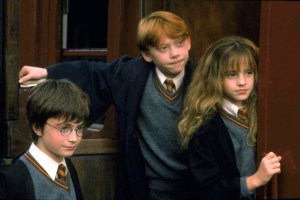
The story of Harry Potter is a long and complicated one, full of numerous funny names as well. Harry (Daniel Radcliffe) is an orphan living with his nasty aunt (Fiona Shaw) and uncle (Riachard Griffiths) who force Harry to live under the stairs. Harry is informed one night by a gigantic and bearded figure named Hagrid (Robbie Coltrane) that both Harry’s parents were magically inclined and he is to gather his own education at Hogwarts School of Magic. On his way there, after picking up supplies in a special place I have forgotten totally the name of, Harry meets and befriends the aloof Ron Weasley (Rupert Grint) and the Type-A studious Hermione Granger (Emma Watson). Once there Harry picks up a rival in Draco Malfoy, a cold glare from Professor Snape (Alan Rickman), a good scare from a poor CGI three headed guard dog, and a mastery in the art of broomstick flying. The school sessions are a barrage of characters and minute plot points that readers will just be grinning that have been included.Through later revelations it is divulged that Harry’s parents were killed by the powerful wizard Lord Voldermort. It seems that old Voldy for whatever reason decided not to kill Harry. Thus because of this Harry has worldwide fame as the boy who lived against Voldermort. It seems as well that this evil wizard is trying to achieve immortality by using the advantages of the hidden Sorcerer’s stone. It’s up to Harry and his friends to stop this from happening.
 Chris Columbus (Home Alone, Mrs. Doubtfire) wrestled this franchise away from such directorial heavyweights like Spielberg, and it’s clear to see why he was selected. Rowling ordered the movie adaptation to be completely faithful to her book, and Columbus is a director with no remarkable visual flair or distinct vision. Everything that is occurring is so faithful to the book that it has no individual flavor or distance. It’s directing with your hands tied, which is fine for most people. With this project he seems like he is basically a go-between with Rowling and the studio suits. Basically it should be Rowling’s name for the director’s credit because she’s the one with the vision being translated.
Large portions of this film need to carried by the acting of several of its young stars and it’s quite a 120 million dollar weight. For the most part the child actors in Harry Potter deliver. Emma Watson is the standout as Hermione, with her extra energy and enthusiasm in every step and every smile simply winning over the audience in spades. The only real detraction acting wise in the entire film is, unfortunately, the star. Daniel Radcliffe plays Harry in a very stiff manor and spends most of the film looking overly subdued. After you experience more time with the other characters in the film one realizes how frightfully dull the character of Harry Potter really is. Any of the characters would be more exciting to watch than Harry. As characters go, he’s about as interesting or entertaining as stereo instructions.
Harry Potter contains an all-star all British cast for the fanciful faculty of Hogwarts. Everyone seems so meticulously cast that they were born to play these roles. Richard Harris becomes a gentle grandfatherly figure as the headmaster. Robbie Coltrane is a large and lovable figure that the audience can rely on again and again. Richard Griffiths is so over-the-top in a very entertaining light. Alan Rickman owns every scene he is in with such a snarling and full-of-life presence. He is perfect, as is most of the adult casting.
 The most exciting moment of the film occurs during a match of Quidditch, which is basically like rugby in the sky. Two teams on broomsticks whiz and zoom around one another in a fierce aerial competition. At this moment Columbus can declare himself the true director. The entire sequence is done that it perks the viewer’s imagination and also provides great moments of excitement. Seeing the scene itself was a testament to the wizardry of special effects.
The length of Harry Potter and the Sorcerer’s Stone clocks in around two hours and thirty minutes, which might seem like an eternity to small children if they weren’t so overly obsessed with the book series. The film is structured more like a novel than a screenplay (again with the induced restrictions), so instead of a usual three-act system it has moments that drag and moments that seem to go on endlessly (like the final near obstacle course the three kids must go through). The entire first hour or more is set-up explaining all of the characters and the world they inhabit, then they just sneak in a mention to the Sorcerer’s stone toward the end and introduce our titular story line. Hopefully, with the set-up out of the way now, the next movie will be a tad shorter.
Harry Potter is a worldwide phenomenon that is already breaking box-office records and parents’ bank accounts. The first four books have been optioned by Warner Bros. so expect to see an armada of kids dressed up in Halloween costumes around Thanksgiving for the next few years. Harry Potter is a fairly light-hearted but entertaining venture that I wouldn’t mind revisiting and reacquainting every now and then like an old friend.
Nate’s Grade: B
Share this:

Shrek (2001)
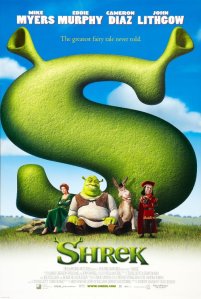 Shrek is Dreamworks’ kick in the pants to fairy tales and some of the staple creations of the Mouse house. There’s nothing a bug eating green ogre named Shrek likes more than his peaceful privacy. But this is brought to an immediate halt when all sorts of fairy tale creatures invade his swampy domain. To regain his privacy Shrek takes it up with Lord Farquad (say the name fast) who agrees to relocate the fairy tale creatures he outlawed to Shrek’s swamp in the first place if he travels to a castle and rescue a princess. Shrek agrees and along the way gets a buddy for the trip with a talking donkey, named appropriately enough, Donkey.
Shrek is amazing world of computer artistry. The characters move so life like and the detail is so magnified that it is a living and breathing world all its own. Mike Myers and Eddie Murphy are the comic duo of Shrek and Donkey and provide a good portion of laughs on their journey. With Mulan and now Shrek, Murphy seems like a natural when it comes to animation voicing. He gives it his all. Cameron Diaz is also a nice contributor as the voice of Princess Fiona, which kinda’ looks like her too creepily enough. Rounding out the cast is the always over-the-top John Lithgow as the stilted Farquad.
The humor of Shrek is enough to please kids with the fart and burp jokes, but lends its aim for more adult humor as well. There are a few jabs at the Disney Empire that are more than hilarious and the story keeps them coming. Shrek turns out to be a delightful tale of an ogre who’s a green softy at heart.
Nate’s Grade: A


 nathanzoebl
You must be logged in to post a comment.