Blog Archives
Horizon: An American Saga – Chapter 1 (2024)
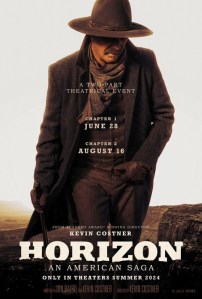
I admire Kevin Costner throwing out all the stops to achieve his passion, a four-part, twelve-hour film series to showcase a sprawling Western epic. The man put a hundred million of his own money into the first two parts of Horizon: An American Saga, and the time devoted to this project was so all-consuming that Costner quit the Yellowstone series, a cable TV juggernaut getting bigger ratings every season. It’s ballsy all right, to abandon a monumentally successful series at the height of its zeitgeist popularity so he can direct not just one but four throwback Westerns that will ultimately be as long as the Lord of the Rings trilogy. It’s rare to see this level of sheer chutzpah in Hollywood. Horizon’s first part was released in June, with its completed second part intended to be released a mere two months later in August. After the poor box-office of Part One, the studio decided to pull Part Two from the release schedule, ostensibly to give people more time to catch the first movie. Will we ever see Part Two in theaters? Will we ever see Part Three, which Costner is currently filming, or Part Four, which Costner is currently raising money for? Costner intended to release the whole saga as a miniseries upon completion, and this might be the best case scenario. As a movie, albeit one quarter of an intended whole, Horizon Part One feels far more structured as an incomplete and rather prosaic TV series.
Upon the completion of the 170 minutes, I was left wondering what was here that would make someone want to come back for a lengthy second part, let alone a third and a fourth. It doesn’t feel like a complete movie or even a completed chapter, and again let me cite Peter Jackson’s Lord of the Rings series. Released over the course of three years, each movie had its own form of a beginning, middle, and end, with each climaxing around some event that left one satisfied by its conclusion. They didn’t just feel like chapters linking to the next; they felt like completed stories that pushed forward a larger overall story. Now, with Horizon Part One, it doesn’t feel like a three-hour movie, rather like three one-hour episodes of a TV series. Each of those hours feels too separate from the other. I’m reminded of television in the streaming era, where producers anticipate viewers binging through multiple episodes in speedy succession. This tacit assumption lends itself toward the general pacing issues I find with too many streaming series, where the filmmakers take far too long to get things moving in a significant manner. I’m reminded of a joke by Topher Florence that back in the day a show like Surf Dracula would feature its lead character surfing in weekly adventures, but the streaming age version would take its entire first season showing how he got his surfboard and then spend five minutes surfing in the finale. When you’re pacing out only one quarter of your possible intended story, calling it slow and lacking development and payoffs is an obvious hazard, which is why every movie needs to be its own thing, to provide a sense of conclusion even if it’s not the final conclusion.
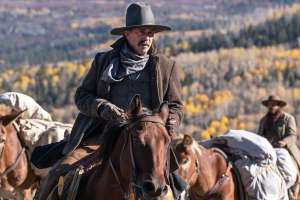
Part One is divided into three parts: 1) the early settlers of Horizon, in the San Pedro Valley, being massacred by the Apache, 2) an old gunslinger (Kevin Costner) tasked with protecting a woman and child on the run from vengeful gunmen, 3) a wagon train of settlers headed to Horizon. Now, from that very streamlined synopsis, which of those storylines sounds the most exciting? Which of those storylines sounds like it can lend itself toward having an in-movie climax? Which of these storylines feels the most fraught with danger and intrigue? It’s the one starring Costner himself, of course, fitting naturally into the role of a tough curmudgeon.
I’m confused why the entire first hour of this movie is devoted to following the frontier town when we’re only going to get two survivors total that go forward. As far as its narrative importance, this entire section could have been condensed to a terrifying flashback from Frances Kittredge (Sienna Miller) and her daughter after the fact. The majority of this hour is spent watching the fine Christian folk of the early days of Horizon die horribly. We’re confined inside the battered Kittredge home that serves as the foundation of a siege thriller, with the band of various townspeople trapped and trying to fight off their indigenous intruders. The attack is prolonged and unsparing in its violence, eliminating all these nice, smiling faces from before. What does it add up to? It’s the tragic back-story for Frances, but it also makes her conveniently romantically unattached so that the nice cavalryman, Trent Gephart (Sam Worthington), can swoon and she can Learn to Love Again. It also sets up a young Apache warrior, Pionsenay (Owen Crow Shoe), making aggressive moves that his elders disagree with in their continued efforts to find some balance with the American settlers grabbing their territory. It also sets up what serves as the only possible character arc completion, with young Russell (Etienne Kellici) escaping the massacre in the beginning to then witness a massacre of Apache, and as he observes the scalping butchery, it galls him, not providing the relief of vengeance he had sought. Now that’s a conceivably emotional storyline, but Russell isn’t the primary character, or even one of the most essential supporting characters. You might genuinely forget about him like I did.
Something else I forgot an hour in was that Part One opens with Ellen Harvey (Jena Malone) shooting her abusive husband and running out. This prologue eventually comes back to setting up the present-day conflicts of the second hour, where Ellen has started a new life as Lucy with her young son. She lives in the Wyoming territory with a prostitute, Marigold (Abbey Lee). This storyline picks up significantly with new characters coming into the mix and disrupting the status quo. The first is Hayes Ellison (Costner) who finds himself attracted to Marigold, perhaps recognizing a woman in over her head. The second are the Sykes brothers (Jamie Campebell Bower, Jon Beavers) who have come looking to retrieve Lucy and her child, the son of their dearly departed pa who was slain in the opening. I am astounded that Costner decided to make the audience wait an hour for this segment because it feels like a much better fit to open Part One. There’s an immediacy to the looming danger and the consequences of actions, and what would serve as the Act One break is when Hayes has to intervene at great risk. This is, by far, the best segment of Horizon Part One. The ensuing on-the-run segment doesn’t get much further, setting up ongoing antagonism between the two sides that presumably will come to blows again. It’s not exactly reinventing the wagon wheel here: drifter reluctantly becoming protector for the vulnerable and reckoning with his shady past and trying to make amends. However, for this first movie, at least this storyline provides a sustained level of engagement with needed urgency.

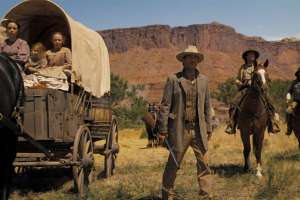
The weakest portion is the wagon train led by Matthew Van Weyden (Luke Wilson). The most significant conflict during this section isn’t even the protection of the wagon train, it’s whether or not the hoity-toity British couple (Tom Payne, Anna and the Apocalypse‘s Ella Hunt) will assimilate to life on the prairie. They’re privileged, though at least he seems to recognize this. She bathes in the drinking water supply in an extended sponge bath sequence that feels so oddly gratuitous and leery. Two scouts are caught eagerly peeping and this seems like the most significant conflict of this whole section. They’re headed for Horizon, the setting of tragedy and indigenous conflict we know, but the entire wagon train lacks any feeling of dread or even the opposite, a feeling of yearning for a new life. It’s just a literal pileup of underwritten characters in movement without giving us a reason to care.
Costner’s Western eschews the trappings of modern revisionism, deconstructing the heroism and Manifest Destiny mythology of popular Wild West media. This isn’t a deconstruction but a full blown romantic classical Western, embracing the tropes with stone-faced gusto. In some ways it feels like Costner’s version of a Taylor Sheridan show (1883, Yellowstone). He left a Sheridan show to make his own Sheridan show. It’s more measured in its portrayal of the Native Americans even as it shows them massacring men, women, and children as our first impression. I wager Costner is showing that the evils of violent tendencies pervade both sides of the conflict, with a troop of American scalp-hunters that don’t really care where those scalps come from. It’s hard to fully articulate the themes given this is only one-fourth of the overall intended picture. The expansive settings are stunning and gorgeously filmed. I can understand why Costner would want people to watch this movie on the big screen with scenery this beautiful from cinematographer J. Michael Muro, who served as Costner’s DP on 2003’s Open Range, another muscular Western. Fun fact: Muro also served as a Steadicam operator on Costner’s Best Picture-winning Dances with Wolves, so their professional relationship goes back thirty-five years and covers Costner’s love affair with Westerns.

During its conclusion, Horizon: An American Saga runs through a wordless montage of clips that serves as a trailer for the forthcoming Part Two. It’s not edited like a trailer, more so a very leisurely preview with clips that look good but, absent context, can be shrug-worthy. Oh look, a character looking out a window pensively. Oh look, a character walking along a trail. Oh look, a character dismounting from a horse. Oh look, another character looking out a window pensively. It’s hard for me to fathom this truncated preview getting too many people excited for what Part Two has to offer, but then I think that’s the same problem with Part One. It doesn’t serve as a grabber, with characters we really care about, with conflicts that keep us glued, and with revelations and character turns that can keep us intrigued and desperately wanting more. It’s hard for me to think of that many people walking out of Part One and being ravenous for nine more hours. I accept that stories might feel incomplete and characters might feel disjointed, but Horizon is perhaps a Western best left in the distance, at least until you can binge it in its completed form, whatever that may be, though I doubt we’re going to get four full movies. Ultimately, Costner’s opus will need to be judged as a whole rather than as consecutive parts.
Nate’s Grade: C
Share this:

Charlie’s Angels (2000) [Review Re-View]
 Originally released November 3, 2000:
These angels aren’t exactly what your father was enjoying when your mother was away fulfilling errands. These angels aren’t delegated as mere sex objects running around providing the jiggle entertainment that is (or was) supplied by today’s Baywatch. The 90s is a different decade after our minority movements and today’s woman is just as apt to do a flying kung-fu face plant into a baddie as any man. The angels of the film are action heroes for an armada of small girls needing some female empowerment when their only other choices consist of a barely clothed Britney or a barely covered Christina. These angels aren’t just the sex objects that the classic assortment of angelic 70s stars were; these angels are also tough-as-nails, resourceful, and not afraid to tussle or tango. Now that this exposition is out I can concentrate on the scattershot film Charlie’s Angels.
The film has been rumored to have at a minimum of 17 writers who tried shaping a story for Cameron Diaz, Drew Barrymore, and Lucy Lui. The story is pretty much shelved toward the back so the forefront is our trio of ladies kicking ass then shaking it with zig-zaggy and wild camera movements from debut filmmaker and video director McG.
Charlie’s Angels is whiz-bang dumb fun. The overall feel of the film is something more difficult to get a grasp on. At times it shows itself as tongue-in-cheek and satirical but then at other times it seems overly serious or overly dumb. The characters are non-existent and basically only discernible by hair color. The characters are very wooden and I actually found more enjoyment watching the villains and seeing more of them; call it the Austin Powers dilemma. Diaz makes the only notable attempt as her goofy and light-hearted angel connects with the audience best. Lui plays a techno-babe dominatrix but is easy to see that she was the last angel chosen and doesn’t exactly gel with the others as much as she could have.
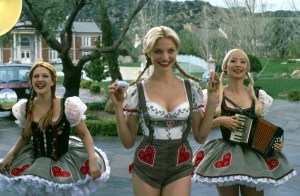 Charlie’s Angels is best when the action is pumping. The scenes are cut together in a jam-packing sequential way adding distinct flavor and style. McG is a true surprise in the effectiveness he can orchestrate his action motifs even if the Matrix effects and moves make absolutely no sense in the real world.
Crispin Glover shows himself as a silent assassin nicknamed “the thin creepy man.” Glover is so suave and slick in his role of the non-verbal Oddjob henchman role that he exhilarated me with every presence he made on screen. Goodness, he was too cool in this film and everyone gets brownie points for allowing him. He has such energy and charisma that I wanted the film to veer off into him and desert our angels. Seeing our ageless McFly perform action scenes and choreographed fights is something I will be pleased with until my grave. seeing Crispin in the excellent Nurse Betty and now huge exposure in this is a true joy. And man… he smokes a cigarette way too cool every time he’s in this film. Some people can smoke cool some of the time but Crispin does it all of the time. His mere presence almost cancels out the annoyance of Barrymore.
The line is drawn with Charlie’s Angels in that it’s sex-kitten jiggle and an acrobatic arrangement of (light) feminism and humor. These gals know they’re sex objects and they’ll use it to their advantage delighting in every second of it. Therefore, you could argue successfully that Angels is exploitation hiding as meaningful but hell… why think about this stuff? The movie rolls along at a fast pace where you don’t keep track of these issues. It’s just an easy sit down.
The gigantic success of Charlie’s Angels makes sequels and a possible franchise all but certain. I’d be happy for McG to hop back in his directorial chair but have a unique idea for Angels 2: Bigger, Longer, and Uncut… it involves Glover kicking a lot of ass really cool like.
Nate’s Grade: B-
——————————————————
WRITER REFLECTIONS 20 YEARS LATER

The 2000 Charlie’s Angels seems to understand that nobody should take this seriously. It even opens with an in-joke of T.J. Hooker: The Movie being inflight entertainment and an undercover character lamenting how bankrupt Hollywood is when it comes to recycling old TV shows. From there, our undercover angel literally exits with her target in the middle of the air and plummets to the water below, safely landing via parachute with a team meeting via helicopter aerial hook-up and a speedboat below. Why any of this? What sense does any of it make? It doesn’t matter in the slightest, and from the opening scene onward the movie lives by this credo, doing its best to be silly and have fun and just not care about the rest, and it shows. Twenty years ago, I think Charlie’s Angels benefited from low expectations as I recall mostly enjoying it. Now, having re-watched the movie for the first time in ages, I will say the fizzy appeal seems to be diluted. It’s still got energy to spare, though it feels a little too antic, a little too episodic and slipshod, and a little too proudly shallow, and that’s before you re-examine its depiction of the angels.
It took 17 writers and considering every under-30 actress in Hollywood to put together Charlie’s Angels. Drew Barrymore had bought the remake rights and wanted to make a big screen splash with a trio of kick-ass heroines that could better relate to the culture of the new century. I understand that Barrymore and her team wanted the angels to be sexy, yes, but also smart and funny and goofy and fearsome and all the things that little girls should believe possible. That’s commendable from a positive representation, but then so much emphasis is placed on their bodies and their off-the-charts sex appeal to bamboozle men that the goal becomes eclipsed. One could argue that Barrymore, Cameron Diaz, and Lucy Lui are embracing their sexuality, and that taking control of this is empowering, and if you feel empowered by Charlie’s Angels, by all right enjoy that and bless you. However, twenty years later, this feels less like the girls are in charge are more like they’re just being exploited in a manner we’re being sold as new feminism.
 There are so many examples where the angels are in skimpy clothing or objectified. There was an entire clip of Diaz dancing in her underwear that I remember Harry Knowles of the early 2000s mainstay Ain’t It Cool News devoted a gross drooling essay to his obsession (“But to sum up, Cameron Diaz’s Swirling Ass is one of the greatest images and objects in the whole of human existence.”). Barrymore’s character is constantly getting undressed and using her body to disarm men. Again, duping men through their hormones can be a key asset as a spy, but it’s happening in every scene and at her disservice as well. She tumbles down a ravine naked in a last-second escape, and the movie treats it as cheeky comedy (no pun intended). Lui adopts a series of disguises that routinely sexualize her, from a masseuse to the most overt, a domineering corporate boss that resembles a dominatrix. They’re straight fetish roles. I’m surprised a Catholic schoolgirl outfit wasn’t adopted as a disguise. The movie’s depiction of its female stars and the emphasis on their bodies feels retrograde for its ideals. I know they wanted to improve upon the portrayals from the 1970s but we still got problems. McG’s stylish direction prioritizes the angels’ sexuality. They can be smart and kick ass but also in a sexy way, the movie is telling you. Thandie Newton was supposed to be an angel but schedule overruns from Mission: Impossible II got in the way, and later she admitted she had strong misgivings because her character was going to be introduced with a closeup of her denim-clad butt. No one is arguing that women should be barred from taking ownership of their sensuality, but the lens Charlie’s Angels utilizes is strictly a male gaze, and these women are repeatedly objectified.
As a result, the movie has a new sheen of discomfort during all the silly, sudsy spy missions and wardrobe changes. Before you might think, “Oh look, they’re dressing up as Japanese geisha girls, what fun,” and now you’re like, “Oh, somebody at the studio was getting off on this.” Before you might think, “Oh look, they’re dressing up as Middle Eastern belly dancers, what fun,” and now you’re like, “Oh, somebody at the studio was getting off on this.” There are a lot of ethnic disguises that would likely get axed today as cultural appropriation. The carefree, frivolous attitude of the movie is meant to be charming and low stakes, but when it’s applied to the exploitative nature of how the women are depicted, it all becomes a bit dodgier to accept.
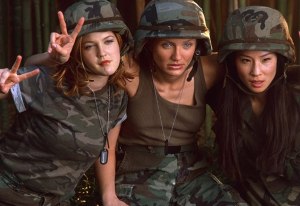 This was the first real blockbuster after The Matrix reshaped action cinema and the stylish choices can run the gamut between exciting and cool to dated and shallow. Twenty years later, it’s just not as impressive that they used wires to swing their actors around for stunt choreography, or that they replicated key Matrix touches like bullet time. The fighting sequences are often choppy in editing and some of the moves meant to demonstrate the power of the angels just feel silly, like a moment where Diaz went full Lui Kang with her flying kicking feet. It’s moments like that where the style gets away from McG. The tonal trick is finding a balance between goofy and cool, exciting and cheesy, and I don’t think the movie achieves this with its action. The set pieces feel built around “cool moments” rather than using geography, organic complications, and escalation. It means that Charlie’s Angels has its share of cool moments but then they are fleeting and ultimately meaningless because they don’t better connect to character, story, or even simply their own satisfying action compositions. It’s like immediately disintegrating cotton candy. The dozens and dozens and dozens of needle-drop music cues feel like another potent example of this charge as well as some anticipated attempt to distract from its shallow and diverting design.
I was dreading revisiting my original review as an 18-year-old because I was convinced my younger self was going to conflate the portrayal of the women as taking ownership. I just knew this would be something I had bought into in 2000, and yet it wasn’t quite so: “The line is drawn with Charlie’s Angels in that it’s sex-kitten jiggle and an acrobatic arrangement of (light) feminism and humor. These gals know they’re sex objects and they’ll use it to their advantage delighting in every second of it. Therefore, you could argue successfully that Angels is exploitation hiding as meaningful but hell… why think about this stuff? The movie rolls along at a fast pace where you don’t keep track of these issues. It’s just an easy sit down.” Hooray for my younger self seeing through this movie’s sheen of empowerment. At the time, it bothered me less because the movie was dumb fun, and now it just seems less fun and also dumber. I was so taken with Crispin Glover (Back to the Future) and his creepy cool style, much of which was Glover’s doing. His character was supposed to have dialogue except he hated the lines and asked to be silent. That’s one way out of memorizing, and it worked because he was a breakout and appeared in the 2003 sequel. Sam Rockwell (Three Billboards) was also a fun discovery though he only gets good once he’s revealed as a baddie. He would reuse those dancing moves for Iron Man 2.
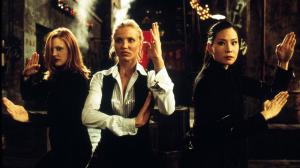 By the time 2003’s sequel Full Throttle rolled out, the appeal was gone. In my own brief review, I summarized, “It all seems so ho-hum and excessive at the same time. Quite an accomplishment. No more please.” I feel like the 2000 film also falls into this summary. It’s clearly not intending to be anything more than a goofy action movie, and I suppose the right person could still likely turn off the necessary parts of their brain to enjoy the rush of sights, sounds, and cleavage. There shouldn’t be a “wrong kind of feminism” so if this works for you, great. Many years later I felt that the male gaze was more ogling the women in the name of celebrating them. And yet Sony still felt there was material to be mined when they tried again with a failed 2019 reboot. The original Charlie’s Angels film is a cocktail of style with a creeping hangover right behind.
Re-Veiw Grade: C
Share this:

Concussion (2015)
 Concussion wants to be a hard-hitting drama exposing the dangers of repetitive head trauma in football and the lengths of the cover-ups and collusion within the NFL, except that movie already exists and is the Frontline documentary League of Denial that was too controversial to air on ESPN. Concussion, in comparison, is an adequate but hopelessly underwhelming film on the Nigerian-born Dr. Omalu (Will Smith) who discovered chronic traumatic encephalopathy (CTE) in the brains of deceased NFL players. The resistance and denials are soft-pedaled, though the movie treats them with heightened dramatic stakes that are unearned. There’s one threatening anonymous phone call but for the most part it feels like Dr. Omalu is just being ignored, and “being ignored” is a hard thing to turn into outstanding dramatic stakes at the movies. The movie doesn’t let the NFL completely off the hook but its critiques have been softened by studio interference (as revealed through the Sony email hack). As a straightforward drama, Concussion is easy to watch and Smith gives an authentic performance that doesn’t have to go to histrionic lengths to communicate his internal struggle. There’s a nice subplot with Omalu courting his eventual wife played by Gugu Mbatha-Raw. Albert Brooks and Alec Baldwin are strong supporting players. David Morse gets a show-stopping part to show off his acting skills. By the end, it all feels just a little too nice, a little too polished, and a little too easy, both in how it presents a complicated medical discovery and its implications but also the NFL’s response. For an awards-season drama that’s meant to shock and inform, being “easy” is the wrong call.
Nate’s Grade: B-
Note: “League of Denial” is currently available on Netflix streaming and I encourage people to check it out.
Share this:

Old School (2003)
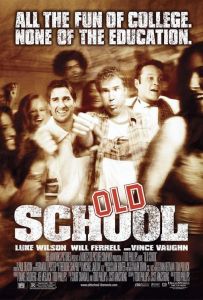 There’s something to be said for stupid comedies. Not necessarily the ones that are centered on large men getting hit in the head or crotch. Or films that climax with pie fights. Or any film where a wild animal plays some kind of pro sport. Or any film where Rob Schneider transforms into something and learns that life is indeed tough from a different perspective. As you can see, the stupid comedy has a very dubious history but when it succeeds at creating those hearty belly laughs, the kind where your face is sore afterwards from laughing so hard, few movies are as entertaining. Billy Madison is every bit as perfect in its humor as the more critically lauded comedies Rushmore and Raising Arizona. So then, is the crass college comedy Old School funny, stupid or both? It’s safe to say its makers did their homework and admirable achieve an unrepentant uproarious stupid comedy.
Mitch (Luke Wilson) is a real estate numbers cruncher who catches an early flight home from a business retreat only to discover his girlfriend (Juliet Lewis) blindfolded and ready to engage in an orgy. Mitch moves into a house on a local campus with the help of his two friends, smooth talker Beanie (Vince Vaughn) and man-child Frank (Will Ferrell). The trio of thirty somethings comes up with the idea to start their own fraternity and relive their youth. Their rebellion from adulthood leads to wild parties, underage girls, KY Jelly wrestling, drunken streaking, birthday party tranquilizers, eulogies featuring White Snake songs and, of course, taking it to the man that just wont let these kids have their fun.
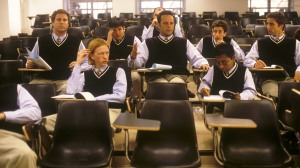 Wilson is relegated to the role of the straight man, which means he pretty much gets to make faces at the antics of Ferrell and Vaughn. Wilson is the nice guy of the film, which in comedy terms means hes the individual tortured by others. And in other terms, means hes normally quite bland. Consider both checked with Wilson in Old School. Wilson is a very capable actor but he’s more or less backdrop.
Ferrell is like instant comedy, just add water and he can make anything funnier. Much has been made of Kathy Bates strutting around in her 54-year-old birthday suit (which may have led to a Best Unsupported Actress nomination) but Ferrell equally jogs around jiggling his goods with glee. Ferrell is hysterical as the films biggest party animal. He takes everything to another level of comedy. Stick around during the end credits just to see him kick some woman’s shopping cart. I’m telling you this simple action is one of the funniest things in the movie.
Vaughn has made a career of playing fast-talking louts that would normally incite people with his caustic remarks if he weren’t so damn charming. What happened to ole Vince and his oodles of sex appeal? Circa 1998 or so he was going to be Hollywoods next leading man, especially after massive exposure from Spielberg’s Lost World. Yes, starring in the very ill conceived remake of Psycho (now with masturbation at no extra charge!) was a bad career move but it shouldn’t have been a killer. I mean, Anne Heche went on to other films after it and this was before she was communicating with aliens with her made up language. Hell, I’m just kind of glad to see Vaughn in films again. His running gag with a bread maker is great.
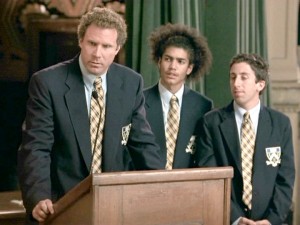 The plot of Old School is really nothing more than a paper-thin device for the jokes to spring forth from. There are only stock characters in these kinds of films. Theres the nice girl (Ellen Pompeo) that will eventually get together with our protagonist in the end. There’s her smug boyfriend played by the smug Craig Kilborn. Jeremy Piven is a stuffy dean trying to shut the boys down to settle old grudges with them.
The women of Old School are really left with nothing to do. Either they are there to have sex with the men or, when older, marry and control them. Lewis is the opposite of the good girl as the oversexed former flame of Wilson. Leah Remini has a very brief role as Vaughns wife who knows when to lead him by a chain. 24‘s Elisha Cuthbert is a naughty schoolgirl that could get Wilson in trouble after one unexpected night. The ladies of this world are really tools for the guys, but what kind of feminist analysis is needed for a film that features Snoop Dog and not one, but two correspondents from The Daily Show?
Old School is from the director and co-writer of Road Trip, a crude yet very entertaining and lively comedy. Old School is kind of a big brother companion to Road Trip, and while not rising to the level of Animal House (as every college comedy wishes to be now) the film is indeed a pristine example of a gloriously stupid comedy aided by a very game cast. See it and be prepared to laugh a few pounds off.
Nate’s Grade: B
Share this:

Charlie’s Angels (2000)
These angels aren’t exactly what your father was enjoying when your mother was away fulfilling errands. These angels aren’t delegated as mere sex objects running around providing the jiggle entertainment that is (or was) supplied by today’s Baywatch. The 90s is a different decade after our minority movements and today’s woman is just as apt to do a flying kung-fu face plant into a baddie as any man. The angels of the film are action heroes for an armada of small girls needing some female empowerment when their only other choices consist of a barely clothed Britney or a barely covered Christina. These angels aren’t just the sex objects that the classic assortment of angelic 70s stars were; these angels are also tough-as-nails, resourceful, and not afraid to tussle or tango. Now that this exposition is out I can concentrate on the scattershot film Charlie’s Angels.
The film has been rumored to have at a minimum of 17 writers who tried shaping a story for Cameron Diaz, Drew Barrymore, and Lucy Lui. The story is pretty much shelved toward the back so the forefront is our trio of ladies kicking ass then shaking it with zig-zaggy and wild camera movements from debut filmmaker and video director McG.
Charlie’s Angels is whiz-bang dumb fun. The overall feel of the film is something more difficult to get a grasp on. At times it shows itself as tongue-in-cheek and satirical but then at other times it seems overly serious or overly dumb. The characters are non-existent and basically only discernible by hair color. The characters are very wooden and I actually found more enjoyment watching the villains and seeing more of them; call it the Austin Powers dilemma. Diaz makes the only notable attempt as her goofy and light-hearted angel connects with the audience best. Lui plays a techno-babe dominatrix but is easy to see that she was the last angel chosen and doesn’t exactly gel with the others as much as she could have.
Charlie’s Angels is best when the action is pumping. The scenes are cut together in a jam-packing sequential way adding distinct flavor and style. McG is a true surprise in the effectiveness he can orchestrate his action motifs even if the Matrix effects and moves make absolutely no sense in the real world.
Crispin Glover shows himself as a silent assassin nicknamed “the thin creepy man.” Glover is so suave and slick in his role of the non-verbal Oddjob henchman role that he exhilarated me with every presence he made on screen. Goodness, he was too cool in this film and everyone gets brownie points for allowing him. He has such energy and charisma that I wanted the film to veer off into him and desert our angels. Seeing our ageless McFly perform action scenes and choreographed fights is something I will be pleased with until my grave. seeing Crispin in the excellent Nurse Betty and now huge exposure in this is a true joy. And man… he smokes a cigarette way too cool every time he’s in this film. Some people can smoke cool some of the time but Crispin does it all of the time. His mere presence almost cancels out the annoyance of Barrymore.
The line is drawn with Charlie’s Angels in that it’s sex-kitten jiggle and an acrobatic arrangement of (light) feminism and humor. These gals know they’re sex objects and they’ll use it to their advantage delighting in every second of it. Therefore, you could argue successfully that Angels is exploitation hiding as meaningful but hell… why think about this stuff? The movie rolls along at a fast pace where you don’t keep track of these issues. It’s just an easy sit down.
The gigantic success of Charlie’s Angels makes sequels and a possible franchise all but certain. I’d be happy for McG to hop back in his directorial chair but have a unique idea for Angels 2: Bigger, Longer, and Uncut… it involves Glover kicking a lot of ass really cool like.
Nate’s Grade: B-
Reviewed 20 years later as part of the “Reviews Re-View: 2000” article.


 nathanzoebl
You must be logged in to post a comment.