Blog Archives
Inside Out 2 (2024)

Of all the Pixar hits, 2015’s Inside Out is one of the better movies to develop a sequel for, and thankfully Inside Out 2 is a solid extension from the original. The internal world of Riley’s burgeoning sense of self is so deeply imaginative and creatively rewarding, balancing slapstick and broad humor with a deeper examination of abstract concepts and human psychology (Freud would have loved this movie… or hated it… or just thought about his mother). The unique setting was made so accessible by the nimble screenplay that the viewer was able to learn the rules of this setting and how interconnected the various parts are. While not being as marvelously inventive as its predecessor, nor as poignant (R.I.P. Bing Bong), Inside Out 2 is a heartwarming and reaffirming animated movie that will work for all ages.
Riley is now turning thirteen years old and in the midst of puberty. That means new emotions, and Joy (voiced by Amy Poehler) has to learn to work well with her co-workers, such as Envy, Embarassment, and Ennui. The biggest new addition is Anxiety (voiced by Maya Hawke) who wants to prepare Riley for her life ahead, which seems especially rocky now that Riley knows her two best friends will be going to a different school. A weekend trip to hockey camp becomes Riley’s opportunity to test drive the “new Riley,” the one who impresses the cool older kids and gains their acceptance. This will force Riley to have to determine which set of friends to prioritize, the new or the old, and whether the goofy, kind version can survive to middle school or needs to be snuffed out.

With the sequel, there aren’t any dramatically new wrinkles to the world building already established. We don’t exactly discover any new portions of Riley’s mind, instead choosing to place most of the plot’s emphasis on another long journey back to home base. This time the other core emotions get to stick around with Joy, each of them proving useful during a key moment on the adventure. The externalization of the emotions invites the viewer to feel something toward feelings themselves. When Joy, at her lowest, laments that maybe a hard realization about growing up is that life will simply have less joy, it really hit me. Part of it was just the sad contemplation that accepting adulthood means accepting a life with less happiness, but a big part was teaching this concept to children and being unable to provide them the joy they deserve. Since the 2015 original, my life has gone through different changes and now I watch these movies not just as an individual viewer recalling life as a former adolescent figuring things out, but now I also come from the perspective of a parent with young children, including one turning thirteen. The development of the mind of this little growing person is a heavy responsibility given to people who are, hopefully, up to that very herculean task. We can all try our best, but recognizing limitations is also key. The kids have to have the freedom to be themselves and not pint-sized facsimiles of a parent.
The emotions inside Riley’s mind are featured like internal surrogate parents, tending to the development of Riley’s emotions, morals, and personality. They presumably want what’s best for her, there just happen to be opposing interpretations of what that exactly means, which leads to the majority of conflict with Anxiety. However, there’s also an understanding that Riley has to do things on her own and be able to make mistakes and learn from them. Inside Out 2 is ultimately about accepting the limitations of providing guidance. Joy and Anxiety are both trying to steer Riley down a deliberate path they think is best, but Riley needs to discover her own path rather than have it programmed for her. I appreciated that Anxiety is not treated as some dangerous one-dimensional villain hijacking Riley’s brain. Much like sadness, there is a real psychological purpose for anxiety, to keep us alert and prepared. Now that can certainly go into overdrive, as demonstrated throughout Inside Out 2, including a realistic depiction of a panic attack. It’s about finding balance, though one person’s balance will be inordinately different from another. The stakes may be intentionally low in this movie, all about making the hockey team and being welcomed by the popular girl she may or may not be crushing over (more on that later), but the focus is on the sense of who Riley chooses to be through her life’s inevitable ups and downs. It’s about our response to change as much as it is our response to the presence of anxiety.
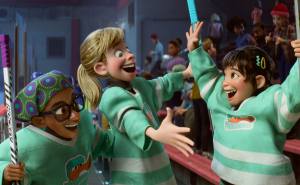
Inside Out 2 also answers a thorny world-building question that the original creators never thought to go into greater detail. It’s established in the 2015 original that even the adults have the same five core emotions manning their brain battle stations: Disgust, Fear, Sadness, Anger, and Joy. So if adults only see these same emotions, what happens to those new puberty emotions? Do they go away? As an adult, do we gradually work through anxiety and embarrassment to the point where they are no longer present (this is where every adult can wryly laugh)? There’s an emotion introduced as Nostalgia, depicted as a kindly grandmother so eager to remember the ways things were. Joy tells Nostalgia to leave, as it’s not time for her to be developed yet until Riley is older. This one moment clears up the world-building question; the emotions don’t leave, they just sit out for periods of time like bench players waiting to be called into the big game. And just like that, it all works and makes sense. I wonder what other new emotions make their appearances later in life. Resentment? Choosing to rather die in authority rather than give up an iota of power to a younger generation? Sorry, that last one was more directed at those stubborn folks clinging to Congressional offices.
There is some sight narrative and thematic redundancy here. The first movie was about learning the importance of accepting sadness as a vital part of the human condition and how we can process our emotional states. It was about Joy learning that not every moment in life can or should be dominated by joy, and that the other emotions are also necessary functions. With the sequel, we have a starting point where Joy is picking and choosing what memories are worthy of being remembered, banishing the “bad moments” to the back of Riley’s mind, forming a cavernous landfill of junked memories. It’s treading some pretty similar ground, prioritizing one set of memories or emotions over others wherein the ultimate lesson is that repression in all forms is unhealthy and robbing one of the necessary tools for self-acceptance and growth. This is further epitomized by a trip to one of these memory vaults where Riley’s Deep Dark Secret is willfully imprisoned. The movie proper never comes back to this self-loathing figure, and the revelation could have really supported the overall message of self-acceptance. Pixar could have done something really special here, like having Riley coming to terms with being bisexual/queer, and that perhaps something we may personally agonize over as a horrifying secret could, once shared, be far from the dreaded life-destroying culprit our minds make it out to be. This would have really worked with the perceived lower stakes of the movie, naturally elevating the ordinary to the profound, as life can often unexpectedly become. Alas, the Deep Dark Secret is just a setup to an underwhelming post-credits joke – womp womp. That’s it? Again, if you’re going to tread the familiar thematic grounds about the dangers of repression, at least give us something bigger to reach than the same lesson that all emotions have a place.

The first Inside Out was a masterpiece. That’s a hard act to follow. This sequel, of which we can all assume there will be more given its billion-dollar box-office, is a solid double to the original’s home run of entertainment. It’s not among their best but it’s one of their better non-Toy Story sequels. Inside Out 2 is a heartwarming winner.
Nate’s Grade: B
Share this:

The Aristocrats (2005)
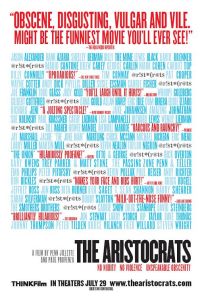 A man walks into a talent agency. He tells the agent he’s got a family act the likes of which no one has ever seen before. The agent tells the man to continue. The man’s wife, children, and pet come into the room and proceed to do the most vile, puerile, horrendously vulgar acts to themselves and each other. The agent is shocked. After a long moment of silence, the agent says, “What do you call this act?” The man replies, “The Aristocrats!” Ba-dum-dum.
It’s really not a good joke, but what makes it special is that the middle is entirely open for the comic to say whatever they want. Comedians will build and build in their obscenity so that the weak punchline is practically an afterthought. It’s a joke that goes all the way back to the days of vaudeville. Comics tell it to each other after shows like a secret handshake. The Aristocrats, an unrated documentary, gathers 100 comedians and lets them put their own crass spin on a classic dirty joke.
 The movie boasts plenty of well-known names getting down and dirty, like Robin Williams, Chris Rock, Whoopi Goldberg, George Carlin, the South Park creators, Jason Alexander, Eric Idle, Richard Lewis, Andy Dick, Fred Willard, Howie Mandel, Eddie Izzard, and Drew Carey (he insists the punchline should be accompanied by finger-snaps). Few comedians give a full rendition of the joke but the clips are just as potent. Judy Gold involves her unborn baby in the act and Carrie Fisher says her mother likes to sing in a very different kind of shower, but the filthiest mind of all belongs to Bob Saget, who can’t make it through without breaking up and saying, “What am I doing?” The Aristocrats also includes comics from different eras, including Larry Storch, the Smothers Brothers (one of which has never heard the joke before), and even Phyllis Diller, who pretty much just cackles at others. Dana Gould manages to pull together a very funny clean rendition involving the Amish version of the joke. The film opens on Carlin, closes on Gilbert Gottfried, and oh what a journey the film takes.
The Aristocrats is very very funny but also a rather incisive look at the nature of comedy. In between dishing the dirt, various comedians rhapsodize about the mechanics of comedy, the freedom in conquering taboos, and the intricacies of delivery (Paul Reiser stresses that any poo-related parts should be saved for the big finish). Penn Jilette says, “It’s the singer, not the song.” The Aristocrats displays comedy like it was jazz, each individual playing the same note a different way.
Things get a tad repetitious after awhile and the vulgarity starts to lose its impact once you’ve listened to countless unspeakable acts, mostly involving family members, the animal kingdom, and the loosening of bowels. As an example, my friend from college, Jason Davis, attended Mardi Gras in New Orleans one year, and as any viewer of late night TV will attest, the girls have gone wild. The ladies, it seems, will freely show you their bosoms in exchange for cheap plastic beads, and some don’t even want anything in return. Jason said the experience was amazing, at first, but after hours of non-stop frontal nudity, it all got a little tiring after awhile. The rampant nudity lost its effect and Jason started paying more attention to the women who actually kept their clothes on. So too is it with The Aristocrats, in a manner of speaking.
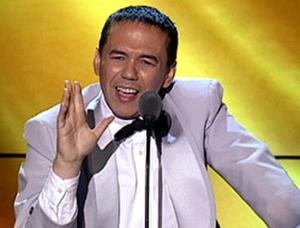 The film’s unabashed vulgarity will spur guffaws and titters, especially in an “Oh-my-God-did-he/she-just-say-that?” way. But after so many tellings, things that were funny because they were taboo don’t seem as funny in repetition. It’s at this point that an audience can really appreciate comics that take unconventional routes toward telling the joke. Eric Meade does a card trick, Kevin Pollack does the joke as Christopher Walken, Mario Cantone performs the joke as Liza Minnelli, Sarah Silverman actually puts herself in the joke’s family (for my money, she gives the best performance), Penn and Teller do a magic trick with a soda bottle, there are jugglers, a ventriloquist, and even a mime. The Aristocrats still has its straightforward dirty pleasures, but it’s much more satisfying when certain comics work outside the box.
It should be obvious at this point but The Aristocrats is not going to be a movie for most people. The incredibly course language and graphic accounts of lewd acts will not sit well with most of the American public. This is a movie strictly for people that have a strong stomach and like hearing a dirty joke. For that group, The Aristocrats will knock you silly with laughter. My three friends whom I saw the film with said they were in pain from laughing so hard. Perhaps that speaks volumes about the company I keep.
The Aristocrats is a bawdy, filthy, hilarious documentary that becomes more than a bunch of funnymen retelling a dirty joke. This is a film for a very select audience, to say the least, and it does lag at parts when the continual vulgarity loses its impact. The Aristocrats also seems to be erratically edited; scenes will rapidly jump from different angles for little reason. Every comedian has their own style and every audience member will find something different to strike their funny bone. At the very end, The Aristocrats invites viewers to submit their own form of the joke for the eventual DVD. I don’t know about you but I’ve already got a goldmine of ideas.
Nate’s Grade: B


 nathanzoebl
You must be logged in to post a comment.