Blog Archives
88 Minutes (2008)
 Typically you can smell something wrong when a movie is continually delayed or held from release for well over a year. The serial killer thriller 88 Minutes actually began filming during the fall of 2005 (!). It was released in the United States well after it had been available on DVD in Europe for over a year. After watching all 108 minutes of 88 Minutes, it’s easy to see why the studio and the film’s astounding 20 producers (!!) were trying to hide this from public eyes.
Dr. Jack Gramm (Al Pacino) is the top forensic psychiatrist in Seattle. His testimony is responsible for convicting Jon Forster (Neal McDonough) of a death sentence. Many years later, Jon is now hours away from execution and still professing his innocence, claiming the real “Seattle Slayer” is still out there. Gramm works as a college professor and he can still woo the young ladies and beds them regularly. His assistant (Amy Brenneman) informs Gramm that a woman in his class has been murdered and her murder is patterned after the “Seattle Slayer” killings. Gramm believes that Forster is collaborating with someone on the outside to cast doubt on his conviction. Then as Gramm walks to class he gets an anonymous phone call that tells him he has 88 minutes to live. Gramm scrambles to try and use the time to figure out who is targeting him, framing him, and why. Could it be his assistant, his T.A. (Alicia Witt), his skeptical students (Benjamin McKenzie, Leelee Sobieski), the skeezy campus cop, or maybe the starting second baseman for the Seattle Mariners?
 First off, the time frame doesn’t work at all. 88 minutes is too short a time frame to do crack investigation, and Gramm runs all over the city of Seattle at least three times without getting caught in any gridlock. The movie establishes a real-time ticking clock but then decides to follow a different set of time. Occasionally the movie will be faster than real life, meaning that it says 10 minutes have passed when only say 6 have, and occasionally the movie will be slower than real life, like when the third act probably takes all of 10 minutes in the film’s universe. It’s not consistent and points out the flaw of the structure. The 88-minute countdown was supposed to add a feeling of suspense but what it does is add an extra level of incredulity. There is no way that 88 minutes would be a sufficient time for the killer to stage murder and mayhem around a large metropolitan city known for inclement weather. Seriously, is the killer trying to set unreasonable personal goals? Why not a three-hour window of time? That way the killer could have a healthy planning period without worrying that everything would collapse if they got stuck in traffic. Also, the 88-minute time frame allows glimpses into the anal retentive nature of our killer. Gramm is harassed by phone calls updating him on his declining time, but what’s truly special is when the killer defaces Gramm’s car saying how long he has to live to the minute. The killer must have known to the second when Gramm would come by his car because had the doc taken a different route, gotten a coffee, gone to the bathroom, or performed whatever other million actions then the death threat would be inaccurate.
Next, all the women are helpless sycophants. They think the world of Gramm and several of these twenty-something college girls have big time crushes on the aged Pacino. It’s hard to take seriously the idea that Gramm, in this context, is still a Lothario that he can bed any coed he sets his sleepy eyes upon. The fact that the movie opens with him waking up from his latest and naked conquest already gives the film a squeamish start, but when multiple characters all confess to having crushes on Gramm then the whole idea transforms into an uncomfortable stroking of Pacino’s vanity and virility. I suppose I shouldn’t expect too much from the plethora of female characters because they’re all in need of comfort and every one of them winds up a pitiful damsel in distress. We’re supposed to believe these are strong and capable women, all of them working alongside a criminal expert so perhaps they know a thing or two about self-defense. They fawn over the man and then inexplicably wind up in danger. Occasionally the women will experience dramatic setbacks and they all take a backseat toward getting a hug from Gramm. These women react to the sight of death in puzzling ways and then will just as easily move on to another topic.
 This is the kind of wretched movie where a flashback tragedy is defined by a memory so inane that it becomes insulting. Gramm keeps flashing back to a simple memory of his long deceased younger sister; she is running along the bank of a rather filthy looking river with a kite trailing inches behind her. Now, 88 Minutes is the type of movie where she has to giggle innocently and say something ridiculously non-descript, which in this case is, “[Giggle], dad look at the kite.” Of course Gramm is not her father (or is he?) and her call to look at the kite makes little sense because 1) its string is about three feet so it cannot go very high at all, and 2) it’s usually flying lower than the girl. I just find this image, this idea, this whole flashback construct to be emblematic of how truly awful and derivative and excruciating 88 Minutes can be.
I must confess there is one scene in 88 Minutes that I will remember for the rest of my life specifically because of how ridiculously appalling it is. Few scenes cause me to simultaneously stare in wide-eyed amazement and resist the urge to vomit. Here goes. Gramm is confronted by his FBI agent pal (William Forsythe) who has some bad news for Gramm. It turns out Gramm’s semen was found inside the “vaginal cavity” of the victim. We know Gramm wasn’t sexually involved with her because he was sexually involved with our opening naked escort lady, Sara Pollard (Leah Caims). Gramm then argues that someone out there framed him by killing Sara Pollard (oh don’t act surprised), retrieving Gramm’s semen from inside her, and then injecting it into the “vaginal cavity” of the victim. Hearing an actor of Pacino’s credit verbalize this theory is akin to having the “sex talk” with your parents, nay, grandparents — it’s just so intensely uncomfortable to watch. I just picture a lab tech with a long syringe that has to run around Seattle to make his semen import/export deadlines. This one icky moment stands out as the most ridiculously awful in a movie that is nothing but collective scenes of awful.
88 Minutes has no characters, only red herrings. Each of the numerous supporting characters is given the chance to act suspiciously and for no real good reason. Gramm takes his turn going through accusing nearly every supporting character he comes across as being in league with Forster. The screenplay even establishes characters like the painfully named Guy LaForge (Stephen Moyer, True Blood‘s Bill the Vampire) who serves no purpose other than to wear a leather jacket and squint in backgrounds.
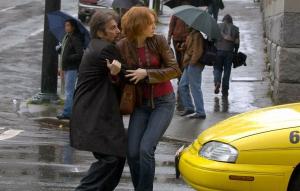 Forget anything approaching characterization because writer Gary Scott Thompson (The Fast and the Furious) has created a script that is woeful in every department, including thrills. The reveal of the killer is mishandled, as is most every plot point, and I’m at a total loss at the rationale of attempting to commit murder in a building the killer called in a bomb threat. Yeah there may not be students but there will be plenty of police sniffing around. More than half of the scenes involve people talking on cell phones. The dialogue is unintentionally hilarious more often than not, with lines like “Someone has penetrated my most secret place” and, “If I can’t forgive you I don’t deserve you,” and the killer taunting, “You see Jacko, I’m a true believer.” Need I remind you of the “vaginal cavity” conversation? This is a complete laughable mess that would have been just another half-rate direct-to-TV movies airing late nights on cable channels were it not for Pacino’s involvement.
Pacino doesn’t even try to hide his disillusionment with the movie. He comes across as sleepy-eyed to the point of being a zombie with a permanent case of bedhead (seriously, Pacino’s crazy hair steals the show). The man is going through the motions to collect a paycheck, and he even gets a couple scenes to work up the frothy barking Pacino voice that he has settled into for the past 15 years of acting. He never seems to be worried that he only has so many minutes to live, so why should we bother sweating? The rest of the cast is awful and they were likely lured to this doomed project because of the chance to work alongside Pacino. Leelee Sobieski must be singled out for being particularly atrocious, especially when she tries to play a tough girl. This has got to be her worst performance since she started speaking. Then again, she has worked with Uwe Boll (Fun fact: one of 88 Minutes‘ many producers is Boll’s longtime producer).
88 Minutes is bad in every possible manner of filmmaking. This is an embarrassment for everyone whose name’s is attached to this film. From the overly anxious musical score, to the choppy editing, to the lackluster cinematography, to the abysmal story and outlandish acting and the lazy direction, 88 Minutes is a cinematic catastrophe. It should only be watched at a safe distance and only with the intention of derisive enjoyment. Because while this movie fails at every level it may just end up becoming the funniest comedy of the year.
Nate’s Grade: D
Share this:

In the Name of the King: A Dungeon Siege Tale (2008)
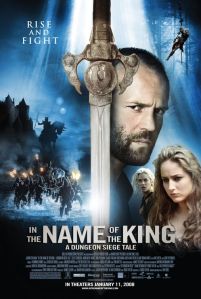 I have no idea how it happened but someone gave infamously reviled director Uwe Boll a bunch of money to adapt a fantasy video game called Dungeon Siege into a star-laden movie. In the Name of the King: A Dungeon Siege Tale seemed to be Boll’s stab at achieving mainstream credibility. He assembled his best cast yet with plenty of recognizable stars. At one point, I remember reading that Boll wanted to divide this film into two, Kill Bill-style, or release a 180-minute version. Until this movie, no Boll film had ever gone over barely an hour and a half. After seeing a slimmed down version that runs a little over two hours, I honestly have no idea what more Boll could have. In the Name of the King struggles to fill two hours worth with crap.
In a far off land, there lives a farmer named, coincidentally enough, Farmer (Jason Statham). His world is turned upside down when his family is killed by a band of creatures known as the Krug. He and his friend (Ron Perlman) must track down Farmer’s captured wife (Claire Forlani) and inflict some peasant vengeance of their own.
Evil wizard Gallian (Ray Liotta) was the cause of the attack. He has built up a whole army of Krug to challenge the King (Burt Reynolds) for the throne. Gallian also has two unwitting allies. The King’s nephew, the Duke (Matthew Lilard), wants to rule and is willing to plot with the evil wizard to achieve this goal. Muriella (Leelee Sobieski) is secretly sleeping with Gallian; he says he is teaching her how to use her blooming magical powers (remove your mind from the gutter) but he is really stealing her powers.
Farmer reluctantly becomes a leader to protect the kingdom. Gallian is stupefied that this simple farmer is somehow beyond the control of his magic. That’s because Farmer should probably change his name to Prince because he is the long-lost son of the King and some stable girl. Merick (John Rhys-Davies) serves as the King’s most trusted advisor but he is also the father of Muriella. He scolds her for being so foolish and being used by Gallian. She suits up like Joan of Arc and wants to fight, but her father won’t allow it.
Eventually this all leads to a large-scale battle between the forces of good and evil where Gallian uses his magic powers to create a cyclone of books to stop Farmer. There you have it.
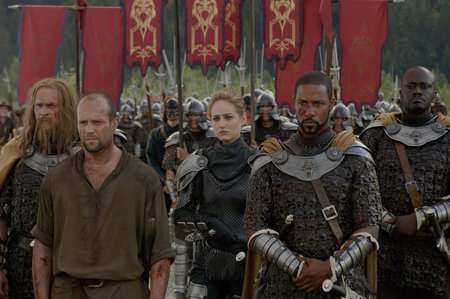 If I were Peter Jackson, I might consider a copyright infringement suit, because In the Name of the King is a sloppy Lord of the Rings rip-off through and through. The long-lost heir to the throne must accept his magisterial destiny … just like in Lord of the Rings. There is a 10-minute fight sequence that happens in a swath of woods … just like in Fellowship of the Ring. The villain relies on an army of stupid supernatural hordes … just like Lord of the Rings. There is a wizard-on-wizard duel … just like Lord of the Rings. A noble woman wishes to fight but her father does not approve, so she sneaks off in armor and does fight … just like in Return of the King. There is a shadowy “other” world that goes beyond our dimension … just like in Lord of the Rings. The eventual trek of our heroes leads to a volcano, but not just that, it’s also the villain’s lair … just like in Lord of the Rings. Bastian (William Sanderson, in his sixth Boll movie) serves no purpose other than to resemble Legolas. John Rhys-Davies you should know better; you freaking starred IN the Lord of the Rings trilogy.
So what does a $60 million budget get Boll? Lots and lots of crane shots. Boll relies on extended aerial photography and zooming, CGI landscapes that serve to remind you how much better Lord of the Rings was and that Vancouver is no New Zealand. There are some segments that lack a firm geographic bearing because Boll wants to jump from expansive crane shot to expansive crane shot. I get that he wants to showcase the depth of the battles, which do feature a fair amount of background action, but the repetition of any camera technique will always grow old if it doesn’t feel congruent to the onscreen drama. I’m happy that Boll wants to open up the scope, but when he relies on a multitude of high-angle crane shots in motion the effect becomes wearisome. The audience can never settle into the action because Boll is too forceful with wanting to demonstrate what he bought with his budget. The cinematography is a notable step up for Boll and longtime director of photography Mathias Neumann. Then again, if I had a $60 million budget I’m sure my movie would look good too, or at least better.
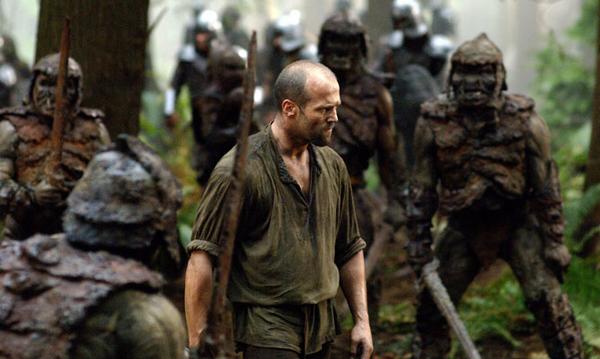
In the Name of the King is the biggest budget Boll has ever had, but it seems like proper costumes must have still been out of his price range. The marauding horde of Orcs, oh I’m sorry, the Krug look like cheesy low-rent Power Rangers villains in goofy rubber outfits. The camera never lets you get a good glimpse of these creatures because even Boll knows how crummy they look. You get another idea of how bad the creatures look when Farmer utilizes the familiar dress-in-other-guy’s-uniform-to-pretend-to-blend-in ploy that was perfected by the aging action stars of the 1980s. So Farmer knocks out a Krug creature, throws on its spongy armor, and is able to walk around the Krug camp.
 The special effects also seem to run the gamut. The green screen work is painfully ineffective and very transparent, like when Farmer is swinging down a rope across a gorge. When Boll tries to show large fields of soldiers it also exposes how fake the CGI work looks. The many battalions of soldiers look like a dated computer video game. The special effects for Alone in the Dark were better and that film had, reportedly, half the budget of this movie. Realizing all this, it’s no wonder that Boll tries to use as many real sets as he can.
And yet despite all of this, In the Name of the King is high-class camp. Boll achieves a workable level of derisive enjoyment that manages to keep the movie entertaining even while its spins into stupidity. The fight scenes are actually decent and Boll manages to compose a few shots here and there that look quite good, like when the camera scans over a field of dead bodies. During the action centerpiece, the 10-minute battle in the woods between man and Krug, Boll’s camera manages to frame some solid, if unspectacular, action with some good angles. It’s also cut to be mostly coherent. The fight choreography is credited to Siu-tung Ching who also did the choreography for Hero and House of the Flying Daggers. He must have procrastinated until the night before his choreography was due. It will pass but there’s little creativity there; however, Boll must have been flabbergasted. I think the true test for derisive viewer enjoyment will be when the ninjas come out of nowhere at the King’s disposal. All of a sudden in the middle of a medieval style fantasy fight there are flipping black-clad ninjas. I loved it for its sheer anachronistic absurdity. To me, it felt like Boll was trying to cram in everything that he thought was theoretically cool into one massive fight sequence. He just didn’t have the money to also include pirates and robots and hobos and vampires and bears and Batman.
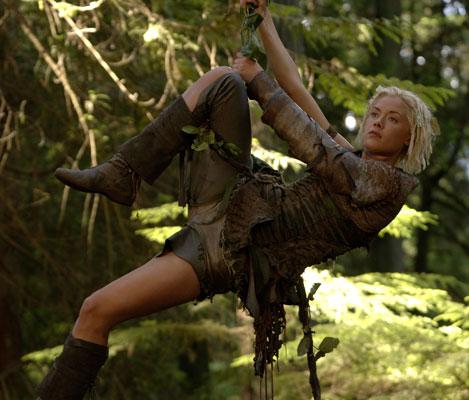
Fantasy is just not Boll’s preferred territory and it mostly shows. He really wants to make his own entry in the style of Lord of the Rings, but you can tell his mind is elsewhere. The plot is a mess but that isn’t indicative of Boll’s lack of interest with the film, it’s just indicative of a typical Boll movie. In the Name of the King feels like Boll is following a checklist of what is expected in a modern fantasy epic, except that Boll cannot provide the epic part. Here’s my proof: the vine-swinging tree nymphs led by Elora (Kristanna Loken). If Boll was really invested in this movie he would have paid more attention to these alluring vixens. These anti-war ladies have sworn off men (take that for what you will) and live their lives like Cirque du Soliel jungle performers. This stuff is right up Boll’s exploitation rich alley, and yet he and the film treat these women of the woods like afterthoughts. They show up and save the day when the film requires an inexplicable savior. I don’t know how helpful tree-dwelling women would be in a fight either unless it was fought in a well-forested area. Boll not capitalizing on these women warriors proves to me that his heart isn’t in this movie.
 Screenwriter Doug Taylor was clearly cobbling a story together by his fading memory of the Lord of the Rings trilogy, and yet this being a Boll movie, there are still plenty of head-scratching decisions that defy logic even for a would-be fantasy film. For instance, why does Farmer fight with a boomerang? How effective can a weapon be when it gets thrown and then needs to be picked up? The boomerangs that I know can hit people, sure, but usually hitting someone stops its path of movement. Then again, these could be magic boomerangs. How did Gallian raise such a massive monster army to rival that of the King’s without anyone noticing? I’m sure the excuse for that is also magic-related. The Duke takes out two legions of soldiers for his own purposes, and when one man asks where the commanding officers are the Duke, in front of everyone, stabs him. It seems like a lousy way to lead but I’m sure Joseph Stalin would approve. A telekinetic sword fight sounds cool on paper until you realize it is just actors standing passively while CGI swords clang around them. During the climactic battle it’s dark and raining (hey, like in Lord of the Rings) for the King’s army vs. the Krug, but then as Farmer and Elora race to the Volcano Lair it is light out. How many time zones does this kingdom have? Also during this climactic battle, the King’s army has the high ground thanks to a hill and the Krug race up the raised land. The archers atop the hill fire their flaming arrows at an angle pointing up, which would sail over the heads of all their targets. I suppose the King’s archery education program has been suffering some severe budget cutbacks.
The dialogue is pretty corny amidst all the sword-and-sorcery antics and induces its fair share of giggles. When Muriella asks Gallian if he always appears out of nowhere he responds, “No. I appear suddenly. Out of somewhere.” Thanks for clearing that semantic argument up. He also has a very icky conversation with his bedfellow Muriella dripping with double entendres: “I knew you would come,” “I told you I would,” “I felt it before you came,” “You told me I could come and go as I please.” I think my favorite moment is when the King is on his deathbed and addressing Farmer. He advises the man of agricultural means to try using seaweed to enrich his soil. “How do you know this?” asks Farmer. “Because I am king,” he replies.
The actors all feel like they are in separate movies on a collision course with one another. Boll has never had a firm command with actors. The big name actors feel their way around a scene with little guidance from Boll, which means they routinely experiment and play their roles like they were an exercise instead of a final performance. A fine example is a single line spoken at a family table; it’s just perfectly off enough to prick your ears to Boll’s tone-deaf direction. I think Boll either doesn’t care that much about performances or is easily cowed into submission by actors. Staham is recycling his glaring machismo that he’s turned into an action movie franchise, but he seems to me like a modern-day Steven Segal who dispatches foes in a monotone whisper. Luckily for Boll, Statham is adept at picking up fight choreography and so the movie benefits by watching the actor clearly in the middle of the fracas performing his own sword fights.
 Most of the actors also seem to be falling back on past performances as inspiration for what to do under Boll’s laissez faire direction. Perlman plays his standard gruff tough with a deadpan delivery. Sobieski hasn’t acted in a movie for some time. She comes across as her usual inexpressively empty self, which is her thing, along with being a physical clone of Helen Hunt. Loken shows she can swing from a vine but not master a vague British accent. Forlani gets to cower and weep. Burt Reynolds is playing Burt Reynolds, and Rhys-Davies falls back on his trademark gravitas. Only Lillard seems to find enjoyment out of Boll’s vacuum of direction. His accent mirrors his wildly over the top style of acting that sometimes feels like a fish flopping around for air. His physical mannerisms are uncontrolled and he sneers through much of his lines, but I’ll give it to Lilard, he is much more fun to watch than any of the other slumming stars.
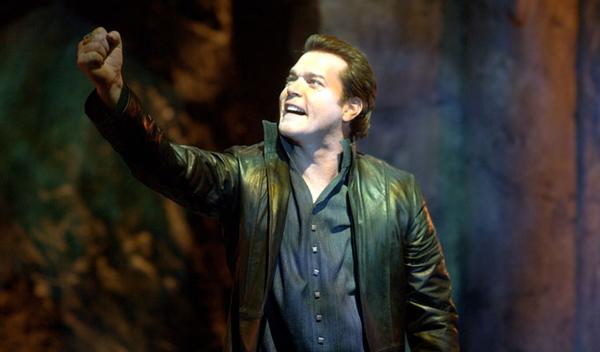
Special attention must be made to Liotta, who is on a different plane of terrible. It’s bad enough that he’s chewing the scenery in his typical manic, bug-eyed crazy yell-speak he refers to as acting, but the movie has to open on the discomfiting image of Liotta trying to suck Leelee Sobieski’s face inside out via kissing. Liotta’s character Gallian feels and looks out of place; he resembles a skuzzy Las Vegas magician with a pompadour and a long leather jacket and a button-down shirt. Where did this man come from? His performance is astonishing in how deeply the awful goes, and when he tells Farmer’s wife, “I feel him inside you,” try your best not to shudder.
After seeing eight of his films and writing 17,000 words on the man (including 2,600 for this review), I feel like I have a special connection to Uwe Boll. I just don’t sense that Boll’s heart was truly in this venture. In the Name of the King seems to be the last time I think we’ll see Boll flirt with mainstream Hollywood genre filmmaking. I think his time luring known actors has come to a merciful end. His next slew of films seem destined to all direct-to-DVD and feature no name casts that are mostly the same actors he has worked with before. In the Name of the King will stand as a ridiculous Lord of the Rings rip-off that has some workable action alongside its many laughably awful moments. It’s a lousy fantasy movie with too many extraneous characters and too familiar a plot outline. Even for a $60 million film, Boll finds new ways to prove that no matter what sized budget the man has he will always try to grasp something beyond his reach.
Nate’s Grade: D+
Share this:

Here on Earth (2000)
 The story is nothing groundbreaking: new guy arrives in town, sweeps girl off her feet because he’s “different” than the rest, earns ire from mean boyfriend, and eventually gets the girl. It’s been the plot from everything from Lady and the Tramp to Edward Scissorhands. But even though the theme is based in predictability, the creators of ‘Here on Earth’ seem to have lazily put forth an execution.
The movie and its screenwriter have their logic completely reversed. The girl’s boyfriend is supposed to be the wife-beating snotty jerk, and the new kid is supposed to be the nice sensitive “different” guy. But in Earth, Klein is the snotty Richy Rich whose colors never change, and Josh Hartnett is the dependable and established nice guy boyfriend. The structure of this tragic tale is no way to build drama, only contempt for the female lead.
Whatever high-minded message Earth is hopelessly aiming for is destroyed by dialogue so cheesy that it could be considered a side dish at a local Taco Bell. By the time Klein starts naming Leelee’s breasts after different states in the Union the movie loses what little credibility it had or thought it did (“Massachusetts welcomes you”). It’s a wonder most of these young actors can even say what they do with a straight face.
Spoilers follow as I make fun of this movie. Just when you’re wondering why the hell Leelee is doing the things she does and it looks as if we may reach a conclusion or insight – BAM! – she has cancer and dies. This ranks up with “it was all just a dream” as one of the cheapest ways to sneak out of an uncomfortable or unexplained position. It turns out our Joan of Arc bumped her knee and somehow that has exploded into unstoppable cancer. The doctor tells the distraught family members that they always suspected this could happen. Like hell! Every time I stub my damn toe it never crosses my mind I’ve contracted cancer.
Here on Earth is supposed to be the tearjerker for the teen audience out there; the Love Story for the under twenty. But the only thing wringing from this formulaic clunker of a sob story is a healthy outpouring of sap, moral high ground, and a warning to always wear knee pads.
Nate’s Grade: C-
Share this:

Eyes Wide Shut (1999)
 There’s a certain awe one has to this film. It’s Stanley Kubrick’s last movie, took over two years in development, has the big name star couple, and no one knows ANYTHING about it. All I can say Eyes Wide Shut the movie is a challenging and engaging work from a titan of a director that will sorely be missed.
The first movie from Kubrick in over a decade comes sweeping in and I couldn’t take my eyes off it. The steady cinematography is gorgeous, coupled with the dream like lighting that seem glowing about on the frames. The story captured my attention and drew me in quickly as I was enthralled. It’s all about the tale of a husband and wife with sexual inadequacies, fantasies, delusions, and jealousy. It’s about the trust in a marriage, and how sex can be used not only as an intimate showing of feelings but as a weapon and as a tool. Journey with Tommy Cruise as he ventures through the city exploring all the different characters and how sex has influenced, controlled, or manipulated their lives.
 The movie is adult, yes, but not pornographic. Those who argue it’s expensive porn don’t know what they’re saying. Though there are probably more butt shots of Kidman then necessary the movie never becomes exploitative or gratuitous. The sex here is portrayed more like a Victorian era arrangement instead of the hard-core stuff of today. In fact the sex is far more creepy than erotic. The actors all contribute nicely to the ensemble, even though Nicole Kidman is the slowest talker in the world here. But I couldn’t wait to see what she’d say next; she had me. The movie as well had me mostly.
The movie will certainly not go over well with audiences planning to see a Basic Instinct sequel in this. I blame the poor marketing that made it into something it was far from: a sexy and steamy adult thriller with TONS o’ nudity. So when people file in and find out it’s a two and a half hour art movie with depth, symbolism, and layers they are no doubt disappointed. Especially those who show up in raincoats. The movie is a fitting final work to Kubrick’s collection. Rest in peace Stanley.
Nate’s Grade: B


 nathanzoebl
You must be logged in to post a comment.