Blog Archives
The United States vs. Billie Holiday (2021)
 The good news is that Andra Day is a surefire star. In her debut performance, the singer makes a bold impression as Billie Holiday, with her raspy voice, sterling stage presence, and powerful singing. Day was nominated for an Academy Award, just as Dianna Ross was for her own film debut, also playing Holiday in 1972’s Lady Sings the Blues. The highlight of this movie is a tight close-up of Day singing “Strange Fruit,” her anti-lynching protest song, written by a Jewish schoolteacher, a song that incensed the U.S. government and essentially began the woe-begotten War on Drugs with a racist task force targeting Holiday as their first victim to make an example of. The moment is filled with rising emotions and barely held restraint and the sheer power of Day’s performance communicates the danger and anger of this politically-charged song that earned such controversy. However, the rest of the movie is a bit of an unholy mess, as director Lee Daniels (Precious) takes his signature campy, over-the-top style and cannot say no to any creative decision in his mind. I don’t know what’s harder to grasp, the clashing tones or timelines, as the movie literally and figuratively jumps all over the place, at one instant having Holiday on top of the world, and another being beaten by a parade of one-dimensional and nearly indistinguishable abusive men, to waltzing through heroin hallucinations, and cuddling close with an FBI informant (Trevante Rhodes) who is definitely a fictional character. Like the recent Judas and the Black Messiah, we divest time from the star to the men who betray her, but none of these louts and schemers are worth that precious time. It becomes an uncomfortable misery montage as we watch Holiday get abused, shoot up, cry, get harassed by the police, and repeat endlessly for 130 minutes. I don’t know if maybe Daniels was trying to make me feel like I was on drugs while watching but the antic, unfocused, and careening narrative and energy levels certainly made me feel dizzy and nauseated. An then there are ridiculous moments where I just wanted to laugh, like the backroom of racist government agents saying lines like, “This jazz music is the devil’s work. That’s why this Holiday woman has to be stopped.” This is based on a chapter of a book about the early War on Drugs, not Holiday’s biography, and it feels very much like her own identity and significance is being strung along just to be a martyr for the evils of government persecution. The movie paints her chiefly as a victim and then seems to glorify in victimizing her, and it all feels so garish and ghoulish and misguided. Billie Holiday deserves an amazing movie but she’ll just have to settle for an amazing performance in an otherwise melodramatic mess of a movie.
Nate’s Grade: C
Share this:

Lee Daniels’ The Butler (2013)
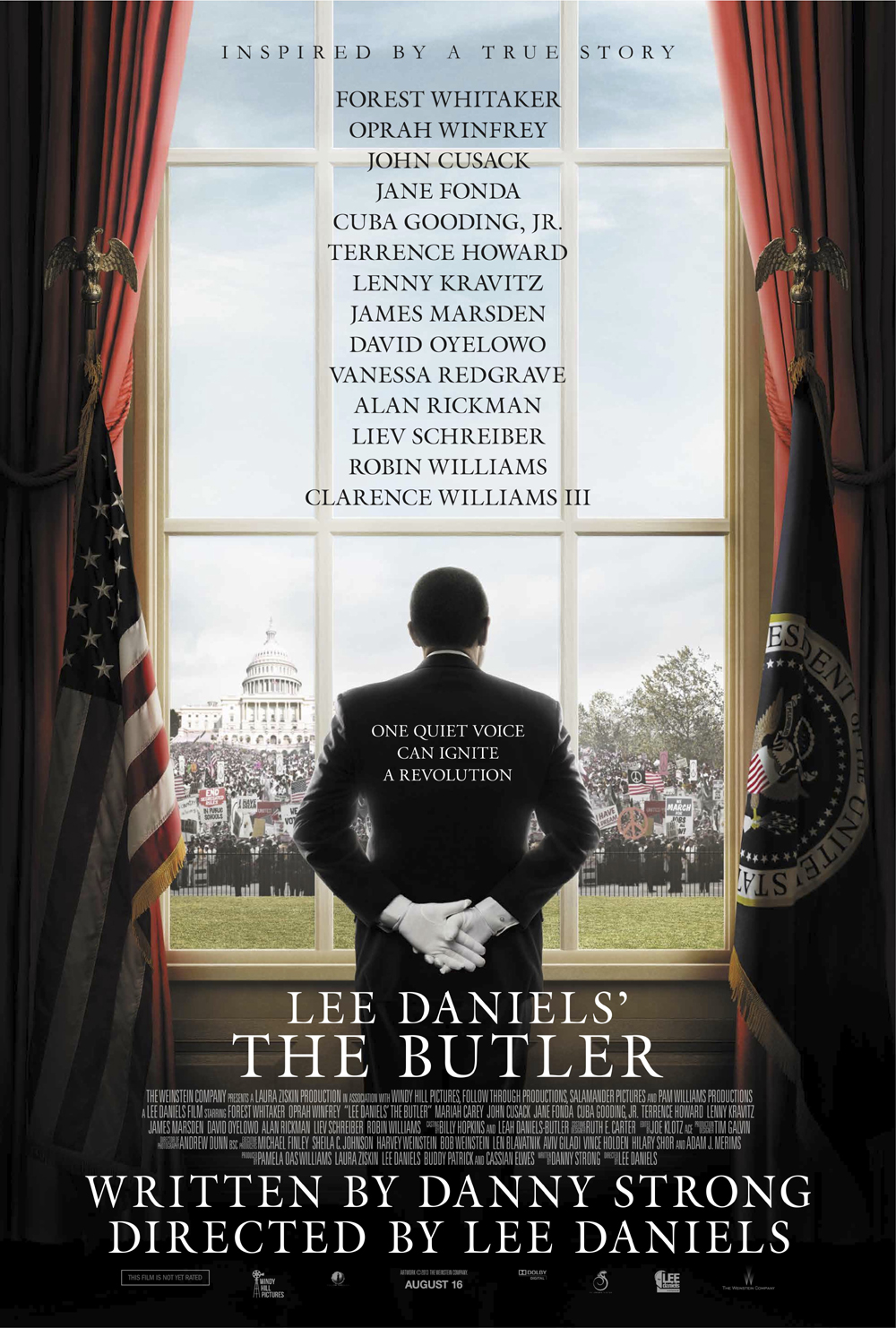 Before I begin my review, I feel the need to come to the defense of Oscar-nominated director Lee Daniels (Precious). Despite what Internet message boards and detractors may have you believe, it was never the man’s intention to insert his name into the title of his latest film, Lee Daniels’ The Butler. Warner Brothers claimed copyright ownership over the title of The Butler. The MPAA mediates title discrepancies in cases where one movie could clearly be confused for another. However, Warner Brothers’ claims a 1915 silent short film in their vault by the same name. Is anyone in the year 2013 really going to pay a ticket for the Butler and reasonably expect a silent short that’s almost 100 years old? Rather than pay a financial settlement, The Weinstein Company decided to alter the original title, adding the director’s name. This isn’t The Butler. Now it’s Lee Daniels’ The Butler. So before I get into the thick of my review, I’d like to absolve Daniels of Tyler Perry-levels of hubris. You’ll excuse me for just referring to it as The Butler throughout the duration of this review, not to be confused with a 1915 short film.
From Harry Truman to Ronald Reagan, one man served them all and his name is Cecil Gaines (Forrest Whitaker). He was a White House butler for over 30 years, even attending a state dinner at the behest of Nancy Reagan. Cecil grew up on a Georgia cotton plantation and moved up the ranks in high-class service. His wife, Gloria (Oprah Winfrey), wishes her husband would worry more about his own home than the White House. Cecil’s two sons, Louis (David Oyelowo) and Charlie (Elijah Kelley), have very different views of their father. Louis feels like dear old dad is too close to the men of power, and Louis is going to do what he can on the frontlines of change.
 I’m sure everyone had good intentions with this movie, but I walked away with the overwhelming impression that The Butler was too heavy-handed, too corny, and too mishandled with its plot construction for it to be the effective drama all desired. I also know that my opinion is of a minority, but that has never bothered me as a critic. Let’s start with the biggest handicap the film has going, and that’s the fact that its central character, the titular butler, is too opaque for a biopic. Early on, Cecil rises through the ranks of black service workers because of his skill, and that skill is none other than “having a room feel empty with [him] inside it.” I’m not downplaying the man’s dedication, or the culture he grew up in that preferred their black workers to be silent, but here is a movie where the man’s claim to fame is that he served eight presidents but he was in the background for all that history. I wasn’t expecting Cecil to lean over and go, “Mr. President, that Voting Rights Act might be a good idea, and I’ll help ya with it.” He is just sort of there. I was expecting him to have some larger significance, especially in his own life, but here’s the kicker: by the end of the movie, you’re left with the impression that all of his years of service were for naught. Cecil comes to the realization that his son, who he has sparred with for decades, was right and he was wrong. Is this the intended point? My colleague Ben Bailey will argue this is Daniels’ subversive intent, to undermine the tenets of typical biopics, to fashion an anti-biopic. I am not as convinced.
The problem is that Cecil is a passive character, which makes him the least interesting character in his own story. He served eight presidents, yes, but what else can you say about him as presented? What greater insights into life, himself, or politics does he have during those years with seven different presidential administrations? I cannot tell. I was thoroughly astounded that Cecil, as a character, was boring. I suspect this is why screenwriter Danny Strong (Recount, Game Change) chose to split Cecil’s story with his son, Louis. Here is a character on the front lines of the Civil Rights movement, getting chased by mobs, beaten, sprayed with firehouses. Here is an active character that wants to make a difference. He also happens to be mostly fictional.
While the film opens with the phrase “inspired by a true story” you should be wary. Upon further inspection, very little is as it happened. I think all true stories, when adapted to the confines of a two-hour film narrative, are going to have to be modified, and pure fidelity to the truth should not get in the way of telling a good story, within reason. I don’t have an issue with Louis being fictional, but it points to the larger problem with the biopic of such an opaque man. The real-life Cecil, Eugene Allen, had one son who went to Vietnam and married a former Black Panther. Strong splits the difference, supplying two sons with different paths. Because of his invention, this means Louis has the benefit of being present at a plethora of famous Civil Rights events, like the Woolworth counter sit-in, the Freedom Rider bus burning, and the assassination of both Malcolm X and Martin Luther King Jr. Seriously, he’s in the same motel room with MLK in Memphis. With the exception of the Woolworth sit-in, the Civil Rights events feel like minor pit stops, barely spending any time to develop. It ends up feeling like a facile Forrest Gump-like trip through the greatest hits of the Civil Rights movement.
This narrative expediency also translates to the supporting characters in The Butler. Beyond Cecil, Louis, and Gloria, there aren’t any characters that last more than one or two scenes. Cecil’s White House co-workers, played by Cuba Gooding Jr. (Red Tails) and Lenny Kravitz (The Hunger Games), provide amiable comic relief but little else to the narrative. Terrence Howard (Dead Man Down) has an affair with Gloria and then is never seen again. That affair, by the way, is also never referenced again nor does it have any further ramifications with the relationship between Cecil and Gloria. So then what was the point? There is a litany of famous faces playing real people, but they’re all in and out before you know it. The actors portraying the presidents are more an entertaining diversion than anything of real substance. Alan Rickman (Harry Potter) as Reagan gets the closest in the physical resemblance game, though I strongly doubt Reagan, as presented in the film, sat down and openly admitted he was wrong to his African-American service workers. John Cusack (The Raven) as Nixon is a hoot. The movie speeds right through the Ford and Carter administrations, so I’ll play my own game of casting (Ford: Dan Akroyd; Carter: Billy Bob Thornton). The presidents, like the clear majority of supporting players, don’t stick around long enough to leave an impression. It’s as if our prior knowledge of these famous faces is meant to serve as characterization. Beyond the immediate Gaines family, you don’t feel like you’re getting to know anyone.
 Then you bring in Daniels as director and the man has not shown much of a penchant for, let’s call, subtlety. This is, after all, the same man who directed Nicole Kidman in the ways of urinating upon Zac Efron. A coherent tone has often been elusive in Daniels’ films, which veer into wild, loud, sometimes clashing melodrama. The most clashing thing in The Butler are the matching 1970s and 80s fashion that will burn your eyes. He tones down his wilder sensibilities but The Butler is an especially earnest movie; but overly earnest without earned drama usually begets a corny movie, and that’s what much of The Butler unfortunately feels like. The significance of the Civil Rights movement and the bravery of the ordinary men and women, and children, fighting for equality cannot be overstated. These were serious heroes combating serious hate. I expect a serious movie, yes, but one that isn’t so transparent about its Staid Seriousness. The Butler is very respectful to history (fictional additions aside) but too often relies on the historical context to do the heavy lifting. It also hurts when the film is so predictable. At one point, I thought to myself, “I bet Cecil’s other son gets shipped to Vietnam and probably dies.” Mere seconds after this thought, young Charlie Gaines says he’s going to Vietnam. I’ll leave it to you to discover his eventual fate.
Daniels’ true power as a director is his skill with actors. The man nurtured Mo’Nique into an Academy Award-winning actress. From top to bottom, no actor in this film delivers a bad performance, which is a real accomplishment considering its stable of speaking roles. Whitaker (Repo Men) is the anchor of the movie and he puts his all into a character that gives him little to work with. He brings a quiet strength and dignity to Cecil, able to draw you in even as he’s presented so passively and ultimately perhaps in the wrong. Winfrey hasn’t been acting onscreen since 1998’s Beloved. Gloria is an underwritten part but she does the most with it and I’d like to see more of Oprah the actress more often. Another highlight is Oyelowo (Jack Reacher) as the defiant son fighting for what he believes is right. I want to also single out former America’s Next Top Model contestant Yaya Alafia as Louis’ girlfriend and eventual Black Power participant, Carol. She’s got real potential as an actress and if she gets the right role she could breakout and surprise people.
Lee Daniels’ The Butler (just one last time for feeling) is an earnest, emotional, but ultimately unsatisfying picture and it’s mostly because of its title figure. The figure of Cecil Gaines is not the kind of man that the entire perspective of the Civil Rights movement can be hung onto as an allegory. He’s treated as background of his own story. If the filmmakers wanted to highlight the life of a man who grew up on a cotton plantation, worked in the White House, and who lived long enough to see an African-American be president, well then tell me that story. But they don’t. I think Daniels and Strong knew the limitations of their central figure, which is why the son’s role was invented to provide a more active perspective outside the hallowed walls of 1600 Pennsylvania Avenue. In the end, I really don’t know what the message is, because the one I’m left with is that Cecil Gaines realizes late in life how wrong he was, not just with his son, but his faith in the office of the presidency. I doubt the majority of filmgoers are going to walk away with this message. While well acted and with a sharp eye for period details, The Butler is earnest without having earned your emotions.
Nate’s Grade: C
Share this:

Precious (2009)
 I can’t tell whether or not I liked this movie or if it simply beat me into submission. The heavy-handed tale of extreme suffering comes across like watching somebody get beaten for two hours. WAM! Your father rapes you. WAM! Your mother doesn’t intervene, in fact, she molests you too. WAM! You’re pregnant with your second kid from dear old dad. WAM! You have AIDS. The material is so unrelentingly dark that the constrained happy ending leaves you with feeling wholly naïve. Precious (Oscar-nominee Gabourey Sidibe) goes from having a hellish existence to having a 10% less hellish existence. It’s hard to find any light of hope within. Thank God that the movie is so well-acted all around, from Mo’Nique’s ferocious Oscar-winning turn as Precious’ monstrous mother, to Sidibe’s heart-wrenching portrayal of an abused and ignored soul, to even a makeup-free Mariah Carrey as a no-nonsense social worker (lack of makeup being the universal sign an actress wants to be taken seriously). Director Lee Daniels lays out the melodrama with the subtlety of a sledgehammer. You feel beaten down by the conclusion. I can’t decide if the fantasy sequences Precious flashes to as a coping mechanism are insightful or just embarrassing. I found Precious’ stoicism worth rooting for, but the movie seems to stop short of finding a way to make me care about her as a character rather than a victim. Her role is mostly impassive but she manages to find her character’s dignity, which is what the film asks us to ultimately fight for. By the end, I felt like I was watching an urban equivalent of A Serious Man, only it wasn’t intended for me to laugh at the misery.
Nate’s Grade: B-


 nathanzoebl
You must be logged in to post a comment.