Blog Archives
Y2K (2024)
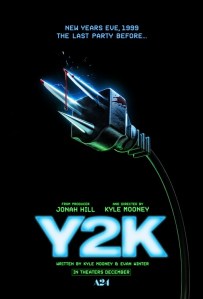
The premise for Y2K is ripe for fun. It’s a nostalgic retelling of that turn-of-the-millenium anxiety over computers getting confused, and the movie says what if technology had turned on humans at the stroke of midnight that fateful New Year? Add the lo-fi chintzy, quirky style of co-writer/director Kyle Mooney (Brigsby Bear) and it’s a setup for some strange and amusing techno-horror. It’s structured like a teen party movie with our group of high schoolers (Jaeden Martell, Julien Dennison, Rachel Zegler) trying to step out of their comfort zones and live their best lives… around machines trying to eviscerate them. The tonally messy movie lacks the heart and specific world-building weirdness of Brigsby Bear, instead relying upon the genre cliches of the high school movie, including the unrequited nerd crush and the pretty popular girl who’s more than what she seems. While watching Y2K, I kept getting the nagging feeling that this movie should be more: more funny, more imaginative, more weird. It’s quite uneven and veers wildly from set piece to set piece for fleeting entertainment. I chuckled occasionally but that was it. I enjoyed the villainous robot assembling itself with assorted junk available, and it’s hard not to see this as a general statement about the movie as a whole. It’s a bit lumbering, a bit underdeveloped, a bit formless, blindly swiping nostalgia and junk to build some form of an identity that never materializes beyond its parts. Y2K won’t make me bail on Mooney as a filmmaker but it’s a party worth missing.
Nate’s Grade: C
Share this:

Unfrosted (2024)
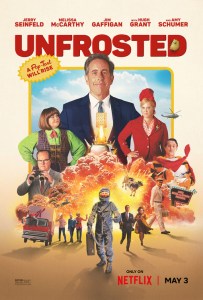 What to make of a movie like Netflix’s Unfrosted. It’s Jerry Seinfeld’s directorial debut, working off a screenplay he co-wrote, his first foray into film writing and acting since 2007’s Bee Movie. His eponymous sitcom “about nothing” was a 1990s mainstay and popularized an ironic meta form of comedy that still continues to dominate comedic tastes. Making a movie about the pseudo history of the invention of Pop Tarts, and the corporate rivalry between the major cereal brands, seems like a further exercise in that realm of humor, potentially satirizing a burgeoning sub-genre of late, the Biopic of Products (Air, Tetris, Flamin’ Hot, Blackberry). Except this supposed “biopic about nothing” is really a head-scratcher. Its humor feels pained and stale, the satire feels missing or glancing at best, and it seems like an expensive lark, wasting the nigh-infinite money of Netflix to purposely make a stupid comedy with all his friends.
Set in the mid 1960s, we follow two households, both alike in dignity, in fair Battle Creek, Michigan where we lay our scene. Kellogg’s has been the dominant cereal-brand for years but its chief rival, Post, is set to launch a new product that will revolutionize breakfast mornings. Bob (Seinfeld) is the head of development for Kellogg’s and reaches out to his old colleague, Donna (Melissa McCarthy), when it becomes evident that Post stole their unused research to develop a pastry treat designed to be cooked in one’s toaster. The warring CEOs, with Jim Gaffigan as Edsel Kellogg III and Amy Schumer as Marjorie Post, are desperate to one-up one another and be seen as more than an inheritor of their family’s wealth. It’s a race to see which company can get their treat to market first and capture the hearts, minds, and sweet teeth of America’s youth.
 I’d be lying if I said I didn’t laugh at points through Unfrosted, which operates like a spoof movie on a slower jokes-per-second pacing guide. There are zany sight gags amidst broadly drawn characters treating the silly straight, though occasionally you’ll have wisecrackers commenting on the inherent absurdity of moments, mostly confined to the stars making asides to the audience. Sometimes it’s lazy jokes that rely upon our foreknowledge, like when Bob coins a NASA beverage by saying it has a “real tang” (get it?). The movie frequently intensifies into goofy escalation when Kellogg’s impanels a team of mascots and inventors as a breakfast brain trust. Every one of these wacky characters is here to provide the exact same joke they will provide throughout the movie, and their inclusion is already suspect. Having the Schwinn bicycle guy (Jack McBrayer) comment on why he should be there is not enough. The hit-to-miss ratio will vary per everyone’s personal sense of humor, but overall I just felt mystified why this project would tempt Seinfeld from his comedy repose. What about this idea excited him? Was it just his lifelong love of cereal and Pop Tarts, a topic from his standup act decades ago? I ate a lot of cereal as a teenager too but I don’t want to make a movie about the Lucky Charms advertising campaign teaching children to beat and pillage the Irish (maybe Ken Loach could direct – to the three people on the Internet who appreciate this joke, I want you to know I appreciate you also).
It can be fun to simply watch dozens of famous people take their turns being silly in what is unquestionably a “dumb comedy.” When you have comedians of this quality in your movie, they’ll find ways to make even so-so jokes hit a little better, and that’s the case here. There’s an entertainment value in just wondering who will show up next, as many characters are only onscreen for a single scene or an abbreviated moment. Unfrosted becomes an example of Seinfeld’s industry power as he empties his Rolodex to fill even the tiniest of roles. Look, it’s James Marsden as Jack LaLanne. Look, it’s Bill Burr as JFK and Dean Norris as Kruschev (double Breaking Bad). Peter Dinklage as the head of the nefarious milkmen cartel? Why not? If you set your expectations low, maybe lower than what you were accounting for, there can be a mild amusement scene-to-scene just seeing who might show up next, almost like a modern-day version of those anarchic big ensemble comedies like It’s a Mad, Mad, Mad, Mad World.
 There is one segment that fell so flat for me that I was in utter amazement, and that was the unexpected January 6th insurrection parody. In a movie that has sustained a surreal and offbeat version of our universe, it evokes one of the most startling days of recent history. I think the humor is meant to derive from simply seeing a bunch of mascots in big colorful costumes as a mob running havoc, but there’s no jokes about like the challenges of a mascot costume in a fight, or say someone tipping over and being unable to get back up like a helpless turtle. There are jokes that can be had with this scenario, but instead Seinfeld is relying on the ironic juxtaposition of the ridiculous with the serious, and I don’t think it ever works as a joke. My sinking feeling began when Hugh Grant’s embittered mascot character wore a headdress resembling the QAnon shaman. It feels tacky and strange and the longer it persists the more I kept wondering what Seinfeld was doing with this. Why include this especially as the only form of relatively topical political humor, beyond, I guess, the depiction of business elites being complete morons? Why this? Again, it would be different if it was funny in execution, like the Saving Private Ryan D-Day parody from Sausage Party. This just isn’t funny, and its inclusion feels so odd compared to the stale nature of its other comedy.
As an admittedly silly enterprise, one that doesn’t even pretend to be accurate even as it flirts with the truth, Unfrosted is a successfully stupid comedy that feels a little too aimless, a little too edge-less and safe, and a little too dated and stale in its approach to comedy (lots of 1960s Boomer nostalgia ahoy). It’s hard to work up that much risible anger over a 90-minute movie that features a living ravioli creature. Clearly this movie wasn’t trying to be anything other than a gleefully stupid comedy, but I wanted more pep from its jokes and whimsy and general idiocy. I think the way to go may have been all the way in the other direction, treating the formation of a toaster pastry like international nuclear secrets and playing the corporate espionage completely straight while also making it patently ridiculous. Unfrosted did, however, make me want a Pop Tart that I ate afterwards, although it was my local grocery store’s generic brand, so I guess that doesn’t directly benefit Kellogg’s. This movie exists as a Seinfeld curiosity that ultimately left me hungry for more.
Nate’s Grade: C
Share this:

Brigsby Bear (2017)/ Dave Made a Maze (2017)
 One way to stand out in a crowded marketplace is to differentiate your movie by making it weird and whimsical. Just being different can grab your attention, and Brigsby Bear and Dave Made a Maze are definitely different. Both of these indie films attracted attention for their unusual concepts and lo-fi designs, banking on a sense of nostalgia for a homemade style of art that’s a little rough around the edges. These might be two of the strangest films that will be released in 2017.
James (Saturday Night Live’s Kyle Mooney) is living underground with his parents, April (Jane Adams) and Ted (Mark Hamil). He does his homework, listens to his parents about never going outside, and anxiously waits every new episode of Brigsby Bear, a children’s fantasy TV show starring a Teddy Ruxbin-looking bear that teaches life lessons. Eventually we discover that April and Ted are not, in fact, James’ parents. They abducted him when he was a baby. The FBI raids their compound and returns James to his biological family, the Popes (Matt Walsh and Michaela Watkins as mom and dad, Ryan Simpkins as younger sis). James just wants to know when the next episode of Brigsby will come out. Unfortunately for James, Brigsby isn’t real. Ted produced the show on a nearby sound stage. He’d even occasionally hire other actors. James is the world’s most knowledgeable fan of a TV show no other person knows one iota about. He’s determined to give it a proper ending and recruits family, friends, and neighbors to make the ultimate Brigsby movie.
 I was pleasantly surprised at how effectively Brigsby Bear was at being cheery and sincere. I was expecting, given the premise, an ironic riff on nerd culture or obsessive fandom, and Mooney and company instead decided to play things very seriously. They take a fantastic premise that seems begging for derisive commentary and choose to find a human story within the absurd. That’s much more commendable and harder to achieve. As I’m aging, I’m becoming more and more appreciative of sincerity over irony (part of this is also that our modern age is inundated with irony). I was reminded of last year’s Swiss Army Man, an alarmingly strange movie with Harry Potter’s farting corpse and went for sincerity without any whiff of detached irony. Brigsby Bear isn’t at the same level of artistic accomplishment and lasting power as Swiss Army Man, but it’s an unconventional and touching movie that earns its quirky-yet-feel-good emotions.
It’s easy to see where this story could have exclusively dwelt in psychological darkness. James was abducted as a child and raised in a strange environment that makes him emotionally stunted and grossly ill prepared for the real world outside his reclusive safe space. The movie could have understandably dealt with James’ crippling sense of loneliness, betrayal, and inability to assimilate since his sense of self were cultivated by a fake children’s TV show. He could have easily been the creepy oddball who makes people uncomfortable. Instead, they made him the goofy oddball who makes people smile. His childlike sense of wonder is in tact and frees him from self-doubt. James is remarkably cheery for having his world turned upside down, and the movie follows his lead. This movie could have been another perplexing Dogtooth and instead it’s more accurately reminiscent of those old Mickey Rooney “we’re putting on a show” pictures. I was waiting for a moment of artificial conflict, a darker plot turn late into the film where perhaps it’s revealed that Ted was a molester. There’s 700 episodes of Brigsby Bear so I figured a few of them would reveal disturbing clues about something even worse. The film never does take that darker turn and instead stays upbeat to the very end.
 As he adjusts to his new home, the movie serves as both a delayed coming-of-age movie and a love letter to the power of creativity and how it can build community. With James transported into the outside world, much is made over his awkwardness with human interactions and his complete lack of guile. He gets his first kiss with a girl, and shortly after his first handjob, and wonders if that means they have to get married. It’s a sweetly naïve reflection. We watch the growing pains of James as he starts to make friends and become more confident in himself, which is a surefire way to win over an audience. James isn’t held up for ridicule. People want to be part of his project. He’s overcoming adversity and triumphing through the transformative power of art. There’s a joy in watching characters find themselves anew, and James serves as the catalyst. This person knows how to do special effects. This person used to act when they were in college. In his heartfelt attempt to provide closure to the Brigsby series, and possibly a chapter in his life, James’ project takes on a life of its own that brings people together. It shows how the community of art can be an empowering venture that can freely inspire the best in others.
The movie doesn’t become overly reliant upon nostalgia either. I figured it would be an ode to 80s television and culture but it really just uses that as backdrop. The world building of the show of Brigsby is bizarre and entertaining every time it’s included, especially when you comprehend the propaganda messages that Ted is sneaking in like, “Curiosity is an unnatural emotion.” The sense of wonder and whimsy doesn’t overwhelm the movie and its poignancy. Director Dave McCary (Saturday Night Live) makes the most of the retro pastiches while still serving the story. James could just have easily been obsessed with any show or ongoing work of art. The content of the show is unimportant. It’s about facilitating his growth into a person comfortable and confident with whom they are. By the end of the film, I was fighting back tears as the full assembly of characters watches the finished product of their labor. You watch them smile, laugh, take a sense of pride in their communal efforts, and they can see the world as James does. It’s a whole-heartedly pleasurable movie with surprising currents of emotional uplift.
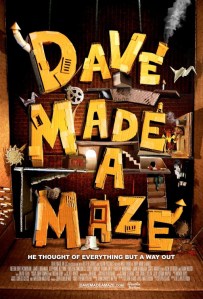 With Dave Made a Maze, the titular Dave (a beardless Nick Thune) is lost in a maze that he built in the apartment he shares with his beleaguered girlfriend, Annie (Meera Rohit Kumbhani). This maze consists of a cluster of cardboard boxes taped together. In time, a group of their friends and even strangers have assembled to admire the maze. Dave warns them not to enter but they do so anyway, and once inside they realize that the maze is considerably bigger and byzantine, and everyone expectedly gets lost. Annie and a documentary crew travel (lead by James Urbaniak) deep into the maze to rescue Dave. They all must confront booby traps, a Minotaur, thirty-something existential ennui, and the unsettling realization that the maze is expanding all on its own.
The real star of Dave Made a Maze is the fantastical environment inside the maze. The resourcefulness, imagination, and implementation of such a bizarre vision on such a limited budget is incredible. Each new room offers a new opportunity for the surreal. The characters stumble from room to room in mixtures of awe and bemusement, and the audience will feel the exact same way. Production designers Trisha Gum and John Sunner, and Art Director Jeff White, come from a world of animation, and they’re meticulous attention to detail pays off to an astonishing degree. In a just world, they would be nominated for an Oscar. There’s a DIY inventiveness that carries an irresistible charm with it, re-purposing everyday items to create a unique and whimsical world. Even when people are being gored to death and dismembered it adheres to the whimsical tone. The blood is replaced by red yarn, confetti, and silly string. The movie smartly underplays the lack of consistent logic within the world of the maze, and so weird things can just happen at a moment’s notice, like the main characters turning into puppet versions of themselves made out of paper lunch bags. There’s even a half-finished maze within the maze, which draws derision from the tired and frustrated people just seeking a way out. Some of the weirdness feels too half-formed and self-conscious, but the movie has an Eternal Sunshine quality where each new location provides another enjoyable opportunity for potential discovery.
 Where Dave Made a Maze runs into problems is when you realize there isn’t anything beyond that sense of invention. There isn’t a larger thematic core to this movie and the characters remain, at best, background players elevated to starting status. Most of these characters are jokes but they don’t even supply much in the way of jokes. The closet to a substantive theme is simply an arrested development fable where the man-child is struggling to finish a laboring artistic accomplishment, he feels humbled and humiliated, and his strained relationship with his accommodating girlfriend will always come together in the clincher. Dave lashes out that he didn’t feel like an adult at 30, so maybe he retreated to the halcyon days of childhood, or maybe it was a nostalgic retreat. Whatever the case may be, the movie suffers from an inevitable lull once the giddy novelty of its DIY fantasy starts to wear off. There’s one sequence where Dave and Annie have a circular conversation that just keeps going, and I’m sure if the filmmakers weren’t so desperate for material that it would have been trimmed down significantly.
Even at 76 minutes before credits, this is a movie that feels stretched beyond the limit because it’s lacking greater consideration to story. There are jokes that feel like they should be funnier too, like a latecomer to the maze who sets off the traps that Dave warns about earlier. This should be a fun structural payoff, allowing us to see both sides of the rooms. It doesn’t really work out that way, and the bumbling latecomer becomes another relatively unmemorable and undeveloped body on screen taking up space. The documentary crew conveys some mild satire as the crew leader keeps prodding others into saying what he needs for his movie, but even this inclusion feels more like a transparent device to get the characters to talk through plot points. Another misfire is the curious lack of stakes. The movie has a light-hearted charm but then doesn’t ever quite make up its mind on the danger being confronted. Real friends die for real. By the end of the movie, they do not come back even after the maze is kaput. They are really dead. Yet the film plays the stakes at a low simmer and the survivors just sort of shrug and move on. The film gives me little reason to be attached to any of these people, alive or dead.
 Whimsy is a fleeting feeling that’s hard to conceive and harder to hold onto. Both movies take whimsical premises that cater to the peculiar but only one delivers something of lasting substance. Brigsby Bear is a charming, heartfelt, and exceedingly sincere movie about an oddball finding his place in the world through the power of the creative process. He is transformed through his love of art and how that serves as the foundation for community. Whereas Dave Made a Maze is a lo-fi curio that I can admire more than enjoy. It’s missing crucial elements that make its journey worth the effort, beside its imaginative and scrappy production design. Both movies are charged by the power of the imagination to transport the ordinary into the extraordinary. Brigsby remembers to use its flights of imagination and whimsy to tell an engaging and ultimately touching story. Dave Made a Maze has cool sets and some infectious silliness. If you see one story of a man-child escaping into a world of nostalgic imagination and inviting friends to tag along, make it Brigsby, a film that uses whimsy to still tell compelling human stories.
Nate’s Grades:
Brigsby Bear: A-
Dave Made a Maze: C+


 nathanzoebl
You must be logged in to post a comment.