Blog Archives
One for the Money (2012)
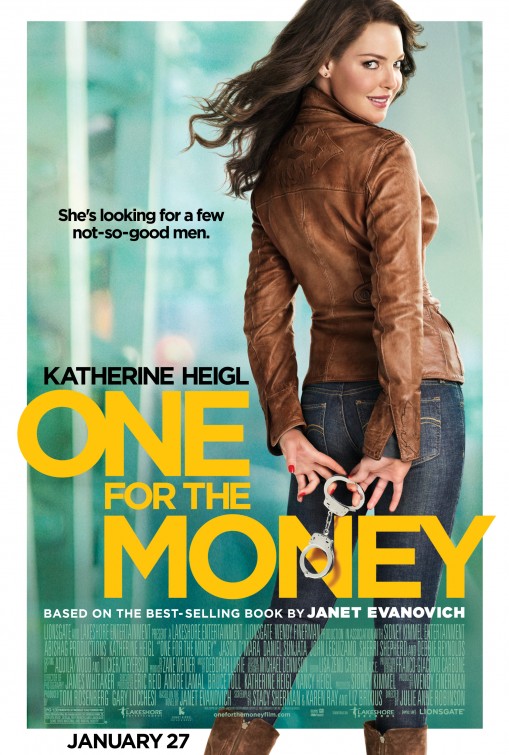 I think it’s about time we all conduct an intervention for actress Katherine Heigl, whatever it takes to stop her from starring, and producing, such middling junk like One for the Money. Heigl plays a novice bounty hunter, a Jersey girl on hard times who is tracking down her ex-boyfriend for a big payday. Yes, it’s essentially a gender reversal of the loathsome Jennifer Anniston movie, The Bounty Hunter, but at least this movie doesn’t foster a forced romance. I give the movie some credit for presenting two potential love interests for Heigl and by film’s end she’s still on her own. Bravo. The rest of the movie, however, is all strictly by the book, including the colorful characters that Heigl seems to collect. One for the Money isn’t particularly funny or particularly good. It also isn’t particularly offensive; it’s just the standard pap you expect from Heigl at this point. Here’s a confession: I really, truly enjoy Heigl as an actress. She’s terrific at comedy and has star-power charisma, and even in junk she’s still effortlessly enjoyable to watch. This woman has talent, she just doesn’t have taste when it comes to picking movie roles. Or maybe she’s content with churning out a mediocre rom-com every year or so for her fans. I just wish Heigl would gain some confidence and bounce from the ghetto of rom-coms, or at least poorly written, blandly formulaic ones. She’s taken the rom-com crown that once belonged to Julia Roberts, Meg Ryan, and Sandra Bullock, but look to them as example. You will have to adapt or die, because eventually Hollywood will find the next Katherine Heigl and supplant the old one.
Nate’s Grade: C
Share this:

Killers (2010)
 Where to begin with this? It’s an action romantic comedy that can?t commit to either genre. First off, this witless rip-off of Mr. and Mrs. Smith (or Knight & Day) can?t even get on track thanks to zero chemistry between Katherine Heigl and a routinely shirt-free Ashton Kutcher. They don’t gel at all. Just because two actors can make goofy faces doesn’t mean they’ll light up the screen as a couple. Their energies do not click. Heigl emits some magic combination of elements that makes her an unusually likeable and compelling actress on screen; note, I never said good, but she’s an ace with the rom-com material. When will she start choosing better material, and movies where she gets to assert herself instead of being a ditz and the butt of jokes? The plot is absurd and the film’s tone doesn’t know how to settle down. One second it’s a jaunty, irreverent action jag, and then the next it’s trying to be some winsome romance about two people who may have rushed into marriage. Oh, and they happen to be living in a neighborhood crammed with sleeper agents all trying to kill Ashton. When you hear the reveal for why this is happening, it will seriously make you rethink the notion of “tough love.” It makes little sense in any realm of thought. The action lacks flair and sizzle, let alone minute tension, and the comedy is just as joyless. Heigl slides right into screwball mode and the film confuses an ongoing argument as characterization. The duo act so cavalier conveniently forgetting that people from all walks of life are trying to kill them at every turn, for the lamest of reasons. Why hire sleeper agents to lie and wait if you want to kill a guy? Is that really the most cost efficient policy? They don’t even get a single decent joke out of this premise. The only thing this movie kills effectively is time.
Nate’s Grade: C-
Share this:

The Ugly Truth (2009)
 Can’t a woman ever catch a break in romantic comedies? The genre occasionally just comes across as contemptible against women. On screen, female figures will fight against misogyny, but then how often do they usually just give in? How often do the female characters change to suit the male characters? Usually, the male romantic lead has some kind of boneheaded secret, but it’s really the women that do all the changing and the man is left off the hook. It’s somewhat appalling and amazing that the unappealing romantic comedy The Ugly Truth was written by three women and produced by Katherine Heigl. I guess they wanted to prove that women could be just as capable of self-sabotage.
Abby (Heigl) is a career-driven TV news producer who’s a bit unlucky when it comes to love. She has a steep checklist of qualifications for a prospective mate. She is aghast when her boss hires Mike (Gerard Butler), a rude public access host of the dating advice show “The Ugly Truth,” to shore up ratings. Mike is an uncivilized shock-jock who dispels pearls of wisdom like, “No man wants to date a fattie.” Abby and Mike bicker from an ideological divide. But when an attractive doctor (Eric Winter) movies in next door to Abby, she agrees to follow Mike’s dating advice. He coaches her on how to win over the doctor, and it generally seems to be working. Of course now Mike thinks he may have fallen in love with Abby as well. Oh what complications await.
 The humor of The Ugly Truth doesn’t even aspire to be sophomoric; it’s questionable whether the comedy even reaches juvenile levels. It’s tasteless and piggish, but the weird part is that it comes across as knowledgeable on the subject of sex as a ten-year-old kid who just discovered his dad’s secret stash of Playboys. It talks about the right stuff but does so in a clueless manner. It’s like an exaggerated randy cartoon that chiefly plays to a male fantasy. The movie feels that the height of comedy is when Abby wears a pair of vibrating panties to a business dinner, and oh no, some little kid is playing with the remote. So Abby is writhing and convulsing while trying to deliver a business speech. It’s the female orgasm turned into a cartoon. I won’t even get into the icky implications that Abby does not even get to control her orgasm, that she is held hostage by the whim of a child (a boy, no less). It just comes across as morally queasy if you think more about it, which may be why Heigl is practically rolling around on the table and chirping like a dolphin. Meg Ryan has nothing to worry about in the world of public displays of an O-face. At least in that movie, the joke was on the audience, and the man, and the woman was in a position of control. I even saw this routine already with a vibrating egg in the 2006 hard-core sex drama, Shortbus.
It doesn’t get much better. There’s a moment at the ballpark where Abby spills her drink onto her date’s lap, so she furiously tries to rub it out, which in crazy movie world means the man instantly attains pleasure. If that wasn’t enough, the movie then takes another step and displays this ordeal on the ballpark’s Jumbotron. And if even that isn’t enough, the movie takes yet another step to obscure what Abby is really doing, so all you see is her bobbing head by the crotch of her date. It’s not really funny because it’s so forceful to the point of being unpleasant. Abby is the butt of most jokes and after awhile it just seems cruel. The jokes recycle the same lousy observations about the differences between men and women. Men want sex. Women want relationships. Men are cretins. Women are crazy. Men like boobies. Blah, blah, blah. This time there’s just more bad language. There’s nothing truly adult here, either in wisdom or comedy. Just because you imply oral sex and throw out a few F-bombs doesn’t mean that your romantic comedy is any more sophisticated and relevant. The Ugly Truth just reeks of desperation.
 The central characters don’t even come across as believable for a romantic comedy. Abby is an intelligent professional woman who will stand up to rampant misogyny in the workplace. She resents Mike’s attitude that the only value women serve is to please men. So then it would only be natural that she follows Mike’s coaching to win the heart of the hunky doctor living next door. She clearly believes that she must become a sexed-up twit to win over a doctor. What? Excuse me, come again? The characters are at the mercy of whatever contrivances the plot requires. Predictably, this is yet another movie where two characters hate each other for two acts only to finally realize in the last act that, surprise, they’re really in love. Because we know the inevitable coupling, an audience likes to pick up on moments that might help explain how we got to our final romantic destination. Will the crude dude really have a mushy heart deep down? Will our icy businesswoman be able to let her hair down and enjoy the messiness of life? Have you ever seen a romantic comedy before and therefore know the answers to these questions? In The Ugly Truth, I could not explain why either of these people would fall in love with the other. I’m sure there are plenty of great backstories where people realized their true love in the basket of a hot air balloon. Seriously, the climax takes place in a hot air balloon and Abby asks, “Why do you love me?” to Mike. “Beats the shit out of me,” he replies. This is intended as a moment of romantic clarity. I view it as the screenwriters giving up, having failed to establish even a remotely credible relationship in a genre replete with easy choices.
I’m actually a fan of Heigl (27 Dresses) and think that she seems like a natural fit within the romantic comedy universe. She’s expressively comedic, has good timing, and she knows how to hit her jokes hard. She can wait until she’s older to do a family drama because right now there’s gold in them thar genre pictures (practice the finer points of singing into a hairbrush and dancing around a coffee table). But The Ugly Truth is a waste of her ability. Abby is a tightly wound control freak and Heigl plays her without an ounce of warmth. Butler (300) can still come across as likeable even if his character is cheerily boorish. He doesn’t hide his natural Scottish brogue too well, though. He’s got more comic firepower and he openly mocks himself, which makes him more appealing as a character. However, there isn’t much in the way of chemistry between Heigl and Butler, only combativeness. Their fighting is the only emotion that seems real.
 So what is the ugly truth of The Ugly Truth? I suppose if you’re a woman, you better not be successful, talented, smart, or slightly overweight. And your dating failures are completely your own fault. And you better be willing to put out or at least dress a little provocatively. And don’t expect your man to change any of his ways, simply lower your standards. That, ladies and gentlemen, is the concluding wisdom from our trio of female screenwriters. Heigl and Butler squander their talents in such a charmless battle of the sexes cartoon. There’s little in the way of wit or insight or even properly executed comedic payoffs. The Ugly Truth needs to be atoned for. It’s rarely funny and it’s insulting and unflattering to both sexes. It exists squarely in the world of exaggerated male fantasy, peculiar for a genre defined by female wish fulfillment. At my screening, there was a family who brought their adolescent kids with them. I could hear pre-teen giggling at the more slapstick-heavy jokes and heard lots of questions whenever something sexual was discussed. At one point, Heigl covers the eyes of a child and says, “This is not for kids,” and I guess that family finally got the message because they left shortly after. Except this movie isn’t intended for anybody. Everyone in the theater should have followed suit.
Nate’s Grade: D+
Share this:

27 Dresses (2008)
 Katherine Hiegl is a likeable enough actress. She got her big break in 1994’s My Father the Hero, which had the exceptionally gross premise of having an adolescent’s father posing as her European lover to score the guy she’s really got her eyes on. The most memorable moment of the movie was a 15-year-old Heigl strutting around in a thong bathing suit. Her resume got better with a steady stream of network TV shows like Roswell and Grey’s Anatomy, and then she broke into another level of stardom thanks to the runaway success of [I]Knocked Up[/I] where she carried Seth Rogen’s baby. Then she told Vanity Fair that she felt Knocked Up was “sexist” and that the women were portrayed as shrews and that the men were fun-loving dudes (I must have seen a somewhat different movie). She’s entitled to her opinion, but what seems very odd is that Heigl’s follow-up to her breakout role is 27 Dresses, a romantic comedy about a woman who is a perennial bridesmaid and yearns for her own perfect wedding when her life will be complete.
Jane (Heigl) busies her time helping others to have heir ideal weddings. She has contributed to so many wedding ceremonies that she has amassed a closet full of 27 bridesmaid dresses that serve as trophies. Jane is in love with weddings. She is also harboring a crush on her boss (Edward Burns, wooden as always) that seems to be going nowhere. Jane’s younger sister Tess (Malin Akerman) comes to visit and immediately hooks up with Jane’s boss/crush. Jane’s wisecracking best friend (Judy Greer) is quick with a quip and declares Tess to be some very negative terms. Poor plain Jane is also taken aback when she meets wedding columnist, Kevin (James Marsden), whose fawning words about weddings are like poetry for Jane. He turns out to be a cynical guy who feels weddings and marriages are “the last legal form of slavery.” When Tess gets engaged to the boss man, wedding responsibilities fall upon Jane and Kevin is right beside her, ready to trade barbs about romance and perhaps start one of his own.
 27 Dresses hews pretty close to the familiar romantic comedy formula trappings. Opposites attract, bickering will lead to romance, and then true love will overcome all misunderstandings, that’s a given. Another given is the fact that we will get a montage of Heigl trying on all 27 titular dresses. 27 Dresses also includes the wisecracking best friend who has no purpose of her own but to comment on the troubles of our heroine with stark bluntness. Once again, this is the type of film where one character has some earlier, negative opinion or statement that resurfaces late to bite them in the ass after they have learned how flawed and shallow that original opinion was (otherwise known as the 11th hour misunderstanding). One party has a personal epiphany and runs to catch the other party leaving by some means of transportation (I’ve seen boats, taxis, motorcycles, barges, but usually they run to catch a plane). And then there’s the sing-a-long; oh what romantic comedy would be worth its salt if it didn’t include a group sing-a-long to some older tune that just united everyone in spontaneous song? 27 Dresses uses Elton John’s “Benny and the Jets” to rock out a beer bar. Really, “Benny and the Jets”? Rocking out a bar? And it’s not even a gay bar? Hmm. 27 Dresses is rather predictable from the first frame onward, but familiarity isn’t necessarily a deal-breaker for a strictly genre movie.
I’ve seen plenty of romantic comedies and I like to judge them fairly, so I use my patented cute-to-cringe count whereby I take stock of the number of times I smile, laugh, or find a moment, line of dialogue, or even choice of song that leaves a favorable impression. I then compare this figure with the number of times I want to roll my eyes, check my watch (if I had one), vomit, or any piece of dialogue or moment that feels so saccharine, so unbelievable even in the rom-com universe that I want to laugh derisively. The final tally for 27 Dresses was somewhere in the middle but I’ll admit it skewed closer to the positive “cute” side of the spectrum.
The acting overall really helps to make the most of the formulaic material. Heigl seems destined to thrive in the rom-com genre; she has an every girl appeal and seems apt making funny faces of seething indignation (take note of the amount of times she uses food in her mouth for comic effect). She seems like the heir apparent to Sandra Bullock movies. Her chemistry with Marsden is ripe and they bring out good thing in one another with their playful give-and-take. Marsden has a terrific smile (seriously, the man might have the best choppers in the industry) and is suitably dreamy but he also has an enjoyably droll delivery. Akerman plays a spoiled brat well, though she isn’t given the opportunities to flash her rather skillful comic skills that she displayed in The Heartbreak Kid remake. Greer is a top-notch scene-stealer and deserves her character deserves her own movie. She has the most fun role to play but Greer sinks her teeth into the character and delivers a juicy performance that feels slightly naughty, uncensored, and carefree.
The movie falters when it trips up in maintaining believability. There’s an extensive scene in a Goth bar/club where the costumed extras are acting like… costumed extras. It’s the least believable Goth club I have ever seen in a movie, not that I was expecting Hollywood fluff to pain an accurate picture. It’s just wall-to-wall stereotypes, but not only that, they’re distracting and lame and dated stereotypes. Then Jane marches outside to scream to the heavens an expletive-filled rant about her bad luck when, ut oh, right next door to the Goth club is an old couple celebrating their 50th wedding anniversary. What? Grandma and grandpa Old People celebrating their marriage vows next door to a Goth club? This incongruous setting takes a long, long while to set up one very blah joke that could have functioned anywhere. Realistically, the joke is that Jane is swearing unbeknownst to others, so why even have it next to the world’s crummiest Goth club? If you’re going that route, why not have grandma and grandpa Old People dressed in tacky Goth apparel as well? This may become my most nit-picky criticism of all of 2008 but it really stuck in my craw.
 A better example is how the film handles Jane’s bratty sister, Tess. For 90 minutes we bare witness to Tess being a thoughtless, self-absorbed, lying, horrible human specimen, and then the movie tries to change strides. In the very end, it wants us to open up and look at Tess’ life and realize that she doesn’t have it so awesome because she was fired and dumped. Oh my, that must be perfectly excusable then for her rampant inexcusable, me-first behavior. If 27 Dresses has an antagonist in its midst than Tess is that bridezilla. The movie plays her bitchiness for comedy but then wants an audience to forget every whine and betrayal because, woe is her life, Tess wants to be happy. Tess remains an unsympathetic twit from beginning to end, no matter how hard the movie and its soft piano score try to change your mind.
The fact that 27 Dresses thought it could throw in some contradictory evidence at the last minute to make an audience forgive Tess is very telling. It showcases that the film has a hard time grasping the realities of characterization; Kevin is cynical about weddings because he was stood up at his; Jane must focus on making others happy because she is afraid of focusing on her self; Ed Burns is a douche. That isn’t necessarily an indictment on the film per se, just my honest opinion. 27 Dresses spells everything out in bold statements that hit like anvils, like when Kevin’s news editor congratulates him on his front-age story ridiculing Jane: “Hey, you got what you wanted, right?” Gag. The movie is too lockstep with the genre’s clichés that it doesn’t push hard enough with its characters, so we get plenty of intermittently cute moments but cute moments that will be easily forgotten and stored away like one of Jane’s hideous bridesmaids gowns.
27 Dresses is more or less par for the course in a genre littered with sappy clichés and cookie-cutter characterizations, and yet the movie possesses enough charm to outdistance its lapses in believability. The acting ensemble help make the movie enjoyable in parts, especially the chemistry between Heigl and Marsden. 27 Dresses passes the time but you wish that Heigl, Marsden, and especially Greer would be teleported to a better movie. One free from bitchy younger sisters, bar sing-a-longs, giddy dress-up montages, and Ed Burns. Did I mention that his character is a douche?
Nate’s Grade: C+
Share this:

Knocked Up (2007)
 Judd Apatow scores again. The man has a long history of creating memorable and heartwarming character-based comedy, and Knocked Up is another winner. This man creates thoroughly human and engaging stories that focus on our own foibles and triumphs. Apatow wrote and directed yet another poignant, clever, and uproarious comedy that has so much more below the surface and becomes universally appealing.
Alison (Katherine Heigl) is out on the town celebrating her promotion at the E! Entertainment Channel. She’s going to go from behind the camera to in front of the camera. It’s at this Los Angeles club where she meets Ben Stone (Seth Rogen), a doughy Jewish slob of a man content to drift through life penniless and high. Their night of partying leads to a drunken one-night stand. Eight weeks later Alison is going through extreme nausea and can’t figure out what kind of flu bug she has, that is, until she remembers her one night out. She locates Ben and informs him that she is pregnant and, yes, he is the father. The two decide to try and make it work, forging a relationship as they plan on becoming parents. Alison’s sister Debbie (Leslie Mann) and her husband Pete (Paul Rudd) and their two kids are a potential glimpse into the future. Pete and Ben hit it off real well, to the point that Alison feels like her mate might not be the one for her even if his DNA is growing inside.
 Naturally, this is a comedy where sex is at its very inception. The humor is ribald and playfully profane. I believe one of the greatest compliments you can give a comedy is when you cannot single out a single set piece or moment as an instant standout. Knocked Up is packed with many wildly funny scenes but it also has killer one-liners from start to finish and sharp pop-culture references (Ben on an exercise bike: “Matthew Fox? From Lost? You know what’s interesting about that guy? Absolutely nothing.”). Ben credits the flick Munich for the ability to get Jews laid. Ben watches the 2003 version of Cheaper by the Dozen with horror, saying that 12 kids is no laughing matter. The roommates are plotting a flesh-friendly website that notes the time and location of celebrity nudity in films. This commercial venture plays right into the frat house lifestyle for this band of stoners that bet their friend not to shave his beard for a year for free rent.
Knocked Up is bawdy and hilarious, sure, but it’s also far more realistic and a lot more emotionally involving than any romantic comedy Hollywood has offered in years. Apatow seems to have mined his personal parental experiences for a lot of hard-earned truths. The film is most natural when it showcases the male perspective of prolonged adolescence and an unplanned pregnancy, but Knocked Up also has a mature and thoughtful view on marriage and feminism. We see the array of personal challenges a woman would go through but the movie still manage to slip in humor amidst the uncertainty. There’s a montage looking for the right gynecologist. The gauntlet of sexual positions is explored while pregnant, with Ben afraid that his child’s first impression will be daddy’s manhood constantly poking it. When Alison and Debbie go shopping for pregnancy tests we see them fill their cart with every kind of tests, and then test after test comes back positive. “Hey this one has a smiley face,” says Debbie, before realizing, “Oh, that’s not a good thing.” Debbie then tests the reliability of the tests herself and for a brief moment panics when she thinks she may be pregnant for a third time. She then calms down and says, sarcasm-free, “Whoa, that would have sucked.” The inclusion of Debbie and Pete offers a whole other relationship viewpoint, something that Alison and Ben can learn from. She’s paranoid and blunt, and he’s apathetic and passive-aggressive, and Alison is terrified that she and Ben are doomed to a similar fate. The insights into marriage and secrecy are realistic and give the film so much more meat to its bones. This isn’t just a movie about what to do with an unplanned pregnancy; it’s fully about male-female dynamics and what it takes to make a family work.
 In the end, you really care about these characters because Knocked Up is a raunch-fest that has a sweet gooey center of sentiment. Ben is pushed into adulthood by this unexpected development and, as they say, puts away childish things after a lot of trial and error. There’s an undercurrent of emotional vexation under most of the comedy, like when Pete confesses that he doesn’t know if he can accept love, and Ben cannot pity this because he sees his love being rejected. Alison doesn’t quite have as big of an arc, but she never gets callously cast to the side and forgotten. She too has a lot of growing up to do very quickly, and when both characters welcome their newborn into this world it’s rather moving and exciting to experience it alongside them. Ben’s confesses to his child that not putting a condom on was the best decision he ever made. In any other movie this ending conversation might seem trite or hokey, but Apatow has paid so close attention to his characters that the emotional payoff is earned and rewarding.
Another hallmark of an Apatow production is how perfect the cast seems with one another. There’s a real camaraderie with the actors and it produces natural onscreen chemistry and amusing improvisation. Rogen and Rudd, teaming again after 40-Year Old Virgin, can riff off one another for a whole movie and I would gladly pay to watch. I loved when the two boys go to Vegas, take mushrooms, see Cirque Solei, and then freak out in their hotel room (“There are five different kinds of chairs in this room”). I was laughing so hard I had tears in my eyes, and I’m sure the crux of this moment was born from the freestyle exchange between the actors. Ben’s roommates have a believable kinship to them as a collection of amicable oddballs and stoners. Mann and Heigl also seem believable as sisters, much more so than would Anne Hathaway, who was originally cast as Alison but left due to creative differences (I guess the difference was she didn’t wish to be apart of a good movie). The Knocked Up cast work together like a truly wonderful team that appreciates the material and each other.
Rogen is destined for stardom after this movie. He can make anything funny with exceptional comic timing and line delivery that never feels forced. Hearing his unique giggle at the end of jokes, you can sense that this sweet and amiable guy would crack himself up and for good reason. Rogen was great in 40-Year Old Virgin and is even better in a bigger dose. Heigl gets to play more familiar notes, from stressing that work will discover her little bun in the oven to the expected birthing scream session. She has a good rapport with Rogen and brings a lot of warmth to her role. Rudd is so effortlessly charming and easy going. Mann plays a perfect bitch, but she also has a nice scene where she explodes at the realization that her days of youth are finally behind her. Special mention must go out to Kristen Wiig. She steals every scene she’s in as an E! Channel employee that makes plenty off-the-cuff passive insults against Alison during two staffer meetings.
 I’ve read online that several leftist bloggers are angry and flabbergasted that Alison does not get an abortion. They argue Ben is a fat and unappealing slob, she’s an attractive career woman, and not having an abortion in this situation is, as one put it, “stupid.” Excuse me, but this may be the first mainstream comedy that actually discusses the prospects of an abortion (or as one character deems it, a “smashortion,” as not to offend the delicate sensibilities of his roommate). I also take umbrage to anyone saying 1) choosing not to have an abortion is a bad decision, and 2) that these critics would be so daft to miss the point that if Alison had an abortion there would be NO MOVIE.
Knocked Up is a very funny and very wonderful sex comedy for adults, but it also happens to be an endearing and heartfelt romance. The cast is excellent, the comedy rarely misses a beat, and Apatow is a instant classic hitmaker. Just like The 40-Year Old Virgin, Apatow has explored a deeply personal topic for all the comedy and pathos he could wring from the material. Knocked Up is nothing short of a knockout. I hope you’re happy with your decision Anne Hathaway. I know I am.
Nate’s Grade: A


 nathanzoebl
You must be logged in to post a comment.