Blog Archives
Hysteria (2012)
 The birth of the vibrator doesn’t seem like a tale that demands telling until you realize that the most prolific sex toy of all time started during one of the most sexually repressive cultures, Victorian England. In 1880, the plague of the era was a malady known as “hysteria.” Half the women in London seemed to suffer from this condition where, as the doctors of the times believed, a woman’s uterus had become unaligned and needed to be properly readjusted; the readjustment produced a “paroxysm” of relief. To treat hysteria, these trained professionals would oil their hands, insert them inside a woman’s vaginal canal, and apply alternating pressure. They were getting these women off. Hysteria presents a charming document about the invention of the vibrator, a miracle of modern science. However, I wish the movie had taken a more mature approach to the material.
The alignment process was an arduous one, and Dr. Robert Dalrymple (Jonathan Pryce) needs a new set of hands. Enter Mortimer Granville (Hugh Dancy), a crusading young doctor who butts heads with the medical establishment over things like washing hands and germs. Under Dr. Dalrymple’s tutelage, the practice is never busier, relieving upper class women of hysteria. It’s going so well that Dr. Dalrymple would like to eventually pass the practice on to his young protégé, as well as his proper young daughter, Emily (Felicity Jones). Then there’s the doctor’s other daughter, Charlotte (Maggie Gyllenhaal), who clashes with authority, is outspoken about women’s suffrage, is critical of the limited role women play in society, and devotes her time to a lower-class shelter to provide refuge and education to those in need. She represents a brand-new kind of woman in time, and Mortimer cannot get a handle on her. Mort is suffering some pretty serious hand cramps from his line of work when he gets a splendid idea from his childhood friend and amateur inventor, Edmund St. John-Smythe (Rupert Everett). It seems with a quick fix, the electric feather duster may have other more scandalous uses.
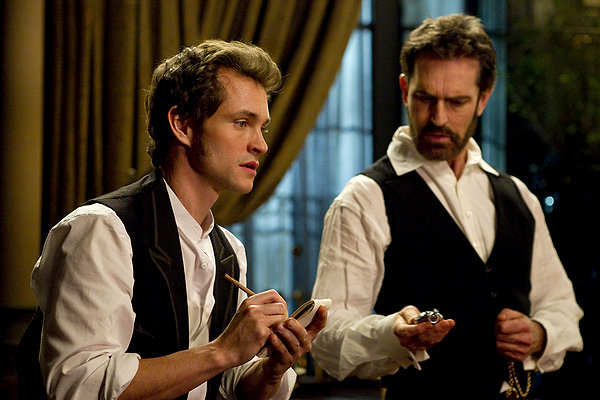 Hysteria is short of being hysterical but it’s certainly charming and provides an interesting history lesson with a light touch. The very nature of women’s hysteria is a fascinating moment in history where men were bending over backwards to find medical assessments for what is, in essence, horniness. The fact that these women’s doctors were getting carpal tunnel from all the manually stimulation of their clients has got to be one of the strangest workplace hazards. In certain regards, the invention of the vibrator has saved lives, or at least the hands of medial practitioners. It’s probably also made a whole lot of women a whole lot happier. Feminine sexuality was just an obtuse concept to the well-educated men in charge. One character says, with absolute certainty, that women cannot achieve sexual pleasure unless through insertion. As another fun historical note of male ignorance when it comes to female anatomy, when Deep Throat was being banned in the U.S., the federal judge who deemed it obscene cited, in his writing, that one of the many dangers of the provocative flesh film was that it mistakenly exposed women to the idea of an orgasm without insertion. This is almost 100 years later and yet men in high places of power are still carrying on complete ignorance of something they very literally know very little about. In that regard, Hysteria is jolly fun as we watch women get their jollies. There’s always something fun about watching uptight characters cut loose, especially when they find pleasure that has been denied them.
Having a talented cast is also a benefit when you’re working in comedy. Dancy (Adam) plays our straight man with fine properness. He has a few moments where he gets to delightfully squirm thanks to bold women and bold topics. He’s got some solid chemistry with Gyllenhaal (Crazy Heart), who is the feisty spitfire we expect in this sort of movie. Gyllenhaal is charming without being obnoxious, and her English accent is impeccable. Pryce (G.I. Joe: Rise of Cobra) and Jones (Like Crazy) are funny in their understated, stuffy British formal way, while Everett (Stardust) provides a great comedic jolt as the self-possessed, blithe technophile, ready at a moment’s notice for a good wisecrack. Sheridan Smith (How to Stop Being a Loser) also deserves special mention as a maid who was formerly employed as a prostitute. Her randiness is a nice counterpoint to all that Victorian repression and she pushes the movie further into sex farce.
While amusing, I wish the filmmakers would have taken a, dare I say it, more mature approach to a very interesting subject of history. The structure and very aim of the movie is that of a typical romantic comedy, which is a shame given the atypical subject matter. It’s pretty much a romantic comedy transplanted to merry old England. Much of the humor of the movie is divided into two camps: 1) watching the uptight Victorian-era Brits cut loose with decorum, or, 2) self-aware humor about the ignorance of the age. The first is always fun since we’re watching people sneak their true feelings through the wall of social repression. Director Tanya Wexler makes sue of a lot of sight gags and heartily enjoys cutaway reaction shots of ladies going orgasmic. It’s enjoyable but the fact that Wexler has to keep going back to the reaction shots for jokes, it loses its effect. Then there’s the self-aware humor built entirely upon dramatic irony, where the writers tweak the knowledge of a bygone era with all of our clever foresight: “Oh those stupid Victorians, not believing in things like germs and female orgasms.” After a while, the self-aware humor becomes tiresome. We get it; these silly Brits did not understand female health and proceeded to rule in their ignorance. I wish the movie left behind the easy jokes for some stronger social commentary. To this very day, we have men legislating women’s bodies and their reproductive rights (see: Oklahoma saying life begins weeks before conception, or Virginia demands medically-unnecessary vaginal probes for no other purpose than to shame women, and so so much more…). Ignorance knows no end, and one imagines the rom-com that makes fun of our current social mores and understanding.
 It’s during the last act where Hysteria really starts to come apart at the seams. Beforehand, it’s been a fairly light comedy with some punctuations of commentary from Charlotte and her idealistic desire for equality. But then, and spoilers will follow, the movie suddenly transforms into a courtroom drama with Charlotte on trial. Her very mental health is on trial and if she’s found to be a hopeless case of incurable hysteria, then she’ll be shipped to a sanitarium and have her uterus forcibly removed. Wow. That is some heavy stuff for a movie that spent an hour making sex jokes. The courtroom setting leads to some pretty transparent speechifying; any subtlety goes out the window and we listen to messages about women’s suffrage, equality, and empathy. This conclusion feels like it was ripped from another movie. It’s tonally jarring. Then, after our lead takes his moral stand and confesses to his belief that there is no such thing as hysteria, that women are just stuck in sexually unfulfilling relationships in a sexually repressed age, everyone goes home to think about life. Then, thirty days later when Charlotte gets out of prison, she’s met by Mortimer where he, I kid you not, proposes to her on the spot. For a movie about breaking misconceptions about women, tying things up with a marriage proposal seems almost hypocritical. It also marks a pretty big leap in the burgeoning romantic relationship between Charlotte and Mort. It seems rushed and a strange way to end a movie about female empowerment. The rom-com elements have won out over any higher messages.
Hysteria starts strong but goes limp. Hysteria runs out of juice. Hysteria is a pleasant experience but doesn’t deliver a proper climax. Hysteria is not the feel-good movie of the year. The very nature of the movie lends itself to all sorts of innuenduous critical blurbs. It’s a rom-com transplanted to Victorian England and I wish that it tried a little harder with the material rather than settling for easy jokes relying upon the ignorance of the age. The cast is superb and the movie is certainly fun, but it falls apart in the end when the messages overtake the narrative. So what is the best Hysteria blurb? I’ve had better.
Nate’s Grade: B-
Share this:

Pirates of the Caribbean: At World’s End (2007)
 Shiver me timbers Jerry Bruckheimer. The Pirates of the Caribbean movies are taking no prisoners when it comes to money and fans. Ten months after 2006’s Dead Man’s Chest comes the concluding chapter to the Pirates saga. At World’s End is longer, bigger, and more expensive, but it is also the first Pirates movie that felt like a ride I wanted to get off.
The British navy, at the command of Lord Beckett (Tom Hollander), is eliminating all piracy once and for all. He now controls the heart of Davey Jones (Bill Nighy) and so controls Jones and the crew of the Flying Dutchman, the most fearsome ship run by cursed barnacle-encrusted crewmen. As the very busy hangmen will attest, it’s not a friendly time to be a pirate. The Black Pearl has set out to Singapore to find support from Soa Feng (Chow Yun-Fat), one of the nine pirate lords. The Pearl is now commanded by Barbosa (Geoffrey Rush) who was brought back from the dead thanks to the witchy Tia Dalma (Naomie Harris). They travel to the ends of the earth to Davy Jones’ locker to rescue Jack Sparrow (Johnny Depp), who was last seen in the belly of a beast. Elisabeth (Keira Knightley) and Will (Orlando Bloom) are both aboard and still bickering about their stalled romance. Once Sparrow returns to the land of the living, the group meets with the other pirate lords from all across the globe in an effort to pull together and stand against Beckett.
 As it turns out, the fear that Pirates of the Caribbean: Dead Man’s Chest was a 150-minute trailer for this movie was unfounded. That’s because the third movie in the Pirates of the Caribbean series completely ignores or messes up the many intriguing setups from the second film. Character motivations from Dead Man’s Chest are mostly unresolved and revert to stock generalizations. Jack Sparrow feels like he’s been grafted onto an unrelated storyline. Most disappointingly is what happens to Davy Jones, the greatest addition to the Pirates landscape. This awesomely-realized villain was scary and fascinating and looked fantastic thanks to Oscar-winning special effects. At World’s End takes such an intriguing villain and turns him into an impotent tool to Beckett. He’s been transformed into a houseboy who might as well fill people’s teacups. Yes Davy Jones thankfully figures into the climax but why in the world’s end must an audience wait that long? Davy Jones reminds me a lot of the ghostly twins from 2003’s The Matrix Reloaded who were completely dropped from the second Matrix film to the third.
But not only does At World’s End fumble the hand-off from the previous sequel, the movie itself establishes many setups with poor or unsatisfying payoffs. So much is made about the pirate lords from all over the world, and we see a colorful collection of international pirating groups that is fitfully amusing, but the whole section has no point at all. Chow Yun-Fat’s character is a non-starter; in fact none of the new characters introduced in At World’s End play any importance on the overall plot. The film is building to a final all-out battle between the united pirate lords and the British navy. We witness the awesome sight of the sea filled with vast armadas of ships, and as an audience we are getting hungry for some epic nautical action. Then At World’s End pretends that none of the other ships matter and sets its entire battle as one ship versus one ship inside a whirlpool. While this is admittedly exciting it isn’t anywhere near as exciting as an entire war amongst hundreds of ships. The filmmakers have all the money in the world and they couldn’t give us a little something bigger in scope? The pirate lords could have just as easily been cut from the movie if they were just going to stand on the sidelines and wave a flag.
The pirate lords make a big deal about their apprehension with releasing the sea goddess Calysto from her earthly prison. The pirates trapped her into the body of a human in order for them to gain control of the seas. They reckon she’ll be one very bitter sea goddess and take out some apocalyptic wrath out on the pirates. So the pirates release her, cowering in fear at her powerful reprisals and,,, nothing. Calysto vanishes, causes some mildly inclement weather, and is never seen again. Talk about a lot of pointless hot air.
 I think perhaps the clearest example of how the movie screws up is with the monstrous Kraken. This slimy beast got a ton of attention in Dead Man’s Chest and was a ferocious terror on the high seas. Now, I would expect that such a creature that played an integral role in Dead Man’s Chest would be back for the next sequel. Ignoring its prominence in the plot, the thing just looked amazing onscreen. But with At World’s End the giant monster is killed off screen and in between the movies. I felt insulted when I saw the mighty carcass washed ashore like a pathetic beached whale. What is satisfying about that? Why would Beckett make Davy Jones kill such a powerful weapon he could use for his own unseemly gain? It makes no sense. The Kraken isn’t the only character done a disservice by a plot stuffed to the gills. Some are killed in terribly pointless incidents and it just becomes irritating.
At World’s End is missing the high-flying fun of the first two Pirates movies, and this venture just feels draggy, tiresome, and far too dreary. You know you’re headed for some morose subject matter when a movie hangs an eight-year-old before the opening credits. This latest film is crushed to death by the weight of excess plot and confusion. There’s a damn near 20-minute section of the movie that’s nothing but characters double-crossing, triple-crossing, quadruple-crossing each other; it literally requires a character to spell out what has just taken place and set the record straight. I don’t think At World’s End ever recovers from this absurdly confusing miscue.
The film seems more interested in talking over an audience than delivering something genuinely thrilling and stirring. There’s a curious lack of action and nothing new matches the imaginative action set pieces of the previous films, like the duel atop the roving water wheel. Excluding a large melee between the Black Pearl and the Flying Dutchman as the climax, the action pops in and out in shortly timed bursts. For a movie within a hair or running three hours, there needed to be more action. Instead of derring-do, At World’s End spends interminable periods of people talking, usually in personal quarters, and explaining the increasingly laborious plot to each other. All of the Pirates movies are filled with false endings and heaping helpings of extra plot, but this is the first time I really felt the real drag of its running time. Director Gore Verbinski still knows how to keep things looking good but he can’t save the film from its anchor of a maddening and convoluted plot.
 The movie is not without its due pleasures. Depp is always going to enchant with his now iconic character, but the true star of the film is Rush, who makes welcomed return. The special effects are still tops. The sequence rescuing Jack from the world of the dead provides many trippy moments that possess their own strange beauty, like when we watch the Black Pearl sail against the black, star-spotted sky. It’s fun seeing Keith Richards appear in cameo as Jack’s father and the stated inspiration for Depp’s performance. A small man and a large gun makes for one very funny sight gag. A Mexican standoff that actually involves an armed monkey is a comic high point. It’s just that all the fun or memorable moments seem to be the ones that matter the least. At World’s End still manages to do enough right to work, especially its Singapore opening. As far as a movie that upholds the quality of its franchise name, that’s a whole other matter.
Pirates of the Caribbean: At World’s End is a somewhat entertaining but heavily flawed final film to a trilogy. It’s the darkest and trippiest of the three movies, but it also makes the least amount of sense and has the least amount of action. That doesn’t seem like a good exchange in my book. There are not enough important events to justify the bloat. At World’s End has a hardcore case of butterfingers when it comes to handling plot and character setups from earlier films, and as a result almost nothing and no one ends in a satisfying fashion. The effects are still eye-popping and Depp will always be a comic treasure, but this lackluster movie feels like tripping at the end of a marathon. I had so much hope for At World’s End after how gratifying I found the other two movies but I cannot quell my disappointment. This is not a fitting conclusion. This feels more Matrix Revolutions than Return of the King. Of course it’ll make tremendous amounts of booty at the box-office, but will demand for a fourth be as rabid after this muddled and murky capper?
Nate’s Grade: B-
Share this:

The Brothers Grimm (2005)
 Director Terry Gilliam is one of the true artists working today in movies. His manic, off kilter, visually grand imagination has crafted wonderfully vivid fantasias, but it also has given Gilliam a reputation for being the captain of a sinking ship. The Adventures of Baron Munchausen is regarded as one of Hollywood’s bigger failures, unfairly I might add. A fascinating 2003 documentary called Lost in La Mancha detailed the bizarre circumstances and implosions that forced Gilliam to shut down production of his pride and joy, a film about Don Quixote. We’re talking things as out of control and unlucky as acts of God conspiring to doom this project. But then, Gilliam has always been fighting someone or something his whole film career. The studio refused Gilliam’s cut of Brazil so he sneaked out a print, showed it to the Los Angeles film community, and they dubbed it the best film of that year. Gilliam is a man governed by his idiosyncrasies. He’s blessed with a unique voice but cursed with the prospects of not having anywhere to say something (would he not make simply the most divine Harry Potter film yet?). And so Gilliam strikes his hands at something a bit more commercially minded with the action/comic fable, The Brothers Grimm.
Will (Matt Damon) and Jakob (Heath Ledger) Grimm are nineteenth century ghostbusters, so to speak. They travel from town to town ridding the villagers of evil spirits, witches, and all sorts of demonic creatures. Trouble is it’s all a lie. The Grimm brothers and their pals set up the spooks and rob the town blind. Will enjoys the fame, and especially the women, but Jakob feels apprehensive. It?s the Napoleonic wars, and the French have occupied the Germanic lands. A snooty general (Jonathan Pryce) plans to behead the two Grimm brothers unless they solve a strange case in a rural town. A slapsticky, torture-loving commander (Peter Storemare) is sent to watch over the “Grimmies.” At the village, Will and Jakob discover the town has had 10 of its daughters kidnapped with little explanation. With the help of a free-spirited woman (Lena Headey), the brothers encounter giant wolves, moving trees, lickable frogs, and the giant tower of the Mirror Queen (Monica Bellucci). The Queen was given eternal life but not eternal youth. In order to gain eternal youth, the Queen needs to take the lives of 12 hearty girls, and only the bumbling Grimm brothers stand in her way.
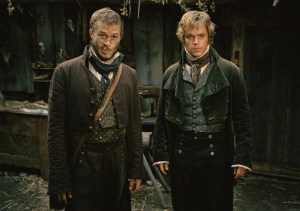 The acting is an example of the film’s messy feel. Ledger talks with marbles in his mouth. He’s putting more detail into the character than it deserves. Damon seems like he’s sleepwalking through the film, and his accent fluctuates wildly. He’s sort of a grinning straight man to Ledger’s tic-heavy daydream believer. Belluci is a ravishing beauty and proof positive for Hollywood that women over 40 don’t need to be put out to pasture. Too bad all she’s expected to do is look pretty and seductive in The Brothers Grimm. Pryce plays his role like a cartoon caricature. Stormare has already given one crazy performance this year (Constantine), and his frenzied, nearly indecipherable performance seems to be the closest to Gilliam’s whacked-out wavelength. Stormare is entertaining in every scene he’s in but can be found guilty of chewing scenery like it was a delicious candy house.
The Brothers Grimm is a gorgeous looking film. The sets are massive and greatly detailed. The location shoots in Prague seem like the perfect environment for Gilliam’s beyond-this-world landscapes. Gilliam experiments with advanced computer graphics for the first time and adds his oddball touches. A child has her eyes taken by a glob of mud, and then the mud reshapes itself into a lumbering gingerbread man. A horse spits out a spiderweb and ensnares a child. And it looks really freaking creepy. The Mirror Queen’s defeat is another standout effect as she breaks apart like shattered glass. The look of The Brothers Grimm is outstanding, but it’s what takes place inside those pretty pictures that dooms the film to mediocrity.
 The Brothers Grimm is an unfocused mess. It has disjointed subplots and several story elements that just don’t fit. The wacky French occupation feels like a leftover from a different movie. It just doesn’t work and grinds the movie to a screeching halt with every resurfacing. The Brothers Grimm will routinely work its way into a narrative corner and then use a “magic” cheat to escape (magic axe, magic mirror, magic kiss). Gilliam has always been a master maestro of chaos and visual oddities, but this time he’s tackled a film with a very weak script by Ehren Kruger (Ring Two). Kruger doesn’t bother laying the groundwork of his magical world or establish the rules. Therefore anything can happen and rarely feels satisfying. The characters are one-note, each given a single character trait to play with (skeptic, believer, idiot, etc.). The pacing is pretty sluggish. The first act takes an eternity to set up the film’s characters, plot, and yet it still feels sloppy. The twists and turns are easily telegraphed and unexpectedly boring. The plot is frustrating, shortsighted in scope, and far too conventional for Gilliam’s tastes. When The Brothers Grimm reaches its happy ending you’ll swear you can hear Gilliam gagging somewhere.
Gilliam adds a worthy macabre tone to the film. There will be touches that you know are pure Gilliam, like a woman skinning a rabbit as she talks, or a cat flying into the blades or a torture device. In fact, The Brothers Grimm has a lot of humor involving the comic demise of animals. This isn’t exactly a film appropriate for young children despite the appeal of a fairy tale background. The film wants to tweak fairy tale legends like the two Shreks, but Gilliam wants to make them disturbing nightmares, not something of irreverence. This puts the film’s tone at odds. One minute you’ll have a scene that?s morbid, darkly funny, and unconventional, and then the next minute you’ll have a scene that’s cliché, dull, and whimsically misplaced.
The Brothers Grimm feels like a Terry Gilliam film under glass. The script is weak and plodding, the characters barely leave a dent, and the tone is uneven. The plot is pulled in too many directions and lacks momentum. There are a handful of fun comic diversions but the movie feels like a loose collection of disjointed story elements. There are flashes of grim humor and visual elegance but more often than not the film is just stupendously boring. The Brothers Grimm feels the same way the Coen brothers’ Intolerable Cruelty felt: a unique vision compromised and downsized by studio conformity. You can see the indie spirit but the heart just isn’t beating. The Brothers Grimm is mediocre at best. How very grim indeed.
Nate’s Grade: C
Share this:

Pirates of the Caribbean: The Curse of the Black Pearl (2003)
 Johnny Depp is THE MAN. But then, we already knew this. Can’t wait to see more.
Nate’s Grade: A
Share this:

Stigmata (1999)
 From the director of Blank Check comes the latest religious up-in-arms controversial picture billed to your local theater. While being wrongly labeled a horror flick, this movie is nothing to get excited over if you take your religion seriously. Because this movie sure doesn’t, and the only ones that will be influenced by this hour and forty minute music video of blood would simply be the gullible.
Patricia Arquette plays Pittsburgh’s young and nubile atheist hero and the finest hairdresser in town, when she isn’t bleeding over her customers that is. Well the party girl gets in touch with some rosaries and has violent seizures and fits, as well as experiencing strange wounds and lashes akin to the wounds of Christ. Faster than you can say “Mulder and Scully where are you?” the Vatican dispatches priest Gabriel Byrne to investigate the bizarre goings on. What he soon discovers turns him into a believer and turns the Catholic church scared that Christ is coming back and brandishing some mean hickory. Paddlin’ line starts west of Rome.
It’s not that the idea is totally repellent or half-baked, but the movie is turned into an MTV video with legs. With all the hyper-editing and pounding electro music from Pumpkinite Billy Corgan you’ll be thrashing in your seat having a violent seizure yourself. The over stuffing of cuts and more blood than a Red Cross drive can’t cover up a head scratcher of a storyline.
The script has so many glaringly logistical problems stacked up everywhere trying to present themselves as pious dogma. Stigmata is merely the recreation of Christ’s wounds, not soul possession. How in the world Arquette becomes the working girl version of Linda Blair is beyond logic. The movie also perceives that stigmata can be transmitted by touch. It’s not an STD people, we don’t need pamphlets trumpeting safe religious reenactments in schools do we? But the biggest hole is not the notion there’s a Catholic conspiracy hiding valuable works of Jesus that may be a threat to their job security. After all the fuss and the build up the hidden passages and books are nothing more than a basic Sunday School lesson. Is this what everyone’s shaking in their gowns over? I’ve seen more religious danger in a Denny’s breakfast menu.
Stigmata is a glitzy and loud poison pen letter to religion. It’s got an incomprehensible storyline and wastes the great actor Jonathon Pryce for the role of a villainous Catholic Cardinal always within reach of his cell phone. Stigmata is an example of what the movie industry is serving out these days: all style, no substance if any, and without any semblance of common sense. So of course it’s destined to make a killing at the box-office.
Nate’s Grade: C-


 nathanzoebl
You must be logged in to post a comment.