Blog Archives
The Meg (2018)

Ever since Steven Spielberg’s Jaws cemented the concept of a Hollywood blockbuster, sharks have been synonymous with the summer movie season. Just last year a small-scale indie thriller, 47 Meters Down, was a breakout hit with a planned sequel on the way (they ignored my obviously brilliant suggestion of naming it 48 Meters Down, thus proving each additional entry would move the depths a measurable increment of peril). People love them some killer shark movies and the bigger the better. Well it doesn’t get much bigger than The Meg, a movie with a monstrous prehistoric Megalodon shark approaching 75 feet long (that’s one half of 47 Meters Down, if you think about it). The Meg has enough awareness, payoffs, and fun to stay afloat and be a better B-movie.
Deep under the Mariana Trench, a team of deep-sea scientists has discovered a new habitat previously cut off by man. From here emerges the Megalodon, a ferocious predator that has no earthly competition. The team seeks out the help of Jonas Taylor (Jason Statham), a one-man rescue squad who had a run-in with The Meg in his tragic past. The science team must rescue its trapped members, track and evaluate the shark, and prevent the ancient beast from feasting on the locals in the South China Sea.

This is a big stupid shark movie about a big stupid shark, and The Meg provides enough fun to at least warrant one trip out into the water. It’s a monster movie that follows a well-worn formula of discovery, containment, escalation, and then all-out large-scale disaster. I appreciated that the succession of events followed enough of a logistical cause/effect relationship that allows the audience to better suspend disbelief and stay within the movie’s agreeable wavelength of campy thrills. This is the kind of movie that introduces a family of whales only to mercilessly kill them off screen as passing shark food. It’s the kind of movie that knows we want to watch Statham punch sharks in the face. There’s genuinely more shark action than I was expecting and the action sequences have been given consideration to maximize their popcorn thrills. I am used to recent shark movies that hinge on the threat of the shark as an aquatic Boogeyman, on the peripheral and always threatening to return. With The Meg, once the shark is loose it’s a constant presence and persistent problem. There is one moment where our hero has to shoot a tracking device into its dorsal fin. He has to get close while also not disturbing the water and calling attention to himself. It’s a well-engineered and developed suspense sequence that takes advantage of the fun possibilities at play. There are more moments like this that exemplify a degree of thinking and development than sloppy, slapdash CGI mayhem.
This is a major co-production with China and it’s easy to tell. It’s a $130 million Hollywood hybrid with an inclusive cast, global danger, and the havoc wrought on the human population this time are Chinese beach dwellers running in panic. The co-lead is Chinese star Bingbing Li (Transformers: Age of Extinction) who is set up by literally every character to be the romantic interest to the dashing Statham. Even the man’s ex-wife is on the same mission, trying to hook these two up. Statham banging this single mom is the key to bridging these two market forces together, apparently.

Speaking of the man in question, Statham (The Fate and the Furious) is dependable and irony-proof no matter the absurd film scenario. He provides the audience a reliable anchor amidst the genre silliness, plus gratuitous shirtless beefcake shots. He can say the most ridiculous lines of dialogue with a straight face and make you believe it. He’s also great with children. Some of his best moments are his interactions with little Meiying (Shuya Sophia Cai), the young daughter of Li’s character. Statham is so charming and natural around children, and he’s able to coax instant chemistry with a child actor. Why hasn’t somebody given Statham a Rock-style family vehicle where he acts alongside a precocious group of kids? What if he’s an over-the-hill action star helping a group of kids make their own amateur movie? What if he’s an ex-special forces agent-turned-birthday party magician trying to fish out a hidden target? What if he’s a retired movie star trying to coach a pair of kids how to get their parents back together? I never knew I wanted this.
There’s enough of a knowing awareness that let me know the filmmakers understood the goofy kind of movie they were making. It’s not exactly turning to the camera and winking but it feels like it’s nodding at you, asking you to play along. This is exemplified in Rainn Wilson’s (TV’s The Office) character Morris, the outspoken billionaire who founded the whole science station. He’s general comic relief in a movie about a giant shark because The Meg doesn’t treat the shark as comic. After discovering the creature, the science team is ready to take things slowly and cautiously, and Morris flatly screams that we have no time for slow here. When Jonas jumps into the water to take on the shark, it’s Morris exclaiming how awesome it is. The best example is when one of the lead scientists takes a moment to bemoan the overreach of science in a “what have we done?” speech, and Morris just throws up his hands and walks away grumbling, disinterested in listening to any self-serious yammering. Morris kept amusing me because we were repeatedly alike in our commentary and requests for this film experience.

Even with scaled-down expectations, The Meg is still a monster movie that probably needed to be campier or more frightening to be a better movie (I gave the same diagnosis to Krampus). It’s a fun film that understands what a genre audience wants, though it could have pushed further and found ways to subvert those expectations or given us more mayhem. This isn’t a tiresome so-bad-it’s-good-but-it’s-still-bad genre wankfest like the tacky Sharknado movies. It’s also not the delightful, campy, gory B-movie that is Deep Blue Sea. It’s a monster movie that has a sense of amusement and doesn’t waste time pretending to be too serious even when the professorial characters are given to lament. It achieves a middle zone that satisfies enough of your cravings but not fully hitting them.
Not quite as enjoyably dumb as the earlier Rampage, The Meg is still a relatively silly, splashy monster movie with solid thrills, action development, and a good sense of what its core audience demands and how to go about fulfilling that promise. Statham and company plow ahead through the genre shenanigans and make it out the other end bloody yet unscathed. My biggest criticism is that I wanted more; more camp, more carnage, more knowing nods, the kind I got in abundance in last year’s gloriously entertaining Kong: Skull Island. It gave me enough of a tantalizing preview of the better movie it could have become. Still, The Meg is a slice of summer escapism that gave me enough thrills, laughs, and satisfaction to leave me wanting more but mostly content with what I ultimately got.
Nate’s Grade: B-
Share this:

National Treasure: Book of Secrets (2007)
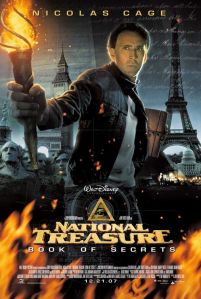 National Treasure: Book of Secrets is like a big dumb puppy that just wants love. It does a trick and thinks it deserves some form of recognition, and me with my cold heart just wants to shrug and move on with my day. How can I be so unmoved when there’s even a cartoon before the movie? For any prospective moviegoers, if you enjoyed the 2004 National Treasure, where I remind all that the U.S. Declaration of Independence had a secret treasure map on its other side, then chances are good you’ll enjoy Book of Secrets. That’s because they’re pretty much the same movie.
Ben Gates (Nicolas Cage) and his father (Jon Voight) are basking in their newfound respect from proving that their crackpot treasure schemes were in fact real. Their respectability is turned upside down, however, when Mitch Wilkinson (Ed Harris, with a dollop of a Southern drawl) has evidence that great-great-grandaddy Gates was responsible for planning President Lincoln’s assassination. He has a piece of John Wilkes Booth’s diary and a list of conspirators is jotted down, with great-great granddaddy Gates listed right there. The diary is authenticated and the Gates are devastated but ultimately unconvinced. They know their Civil War era ancestor would never betray his country and was unknowingly decoding a secret that could lead the Confederacy to an ancient golden temple, something that could help turn the tide of the war. This ancestor ripped pages out of the diary and threw them in a fire to protect the welfare of his country and was then shot by a secret Confederate soldier. In order to clear his ancestor’s good name, Ben Gates will have to find this hidden treasure, which is precisely what Mitch has wanted from the start.
 Gates re-teams with his pals from their first successful adventure, computer whiz Riley (Justin Bartha) and Abigail (Diane Kruger), who has thrown Gates out of their home due to his single-minded focus. Dating a treasure hunter is a certain path to a rocky relationship, ladies. Riley, who even wrote a book about his treasure exploits but still can’t get recognized, is game but Abigail has to be tricked into help. The group finally figures out that the only way to verify the temple’s hidden location is by getting their eyes on the mysterious President’s Book of Secrets, which only presidents can read. This means that Ben has no choice but to get the president (Bruce Greenwood) alone and beg to see a book not meant for outside eyes.
Book of Secrets is a little less dopey than the first preposterous National Treasure adventure, but that doesn’t mean it isn’t chock full of stupidity. According to these movies, apparently damn near everything in this country is built over an Indian burial ground or a giant cavern of treasure. I advise all readers to try digging in their backyards because it appears that the odds are in their favor (also: beware of your real estate company moving the tombstones but not the bodies). The clues are a little less mind-boggling, so instead of a single brick that’s been undisturbed for 200 years we get matching furniture for the Queen of England and the President of the United States. One doozey of stupidity is that one clue requires people to douse a large rock formation with water in hopes that they hit exactly the right spot and have an invisible eagle make its appearance. The plot is still structured on the clue-leads-to-other-clue template, which can be exhausting after a while because there’s never any indication of progress until the end arrives.
The subplot about kidnapping the president is ridiculous in the fact that, while already being dumb, it adds needless conflict. When Gates “”kidnaps” Mr. President he does so through a secret tunnel under George Washington’s Mt. Vernon estate. The passage closes behind them and cuts off the frantic Secret Servicemen. It is here where Gates makes his plea for the titular Book of Secrets, which the president confirms but cannot confirm publicly (well, it is a secret book of secrets). Instead of sensibly saying to his men, “Sorry guys, you know how old these places are, we got trapped, but Mr. Gates here helped get me out,” the movie tries to claim that the next course of action is that Gates will be on the run for kidnapping the leader of the free world. Huh? What makes this sequence stand out is how easily explainable it could all pass, and yet Book of Secrets figures the movie is better served by a contrived complication to add more outside pressure on Gates and his treasure hunting crew.
Of course all of the silliness and off-the-wall shenanigans would be acceptable if the film delivered some exciting action sequences that pinned you to your chair, but just like the first National Treasure, this movie is pretty much devoid of a well-thought out action sequence. Returning director Jon Turtletaub has no real visual flair and lets the material simply lay there on screen without much effort to jazz it up. Many action sequences are brief and never really flirt with complications. Usually, the script will propose a simple sequence of events like, say, “Good Guys on Run from Bad Guys” and then Turtletaub will show us exactly that, no better no worse. There’s nary a scene that actually utilizes its globetrotting destination to its advantage; most of the action is not geographic based, which means that it could happen anywhere because it doesn’t take advantage of the specifics of exotic locales. That is inexcusable to me, a big fan of good action sequences. A lengthy trip to an underground golden temple tries the patience as it rambles on and unabashedly apes the Indiana Jones series. Book of Secrets has a halfway decent car chase through the streets of London and that ends up being the highlight of the film. The trouble is that there’s more than an hour left at that point.
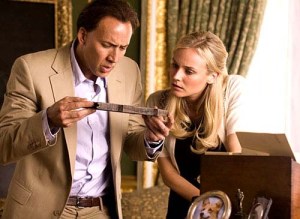 Book of Secrets is a slightly better film than the original. It jumps around in time through the lineage of the Gates clan and gives a better sense of the personal stakes for Ben and his father. Having their long-dead heroic family members linked to a dastardly assassination is good motivation for action, even if that action is ultimately finding an underground temple of gold (how A+B = C I will never know). The production design is skillful and the various European locations bring some sense of grander excitement that, sadly, will never be fully capitalized upon. The characters are still pretty shallow and one-note, but it seems like it’s less annoying this time because there’s less setup on who these characters are, which is, in short, shallow and one-note.
Cage is on autopilot and plays up his goofy mannerisms and William Shatner-esque line readings. This is a paycheck job for Cage and nothing more. Just because the first flick made tons of money is a lark to him and not an indication that he should try something different. He’s giving the people what they seemingly want, which is a wacky Nicolas Cage hamming it up with his patented version of kooky acting. Kruger is the exact copy of her character from the previous National Treasure, meaning she’s the bickering blonde counterweight to the conspiracy theorists on the journey. I suppose she plays a damsel in distress adequately. Voight gets more screen time this go-around thanks to a plump subplot involving the team seeking out the assistance of his ex-wife, played by Oscar-winning actress Helen Mirren. Yes, that Helen Mirren. Harris is given a do-nothing part as the villain and then the movie can’t even follow through on that. Everyone seems to have fun with all the nuttiness and goofy stunts, so I can’t fault them too much for faking it in a big Hollywood blockbuster.
I understand the appeal of these movies, which have found a sizeable audience willing to lap up a Cliff Notes of History along with their popcorn thrills. I imagine the fans of the original will show up in droves and make sure that National Treasure 3: The Mystery of Franklin’s Syphilis is fast-tracked for a future holiday release. I don’t mean to be a killjoy (my mother really enjoys these films) but I cannot get behind the National Treasure movement when the movies are riddled with rampant stupidity, contrived situations, convoluted conspiracies, one-note characters, and inept action sequences that never amount to much of anything beyond teetering homage to better adventure films. Book of Secrets is essentially the exact same movie reheated to take the chill off. Replace Sean Bean for Ed Harris as rival treasure hunter, add another female character, and there you have it, a mostly undisturbed formula that proved profitable in 2004.
Nate’s Grade: C
Share this:

National Treasure (2004)
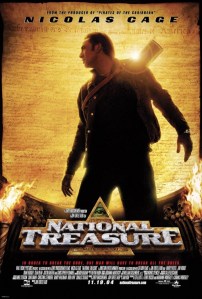 The premise for National Treasure, the newest Jerry Bruckheimer action film, is something of a mess. According to the film, during the Crusades a magnificent treasure was found. The Knights Templar swore to protect it, and the Masonic order carried the vow through the ages. The founding fathers of the Unites States were among this Masonic order, and they went about hiding the fabulous riches and set up a series of elaborate clues to discover its whereabouts. These clues include symbols on the back of our currency and, get this, a secret invisible message on… the back of the Declaration of Independence. Yes, the Declaration of Independence is a treasure map. The silly premise for National Treasure equates the Declaration of Independence with a Denny’s place mat. Can something this outlandish make for a good movie? Well, it depends on your working definition of “good.”
Benjamin Franklin Gates (Nicolas Cage) is somewhat of a laughing stock amongst his peers. His family name is cursed with the crazy belief in some long lost treasure hidden by the founding fathers. His father (Jon Voight) rues the family name being attached to such foolish theories. Of course such foolish theories in Hollywood are always right, no matter how stupid (did I mention the Declaration of Independence is a treasure map?). Ben and his treasure hunting partner Ian Howe (Sean Bean) find a definitive clue, but then Ian double-crosses on Ben and, gasp, wants the treasure for himself. This turns into a race to see who can steal the Declaration of Independence, though Ben wishes to steal it to protect the document and the treasure. Along the way, Ben teams up with a techno-nerd (Justin Bartha) and a hot government official (Diane Kruger) to crisscross historical monuments and sites to unravel the clues before Ian can.
 National Treasure is dumb. Little to absolutely nothing makes sense in this film. This is an obvious, embarrassing attempt to ride the popular coattails of The Da Vinci Code and Americanize the quest. Except that National Treasure really comes across as some half-baked movie version of a kid’s educational game show.
There are so many holes, so where do I begin? First off, why would the founding fathers make it so pointlessly, hopelessly elaborate to find this stockpile of treasure? I’m talking crazy complicated, like having one clue involve finding a ship buried in the Arctic Circle. Yes, the Arctic Circle. Supposedly, the founding fathers decided to hide the treasure because they didn’t want the British to get their grubby, nice-fitting gloves all over it. Something tells me that the founding fathers had more important things going on, like, oh I don’t know, a war! It’s purely absurd to have Washington, Franklin, Jefferson, Adams, and all the rest more interested in hiding some treasure than breaking from England and building an independent nation based on their ideals.
There are some other head-smackers, like the fact that an assembly of clues has been left entirely undisturbed in 200 plus years, like a single special brick. And, for that matter, how does Cage cut through mortar so easily with just a pocket knife? If there’s a gigantic catacomb under D.C., then what’s holding up the city? How come 200 year old oil still burns as well? Wouldn’t that have dried out by now?
 Cage reverts back to his manic show-offy character behavior. In Bruckheimer movies, Cage seems to have theoretic spurts here and there, like he keeps sticking some extremity in an off-screen light socket. He’s generally likeable but his character comes across more like some social studies teacher’s daydream. Bartha and Kruger add less-than-snappy one-liners, but their presence never becomes grating. Bean seems to be playing the stock bad guy role he always is, whether it be GoldenEye, Don’t Say a Word, or Patriot Games.
Sure, even the Indiana Jones films had plot holes (how does closing your eyes guard you from the wrath of God?) but their thrilling adventures overcame any quibbles. National Treasure, on the other hand, is an adventure lacking anything thrilling. This is the first action film to put me to sleep. I can forgive an action/adventure flick being dumb but being boring is a capital offense.
The action sequences in National Treasure are never fully thought out; they usually involve Cage and his cronies outrunning Sean Bean’s group of thugs (repeat). The film’s best moment is the actual theft of the Declaration of Independence. This is the lone sequence in the film that feels like thought was put into drawing out suspense, thinking of natural and interesting complications, and, surprisingly, having the sequence not be overcome by idiocy. After this scene, National Treasure descends into ill-conceived chase scenes strung between crazy elaborate clue hunting. By the time the film reaches its anticlimactic ending, you may have rustled through your change, eyeing the backs of quarters and dimes to ensure there’s no hidden message about a sequel.
National Treasure is a ridiculously stupid, inexcusably boring, ineptly plotted historical adventure for people who get their history solely from movies. Bruckheimer and Cage have an up-and-down partnership, but National Treasure starts with the worst film premise of the year and can?t go much further. Fans of clue-hunting adventure tales may excuse the gaping plot holes, and National Treasure has found a sizeable audience willing to go along for the ride, but the movie doesn’t contain much thrills, entertainment, or anything historically resonant. National Treasure should have stayed buried.
Nate’s Grade: C


 nathanzoebl
You must be logged in to post a comment.