Blog Archives
IF (2024)/ The Imaginary (2024)/ Imaginary (2024)
Every so often, I find myself drawn to reviewing movies in pairs, whether it’s because of the same source material (the 2022 Pinoochios), similar perspectives (2018’s BlackkKlansman and Sorry to Bother You), or even diametrically opposed artistic responses to a similar theme (2016’s Manchester by the Sea and Collateral Beauty). However, in my twenty-five years as a fledgling film critic, I don’t think I’ve ever reviewed three movies at the same time for whatever relevancy, yet that is what I find most appropriate for this trio of exceedingly similar films about imaginary friends. Earlier in the year, Blumhouse released Imaginary, their horror-thriller take on an imaginary friend refusing to go away. At the start of the summer, writer/director John Krasinski gave us IF, a live-action fantasy/comedy about imaginary friends finding their former children as adults. And recently, Netflix released an anime movie The Imaginary, a Studio Ghibli-esque fantasy about forgotten imaginary friends trying to find new kids and new homes. I’ve elected to review all three at once and, much like the Pinnochios, declare a winner through different categories.
Begin the critical gauntlet! Bring on the (imaginary) bloodshed!
- PREMISE

Two of these movies went in a sweetly sentimental direction and the other went in the horror direction, so let’s tackle that one first. Imaginary gets at a rarely spoken truth: children can be super creepy. Watch a child hold an involved conversation with some entity that isn’t there, or just stare into the dark and say, so plainly, “That’s where the eyes are watching me,” or any number of personal anecdotes to make you shudder, and you’ll understand the significant horror potential with a malevolent creature that the child can communicate with that adults cannot see. This also lends itself to a low-budget film production as so much of the wicked entity is implicit and unseen. It’s a cost-saving genius when you can just use your, wait for it, imagination. Now Imaginary isn’t the first horror version of this premise, but it deserves points for taking a childhood concept and thinking of an effective way to transform it into a diseased and malignant antagonist, haunting its adult child Jessica (DeWanda Wise) and seeking a new child, likely her youngest step-daughter Alice (Pyper Braun). It then presents its conflict like a curse that the past generation is trying to spare the next generation from suffering through. Of course this also includes getting adults to recognize the threat as they are often dismissing it. Nobody wants to believe that Chauncey the teddy bear is the one urging you to self-harm.
The other two movies take a far more family-friendly approach to their imaginary premises. There’s a lot of shared real estate between The Imaginary and IF. Both are about outdated imaginary friends finding refuge together in a sort of halfway house, a… foster home for imaginary friends (someone should make a cartoon series about that). Both of the movies follow imaginary friends trying to find new children who will accept them and give them a new life. IF briefly follows the possibility of reuniting the forgotten imaginary friends (a.k.a. IFs) with their former owners now grown up into adulthood. This is actually the movie at its best, as the creatures find a renewed sense of purpose and reconnect with a person they cherished but had to let go. For a strange reason, Krasinski only dabbles with this poignant story direction, switching gears to find them new homes with new kids, which serves as another story direction that is also quickly ditched. IF seems to be trying on so many different versions of its premise and then discarding them like the IFs themselves. The Imaginary has more focus on its central predicament, finding new homes before these characters fade away, or worse, get eaten by a cannibalistic imaginary fiend looking to gain more years of his own existence by consuming the life force of his imaginary peers. It also has the urgency of its main character, an imaginary boy named Rudger, hoping that his child wakes up from a car accident, and if so, that she’ll still need him. The other characters are trying to set Rudger up for a life after his child, since they’ve all experienced the same fate and are trying to help him adjust to not just letting go but also being open to a new child. It’s simplified but has plenty to still explore, plus a creepy super villain.
Winner: The Imaginary
2. WORLD-BUILDING

This is what really separates IF from The Imaginary. The world of imaginary figures populated in Kransinski’s movie are cute but their larger world context is unfortunately underdeveloped. This is likely because much of the movie is connected to the personal journey of one twelve-year-old girl, Bea (Cailley Fleming), trying to keep herself busy while her father (Krasinski) undergoes vague “heart surgery.” The IF Coney Island respite feels like a secret nursing home where the discarded friends just kind of hang out. There’s even swimming and painting lessons. There’s no further examination on whether these are only the IFs from this zip code, though Bradley Cooper voices a talking glass of ice water whose child originated in Arizona, so that’s undetermined. I was also hoping for an imaginary friend from decades back, like Franklin Roosevelt or Alexander Hamilton’s imaginary friend, or from other countries. Each character design can say something inherently about their past child creator, what they regarded as fulfilling or lacking from their present. Alas, the world-building is mostly one little girl’s discovery of her new friends and then how they ultimately support her with her family predicament looming over every scene. Seriously, for a father going through major surgery, the family in IF is pretty blase about Bea’s whereabouts. Her grandmother (Fiona Shaw) doesn’t seem too pressed about letting an unattended adolescent run around New York City for hours. Bea’s experience with helping the IFs are reflections of her optimism and hope. It all comes back to her, so the movie chooses to ignore the larger possibilities of its magical unseen world.
The Imaginary feels modeled after the Studio Ghibli movies that have delighted children and adults for generations. Its main character is Rudger, an imaginary friend, and not the child who birthed the imaginary friend, Amanda. That creates a different sense of discovery, as Rudger also learns about the hidden library housing other imaginary friends and the rules. He’s to stare at a bulletin board and await a prospective child he feels a connection to, then holds onto a picture of them to transport into the child’s imaginative play where they can contribute to the creative adventure. However, there are dangers like if you die in the imaginary world, you can die for real, which is never fully explored as a real threat. The imaginary characters are told to stay indoors at night, as they don’t want to run into Mr. Bunting, the cannibalistic antagonist. I got a little lost with the different rules, some of which seemed to be emphasized more or canceling out previous rules, but I appreciated the level of thought given to making its world alive.

This is also where Imaginary begins to get lost in its own hazy imagination. Imagine the bedroom door-hopping mechanic from Monsters Inc. but with the narrative formula of Insidious, and there you have Imaginary. The world of imagination is treated very similarly to a hellish dimensional getaway, much like what happens in Insidious where dad had to retrieve his son in the demon’s phantasmagorical realm. Because the spooky imaginary world relates back to the main character’s childhood, we have a few other characters that have history with this trauma. Jessica’s father Ben has been committed to a hospital and seemed mentally ill, until you realize he rescued his little girl from evil Chauncey and lost his mind in the process. He’s not some lost cause, he’s a hero. Also, there’s a former neighbor and babysitter (Betty Buckely, always welcomed) who is obsessed with childhood psychology and willing to do some extreme things to continue her obsession with Chauncey. It’s at least widening the scope to look at how these traumatic events have impacted other people, not just the little girl bottling up those nightmares. However, beyond the simple explanation of Chauncey existing as a parasite feasting on the imaginative power of children, little else is established about the creature or its own world. At one point, a character relishes the possibility of imagination as a wish-fulfillment service, but why would this evil creature delegate its power? It reminds me of all sorts of other movies where characters side with some apocalyptic power thinking they’ll somehow be the lucky exception.
Winner: The Imaginary
3. CHARACTERS

This is where IF shined the brightest. The little girl is cute and optimistic, a fitting tonal foil to Ryan Reynolds being such a loquaciously sardonic naysayer. She wants to be so helpful, though keeping herself so busy might just be her coping mechanism to try and stop her dreadful encroaching thoughts about the possibility of losing her second parent. Her taking the lead to help the IFs then allows for little episodic asides for the different characters to share their stories and their former creators. Having a protagonist be so driven at being empathetic is a natural conduit for championing the feelings and triumphs of others. It works. Reynolds is still doing his fast-talking cynical schtick, so your mileage will vary how well it continues to appeal. Curiously, I don’t think the character of Blue (voiced by Steve Carell) is fully utilized. He’s a more childlike exaggeration of the character features already provided by Bea’s involvement. Blue resembles the McDonalds’ Grimace, and is outwardly friendly, unafraid of big emotions, and a bit silly, but his elevation in the script as being the primary IF sidekick is arbitrary. The same story could have afforded tapping, say, the excitable unicorn (voiced by Emily Blunt) as the primary sidekick and produce similar results. Again, I think there’s so much that could have been further explored as to the existential requirement of the different imaginary characters, how they represented what their former kids felt they needed. Their exact existence was what a child yearned for (the strong IF to protect the child who is afraid, the squishy lovable IF to comfort a lonely child, etc.).
The characters from The Imaginary fall into general archetypes that any Miyazaki fan will be familiar with. There’s the bossy know-it-all, the excitable goof, the silent contemplative, the wise and warm-hearted authority figure, the dangerous rogue. They all work but it’s the larger themes that resonate more than any specific individual character. Mostly, the conflict is whether Rudger decides to move on from his creator and find a new child/home. He has loyalty and emotional attachment to little Amanda but the reality is that, at some point, she will grow up and he’ll be left behind. Whether that happens now, because she passes away, or years later through becoming an adult, there will be a parting and he will need to consider a new life. The loneliness and melancholy of this existence is ignored through the kooky characters, strange worlds, and pressing points of danger, so the reality of Rudger’s eventual loss is thematically sidelined.

With the Blumhouse Imaginary, the characters are relatively stock types for a supernatural horror mystery. There’s some effort to make it about Jessica trying to ingratiate herself with her new step-children, the oldest who looks at the new mom with great suspicion and resentment. At one point, the old mom serves as a jump scare, hiding in the house; the old mom is mentally ill but the stepdaughter thought, erroneously, that mom was “getting better.” Jessica is trying her best to rise to the challenges of being a parent, but it’s hard when there’s a sneaky ghost trying to emotionally manipulate your youngest to hurt herself. I don’t know why Jessica decided to move her new family back into her childhood home, the source of her trauma, except if you looked at the real estate market, it might have been by far the best deal she could swing. What’s some reawakened childhood trauma when it comes to skipping ballooning mortgage payments? Have you seen interest rates and the price of houses post-pandemic? That’s the real terror for adults.
Winner: IF
4. EMOTIONAL INVOLVEMENT/CONCLUSIONS
Despite what Pixar may have set in stone, it’s not a requirement for a children’s movie to make you cry. I did end up tearing up from two of these movies, and it should likely be obvious which of the three was the outlier. Krasinski’s movie is designed as a big warm hug, complete with soothing, milky light pouring in from every setting. I thought it looked very similar to how Steven Spielberg’s preferred cinematographer, Janusz Kaminski, shoots natural light, and lo and behold Kaminski was the cinematographer for IF (excuse my pat on the back here). Bea’s big emotional moment where she tells her story of adventure to her unconscious father in his hospital bed pulled some heartstrings, but what I felt even more emotionally cathartic were the asides where Bea helps the IFs reunite with their former kids. When an IF is being thought about, they start to glow from within, like happiness radiating out. It was these little moments, like Blossom (voiced by Phoebe Waller-Bridge) getting to dance with Bea’s grandmother like they used to, or the simple act of Blue wishing good feelings to his nervous former-child with a silent shoulder touch and world-clarifying exhale. It was the acknowledgement that these friends, while gone, are still fondly remembered, and that they will always have that connection even if their exact relationship has changed through the years. The Imaginary operates on a similar emotional wave of adults reuniting with their former childhood friends, and it’s that sweet acknowledgement of appreciation and love that hits hardest. It reminded me a little bit of 2001’s Amelie where she’s on a mission to help strangers remember beloved items from the past. The overarching worry about losing her father seems unnecessary as a complication, especially how “heart surgery” is kept so purposely vague and seemingly uneventful until that bedside chat. There is a difference between wanting to protect your kid from the possible trauma and downplaying it to the point where it becomes a strangely superfluous plot device.

I won’t pretend there’s much to get emotional over with the Blumhouse Imaginary, though there is one Act Two twist I thought was simply astounding, but in order to explain I will need to go into spoilers, so you have been warned, dear reader. For a solid hour, we watch Alice play with a teddy bear that she calls Chauncey, the embodiment of her imaginary friend. So far so good. Then after a disturbing session with a child psychologist, the professional shows Jessica her recorded session. This is where we discover that Chauncey the bear… has never been there. Alice has been talking to the unseen entity of Chauncey and Jessica has been the only person who was seeing a teddy bear. That’s right, the twist is that the bear was never there. Bam.
Winner: IF
Three imaginary friend movies and the exploration of the meaning these figures have to children and adults after years removed. I had my quibbles with each movie, but with adjusted expectations, each movie can supply a degree of entertainment. The animation in The Imaginary is gorgeously fluid, so that alone will prove a draw to hand-drawn animation fans such as myself. Krasinski’s family film is gooey at its well-meaning core though it has underdeveloped avenues I wish had been given more articulation and exploration. The Blumhouse Imaginary movie is fairly formulaic but has a couple enjoyable twists and turns, even if they’re ridiculous. There is a potent storytelling reservoir with imaginary friends, both benevolent and malevolent, so I imagine (no pun intended) this won’t be the end of these stories making their way to the big screen.
Nate’s Grades:
Imaginary: C
IF: B
The Imaginary: B
Share this:

Spiral (2021) / A Quiet Place Part II (2021)
 Chris Rock seems like an odd choice to spearhead a revival of the dormant Saw franchise, but the actor was a rabid fan of the grisly horror series and came to producers with an idea for a new Saw movie, and the results are Spiral: From the Book of Saw, like it’s a Biblical chapter. A Jigsaw copycat killer is targeting corrupt police officers and those who protected them, and Rock plays a detective who dared to turn in his partner after he murdered a crime scene witness. Rock’s character is seen as a traitor by his fellow brethren in blue, and as the Jigsaw copycat continues his or her bloody rampage, the history of police abuse and cover-ups comes to light. The problem with Spiral is that it feels like an entirely different independent script that somebody attached gory Saw set pieces and said, “Reboot.” The Saw set pieces get increasingly ludicrous and gross and the drama in between, where Rock tracks clues and barks at his peers, feels like boring connective tissue the movie can’t even bother to pretend is worth the effort. Both parts feel rote, the police conspiracy thriller and the gory death traps. The movie is also entirely predictable by the nature of the economy of characters. Within 15 minutes, I was able to predict the identity of the copycat killer as well as their connection and motive. This movie desperately needed more time with Rock and Samuel L. Jackson together. Another issue is that the movie ends abruptly and with a needed extra turn missing, perhaps where Rock agrees to work with the killer and justifies the executions as righteous reform. I wanted this new Saw to be more in keeping with Saw 6, the best sequel and most topical of the franchise where health care employees were put to fiendish ironic tests to punish them for denying medical coverage. It feels like targeting bad cops would produce more social commentary, but I guess that would get in the way of watching people try and sever their own spine on a single nail. Spiral doesn’t feel any more promising than the other attempted Jigsaw reboot in 2017 even with its topical elements. It might be cheap enough to earn a sequel, but it feels like a franchise eternally going in circles.
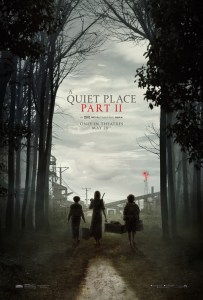 A Quiet Place Part II is the first movie I’ve seen physically in theaters since the middle of March 2020, and I genuinely missed the experience. It’s been the longest I’ve ever gone in my adult life without seeing movies in the theater, and this was one that felt like the presentation would be elevated by the big screen and superior sound system. Taking place nearly minutes after the conclusion of the 2018 hit, the surviving Abbott family ventures off their farm to find refuge and potentially find a way to protect themselves and neighboring communities from the killer monsters attracted to noise. The opening is the only flashback we get; everything else is forward-looking. I would have enjoyed getting more Day One experiences where the monsters first attacked, especially as we become open to new characters and their own harrowing journeys. The movie, written and directed by John Krasinski, isn’t quite as novel and brilliantly executed as its predecessor, but it’s still a strong sequel that gives you more while leaving you wanting more by the end. The majority of this lean 97 minutes is split between the family, one half staying put in a warehouse basement, and the other traveling out into the open to find a radio tower. The set pieces are still taut though rely more on jump scares this go-round, granted well executed jump scares that still got me to jolt in my seat and squeeze my girlfriend’s hand a little tighter. Cillian Murphy (Batman Begins) is the most significant addition as an Abbott family friend who has lost his whole family since that opening flashback. He’s a broken-down man, a parallel for Krasinski’s father figure from the first film, and at points it feels like he’s being set up to appear sinister, or at least hiding some dark secret that never really comes to fruition. The world building is expanded and introduces a very Walking Dead-familiar trope of desperate people being just as dangerous as deadly monsters, though in a world of hearing-enhanced creatures, I would think there’s more danger in larger numbers than security. The movie earns its triumphant ending even if the staging, and cross-cutting, is a little heavy-handed. A Quiet Place Part II is a successful sequel that understands the unique appeal of its franchise and how to keep an audience squirming while also remain emotionally involved and curious for more.
Nate’s Grades:
Spiral: C
A Quiet Place Part II: B+
Share this:

A Quiet Place (2018)
 I’m going to write a sentence I’ve never written in my history of writing about film: make sure you get all the gas out of your system before sitting down to watch A Quiet Place in the theater. This intense little thriller relies upon a nearly silent film experience which makes you, in the audience, hyper aware of just about every little noise permeating your surroundings. Munching popcorn, opening candy wrappers, brief coughs, you’ll become highly attuned to the faintest of noises. This is why you, dear reader, should be advised to make sure you have no bodily gasses stored in your system. Unless that’s your plan all along, to break the tension with a well-timed expelling of flatulence, going from screening to screening, finding new purpose with being that guy, eating plates of beans in preparation for the long withholding. With all that being said, A Quiet Place is an ingenious little thriller with near flawless execution.
It’s over a year into a world overrun by monsters that are trained to attack the smallest of sounds. What’s left of humanity has had to adapt to a very quiet way of life. The Abbott family has ironically be given a head start to adapt into this scary new world that prioritizes silence. Lee (John Krasinski, also co-writer and director) and Evelyn (Emily Blunt) have a daughter, Regan (Millicent Simmonds), who is deaf, so the family has learned to communicate via sign language. The family walks barefoot on paths of sand and resides in a farmhouse on the edge of a rural community. The Abbott clan is still overcoming the loss of their youngest child who, at and innocent and naïve four years old, was taken by the monsters. Now Evelyn is expecting a new child and the Abbotts must stick together if they are going to survive.
 A Quiet Place is a brilliantly simple concept that’s exceptionally well developed and executed. Using the very concept of sound itself as the monster, or the prelude to the monster, is so clever and completely relatable. It trains the audience to fear sound itself. It also serves the role of placing the audience in a hyper aware state of continuous dread. Any little sound we deeply dread, and there are so many ways to make sound in this world above a whisper. The emptiness of the aural landscape creates a template to build upon, so that any small noise feels like an alarm to the sense. The gripping sound design brings a sense of the looming dangers as we hear the thundering claps and crashes of the monsters approach. Krasinski also very cleverly communicates the world from Regan’s deaf perspective. When the camera focuses on her, the sound levels drop entirely, and then when another character is onscreen, they rise back up. It’s an extremely effective and smart way to drop the audience into her vulnerable position.
This is a movie that sets up the stakes upfront. A young child dies for doing something stupid but entirely in character for a young child (whom I’m assuming never personally encountered these creatures). A Quiet Place establishes immediately that this new world is unforgiving of mistakes. A distracted mind, a false step, a sudden impulse, and anyone can be gone forever.
Like the similarly themed Don’t Breathe, the fun is setting up the world, the playing space, and the rules, and then watching it all play out. A Quiet Place does a great job of establishing its world and surroundings and once the action hits midway through it doesn’t let up until the end credits. Fortunately, the thrills never get old too because Krasinski and the other screenwriters, Bryan Woods and Scott Beck, keep finding new and intelligent challenges to explore. The pieces all add up and the details make this world feel extremely well realized, from the marked squeaky floorboards to the routines if separated to the colored warning lights. The tension is already at a constant simmer from its very effective opening sequence that sets the mood. A simple exposed nail on a stair can be a returning point of tremendous uncertainty time and again. The very presence of a pregnancy with a looming due date feels like a bomb waiting to explode. How in the world will a baby be born in a world that punishes sound? I watched this movie with my hand covering my mouth for a far majority of it. Even the jump scares feel well distributed and earned in this movie. Mostly, it’s a film that makes you twist in that delicious sense of anxiety as you wait. It’s nerve-rattling in the best possible way.
 Another aspect of what makes the film so worthwhile that won’t get as many headlines is how well developed it is as a drama about a family overcoming grief and guilt. Each member of the Abbott family feels some level of blame for the tragedy and is punishing his or herself. In a way, the events of the film are about processing that grief and handing over the protection of the family. It’s an unspoken shroud that hangs over the entire family, you can see it on their faces, with the heaviness in their eyes, and in their day-to-day anxiety. The film does a great job through the character of Marcus (Noah Jupe), the middle child, of showcasing how this terrifying new normal would affect and fray one’s psyche. He’s petrified with fear and consumed with the scary burden of having to ascend into the role of protector and provider that his father is trying to groom him for when the inevitable comes. The happy version of “the inevitable” is Evelyn and Lee growing old and feeble. The more realistic version is the two of them at some point being felled by these murderous monsters. When Marcus is given a moment to let his guard down, to not worry about the volume of his voice, it’s a sweet father/son moment of bonding that feels entirely fulfilling as well as insightful about this new, peculiar way of life.
A central conflict is the friction between Regan and her father and their desire to understand and empathize with one another. The film’s biggest emotional moment is the conclusion of this, and it feels so fully earned and poignant that even typing it out now stirs me. It’s the culmination of a well-structured screenplay that has found its moments for character development in a nearly silent movie, so that when declarations are made, even with the monsters and its creepy gimmick, you’ll still feel something. These characters matter and their struggles are universal and emotionally appealing. The acting all around by the young children and Krasinski and Blunt is completely believable and engaging.
 For a relatively low-budget thriller, I was surprised how much of the monsters we actually saw onscreen. Krasinski still prefers to keep his monsters on the peripheral or in the background, letting the audience’s imagination fill in the horrifying rest. That’s where I thought the movie would stay, but it does not. There are several close-ups of the creatures at work, a mass of teeth and auditory sensors. Their heads open up like blossoming flowers. I know the designs are CGI and yet they looked very realistic, as realistic as a fanciful monster can, naturally. It had the sheen of practical effects, which is the best compliment. The monsters reminded me of the Cloverfield creatures mixed with the Pitch Black aliens. It’s a spooky design and under Krasinski’s attention the menacing creatures never stop being scary.
Who knew John Krasinski had this in him? The affable actor best known for portraying Jim Halpert on the long-running American version of The Office has directed before, an adaptation of a David Foster Wallace book and an indie family dramedy. He’s never ventured into genre filmmaking before. But then again, neither had fellow funnyman Jordan Peele, who came out of nowhere in 2017 with Get Out and rode that to box-office riches, critical acclaim, and an Oscar for Best Original Screenplay. Maybe more performers we view simply through the lens of comedy have tremendous potential to be genre virtuosos. A Quiet Place is not an outright silent movie but one where silence is most keenly felt. The simple premise is beautifully realized, the characters and their plights are affecting, the details are fully thought through (though newspaper publishing is questionably late into this sound apocalypse), and the structure is smartly placed and paced. If you’re looking for a suspenseful, intense, and invigorating movie, A Quiet Place feels like a work out for the senses.
Nate’s Grade: A-
Share this:

Detroit (2017)
 Something akin to an art house exploitation film, Kathryn Bigelow’s Detroit is a pressure cooker about the horror of institutional racism, but it’s also a limited drama that lacks any sense of catharsis for an audience. Set among a hellish series of days in 1967, the film follows the events at the Algiers Motel, where Detroit police officers killed three innocent black men in their pursuit of what they believed to be a sniper. An all-white jury then acquitted the officers. Will Poulter (We’re the Millers) plays the lead racist cop and instigator, the man who tries using every effort to get a confession. His bad decisions lead to further bad decisions and miscommunication and then cold-blooded murder. It takes a solid 45 minutes to establish the various supporting characters, the fragile tinderbox that is Detroit during a series of riots, and getting everyone to the fateful motel. Afterwards, it’s like a real-time thriller that’s extremely harrowing to watch. It’s very intense and very well made by Bigelow and her go-to screenwriter Mark Boal (Zero Dark Thirty). Like Get Out, it turns the day-to-day black American experience into a grueling horror film. I was squirming in my seat and felt nauseated throughout much of the movie. I wanted to scream at the screen and tell people to stop or run away. However, it’s a movie with a lower ceiling, whose chief goal is to provoke primal outrage, which it easily achieves, but it feels like there’s little else on the artistic agenda. The characterization can be fairly one-note, especially with the racist cops who stew over white women hanging around virile black males. It’s victims and victimizers and we get precious little else. Your blood will boil, as it should, but will you remember the characters and their lives, their personalities, or mostly the cruel injustices they endured? It’s an intense, arty, exploitation film, and I can perfectly understand if certain audience members have no desire to ever watch this movie. It’s not so much escapism as a scorching reminder about how far race relations have come and have yet to go in this country. Detroit is a movie with plenty of merits but I think it’s the least of the three major Bigelow-Boal collaborations.
Nate’s Grade: B
Share this:

13 Hours: The Secret Soldiers of Benghazi (2016)
 Michael Bay is the kind of filmmaker that naturally attracts negative attention and derision, so when he fast-tracked a movie about the Benghazi embassy attacks, and in a presidential election year too, there were plenty that cried foul. Bay’s not exactly known as the subtlest filmmaker, and many feared a Benghazi movie under his guidance would only reaffirm the worst. 13 Hours: the Secret Soldiers of Benghazi (a subtitle that never appears in the movie, by the way) is a surprisingly serious and generally apolitical action movie that reaffirms the strengths and weaknesses of Bay as a filmmaker.
On September 11, 2012, an armed mob stormed an American outpost in Benghazi, an attack that left four Americans dead. After Libya had toppled its decades-long autocrat, a power vacuum emerged and militants filled its place. An unclassified CIA annex in Benghazi was established to track the possible sale of munitions from the old regime. The CIA chief, Bob (David Constabile), has been forced to hire a security team of former Army Rangers and Navy Seals to protect his agents. Jack Silva (John Krasinski) is a family man reuniting with his old pal Tyrone “Rone” Woods (James Badge Dale), the head of the hired security team. The other guys (Pablo Schreiber, David Denman, Dominic Fumusa, Max Martini) welcome Jack, explaining the rising tensions in Benghazi and how they’re generally frustrated by the CIA know-it-all attitudes. They’re wary of the State department outpost for Ambassador Chris Stevens (Matt Letscher), wary of the security detail watching him, and wary of the Libyan local forces providing assistance. Flash forward to the night of the attack and Rone and his team are stymied in their early attempts to rescue the ambassador. Afterwards, the focal point of the fight shifts to that very CIA annex and one hellish night of intense combat.
 This is Bay’s return to the realm of more “serious filmmaking,” a world he hasn’t considered since 2001’s lackluster Pearl Harbor, and while the standard Bay elements of boom are present and accounted for, the drama doesn’t stack up to the action. First, the good news is that the action in 13 Hours is often thrilling, beautifully staged and photographed by Dion Beebe (Collateral), and unlike Bay’s Transformers films, easy enough to follow along. It’s a chaotic incident where plans and communication are broken down, but Bay is able to keep the geography and the immediate and secondary goals of each action sequence clear. While the storming of the embassy isn’t quite as nerve-racking as Argo, it’s still plenty thrilling and communicates the fog of war and dawning horror of those trapped on the inside. The centerpiece is the attack on the CIA annex, which both sides anticipate and prepare for. It establishes the geography of the field of combat, the different access points, and the most likely ambushes. From there, it’s our outnumbered professionals versus a horde of armed Libyans, a standoff reminiscent in classic Hollywood action cinema. Over the course of those titular 13 hours, our security force faces wave after wave of attacks, each once becoming more sophisticated and bringing heavier firepower. Bay’s camera captures the explosions and gunfire in his usual balletic decadence. Say what you will about the man and his jingoistic tendencies, but he’s an ace visual stylist who bathes a sheen of popcorn entertainment to visceral struggle. When the action is heated, that’s when 13 Hours packs its most powerful punch.
Unfortunately, there are lulls in between the fighting, and it’s during these moments that we realize how poorly written our characters are. With the battle looming ahead, the mitigated character development emphasizes easy clichés we’ve come to expect, like the family man who needs to realize his family should come first, etc. These six guys are little more than stock characters on the screen, differentiated more by appearance and the occasional reading material than any significant personality differences. The dialogue is also rather clunky, falling too often upon tough guy speak to make up the difference. The way I was able to separate them in my head was through the actors’ previous roles (“There’s Pornstash, there’s Roy from The Office, there’s the guy from The Pacific who was the bad guy in Iron Man 3, and boy did Jim from The Office get buff”). Krasinski (Aloha) is the audience’s entry point into this world and given the most attention, so he’s ostensibly our main protagonist. He’s a strong presence to anchor the film despite the character’s shortcomings. I enjoyed watching Krasinski in such a different sort or role and started thinking about he and his wife, Emily Blunt, must have traded workout regiment advice. “Jim from The Office” with a six-pack is a surprising sight.
There’s a strange defining conflict for the first hour of the movie, namely Bay and Hogan narrowing personal clashes down to a slobs vs. snobs mentality of war. Bay has a history of fetishizing machismo and military hardware, so it should be no surprise that his movie lionizes the beefy, strapping military men serving as security. They’re placed against the eggheads of the CIA, who take every moment to remind our burly, bearded security guys that they were educated at Ivy League schools and know so much more about the Middle East. They often sound haughty when they’re scolding the security force for interfering even when it’s clear they’re saving their lives. The perspective aligns with the idea that the military-experienced, no-nonsense men of action are being ignored and looked down upon by the CIA ninnies who look at them as unnecessary babysitters. Naturally, with the hindsight of history, we know the concerns of Rone and his guys will be vindicated and the CIA snobs will be grateful they had these blue-collar American heroes. The entire role of Bob is to condescend and ignore our guys and their warnings. Bob even says early in his introduction that he’s on the brink of retirement and they won’t ruin it for him. Until the attack on September 11, we’re stuck with this reductive class warfare clash.
Another interesting aspect is that the movie makes use of its audience’s relative ignorance when it comes to the specific people involved in the Benghazi firefight. I doubt that many people know the names of the four victims excluding Ambassador Stevens. Because of that uncertainty we don’t know which of our six security characters will live, and the screenplay seems to know this, which is why it takes time to present each of the six with some sort of looming tragic back-story. We have multiple characters sending loving messages to their young children, learning they’re wife is pregnant, and making all sorts of “final” decisions, the kind that set up these characters in most movies for an early demise (if you write your girl during war or talk about your post-retirement plans, you’re guaranteed to die). I was slightly amused that the movie established each character to have a moment where it potentially sets up this tragic outcome.
 One of my big questions walking into Bay’s Benghazi movie was exactly whose version of events was the story going to follow. After eight congressional investigations, and a prominent Republican slipping by admitting one of the guiding purposes is to tarnish Hilary Clinton as a presidential candidate, I was worried that the movie was going to be a hacky, manipulative promotion of propaganda. There’s a reason that eight congressional investigations, including one that has lasted longer than Watergate, don’t seem to satisfy those calling for blood: they keep coming to the same inconvenient conclusions, namely that there was no stand down order, no conspiracy, no cover-up. There’s been a flurry of rightwing fury brewed over stoking unfounded rumors of conspiracy with Benghazi; it’s a fundraising industry unto itself for politicians. Therefore, I was initially worried that the movie was going to reinforce a version of events that eight (and counting?) congressional committees have refuted. I was relieved then that Bay’s movie keeps its focus pretty much squared on the heroism of the security team. In a way it reminded me of Black Hawk Down as it strived to recreate a series of harrowing life-and-death events with its focus more on the brotherhood and bravery of the ones in harm’s way rather than the broader political context. There is the infamous “stand down” order; however, it’s played almost incidentally, as Bob is trying to process all the chaos unfolding and the best recourse. As presented, it doesn’t sound like “stand down and let them die,” and more, “wait and let me think for a minute.” The fight to get air support from Italy doesn’t mention the fact that those Italian fighter jets sitting on the runway were not combat ready and were for flight training. There’s only one other passing dialogue exchange that touches the political, when the guys recount that the news is telling them it was a protest, which they scoff at and then let it go. That’s it. I imagine the audience that would be most excited for a Benghazi movie will be deflated. For everyone else, the sidestepping of politics lets the movie stand on its own better.
An article from Vox.com raises the issue of whether any movie about Benghazi can possibly be apolitical. It appears like the topic of Benghazi has been so cravenly politicized that any rendition of the events of that fateful day will reinforce or contradict some narrative, be it the security contractors, the CIA, the politicians on both sides of the aisle. And the absence of what others declare with certainty will only make those same people cry “cover-up.” It’s a shame that this topic is so radioactive that an objective approach celebrating the courage of those involved, mourning the loss of life, and asking for better from those in power seems impossible given the current divisive political environment. Did it have to come to this? Bay’s Benghazi is easily his most restrained movie in his bombastic career, paying reverence to the people who paid the ultimate sacrifice. The action is well staged and often visually striking, but Bay wants this movie to be more than a series of escalating action sequences. You feel he wants this to be his version of a Zero Dark Thirty-style thriller. Except it’s not. You watch the movie and sense there’s a more intelligent, nuanced, and ambiguous movie here that can make cogent points about foreign policy and the state of the Middle East. This is an action movie where the good guys shoot the relatively faceless bad guys. 13 Hours is an acceptable action movie but that’s all it ever asserts to be. Is that enough after all?
Nate’s Grade: B-
Share this:

Promised Land (2012)
 Actors Matt Damon and John Krasinski co-wrote Promised Land, which has been labeled as the anti-fracking movie. I wish. While it does take a suspicious view of the practice of extracting natural gas via high-powered underground water jets laced with chemicals, the movie feels too timid to really land home its points, settling on a familiar narrative of the redemption of one man working for The Man. The character development feels like it happens overnight rather than through a gradual process. Damon begins as a corporate raider, a guy selling false hope to the economic downtrodden, and ends up an altruistic environmental fighter. I mostly found him to be a pompous jerk. The scenes with Damon squaring off against Krasinski, an environmental activist, are easily the best, giving the movie a bristling energy it otherwise lacks. Krasinski provides a fine foil and some snappy competition until a late preposterous plot turn muddies everything up. I feel like the writers, as well as director Gus Van Sant, wanted to lure in wary moviegoers with something more broadly appealing (the evolution of one man) versus a more alarmist, message-heavy movie. That’s fine, but at least give me a better story. Promised Land even falls into the trap of having he Damon/Krasinski competition come down to a woman (Rosemarie DeWitt) they both fancy. Because otherwise it wouldn’t feel serious, right? It’s a solidly acted movie, with some nice turns by veterans like Frances McDormand and Titus Welliver (TV’s Lost), but the movie just doesn’t live up to the promise of its potential.
Nate’s Grade: B-
Share this:

Away We Go (2009)
 Away We Go sort of came and went in the blink of an eye over the summer. Some critics dinged the indie production as being insufferable, hipster, smug, and unlikable. I agree that the plaintive guitar-strumming score grates, and the costumes have that trying-hard-not-to-be-hip coolness, which can be insufferable, but Away We Go is more than just faulty hipster packaging. There is a moving and entertaining drama inside here. The problem is, you have to sift through some of the junk to reach it.
Burt (John Krasinski) and Verona (Maya Rudolph) are in their early thirties and about to have a baby. They aren’t exactly hipsters but they have been living a somewhat fringe existence; Verona even points out that they have a cardboard window. Their existence has been mostly ramshackle and now its about to change forever. Burt and Verona decide to journey across the country and reunite with family and old friends. They’re studying widely different family units across the country to discover not just what kind of parents they will be but what kind of family they will be.
Just by the fact that nobody dies at the end, this is a big departure for director Sam Mendes (American Beauty, Revolutionary Road). This low-key road trip comedy is quite different from the meticulous prestige pictures associated with the Mendes name. Away We Go is a scruffy, small, and disarming little picture that wants to say something. I was taken aback at how affecting I found moments of Away We Go, though it is only moments. Burt and Verona are not exactly the best equipped to start a family right now, which makes them anxious and nervous, and anxious about not being more nervous. They haven’t exactly matured much since graduated college years ago. But amidst their search for the definition of a “working family” they must accept the uncertainty of life. Burt and Verona have a comfortable interaction, from his upbeat sarcasm to her grounded realism. There’s a great running gag where Burt tries to raise the baby’s heart rate, so his goofy bouts of fake agitation will be immediately followed by a stethoscope and an adorable grin of satisfaction. They are a compatible couple and it is refreshing to see a movie couple that compliments each other in personality. They actually love each other, are good for one another, and are not beset with contrived conflicts. In fact, the movie ends up pretty much exactly where it began, only with a smattering more of wisdom. The lesson learned in Away We Go is that it doesn’t matter what the bumps in life may be, it’s all about who you have as your co-pilot.
 Screenwriters and married partners, Dave Eggers and Vendela Vida, mix in small moments of weight and an overall tone of genial sweetness. The drama and the comedy are given equal share of the script, though the elements don?t mix that often. The funniest moment, by far, is when a little boy tells his mother exactly what he knows about babies (I won’t spoil the guffaw-inducing surprise). There are some quiet yet weighty moments of human observation here. There was a tender exchange between Verona and her sister Grace (Carmen Ejogo) that had me on the verge of tears. The sisters reminisce about their parents, long dead, and then Grace says that having this baby keeps their parents alive; the sisters can see parts of their mother in the baby’s face. Verona is giving back life to her dearly departed mother and keeping her parents’ legacy ongoing. This lovely thought struck me with such sudden force that I felt overcome with emotion. It could be dismissed as a common sense fact of genetic proliferation, but I had never thought of the birth of a child as a means of keeping the past alive and honored. To me, this is a simple yet wonderful and powerful statement. Another great moment is when Burt and Verona make lifelong promises to each other on a trampoline. Verona doesn’t want to marry, so the scene is the equivalent of the two lovebirds exchanging vows. It’s heartfelt and sincere and well within the bounds of the characters.
What?s frustrating to me is that the movie?s poignancy is undercut by its excisions with grotesque cartoon versions of bad parents. Burt and Verona visit different imperfect family units, but it isn’t until the end of the movie where we see anything resembling a semi-authentic brood. Alison Janney plays an obnoxiously loud parent who berates her children for laughs and accepts the brokenness of children; to her, she can’t fight against genetics and thus gives up parenting. On the flip side, Maggie Gyllenhaal plays a narcissistic earth mother who still nurses her children and condemns the very idea of strollers (“I love my babies. Why would I want to push them away?”). In each case, the depicted family is a caricature and readily ridiculed for some easy and snide laughs. Even Burt’s parents (Jeff Daniels, Catherine O’Hara) are figures set to be mocked for their self-absorbed bourgeois values. In some ways, Away We Go started to remind me of that awful movie North, where a young Elijah Wood travels the globe in search of new parents. At each stop, Wood encounters broad caricatures of different family units. In Away We Go, half of the movie is spent palling around with repulsive idiots who overstay their welcome fast. What’s even more frustrating is that the script becomes locked into a pattern, meaning that we spend the same amount of time (10-15 minutes) with each family. This is not helpful when Burt and Verona finally reach the relatable families, in Montreal and Miami, then the movie shortchanges the palpable drama. In Miami, Burt’s brother has had his wife run out on her family, abandoning their daughter. We’ve finally reached interesting and complex character, each with an aching sadness just below the surface about the hardships of parenthood, and the movie has to keep on moving because we spent too much time with the crazies for easy laughs. You’re supposed to spend more time with the good stuff, not the bad.
 The noisy, exaggerated supporting characters are balanced by the believably baffled Krasinki (TV’s The Office) and Rudolph (Idiocracy). He’s effortlessly charming and Rudolph plays her character with subdued texture, uneasily taking everything in for due consideration. Both actors are likable and we grow in empathy with them as they go from stop to stop. The couple is so charismatic that it makes the drama-free reality of functionality forgivable. The rest of the cast play their parts to the hilt, but special consideration should go out to Melanie Lynskey (The Informant!, Heavenly Creatures) who plays the mother of a large adopted clan of kids in Montreal. Her problem is that she cannot conceive and she’s endured five horrible miscarriages. Her slow and melancholy dance around a stripper’s pole is heartbreaking, and that?s something I thought I would never write in my life.
Despite some missteps, Away We Go is a sweet and affectionate little movie that fights against being overly twee and precious. It’s definitely not sentimental but at the same time it rejects cynicism and detached irony, embodied by the compatibility of a couple that truly love each other. At the same time, the movie can be annoying with its loud side characters that act as distractions. The best moments in Away We Go are the small ones centered on Burt and Verona. It’s those handful of small moments that pierce your heart. It’s strange but after writing this review, I realize that I like the good moments even more and the bad moments even less. It’s like Away We Go has become more entrenched in my mind. This is a sometimes promising, sometimes frustrating, drama that knows enough about life to not settle for easy answers. If only it didn’t settle for easy jokes with stupid characters.
Nate’s Grade: B+
Share this:

License to Wed (2007)
 Someone just tell Robin Williams to stop already. This painful and dated movie exists in another realm, a realm too fanciful and bizarre to exist even in sitcoms. The characters are all unlikable nitwits and I could not suppress to urge to want to dropkick William’s astoundingly annoying pre-teen sidekick. This implausible and puerile comedy is like an enema for the brain; it will wipe you clear out. The PG-13 movie regularly wades in tired pee and fart jokes, sometimes combing the two, but what really irritates me is how lazy the whole enterprise is. Williams makes a joke about O.J. killing his wife. I repeat, in the year 2007, Williams makes a joke about O.J. killing his wife. How topical and cutting edge. This whole movie induces one long, never-ending exasperated sigh from anyone that appreciates good comedy. If it weren’t for casual cameos by stars of NBC’s TV show The Office, this film would be totally worthless. As it is, License to Wed is yet another nail in Williams’ comedy coffin.
Nate’s Grade: D
Share this:

Kinsey (2004)
 Bill Condon’s probing, fascinating biopic of Indiana University sex pioneer Kinsey (Liam Neeson) could not come out at a more important time. Kinsey lived in the Dark Ages of sexuality and fought against what he saw as “morality disguised as fact.” Kinsey broke barriers studying the science of sexuality and gathered nationwide statements to amass the first thorough book on what’s under the sun and what’s going on under the sheets. Today, we live in a splintered world where people listen to information that affirms their beliefs, and tune out contradictory evidence even if it’s fact (look at the latest report on abstinence-only programs dishing out highly erroneous information). Kinsey railed against this dangerous line of thinking. The man was no saint and had issue comprehending some of the more complicated human emotions. Kinsey is exceptionally well acted and Neeson gives a career best performance. Kinsey is fearlessly graphic in its frank discussion but also enormously intelligent. The fact that conservative groups are actually protesting it shows that Kinsey’s work is far from over.
Nate’s Grade: A-


 nathanzoebl
You must be logged in to post a comment.