Blog Archives
Eddington (2025)

I’ve read more than a few searing indictments about writer/director Ari Aster’s latest film, Eddington, an alienating and self-indulgent movie starring Joaquin Phoenix on the heels of his last alienating and self-indulgent movie starring Phoenix. It’s ostensibly billed as a “COVID-era Western,” and that is true, but it’s much more than that. I can understand anyone’s general hesitation to revisit this acrimonious time, but that’s where the “too early yet too late” criticism of others doesn’t ring true for me. It is about that summer of 2020 and the confusion and anger and anxiety of the time; however, I view Eddington having more to say about our way of life in 2025 than looking back to COVID lockdowns and mask mandates. This is a movie about the way we live now and it’s justifiably upsetting because that’s where the larger culture appears to be at the present: fragmented, contentious, suspicious, and potentially irrevocable.
Eddington is a small-town in the dusty hills of New Mexico, neighboring a Pueblo reservation, and it serves as a tinderbox ready to explode from the tension exacerbated from COVID. Sheriff Joe Cross (Phoenix) has had it up to here with mask mandates and social distancing and the overall attitude of the town’s mayor, Ted Garcia (Pedro Pascal). Joe decides to run for mayor himself on a platform of common-sense change, but nothing in the summer of 2020 was common.

Eddington is a movie with a lot of tones and a lot of ideas, and much like 2023’s Beau is Afraid, it’s all over the place with mixed results that don’t fully come together for a coherent thesis. However, that doesn’t deny the power to these indefatigable moments that stick with you long after. That’s an aspect of Aster movies: he finds a way to get under your skin, and while you may very well not appreciate the experience because it’s intentionally uncomfortable and probing, it sticks with you and forces you to continue thinking over its ideas and creative choices. It’s art that defiantly refuses to be forgotten. With that being said, one of the stronger aspects of Aster’s movies is his pitch-black sense of comedy that borders on sneering cynicism that can attach itself to everything and everyone. There are a lot of targets in this movie, notably conspiracy-minded individuals who want people to “do their own research,” albeit research ignoring verified and trained professionals with decades of experience and knowledge. There’s a lot of people talking at one another or past one another but not with one another; active listening is sorely missing, as routinely evidenced by the silences that accompany the mentally-ill homeless man in town that nobody wants to actively help because they see him as an uncomfortable and loud nuisance. For me, this is indicative of 2025, with people rapidly talking past one another rather than wanting to be heard.
When Aster is poking fun at the earnestness of the high school and college students protesting against police brutality, I don’t think he’s saying these younger adults are stupid for wanting social change. He’s ribbing how transparently these characters want to earn social cache for being outspoken. It’s what defines the character of Brian, just a normal kid who is so eager to be accepted that he lectures his white family on the tenets of destroying their own white-ness at the dinner table, to their decidedly unenthusiastic response. I don’t feel like Aster is saying these kids are phony or their message is misapplied or ridiculous or without merit. It’s just another example of people using fractious social and political issues as a launching point to air grievances rather than solutions. The protestors, mostly white, will work themselves into a furious verbal lather and then say, “This shouldn’t even be my platform to speak. I don’t deserve to tell you what to do,” and rather than undercutting the message, after a few chuckles, it came across to me like the desperation to connect and belong coming out. They all want to say the right combination of words to be admired, and Brian is still finding out what that might be, and his ultimate character arc proves that it wasn’t about ideological fidelity for him but opportunism. The very advancement of Brian by the end is itself its own indictment on white privilege, but you won’t have a character hyperventilating about it to underline the point. It’s just there for you to deliberate.

Along these lines, there’s a very curious inclusion of a trigger-happy group in the second half of the movie that blends conspiracy fantasy into skewed reality, and it begs further unpacking. I don’t honestly know what Aster is attempting to say, as it seems like such a bizarre inclusion that really upends our own understanding of the way the world works, and maybe that’s the real point. Maybe what Aster is going for is attempting to shake us out of our own comfortable understanding of the universe, to question the permeability of fact and fiction. Maybe we’re supposed to feel as dizzy and confused as the residents of Eddington trying to hold onto their bearings during this chaotic and significant summer of 2020.
I think there’s an interesting rejection of reality on display with Eddington, where characters are trying to square news and compartmentalize themselves from the proximity of this world. Joe Cross repeatedly dismisses the pandemic as something happening “out there.” He says there is no COVID in Eddington. For him, it’s someone else’s problem, which is why following prevailing health guidelines and mandates irks him so. It’s the same when he’s trying to explain his department’s response to the Black Lives Matter protests that summer in response to George Floyd’s heinous murder. To him, these kinds of things don’t happen here, the people of Eddington are excluded from the social upheaval. This is an extension of the “it won’t happen to me” denialism that can tempt any person into deluding ourselves into false security. It’s this kind of rationalization that also made a large-scale health response so burdensome because it asked every citizen to take up the charge regardless of their immediate danger for the benefit of others they will never see. For Joe, the tumult that is ensnaring the rest of the country is outside the walls of Eddington. It’s a recap on a screen and not his reality. Except it is his reality, and the movie becomes an indictment about pretending you are disconnected from larger society. It’s easier to throw up your hands and say, “Not me,” but it’s hard work to acknowledge the troubles of our times and our own engagement and responsibilities. In 2025, this seems even more relevant in our doom-scrolling era of Trump 2.0 where the Real World feels a little less real every ensuing day. It’s all too easy to create that same disassociation and say, “That’s not here,” but like an invisible airborne virus not beholden to boundaries and demarcations, it’s only a matter of time that it finds your doorstep too.

You may assume with its star-studded cast that this will be an ensemble with competing storylines, but it’s really Joe Cross as our lead from start to finish, with the other characters reflections of his stress. I won’t say that most of the name actors are wasted, like Emma Stone as Joe’s troubled wife and Austin Butler as a charismatic conman pushing repressed memory child-trafficking conspiracies, because every person is a reflection over what Joe Cross wants to be and is struggling over. Despite his flaws and some startling character turns, Aster has great empathy for his protagonist, a man holding onto his authority to provide a sense of connectivity he’s missing at home. Our first moment with this man is watching him listen to a YouTube self-help video on dealing with the grief of wanting children when your spouse does not. Right away, we already know there’s a hidden wealth of pain and disappointment here, but again Aster chooses empathy rather than easy villainy, as we learn his wife is struggling with PTSD and depression likely as a result of her own father’s potential molestation. This revelation can serve as a guide for the rest of the characters, that no matter their exterior selves that can demonstrate cruelty and absurdism, deep down many are processing a private pain that is playing out through different and often contentious means of survival. I don’t think Aster condones Joe Cross’ perspective nor his actions in the second half, but I do think he wants us to see Joe Cross as more than just some rube angry with lockdown because he’s selfish.
It’s paradoxical but there are scenes that work so splendidly while the movie as a whole can seem overburdened and far too long. The cinematography by the legendary Darius Khnodji (Seven, City of Lost Children) expertly frames and lights each moment, many of them surprising, intriguing, revealing, or shocking. There can be turns that feel sudden and jarring, that catapult the movie into a different genre entirely, into a Hitchcockian thriller where we know exactly what the reference point is that I won’t spoil, to an all-out action showdown popularized by Westerns. Beyond Aster’s general more-is-more preference, I think he’s dabbling with the different genres to not just goose his movie but to question our associations with those genres and our broader understanding of them. It’s not quite as clean as a straight deconstructionist take on familiar archetypes and tropes. It’s more deconstructing our feelings. Are we all of a sudden in a forgiving mood because the movie presents Joe as a one-man army against powerful forces? It’s all-too easy to get caught up in the rush of tension and satisfying violence and root for Joe, but should we? Is he a hero just because he’s out-manned? Likewise, with the conclusion, do we have pity for these people or contempt? I don’t know, though there isn’t much hope for the future of Eddington, and depressingly perhaps for the rest of us, so maybe all we have are those fleeting moments of awe to hold onto and call our own.

Eddington is an intriguing indictment about our modern culture and the rifts that have only grown into insurmountable chasms since the COVID-19 outbreak. It’s a Western in form pitting the figure of the law against the moneyed establishment, and especially its showdown-at-the-corral climax, but it’s also not. It’s a drama about people in pain looking for answers and connections but finding dead-ends, but it’s also not. It’s an absurdist dark comedy about dumb people making dumb and self-destructive decisions, but it’s also not. The paranoia of our age is leading to a silo-ing of information dissemination, where people are becoming incapable of even agreeing on present reality, where our elected leaders are drowning out the reality they don’t want voters to know with their preferred, self-serving fantasy, and if they just say it long enough, then a vulnerable populace will start to conflate fact and fiction. I don’t know what the solution here is, and I don’t think Aster knows either by the end of Eddington. I can completely understand people not wanting to experience a movie with these kinds of uncomfortable and relevant questions, but if you want to have a closer understanding of how exactly we got here, then Eddington is an artifact of our sad, stupid, and supremely contentious times. Don’t be like Joe and ignore what’s coming until it’s too late.
Nate’s Grade: B
Share this:

Joker: Folie à Deux (2024)
 Movie musicals can be sweeping, invigorating, and at their very best transporting, They mingle the high-flying fantasies and visual potential of cinema, and we’ve gone through many waves of kinds of musicals. Today, we’re in an outlandish world of the outlandish musical, an experience in ironic air quotes, where stories that you never would have thought could be musicals would then dare to be different and attempt to be musicals. The much-anticipated Joker sequel, Folie a Deux, dares to be a challenging jukebox musical of old favorites. The French movie Emilia Perez tells the story of a cartel leader that undergoes a sex change and tries to do good with her second life. Both movies are deeply interesting messes as well as experiences I don’t think actually work as musicals.
Joker 2, which I will be referring to it as for the duration of this review mostly because I don’t want to type out Folie a Deux, and not due to some explicit dislike of the French, is a fascinating misfire that comes across as downright disdainful of its audience, its studio, and its very existence. The last time I felt this way from a sequel was 2021’s Matrix Resurrections, another fitfully contemptuous movie that was alienating and self-erasing and also from Warner Brothers. The first Joker movie in 2019 was a surprise hit, grossing over a billion dollars, which meant that the studio wasn’t going to sit idly by and not force a sequel for a movie clearly intended to be one complete movie. While the first movie cost a modest $50 million, the sequel cost close to $200 million, with big pay days for Joaquin Phoenix, Lady Gaga, and co-writer/director Todd Phillips, who I have to remind you, dear reader, was actually nominated for a Best Director Oscar in 2019. Having gotten their paydays, it feels like Phillips and his collaborators have set out to scorch all available earth, going so far as to even insult fans of the earlier movie. Add the bizarre musical factor, and I don’t know how else to describe Joker 2 but as an alienating and miserable protracted exercise in self-immolating artistic hubris. It’s so rare to see this level of artistic clout used to proverbially stick a finger in the eye of every fan and studio exec who might have hoped there could be something of value here.
 Let’s tackle the plot first, as we pick up months after the events of the 2019 film where lowly Arthur Fleck (Phoenix) is being tried for the murders he committed, most famously on a TV talk show where he debuted his stand-up comedian persona as Joker in full regalia. There’s an (un)healthy contingent of the rabble that idolize Arthur, finding the Joker to be some kind of mythic hero of class-conscious revolution, pointing out how society is failing all the little guys getting crushed by the rich and powerful and privileged, like that dead Wayne family. One of those fans is Lee (Gaga), a.k.a. Harleen Quinzel, a disturbed young woman obsessed with getting closer to Arthur, and he is extremely appreciative of the fawning attention. The defense case hinges upon whether or not Arthur was acting on his own accord or had a psychotic break, disassociating as “Joker,” and thus cannot be held accountable for the murders. Except it seems “Joker” is all the people of Gotham want to talk about, whether it’s the media or the public, and what about poor lonely Arthur?
If I had to fathom a larger thematic point, it feels like Phillips is trying to put our media ecosphere and comics fandom into judgement. He’s pointing to his movie and saying, “You wouldn’t have cared nearly as much about this project had it just been some other spooky, disturbed man losing his sanity and lashing out. You only care because he would eventually become the notorious Batman villain or lore, and that’s why you’re back.” Well, to answer succinctly, of course. When your movie’s conceptual conceit is all about providing a gritty back-story for a famous supervillain, don’t be surprised when there’s more attention and interest. This would be the same if Phillips had made a searing drama about teenage nihilism and easy access to guns and then called it Dylan Klebold: The Movie (one half of the Columbine killers, if you forgot). Stripping back layers to provide setup for a famous killer will always generate more interest than if it was some fictional nobody. It’s an accessible starting point for a viewer and there’s an innate intrigue in trying to answer the tantalizing puzzle of how terrible people got to be so terrible.
I found the 2019 movie to be a mostly interesting experiment without too much to say with its larger social commentary. It felt like Phillips relied a bit too heavily on that assumed familiarity with the character to fill in the missing gaps of his storytelling. It was a proof of concept for that proved successful beyond measure (a billion dollars, 11 Oscar nominations, including THREE for Phillips). This time, Phillips is taking even less subtlety with his blowtorch as he actively annihilates whatever audiences may have enjoyed or appreciated in the first movie.
 And in order to fully appreciate the scope of this movie’s active distaste for its own existence, I’ll be treading into some major spoilers, so jump forward a paragraph if you wish to remain unspoiled, dear reader. The conclusion of this sequel is a miserable succession of hits that degrades Arthur. At the conclusion of the 2019 original, at least you could say he was becoming a more realized version of what he wanted to be, albeit a disturbed murderer, but one who became the face of a revolution and gained a legion of adoring followers that he desperately craved. At the end of Joker 2, Arthur pathetically admits in his trial there is no alternate Joker persona and that he’s just a sad loser. Then Lee admits that she was only ever interested in “Joker” and wants nothing to do with Arthur the sad loser. And then upon returning to prison, another inmate confronts Arthur, apparently feeling personally betrayed for whatever reason. This irate prisoner stabs Arthur to death and then laughs in a corner, slicing a smile into the sides of his mouth, Heath Ledger-style. The movie literally ends with Arthur laying in a pool of his own blood, staring dead-eyed into the camera, with Phillips metaphorically painting emphatically at his corpse and defiantly saying, “Look, he’s not even the Joker now! Do you still care? Do you?” These movies were designed to be the untold history of the man who would be Joker, and they now have ended up being four hours about the guy whose idea maybe inspired a criminal lunatic to improve upon what he felt was another guy’s brand. What’s even the point? We followed two movies about the guy who isn’t the Joker? Seems pretty definitive there won’t be a third Arthur Fleck movie, as there’s nothing left for Phillips and his anarchic collaborators to demolish to smithereens.
When I heard that Joker 2 was going to be a musical, I actually got a little excited, as it felt like Phillips was going to try something very different. Now the curse of many modern movie musicals is trying to come up with an excuse for why the world is exploding in song and dance, like 2002’s Chicago implying it’s all in Roxy’s vivid imagination. Joker 2 takes a similar approach, conveying that when Arthur is breaking out into song that it’s a mental escape for him, that it’s not actually happening in his literal reality. Except… why are there sequences outside Arthur’s point of view where other characters are breaking into song, notably Lee? Is this perhaps a transference of Arthur’s perspective, like he’s imagining them on the outside joining him in tandem? The concept fits with his desperate desire to forge meaningful human connections with people that see him for who he is, and having another character harmonize with him provides a fantasy of validation. Except… there’s no meaningful personal connection between Arthur and the allure of movie musicals. It’s not like he or his domineering mother, the same woman he murdered if you recall, were lifelong fans of musicals and their magical possibilities. It’s not like 2001’s Dancer in the Dark where our lonely protagonist dreamed of being in a movie musical as an escape from her depressing life of exploitation and poverty. It just happens, and you’re listening to Phoenix’s off-putting, gravelly voice straining to recreate classics like “For Once in My Life” and “When You’re Smiling (The Whole World Smiles With You).” It’s also a criminal waste of a perfectly game Gaga.
 Phillips’ staging of his musical numbers are so lifelessly devoid of energy and imagination. Most of our musical numbers are merely in the same setting without any changes besides now one, or occasionally two, characters are singing. There’s one number that becomes a dance atop a roof, and several duets that appear like a hammy Sonny and Cher 1970s variety TV show, and that’s all you’re getting folks in the realm of visual escapism and choreography. In retrospect, it feels like the musical aspect of the sequel might have been a manner to pad it to feature-length, adding 16 performances and over 40 minutes of singing old standards. There’s a good deal of repetition with this sequel, as much of the plot is restating the events of the first film; that’s essentially what the courtroom drama facilitates as it trots out all the previous characters to recap their roles and point an accusatory finger back at Arthur.
There is one lone outstanding scene in Joker 2, and it happens to be when Arthur, in full Joker makeup, is cross-examining his old clown entertainer work buddy, Gary Puddles (Leigh Gill). Arthur admonishes Gary, saying he spared him, and Gary painfully articulates how hellish his life has been as witness to Arthur’s killing, how little he sleeps, how it torments him and makes him so afraid. For a brief moment, this character shares his vulnerability and the lingering trauma that Arthur has inflicted, and it appears like Arthur is wounded by this realization, until he settles back into the persona he’s trying to put forward, the “face” for his defense, and goes back to ridiculing Gary’s name and turning the cross-examination into an awkward standup session. It’s a palpable moment that feels raw and surprising and empathetic in a way the rest of the movie fails to.
Is there anything else to celebrate with Joker 2’s troubled existence? The cinematography by Lawrence Sher can be strikingly beautiful, especially with certain shot compositions and lighting contrasts. It makes it all the more confounding when almost all the musical numbers lack visual panache. The Oscar-winning composer returns and while still atmospheric and murky the score is also far less memorable and fades too often into the background, like too many of the technical elements. Joker 2 has plenty of talented people involved in front of and behind the camera, but to what end? What are all their troubles adding up to? It practically feels like a very expensive practical joke, on the audience, on the studio, and that is genuinely fascinating. However, it doesn’t make the end product any better, and the film’s transparent contempt sours every minute of action. Even if you were a super fan of Joker or morbidly curious, steer clear of Folie a Deux, a folly on all of us.
Nate’s Grade: D
Share this:

The Village (2004) [Review Re-View]
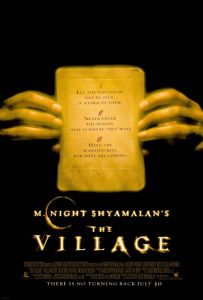 Originally released July 30, 2004:
When saying director names you can play a fun little game of word association. Someone says, “George Lucas,” and things like big-budget effects, empty storytelling, and wooden dialogue come to mind. Someone says, “David Lynch,” and weird, abstract, therapy sessions dance in your head. The behemoth of word association is M. Night Shyamalan. He burst onto the scene with 1999’s blockbuster, The Sixth Sense, a crafty, moody, intelligent thriller with a knock-out final twist. Now, though, it seems more and more evident that while The Sixth Sense was the making of M. Night Shyamalan, it also appears to be his undoing. His follow-up films, Unbreakable and Signs, have suffered by comparison, but what seems to be hampering Shyamalan’s growth as a writer is the tightening noose of audience expectation that he kowtows to.
With this in mind, we have Shyamalan’s newest cinematic offering, The Village. Set in 1897, we follow the simple, agrarian lives of the people that inhabit a small secluded hamlet. The town is isolated because of a surrounding dense forest. Mythical creatures referred to as Those We Dont Speak Of populate the woods. An uneasy truce has been agreed upon between the creatures and the villagers, as long as neither camp ventures over into the others territory. When someone does enter the woods, foreboding signs arise. Animals are found skinned, red marks are found on doors, and people worry that the truce may be over. Within this setting, we follow the ordinary lives of the townsfolk. Ivy Walker (Bryce Dallas Howard) is the daughter of the towns self-appointed mayor (William Hurt), and doesn’t let a little thing like being blind get in the way of her happiness. She is smitten with Lucius (Joaquin Phoenix), a soft-spoken loner. Noah (Adrien Brody), a mentally challenged man, also has feelings for Ivy, which cause greater conflict.
 Arguably, the best thing about The Village is the discovery of Howard. She proves herself to be an acting revelation that will have future success long after The Village is forgotten. Her winsome presence, wide radiant smile, and uncanny ability to quickly endear the character of Ivy to the audience. She is the only one onscreen with genuine personality and charisma, and when shes flirting and being cute about it you cannot help but fall in love with her. And when she is being torn up inside, the audience feels the same emotional turmoil. I am convinced that this is more so from Howard’s acting than from the writing of Shyamalan. She reminds me of a young Cate Blanchett, both in features and talent.
It seems to me that Shyamalan’s directing is getting better with every movie while his writing is getting proportionately worse. He has a masterful sense of pacing and mood, creating long takes that give the viewer a sense of unease. The first arrival of the creatures is an expertly handled scene that delivers plenty of suspense, and a slow-motion capper, with music swelling, that caused me to pump my fist. The cinematography by Roger Deakins is beautifully elegant. Even the violin-heavy score by James Newton Howard is a great asset to the film’s disposition.
So where does the film go wrong and the entertainment get sucked out?
What kills is its incongruous ending. Beforehand, Shyamalan has built a somewhat unsettling tale, but when he finally lays out all his cards, the whole is most certainly not more than the sum of its parts. In fact, the ending is so illogical, and raises infinitely more questions than feeble answers, that it undermines the rest of the film. Unlike The Sixth Sense, the twist of The Village does not get better with increased thought.
Shyamalan’s sense of timing with his story revelations is maddening. He drops one twist with 30 minutes left in the film, but what’s even more frustrating is he situates a character into supposed danger that the audience knows doesn’t exist anymore with this new knowledge. The audience has already been told the truth, and it deflates nearly all the tension. It’s as if Shyamalan reveals a twist and then tells the audience to immediately forget about it.
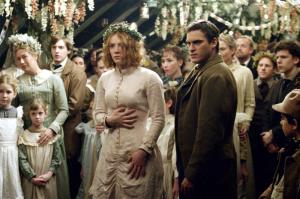 Shyamalan also exhibits a problem fully rendering his characters. They are so understated that they don’t ever really jump from the screen. The dialogue is very stilted and flat, as Shyamalan tries to stubbornly fit his message to ye olde English vernacular (which brings about a whole other question when the film’s final shoe is dropped). Shyamalan also seems to strand his characters into soap opera-ish subplots involving forbidden or unrequited love. For a good hour or so, minus one sequence, The Village is really a Jane Austin story with the occasional monster.
The rest of the villagers don’t come away looking as good as Howard. Phoenix’s taciturn delivery seems to suit the brooding Lucius, but at other times he can give the impression of dead space. Hurt is a sturdy actor but can’t find a good balance between his solemn village leader and caring if sneaky father. Sigourney Weaver just seems adrift like she’s looking for butter to churn. Brody is given the worst to work with. His mentally-challenged character is a terrible one-note plot device. He seems to inexplicably become clever when needed.
The Village is a disappointment when the weight of the talent involved is accounted for. Shyamalan crafts an interesting premise, a portent sense of dread, and about two thirds of a decent-to-good movie, but as Brian Cox said in Adaptation, ”The last act makes the film. Wow them in the end, and you’ve got a hit. You can have flaws and problems, but wow them in the end, and you’ve got a hit.” It’s not that the final twists and revelations are bad; it’s that they paint everything that came before them in a worse light. An audience going into The Village wanting to be scared will likely not be pleased, and only Shyamalan’s core followers will walk away fully appreciating the movie. In the end, it may take a village to get Shyamalan to break his writing rut.
Nate’s Grade: C+
——————————————————
WRITER REFLECTIONS 20 YEARS LATER

Usually in the M. Night Shyamalan narratives, 2004’s The Village is where the cracks first started to show in the filmmaker’s game. While 2000’s Unbreakable didn’t exactly reach the box-office successes of The Sixth Sense and Signs, it still earned $250 million worldwide and was definitely ahead of the cultural curve, introducing a grounded superhero story before the oncoming wave of superhero cinema. No, it was The Village that started the questioning over whether Shyamalan’s need for big twist endings was hampering his creativity. While still earning almost the exact same box-office as Unbreakable, The Village was seen with more hesitation, a cautionary tale about a filmmaker, as Matt Singer recently put it, flying a little too close to the sun. From here, Shyamalan entered his down period, from 2006’s Lady in the Water, to 2008’s The Happening, and the big-budget sci-fi misfits of 2010’s Last Airbender and 2013’s After Earth. This was the beginning of the general public becoming wise to Shyamalan’s tricks.
The real kicker is that, twenty years later, it’s clear to me that The Village is two-thirds of a good-to-great movie, ultimately undone by the unyielding desire to juice up the proceedings with an outlandish twist ending. For that first hour, Shyamalan has done a fine job of dropping us into this outdated community, learning their rules and restrictions, and gradually feeling the dread that the old ways might not protect them from the monsters just along the boundaries. There’s an efficiency and confidence to that first hour, with carefully planned shots that establish key points of information, like little girls panicking at the sight of a red flower and burying it in the ground before going back to their chores. The cinematography is elegant and moody, and the violin-soaring score by James Newton Hoard is a consistent emotive strength. The first encounter with the monsters roaming around the town is fraught with tension, especially as our one character holds out her hand waiting for her friend/love interest to return. The cloaked monsters are also just a cool design, with their long claws and porcupine-like frills extending from their hides.
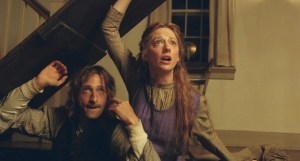 The greatest strength is Bryce Dallas Howard (Jurassic World) as our surprise protagonist, Ivy, daughter of the community founder, Edward Walker (William Hurt). Howard had made small cameo roles in her father’s films, but she was cast by Shyamalan after he watched her perform on stage. She is spellbinding as Ivy, a woman of great vulnerability and strength, of integrity and charisma. The scene where she sits down on the porch beside Lucius (Joaquin Phoenix) and dance around the edges of flirting is sensational, and when she talks about seeing people’s colors, or auras, and then smirkingly whispers, “No, I will not tell you your color, stop asking,” in the same breath, I defy anyone not to fall in love with her like poor Lucius. This simple love story actually works well. Lucius is an introverted man given to great emotions he doesn’t know how to fully express, which pairs nicely with the chatty and ebullient Ivy. The protagonist shift works wonderfully as well. For the first hour we believe we’re following Lucius as our main character, especially since at this point Phoenix’s star power was rising and Howard had none. Then, with the sudden sticking of a knife, Lucius is taken down and the movie becomes Ivy’s story and her quest to save her beloved. Her cry of not being able to see Lucius’ color is a well-coordinated punch to the gut. This is an example of a rug pull that really works, elevating the stakes and presenting the real star, the girl so many have overlooked for one reason or another, who will be our hero when we need her most.
But then it all falls apart for me once Shyamalan reveals two twists: 1) the monsters are not real, merely costumes the adults wear to enforce their rules through fear, 2) the setting of this village is not 1897 but modern-day, with the villagers living in a secluded nature preserve. Apparently, Edward was able to gather enough violent crime victim relatives to begin this experiment in “returning to our roots.” He served as an American History professor, so who better than to create a thriving community? You know how to establish safe drinking water there, my guy? How about cabin-building? I assume one of the elders must have had some wealth as it’s revealed later, via Shyamalan’s onscreen cameo role, that the government got paid off to stop having airplanes fly over the nature preserve. I actually kind of hate this twist. It feels the most superfluous of all Shyamalan’s fabled twist endings. I was genuinely enjoying the movie and how it was spinning up until this point, but Shyamalan cannot leave well enough alone. I get that Shyamalan is crafting an allegory for the War on Terror and the constant anxiety of post-9/11 America, replete with color codes meant to serve as warning signs. I get that we’re meant to find the town elders as villains, keeping their community repressed through the fear of convenient monsters. The lessons are there to dissect, but I’m disappointed because I was enjoying the allegory on its literal level more than its intended themes. It’s also because I feel like the twists overburden the movie’s charms.
 Another reason the twist really falters is that it creates all sorts of nagging questions that sabotage whatever internal logic had been earlier accepted. Adults deciding to break free from modern society so they can start their own secluded LARP community can work as a premise, but it requires a lot more examination that cannot happen when it’s slotted as a concluding twist. Imagine the kind of determination it would take to retreat from modern society and rekindle an agrarian life from hundreds of years ago. That means abandoning all your family, friends, the comforts of modern-day, and the sacrifices could have been explored, but again, it’s just a twist. There are present-day communities, most famously the Amish, that shun the technological advances of modern society to retain an outdated sense of homespun culture and religious community, but often the members have grown up in this culture already. Regardless, retreating into the woods to start your own 18th century cosplay is a commitment, but when you know all the adults are in on this secret, why are they staying in character at all times? When it’s just two adults talking to one another, why are they keeping to their “characters” and talking in that antiquated jargon and syntax? Is it collective Method acting? Is it a sign they’ve ref-ramed what they consider normal? Have they gone so deep that their muscle memory is to say “thee” and “thou” vernacular in the mirror? They went through this elaborate facade because they lost people in the “real world,” but human impulses, violence, and accidents can occur in any community, no matter if you got cell phones or pitchforks. It starts to gnaw away at the tenuous reality of the scenario, a reality I was accepting until the late rug pull.
It also eliminates some of the stakes of Act Three when Ivy travels beyond the boundaries and may face the wrath of the monsters. It’s maddening that Shyamalan reveals the monsters are not real, mere tools to scare the children into obedience, and then has a supposed suspense sequence where Ivy stumbles upon a thicket of red flowers, the dreaded color the monsters hate. But wait, you might recall, there are no monsters, so then why does it matter? When you realize that her dad could just have taken a hike and driven to a drug store to gather medical supplies, without the supernatural threat keeping them confined, it kind of seems silly. Here you were, worried about the fate of this blind girl, when there’s no reason she had to even venture into this danger because one of the adults could have performed the same task without risking their big secret. I know they think Ivy’s blindness might uphold their secret, but why even risk her possible danger from falling down a hill she couldn’t see or a rock that twists her ankle? Her dad would rather have his blind daughter venture into the woods than do this trek “to the next town” himself. At the same time, her personal journey outside the community is robbed of the supernatural danger and it also re-frames the father as someone burdening his blind daughter with a task he could have achieved. He says she has the power of love and that will guide here, but you know a compass could also help. You could make the argument that maybe his guilt was eating away at upholding such a big secret, maybe he wanted to get caught, but I don’t buy it. Edward argues with his fellow elders that it is the next generation that will keep hold to their traditions and ways of life, and they must ensure this survival. That doesn’t sound like the perspective of a man wishing to break apart the close-knit community he helped build.
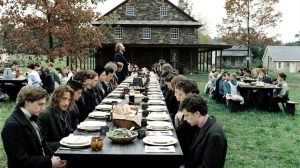 What to make of Adrien Brody’s mentally challenged character, Noah? He’s living in a time that doesn’t know how to handle his condition, but he’s also set up as a quasi-villain. He’s the one who stabs Lucius out of jealousy that Ivy favors him. He’s the one who breaks free, steals a monster get-up, and antagonizes Ivy in the woods. He also falls into a pit and dies alone. I don’t really know how to feel about this character because I don’t think Shyamalan exactly knows what to do with him.
Having recently re-read my original 2004 review, I’m amazed that I am sharing almost the exact same response as I did with my younger self. Even some of the critical points have similar wording. My concluding summation still rings true for me: “It’s not that the final twists and revelations are bad; it’s that they paint everything that came before them in a worse light.” You can rightly tell an allegorical story about people rejecting modern society and living a secluded and hidden life. You can rightly tell a story about adults posing as monsters to keep their children in line and obedient. However, if you’re going to be telling me that story, don’t supply an hour’s worth of setup that will be damaged from these revelations. After The Village, it was a steady decline for the filmmaker once dubbed “the next Spielberg” until 2017’s stripped down thriller Split, anchored by a tour de force performance from James McAvoy. It’s frustrating to watch The Village because it has so much good to offer but ultimately feels constrained by the man’s need to follow a formula that had defined him as a mass market storyteller. This was a turning point for Shyamaln’s fortunes, but the quality of The Village has me pleading that he could have shook off the need for ruinous twists and just accepted the potency of what was already working so well.
Re-View Grade: B-
Share this:

Napoleon (2023)
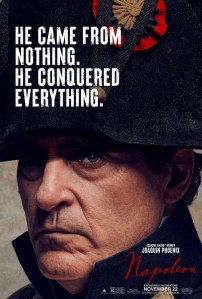
I may be completely in the wrong, but I feel the only way to view Ridley Scott’s latest historical epic, a 158-minute account of the life of Napoleon Bonaparte, is as a comedy with the full intention of not retelling history but of de-mythologizing the grandiosity of its star. Otherwise, these 158 minutes feel like an accelerated Wikipedia summary of the man’s many famous deeds as he rose from general to Emperor and swept his armies across the continent conquering much of Europe. Rather, I choose to think of the movie as a strange comedy that shows how this fearsome military genius might also have been just a strange little guy with a temper.
The Revolution in France is burning out of bodies and the people are growing restless at the lack of meaningful democratic progress. Enter Napoleon Bonaparte (Joaquin Phoenix) as a successful general who will eventually crown himself as Emperor of France. He will wage war across the continent, lead to the deaths of three million by his final defeat 1815, and reshape and revolutionize the military of its days. He will also die alone, exiled, and without the love of his life, his wife, Josephine (Vanessa Kirby).

This all has to be a comedy, right? Ridley Scott (Gladiator, The Last Duel) went to elaborate lengths to make fun of the little general, right? How else to read scenes where Napoleon and Josephine argue at the dinner table where he accuses her of being infertile, she accuses him of being fat, and he agrees that he heartily likes his food and says, “Fate has brought this lamb chop to me.” How else to read a scene where he throws a hilarious hissy fit before the English ambassador, who Napoleon feels has been rude and less than deferential, and he screams, “You think you’re so great because you have boats!” How else do you read a montage of Napoleon seizing power with the military pushing out the old figures of power and one of them, aghast, shouting, “This cannot be. I am enjoying a succulent breakfast!” How else to interpret the scene where Napoleon is going to achieve his coup from the French parliament and he’s run out of the chamber, falling and scampering out like a child caught playing tyrant. It’s moments like these, as well as the acting choices, that push me in the direction of interpreting this movie less as another handsomely mounted biopic of The Great Men of History and more tearing down the lockstep reverence for this figure glorified through centuries of back-patting. I’m reminded of Josh Trank’s relatively unloved Capone movie from 2020, and while imperfect, I appreciated that Trank spent the entire movie tearing down the legend and myth of this bad man and showed him for what he was late in life, a pathetic, decrepit loser riddled with syphilis losing his mind and crapping his pants. I think we need more biopics that have a less reverent approach to their subject because then it provides a public service of inviting viewers to be more critical of history rather than blindly accepting.
I think this is also showcased by the fact that Scott and screenwriter David Scarpa (All the Money in the World) are choosing to tackle the legends rather than the history. Take for instance the acclaimed Battle of Austerlitz, one of the film’s high-points. Napoleon surprises the combined Russian and Austrian troops by firing cannons at the frozen lake, causing it to shatter and entomb thousands of men to their watery graves. It’s a stunning visual sequence that blends the beauty and terror of the events and of course little of it happened in real life. In reality, the lake was really more a series of small ponds and reportedly very few enemy soldiers drowned. In reality, Napoleon never rode into battle as part of his cavalry. The generals stayed behind with orders. Or take for instance Napoleon’s ill-fated march into Russia, and when he arrives he’s so bored and thoroughly depressed as he sits on the empty throne in Moscow, acting like a little kid who is eager to go home already. That’s the difference between history as it happens and history as it is remembered, and that’s the myth-making that Scott is attempting to work through and re-contextualize for the many people who aren’t fanatical acolytes of the historical record. This is Scott saying he’s going to take all the myths and legends and make you critically reconsider.

Then there’s the relationship with Josephine which defines much of the movie, so much so that it provides explanations for why Napoleon left his first exile, because, apparently, he was upset his wife was seeing other people. The relationship plays out like one more of political maneuvering than romance, with some eyebrow-raising bedroom kinks to modernize the tale. Much of their conflict is on Napoleon’s inability to sire a male heir, which is put through the steps of the scientific method by his concerned and opportunistic mother as he attempts to father bastards with other women. This is the storyline that suffers the most from the accelerated pacing and editing, so consumed with moving from place to place and fitting in all the historical checkpoints. The larger nuance of this relationship, and Josephine as a character, is taken out by simplifying it as a tale of two people who realize that gender-specific baby-making is their top priority. In reality, Napoleon absolutely adored his wife and wrote lengthy love letters that you can read today, with lines such as, “I hope before long to crush you in my arms and cover you with a million kisses burning as though beneath the equator,” and, “Without his Josephine, without the assurance of her love, what is left him upon earth? What can he do?” It’s a shame so much of this is reduced to heir-production anxiety.
Phoenix (Beau is Afraid) plays the titular role like he’s sleepwalking, slumped and grumpy and rarely providing much energy except around plates of food. It’s a curious performance and one that helps me to further see the depiction as one through the lens of a critical offbeat comedy. He’s certainly not playing the man like he’s one of the great inspirational figures, and he’s certainly not playing the man like he’s tearing through a multitude of doubts and inner demons. He’s playing Napoleon like a grumpy weird little guy who would rather be dining than conquering. Kirby’s (Mission: Impossible Dead Reckoning) more an accessory in her character’s limited scope but she does have a few moments that reflect Josephine’s moxy.
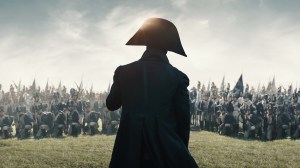
I would be remiss to pass up this chance to sing the praises of my former high school AP history teacher, Mr. Jerry Anglim, who had been teaching history and government for over 26 years before I stepped foot in his classroom. The man brought history alive for me and really crystalized my love for the subject, seeing how it’s all just one big canvas of storytelling. And this man loved teaching the Napoleonic Wars in great detail, and I loved scribbling down those notes every day. I even thought about getting a Napoleon poster to hang in my room, which would have been quite the odd teenage decorating choice. We watched the 1970s Waterloo movie starring Rod Steiger as Napoleon in class on a tiny TV attached to the corner, and yet I was spellbound because of what this teacher had done for me with the subject. So, wherever you are Mr. Anglim, thank you, and I’m sure you have your complaints with this new movie and I would love to hear them.
As a long movie still barely chronicling the major events of its subject, Napoleon feels lacking unless viewed through the lens as a critical comedy tackling his legends and myths. Then the abrupt nature of the plotting becomes more an addition than a subtraction. However, Scott has gone on record that he has a four-hour director’s cut that Apple plans to make available on its streaming platform in the near future, so perhaps my entire interpretation could be blown up. To be fair, the real Napoleon was a military genius and did revolutionize and modernize the French military, and while he didn’t “conquer everything,” especially Great Britain and Russia, the man and his ambitions and good fortune dominated the first fifteen years of the nineteenth century. Human beings will always be drawn to the stories of conquerors, but it’s important to also see them as people, quite often terrible people, but human beings with failings and complexities that are often left behind from decades if not centuries of propaganda and historical whitewashing. As a biopic, Napoleon the movie feels too short and shrift. As a comedy, it’s a lamb chop served up by fate.
Nate’s Grade: C+
Share this:

Beau is Afraid (2023)
 Beau is Afraid is a ramshackle mess of a movie, and that is both the highest compliment and an indictment on its tremendous excess and lack of focus. It’s Ari Aster’s big swing after his modest successes in elevated horror (Hereditary, Midsommar), so the indie maven studio A24 gave him a thirty-million budget and three hours and full artistic reign to do whatever he wanted, and love it or hate it, one has to objectively admit, Aster really went for something all right. I’m still deliberating where that final something falls on the artistic merit equation. There’s undeniable ambition and artistry here, but there’s also so many ideas and moments and bloat, it genuinely reminded me of 2007’s Southland Tales (did your stomach just drop, dear reader?). It’s because both movies are stuffed to the brim with their director’s assorted odd ideas and concepts, as if either man was afraid they were never going to make another movie again and had to awkwardly squeeze in everything they ever wanted into one overburdened project (in Richard Kelly’s case his suspicion might have been correct, as he did only direct one more feature -so far). While I certainly enjoyed -if that is the right word- Aster’s movie more, Beau is Afraid is not an easy movie to love, or enjoy, or even simply sit through, and not just because of its bloated time.
 If I had to boil down this sprawling movie into one easy-to-digest concept, it’s about Jewish guilt. If you’re not a fan of feeling uncomfortable or anxious from the intensity of a movie, I would skip this one entirely. Beau (Joaquin Phoenix) might as well be a stand-in for the biblical figure of Job for all the cruel punishments and indignities he endures. Just when you think, “Well, it can’t get any worse,” Aster rolls up his sleeves and rises to the challenge and makes things even worse for his pathetic put-upon plebeian. This is a movie of escalating discomfort, chiefly meant to convey the constant state of anxiety that is Beau’s daily existence, and for the first hour or so, Aster works marvelously at making you squirm. It’s a movie less meant to reflect our objective reality and more a projection of one man’s anxious feelings and paranoia, the unsettling urge that everyone secretly hates you and something bad is always ready to lethally strike.
Beau is Afraid is an absurdist comedy of heightened almost screwball proportions, with Beau becoming increasingly frazzled and muttering “Oh no” hundreds of times as fate has it out for him. Small worries become all-consuming, like the simple task of trying to get water to swallow his new prescription medication, and how this eventually spirals to the ransacking of his apartment building, which is also all Beau’s fault, inadvertently, though that won’t mitigate the guilt. There are numerous fears and worries amplified to breaking points, inviting morbid chuckles and nervous titters. Beau sits in his bathtub to stare at an unknown man squeezed against the walls of his ceiling and about to slip and fall. Why is this man there? Why does Beau not immediately leap out of the tub? Why do both men remain fixed in their positions until the inevitable? It’s because it’s a ridiculous paranoid fear manifested into a ridiculous scenario made even more ridiculous. It’s the same with ignoring his mother’s calls only to have a stranger answer her phone to inform Beau that she has been killed and happens to be without a head now. It’s a realistic fear, avoiding phone calls and the draining emotional energy required to answer, and following it up with a consequence of darkly absurdist proportions to make him feel even worse. The movie leaps from one squirm-inducing, grueling sequence to the next, testing your limits and patience. There’s a post-coital revelation debunking, and then confirming, an outlandish worry that made me laugh out loud with tremendous auditory force. What else could I do? It certainly feels like Aster is inviting the audience to laugh at Beau’s pain and tragedy because what other human response can there be but to laugh in the face of unrelenting torment?
 Where the movie loses momentum is about halfway through, after Aster has established the drive of the movie, Beau’s attempts to get to his mother’s funeral so they can finally bury her. Every hour he is delayed, Beau is reminded that his mother’s body is rapidly decaying and only furthering her “humiliation” at the hands of Beau’s inaction. The second part of the movie involves Beau recovering from injuries in an upper class family’s home, the same family (Nathan Lane, Amy Ryan) that accidentally ran him over and is now kind of holding him hostage against his weakened will. We have an urgent goal, we have obstacles keeping him from that goal, and this is where the movie continues to work, as each new attempt to escape only confirms how much stranger and dangerous this family unit is. This dynamic plays into the established heightened fears and absurdist complications. It’s keeping him from his goal. But when he does eventually free himself from this hostage scenario, he literally wanders into the woods and discovers a troupe of thespians that refer to themselves as the Orphans of the Forest, and then a theatrical production may or may not present the rest of Beau’s natural life. This was where the movie’s momentum, which had steadily been ratcheting up along with the dark comedy, began to flag, and when I started to worry, then suspect, then confirm my sinking feeling that this all isn’t going to add up to something more cohesive and thought-provoking. It’s really more a movie of sustained memorable moments and unpredictable, tone-shattering twists and turns. Beau is Afraid is unpredictable, and that both works as an asset and eventually as a handicap. That’s because every scene is hammering the same overall thematic point just with a different stylistic arrangement of fears and anxiety. Following this redundant framework, a 130-minute version of this movie world would feasibly have the same thematic impact as the 180-minute version, merely eliminating some of the many detours.
Another nagging aspect of the movie that failed to add up to much more for me was how little Beau seems to matter in his own story. He’s more intended to be the universe’s lone fall guy rather than a person, a victim whose chief characterization is his ongoing victimization. He suffers and that is his identity. Considering the movie is more a loose fable, this can work since Beau is essentially a stand-in for all of humanity, but there are more personal aspects of him worth exploring in finer detail. The toxic relationship with his mother is worthy of further examination, especially the decades of emotional manipulation to ensure Beau would never replace her with another woman. I wish Aster had devoted more of his 180-minute run time to exploring Beau as a person rather than pitting him against a proverbial assembly line of pies to the face. Phoenix (Joker) has so little to do here except stare wide-eyed, helpless, and mumble as the world constantly befuddles and antagonizes him. It’s a performance purely of pained reaction.
 Can I recommend Beau is Afraid? For most viewers, probably not. It’s too long, too sporadic, and doesn’t come to anything cohesive or cumulative or even meaningful beyond a mean-spirited sense of pessimism directed at our titular human punching bag. It’s wildly ambitious and off-putting and bloated and outlandish and the kind of big artistic swing that artists usually only get so rarely in their careers. And yet I have to admire the sheer gusto of Aster making a movie this strange and alienating, a movie that’s constantly altering its very landscape of possibilities, usually to the detriment of Beau’s physical and mental well-being. It is an exhausting experience, so that when the end finally arrives, we, much like Beau, are simply ready to accept the finality we’ve been waiting for after so much abuse. There are moments throughout these ungainly 180 minutes that are sheer brilliance, and sequences that are sheer torture, some of which are on purpose. There’s also just way too much of everything, and without variance or finer exploration of its themes and specific characterization, it becomes a cosmic game of whack-a-mole where you might be the one actually getting hit over the head, and after so long I can’t blame anyone for not enjoying the prolonged experience.
Nate’s Grade: B-
Share this:

C’mon C’mon (2021)

Writer/director Mike Mills’ latest is a gentle and meandering movie, which is coming to be his indie specialty for me. C’mon C’mon features Joaquin Phoenix (in his schlubby every-man phase) as an audio journalist collecting interviews. He suddenly finds himself watching his young nephew (Woody Norman) after his sister (Gabby Hoffman) has to tend to her husband’s deteriorating mental illness. What follows is a lot of small moments that play quite naturalistic and in wry, nice dialogue exchanges. It’s also kind of sweetly boring. It’s a collection of moments of Phoenix struggling with how to relate to children, what we pass down to the next generation as legacy, and how to try and be a responsible parent and role model for an impressionable youth. It’s all messages and themes we’ve seen in dozens of other heartwarming parenting movies. The draw is the relationship between Phoenix and Norman, who proves to be a wonderfully natural performer, enough so that the movie often feels more observed than written. Their relationship is sweet but I felt like the movie was too often circling the same points and character differences for far too long. Perhaps others will get more out of this, find more to personally relate to, especially those finding themselves caring for children in unexpected circumstances. C’mon C’mon is reflective and compassionate and also kind of a snoozer.
Nate’s Grade: B-
Share this:

Gladiator (2000) [Review Re-View]
 Originally released May 5, 2000:
Director Ridley Scott has given the world of cinema some of its most unforgettable visual experiences. But can Scott breath new life into a genre whose heyday was when a badly dubbed Steve Reeves oiled his chest and wrestled loincloth-clad extras in the 1950s?
The year is roughly 180 AD and Rome is just finishing up its long-standing assault on anything that moves in the European continent. General Maximus (Russell Crowe) merely wants to retire back to his loving family and get away from the doom and war that has plagued his life. This is made all the more difficult when the ailing Emperor bypasses his treacherous son Commodus (Joaquin Phoenix) and decides to crown Maximus as the Defender of Rome. Because of this Commodus rises to power through bloody circumstances and has Maximus assigned to execution and his family crucified. You’d think crucifixion would be so passé by now. Maximus escapes only to be sold into slavery and bought by a dirt-run gladiator training school. As he advances up the chain and learns the tricks of the primal sport he seeks but vengeance for his fallen family.
Gladiator is an absorbing and sweeping spectacle of carnage and first-rate entertainment. The action is swift and ruthlessly visceral. The first movie in a long time to literally have me poised on the edge of my seat. The blood spills in the gallons and life and limb go flying enough your theater owner may consider setting down a tarp.
 What Gladiator doesn’t sacrifice to the muscle of effects and action is storytelling. Are you listening George Lucas? Gladiator may unleash the beast when the rousing action is loose, but this is coupled with compelling drama and complex characters. Phoenix may at first seem like a snotty brat with an unhealthy eye for his sister (Connie Nielsen), but the further Gladiator continues the more you see in his eyes the troubled youth who just wants the love of his father that was never bestowed to him. Maximus is a devoted family man who regularly kisses clay statues of his family while away, and must ceremoniously dust himself with the earth before any battle.
The acting matches every sword blow and chariot race toe-for-toe. Russell Crowe marks a first-rate staple of heroism. Every calculating glare he exhibits shows the compassion and ferocity of this warrior. He becomes a rare breed – an action hero who can think and actually act. Oliver Reed, in what sadly was his last role, turns in a splendid and charismatic turn as the head of the gladiator school of Fine Arts and Carnage. Mysteriously everyone carries a British accent closer to them then a toga two sizes too small. Even Crowe who is nicknamed “The Spaniard” speaks like he walked out of Masterpiece Theater.
The effects and visuals are a sumptuous feast. The aerial shots of Rome and the Coliseum are simply breath taking. Gladiator rivals American Beauty for the most rose petals used in a movie, except in this one they don’t shoot out of Mena Suvari’s breasts.
Ridley Scott’s track record may be hit or miss but Gladiator is definitely one sorely not to be missed.
Nate’s Grade: A-
——————————————————
WRITER REFLECTIONS 20 YEARS LATER

As Russell Crowe famously barked, “Are you not entertained?’ It was hard to argue in 2000 and it still holds true to this day. Gladiator was a big-budget throwback to the swords-and-sandals epics of old Hollywood. It was a box-office hit, made Crowe a star, and won five Academy Awards including Best Picture. My own elderly grandmother loved it so much that she saw it three times in a theater that summer, which was practically unheard of in her later years (she also, inexplicably, loved the 1999 Mummy movie). It was a millennial DVD staple. I can recall everyone on my freshman dorm hall owning it and hearing it on regular rotation. As studio projects were getting bigger with more reliance on CGI, Gladiator felt like a refreshing reminder on how powerful old stories can be with some modern-day polish. Re-watching Gladiator twenty years later, it still resonates thanks to its tried-and-true formula of underdog vengeance.
We all love a good story where we follow a wronged party seek to right those wrongs, plus we all love a good underdog tale, and given the pomp and circumstance of the gladiatorial arena, it’s easy to see how this movie was engineered to be a success from the page. This isn’t a particularly new story. Stanley Kubrick’s Spartacus mined the same territory with an even bigger scope, both in politics and in war, and there have been many movies covering the same history around the rise of Commodus, like 1964’s The Fall of the Roman Empire and The Two Gladiators. We’ve seen this kind of story before even in this setting but that doesn’t matter. The familiarity with a story isn’t a hindrance if the filmmakers take their story seriously and make an audience care about its characters. It all comes down to execution. As long as the filmmakers don’t get complacent and take that formula familiarity for granted, old stories can have the same power they had for decades because, deep down, cooked in their structure, they just work.
 Gladiator gives us everything we need to know by the conclusion of its first act, introducing us to Maximus, showing his leadership and loyalty, giving us the strained father-son relationship with Marcus Aurelius and Commodus, the expectations of the son of his ascendancy, the regrets of the father and hope for a return to a Republic, the reluctance of Maximus to be more than a general of Rome, and finally after the murder of the old emperor, a decisive choice for Maximus that challenges his morals and responsibility. From there, screenwriters David Franzoni (Amistad), John Logan (The Aviator), and William Nicholson (Les Miserables) put our hero and villain on parallel tracks heading for a collision. Maximus rises through the ranks of gladiators and builds a name for himself, getting called to the major leagues of bloodsport, and Commodus schemes to have his old enemy killed with increasingly dangerous trials in the Coliseum. It’s a natural progression and escalation, which makes the storytelling satisfying as it carries on. Gladiator never had a finished script when they began filming, which has become more common with big budget tentpoles with daunting release dates and rarely does this work out well. However, this is the exception (the screenplay was even nominated for an Oscar). It should be stated that the events of Gladiator pay very little to the actual history but fidelity is not necessary to telling a compelling story (the real-life Commodus rose to power after dear old dad died from plague). Use what you need, I say.
Ridley Scott was on an artistic hot streak during the start of the twenty-first century, directing three movies within one and a half years of release and earning two Oscar nominations. He wanted to veer Gladiator away from anything too cheesy of older swords-and-sandals epics, as reported. This isn’t about homoerotic wrestling with men in unitards (in Jerry Seinfeld voice: not that there’s anything wrong with that) and instead about the grit and superficial glory of Rome. The opening battle in Germania is meant to show Maximus in action but it also shows just how overpowering the Roman Empire was during this time period. They just massacre the remaining German tribe, and there’s a reason we don’t focus on battle strategy and instead on the chaos. The conclusion of the battle is a shaky camera mess of bodies and flames and dark shapes. It’s a bloody mess and not something to be glorified. Maximus is tired. His men are tired. Even Marcus Aurelius is tired of his decade-long conquering of a map, adding little inches to an already gargantuan territory. When is it all enough? When is war a self-perpetuating quagmire?
 This same dismissive view over conquest and glory carries throughout. When Maximus becomes a slave, he must play the blood-thirsty appetites of the crowd to reach his goals. He disdains the theater of combat, the delaying of strikes simply to draw out the drama of two men fighting to the death. Later, these same venal interests of the mob form a protection for Maximus. He’s too popular to just be assassinated because the Roman people just love watching how he slays opponents. There’s an implicit condemnation of popular entertainment built around the suffering of others. Scott has a purpose for his depictions of violence, and you could even make the argument he is drawing parallels between the bloodthirsty crowds of the Coliseum and modern-day moviegoers screaming for violence. What are the human costs for this entertainment? It’s not explicitly stated, and some might even say this level of commentary for a movie awash in bloodshed makes any such condemnation hollow or hypocritical. Maybe. The violence feels like it has weight even when it can border on feeling like a video game stage with enemies to clear.
Crowe (The Nice Guys) was already making a name for himself as a rugged character actor in movies like L.A. Confidential and The Insider, but it was Gladiator that made him a Hollywood leading man, a title that he always seems to have felt uncomfortable with. Crowe wasn’t the first choice of Scott and the filmmakers (Mel Gibson turned Maximus down saying he was too old), but it’s hard to imagine another person in the role now. Crowe has a commanding presence in the film, an immediate magnetism, that you understand why men would follow him into hell. That flinty intensity plays into the action movie strengths, but there’s also a reflective side to the man, a sense of humor that can be surprising and rewarding. There’s more to Maximus than avenging his wife and child, and Crowe brings shades of complexity to an instantly iconic role. He finds the tired soul of Maximus when he could have simply been a kickass killing machine. Between Crowe’s three Best Actor nominations in a row from 1999-2001, I think he won for the wrong performance. It’s a shame Crowe hasn’t been nominated since, which seems downright absurd. People have forgotten what an amazing actor Crowe can be, singing voice notwithstanding (I need a sequel to Master and Commander please and thank you).
 This was also a breakout role for Joaquin Phoenix (Her), who has risen to become one of the most celebrated and chameleon-like actors of his generation. The character of Commodus is your classic example of an entitled child who doesn’t understand why people don’t like him. He’s a sniveling villain prone to temper tantrums (“I am vexed. I am very vexed”). Much like his co-star, Phoenix finds layers to the character rather than resting on a stock villain characterization. He’s really the jealous son who envies the preference and love given to Maximus, first from his father, then from his widowed sister (Connie Nielsen), and then from the Roman people. He whines that they love Maximus in a way he will never deserve. It’s hard not to even see a Trumpian psychology to Commodus, a man not equipped for the position of power he occupies who longs for adulation he hasn’t earned. You can hate the man, but you might also feel sorry for him despite yourself. When he wants to be pompous, he can be hilarious (I adored his quick reaction shots to the theatrical combat). When he wants to be creepy, he can be terrifying. You can even see some of the broken pieces here that Phoenix would masterfully use to compose his Oscar-winning Joker performance.
The supporting cast was gifted with great old actors getting one last victory lap. Richard Harris was so stately and grandfatherly that it got him the role of Dumbledore in the Harry Potter franchise. It also served as a great sendoff for Oliver Reed (Oliver!) as Proximo, the selfish, trash-talking former gladiator turned gladiator trainer. Reed died months into the production and before he had wrapped his part, requiring extensive reworking from the screenwriters (Logan was on set for much of the production to cater to the immediate day-to-day story needs). Scott used a body double and parlayed visual effects to recreate Reed’s face, much like what 1994’s The Crow was forced to do after the unfortunate death of its star, Brandon Lee. I kept looking for what moments would be Reed and what moments would be the CGI-enabled Reed double, and it was harder to determine than I thought, so nice job visual effects team. Reed had a reputation of being a carousing reprobate, so having a final performance that allowed him to tap into those old impulses plus the regrets of older age was a wonderful final match.
 The other big takeaway upon my twenty-year re-watch was how recognizable and stirring Hans Zimmer’s famous score was, which lost the Oscar that year to Crouching Tiger, Hidden Dragon, and that seems insane to me. Zimmer has been in a class all his own since the 90s with classic, instantly hum-able scores for True Romance, The Lion King, The Dark Knight, Inception, and The Pirates of the Caribbean, which borrows heavily from his theme for Gladiator. The score greatly adds to the excitement and majesty of the movie and can prove transporting by itself.
A truly bizarre post-script is the story of how the studio tried to develop a sequel. Gladiator was hugely successful but any sequel presented problems. Given the death of its star, following another character makes the most sense, and yet that’s not the direction the screenplay took. Eventually, the sequel to Gladiator was going to follow the ghost of Maximus as it travels through time including to modern-day. Just take a moment and dream of what could have been. Alas, we’ll likely never get time-traveling ghost Maximus now and we simply don’t deserve it as a society.
Reviewing my original film critique from 2000, I feel that my 18-year-old self was more entranced with making snappy, pithy blurbs than going into further detail on my analysis. My early reviews were far more declarative, saying something was good or bad and giving some detail but not dwelling on going deeper into the examination. This line, “The blood spills in the gallons and life and limb go flying enough your theater owner may consider setting down a tarp,” makes me cringe a little because it’s just trying too hard to be casually clever. I do enjoy the Mena Suvari rose petal joke. Still, I celebrated that a studio movie could emphasize its story first and foremost and my observations are still valid. I’m all but certain the only reason I knew who Steve Reeves was back then was because of his many appearances via Mystery Science Theater 3000 covering his cheesy swords-and-sandals films of old that Ridley Scott was so eager to avoid recreating (“Do you like films about gladiators?”)
Because the movie does so much so well, with some exceptional, it’s hard for me to rate Gladiator any lower than my initial grade of an A-, so that’s where I’m keeping it twenty years later. I think the national conversation has cooled on Gladiator, forgotten it because it wasn’t quite as audacious as other examples of early 2000s films, but it sets out to tell a familiar story on a big canvas and deserves its plaudits for somehow pulling it all off with style and gravity. It would be flippant to say Gladiator still slays the competition but it’s still mighty entertaining.
Re-View Grade: A-
Share this:

Joker (2019)
 There has been a lot of discussion over Joker, a new dark R-rated spinoff unrelated to other comic book movies and directed by the man who gave the world The Hangover films. Director/co-writer Todd Phillips desired to tell a character-driven drama that explored how Batman’s most notorious villain, and perhaps the most widely known villain of all pop culture, became exactly the clown he is. Some people said the Joker didn’t need a back-story, others said that Phillips had no place dabbling into the realm of superhero cinema, and there were plenty of others who expressed unease that the movie might inadvertently serve as an inspiration for disaffected loners looking for encouragement to make others feel their pain and suffering. After all those think pieces and cultural hand-wringing, Joker, as the actual movie, isn’t quite the transgressive experience that others feared and that the movie very much wants you to believe.
Arthur Fleck (Joaquin Phoenix) is a quiet, pathetic man who is being ground down by the forces in his life. He has a unique medical condition that causes him to break out in hysterical laughter when he’s nervous or upset, which only makes others feel nervous and upset. It’s hard for him to keep his job as a for-hire clown and his therapy and medicine are being eliminated thanks to budget cuts. He cares for his elderly mother (Frances Conroy), crushes on an attractive neighbor (Zazie Beetz), and dreams of being a stand-up comic who will one day grace the set of his favorite late-night talk show host, Murray Franklin (Robert De Niro). Arthur’s life changes from one night of extreme violence and how it shapes his concept of himself and society. He’s tired of feeling bad for who he is and he’s going to realize his true potential on the biggest stage.
 There’s something, excuse the modern parlance, quite “edgelord” about the film and its artistic approach. It’s very eager to be dangerous, edgy, disturbing, and there are certainly extended moments where it achieves these goals, notably thanks to Phoenix’s performance. However, I was cognizant of how eager the film was to be gritty, and dark, and different, to the point that it felt like the whole enterprise wasn’t just trying too hard to be different but wanted you to know it was trying. After a while, you just have to shrug and say, “Hey, movie, I get it.” This guy’s life ain’t too hot. The first 45 minutes could probably be condensed in half. The first two acts feel redundant as they establish the many trials and tribulations of this man on the edge of a broken society that has abandoned him. Because of this, Joker can be an entertaining experiment in solo superhero stories but there is a critical absence of depth that keeps the film from going beyond a stellar lead performance. It’s a Martin Scorsese hodgepodge, a cover song for a famous villain.
This is the kind of movie where subtlety is rarely used, which increases the sensation that it’s trying too hard because it seems like it’s saying all of its points with exclamation marks. Even in the opening minutes, while Arthur is applying his clownish makeup, we hear a voice over narration from a TV newscaster who is essentially screaming to the audience all of the important social contexts for the setting (Things are bad! People are mean! The economy is bad! People are getting desperate! What has the world come to?!). There’s a fantasy experience where the characters are just openly explaining their desires. The visual metaphors are pretty simple, like the idea of hiding behind a mask (don’t we all wear masks, man?) and the intimidating set of stairs ascending to Arthur’s apartment that he must climb. So many supporting characters act like mouthpieces for larger collective groups, like a paid therapist who tells Arthur that the people with money don’t care about her or Arthur, the little people caught in the machinery of runaway capitalism, or Thomas Wayne as the callous and cold business elite who seems disdainful about any sort of empathy for others that challenge his responsibility to a larger society. De Niro’s talk show host feels like an amalgamation of a lot of different themes, like daddy issues, the media, but also the representation of ridicule as comedy and mass entertainment. There aren’t so much supporting characters as there are ideas, and in a weird way this could have worked, as if each figure represents some different level of psychosis for Arthur, almost as if it was repeating the 2003 movie Identity and everyone really is a reflection of Arthur’s damaged personality. The inclusion of Beetz (Deadpool 2) is more a plot device meant to humanize Arthur, but the entire premise feels like it’s missing development to make it believable, and ultimately this is the point of her character but it’s a long wait for a reveal for a character that is superfluous at her core. It’s the kind of movie that thinks we need to yet again see the definitive formative act of every Batman movie.
 The movie does pick up a momentum when Arthur starts to get set on his way toward becoming the clown prince of crime. When the Joker gets his first taste of violence, in self-defense, the clown vigilante becomes a symbol for a reactionary contingent of Gotham’s lower classes. The groundswell of support provides a welcomed sense of community for a man who has been secluded for his idiosyncrasies, but it’s a celebration of a loss of morality, and so to fully embrace this tide of supporters he must give away the last of vestiges of his soul. This downfall allows for the movie to feel like it’s finally committed to something, where the setups are finally starting to coalesce around a character who is now driving his story rather than being the recipient of misfortune. The violence becomes more shocking and Arthur stops caring about hiding who he really is, and that’s when the movie becomes the full force it had been promising. I was tapping nervously throughout the final thirty minutes because I was anticipating bad things for anybody on screen. Phillips can use this anxious anticipation for unexpected comedy too, like where a character was trapped due to their unique circumstances and whether they too were in mortal peril. I wish Phillips had pulled back because there’s a perfect visual to conclude his movie, that brings the entire self-actualization and loss of morality full circle, and yet the movie gives us another two-minute coda.
Joker certainly feels like Phillips’ version of a Scorsese movie, for better and for worse. If you’re going to imitate anyone, it might as well be one of the greatest living filmmakers whose crime dramas have reshaped the very language of the movies and how we view violent crooks. The go-to response I’ve seen is that Joker is a combination of Taxi Driver and The King of Comedy. I’ll readily agree with the Taxi Driver comparisons. It’s everywhere. We have a disaffected loner who is turning sour on an increasingly hostile and unstable society he views as beyond repair. Even the shot selections, camera movements, and 1970s era set design evoke that influence. The King of Comedy is more a facile comparison, as Arthur is a disturbed man trying his luck at standup comedy, failing, and becoming more unhinged. The real reason reviewers seem to be making this connection is the inclusion of Robert De Niro, and it feels like that is the only reason he’s actually involved, to ping back to King of Comedy. The idea of a stiff actor like De Niro being a glib talk show host, even in the 1970s, seems like a bad fit. The other real film influence I don’t see getting as much recognition is Network. This is a tale of one man tapping into a vent of anger and starting a movement that ripples out beyond them into something uncontrollable.
 Phillips is best known for his comedy work but I could feel his leaning to do a straight genre picture. In other reviews, I’ve cited Phillips’ keen eye for noir-flavored visuals (think of the car traveling across the desert as seen through the reflection of sunglasses in The Hangover). He had the chops to tell a straight genre crime thriller, so it’s not surprising that Joker is a slickly made, unsettling, and effective movie when it counts. This is a grimy-looking New York City, I mean Gotham City, where the garbage piles high (another not so subtle visual metaphor) and the city feels like a maze all its own crushing our main character. The cinematography is great with several strong moments that amplify the mood of unrest and distaste. The crafty costumes by Mark Bridges (Phantom Thread) lend to the overall authenticity of the period. The cello-heavy score by Hidur Guonadottir (HBO’s Chernobyl) is very evocative and ominously conveys the turmoil bubbling below the surface in a manner that doesn’t feel like pandering. This is a good-looking production made by talented technicians and Phillips has enough skill to pull it all together, even if that aim is really to recreate a style of another filmmaker and the time and place of his films.
I’ve purposely saved the best for last, and that’s Phoenix as the titular character. He is mesmerizing as a broken man trying to find his place in society and flailing wildly. His uncontrollable cackling is so unsettling that when he broke into laughing fits, I could feel myself getting more and more unnerved. At first it was the awkward sympathy of watching a man struggle to get through his disability, trying to compose himself, and embarrassed for the discomfort he was projecting. The very sound of the cackling trying to be contained, as a friend and co-worker Jason credited, watching the laughter catch in his throat, it had such an immediate, almost physical reaction in me. Later in the movie, I cringed because it made me worry what was going to happen next because I know it’s a precursor to bad feelings. When he’s becoming more comfortable with his impulses and dark thoughts, you notice the cackling starts to ebb away. There’s a small moment that I loved where after he flees from his first murder he runs into a bathroom, and once his breathing calms, it’s almost like his body is commanded by some spiritual serenity as he begins to dance. Phillips allows the scene to breathe and play out, to invite the audience to join. This little motif probably appears a few too many times, but it’s a beautiful little moment of physicality that expresses the chaos becoming harmony within a man. Phoenix lost 50 pounds for the role and his gaunt, haunted frame reminds you how much of a shell of a human being this character feels like. He even tells his therapist that he questioned whether he was even a person or not. Phoenix burrows deep into the character and unleashes a committed intensity that is impressively communicated through his sad, reedy, sing-songy voice, his slippery stances and body language, and the madness that seems to resonate from his bulging eyes. Even when the movie is repeating its steps and tricks, it’s Phoenix that constantly gives back to the audience. It’s a performance certainly worthy of Oscar attention and plaudits, though in my mind it’s still a step or two below the instantly iconic, and Oscar-winning, performance from Heath Ledger.
 Joker is a movie and should not be held responsible for the actions of others and what they may read from the film. I don’t sense Phillips and his team condoning their protagonist’s lawless actions, and the violence is often undercut so that it feels more disturbing than triumphant and exhilarating. When Arthur does get his first kill, the audience has likely been silently rooting for him to fight back, to punish the wrongdoers, but the movie draws out the scene in a manner that’s akin to a wounded animal panicking as it scrambles for its life and a cold execution. It’s not meant to be cool. Phoenix’s performance elevates the entire enterprise and will unnerve as much as it ensnares. It’s not a subtle movie at all, and it hugs the works of Scorsese a little too closely, both in tone as well as visual symmetry. It’s trying very hard to be nihilistic, edgy, and provocative (this isn’t your “normal comic book movie” it wants to scream with every frame). Arthur just wanted to make people laugh, the movie tells us, but the joke was on him after all (subtlety). If anyone is inspired from this movie, I hope it’s to seek out other Scorsese movies.
Nate’s Grade: B
Share this:

First Reformed (2018)/ You Were Never Really Here (2018)
 Both First Reformed and You Were Never Really Here use sly genre subversion to act as commentary on what kinds of movies the audience associates with these kind of haunted men, their arcs, and the nature of violence. Subverting audience expectations is in and of itself not necessarily a better option. You can have unexpected things happen but the narrative that happens after needs to be compelling, and if possible, unavoidable in hindsight (Game of Thrones is good at this). By the same notion, the finale of Breaking Bad was pretty easy to anticipate but that’s because of how well written the storytelling trajectory was pointing to its natural end. I can tell a tense father-son reconciliation story and then if I end it with a meteor wiping out the Earth all of a sudden, well that’s unexpected but that doesn’t make it better storytelling. What helps elevate both movies is that the subversions are thematically related to the relationship between violence and vengeance, absolution and atonement, and the audience and our desires with these films.
In First Reformed, Reverend Toller (Ethan Hawke, enthralling) is the caretaker of a small upstate New York church where the weekly attendance can be counted on one hand. The church, First Reformed, is nearing the commemoration of its two hundred-fiftieth anniversary that will be celebrated by local dignitaries and the governor. Reverend Jeffers (Cedric the Entertainer, surprisingly adept in drama) is the pastor for the mega church that seems to have everything that First Reformed lacks. Jeffers wants to help out Toller but the humble man of the cloth refuses. Rev. Toller is pushed out of his comfort zone by the husband of a pregnant woman (Amanda Seyfried) who challenges him on man’s stewardship of the environment. The husband worries about bringing a child into this world and contributing the larger problem of climate change. This interaction gets Rev. Toller to think about his own culpability and sets him on a path of righteous justice.
 Writer/director Paul Schrader is famous for his stories about violent men confronting the wickedness of the world around them. From Taxi Driver to Raging Bull to Hardcore, Schrader has a penchant for documenting the self-destructive recourse of flawed men who feel removed or constrained by a society they feel is out of step with morality. What better canvas then for Schrader than a middle-aged pastor at a small, reclusive church? Rev. Toller is so humble he doesn’t own more than a few sticks of furniture in his home, the adjoining parsonage to the church. He’s friendly but often choosing to keep to himself, forgoing comforts and perceived handouts from the people around him. A woman his own age keeps trying to connect with him, their romantic coupling in the past a platform for her to continue hoping he’ll come around to her. She’s a perfectly nice woman, a choir headmistress for the mega church down the road, but she reminds Toller of his weakness and maybe even something worse. The aforementioned mega church basically keeps Toller’s small parish afloat as a charity (First Reformed is nicknamed the “gift shop church” for its historical notoriety). Rev. Jeffers is concerned about his fellow man of the cloth and the toll his solitude and seclusion is taking on him. It’s like he’s trying to atone for something, taking on a very Christ-like path of penitence. It’s around here that the character is activated into a higher calling in conflict with the church.
I’ll explain what I was expecting given the premise and presence of Schrader. I was expecting a movie much in keeping with A History of Violence, where a small-town man is thrust back into a past life of violence by outside forces and he has to confront how far this “new him” has come from the sins of “old him.” I was expecting Toller to become more violent and radicalized, pitting others in his cross-hairs for retribution. That’s not really First Reformed at all. First off, it’s the slowest of slow burns. You better be prepared to luxuriate in the day-to-day details of Rev. Toller’s simple life, from unclogging toilets to visiting with parishioners in their homes and having long philosophical conversations with them about faith and man’s role in the ecosystem. That conversation specifically teeters toward ten minutes and serves as the end of Act One, and I think if you’re still invested by then, you’ll be along for the rest of the film. However, it’s not going to be an easily accessible movie. This conversation stirs something deeper inside Toller, dissatisfaction with the church and how it coddles with big business, the chief polluters of God’s kingdom. Toller becomes a late-in-life environmental activist who questions the stewardship of the church body. This sets him on a path that seems destined for bloody violence. He’s going to go out in a fury of righteousness. We’re expecting a big bang by the end, especially given Schrader’s history of these kinds of stories with these kinds of men. But that doesn’t happen.
 I’ll try and avoid spoilers but discussion over the thematic relevance of the end of First Reformed will unavoidably suggest to the reader some significant plot developments, so please feel free to read this paragraph or skip to the next one. The second half of the movie is setting you up for a very specific ending, one where Toller strikes back against forces he feels are detrimental to the well being of the church. It’s setting you up for a climactic showdown with powerful forces that feel unaccountable for their actions. I was ready for a final rush of violence to serve as the crescendo to Schrader’s slow burn. This is where the movie swerves away from audience expectations. We’re prepared for a meaningful death but instead Schrader’s ending, in retrospect, makes us question why we should have desired such a violent and vengeful finale. Why should this character be a martyr for our bloodlust against the powerful? Ultimately, Schrader’s movie ends on a romantic, optimistic note of personal salvation after setting you up for a dark story with a predetermined, self-destructive end. The abruptness of the ending may inspire some titters, but when you look back at the film, it makes complete sense and calls into question why we would wish for blood and violence over human connection and forgiveness. Schrader is saying that you wanted the wrong kind of movie.
First Reformed takes the modest aims of its protagonist to heart when it comes to the presentation of its story. Schrader films the entire movie in the old-fashioned 4:3 aspect ratio, the square box of old pre-high definition televisions. It’s an aspect ratio that keeps everything centered for the audience and on display. I think there was exactly four camera movements in the entire movie; almost the entirely of the 113 minutes is from a stationary, documentary-styled camera. It’s a very specific visual style that limits the visual information and dynamism but manages to personalize the main character even more. It’s his movie and his journey of self, so the visual representation is also restrained. There’s really one flash of upsetting violence in the whole movie, as if to remind the audience how a violent death is not something to be celebrated. For an R-rated Paul Schrader movie, it’s far more reserved, subtle, and thoughtful. It left me thinking about Rev. Toller and his messianic mission and our desire for a big bloody finish. The idea of a selfless death directed toward violent retribution is inherently self-involved. It’s not death that provides meaning but life, it’s not how we end but what we do with the days beforehand.
 You Were Never Really Here is built as a hitman thriller based on Jonathan Ames’ novel. Joe (Joaquin Phoenix) is a hired gun who specializes in rescuing young women. He’s hired to find the missing adolescent daughter of a senatorial candidate. He investigates the underbelly of sex trafficking to save this little girl, but larger forces are at play and will make Joe suffer gravely for interfering with their wanton exploitation.
The average audience for You Were Never Really Here has been steadily fed a diet of these kinds of movies, from the artful (Luc Besson’s The Professional), to the pulpy (The Long Kiss Goodnight), to any number of hollow, nihilistic video game-styled murder fantasies (Hitman, a thousand straight-to-DVD movies). We’re expecting men of action who are ruthlessly efficient and clever when it comes to their killing. We’re expecting stylish merchants of death who leave behind a heavy body count with swagger. That’s not what brilliant Scottish writer/director Lynne Ramsay (We Need to Talk About Kevin) has in mind at all. She takes the iconography of the hitman thriller and turns it into an expectation-smashing existential character study, but not just of its disturbed main character but also for the audience and our relationship to these movies. We expect remorseless killing machines that turn death into splashy and cool tableaus. These movies aren’t so much key on mediation and reflection, beyond the standard “reap what you sow” adage.
Much of the violence is kept off screen or purposely denied to the audience. I’m trying to remember if we even see Joe kill anyone on screen. The infiltration of the sex trafficking organization hops between fixed security angles, edited together in a dissonant manner, where the last shot doesn’t fully line up for a smooth edit, leaving a half second. The effect is one that’s knowingly alienating and challenging. When Joe does unleash his violent skills, it’s rarely given a showcase for entertainment. This is a movie that doesn’t celebrate its violence. There’s a moment where Joe lies on the ground beside a mortally wounded bad guy. They exchange a few cordial words, he procures some vital information, but then Joe stays with the man and the two sing a song together. It sounds bizarre when written out but it’s a moment that really stuck with me. After everything, these two men can find a small sliver of humanity between them to share. Even the final confrontation, the big climactic set piece of any other movie, ends with a shoulder shrug, as if Ramsay is saying to the audience, “Why would seeing all that be cathartic?”
 For Ramsay, the focus of the movie is on the man committing the acts of violence rather than how stylish and cool and cinematic those acts of violence can be. This is the one area where I feel a longer running time could have better helped her goal. I think Ramsay might be the best filmmaker we have for triptych narratives. 2011’s We Need to Talk About Kevin is a startling and insightful movie that opens up the guilt of a woman whose son grew up very badly, jumping around time periods, using a repetition of images to provide visual stings and associations. You Were Never Really Here does similar labor, establishing our strong silent protagonist through glimpses of a troubled past, from a childhood with an abusive father and a mother he would have to save, to incidents during military service and police investigations that reminded Joe about the depravity of others, in particular the ability to exploit and dehumanize women as disposable property. Ramsay offers discorded images and brief flashes and asks the audience to put together the pieces to better understand Joe as a man propelled and haunted by his bloody past. However, at a slim 89 minutes, the audience could have used more time and opportunity to better develop and analyze this central character. The pieces are tantalizing but I wanted more, and as a result I found Joe to be an interesting start to a character that was in need of more time and attention to transcend the boundaries of his archetype. I needed a little more from him and his world.
There are several moments that quickly come to my memory, sticking with me because of the level of artistic arrangement or implication. Because Ramsay wants to take the Hollywood hitman revenge thriller and deconstruct it and provoke her audience and its desires for violence, there isn’t much of a plot to this movie. I could literally spoil the whole thing with the following sentence: a man of violence is hired to find a missing girl, finds her, loses her, and finds her again at great personal expense. The movie is more of a poignant and intriguing exercise in our relationship to these kinds of stories. There are moments of beauty in the movie that took my breath away, like when Joe lowers a wrapped body into the depths of a lake, and with the shafts of light, the curls of hair, the small visual details, it felt like watching a living baroque painting. There are also several bizarre moments that stand out, like when Joe fantasizes about blowing his brains out at a diner while the patrons, and the blood-soaked waitress, go about their day. It’s these little flourishes that make the movie stand above other hitman movie deconstruction exercises like George Clooney’s overly solemn The American. It’s not all tragedy and inescapable dread. Amidst Joe’s tortured past and troubled future, there’s a necessary sense of hope. You don’t know what will happen next but you’re not resigned to retrograde nihilism.
 Both First Reformed and You Were Never Really Here are slow burn indie character studies that ask their audience to question the movies they’ve been set up for. Schrader and Ramsay are deft storytellers who pair their visual gifts to the psyches of their damaged, haunted, and self-destructive middle-aged men. Hawke is phenomenal as Rev. Toller and Phoenix is suitably unsettled from a life of confronting predatory violence. Both movies have also stayed with me, though First Reformed I find to be the better developed, better executed, better acted of the two films. It’s enough of a comeback for Schrader, whose last film I remember seeing was the laughably bad Lindsay Lohan “erotic thriller” The Canyons. These are two movies that aren’t exactly the most accessible. Both challenge the audience to analyze the personal relationships with genre storytelling. If you have patience and an open mind, both First Reformed and You Were Never Really Here provide thoughtful and methodical examinations on genre, violence, and the visceral appeal of empty bloodshed.
Nate’s Grades:
First Reformed: A-
You Were Never Really Here: B
Share this:

Inherent Vice (2014)
 This is one of the most difficult reviews I’ve ever had to write. It’s not because I’m torn over the film; no, it’s because this review will also serve as my break-up letter. Paul Thomas Anderson (PTA), we’re just moving in two different directions. We met when we were both young and headstrong. I enjoyed your early works Paul, but then somewhere around There Will be Blood, things changed. You didn’t seem like the PTA I had known to love. You became someone else, and your films represented this change, becoming plotless and laborious centerpieces on self-destructive men. Others raved to the heavens over Blood but it left me cold. Maybe I’m missing something, I thought. Maybe the problem is me. Maybe it’s just a phase. Then in 2012 came The Master, a pretentious and ultimately futile exercise anchored by the wrong choice for a main character. When I saw the early advertisements for Inherent Vice I got my hopes up. It looked like a weird and silly throwback, a crime caper that didn’t take itself so seriously. At last, I thought, my PTA has returned to me. After watching Inherent Vice, I can no longer deny the reality I have been ducking. My PTA is gone and he’s not coming back. We’ll always have Boogie Nights, Paul. It will still be one of my favorite films no matter what.
 In the drug-fueled world of 1970 Los Angeles, stoner private eye Doc (Joaquin Phoenix) is visited by one of his ex-girlfriends, Shasta (Katherine Waterston). She’s in a bad place. The man she’s in love with, the wealthy real estate magnate Mickey Wolfmann (Eric Roberts) is going to be conned. Mickey’s wife, and her boyfriend, is going to commit the guy to a mental hospital ward and take control of his empire. Then Shasta and Mickey go missing. Doc asks around, from his police detective contact named Bigfoot (Josh Brolin), to an ex (Reese Witherspoon) who happens to be in the L.A. justice department, to a junkie (Jena Malone) with a fancy set of fake teeth thanks to a coked-out dentist (Martin Short) who may be a front for an Asian heroin cartel. Or maybe not. As more and more strange characters come into orbit, Doc’s life is placed in danger, and all he really wants to find out is whether his dear Shasta is safe or not.
Inherent Vice is a shaggy dog detective tale that is too long, too convoluted, too slow, too mumbly, too confusing, and not nearly funny or engaging enough. If it weren’t for the enduring pain that was The Master, this would qualify as Anderson’s worst picture.
One of my main complaints of Anderson’s last two movies has been the paucity of a strong narrative, especially with the plodding Master. It almost felt like Anderson was, subconsciously or consciously, evening the scales from his plot-heavy early works. Being plotless is not a charge one can levy against Inherent Vice. There is a story here with plenty of subplots and intrigue. The problem is that it’s almost never coherent, as if the audience is lost in the same pot haze as its loopy protagonist. The mystery barely develops before the movie starts heaping subplot upon subplot, each introducing more and more characters, before the audience has a chance to process. It’s difficult to keep all the characters and their relationships straight, and then just when you think you have everything settled, the film provides even more work. The characters just feel like they’re playing out in different movies (some I would prefer to be watching), with the occasional crossover. I literally gave up 45 minutes into the movie and accepted the fact that I’m not going to be able to follow it, so I might as well just watch and cope. This defeatist attitude did not enhance my viewing pleasure. The narrative is too cluttered with side characters and superfluous digressions.
The plot is overstuffed with characters, many of which will only appear for one sequence or even one scene, thus polluting a narrative already crammed to the seams with characters to keep track of. Did all of these characters need to be here and visited in such frequency? Doc makes for a fairly frustrating protagonist. He’s got little personality to him and few opportunities to flesh him out. Not having read Thomas Pynchon’s novel, I cannot say how complex the original character was that Anderson had to work with. Doc just seems like a placeholder for a character, a guy who bumbles about with a microphone, asking others questions and slowly unraveling a convoluted conspiracy. He’s more a figure to open other characters up than a character himself. The obvious comparison to the film and the protagonist is The Big Lebowski, a Coen brothers film I’m not even that fond over. However, with Lebowski, the Coens gave us memorable characters that separated themselves from the pack. The main character had a definite personality even if he was drunk or stoned for most of the film. Except for Short’s wonderfully debased and wily five minutes onscreen, every character just kind of washes in and out of your memory, only registering because of a famous face portraying him or her. Even in the closing minutes, the film is still introducing vital characters. The unnecessary narration by musician Joanna Newsome is also dripping with pretense.
 Another key factor that limits coherency is the fact that every damn character mumbles almost entirely through the entirety of the movie. And that entirety, by the way, is almost two and a half hours, a running time too long by at least 30 minutes, especially when Doc’s central mystery of what happened to Shasta is over before the two-hour mark. For whatever reason, it seems that Anderson has given an edict that no actor on set can talk above a certain decibel level or enunciate that clearly. This is a film that almost requires a subtitle feature. There are so many hushed or mumbled conversations, making it even harder to keep up with the convoluted narrative. Anderson’s camerawork can complicate the matter as well. Throughout the film, he’ll position his characters speaking and slowly, always so slowly, zoom in on them, as if we’re eavesdropping. David Fincher did something similar with his sound design on Social Network, amping up the ambient noise to force the audience to tune their ears and pay closer attention. However, he had Aaron Sorkin’s words to work with, which were quite worth our attention. With Inherent Vice, the characters talk in circles, tangents, and limp jokes. After a protracted setup, and listening to one superficially kooky character after another, you come to terms with the fact that while difficult to follow and hear, you’re probably not missing much.
Obviously, Inherent Vice is one detective mystery where the answers matter less than the journey and the various characters that emerge, but I just didn’t care, period. It started too slow, building a hazy atmosphere that just couldn’t sustain this amount of prolonged bloat and an overload of characters. Anderson needed to prune Pynchon’s novel further. What appears onscreen is just too difficult to follow along, and, more importantly, not engaging enough to justify the effort. The characters fall into this nether region between realism and broadly comic, which just makes them sort of unrealistic yet not funny enough. The story rambles and rambles, set to twee narration that feels like Newsome is just reading from the book, like Anderson could just not part with a handful of prose passages in his translation. Much like The Master, I know there will be champions of this movie, but I won’t be able to understand them. This isn’t a zany Chinatown meets Lewboswki. This isn’t some grand throwback to 1970s cinema. This isn’t even much in the way of a comedy, so be forewarned. Inherent Vice is the realization for me that the Paul Thomas Anderson I fell in love with is not coming back. And that’s okay. He’s allowed to peruse other movies just as I’m allowed to see other directors. I wish him well.
Nate’s Grade: C+


 nathanzoebl
You must be logged in to post a comment.