Blog Archives
Interstellar (2014)
 While arguably the industry’s most ambitious blockbuster filmmaker, Christopher Nolan hasn’t released a film to his name that I would call a misstep; even the weaker but still altogether thrilling Dark Knight Rises. Until now.
In the twenty-first century, food shortages and climate change will render Earth inhabitable. The planet is dying and the only hope is to find a new home in the stars. Conveniently, a wormhole near Saturn has opened and a secret NASA mission sent 12 brave astronauts through to send back information on the 12 potential worlds. Cooper (Matthew McConaughey) is the best pilot in the world, a former NASA employee, and trusted by the project’s leader (Michael Caine) to lead a team (Anne Hathaway, Wes Bentley, David Gyasi) to the other side of the universe. Cooper is hesitant to leave his children behind, particularly his ten-year-old daughter Murph (Mackenzie Foy), who says a peculiar ghost is haunting her in her room. The greater good wins out, and Cooper reluctantly blasts off into space to save his children and all Earth’s children.
Interstellar is clearly a personal film for Nolan. It’s about nobility, exploration, sacrifice, but really it’s about a father trying to get home to his daughter (the son doesn’t really seem to matter as much in the story). Nolan’s catalogue of films has been able to straddle the line between blockbuster and art, providing mass appeal with uncommon intelligence and nuance. However, I don’t think Interstellar is going to work for most audiences.
 Maybe I’m just too savvy for my own good having seen plenty of movies, but I could accurately predict every single plot turn and Nolan and his co-screenwriter brother Jonathan made it easy. When we’re told about a ghost within minutes and it’s a movie about space travel, you shouldn’t need any help. And then the ghost ends up speaking in Morse code and communicating, “stay,” that’s Nolan hitting you over the head with what to expect by the end (a conversation how parents are ghosts for their children is too much). You should also be able to figure out who Ellen Burstyn is going to be, and it’s not going to be Talking Head #3 in a television interview. Likewise, the illustrious astronaut Dr. Mann is referred to but purposely never shown, so you can assume it’s going to be a familiar face, which it is. Then once that A-list actor is onscreen you know there has to be more to this character because why would a movie star agree to play a part that amounts to merely, “Yeah, this planet is good. We’re done here”? Because of the slow nature of the film it makes the easily telegraphed plot turns more frustrating. The supporting characters are presented so incidentally, as if they didn’t merit extra time. Amelia (Hathaway) has one mushy monologue about the power of love, tipping the film’s philosophy, but that’s all there is to her character. The rest of the cast amounts to stuff like Black Guy on Ship and Bearded Wes Bentley. Nolan’s past work has been very generous to the characterization of his supporting players, especially with the Dark Knight trilogy. These people mattered. With Interstellar, their impact is purely in the name of plot and serving the father/daughter relationship.
And yet, the movie also precariously dips into the danger zone of boredom. Quantum physics isn’t going to be a popular conversation topic for your average moviegoer. There’s a reason that Back to the Future has a wider audience than Primer. By no means am I advocating for a lobotomized science-fiction experience, but Nolan seems to only have two modes when it comes to his characters and their dialogue here: treacle or science jargon exposition. I paid attention but it’s easy to zone out or just have your eyes glaze over as characters talk about the ins and outs of time travel, black holes, relativity, and gravity. The equally frustrating part is that all of the emphasis on science is thrown out the window for the film’s protracted resolution, offering a climax that intends to close a time loop but really only opens further questions when you know the identity of the “they” in question making all the plot mechanics happen. It all just ends up as a simple message to spend more time with your kids. The plot is dense without being particularly complex. The pre-space sequences take up far too much time and in general the Earth plots just don’t compare with the alien planet space exploration. When Cooper is venturing into a rocky alien world, I don’t want the film cutting back and forth between that struggle and his daughter on a dusty Earth. I wish all of the Earth sequences post-liftoff were jettisoned from the screenplay.
For a solid chunk in the middle, Interstellar becomes the exact film I wanted it to be. The crew has traveled through the wormhole to another galaxy and now has to deliberate. Which planets will be visited? What are the risks? Is data more important than human messages? Is returning home more important than fully exploring the worlds? What happened to the explorers? I could have dealt with the entire movie playing out this intriguing and conflict-driven scenario. You feel the immense magnitude of every one of their decisions. The future of humanity depends on them. Every planet provides a new mystery; what’s it like and what happened to the explorer? When you’re dealing with a finite supply of fuel and time dilation, there are debatable options as to what is best for the numbers. There’s always Operation Repopulate as well. If you have to start somewhere, McConaughey and Hathaway are not bad genetic pools. For this stretch, Interstellar is fabulous. It’s a shame then that the film then engineers a plot conflict that dominates the direction of the third act.
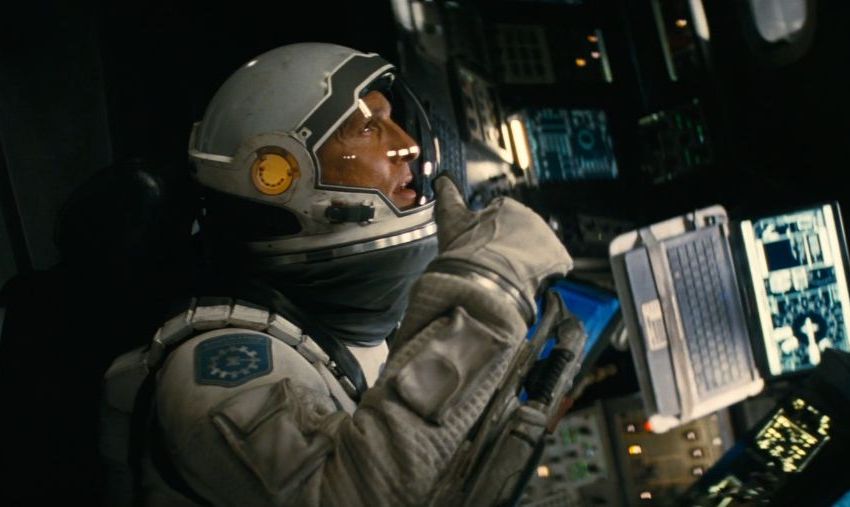 Nolan hasn’t lost his gift for crafting eye-popping visuals and bringing a rousing sense of scale to his movies. Interstellar is blessed with spectacular images of our universe, alien worlds, and mankind’s place in the whole realm of the cosmos. Nolan’s usual DP, Wally Phister, was unavailable, taking time to direct his own debut, Transcendence (probably the last film he directs as well, like Janusz Kaminski’s little-seen, little-remembered Lost Souls). The change of DP does Nolan good, giving the film a different, Earthier feel under Hoyte Van Hoytema (Her, Let the Right One In). Nolan isn’t the greatest stager of action but he is remarkable about putting together memorable set-pieces, and Interstellar has some standouts from the hostile alien environments to a thrilling space-station docking that is not for those susceptible to motion sickness. The special effects are terrific and the retro cubist robots are a fun addition. The only technical element I found lacking is the score by Nolan’s usual accompanist, Hans Zimmer. It’s bleating organ music intended to add a spiritual sense to the cosmic awe but it mostly becomes annoying. It sounds like a church organist died atop their instrument.
There is one great moment of acting in the film. Not to say there is an overabundance of bad acting, more like over emoting with a script and dialogue that do not deserve the waterworks. It involves Cooper after a mission, catching up on video messages sent from his children on Earth. In this very efficient scene, the magnitude of the consequences of Cooper’s decision is emotionally raw and he is overpowered with regret. McConaughey has been on a record-breaking tear of supreme acting performances, especially if you count his mesmerizing turn in HBO’s True Detective. Nolan allows the moment to play out, to sink in, without overdoing it, and it succeeds wildly. The other times Interstellar tries to wring out emotion feel too facile and maudlin to be effective.
This is my first real Nolan disappointment, a bloated film struggling to be important and say Important Things about the Human Condition but coming up short. It has its moments of excitement and awe but more so those moments are surrounded by too much dead space. The story is dense while still being undercooked, with too many listless supporting characters that amount to nothing, and easily telegraphed plot turns that are frustrating. Interstellar snuffs out all the intriguing possibilities it has to come back to its sappy father/daughter relationship that never truly feels earned. By no means is Interstellar, Nolan’s space travel opus/ode to Stanley Kubrick, a bad film. Unless you’re a sucker for easy sentiment, it will likely be a disappointment in some way, whether it’s too long, too boring with its science, too cloying with its emotional tugging, or just underdeveloped and overcooked at the same time. Interstellar is ambitious with its vision but seriously flawed and ultimately an obtusely personal sci-fi snoozer.
Nate’s Grade: C+
Share this:

Mama (2013)
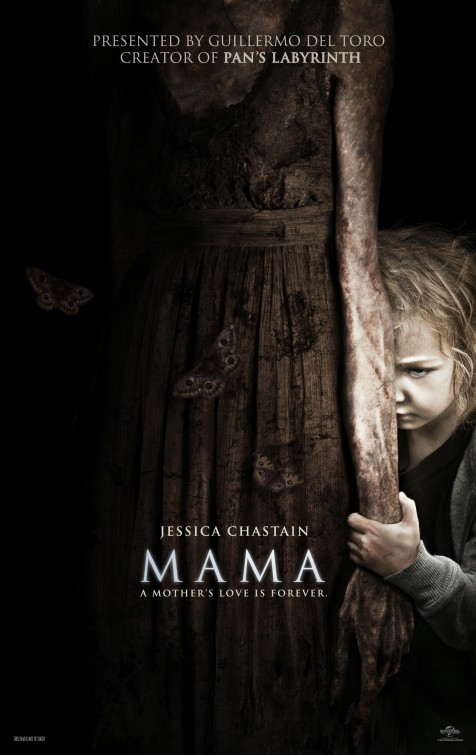 Guillermo del Toro is no stranger to the things that go bump in the night. He helped shepherd the horror film Mama to the big screen, and his love of heavy atmosphere and creepy, agile, lithe figures of terror is still evident. This is a rather effective and very creepy little horror movie that has enough little scares, big screams, and plain skin-crawling moments to recommend. The plot involves two little girls left to fend for themselves out in the wilderness. The two young actresses are fantastic, with terrific physical command of their bodies, able to slink and hop around like feral beasts. They help emotionally ground what could have been an otherwise ordinary ghost story. Oh yes, the girls prayed to a protector known as “Mama” who happens to be a malevolent and jealous spirit. Pity Jessica Chastain (Zero Dark Thirty), not just for her Gothic haircut and heavy eyeliner, but also as the girl’s reluctant foster mom. I’m shocked at how disturbing it is to watch a highly articulated physical specimen bend and snap and scurry at odd angles, broken arms bouncing like insect mandibles. And director/co-writer Andrés Muschietti knows how to properly tease an audience with just enough show and tell. The end is rather rote and familiar but, due to the emotional connection, has moments of genuine poignancy. Credit the considerable talents of the little ones as well as the devious vision of Muschetti and the guiding hand of del Toro. Give Mama a look.
Nate’s Grade: B
Share this:

Zero Dark Thirty (2012)
 Director Kathryn Bigelow and journalist-turned-screenwriter Mark Boal, Oscar winners for 2009’s Best Picture-winner war film The Hurt Locker, were hard at work on their next movie when fate intervened. They were about to start production on a film about a 2001 incident where U.S. Special Forces almost nabbed Osama bin Laden, the notorious mastermind behind 9/11. Then on May 1, 2011, the world learned that Seal Team Six stormed bin Laden’s secret compound in Pakistan and executed the most wanted man in the world. Bigelow and Boal scrapped all plans and rewrote their movie from scratch. Now they had the ending we’d all demand; isn’t a movie where we get bin Laden way better than one where he narrowly escapes? Zero Dark Thirty (military terminology for well after dark) is the stunning result of Boal’s impressive reporting and condensing, Bigelow’s masterful direction, and a great supporting cast that brings history to vivid life. If you’re like me, you’ll walk out of the theater whistling to yourself, speechless at the spellbinding artistic achievement of the movie. This, ladies and gentlemen, is what essential, invigorating, quality filmmaking is all about.
We may know about Seal Team Six and the lead presented from tracking the courier, but few people know of the CIA analyst at the heart of the manhunt. Maya (Jessica Chastain) is a young agent stationed in Afghanistan who desires nothing more than to be the one who helps ensure that bin Laden gets killed. We follow her decade-long quest as she chases down leads, interrogates prisoners, and successfully presses the CIA brass for action, resulting in the fateful raid that took out bin Laden.
 You can tell early on that Zero Dark Thirty is going to be an excellent film. Given the pedigree of is creators, my expectations were enormously high. I rated their previous collaboration as my top film of that year. I knew I was in capable hands when the film opens on September 11, 2001 but skips any visuals. We sit and watch a minute of a blank screen while the sounds of desperate 911 calls become a wall of sound. It’s enough to reassert the stakes while still being restrained. Bigelow’s directorial command is astonishing, pitting you in the thick of the action. There are a lot of moving parts with a movie like this, wheels within wheels, and Bigelow keeps everything moving and focused. It helps that the bigger manhunt is broken up into a series of mini-missions over the ten years. Bigelow and her talented production team have recreated the ends of the world to bring this story to life. That added sheen of verisimilitude gives every moment a sense of magnified power, an electric sense of relevancy. You’ll get goose bumps as they start circling the actual location of bin Laden. Bigelow, who won an Oscar for her virtuoso work on The Hurt Locker, still knows how to play every one of your nerves. There’s a clandestine meet up with a possible turncoat that is stuffed with dread. Every checkpoint, every safety procedure waved, you’ll be biting your nails, the voice in your head clearly saying, “Oh no, this isn’t going to go well.” Zero Dark Thirty is more crime procedural than the action thriller. Even so, Bigelow’s direction is top-notch and brings an intense, churning verve to the film, down to the smallest detail.
The film plays out like an absorbing, hard-hitting piece of investigative journalism, recreating the steps and false turns over the ten-year manhunt for bin Laden. There is a lot of information to process and over 100 speaking roles, and Boal and Bigelow do not stoop to pander to the less intelligent in the audience. You will be expected to catch up or fall behind. It can get confusing at points but Boal does an exceedingly articulate job of narrowing the particulars of the bin Laden case and presenting a clear through line. It’s a story that hops around the globe through a series of mini-missions, from a meet up with a possible al Qaeda spy to locking down a phone number to trace a courier in Pakistan. You see every step, every deal, and every effort that it takes to land the big break, namely tracking down bin Laden’s trusted courier to his Abbottabad compound. Boal even separates his narrative with titled sub-sections like a lengthy piece of journalism. We all know where the story is going to end up, but Boal’s supreme talent is making every step meaningful and tense leading up to that fateful raid May 1, 2011. The level of reportage detail is completely enthralling and will be relatively unknown to most filmgoers. Beyond 9/11 and the London bombings, I confess to being ignorant of the other al Qaeda attacks highlighted throughout. Therefore, not only is Zero Dark Thirty an exciting manhunt, it’s also an educational endeavor for most Americans.
 The proceeding two hours are an engrossing manhunt, but when Zero Dark Thirty gets to the raid sequence, that is when the movie ascends to a level of cinematic excellence unsurpassed this year at the movies. There is nothing else in 2012 that comes close to matching the 30-minute raid on bin Laden’s compound. My heart was in my throat the whole time. I was physically shaking. I was pinned to my chair. The conclusion, nabbing bin Laden, is one of the most riveting sequences in film I have ever seen. It’s like Bigelow has complete control of your senses, and even though we all know how this story ends, you’ll be glued to the screen, pulse racing, anticipating every step. After the film ended, I told my friend Eric that I felt like I needed to start smoking, thus was how exhilarated I felt leaving the theater (message to kids: don’t smoke, even if you see Zero Dark Thirty). My head was bustling afterwards. All I could think about was the masterful conclusion to a very good movie. The raid sequence is brilliantly recreated and just about portrayed in exacting real time; you feel like you’re right there along with the members of Seal Team Six. For a civilian, it’s fascinating jut to watch the minutiae of what went down, but under Bigelow’s taut direction, it’s the moment every American has been waiting for since September 11, 2001. Bigelow is also careful not to portray the death in any sort of jingoistic, fist-pumping context. She sticks with her docu-drama approach, avoiding sensationalism, and you don’t even see the shot that takes down bin Laden. The film is also very careful not to linger on bin Laden’s dead body or even reveal his face; she doesn’t, as President Obama said, “spike the football.” Bigelow deserves a second Oscar just for her superlative handling of those unparalleled 30 minutes of pure filmmaking bravado. Plus, it’s the best ending of the year at the movies.
Let me address the brewing controversy ensnaring the movie regarding its depiction of torture. Zero Dark Thirty does demonstrate torture but it never glorifies it or presents it as anything less than dehumanizing and morally repugnant. But torture did happen (I’m sorry Dick Cheney… “enhanced interrogations”) and to whitewash this regrettable period of time from the historical record is a disservice to the truth. This country, as well as any other, engages in extreme and detestable measures; we only hope that our leaders have the moral clarity to make these ethical lapses as few and far between as possible. Now, the politicians and bloggers have attacked Bigelow’s movie as tacitly condoning torture, indicting that it was successful in getting that big break. This is not the case. Zero Dark Thirty shows a variety of methods being used, and yes we get a heavy helping of torture and humiliation, but it’s when Maya and others start treating the detainee like a human being again, offering food and conversation, is when the progress is made. The film does not explicitly declare one interrogation method successful, however, I can see where people will draw their own (wrong) conclusion. If anyone wants to read my exact stance on torture, just check out my lengthy review of the 2007 Oscar-winning documentary, Taxi to the Dark Side. In short, torture does not work and Zero Dark Thirty does not purport that it does, though many may conclude otherwise. It seems to me that the critics don’t have enough faith in the audience to accept ambiguity.
2011’s breakout actress, Chastain (The Help), is the focal point of the movie and she delivers. Her character has no life outside of doggedly hunting for bin Laden. She’s completely driven by the goal of killing him, and as such she gets to uncork some dandy angry monologues dressing down her colleagues for their failing dedication. Chastian does a fine job of keeping a veneer around Maya, shrouding her emotions into a mysterious calm, which seems realistic given the nature of the character but also makes it tricky to connect with her emotionally. This movie is not the great character study that The Hurt Locker was, and so Maya gets some rather shrift characterization: she’s a workaholic fighting for credibility. The real star of the movie is the story so all the characters take a back seat to Boal’s journalism. While Chastain is quite good, I have to shrug my shoulders at the various critics groups throwing Best Actress accolades her way (go Jennifer Lawrence).
 The supporting cast doesn’t have a weak link amongst them, from Kyle Chandler (Super 8) as an outpost boss, Mark Strong (Tinker Tailor Soldier Spy) as a CIA superior screaming at the bin Laden team to “find me targets to kill,” Jennifer Ehle (Contagion) as Maya’s closest friend in a hostile land, James Gandolfini (TV’s Sopranos) as CIA director Leon Panetta, Stephen Dillane (Game of Thrones’ Stannis Baratheon) as a skeptical NSA head, and Chris Pratt (TV’s Parks and Recreation) as a member of Seal Team Six. That’s right America, TV’s Andy Dwyer helps cap bin Laden. But the real standout is Jason Clarke (Lawless) as an interrogator who eventually leaves the field for an office but still makes headway for Maya.
Much like The Hurt Locker, here is a movie that transcends politics and genre. Zero Dark Thirty is a nerve-wracking thriller, it’s an intelligent crime procedural, and it’s an engrossing and powerful work of relevant art. It operates on such a high level of artistic achievement that little else from 2012 even comes close. This thorough, intense, provocative, thought-provoking, morally ambiguous, thrilling, and generally tremendous movie is taken to a whole other level with its concluding act, brilliantly recreating the raid that took down Osama bin Laden, the most cathartic and satisfying ending of the year. You’ll be liable to whistle in awe at how accomplished Zero Dark Thirty is. Of course audiences should not accept every thing they see in the movie as unimpeachable gospel, as dramatic license is needed to help shape a formidable narrative. This is still a movie that desires to entertain and yea does it entertain. I look forward to the American public getting a chance to experience the same riveting theatrical experience that I had with my critical brethren, as well as the sense of catharsis and relief by film’s end. Zero Dark Thirty forgoes sensationalism for modulation, eschews moral righteousness for ambiguity, and expects the audience to keep up with its retinue of information. And you’ll be grateful to be given the chance to tag along. Run out and see this remarkable movie when you have the chance. Movies don’t get much better than this, folks.
Nate’s Grade: A
Share this:

Lawless (2012)
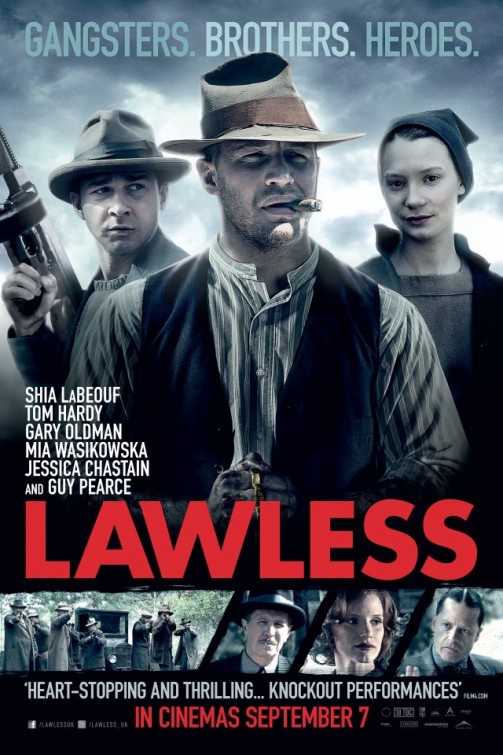 The bootlegging drama Lawless certainly has all the right elements to be an enjoyable movie. It’s by the men who gave us the great noir-Western The Proposition (director John Hillcoat, writer Nick Cave), it’s got a star-studded cast, plenty of bloody action, and a handsomely recreated production of the Prohibition era. But as I watched the Bondurant boys struggle against those who would like to put them in jail and/or murder them, I kept noticing something odd. I wasn’t that engaged. There was plenty of life-and-death drama, but why wasn’t I involved in the story more? Lawless feels like a series of scenes rather than a movie. Even when the plot changes it doesn’t feel like the movie is advancing. Even when things are more desperate it doesn’t feel like the momentum is building. The characters are somewhat sluggish as well, Shia LaBeouf as the scared youngest brother, Tom Hardy as the grumbly big brother who talks like his mouth is full of molasses. Jessica Chastain as the abused Good Woman who opens herself up to our Strong Hurting Man. Then you got a plot with a mobster (Gary Oldman) that weirdly climaxes with an hour left in the movie. He’s ignored for the remainder. Then there’s Guy Pearce as a colorfully fiendish and foppish special deputy that terrorizes the town. I am a Pearce fan but this guy is acting like he’s in his own weirder personal movie; it’s the kind of stuff Marlon Brando did. I appreciated that Lawless kept things gritty and bloody for realism, but I kept finding moments that ripped me out, namely the indestructible nature of Tom Hardy. Seriously, this guy has to be the Terminator. When he miraculously survives yet another seemingly fatal injury, all you can do is laugh. Lawless is passable entertainment but with its pedigree this should have been better.
Nate’s Grade: B-
Share this:

Coriolanus (2011)
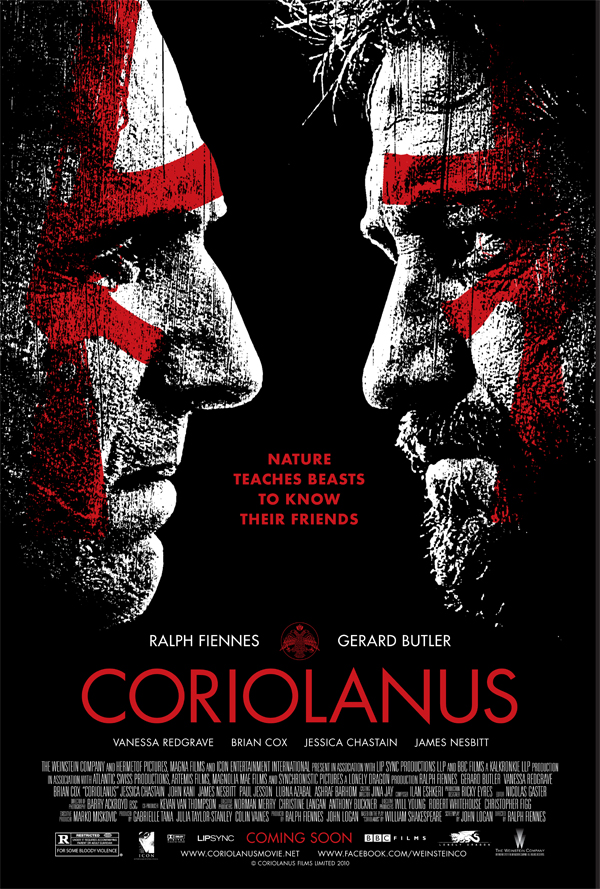 William Shakespeare’s little-known play has a surprising amount of cultural relevance: attacks on the border, suspension of civil liberties, political scheming, populist uprisings and riots, and a military elite arguing against the principles of appealing to the uneducated, mob-ruled masses. Plus Ralph Fiennes, taking on the hat of director for the first time, sets the play in modern-day. It seems like a struggle between Scotland and England, judging from the two mortal enemies, Coriolanus (Fiennes) and Tulius Aufidus (Gerard Butler). So it’s the Scotland/England struggle, termed ancient Rome, but set in what looks like the war-ravaged Balkans. Hey, at least Fiennes gets to have a nose in this film. The Shakespearean verbiage is certainly beautiful to hear, especially coming from the mouths of excellent thespians, notably Fiennes, Brian Cox, and Vanessa Redgrave. The actors achieve that synergetic level of excellence where it feels like they were always meant for the parts. Butler acquits himself well though his character sort of disappears unless needed by the plot. The elements that work best reside in Coriolanus’ refusal to play the game of political optics, neither serving a crowd of ignorant peasants he feels should remain out of the political process or the wily, double-crossing, self-serving politicians inflaming populist unrest. The movie sets itself up for some serious wrath to befall Rome, and besides the Greeks (and Koreans), nobody does revenge like this guy Shakespeare. We’re chomping at the bit for a cataclysm of death, but then the plot just sort of skips to a hasty conclusion, ditching the wrath. It makes you realize that, except for the intriguing title character, this isn’t one of the bard’s better plays. The characters are hard to empathize with, their conflicts too repetitive without deeper insight, and an ending that would be best described as a bit of a rush job. Still, even Shakespeare’s lesser work towers above most writers’ best material. Fiennes does a fine job as director, choosing lots of disorienting close-ups to communicate the rage of his character. Coriolanus is an interesting stab at something more, it’s just that sometimes it swings and misses.
Nate’s Grade: B
Share this:

The Tree of Life (2011)
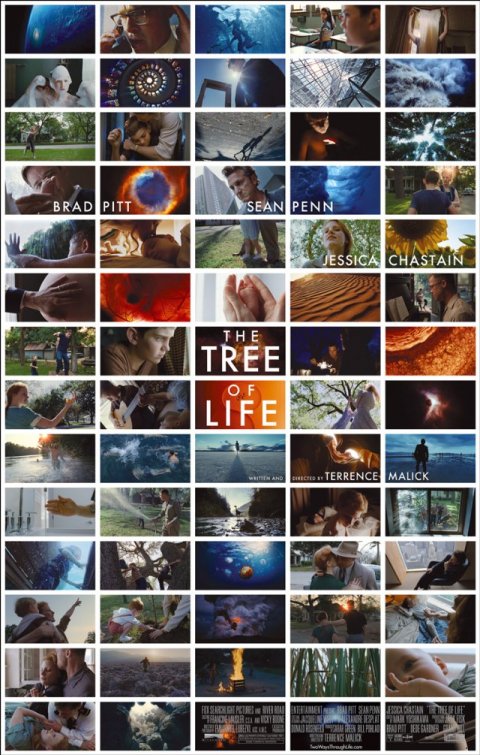 If a Terrence Malick film (The New World, The Thin Red Line) is the closest thing cinema has to creating a religious experience, turning the theater into a church, then I choose to worship elsewhere. After four movies I can decisively say that I am not a Malick fan. The man is more interested in making ponderous nature documentaries attached with pretentious, whispery, obtusely poetic voice over. The man is not interested in narrative filmmaking. The Tree of Life, the inexplicable winner of the Cannes Palme d’Or, is less a movie than an impressionistic experience inside a dying man’s brain. It feels like all the synapses are sizzling, memories and fantasies bouncing around and melding. We see a 1950s childhood and a pushy father (Brad Pitt), but then we also see mom (Jessica Chastain) floating at one point, and Malick also manages to squeeze in a 15-minute sequence charting life from the Big Bang to the end of the dinosaurs. What? The Malick faithful declare their man a singular auteur, a man who uses cinema to explore the unanswerable questions of life, the universe, and everything. Terrific. However, most of these edits are only a couple seconds, and with little narrative momentum the scenes drag and drag, and every Malick minute feels like a thousand hours. Sean Penn, as the adult son, probably filmed his stuff during a pee break from another movie; it’s that short. The film is a technical marvel, the cinematography making tremendous use of different light levels, but that’s all this movie is for me — pretty pictures. It’s yet another frustrating, pompous, punishing “film,” a term I’m being generous with, from Malick. The Tree of Life moves so slowly and intractably that I wondered if literally watching grass grow would be a better use of my time. Sorry Malick disciples, I guess I am a movie secularist.
Nate’s Grade: C
Share this:

Take Shelter (2011)
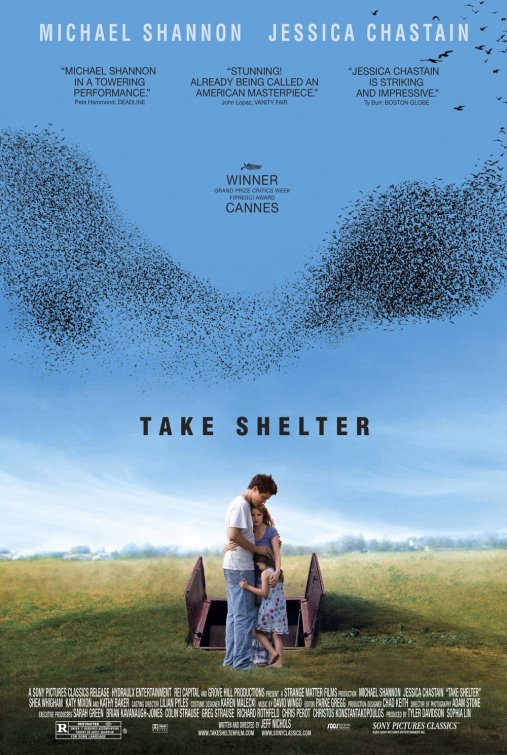 It’s rare that I get to take some local pride and puff my chest about a movie being shot in Ohio. Take Shelter, a small, suspenseful character-piece, was filmed in Loraine County, near Cleveland. Several of the actors in the production are local actors, including Tova Stewart, the adorable seven-year-old who plays the onscreen deaf daughter. The young gal, who is also deaf in real-life, is from Columbus and was in attendance at the theater I saw Take Shelter at. And I can beam with even more local pride at the fact that Take Shelter is unwaveringly magnificent. It’s a remarkably tense movie, deeply realized, expertly crafted, and one of the best films of the year.
Curtis (Michael Shannon) is a working-class family man in rural Ohio. He works as a manager of a two-man drill team, scouring the earth for valuable deposits. His wife, Samantha (Jessica Chastain), cares for their recently deaf daughter, Hannah (Stewart), and sews pillows and embroidery on the side. They are making ends meet to save up for Hannah’s cochlear implant surgery. This family tranquility is interrupted when Curtis begins having strange visions. He sees dark, ominous storms that no one else seems to see. He hears loud cracks of thunder during clear skies. He feels the dark rain fall on his person. He wakes from frightful dreams detailing friends and family turning on him. What does it all mean? Curtis feels compelled to remodel the storm shelter in the backyard. He even purchases a cargo container and buries it in the yard, collecting some end-of-the-world provisions. Could Curtis just be crazy? His mother has been in a psychiatric home since she abandoned Curtis as a child. She began having schizophrenic episodes in her mid 30s, and Curtis is now 35. Is he being warned of what lies ahead or is he succumbing to the pull of a hereditary mental illness?
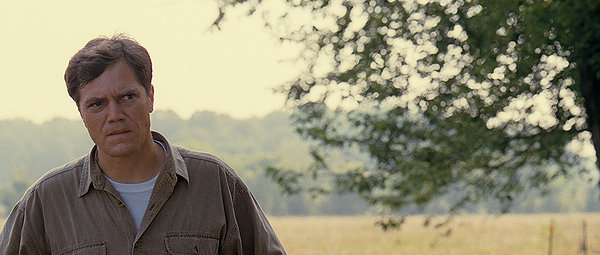 This is very likely the most nerve-racking, tense, dread-filled film I’ve watched since 2009’s Oscar-winner, The Hurt Locker. Writer/director Jeff Nichols (Shotgun Stories) masterfully lays out the particulars of his tale. Even the family drama has some nicely constructed tension. Curtis’ family is living paycheck to paycheck, so his backyard project is a real financial setback. By borrowing equipment from his work, Curtis is even risking losing his job, the only way he can afford his child’s cochlear implant. Not only do we dread stormy weather and strange flocking patterns for birds, we dread the everyday struggles of keeping afloat. Curtis following his visions can very likely put his family into financial ruin, but is that a risk worth taking? Nichols nicely creates an authentic small-town setting. There are small, acute character touches that enrich the story, like when Dewart (Shea Wigham) concludes that the best compliment a man can give is that “he’s lived a good life.” When Curtis and Samantha watch their daughter sleep, they share behavior they are still trying to kick in adjusting to having a deaf child (“I still take my boots off not to wake her,” he confides. “I still whisper,” she returns). These people and their troubles feel believable, and their reactions to Curtis’ strange behavior feel extremely believable. Whispers begin to spread and people start to treat madness like it’s a communicable illness. Religion seems like a natural landing zone when discussing anything apocalyptic and/or prophetic, but Nichols sidesteps this discussion. There could have been some interesting theological room to explore here, considering a Biblical prophet would likely be derided as mentally ill in our modern age. Nichols keeps things secular. Curtis is admonished for missing church again, but that’s about the extent of religion in the man’s life. He does not seek out spiritual advice. He seeks out psychiatry, at least if he could afford it he would.
There are some terrific standard thriller moments, like some well-calculated jump scares and many nightmare fake-outs, but the film’s real skill is drawing out tension to the point where you want to shout at the screen. This is a deliberately paced thriller knotted with unbearable tension. We become conditioned to start doubting the onscreen imagery after Curtis’ series of nightmares. Every time there’s a storm now the audience, too, fears the validity of what we witness. What is the significance of these portent signs? There’s a moment toward the climax, where a storm door needs to be opened, and I simultaneously was dreading every second leading up to that door opening and silently screaming in anticipation. Every part of me wanted to see what was going to happen next and I could not guess where Nichols would take us. I was a nervous wreck. The dread was so heavy, so all consuming, and not just from an apocalyptic standpoint. Curtis understandingly thinks he may be nuts, especially since his own mother is a paranoid schizophrenic. The threat isn’t just the strange apocalyptic signs but also Curtis himself unraveling and lashing out. He worries that he’ll become a danger to his own family, and if he cannot discern the difference between reality and fantasy it’s only a matter of time before he jeopardizes his loved ones. He fears he’ll be ripped away from his family. He wants to be better, he wants to be “normal,” but he can’t trust his own senses.
 Take Shelter is also so effective thanks to Shannon, a talented actor who always seems to be on the brink of freaking out. The bug-eyed, crazed, monotone actor has played plenty of nutcases in the movies. He was nominated for an Oscar in 2009 for Revolutionary Road for playing such a nutter. He’s a live wire of an actor, simmering, waiting for the final cue to explode. Shannon uses this intensity to his great advantage, wonderfully mirroring the movie’s compounding dread. Shannon’s character is troubled, that’s for sure, and worries about slipping into insanity. His performance is simply riveting, searching for answers amidst the desire to keep his family safe at all costs, even if that eventually means his removal. When he has to confront his central dilemma, the legitimacy of his visions, Shannon is racked with fear, eyes glistening with tears, terrified to go on faith, and your eyes are glued to the screen, completely taken in by the depth of the performance. I hope Shannon gets some due recognition come awards season because I doubt I’ll see few performances more compelling.
Chastain has had quite a breakout year for herself with lead roles in Tree of Life, The Help, and The Debt. She has a remarkable vulnerability to her, radiating an ethereal vibe (no doubt why Terrence Mallick chose her), and both aspects are put to fine use in Take Shelter. She’s much more than the oft underwritten put-upon wife, silently enduring her husband’s foibles. She’s desperate for an answer to explain her husband’s actions and motivations. She’s alert, angry, compassionate, and deeply concerned. Chastain holds her own with Shannon, and the two elevate each other’s performance subtlety, making their supportive relationship even more believable.
Take heed movie lovers, and make sure to find Take Shelter, an intelligent, expertly constructed, suspenseful drama with powerful performances and a powerful sense of dread. Shannon’s coiled intensity nicely fits the mounting tension. Nichols has created a taut thriller, a fiercely felt human drama, and an involving character-piece attuned to the talents of its cast. Take Shelter is a commanding, unsettling film that puts the audience in the unreliable position of the main character’s point of view. You may almost hope for some actual apocalypse just to validate the guy’s struggle. When was the last time you secretly hoped for the end of the world just to give one person a sense of relief? Take shelter from inferior movies and find a theater playing this tremendous movie.
Nate’s Grade: A
Share this:

The Debt (2011)
 A tense and mature spy thriller that’s as well written as it is acted, The Debt is a thriller that even stops to ponder some serious moral ambiguities along the way. Back in 1965, a group of Israel agents (Jessica Chastain, Sam Worthington, Marton Csokas) were sent to Berlin to capture a notorious ex-Nazi doctor (Jasper Christensen) and bring him back for justice. When things don’t go according to plan, the group must decide what is justifiable in the name of moral cost. In 1997, the aged former agents (Helen Mirren, Cirian Hinds, Tom Wilkinson) have to deal with the full consequences of their actions. A far majority of the film takes place in the 60s, and it’s for the best considering that’s where most of the tension and interest reside. As a thriller, drama, and non-linear mystery, there’s always something going on. The film is not without its genre clichés, but the sequences of holding Christensen (Quantum of Solace) hostage rise beyond genre mucking. He is a true monster and his dialogues with the various agents are chilling, reminiscent of Hannibal Lector’s tête-à-têtes. The cast is uniformly good, even Worthington, but the real star is Chastain (The Help, Tree of Life). She is magnetic. It’s a shame that The Debt felt it needed to tie up its loose ends in a conventional ending that discards the film’s more ambitious moral quandary. I suppose the toll of false identities and moral relativism just doesn’t make audiences happy like good old-fashioned vengeance. I guess that’s a debt everyone would rather have paid.
Nate’s Grade: B+


 nathanzoebl
You must be logged in to post a comment.