Blog Archives
Hurry Up Tomorrow (2025)
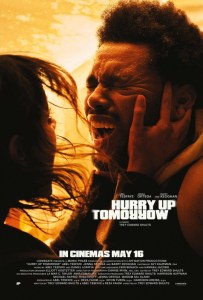
The pop star vanity project is a dubious film enterprise, though it’s been quite a while since we had a theatrically released bauble from one of the most popular singers in the world. Typically, if musicians want to get experimental and “arty” with a visual medium, they turn to longer-form music videos for even the entirety of a new album release, like what Beyonce and Halsey have done. That wasn’t good enough for The Weeknd, a.k.a. Abel Tesfaye, as he co-wrote a starring vehicle for himself that could be filmed alongside his world tour where he essentially plays an enigmatic version of himself that Jenna Ortega is obsessed with. At this rate, I’m surprised he didn’t write a scene where a bunch of women congratulate him on being the world’s best lover. Hurry Up Tomorrow is a glorified longer-form music video collection of extended musical performances and some more trippy experimental videos in the second half. It’s also a low-rent Misery with Ortega being a crazy fan who eventually takes her target of obsession hostage. She thinks she can help the troubled singer confront his past through her extreme therapy. If this was the whole dynamic, this could have been the movie rather than the final twenty minutes of it. It’s gob-smacking that Tesfaye is able to spare his life through the unquestioned power of song and his talent (“You had it in you all along, most talented superstar”). By the end, I don’t think anyone has learned anything after all the kidnapping and murders and arson except that Tesfaye has a pretty high opinion of himself. Unless you’re the biggest Weeknd fan, you’ll be left blinded by the meandering artistic hubris of Hurry Up Tomorrow. There’s just nothing here to grapple with besides the self-serious self-indulgence. What to expect from two of the three credited creators of HBO’s abysmal and cringe-inducing canceled-after-one-season show, The Idol?
Nate’s Grade: D
Share this:

Death of a Unicorn (2025)
 Unfortunately, this never became the glorious B-movie its premise promises, a monster movie with ghastly gore that also satirizes the rich business elites. Death of a Unicorn has enough appealing elements, from the father/daughter relationship between Paul Rudd and Jenna Ortega, to some ridiculous gore and kills, to impressive creature prosthetics to bring the unicorn to life (and death). The setup has Rudd and Ortega run over a unicorn in a secluded nature reserve on their way to meet dad’s boss. They discover the unicorn blood can be miraculously healing, which is a fortuitous discovery considering Rudd’s boss runs a pharmaceutical company. You can see where this goes, especially when you learn that there are more unicorns out there and they are not happy. It becomes a wily creature feature from there, with unicorns picking off the characters one-by-one as they try and escape. The satirical broadsides are a bit too broad, thus only really glancing in their pointed attacks that the people in charge of medical care are themselves venal and selfish. Got it. Much of the humor is related directly to the absurdity of watching a unicorn as a blood-thirsty monster. If you replaced the unicorn with, say, a yeti, would the situation still be amusing? Maybe, but I seriously doubt it. Death of a Unicorn could have been a little scarier, funnier, even freakier, and maybe carried through on the courage of its convictions.
Nate’s Grade: C+
Share this:

Beetlejuice Beetlejuice (2024)
 Usually sequels over thirty years later reek of desperation, trying to rekindle the past while usually only hoping to tickle people’s fading sense of nostalgia. Rare is the 30-year-plus sequel that excels by breaking free of its imitator and making us see the original in a new light. It helps to keep your expectations in check, especially for a project that is so miraculous as the original 1988 Beetlejuice. What a wild movie that was, an introduction to horror comedy for a generation, and a near-perfect balance of creepy, silly, and imaginative. From director Tim Burton’s career-launching sense of style, to Michael Keaton’s electric comedic performance, to Danny Elfman’s outstanding score, to the stop-motion visuals, fun and freaky makeup effects, and you had a madcap movie that felt like a unique discovery. Recreating that is near impossible, but if Beetlejuice Beetlejuice can recreate some of the elements and feelings that made the original what it was, then it can be considered a modestly successful late-stage sequel.
Lyrdia Deetz (Wynona Ryder) has become a long-running host of a paranormal TV talk show connecting people with messages from loved ones from beyond the grave. Her teenage daughter, Astrid (Jenna Ortega), is moody and embarrassed by her mother, feeling that she “sold out.” Mother and daughter return back to Connecticut to attend the funeral of Charles Deetz, Lyrdia’s father. Her pretentious and snippy stepmother, Delia (Catherine O’Hara), is trying to better commune with his spirit, and the entire town has become famous for its spooky seasonal history. Meanwhile, Beetlejuice (Keaton) is trying to avoid his former wife, Delores (Monica Bellucci), who naturally is seeking to obliterate him to ectoplasm. He’s still got his sights set on Lydia, who spurned his marriage hopes, and might be able to manipulate the Deetz family back into his control.
 Beetlejuice Beetlejuice gets the closest to rekindling that lightning-in-a-bottle alchemy from the 1988 original, serving as an appealing and enjoyable sequel. Nothing will ever be as original and wild and such a discovery as that first movie, which serves as a point of entry for many a Millennial fan who discovered that irresistible Tim Burton Neo-Gothic aesthetic. However, it recreates enough of the qualities that stood out about the original. The skewed sense of humor and surreal visuals, as well as goofy slapstick and vibrant imagination about life after death, it’s all such a fertile playground for Burton’s visual charms. The genius of the original was telling a ghost story from the ghost perspective as they learned about how to be better ghosts to try and scare their new living owners away. Given the world of the dead, there’s such tremendous storytelling and world-building possibilities here, explored richly in the animated 90s series for kids. Further stories in this universe have an automatically appealing power, and it’s just nice to watch Burton apply his specific aesthetic again, something fans haven’t really seen since 2007’s Sweeney Todd. I appreciated the weird morbid details and the practical production values; the Alice in Wonderland movies have shown that the “Burton look” isn’t best complimented by massive green screen sets. Having Burton, the “Burton look,” the original actors, with some exceptions (more on that later), and enough of that offbeat, chaotic, morbid tone return is a victory.
Beetlejuice Beetlejuice doesn’t so much alter our understanding of the world of the dead as established; it doesn’t radically rethink the landscape but it doesn’t repeat the same plot events either. I really liked the evolution of the adult Lydia as a jaded TV host. There’s a real dramatic punch to the reality that she sees the dead but has yet to see her deceased husband. She is incapable of reuniting with the man she misses the most, and she doesn’t know why. That yearning, paired with a lingering thematic mystery, can be a palpable storyline to explore. Pair that with some three generations of Deetz women trying to understand one another and work through personal resentments and we have fertile narrative ground. The three women were my favorite part of the movie, and their interactions and reflections on parenting and the challenges of trying to better understand one another are the foundation of the movie’s sense of heart. I really enjoyed the dynamic between the three, significantly upping Delia’s screen time and finding room to give her more dimension, an artist struggling in the wake of her grief. I’m a bit surprised that Ortega’s character isn’t more central to the drama. For all intents and purposes, she’s Lydia 2.0, so butting heads with Lydia 1.0 I guess feels redundant, so the story sends her off to find a cute boy in town and use that as an excuse for several unexpected needle-drop song use. There’s something inherently wrong watching a Tim Burton movie and hearing contemporary music. Imagine the Beetlejuice “Day-O” singalong but to, say, Sabrina Carpenter instead. No.
 Beetlejuice, as a character, is such an exciting agent of chaos, a horny ghost who operates on the same tonal wavelength as a Looney Tunes cartoon character. Even though the original movie is named after the guy, he’s only in the film for approximately twenty percent. Keaton was absolutely incredible in his comedic bravado, creating much of the character through his ad-libs and hair and makeup choices. Keaton is still fantastic in this go-for-broke sort of performance, a performance we’ve seen far less as he’s settled into a respectable dramatic acting career. It’s hard to remember, dear reader, but when Keaton was initially cast for Burton’s Batman, the fan base at the time was up in arms, considering Keaton more of an un-serious funnyman. It would have been easy to have Beetlejuice front and center for the movie, so it’s admirable that Burton and Keaton decided to keep his on-screen appearances short, leaving people wanting more. There’s a late turn of events that pairs Lydia and Beetlejuice together, and I wish this fractious pairing had been the bulk of the movie. The whole enemies-to-uneasy-allies would have put much more emphasis on their character dynamic and the comic combustibility. Still, seeing these characters come back and retain their appeal and personality without obnoxious pandering is welcomed.
The screenwriters find a clever solution for the Jeffrey Jones Dilemma. For those unaware, Jones, who portrayed Lydia’s father in the original, and best known for pugnacious supporting roles in movies like Ferris Bueller’s Day Off, Howard the Duck, and HBO’s Deadwood, was charged with soliciting a child for sexual exploitation. The movie continues with the character of Charles Deetz but without the involvement of Jones. The character gets his top eaten by a shark, so for the rest of the movie he’s a walking half of a corpse with a mumbly voice. It’s a clever way to include the character without the need for the actor.
With that decision to limit the Beetlejuice quotient of Beetlejuice Beetlejuice, it makes for a sloppier movie juggling a few underwritten subplots and side characters. The biggest non-factor is the return of Mrs. Beetlejuice. Here is a powerful antagonist who has the literal ability to suck out the souls of the recently dead and turn them into shriveled husks. She’s seeking vengeance against her ex and tracking him down through the netherworld. And yet, she could be completely eliminated from the movie without really affecting the other storylines. The whole Mrs. Beetlejuice/vengeful ex-wife character feels like a holdover from a different sequel script, clumsily grafted onto this other project, a vestigial artifact of another path not taken. There’s plenty of potential with the concept of the past victims of Beetlejuice coming back to seek retribution, and especially a trail of angry former lovers. It would explore the character’s history more meaningfully than an albeit amusing silent film interlude about how he married her during the era of the Bubonic Plague. We see how he died as a human, but there’s hundreds of years that can be illuminated from his failed schemes and odd jobs. Certainly there could be a whole club of ax-grinding malcontents sharing their mutual hatred of the Ghost with the Most. This character should better reflect Beetlejuice, and instead she’s just a monster on the prowl that eventually gets indifferently cast aside. It feels like Burton was looking for something for Bellucci to portray (Burton and Bellucci have officially been dating since 2023).
 She’s not alone as an antagonistic villain that pops up to provide momentary danger but is also hastily resolved to the point that it raises the question why they were even involved. There are three antagonists, not counting Beetlejuice, that appear throughout to threaten our Deetz family members in Act Three, each of them individually interesting and targeting a different member of the family for ill-gotten gain. Yet each one of these characters is conquered so easily that it nullifies their importance and overall threat. If Beetlejuice could, at any moment, just open a trapdoor to hellfire at a moment’s notice, what danger does any other character pose then? If a sand worm can just appear from nowhere and consume our pesky antagonist, then why can’t this be a convenient solution earlier? The defeats feel arbitrary, which make the antagonists feel arbitrary, which is disappointing considering that we have the full supernatural arsenal of undead possibilities to tap into. I enjoyed these characters for the most part, but it’s hard not to feel like they’re tacked-on and underwritten. The same can be said about Willem Dafoe’s police chief, a former actor who played a chief on TV and now tries to fill the role for real after death. I’m always glad to have more Dafoe in my movies (woefully underrepresented in rom-coms, you cowards!) but he’s just mugging in the corner, waiting for some greater significance or, at minimum, more memorably morbid oddity to perform.
Beetlejuice Beetlejuice is better than a desperate sequel cash-grab, though there are elements, ideas, characters, and jokes that could have been smoothed out, better incorporated, and developed to maximize the potential of the undead setting. It’s an enjoyable throwback for the fans of the original that does manage to tap into enough of those potent elements that made the original so memorable. It’s definitely less edgy and transgressive, maybe even a little too safe given the territory of spooky specters; the entire Soul Train bit felt like a bad Saturday Night Live sketch from the 1980. However, it’s still got enough of the charm and silliness to leave fans, old and new, smiling and wondering where it might go next in its wild world.
Nate’s Grade: B
Share this:

Scream 6 (2023)
 When horror franchises dramatically shift their locations to somewhere new, like New York City, it’s usually a bad sign that the series is desperately looking for new creative life. Not every franchise can rebound like a Leprechaun in Space. Most of them just become another Jason Takes Manhattan, where now instead of Character Group A running and dying from the masked killer, it’s now Character Group B running and dying from the same masked killer. It’s more reminiscent of cartoons where the backgrounds might change but the on screen events are stuck in the same drab routines. The Scream franchise was rebooted with 2022’s satisfying fifth installment, so I hoped that a sixth Scream could at least exceed where so many others have failed. Those hopes were quickly fulfilled in what I consider to be one of the best sequels of the seminal slasher series with all of its air-quote irony.
There are more than a few entertaining new turns as the bloody hi-jinks head to the Big Apple. It feels bloodier and gorier than most of the Scream movies, but it also has well-developed suspense sequences that work extremely well at making you squirm. Every brutal burst of violence elicited a “oomph” exhalation from me, and I found myself tensing up as the initial scene constructions transformed. I was quite enjoying myself from set piece to set piece. Take for instance an escape that requires the characters to flee from one high-rise window to another across an alley via a rickety ladder. Or take a subway escape packed with masked Halloween revelers to make you paranoid who among the many Ghostfaces might be the potential killer (I enjoyed the other costumes of horror old and new – I saw you Midsommar May Queen). Even a hide and seek sequence inside a convenience store can be thrilling. All credit to returning Scream 5 directors Matt Bettinelli-Opin and Tyler Gillet, the same pair that delivered 2019’s wonderfully twisted Ready or Not. These gentlemen have proven that they know how to squeeze the most tension from any scenario no matter how bizarre. I loved that the opening kill (Ready or Night alum Samara Weaving) goes in a different direction, revealing the culprit right away, and then it goes in even another direction. There are still some new cool tricks to be had with the sixth installment in a 27-year-old horror series.
 I was asked if you had to watch any of the prior Scream movies to enjoy Scream 6, and while it’s not necessary, you will be missing out on some of the larger connective tissue and themes. You should definitely have familiarity with Scream 5 since it’s a direct sequel and continuation of the core (four) characters. I was surprised how much more emotional resonance I found with the Carpenter sisters than any of the other characters, new or legacy, from the earlier movies. I think it was smart having Sam (Melissa Barrera) be the daughter of the first Ghostface as was her seeing visions of her late father, this time as an adult Skeet Ulrich, which might have been the wrong choice considering the character never lived to be this age (is her imagination doing one of those age approximations you see for runaway kids?). Our lead heroine is trying to navigate where her instincts are taking her, which might be a darker path that she feels trepidation about ignoring for only so long. Sam’s therapist balks when he discovers her actual parentage, which makes him maybe the worst therapist. Her relationship with her younger sister Tara (Jenna Ortega) is more complex than any of the close friendships of Sydney Bristow. Even with all the carnage and bloodshed, Scream 6 still finds breather moments to let the sisters react realistically to their dilemma and how it affects their own relationship. I’m glad these characters returned because they serve as the emotional focal point of an otherwise famously glib franchise.
The biggest drawback from Scream 6 is the tacit understanding that this will not be the final film in the franchise given its box-office success, the first film to cross the $100 million-dollar threshold since 1997’s Scream 2. This feels like a culminating climax as the characters now view their lives not as their own but as part of a “franchise,” which means the stories will keep going on beyond them and that nobody is safe, not even the “leads.” For a series entrenched in heavy meta-textual irony, it feels like it’s reaching the end of its genre self-awareness cycle when the movie acknowledges itself as its own IP. The scope of the movie is retrospective, not just reaching back and acknowledging the history of where things began for the legacy characters but for every movie. Each one of the former Ghostfaces is being collected and commented upon, with murder nerd Easter eggs left at each crime scene or in its contextual arrangement. It’s the kind of totality that I would expect from a movie franchise coming to an end, and nodding at its various twists and turns, finding places to even include elements from the lesser beloved Scream sequels. There’s even an unspoken satirical jab at the number of characters that miraculously survive, as if the film is throwing up its hands and saying why not, as if this is the last movie and the rules of who survives and who dies are inconsequential because we’re subverting expectations, as we’ve been explicitly told, so expect the unexpected.
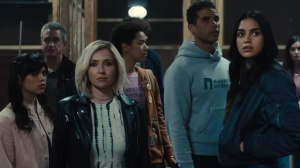 The other aspect of this drawback involves some slight spoilers but I’ll try and tread lightly. After our genre-savvy movie geek explains the stakes of this new episode, the characters start to review one another as potential suspects, and the new supporting characters even cast an accusing eye on the returning characters saying they could have cracked from their trauma. There’s emphasis on the drive to subvert expectations and break away from the patterns of old.
And here is where I’ll venture into some light spoilers so if you want to skip ahead to the next paragraph, please do so, dear reader. There is an ongoing thread where an Internet subculture has re-framed the Carpenter sisters as the real villains of their own horrendous story, and it’s an intriguing element that brings the echo chambers and confirmation bias and novice sleuths-in-the-making of the Internet to further examination. It’s reminiscent of any bottom-feeding conspiracy that asks people to pick apart their reality for “the real story” magically hidden in plain sight. The Scream franchise is famous for its fun guessing game of who the real killers could be from our gallery of suspects, and Scream 6 is no exception. However, the subversion that could have really separated this Scream from its elders is by having the killers actually be… nobodies (the Rian Johnson twist). What if the mask comes off and it’s a brand new character? I’m sure many viewers would feel like they had been betrayed, but then the point emerges that it’s simply some conspiracy theorist who has gone full-tilt crazy into the cult and taken matters into their own hands, attempting to hold “the real killers” to account or to prove they were truly guilty. And the larger point is that the “fake news” has already won out. It doesn’t matter what happens from here, what news coverage should stamp out ignorance, because you can’t pull every cult member out of their self-inflicted cocoon of delusion, which means there will always be more to take their place. That’s the legacy of what has transpired, that there will never be a real escape any longer. I thought that would be such a jarring and thematically intriguing and summative ending.
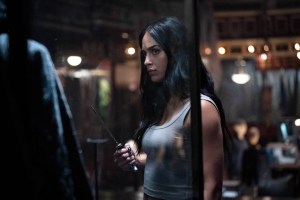 For the many fans of the slasher series, I believe Scream 6 retains plenty of the same pleasures of its prior movies while stretching out into new and interesting directions. It helps that I cared about the central sisters, at least enough by the low bar of horror movie standards. It’s bloody, fun, twisty, and satisfying enough that it could have served as a capper for the entire franchise. But it won’t be. I look forward to this new creative team re-evaluating trilogies better than Scream 3 did. In the meantime, this is a bloody good time to be had for long-term fans and newcomers from the 2022 reboot alike.
Nate’s Grade: B


 nathanzoebl
You must be logged in to post a comment.