Blog Archives
The Mechanic (2011)
 The Mechanic is a routine remake of a 1972 Charles Bronson hitman thriller. But when did “mechanic” ever become commonplace slang for “killer”? The film treats this concept like everyday knowledge. Bishop asks, “You know what a mechanic is?” A character responds matter-of-fact: “A hitman.” And the “mechanic” services are advertised via a system that includes a Craigslist style message board. It makes me wonder what the “adult services” section on Craigslist was really all about this whole time.
Arthur Bishop (Jason Statham) is the world’s greatest hitman. He meticulously plans his hits, deciding whether to make it look like a suicide or an accident or whether to send a message. He’s the cleanest of the cleaners. Then he gets a very delicate assignment – he’s to take out his mentor, Harry McKenna (Donald Sutherland, taking a paycheck). Bishop’s boss (Tony Goldwyn) tells him that somebody is going to kill Harry. If it’s Bishop at least he can make it more humane. Bishop takes out his mentor and makes it look like a carjacking. Then Harry’s screw-up of a son, Steve (Ben Foster), appears to get vengeance for his old man. Bishop takes the hotheaded kid under his wing and trains his to be an assassin. Then, naturally, Bishop discovers he was set up and played by his employers, which brings about a larger examination on the cyclical nature of violence. Just kidding. There’s more killings.
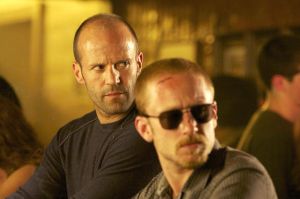 To say that The Mechanic is a well-oiled formula picture is probably the kindest thing that can be said. It follows the path of its hitman forbears fairly close. The opening pre-credit sequence is a hit that established the abilities of our deadly lead, Donald Sutherland pops up just long enough to lay down the necessary exposition for the film, and then before we even finish the first reel (20-minute mark) the movie manages to introduce a sexy female (Mini Anden) whose only purpose, in grand action movie tradition, is to have enthusiastic sex with the lead whenever his tank is low. The rest of the movie follows rather lockstep with the various beats of the genre, meaning that Bishop takes on an apprentice, shows him the ropes, they bond by taking out the bad guys, and then of course the final show drops and the truth about Bishop killing Harry is revealed. Along the way, The Mechanic does enough to satisfy genre fans looking for the goods when it comes to thrills.
The best moments are the tag-team hitman efforts of Bishop and Steve. The stuntwork is occasionally impressive like when Bishop and Steve repel down a large hotel building or when a car literally drives all the way inside a bus. There’s a brutal, visceral fight between Steve and his first kill that serves as the film’s highpoint. It was these sequences that made me actually sit back and think, “You know, I think this concept would actually play best as an ongoing TV series.” Think about it: you’d have your target of the week, the planning and execution that always make for satisfying payoffs, and then week-to-week Bishop and Steve would continue their complicated relationship with Bishop’s guilt eating away at him while he tries to keep the truth at arm’s length away from his neophyte partner. To me, that sounds much more dramatically rich while still keeping the body count consistently high.
Of course by hewing so close to the confines of genre, The Mechanic also has very little going on outside of the mini-missions of the hit jobs. Bishop obviously has been misled and setup by his sleazy employers. It’s fairly clear early on that when a guy gets out of a limo in a three-piece suit and tells you that the old man in the wheelchair is the bad guy, red flags should be waving. There doesn’t seem to be a formidable opponent in this fight mostly because Bishop is long described as the best at what he does. So how do you stop the best? You’d think you’d hire other players of comparable skill or offer an incalculable amount of money to kill the guy. But our villain doesn’t do any of this. Five minutes prior to his death, our villain fails to even once threaten Bishop (don’t even pretend like that’s a spoiler). The main conflict is really the complicated connection between Bishop and Steve; however, this relationship is kept at a slow simmer the whole film, even after Steve pieces together the ugly truth. The character development is left mostly at an inferential level. That means that there are long stretches where the characters glare, dispense with macho cool speak, glare with sunglasses, and then fall back on some unique hitman quirk they all have to relax (Bishop listens to classical music on vinyl records because he takes life yet appreciates beauty! IRONY!).
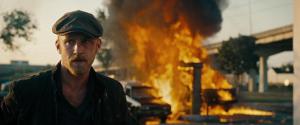 But the ending needs to be further discussed because it leaves a terrible aftertaste. Given the dramatic dynamic at work, you pretty much know that Bishop and Steve will eventually come to a head. Bishop regrets what he’s done and is trying to make amends and find some meager form of redemption by taking Steve under his wing. He’s trying to make amends for the many sins in his life. He’s coming to terms with his life’s choices. So then you would assume (spoilers to follow) that when Steve ultimately seeks his own very deserved sense of vengeance, that the old pro would accept his doomed fate. It makes the most sense. It provides an end for the character’s journey, it provides closure to Steve, and it allows for an ending where people have to pay for their life’s mistakes. It’s not even downbeat because it feels right; it’s the correct ending for this material. It’s also the way the original Mechanic ended. But why end the movie on Statham accepting death? That would shuttle any chances for Mechanic sequels. And so, in a colossal cop-out, our hero narrowly survives and even manages to set up a bomb to take out Steve. While his young partner was emotionally unstable and looking for an outlet for his billowing anger, but the man was warranted in his vengeance. It’s entirely the wrong ending for not just this kind of movie but this movie specifically. It smacks of a pathetic attempt to leave the option open for a would-be franchise. It eliminates the entire idea of consequences mattering.
Statham gives the exact same performance he’s been giving in every movie for a decade plus. You know what you’re getting with a Statham action vehicle, for better or worse. He’s going to get shirtless, he’s going to dispatch the bad guys with relative ease, and never once will an expression flash across his stony face. He even verbalizes guilt while still being completely stone-faced. You don’t really buy any inner turmoil with this guy; he’s too “cool” to have feelings other than anger and vengeance. But then Foster practically redeems the entire movie. The young actor has been delivering intense performances for years now, whether it is an emotionally unstable guy in Alpha Dog, an emotionally unstable guy in Hostage, an emotionally unstable guy in 3:10 to Yuma, or an emotionally unstable guy in The Messenger. Notice a pattern? I’m amazed the reservoir of little tricks Foster finds to make Steve pop. Foster gives a far better performance than the movie deserves.
The Mechanic is a routine action movie that fails to rise above its genre conventions due to a lackluster plot, some vapid character development, and a horrendous ending. Statham does his thing, his shirtless chest gets due prominence, but the movie lets both he and a game Foster down. The kills are rather sloppy leaving behind mountains of evidence and dead bodies, and yet there seem to be no consequences. That makes for a long march to an inevitable conclusion with a few bursts of colorful violence to entertain. But what actually exists on the screen isn’t half bad. It’s fairly unremarkable, straightforward genre pap, but that can be suitable for the right audience and the right frame of mind. I was seeking something brainless to excite me when I caught The Mechanic, and it modestly achieved these modest goals.
Nate’s Grade: C
Share this:

The Expendables (2010)
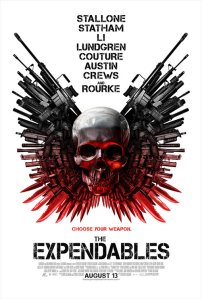 Casting can make or break a movie, and occasionally the cast is the only advertised reason why the public should give a damn about a movie. Ocean’s Eleven wasn’t sold on its craft plot or cool director, it was the George Clooney, Brad Pitt, Matt Damon, Julia Roberts movie. Sylvester Stallone is an actor who?s had some lengthy dry spells but he redeemed his legacy a bit with the modestly affecting Rocky Balboa and his ultra-violent modern Rambo. Now he has set his sights on co-writing and directing The Expendables, a film that gathers as many action movie stars together as possible and dares you not to buy a ticket. There?s Stallone, Jason Statham (Transporter), Jet Li (Unleashed), Dolph Lundgren (Masters of the Universe), Mickey Rourke (The Wrestler), Terry Crews (Gamer), Eric Roberts (The Dark Knight), along with wrestler Steve Austin, mixed martial arts champ Randy Couture, and direct-to-video kickboxing ace Gary Daniels. It?s a smorgasbord of testosterone, a group of guys whose median age qualifies them for an AARP membership. The selling point of The Expendables is the cast and the cast alone. The story about some military general (Dexter”s David Zayas) is completely incidental. These men are here to inflict punishment.
The Expendables is ridiculous with a capital R. Whether it’s punching guys in the face while they’re on fire, breaking necks through kickboxing, or, my favorite, hurling an ammunition shell like a shot-put and shooting it in the air, The Expendables exists in that 1980s world of brute and mostly brainless action. It’s a throwback to those halcyon days for the majority of the cast members, back when men were men, women were damsels or temptresses, and action heroes didn’t have to have more than one dimension, and usually that dimension was muscle. The Expendables is enjoyable but much of that enjoyment is because it’s simply enjoyably bad. I have to assume that Stallone had his tongue firmly in cheek when he was designing and executing this film. How else to explain the bizarre moments of action overkill described above, the premise of saving a single girl from a small Latin American military, the fact that the sleazy CIA villain takes off with the damsel, for no personal gain whatsoever, and even gets to deliver the all-important, “You and I are alike” speech villains are always fond of giving.
I was laughing throughout the movie from its excesses and logistical and narrative shortcomings. This is the kind of movie where characters make veiled comments about a family but then we never see the family. This is the kind of movie where the good guys have perfect aim and it never matters how many bad guys there are because they never know how to wield a firearm. This is the kind of movie where Statham’s ex-girlfriend (Charisma Carpenter) gets beat up by her new dude, so Statham goes to confront the guy at a basketball court with all his friends. But the weird part is that the guy’s posse of friends shows no regret that their dude struck a woman. They all rally behind the domestic abuser, and Statham promptly hands them their asses. Just look at the character names: Ying Yang, Lee Christmas, Gunner Jensen, Tool, Barney Ross, James Munroe (no relation to the fifth president), Toll Road, Hale Caesar. Those aren’t cagey nick-names, those are the characters honest-to-God real names. You can?t help watching The Expendables without the impression that the whole movie is one big joke. However, I cannot rationalize that Stallone spent time and money to make a satire of the burly action genre.
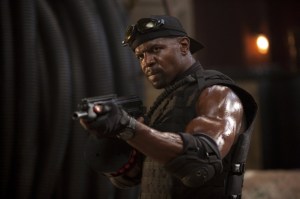
 Throughout The Expendables you quickly realize why these guys are men of action and not men of debate. Their speaking voices are terrible. Some are marble-mouthed mumblers, like Stallone and Rourke. Some are just hard to understand, like Lundgren. Some have pretty bad English, like Li. Some are weirdly whisper-quiet in their intensity, like Statham. And others are just plainly bad actors, like Austin and Couture. The characters they?re given to play are pretty thin, defined by a quirk or two but not much else. Statham’s character is away from his girl too often, that’s why she becomes an ex. The film is basically a contest of machismo. Everyone tries to out-do the competition in glaring and teeth grinding. Also, given the title, (semi-spoiler) is it a little much to think that Stallone’s entire wrecking crew can escape death, even the guy that gets shot inches above his heart? These are men you want to see doing things, preferably painful plural things, and speaking at a minimum. Only Crews seems capable of doing both acting and action. Too bad he gets short supply when it comes to screen time.
And that’s certainly another problem when the selling point of the movie is an all-star collection of action movie badasses — screen time. Everybody has to be juggled around and fight for screen time. As you’d assume, Stallone and Statham rise into the upper character branch while everybody else must be content for a series of moments and one-liners. Part of the fun of seeing this group of actors together is seeing this group of actors together, which is in relatively short supply save for an all-out assault climax. There’s a scene with some great cameos, ruined through TV advertising, where Bruce Willis and Arnold Schwarzenegger appear on screen and playfully jab at one another. For some, it will be a movie moment decades in the making. My response: “Oh my God! The founders of Planet Hollywood are finally together again (minus Demi Moore).”
On the subject of action, the film presents plenty of bloody, macho men-on-a-mission mayhem, but Stallone edits the sequences too quickly. It becomes a rush of images that the brain barely has time to process before moving on to another location and fight. There are a handful of gory money shots to the R-rated spectacle, but I just wish I was able to understand what was happening. I know Stallone was not trying to emulate the hyper-kinetic verite editing style of the Bourne movies, which have influenced much of action cinema for the last five years. Perhaps given the realities of shooting fight sequences around aging superstars, Stallone was forced to rely on quick edits to mask the illusion that these geriatric men are still capable of intense beat downs. The editing is occasionally disorienting but even worse it?s distracting. It’s harder to enjoy the action. Nor are the action sequences really well thought-out or specific to their location. It’s mostly the guys with guns chase other guys with guns variety. There are some impressive knife fights and brawls, but the concluding 30-minutes consists mostly of action chaos. Men with guns run, get shot, people hurl grenades (why does a martial arts guru like Li forced to use guns most of the time?), explosions occur, rather, rinse, repeat. From a fighting standpoint, there are six good guys and three bad guys, though t?s hard to take Roberts seriously. That’s not a good ratio for battles. There needs to be more colorful henchmen.
 My friend Eric Muller and I came to an intriguing ending that would have made The Expendables legendary. After the film’s mission is complete, the gang collects back at Rourke’s tattoo parlor/clubhouse. Instead of palling around and talking shop, the gang all of a sudden starts having a giant orgy, and then Stallone looks directly into the camera and says, “It was always leading up to this. You just never wanted to admit it, audience!” The movie is awash in testosterone and nostalgia, naturally gathering an older male audience. Would it not be hilarious to instantaneously make all those men uncomfortable? They love their masculine superheroes when it comes to death but love is too out of bounds. It would be the greatest piece of performance art ever and certainly gives people something to think about (now that you mention it, those character names sound like porn names anyway).
The Expendables is pretty clear in its intentions. It wants to be a gritty, bloody, hard-edged action movie throwback to the 1980s when the world was simpler and all you needed was one man with a gun running through the jungle to solve political disputes. The film’s entire selling point is its cast of action stalwarts from past and present, though many are beefcake past their prime (Statham is only 37, though). The movie works as a casting gimmick but it doesn’t work as a movie. I’d be lying if I said The Expendables wasn’t entertaining and with its moments of silly, mindless fun, but clearly this could have been a much sharper action movie. At times it feels like a winking satire of the genre that helped make these men stars, but perhaps that’s just me projecting onto the film. Perhaps I’m trying to make it more self-aware to excuse its various shortcomings. This is a fairly mediocre action product despite the all-star reunion. Given the film’s relatively warm reception by its core audience, I await future installments of the Equally Expendables to feature Kurt Russell, Wesley Snipes, Rutger Hauer, Patrick Swayze (composed of archival footage), Steven Seagal, Hulk Hogan, Mr. T, and, naturally, the biggest badass of them all Chuck Norris. As long as Norris roundhouse kicks a live ammunition shell, consider my ticket bought and my sense of dignity put on review.
Nate’s Grade: C+
Share this:

The Bank Job (2008)
 An intelligent and rather crackling heist movie that also happens to be based on a true story. The 1971 British bank heist has so many characters involved that you may need a helpful cheat sheet, especially when it comes to varied loyalties. There are three separate groups all playing their own game, and when the heist doesn’t go exactly according to plan, and then the movie gets even more complicated. It’s a flavorful and funny heist movie that also doesn’t ignore the severe repercussions and life-and-death stakes. The Bank Job is an engrossing crime caper that still manages to thrill and surprise an audience.
Nate’s Grade: B+
Share this:

In the Name of the King: A Dungeon Siege Tale (2008)
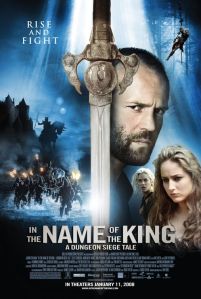 I have no idea how it happened but someone gave infamously reviled director Uwe Boll a bunch of money to adapt a fantasy video game called Dungeon Siege into a star-laden movie. In the Name of the King: A Dungeon Siege Tale seemed to be Boll’s stab at achieving mainstream credibility. He assembled his best cast yet with plenty of recognizable stars. At one point, I remember reading that Boll wanted to divide this film into two, Kill Bill-style, or release a 180-minute version. Until this movie, no Boll film had ever gone over barely an hour and a half. After seeing a slimmed down version that runs a little over two hours, I honestly have no idea what more Boll could have. In the Name of the King struggles to fill two hours worth with crap.
In a far off land, there lives a farmer named, coincidentally enough, Farmer (Jason Statham). His world is turned upside down when his family is killed by a band of creatures known as the Krug. He and his friend (Ron Perlman) must track down Farmer’s captured wife (Claire Forlani) and inflict some peasant vengeance of their own.
Evil wizard Gallian (Ray Liotta) was the cause of the attack. He has built up a whole army of Krug to challenge the King (Burt Reynolds) for the throne. Gallian also has two unwitting allies. The King’s nephew, the Duke (Matthew Lilard), wants to rule and is willing to plot with the evil wizard to achieve this goal. Muriella (Leelee Sobieski) is secretly sleeping with Gallian; he says he is teaching her how to use her blooming magical powers (remove your mind from the gutter) but he is really stealing her powers.
Farmer reluctantly becomes a leader to protect the kingdom. Gallian is stupefied that this simple farmer is somehow beyond the control of his magic. That’s because Farmer should probably change his name to Prince because he is the long-lost son of the King and some stable girl. Merick (John Rhys-Davies) serves as the King’s most trusted advisor but he is also the father of Muriella. He scolds her for being so foolish and being used by Gallian. She suits up like Joan of Arc and wants to fight, but her father won’t allow it.
Eventually this all leads to a large-scale battle between the forces of good and evil where Gallian uses his magic powers to create a cyclone of books to stop Farmer. There you have it.
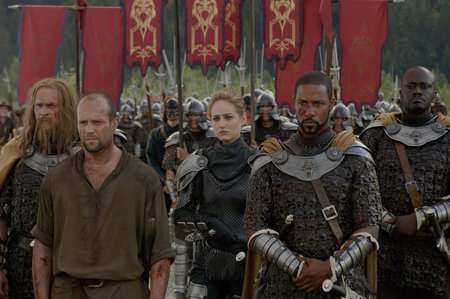 If I were Peter Jackson, I might consider a copyright infringement suit, because In the Name of the King is a sloppy Lord of the Rings rip-off through and through. The long-lost heir to the throne must accept his magisterial destiny … just like in Lord of the Rings. There is a 10-minute fight sequence that happens in a swath of woods … just like in Fellowship of the Ring. The villain relies on an army of stupid supernatural hordes … just like Lord of the Rings. There is a wizard-on-wizard duel … just like Lord of the Rings. A noble woman wishes to fight but her father does not approve, so she sneaks off in armor and does fight … just like in Return of the King. There is a shadowy “other” world that goes beyond our dimension … just like in Lord of the Rings. The eventual trek of our heroes leads to a volcano, but not just that, it’s also the villain’s lair … just like in Lord of the Rings. Bastian (William Sanderson, in his sixth Boll movie) serves no purpose other than to resemble Legolas. John Rhys-Davies you should know better; you freaking starred IN the Lord of the Rings trilogy.
So what does a $60 million budget get Boll? Lots and lots of crane shots. Boll relies on extended aerial photography and zooming, CGI landscapes that serve to remind you how much better Lord of the Rings was and that Vancouver is no New Zealand. There are some segments that lack a firm geographic bearing because Boll wants to jump from expansive crane shot to expansive crane shot. I get that he wants to showcase the depth of the battles, which do feature a fair amount of background action, but the repetition of any camera technique will always grow old if it doesn’t feel congruent to the onscreen drama. I’m happy that Boll wants to open up the scope, but when he relies on a multitude of high-angle crane shots in motion the effect becomes wearisome. The audience can never settle into the action because Boll is too forceful with wanting to demonstrate what he bought with his budget. The cinematography is a notable step up for Boll and longtime director of photography Mathias Neumann. Then again, if I had a $60 million budget I’m sure my movie would look good too, or at least better.
In the Name of the King is the biggest budget Boll has ever had, but it seems like proper costumes must have still been out of his price range. The marauding horde of Orcs, oh I’m sorry, the Krug look like cheesy low-rent Power Rangers villains in goofy rubber outfits. The camera never lets you get a good glimpse of these creatures because even Boll knows how crummy they look. You get another idea of how bad the creatures look when Farmer utilizes the familiar dress-in-other-guy’s-uniform-to-pretend-to-blend-in ploy that was perfected by the aging action stars of the 1980s. So Farmer knocks out a Krug creature, throws on its spongy armor, and is able to walk around the Krug camp.
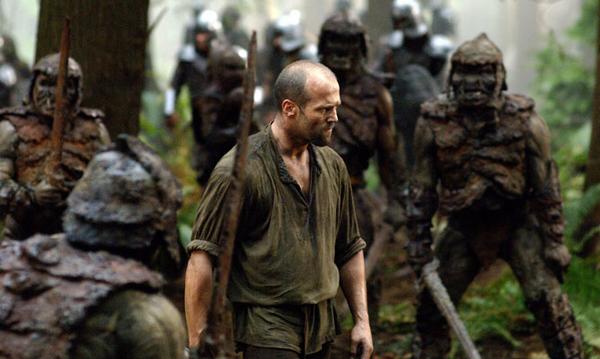 The special effects also seem to run the gamut. The green screen work is painfully ineffective and very transparent, like when Farmer is swinging down a rope across a gorge. When Boll tries to show large fields of soldiers it also exposes how fake the CGI work looks. The many battalions of soldiers look like a dated computer video game. The special effects for Alone in the Dark were better and that film had, reportedly, half the budget of this movie. Realizing all this, it’s no wonder that Boll tries to use as many real sets as he can.
And yet despite all of this, In the Name of the King is high-class camp. Boll achieves a workable level of derisive enjoyment that manages to keep the movie entertaining even while its spins into stupidity. The fight scenes are actually decent and Boll manages to compose a few shots here and there that look quite good, like when the camera scans over a field of dead bodies. During the action centerpiece, the 10-minute battle in the woods between man and Krug, Boll’s camera manages to frame some solid, if unspectacular, action with some good angles. It’s also cut to be mostly coherent. The fight choreography is credited to Siu-tung Ching who also did the choreography for Hero and House of the Flying Daggers. He must have procrastinated until the night before his choreography was due. It will pass but there’s little creativity there; however, Boll must have been flabbergasted. I think the true test for derisive viewer enjoyment will be when the ninjas come out of nowhere at the King’s disposal. All of a sudden in the middle of a medieval style fantasy fight there are flipping black-clad ninjas. I loved it for its sheer anachronistic absurdity. To me, it felt like Boll was trying to cram in everything that he thought was theoretically cool into one massive fight sequence. He just didn’t have the money to also include pirates and robots and hobos and vampires and bears and Batman.
Fantasy is just not Boll’s preferred territory and it mostly shows. He really wants to make his own entry in the style of Lord of the Rings, but you can tell his mind is elsewhere. The plot is a mess but that isn’t indicative of Boll’s lack of interest with the film, it’s just indicative of a typical Boll movie. In the Name of the King feels like Boll is following a checklist of what is expected in a modern fantasy epic, except that Boll cannot provide the epic part. Here’s my proof: the vine-swinging tree nymphs led by Elora (Kristanna Loken). If Boll was really invested in this movie he would have paid more attention to these alluring vixens. These anti-war ladies have sworn off men (take that for what you will) and live their lives like Cirque du Soliel jungle performers. This stuff is right up Boll’s exploitation rich alley, and yet he and the film treat these women of the woods like afterthoughts. They show up and save the day when the film requires an inexplicable savior. I don’t know how helpful tree-dwelling women would be in a fight either unless it was fought in a well-forested area. Boll not capitalizing on these women warriors proves to me that his heart isn’t in this movie.
 Screenwriter Doug Taylor was clearly cobbling a story together by his fading memory of the Lord of the Rings trilogy, and yet this being a Boll movie, there are still plenty of head-scratching decisions that defy logic even for a would-be fantasy film. For instance, why does Farmer fight with a boomerang? How effective can a weapon be when it gets thrown and then needs to be picked up? The boomerangs that I know can hit people, sure, but usually hitting someone stops its path of movement. Then again, these could be magic boomerangs. How did Gallian raise such a massive monster army to rival that of the King’s without anyone noticing? I’m sure the excuse for that is also magic-related. The Duke takes out two legions of soldiers for his own purposes, and when one man asks where the commanding officers are the Duke, in front of everyone, stabs him. It seems like a lousy way to lead but I’m sure Joseph Stalin would approve. A telekinetic sword fight sounds cool on paper until you realize it is just actors standing passively while CGI swords clang around them. During the climactic battle it’s dark and raining (hey, like in Lord of the Rings) for the King’s army vs. the Krug, but then as Farmer and Elora race to the Volcano Lair it is light out. How many time zones does this kingdom have? Also during this climactic battle, the King’s army has the high ground thanks to a hill and the Krug race up the raised land. The archers atop the hill fire their flaming arrows at an angle pointing up, which would sail over the heads of all their targets. I suppose the King’s archery education program has been suffering some severe budget cutbacks.
The dialogue is pretty corny amidst all the sword-and-sorcery antics and induces its fair share of giggles. When Muriella asks Gallian if he always appears out of nowhere he responds, “No. I appear suddenly. Out of somewhere.” Thanks for clearing that semantic argument up. He also has a very icky conversation with his bedfellow Muriella dripping with double entendres: “I knew you would come,” “I told you I would,” “I felt it before you came,” “You told me I could come and go as I please.” I think my favorite moment is when the King is on his deathbed and addressing Farmer. He advises the man of agricultural means to try using seaweed to enrich his soil. “How do you know this?” asks Farmer. “Because I am king,” he replies.
The actors all feel like they are in separate movies on a collision course with one another. Boll has never had a firm command with actors. The big name actors feel their way around a scene with little guidance from Boll, which means they routinely experiment and play their roles like they were an exercise instead of a final performance. A fine example is a single line spoken at a family table; it’s just perfectly off enough to prick your ears to Boll’s tone-deaf direction. I think Boll either doesn’t care that much about performances or is easily cowed into submission by actors. Staham is recycling his glaring machismo that he’s turned into an action movie franchise, but he seems to me like a modern-day Steven Segal who dispatches foes in a monotone whisper. Luckily for Boll, Statham is adept at picking up fight choreography and so the movie benefits by watching the actor clearly in the middle of the fracas performing his own sword fights.
 Most of the actors also seem to be falling back on past performances as inspiration for what to do under Boll’s laissez faire direction. Perlman plays his standard gruff tough with a deadpan delivery. Sobieski hasn’t acted in a movie for some time. She comes across as her usual inexpressively empty self, which is her thing, along with being a physical clone of Helen Hunt. Loken shows she can swing from a vine but not master a vague British accent. Forlani gets to cower and weep. Burt Reynolds is playing Burt Reynolds, and Rhys-Davies falls back on his trademark gravitas. Only Lillard seems to find enjoyment out of Boll’s vacuum of direction. His accent mirrors his wildly over the top style of acting that sometimes feels like a fish flopping around for air. His physical mannerisms are uncontrolled and he sneers through much of his lines, but I’ll give it to Lilard, he is much more fun to watch than any of the other slumming stars.
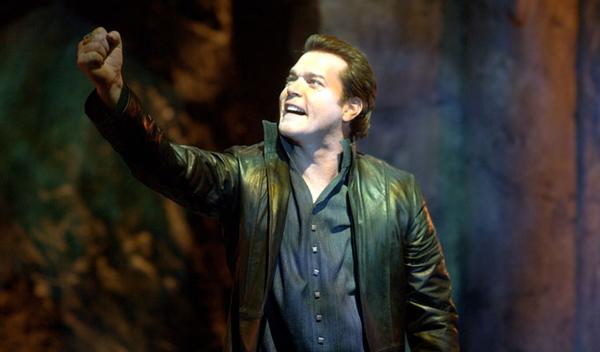
Special attention must be made to Liotta, who is on a different plane of terrible. It’s bad enough that he’s chewing the scenery in his typical manic, bug-eyed crazy yell-speak he refers to as acting, but the movie has to open on the discomfiting image of Liotta trying to suck Leelee Sobieski’s face inside out via kissing. Liotta’s character Gallian feels and looks out of place; he resembles a skuzzy Las Vegas magician with a pompadour and a long leather jacket and a button-down shirt. Where did this man come from? His performance is astonishing in how deeply the awful goes, and when he tells Farmer’s wife, “I feel him inside you,” try your best not to shudder.
After seeing eight of his films and writing 17,000 words on the man (including 2,600 for this review), I feel like I have a special connection to Uwe Boll. I just don’t sense that Boll’s heart was truly in this venture. In the Name of the King seems to be the last time I think we’ll see Boll flirt with mainstream Hollywood genre filmmaking. I think his time luring known actors has come to a merciful end. His next slew of films seem destined to all direct-to-DVD and feature no name casts that are mostly the same actors he has worked with before. In the Name of the King will stand as a ridiculous Lord of the Rings rip-off that has some workable action alongside its many laughably awful moments. It’s a lousy fantasy movie with too many extraneous characters and too familiar a plot outline. Even for a $60 million film, Boll finds new ways to prove that no matter what sized budget the man has he will always try to grasp something beyond his reach.
Nate’s Grade: D+
Share this:

Cellular (2004)
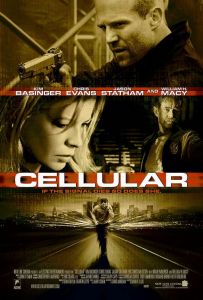 Cellular, a new thriller, relies on the simple device of a cell phone for the crux of its plot. With cell phones becoming ever more present, and ever more an eyesore in our daily lives, it was only a matter of time before they had their own movie. They’ve slimmed down from their heavier 1980s days, and become more useful, allowing one to surf the Web, take candid pictures of people in gyms, and are able to ring in the tone of the new hot rap song of the week. The premise for Cellular may be pitch-perfect for our modern society, but will an audience answer its call?
Jessica Martin (Kim Basinger) is a high school biology teacher caught up in some scary events. She’s been kidnapped by a gruff man (Jason Statham), and locked in an attic. She’s informed that her son and husband will be found and kidnapped, unless she tells him what he wants to know. Unfortunately, she’s clueless as to what her kidnappers want. There is a wall phone in the attic, and one kidnapper smashes it with a sledgehammer and walks away satisfied. Jessica goes to work re-configuring the shattered phone pieces, tapping wires until she can reach out and touch somebody.
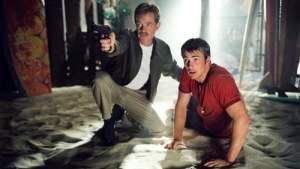
Ryan (Chris Evans) is a hunky beach bum who’s chastised by his ex (Jessica Biel, I know, I didn’t believe it too) for being too irresponsible. He’s driving around in his cool ride when he gets a panicky phone call from, you guessed it, Jessica. At first he thinks it’s a practical joke until he overhears her kidnappers threaten her. Reluctant to help, Jessica asks him to stop the kidnappers from reaching her family. Ryan runs around town all day scrambling to help Jessica’s family and solve the case. He also enlists the help of a retiring police officer (William H. Macy), who’d rather open a day spa than do desk work.
 The premise for Cellular is near-genius and provides an abundance of smart, problematic possibilities. Ryan runs around and is always in danger of losing the signal. At one moment his cell phone is about to die from low battery charge. Another time the lines get crossed. Every step seems believable and the characters’ reactions seem credible. With Cellular, the audience thinks along with the characters step-by-step. When Ryan encounters stumbling blocks, the audience is with him in solving them, and this makes for a very engaging and thrilling movie.
The acting in thrillers is usually a minimal speed bump but the actors in Cellular do fine work. Basinger attempts to make up for her role in The Door in the Floor and plays harried and teary like a pro, but her best moments are when she uses her biology teacher know-how in precarious situations. She’s like a female MacGyver. Cellular is really a coming-out for Evans as a leading man. He’s had small roles before in The Perfect Score and Not Another Teen Movie, but this is his first leading-man role, and he handles the running, shouting, and panting with aplomb. Statham does his usually fine work of sneering and acting menacing. It’s also fun to watch William H. Macy, usually playing an every-man or a sadsack loser, play a bloodhound cop that morphs into an action hero.
The pacing in Cellular is breakneck. In the first 10 minutes, we witness Jessica’s kidnapping, and the momentum built up from that point is exhilarating. There is rarely a moment to catch your breath in Cellular. The action sequences are exciting but not redundant, and the tension readily mounts, especially when the audience is given more information than our heroes. There’s also some fun jabs at our country’s cell phone lifestyle.
 Director David R. Ellis worked as a stunt coordinator for 20 years, before advancing into the director?s chair and helming 2003’s schlocky gore-fest Final Destination 2. Ellis knows how to keep his plot moving, and something is always happening in Cellular to draw our attention or to push us on edge. Cellular was written by Larry Cohen, who also penned Phone Booth and probably won’t rest until he’s the Robert Rodat of telecommunications (Rodat wrote Saving Private Ryan and The Patriot, and seems destined to write a movie about every American war). Might I envision an erotic thriller with the “Can you hear me now?” Verizon guy just around the corner? Only time will tell.
As with any thriller, there are going to be lapses in logic that have the possibility of stopping the story dead in its tracks. Cellular‘s biggest logic loophole occurs right at the start, and if you can get behind it then you can enjoy the rest of the ride. Instead of smashing a telephone, why not yank it out of the wall and fully decommission it? Or, even better, why leave your kidnapped victim in a room, out of your sight, with a phone? Would it not have been easier to just tie her to a chair in plain sight? The mind boggles. The real answer we all know, of course, is because then we wouldn’t have a movie. There’s also a sequence late in the film where the bad guys discuss their evil plan on cell phones, which seems a tad careless considering anyone with a police scanner could listen in. As I said, gaps of logic are expected in this movie terrain and it’s your ability to rise above them that will determine if you enjoy the film.
Cellular is a thriller that dials the right numbers. It may have some gaps in logic, but it delivers when it comes to sharp suspense, smart action and a great premise. Fans of action thrillers should lick their lips with what Cellular has to offer. Just remember to keep your cell phones turned off during the movie, unless, of course, you’re surfing the Web, sneaking pictures of some girl, or jammin’ to the rap song of the week.
Nate’s Grade: B
Share this:

The Italian Job (2003)
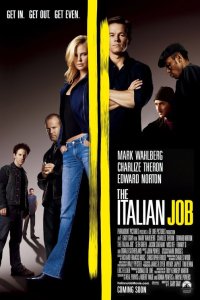 The Italian Job is equal parts dumb and equal parts entertaining, which makes for fine breezy summertainment. The cast is agreeable, the heist is interesting, the action is full of sexy cars and explosions; I call into question how in the world Jerry Bruckheimer’s name is absent from this. Maybe he’s too busy with his TV work.
The film opens up on a nifty heist in, of all places, Venice. Grizzled old-timer John Bridger (Donald Sutherland) leads his crew for, say it with me now everyone, one last heist. Charlie (Mark Wahlberg) is his second in command and the heir to the thievery throne. The crew steals a safe full of gold bars by applying explosive paint to specific levels of ceilings, causing the safe to drop two floors into the awaiting arms of our scoundrels. The Venice police believe the safe to be riding off in a boat, driven by the crew’s getaway man Handsome Rob (the always good to have Jason Statham). But no the real safe has fallen into the canal and Charlie and John are scuba-safe-crackin’. The crew gets away with their misdeed and toast about their thievery atop a mountainside.
 Everything is good. But wait, Steve (Edward Norton) double-crosses his peers and hijacks the gold and kills John. Heres what I dont get. Everyone in the crew is shocked, especially an overactive and whiny Wahlberg (and there’s no worse kind than a whiny Wahlberg). “How could you do this?” whines Whiney Wahlberg. Let me think here. Maybe its because … YOU’RE ALL THIEVES, JACKASS! What was that old saying, no honor among thieves or something. To paraphrase Go, you guys aren’t exactly in a highly ethical industry. There aren’t good thieves and bad thieves; this ain’t no Errol Flynn pic. I would also like to note that everyone in the crew should have known of Steves predestined treachery just by the fact that Norton has a mustache. C’mon, do you need any bigger a sign? Anyway, the van the crew is in drives off a bridge into subzero water. Steve fires some round into the water and believes hes killed his former crew. They of course are not dead and instead are using the scuba gear to breathe. Of course, it’s still subzero temperatures but what does that matter?
We then flash to one year later. Dead John’s not-so-dead daughter, Stella (Theron), conveniently works as a professional safe-cracker to tests security systems. Hmm, I wonder if that will come in handy later. Charlie approaches her with a plan to re-re-re-steal the gold from Steve, the man who, dramatic pause, killed her father. She agrees to help because she wants to see the look on Steve’s face when he finds his money gone. Its probably something very similar to many people over 40 I see now that the stock market is full of price-inflated charlatans.
 What follows is Charlie reassembling his crew; Seth Green as the geeky tech dude, Handsome Rob, and Mos Def as the demolitions expert. Together they work out a plan that is part elaborate and part ludicrous, but still entertaining. This is where The Italian Job gets the rules of heist cinema right: 1) Efficient amount of time must be made to plan the heist so the audience knows the steps and every role of importance. 2) The heist must go off for an extended period of time for the audience to enjoy the payoff of watching all the rehearsal proceedings. 3) The heist has got to be done in an interesting way. 4) Not everything has to go according to plan. The only real action sequences in The Italian Job bookend the film, with the opening Venice heists and the later and extended Steve steal. With this said, the end still carries a good sense of payoff for the audience, and watching all of the different elements of the team work together with their own responsibilities builds a sense of attachment to these otherwise undeveloped characters.
I am convinced Mark Wahlberg is a black hole of acting. Sure, he can do Affable Lug fine and dandy as evidenced by Boogie Nights, but when Wahlberg attempts (and that is the operative word) to emote he looks like his leg is caught in a bear trap. His whole bland handsome understatedness isn’t fooling me. Theron is a pretty face but I still havent seen anything shes done to convince me shes anything more. Green is very funny in his geeky role, complaining that he had the original idea for Napster and it was stolen from him by his roommate. Statham and Mos Def round out a likable if slightly one-note crew.
Director F. Gary Gray (The Negotiator) has graduated from the world of music videos but still knows how to stage some exciting scenes. The slick ending heist, with the L.A. gridlock, three trucks to chase after, and fleet of patriotic Minis is a great popcorn action set piece all the more appreciated because of the patient setup the movie has given.
In the days of summer, where some people wrongly consider a bloated and pretentious action film to be entertaining, even if they dont get a lick of it, it’s especially nice to have something like The Italian Job remind us the escapist fun summer flicks can offer. Just don’t worry if Wahlberg looks to be in pain.
Nate’s Grade: B-
Share this:

Snatch (2001)
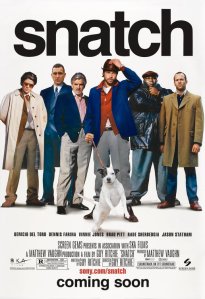 Snatch is really more of the same for writer/director Guy Richie as he retreats back to his magical land of London gangsters with Dick Tracy-esque names and thick cockney accents intermixing in comically violent and ironic ways. He’s like a more stylized version of Tarantino, if Tarantino ever got to have sex with Madonna. So if you like the niche Richie has trapped himself in for the moment (like myself) then you’ll like Snatch. The film is coursing with energy to spare and never loses its sense of fun, which carries over into audience smiles (at least for me and my gal it did). Brad Pitt is a riot as the hardly intelligible Irish gypsy and part time boxer.
Nate’s Grade: B+


 nathanzoebl
You must be logged in to post a comment.