Blog Archives
Extract (2009)
 Writer/director Mike Judge’s third movie isn’t quite as funny or just plain fun as his previous pair, Office Space and Idiocracy. Set in a local factory, we follow the misadventures of the boss (Jason Bateman) as he deals with incompetent employees, looming lawsuits, and a wife (Kristen Wiig) who he feels disconnected with. What Judge has is two competing movies; one of them garners the bulk of the first 45 minutes and proves to be funny. The other gets most of the second half and plays out sloppy and dumb. The more interesting half involves Bateman trying to feel guilt-free about wanting to have an affair, so his friend (Ben Affleck, very funny) hires a clueless gigolo to seduce the wife. This scheme actually works but causes humorous complications, like when the gigolo keeps going back for more. This comedic scenario would be enough for one movie. The other half of the tale involves Bateman trying to sell the company but the buyer is wary of an impending lawsuit due to an accident on the work floor that left a man sans his testicles (so much wasted potential here). Mila Kunis is the sexy con artist behind the scenes, encouraging the ball-less worker not to settle. Obviously Judge had work-related gags he wanted to tackle, but he proves that his real interests lie in the complicated relationship comedy. Extract fumbles forward not knowing what kind of movie its really wants to be, so it settles for hackneyed solutions and abrupt endings. Extract would have been a better comedy completely removed from the workplace.
Nate’s Grade: B-
Share this:

Couples Retreat (2009)
 Vince Vaughn is a likable scamp. He’s generally played the same quick-witted, charming, motor-mouth lout in every movie since 2005’s smash, Wedding Crashers. He’s been working fairly nonstop since then and has, by all accounts, become something of a box office draw, which seems bizarre if you think about it long enough. So the best thing I can say about Vaughn’s new comedy Couples Retreat is, hey, at least he’s making sure his pals can pay the bills.
I think it was that famed poet Pat Benatar who said love is a battlefield. She never went through marriage counseling (note: maybe she did, I don’t care to actually research this). The movie centers around four dysfunctional couples that take a vocational to a tropical island resort. Dave (Vaughn) has trouble prioritizing his wife, Ronnie (Malin Akerman). Joey (Jon Favreau) and Lucy (Kristin Davis) have been together ever since she got pregnant in high school. They’re at each other’s throats and secretly looking to cheat on each other. Jason (Jason Bateman) and his way younger wife, Cynthia (Kristen Bell), are unable to conceive a baby. They’re very organized about their life and cannot handle life’s deviations. Finally, Shane (Faizon Love) has been dumped by his wife and is taking the loss hard. He’s found comfort in a flighty twenty-year-old girl (Kali Hawk) that he can barely keep up with. The vacation is interrupted when the couples learn that they must participate in the resort’s relationship therapy sessions or leave. The couples must stick it out to in order to save failing relationships and ride those nifty Jet skis.
 Couples Retreat sure doesn’t feel like any vacation for the audience. Directed by Peter “Ralphie” Billingsley (longtime friend and producing partner for Vaughn and Favreau), the pacing is leaden and the movie feels like its coasting without any momentum. Structurally, the plot is not your series of escalating events but more a relentless parade of tiny plot speed bumps, seemingly indistinguishable from the last. Many scenes just bump right into each other with little transition. Billingsley does not show that he comprehends the rhythms of comedy. Even at a mere 107 minutes, this movie felt twice as long to me. Like Peter Jackson’s King Kong, it just takes way too damn long for these people to get to the freaking island. I don’t need a half hour of setup for stock characters. Many scenes will go on too long and then just sort of come to an abrupt end, like Vaughn and his friends were saying, “Well, we’ve taken this as far as we can go. The scenes don’t end in climaxes or revelations or punch lines, they just end. So after a while I felt like Couples Retreat was one long draggy middle of a mediocre movie stretched out interminably. It’s the equivalent of an eternity of waiting in a doctor’s office.
The character work is haphazard at best. You would think with the premise involving introspection and communication that the screenplay might offer up some deeper characters. You would be mistaken. Each character is given one note/generalized conflict to work, and they stay exactly within that narrow field of play. The male-female dynamics are Joey and Lucy have been together since high school and now they each have wandering eyes. Of course this kind of waffling infidelity is played for such sophomoric yuk-yuks like Joey getting caught masturbating and Joey getting an erection during a massage. You see a trend there? Cynthia and Jason are too anal retentive about their lives and the fun has died out. Sounds like room for some comedy. Oh, and they are also having trouble conceiving, which is way too serious a topic for this kind of movie. It’s somewhat amusing to think of Vaughn as the most stable character in a family comedy; it’s sort of like when Christopher Walken was the voice of reason in 2004’s equally bad, Man on Fire. What is Vaughn’s problem exactly anyway? He’s a “video game seller” who spends too much time… selling video games? The particulars of his job are too nebulous; does he work at a large chain, does he work at a software production company, what does he do that he can’t bother helping out his wife for one afternoon? You could almost certainly eliminate Faizon Love’s character completely. He’s just in the movie to crank out obligatory “older guy with too young girl” jokes, and his resolution is so hackneyed and reliant upon ridiculous coincidence (surprise, his ex-wife has tracked him down to the resort!) that it hurts the brain.
The movie has the benefit of being made in one of the most gorgeous places on earth. I’m sure the cast and crew had a great time making this movie. Too bad it doesn’t translate well to the paying customers. I was surprised at how stodgy the overall film is. I expected it to look down on hedonism, and I appreciated the movie treating marriage as a serious commitment that constantly needs to be engaged, but what is up with how stuffy this message comes across? The people who aren’t in relationships are seen as little party animals looking for their next carefree fix. Sure marriage is going to look better to the masses when you make the alternative so irresponsible. However, prolonging unhappy, extremely dysfunctional couples who can no longer stand each other isn’t helping either. Can’t some dysfunctional couples just grow apart? Why must there be reprehensibly forced happy endings all around? Couples Retreat, after awhile, kind of feels like your grandmother lecturing you about your relationships.
 There’s much potential for laughs with Couples Retreat, but you’ll do no better than scattered chuckles. This is definitely a case where all the good jokes were highlighted in the trailer. Couples Retreat squanders so much talent, mostly consisting of a boy’s club and giving the actresses little to do or play off of. Akerman (The Heartbreak Kid), Bell (Forgetting Sarah Marshall), and Davis (Sex and the City) are all very capable comedic actresses; Kali Hawk quickly becomes irritating with what she’s been given. The island therapists include the hilarious John Michael Higgins (The Ugly Truth) and Ken Jeong (The Hangover), who must be contractually obligated to appear in every movie this year. I would have thought that eccentric therapists plus the natural conflicts of couples counseling would have provided a wealth of funny material. It’s a shame then that the counseling scenes are kept short. It would be a better asset for this movie if it spent more time in therapy and less time doing goofy, trust building exercises by island guru Jean Reno. Seriously, swimming with sharks is supposed to help a deteriorating marriage how? There are comic setups that look like they’re going to lead to something juicy, and then they just fizzle, like a Guitar Hero battle that goes from silly to lame all too quick. A buff and tan yoga instructor (Carlos Ponce) gets a little too in touchy-feely with his female pupils. But then it stays at a distance, hammering home the same PG-13 safe sight gags. It’s like watching people dry hump for laughs. As I expected, the funniest parts are the naturally combative interplay between Vaughn and Favreau. Part of that may be because they’ve been friends for over a decade and part of that might be that both are credited as screenwriters, along with producer Dana Fox (What Happens in Vegas).
Let’s look at how I’ve described Couples Retreat in this review. Waiting in a doctor?s office. Listening to your grandmother condemn your relationship. Doesn’t sound like much of a good time, does it? The comedy consists of mostly one-liners with a whole lot of dead space in between. The characters are so limited, the actors are shamefully wasted, and the comic set pieces are too meandering to be amusing. Somewhere there’s an edgier, R-rated version of this movie that got scrubbed clean to fit a PG-13 mandate. You see glimpses of the naughtier movie Couples Retreat might have been. This is a movie in need of some serious counseling of its own.
Nate’s Grade: C
Share this:

The Invention of Lying (2009)
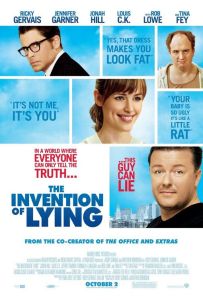 Imagine a world where people could only tell the truth. Sounds scarier than anything in horror movies today.
Mark (Gervais) is trying to romance Anna (Jennifer Garner) but even the waiter tells him she’s out of his league. She tells him upfront that she finds him unattractive and he will never have any hope of having sex with her. She’s more interested in Mark’s snide but handsome co-worker, Brad (Rob Lowe), who she feels is a better genetic match. Mark is about to be fired from his job, writing historical screenplays about the 13th century, and his secretary (Tina Fey) delights in telling him that she loathed every minute they spent together. This is a world without a filter. Until one day Mark goes to take out money from the bank, and something inside his brain switches. His balance is $300 but he asks for $800, and the bank teller apologizes for the computer error and gets Mark his full $800. He explains to his barfly friend Greg (Louis C.K.) that he said something that wasn’t. Nobody understands. “I’m a black Eskimo,” Mark says. Everybody takes him at his word. Mark is the only human on earth who has the ability to tell a lie, which he uses to his great advantage whether it be gambling, getting out of a traffic ticket, or unearthing a “lost” historical chapter about ninjas and aliens that makes for a stirring “non-fiction” film. Mark can’t even explain what he’s done, since the world lacks even a word for “lie.”
Gervais and co-writer Matthew Robinson concoct some interesting and inspired ideas of what a world bereft of lying would be like. Naturally, advertising would be completely different if people had to tell the truth, the whole truth, and nothing but the truth; imagine prescription drug ads that only said, “This is a placebo. Your penis won’t ever grow bigger.” The slogan for Coca-Cola is, “It’s very famous,” and the slogan featured for its rival, Pepsi, is, “When you can’t have Coke.” No one has any concept of fiction, of people pretending to play parts, so movies only consist of an older man sitting comfortably and reading a historical account with some minor dramatic inflection. Movies have become book reports. The sign in front of a retirement center says, “A Sad Place for Hopeless Old People,” and a motel sign reads, “A Cheap Place to Have Intercourse with a Near Stranger.” However, I’m puzzled by how forcefully open every person is. Just because you can only speak the truth doesn’t mean you have to be talking constantly. I understand Gervais’ point about the need for lies to protect people’s feelings, but just because you think someone looks fat doesn’t mean you have to blurt it out. When Mark greets Anna at the door for their date she reveals, “You’re early. I was just masturbating.” It’s funny, sure, but did she feel compelled to link the two statements? It seems in this world, everyone is incapable of keeping their mouths shut.
 The premise of the movie is terrific, and I’m honestly shocked no one has thought of it before. But the premise wears a little thin after the first 30 minutes of people speaking with no filter. You begin to expect outrageous comments that will be hurtful and blunt, and because you expect them it takes away the shock value and lessens the humor. But then The Invention of Lying takes a sharp right turn at about minute forty and becomes a radical and subversive and much funnier movie. Mark is comforting his dying mother (Fionnula Flanagan) who is afraid of leaving existence. She’s afraid of a cold nothingness. So Mark explains to her that there is an afterlife, a world beyond our own, where everybody gets to be around their loved ones in a mansion, and there’s no pain. She closes her eyes and dies in peace with this new knowledge. The doctors and nurses are amazed and beg to know more. Mark has created the idea of religion and God! He’s mobbed by people and camera crews demanding him to explain what he knows. Mark then works up the courage to establish a system of 10 rules to follow, which he tapes onto old pizza boxes. He then addresses his flock and has to explain the complicated minutia of religion, with hilarious questioning from the acolytes. Mark explains that there is a “man in the sky” who watches everything we do and is responsible for everything that happens. “Does that mean the Man in the Sky gave my sister cancer?” someone asks. Mark tries to explain the nature of a loving, all-powerful deity who willingly allows bad things to still happen. “Screw the Man in the Sky,” someone yells, “He’s going to kill us all. We need to fight back!” You try explaining the nature of the unknown to people.
It’s at this point that the movie transforms into a biting satire on belief and belief. I was cackling but I noticed that my theater seemed to get awfully quiet the longer the religious satire went on. I almost spat out my drink when I saw a spinning newspaper headline that said, “Man in the Sky Continues to Give Children AIDS.” It’s offensive but completely within the bounds of religious questioning. Gervais and Robinson aren’t ridiculing religious belief; in fact they seem to prove that it has a definite place of significance within society and can be beneficial psychologically. The satire isn’t savage and still manages to play with the amiable, fable-like nature of the story. Gervais isn’t laying out an argument that believing in an unforeseen deity is stupid. The movie isn’t condescending or hectoring, like Bill Maher’s anti-religion documentary Religulous, but it does take some slyly subversive swipes at the nature of faith and its reliance upon the unproven.
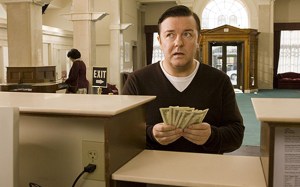 The Invention of Lying suffers from trying to be a romantic comedy. Too much of its conflict is spent on whether the chubby guy can get the pretty girl. The movie gets a tad sentimental for dealing in bitter-truths, and Gervais and Robinson steer the film to the ultimate romantic comedy setting: objecting at a wedding. I wouldn’t have minded the rom-com asides if they didn’t feel like they kept striking the same chord. Mark wants to be in a relationship with Anna. She points out that he’s fat, has a snub nose, and not a good genetic match. He persists. She points out that he?s fat, has a snub nose, and not a good genetic match. This goes on and on until the inevitable break at the end. Mark, and especially Gervais, is an appealing guy, self-effacing and witty, even downright cute at turns, but when Anna keeps repeating the same looks-first mantra, it makes her seem increasingly shallow and him seem like a glutton for punishment. Garner is a fabulous comedic actress and packs a lot more emotion into her character than I would have expected given the conceit.
Ricky Gervais is catching fire as of late, and it seems that America is finally waking up to the charms and brilliance of this squat comedian. He created The Office, the standard for squirm-based comedy, and appeared in the underrated supernatural comedy Ghost Town last fall. Gervais shows the necessity of lies in our world, from sparing hurt feelings to making mass-market entertainment. The world needs dishonesty. When The Invention of Lying is on-target, it is a hilarious, almost brilliant, comedy, with its best gags saved for taking on “the Man in the Sky.” It’s too bad then that the entire movie doesn’t live up to these flashes of comedic brilliance. Still, the movie is sweet enough and ends on a satisfying level, even if The Invention of Lying begins as one movie and ends as another. Gervais is an appealing lead, though he doesn’t prove much in the way of a director, and he has some real dramatic acting chops too, nicely put to use during his mother’s deathbed scene. I hope more Americans wake up to this man’s charms. Gervais continues to show audiences the sharp wit that has made him one of the world’s foremost funnymen.
Nate’s Grade: B+
Share this:

Hancock (2008)
 Hancock is perhaps the first movie that looks at the consequences of being a super-powered do-gooder. I’m not talking the self-doubt or placing your loved ones in danger. I’m talking about money. A super hero can rack up super amounts of damage to a city, and the titular character often causes millions of dollars in destruction as he sloppily combats crime. In some ways, the super hero is more costly than the criminals. As you can imagine, the public at large isn’t too taken with Hancock (the film misses the opportunity to have neighbors worry their property values will plummet if Hancock moves into town). It’s too bad that Hancock, the film, doesn’t stay as original.
John Hancock (Will Smith) is a disgruntled man. He likes to drink, sleep, and keep to himself. Unfortunately, people keep bugging him for help. This may have something to do with the fact that Hancock is a man with the abilities of a super hero. He can fly, has incredible strength, and appears to be physically impervious, but that doesn’t stop criminals from emptying their guns at him. One gang learns firsthand the anger of Hancock when they destroy his whisky bottle. The city doesn’t know what to do with the world’s lone super being because he causes so much destruction. Ray (Jason Bateman) is a PR man fighting a losing battle to convince major corporations to donate supplies to needy countries for free. Hancock saves his life one afternoon and Ray decides to use his skills to give the irritable super hero an image makeover. He’s going to use Hancock to help change the world for the better. The plan to reform Hancock involves sending him to prison and waiting until the city begs for his assistance with rising crime. Ray’s wife, Mary (Charlize Theron), is wary of her husband’s super hero project. She just wants to live a quiet life with regular meatball madness dinners with her family.
 I think I’m already starting to get sick of super heroes and there’s still more to come this summer. There are several good ideas rolling around inside Hancock, but at a scant 92 minutes there’s little time to develop them. The movie takes off in a mildly satisfying manner but then botches the landing.
Smith’s considerable charms at put at odds with a character that resembles an ornery bastard. It’s a bit of a wink to the audience because no Hollywood studio would let the most popular international movie star release a super expensive summer movie where he begins and ends as a total jackass. The film seems to be tailor-made to Smith’s strengths, which still include his ability to naturally command attention and likeability. The idea of a lone super hero who drinks heavily, destroys personal property, and whom the public vocally dislikes is a sound idea and allows Smith and the filmmakers to explore certain realities not seen in other super hero flicks. The public griping over the methods Hancock chooses to save the day seems rather believable, especially when those methods usually involve heavy-duty collateral damage consequences. I like the idea that every time Hancock lands from flying he takes chunks of concrete or tar with him. There are several interesting ideas that come from the conflict between society and a super hero who would rather sleep off a hangover. I think the idea of paring a disgruntled super hero with an idealistic PR man is a great concept, benefited by Bateman’s sterling comic abilities fine-tuned from Arrested Development (where he also romanced Theron). I really enjoyed the interaction between Hancock and Ray. For a decent 60 minutes, Hancock is a passable super hero excursion lifted by Smith and Bateman’s chemistry.
Hancock starts with some promise but then goes in a completely different direction for its third act (let me just say this: there’s a reason they’ve been hiding Theron from any advertisement). The film also overplays its hand early. When Hancock and Mary first meet they hang on to each other, then she looks at him suspiciously and continues to, then she says some very leading dialogue that is a bit on-the-nose. All an audience needs is one award, penetrating look to understand that something is up. Hancock ends up feeling pulled in too many directions. It begins as a sly satire on super heroes and is mostly confined to jaunty comedy, but then the movie gets dramatic and grim and a bit hard to follow. The film begins as a jokey riff and then gets gritty, finding room to fit in mythology, religious questions, age-old racism about interracial dating, and a terribly clunky villain (Eddie Marsan) who breaks out of jail so that he can seek improbable vengeance against an immortal. Hancock’s origin is muddled and as preposterous as most other super heroes. The third act shift seems to drain all the fun out of the movie and it gets too serious, too confusing, and too convoluted (what’s the distance rule here between super people?). Hancock ultimately has too many chefs in the kitchen and becomes a mess.
 I’m sad to say but director Peter Berg really whiffs with this movie. His visual style is a hindrance to the film. I recently re-watched his first action film, 2003’s The Rundown, and Berg was able to craft stylish, highly playful action sequences without shaking the camera all over the place. A tripod served the film’s best interest and Berg tailored his visual style to the material. I expressed worry with his previous film, 2007’s The Kingdom, that Berg has become locked in to his handheld docu-drama style that bobs and weaves around his actors and employs numerous quick cuts and odd angles. His erratic style can improve and assist narratives but it can also hamper the storytelling. Nothing is really gained by Berg filming his tender moments at obtuse angles, extreme asymmetrical close-ups, and a hovering camera. It feels like a style completely unsuited for the material. I would have liked to fully watch the action sequences and enjoy the clever tweaks on the genre. Berg is an imaginative and underrated director, but his jittery docu-drama style he has embraced can also make his films seem cobbled together and overly rushed and, potentially, half-assed.
Hancock is much like the title character. It means well and wants to help but an audience can’t help but grumble about its methods. The concept of a super hero that is rejected by the people he saves is a subject ripe with subtext that could explore meaningful and insightful glimpses about guilt, the weight of expectation, the desire for human affection and acceptance, the frustration to be understood, the questions of personal responsibility and loyalty, and rejecting or heeding the call to do better. Hancock does not delve into any of these potent psychological areas. That’s fine, as long as the film delivers top-notch popcorn thrills and makes me forget about its wasted potential. Sadly, Hancock fails to deliver. The special effects are generally sub-par, the story misfires, and the whole film begins with promise but ends up turning into a mundane mess. Berg’s aesthetic doesn’t square with the material. Smith is still as charming as ever and will always be a genial presence onscreen, but Hancock turns into a movie that feels like a super hero hangover itself.
Nate’s Grade: C+
Share this:

Juno (2007)
 Juno is a hysterical teen comedy with equal parts sweetness and sour. The idea of an underage pregnancy certainly presents a lot of conflicts and seriousness but the film avoids direct messages on the big topics thanks to large doses of levity and some hard-earned wisdom. With this serving as a companion piece to Knocked Up, I suppose Hollywood is convinced there’s something inherently funny about unplanned pregnancy. Remember that, suddenly expectant fathers and mothers.
16-year-old Juno MacGuff (Ellen Page) drinks her “weight in Sunny D” to take pregnancy test after test, but each pee-dipped stick gives the same result: Juno is going to become a mommy. The father is Paulie Bleaker (Michael Cera), a fellow high school student who has a fondness for jogging shorts and orange Tic-Tacs. Juno’s father and step-mother (J.K. Simmons, Allison Janney) lament that they wish their daughter would have told them she was expelled or into hard drugs instead of being pregnant. Still, they are supportive and Juno decides to give away her bun in the oven to a childless couple, Mark and Vanessa (Jason Bateman, Jennifer Garner).
 Juno doesn’t patronize or dismiss the gravity of what is indeed happening (a life is being brought into this world); Juno says she is trying to come to grips with issues “way beyond my maturity level.” There are moments that reveal real sadness and regret for some of these characters, and moments of palpable doubt about what it means to officially grow up and assume responsibility for another. Juno also refrains from easy high school stereotypes and coarse humor. Juno is an intelligent comedy that doesn’t make light of its circumstances even if the sarcasm is off the charts. It’s this winning combination of wicked wit and heart that makes [I]Juno[/I] destined to be a crowd-pleaser.
Writer/blogger/former stripper Diablo Cody makes one hell of an impressive screenwriting debut. The dialogue is practically sparkling and revels in the hip, hyper-literate realm that used to dominate the teenage speech patterns of shows like Dawson’s Creek. Sure, it’s not terribly realistic when characters can spout pithy one-liners mixed in with heavy jargon and lots of cool speak, but what do I care when I’m cracking up with laughter so often. But Juno cannot easily be dismissed as glib because Cody throws in some incisive moments that display shades of vulnerability and tenderness with her wacky assortment of characters. Even the aloof oddballs have moments that deepen them from just being quirky for quirky’s sake. These people are more than just receptacles for Cody’s wonderful words; they may begin that way but through the course of 96 minutes they manage to transform into flesh-and-blood where we, the audience, feel their pain and celebrate their happiness. You may be surprised, as I was, to discover yourself holding back tears during the movie’s inevitable and tidy conclusion.
The heavily acoustic score banks on a lot of pleasant, leisurely strumming but it suits the film and the song selections are apt. The very end involves a long acoustic duet rendition of the Moody Peaches’ “Anyone Else But You” and it may be one of the most disarmingly sweet, romantic moments of the year (the repeated lyric “I don’t see what anyone can see in anyone else” is a perfect summary for two outsiders finding their match). In fact, it’s probably the most potentially romantic song ever to include the line “shook a little turd out of the bottom of your pants,” but then again I do profess ignorance when it comes to romantic odes that include defecation references. Somewhere there has to be a Barry White song that has to cover this.
 Director Jason Reitman feels like a natural fit for this smart-allecky material. He lets the story take center-stage and, just as he proved with last year’s Thank You for Smoking, he can coax terrific performances from a strong body of actors. He keeps the pace chugging along and keeps form command of the many storylines and characters needing to be juggled. Juno is a comedy that says more about a character through a handful of smart, wry observations that cut to the bone, which is helpful considering the short running time means the film needs to do the most with its time.
Page should have been crowned a star immediately after her blistering performance as jail bait with claws in Hard Candy, but perhaps her top notch comedic turn in Juno will right this slip-up and give Page the opportunity to star in, at least, the same amount of movies as, oh, I don’t know, Amanda Bynes (Seriously, Hollywood, are you just throwing money at her?). Page is the perfect embodiment of the wiseacre teenager that thinks she knows more than anyone else. She recites the refined dialogue with such precision and ease, always knowing what segments to enunciate or de-emphasize to maintain a seamless comedic tone. Page brings great empathy to a know-it-all character and is the snarky spirit that makes Juno resonate.
The supporting cast around Page doesn’t let her down. Cera gives another fine performance of comic awkwardness befitting a teenager contemplating fatherhood. Simmons and Janney make a great pair of unflappable parents, particularly Janney who gives an ultrasound doc a memorable tongue-lashing for an off the cuff remark about Juno. Bateman works the same laid-back demeanor that he excelled at on TV’s Arrested Development. Rainn Wilson (TV’s The Office) makes a very funny cameo in the beginning.
 Garner as an actress has been somewhat hamstrung by her roles, either focusing on her multitude of ass-kicking abilities or landing her leads in romantic comedies that don’t require more than dimples and twinkling eyes. In Juno she is driven by her desire to have a baby; she’s affluent, prim, and an easy joke thanks to her stick-in-the-mud seriousness. But then Juno and the audience get a glimpse about how important being a mother is to Vanessa, and Garner nails a rather touching scene where she directly speaks to the growing child inside Juno’s belly upon Juno’s request. She speaks softly to the baby, briefly mentioning how loved they will be, and then she marvels at feeling the baby move. In lesser hands this scene could have induced eye rolls but instead seems genuine and a turning point for how we see Vanessa.
If Juno does have a flaw it is a minor one. The film places its teen romance on the back burner for so long that when it resurfaces and positions itself front and center the storyline lacks credence and believability. The conclusion would have had more emotional weight had the filmmakers spent more time on the teen romance angle, but regardless I was still amused, entertained, and grateful for the ending that came.
Juno is a delightfully tart and hysterical comedy that is easily quote-able thanks to Cody’s quick-fire retorts and snappy dialogue. Page is destined for greatness and Reitman proves once more that he can handle anything thrown at him with deftly comic aplomb. This is an impressive and assured comedy that bristles with comic vitality and confidence. This holiday season, make sure to take a trip to Juno.
Nate’s Grade: A
Share this:

The Kingdom (2007)
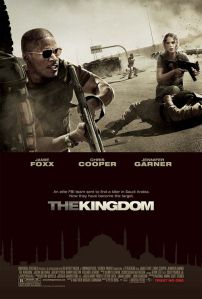 Now that summer is but a hazy memory, get ready for a roll out of serious minded movies Hollywood hopes vie for serious award attention. It may be five years into the current war, but the movies are now cranking out Iraq-themed dramas that will dominate the release schedule for the approaching months. Things are about to get heavy and somber. First out of the gate, though, is The Kingdom, a film about the nebulously termed War on Terror set within the confines of an action movie. Actor-turned-director Peter Berg (Friday Night Lights, The Rundown) knows how to create a stylized movie that feels organic to its genre, and The Kingdom is another example of his growing cinematic pedigree.
In Saudi Arabia, a housing enclosure of American contractors and their families is brutally attacked by terrorists that have infiltrated the Saudi security. Two hundred American lives are lost and FBI agent Ronald Fluery (Jamie Foxx) is intent on leading a team of experts (Chris Cooper, Jennifer Garner, Jason Bateman) to the soil of the Saudis, otherwise known as The Kingdom. The State Department refuses to authorize an investigation citing the jurisdiction of the Saudis as well as the danger of violent reprisals if agents are within reach of the perpetrators. Colonel Faris Al Ghazi (Ashraf Barhom) is assigned to baby-sit the American agents and keep them stuck in red tape during their five days allotted to them. Fluery refuses to take a subservient role and works with Al Ghaazi to get some answers.
 The animated opening credit crash course in Saudi history is fun and informative, however, it really doesn’t relate to The Kingdom even though the damn movie is set in that country. Curiously, the movie only makes cursory statements on the wary relationship between the Saudis and the United States, but otherwise this movie could have been dropped in any nondescript Muslim country in the Middle East. If The Kingdom was relocated to, say, Yemen, I doubt the script would need that much fine-tuning; snip some references to royalty here and there. This is a story about the balance between a moderate Middle East regime and radical elements within the country willing to buck Western influence by any destructive means necessary. I’m measurably disappointed that the movie didn’t tackle more about the unique and tenuous Saudi-U.S. relationship, but then I accepted the fact that The Kingdom wasn’t so much about a country but an ideology that knows no borders.
To that end, The Kingdom is one part CSI: Saudi Arabia, one part political thriller, and one part gung-ho Hollywood action extravaganza, and none of the parts seems to work well together as a whole. The film doesn’t work as a cohesive unit and perhaps tries to do too much. Now, this does not mean that any of those parts are not entertaining. The criminal investigating is rather interesting because of all the cultural barriers between the U.S. agents and the Saudi governing system (a miscast Jeremy Piven, as an ambassador, admonishes Janet, in a very Ari Gold way, to “dial down the boobies”). The central mystery of who is responsible is pretty thin and easy to solve, which may be why the film spends so much time finding obstacles to delay our FBI team from getting their hands on the evidence. The political thriller elements are expressed with the subtlety of a sledgehammer, and yet they feel like thoughtful counterpoints to any rah-rah jingoism that The Kingdom may instill in an American audience. The climax provides plenty of fist-pumping violence but it also ends on a note about the futility of violence as well as the durability of hate. I even appreciated devoting time to interdepartmental jockeying and watching agency heads seeing who will blink first in a public relations-dominated world. The Kingdom doesn’t have a desire to become Syriana 2: No Blood for Oil, but it does possess a greater deal of intelligence and relevance than most of what big budget Hollywood is spewing out (I refuse to believe the FBI would send an agent, with a personal family tie to Israel, into a Muslim country).
Strict action fans, however, are going to have a lot of downtime on their hands. The Kingdom opens with an action sequence and closes with an action sequence, and there’s a wide gap in between those bookends. The final 20 minutes are devoted to a nail-biting ambush and rescue that transforms our FBI agents into improbable action movie warriors. Berg’s restless camera isn’t as well honed as Paul Greengraas (The Bourne Ultimatum), and sometimes you just wish the jittery cameraman would allow you to see what’s going on. I don’t know if the docu-drama emphasis is fully needed, especially when the movie jumps between shots of just two people having a conversation. Berg is a terrific director and the action sequences hit hard; I just hope he doesn’t become trapped trying to fit himself into one style.

In truth, the most intriguing part of The Kingdom is the relationship between Fleury and Al Ghazi. They begin frustrated and fighting for control, but soon, in true buddy cop genre fashion, a mutual respect forms as they search for the bad guys. The script offers helpful examples of good Movie Arabs and bad Movie Arabs, and the audience is able to easily identify the two sides. The interplay between Fleury and Al Ghazi leads to some humorous exchnages as well as some reflective opportunities, like where the men recount their families and declare they do not care why such dastardly acts were done, they just want to inflict some punishment on the rightful parties.
The acting, like the film, is a bit all over the place. Foxx seems to be on autopilot. Foxx has bunkered into his acting troupes; intense, penetrating stare, whispery dialogue recitations, and a cocksure attitude. Cooper is cranky and incredulous older timer along for the ride. Garner does her best with a character that was written for the sole purpose of concocting culture squabbles over the role of the opposite sex. She does unleash a torrent of anger and power in one very hard-core and frighteningly extreme fight scene. Bateman is playing comic relief and does sarcastic quips with great ease, but his character also gets unexpectedly thrown into a very harrowing experience and Bateman makes you feel every drop of his fear. Barhom (Paradise Now) gives a convincing performance of a man torn apart by his moral compass and the path of his country. He feels a sense of duty to protect the innocent but at the same time he is scoffed at by colleagues for helping “them.”
The Kingdom is an action movie with more on its mind than blowing up the enemy real nice like, though that also plays a key component. The pieces don’t fully add up to a whole and the film’s politics are a little tricky to get a bearing on; is this a red state movie, a blue state movie, or something for both audiences? Berg’s ambition is admirable and his film never drags out a soapbox to preach. The Kingdom is a topical movie aimed at planting seeds of debate among a mainstream audience in between their handfuls of popcorn and gulps of soda.
Nate’s Grade: B-
Share this:

Smokin’ Aces (2007)
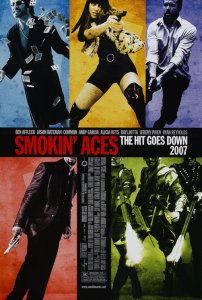 Writer/director Joe Carnahan (Narc) wants to impress an audience so bad with his muscular and macho gangster flick, but his Smokin’ Aces is vapid, nihilistic, and opines not to simply be a Tarantino rip-off, but a rip-off of a Tarantino rip-off. The premise seems ripe enough as we follow a rogue’s gallery of hitmen and killers trying to be the first to knock off a mob snitch/Vegas magician (Jeremy Piven) for a million dollar bounty. The colorful characters are introduced and some are quickly and unexpectedly taken out, but Carnahan never fully knows what to do with his bushel of baddies after he establishes their character quirks. The killers don’t really interact that much with one another and some of them hardly have any screen time at all; perhaps less would have been more in this jumbled stew. Carnahan throws out a few nifty visual tricks but it’s all superfluous and empty. Smokin’ Aces moves quickly, doesn’t make much sense in the beginning and end, and little to any of the characters have satisfying conclusions. So much of the writing feels like lame macho posturing without anything new or interesting to add to an overstuffed shoot-em-up. There are cops, robbers, plenty of gunfire, lesbians, and all sorts of convoluted twists, but it never holds together. Carnahan throws a lot of different elements together but they never extend beyond the elemental stage, so every storyline and character feels like an introduction that?s never capped off. The man has no idea what to do with what he’s started, and a karate kid on Ritalin is all the proof I need. Guy Ritchie did this territory far better service with the marvelously entertaining 2001 film Snatch. Rent that instead and save yourself the headache.
Nate’s Grade: D+


 nathanzoebl
You must be logged in to post a comment.