Blog Archives
Dallas Buyers Club (2013)
 It’s been a while since Hollywood really tackled the AIDS crisis and the prejudices associated with it. Thanks to better understanding and tolerance, and a rise in life-extending drug treatments, AIDS is rarely stigmatized today as it once was, as a death sentence, as a gay disease. It’s faded into the back of most people’s minds. It’s been twenty years since Philadelphia and Tom Hanks’ Oscar-winning performance. Has it been too long? The drama Dallas Buyers Club returns to the early years of the AIDS crisis and the ignorance of the age, illuminating a lesser known true story about one of the most unlikely activists to emerge.
In 1985, Ron Woodruff (Matthew McConaughey) is a Texas electrician and part-time rodeo bull rider. He’s drinking, snorting cocaine, and sleeping with every woman he lays eyes on. Then one day he collapses and wakes up in the hospital. He’s told he has contracted HIV/AIDS and likely only has 30 days left to live. Ron is aghast, instantly defensive, declaring, “I ain’t no faggot.” Rather than wallow, he fights to live as long as he can, refusing to be part of a hospital drug treatment for AZT unless they can tell him, definitively, he’s getting the actual drug and not the placebo. Ron travels to Mexico and finds a sympathetic doctor with alternative treatments involving vitamins and other natural drugs, none of them illegal, just unapproved by the FDA. Ron returns to the States and runs into trouble trying to sell his wares to the afflicted gay community. Raylon (Jared Leto), a kindly transvestite suffering from AIDS, agrees to help Ron make inroads, for a percentage of the sales. Ron and his unlikely business partner skirt legal loopholes to sell “memberships” into the titular Dallas Buyers Club. With monthly dues, every member gets a dose of attentive medicine, and it’s having remarkable results.
 The bulk of the attention Dallas Buyers Club has received is from the transformative performances of its two lead male actors, and they are exceptional. McConaughey (Mud) begins as the sort of character we’ve seen before, the swaggering cowboy who’s a natural ladies’ man, but as his life quickly falls apart and his circle of friends turn on him in gay panic and ignorance, Ron is pushed to the brink. McConaughey’s weight loss, which garnered plenty of ink in tabloids last year, is startling and instantly echoes his character’s dire state. Likewise, when you see a late scene of Leto (Lord of War), his frame is so gaunt, so frail, and so evocative of the few remaining moments these men have left to them. It’s no stunt or gimmick because their performances, even without the weight loss, are enormously affecting and powerful. Both men project a blustery confidence they themselves occasionally buy into, but both men are, naturally, scared witless, fumbling, scrambling against the clock. McConaughey is the strong face, the wheeler-dealer who has to use his live-wire charm and bag of tricks to get the meds. As roadblock after roadblock is thrown his way, we readily watch the toll is takes on Ron, the heaviness of his burden that becomes more about people than money. Leto is the conscience of the film and as he shrinks away, you can’t help but feel the inescapable tragedy. Leto will break your heart. I fully expect both men not only to be nominated for Oscars but likely to be favorites to win.
Despite the strength of those two outstanding performances, the film itself doesn’t measure up in a disappointing number of ways. The script by Craig Borten and Melissa Walleck misses far too many opportunities to round out the characters and the central conflict. The second half of Dallas Buyers Club feels a tad rudderless, and this is mostly because of a general sense of sameness in Ron’s conflicts. He butts heads with the FDA, finds a loophole, keeps going. This pattern repeats but it never escalates until the very end. As a result, the film feels like it’s treading water when it shouldn’t be. The portrayal of the FDA and other antagonists is decidedly one-note, almost to a ghoulishly degree. The movie sets up the piñata of Big Business/Pharma to take easy whacks at a faceless, money-driven entity that put profits before human lives. I get it, but it’s too easy and a movie that gropes for emotional depth should not have to stoop to caricatures of bureaucratic evil. The truth of the matter is that there was plenty of legal intransigence and feet dragging when it came to the response to AIDS, and that’s why it feels almost callously wrong for Dallas Buyers Club to reduce this dramatic point in history, where 95% of people who contracted HIV/AIDS had a month left to live, to an us vs. them/slobs vs. snobs underdog tale. That reductive condensing is a disservice to the real people but also a greater dramatic story at heart here.
I’d also like to note that the characters themselves are lacking. They held my interest, certainly, but what can I say about them? What moments revealed nuance or progression? The character arcs are dramatic with a capital D: homophobic Texas good ole’ boy becomes unlikely AIDS activist and friend to gays. The parameters are clearly mapped out, the start and the finish, but what’s lacking is substantive growth that I can acknowledge onscreen. Beyond the ongoing presence of Raylon, the movie doesn’t provide enough evidence for me to move Ron from homophobe to activist. I think this is due to the script meeting the basic requirements of what it thinks are the big signposts along Ron’s personal journey. So we get a scenario such as Ron refusing to enter a gay bar, then cautiously entering, then feeling comfortable around gay people. I don’t need people to trip over soapboxes to blurt out their inner feelings, their changing perspectives, but there has to be more than what’s presented in the interest of time and narrative cohesion. Likewise, Raylon is portrayed as saintly, your prototypical movie gay man with flamboyance and attitude, and he is certainly charming, but much like the main character in 12 Years a Slave, Raylon is more tragic martyr than fully-realized character. His service to the script is to push Ron forward on his own humanizing arc, and I’ve already stated my problems with that. The remaining characters are underwritten, with the unfeeling Dr. Sevard (Dennis O’Hare) served up as a stooge. Except he’s trying to get a sample size to test a drug’s viability, the same process with all medicine. Yet because he’s looking at the big picture, and lacks bedside manner, he’s the enemy to harrumph. Jennifer Garner’s character is more an exposition spout than person.
 Weirdly, the movie drifts into an extended subplot, almost a secondary antagonist after the FDA, against the preliminary AZT drug treatment. This was the first major drug produced to combat HIV/AIDS. It had major backing with huge pharmaceutical industries. Opposition to the conventional norm of the time (AZT is our only medical hope) provides a snug storyline to garner our rooting interest in Ron, but this fight seems too impersonal and one-sided. We’re given reams of stats on the effects of AZT on AIDS patients, presenting a picture that AZT breaks down the patient’s immune system. Dallas Buyer’s Club becomes a sermon against AZT. The movie doesn’t have to be apolitical but it needs to mask its sermonizing or at least be more passionate about its case. Then in the end credits we’re served a short post-script saying that a low-dose AZT, in combination with other drugs, saved millions of lives. After hearing two hours of how terrible and stupid AZT is for treatment, it’s a surprising endnote. Does that justify the doctors that the film so easily vilified?
Ultimately a good film worth watching, I can’t help but continue finding problems as I reflect upon my Dallas Buyers Club experience. If it wasn’t for the excellent acting onscreen, I would have noticed the flaws of Dallas Buyers Club even earlier, but strong acting has a way of being a soothing balm with the deficiencies in a film. The narrative, with easy one-note villains and a runaround of repetitive conflicts, needs more development to match the caliber of performances of McConaughey and Leto. Both men give it their all, breaking your heart in the process, and their performances are even more commendable and impressive when you realize that the film’s characterization is wanting. I feel like the complexity of this volatile time, and Ron Woodroof as a human being and unlikely activist, have been simplified into a rah-rah mass appeal underdog vehicle. I think this does a disservice to the characters and their personal drama, and I wish the filmmakers presented them better as well-rounded individuals rather than tools for the re-education of Ron Woodroof. There’s enough good here to balance out the could-have-been-better, chiefly the power of the central male performances. However, if you want a passionate account of early AIDS activism, I suggest checking out last year’s Oscar-nominated documentary How to Survive a Plague.
Nate’s Grade: B
Share this:

Lord of War (2005)
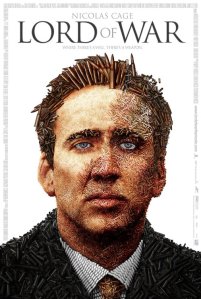 Andrew Niccol is back in my cadre of cool. He’s responsible for two awesome movies (Gattaca, The Truman Show) and one very lackluster Hollywood satire (Simone). But now the man is back and Lord of War is a startling look into the amoral world of international arms dealing. The film is enthralling as Uri (Nicolas Cage) narrates us about the ins-and-outs of his world a la Ray Liotta in Goodfellas. Not to be outdone by a juicy narrative by Niccol the writer, Niccol the director adds lots of stylish flash to his tale. The opening watches the manufacturing and journey of one bullet, it’s ending destination in the head of a little African boy caught in the crossfire. It’s jarring, it’s powerful, and it’s direct. That’s Lord of War in a nutshell.
Nate’s Grade: A-
Share this:

Alexander (2004)
 I was standing in a theater weeks ago and saw a large banner for Oliver Stone’s epic about Alexander the Great. I listed the names; Colin Farrell, Angelina Jolie, Val Kilmer, Rosario Dawson, Jared Leto. This had to be perhaps the greatest assembly of pretty actors ever in a motion picture. There’s a whole lot of sex appeal there, and Anthony Hopkins, as the film’s reflective narrator, isn’t too shabby looking himself for a man his age. After having seen Alexander, it’s safe to say the actors sure are pretty but the movie is far from it.
Alexander (Farrell) is one of the greatest historical figures. He rose to become a Macedonian king, dominated much of the known world before he was 30, and then died mysteriously at a young age. In flashes to his youth, we see Olympias (Jolie) coaching young Alexander on his future glory. Standing in her way is one-eyed King Phillip (Kilmer), Olympias’ husband though not the father to Alexander. She frets that he will sire a direct heir to the throne, and upon Phillip’s assassination, Alexander reaches new heights. He travels to Babylon with the purpose of avenging his father’s death, rumored to be paid for by Persian gold.
Alexander keeps traveling east conquering new lands but returning kings to their rule and assimilating “barbarians” into his armies. His generals begin to question Alexander’s actions, especially his surprise marriage to an Asian peasant woman (Dawson). He is unable to sire a male heir with her. Hephaistion (Leto), Alexander’s childhood friend and lifelong lover, worries that Alexander has become power hungry and distrustful of those around him. Many of his men only want to see home after seven years of battle. After defeat in India, Alexander decides to turn back but he never sees home again.
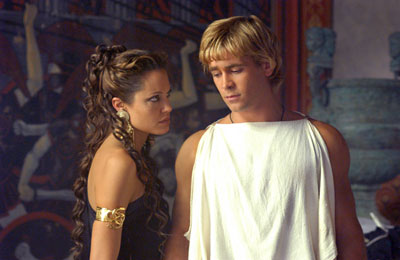 For such a lavish biopic, Alexander seems fairly remote. We don’t really get to know much about the psychology of Alexander. He’s a historical figure with equal parts good and bad ready for debate, but whenever Alexander does hit some of its star’s less-than-stellar moments, it seems to gloss right over them. Hopkins will narrate about some town that resisted, then we’ll see a quick image of it burning, and then we move on. Or we’ll see a slew of dead army officials and Hopkins will say, “He slaughtered all he felt were responsible for mutiny, but I’d expect any general to do the same.” There are several moments where we’ll hear Alexander massacred a town, or sold people into slavery, and then we get the next scene. It’s quite comical, almost as if Hopkins is a tour guide at a museum saying things like, “And then Alexander ate all of the first born babies. Moving on now…”
There are just so many awful laugh-out-loud, loopy moments in Alexander. It’s not enough that Jolie speaks in some bizarre accent; to make sure the audience understands that she’s duplicitous she has a snake wrapped around her in every scene. I’m not kidding; every scene that Jolie is in she has snakes coiled around her.
There’s a moment late in the film that is so hilariously dreadful, it’s hard to believe what you’re seeing. Hephaistion has caught ill and is on his death bed. Alexander is wrought with emotion but then strolls over to a window and begins another huge speech that ends up being all about his glory. What makes the scene go from bad to I-cannot-believe-they’re-doing-this bad is that Hephaistion, in the background, is convulsing and dying. You see his body tense up, twitch, leap into the air, and practically do some kind of triple axle, all while Alexander speechifies blithely unaware. I challenge anyone not to laugh.
Stone needlessly complicates his film with flashbacks, giant leaps forward in chronology skipping Alexander’s rise to respected leader, and skittish hallucinations. Stone is accustomed to breaking up the chronology of his films, but Alexander is too long and too campy to play around with for effect.
The acting of Alexander is set to overkill. Farrell seems miscast and doesn’t have the weight to carry such a historically meaty role. He looks pretty, and he can snarl like a pro, but the only thing worse than his overblown performance is his terrible blonde hair. This just wasn’t the right role for this talented actor. Jolie is so naturally seductive that she could have played her role mute and been effective, maybe more so. Kilmer seems to be working some kind of Irish accent but he comes off the best of the three. Leto gets overshadowed by his bangs.
Alexander also seems to speed over its star’s bisexuality. It wasn’t uncommon for men to bed both sexes, but the movie seems terrified of portraying anything beyond longing glances. Alexander and Hephaistion are reduced to some whispers here and there, but the limit of their physical affection stops at hugs. It actually is kind of funny the amount of times they hug, which I think is over five. You can tell the filmmakers wanted more but then were like, “Eh, let them hug again.” In some weird turn, it seems the film shows more depth with Alexander’s relationship with his horse than with his lifelong lover.
For a three hour movie about a military man who conquered much of the known world, there’s a shocking lack of action. Alexander has two action set-pieces and then that’s it. The first set-piece is a battle between Alexander and the vastly numbered forces of the King of Persia. The battle lasts twenty minutes and is disjointed, bloody, and perfectly indicative of the confusion of war. Stone cuts back and forth between majestic aerial shots showing the progress of battle and hand-to-hand combat amid the sand and dust clouds. Stone also labels certain sections of the armies, which gives a greater understanding of the battle. It shouldn’t be a surprise that this battle is the highlight of Alexander.
The only other action set-piece comes very late in the movie. Alexander’s forces have marched all the way into India. Warriors on the backs of monstrous elephants stampede onward to intercept Alexander’s armies. This battle is also chaotic, and Stone utilizes a lot of quick point-of-view shots like people getting squashed by pachyderms. The action is satisfying if a bit over the top (a warrior gets impaled on a slow-moving elephant’s tusks), that is until Stone goes off the deep end. Alexander gets wounded in battle and suddenly the film switches tints, bathing everything in reddish and bright neon hues. Everything has a tin outline. It’s rather ridiculous and unfortunately reminds me of Ralph Bakshi’s misguided animated Lord of the Rings.
 That’s all you get for action, so I hope you like speeches rich with superfluous historical name-drops, because that’s what Alexander is all about. I’d bet money that nearly an hour of this three-hour opus involves people delivering speeches. Alexander rallies his men, Phillip talks about the Greek tragedies, Olympias strokes Alexander’s greatness and need for kingship, his generals talk about his decisions, and then we get endless moments of Alexander talking about a new world, bringing people together, and respecting other cultures. Alexander seems to go dead as soon as some character pulls out a soapbox. Worst of all, many speeches involve lots of historical references that an audience cannot be expected to keep up with. The overall effect is like listening to an unwanted party guest drone on. Alexander may be trying to talk to death his enemy.
What makes all of this worse is that the dialogue and the drama are so melodramatic. The center of Alexander’s creaky psychology is a domineering mother and a scornful father who scream at each other a lot. Whenever someone has a disagreement in Alexander they resort to over emotive screaming. You may start tuning the actors out after awhile. Much of the dialogue is terrible, but there is the occasional howler line like, “It is said that the only defeat Alexander suffered was Hephaistion’s thighs.” You may concur with Alexander’s men and want to return to your family as soon as possible after watching this.
I was trying to think how something like this, so misguided and off the rails, could chug along without a peep from someone saying, “Hey, maybe this isn’t working.” Then I got it. You see, Alexander is Oliver Stone. Both men are revered for previous victories, both men are generals that take full control of their armies, and both men are fiercely stubborn. If someone questioned Alexander’s decisions, chances are they could be killed. Now I’m fairly certain Stone wouldn’t go that far (there may be many graves dug over the grumblings over U-Turn), but I can see how difficult voicing dissension might have been.
Stone’s long in the waiting Alexander epic is bloody, ponderous, exaggerated, talky, sumptuous and off-the-charts loony. This is a giant mess only a visionary director could amass. Only historical junkies might be entertained by Alexander, and the rest of us will just be glazed over. We never get to really know Alexander, nor do we even get our money’s worth for action, so unless you click your heels to the thought of hours of speeches, skip Alexander. Trust me, it’s far from great.
Nate’s Grade: C-
Share this:

Panic Room (2002)
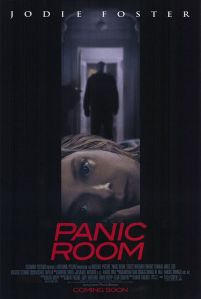 Meg Altman (Jodie Foster) is a newly divorced woman shopping around Manhattan for a new place to sow her wild oats thanks to a healthy marital settlement. The brownstone in question is truly spacious. It comes complete with four floors and a working elevator installed by the invalid former owner. Megs teenage daughter Sarah immediately takes a shine to her new digs and urges mom to sign the dotted line. It seems besides a great location the place also comes complete with a secret room that houses a separate phone line, a wall of monitors all corresponding to cameras, as well as medical supplies and a silver commode. This panic room is surrounded by four feet of concrete and sealed by an airtight steel door. It seems its the ultimate in home protection.
But before Meg and Sarah can barely unpack a trio of burglars enters the home with the hopes of securing the reclusive former owners riches. Meg grabs her daughter and scurries into the panic room just in time to seal the door behind her. She communicates to the men to take what they want and leave. One of them writes on a piece of paper that what they really want is inside the panic room. The burglars aren’t going anywhere, are well equipped and know the panic room better than she does. Meg and her daughter are safe but trapped with little voice to the outside. Thus the pieces are all set and an intricate game of moves and counter-moves takes place to see who has the upper hand, in and out of the panic room.
 Panic Room is that rare treat as a movie alive and well with energy, tenacity and a double-dose worth of entertainment. The movie flies by and youre left catching your breath or checking your pulse at certain junctures. The suspense continues in an arching fashion and keeps giving the audience new situations to be taken with.
It’s been two years since the public has last seen Jodie Foster in a movie and its good to have her back. Her performance is nominal but she’s put through what must be the most physically strenuous film of her career. She has that rare versatility as an actress to wear corsets and frilly-wear one film and then to be holstering a gun and barking at transsexual serial killers the next, all while maintaining complete confidence and integrity at either.
It seems that today we have a staggering lack of female action leads that could kick your ass. Sigourney Weaver once owned this throne but now the only thing we have to offer is pinups. We have Angelina Jolie’s scary glares. We have the pout of Michelle Rodriguez, who has since blown what promise she showed in Girl Fight by starring in two horrible consecutive films about zombies (one of these said zombies being Vin Diesel). And I dont think I even need to go into Milla Jovovich. So it’s refreshing knowing that Foster, even while pregnant for part of filming, can swing with the big boys and surely roll some heads and take some names.
The actors portraying the burglars play basic criminal archetypes, but do passable jobs with them. Forest Whitaker is the soft-spoken security expert who refuses to play rough if the situation calls for it. Jared Leto is the comically impulsive grandson who feels slighted by not being granted a sum of the inheritance. Dwight Yoakam (yes the Dwight Yoakam) is the questionable addition with an itchy trigger finger and a determination to get his mitts on the money.
 Director David Fincher, the auteur that gave us a head in a box with Se7en, returns with his kinetic kick and brooding finesse. Fincher is a vastly talented visual director and adds more richness to the film with lovely cinematography and an astutely mature sense of tension.
However, Fincher’s sensory excesses get the better of him the longer the film goes. Does the audience really need to have the camera travel through the handle of a coffeepot? Does anyone really need the camera to swirl into the bulb of a flashlight so we see how it works? It may come to the point where you’re anticipating the next superfluous camera movement, and praying that it isn’t plunging into Yoakam’s nostrils. Once or twice is fine, but after awhile the nomadic camera movements become far more distracting to the film. The ending is also a bit anti-climactic for my taste.
Panic Room, despite a few missteps, is a great exercise in suspense. You may get so wrapped up youll find yourself, as I surprisingly did, reverting to the annoying habit of talking to the characters on screen and trying to instruct them. Panic Room is the kind of movie you wish Hollywood made more often: something with genuine thrills that leaves you pinned to your seat and bubbling with anticipation, before turning you into a puddle of warm goo.
Nate’s Grade: B
Share this:

Requiem for a Dream (2000)
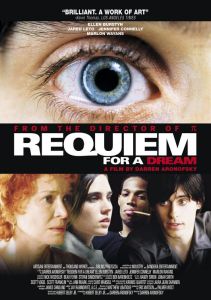 Rarely does a movie today affect you that when the end credits roll you’re left silent and unable to speak. Requiem for a Dream is an unforgettable and intensely harrowing experience. You can’t take your eyes away from it. Afterwards you’re left in disarray and unable to think straight for most of the day.
Requiem chronicles the lives of four individuals and their spiraling addictions and missed choices. Harry (Jared Leto) is a small time coke dealer along with his friend Tyrone (Marlon Wayans) who can’t help to taste their merchandise and eventually end up broke again. Harry has gotten into the habit of routinely pawning his elderly mother’s TV set for some quick cash to score with. This happens so often that the pawn broker has a special folder for Sarah Goldfarb (Ellen Burstyn) and her televison. Harry is in love with his more positioned girlfriend Marion (Jennifer Connelly). She’s given an annual allowance of money from her wealthy folks to spend in her own fashion, but she’s denied love or attention. It’s between these four main characters that we will go through hell with.
 Ellen Burstyn shows her grace with age and utterly blows your mind with her jaw-dropping performance as the lonely and strung out Sarah. Sarah has no husband anymore or a son to look after. She is alone and old, and those are two bad ingredients. She lives in an apartment complex overlooking the decaying ruins of Coney Island. Sarah has a different addiction than her child, she is addicted to food and is overweight. One day she mistakes a random junk phone call as her ticket to appear on television. She daydreams about gliding across the stage in her red dress that she doesn’t be able to properly fill anymore. With her elderly peers aflutter she tries her best to stick to a diet to fit into her slender dress. When the temptation becomes overwhelming she consults a friend’s doctor for some special “pills” to suppress her appetite.
Harry and Tyrone are embarking on their own dealing dreams to evetually move up the ladder and score some pure coke. Marion and Harry experience their love through simultaneous shoot-ups that space them out and turn them into romantic philosophers. Harry speaks of great dreams he has and the yearning to be something. Tyrone is haunted by thoughts of himself as a child and disappointing his sweetly loving mother who was proud of her son no matter what.
 The film starts off in the summer and we are in the good times for all four characters. Harry and Tyrone are successful and racking up profits. Sarah has an unusual amount of energy through her prescribed pills and feels good about herself when she sees actual results as the pounds begin to melt away. Marion dances in her love of Harry and is ambitious with plans for her own design store. Things never are as good as they are again. Fall rolls along and Tyrone and Harry lose their money and lose their ability to secure drugs to sell. Sarah is noticing her pills are not having the same effect they were earlier and decides to ignore guidelines and take them like M&Ms. Marion starts to lash out at Harry’s ineptness at scoring and begins to tear at their relationship. She gets pushed to the brink to score that she resorts to the practice of using her body to secure what she needs. This isn’t even the beginning of how dour and horrible events will become for these four.
One of the strengths of Reqiuem is the treatment of these characters. The film shows sympathy for them and their situations but never condone them. Harry and Sarah are a family that have much love between them they just don’t know how to express it. When Harry discovers his mother is on essentially speed when he pays her a visit he’s left a shattered and crying mess. Only an injection into his veins in that cab ride saves him from his emotions. The relationship between Harry and Marion is initially seen as puppy love or people brought together through a love of drugs, but there are moments where you see the true beauty they have. In the end when Harry is out of state and dramatically in the need of hospitalization he calls Marion just as she’s doing her make-up for a “special” get-together. In a hushed tone she asks when he will be coming home, to which he responds in a mix of pain soon. She then so sincerely and beautifully asks if he can come back today – to which through an array of tears he agrees. Her sincerity and emotion in this sequence is a powerful glimpse at the love that does exist between the two of them. The second time I watched this film I started crying at this moment.
 Burstyn is the stand-out star and if she doesn’t at LEAST get an Oscar nomination then that is the most unjust crime of them all. It’s been some time since her roles in ‘The Exorcist’ and Alice Doesn’t Live Here Anymore but she still shines like a true gem. She magnificently portrays Sarah’s descent into madness and chemical dependency and leaves us with a chilling and haunting figure. Leto and Connelly show that they aren’t merely pretty faces and deliver their best performances of their lives. Both show incredible warmth and emotion.
Requiem was directed and adapted for the screen by Darren Aronofsky who gave us the head trip that was Pi. Here he uses camera trickery like speed up and slowed paces to show Sarah’s journey through her drugs. Other items include cameras mounted on the actors, split screens, and hyper edits to show the process of every drug shoot-up. His camera moves and tricks are never out of place though, as many gimmicky video director’s are. Each effect has a specific purpose. Aronofsky brilliantly uses a scene where Leto and Connelly are lying in bed besides one another but split screen to show the closeness they can strive but the distance that still exists. While each talks we see shots of the other’s hand carefully caress the other’s body. It’s a scene that’s as powerful as it it thematically romantic.
The tragedy of this is this film has been rated NC-17 by the MPAA and of course anyone who sees it knows the exact scene. The film is being released unrated by Artisan because NC-17 is a commercial kiss of death. The shame is this movie needs to be seen. Make it mandatory in schools. DARE isn’t working but this film will. No one with an urge to use drugs will have that same urge after seeing this harrowing film.
Nate’s Grade: A+
Reviewed 20 years later as part of the “Reviews Re-View: 2000” article.
Share this:

American Psycho (2000)
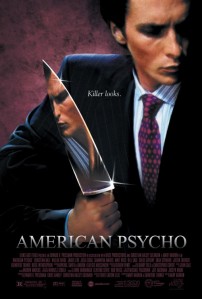 American Psycho is based on the controversial 1991 best seller by Bret Ellis though it got old fast. One can easily grasp how the lead connects with brand names on page one, but repeat it for 300 more and you’re tempted to add the book to your collection of firewood. Ellis’ novel was sadistically perverse, but director Mary Haron (I Shot Andy Warhol) has somehow managed to pull out an entertaining social satire from the pages of blood and name brands.
Christian Bale, mainly known as the boy-next-door in period piece films, plays Patrick Bateman with ferocious malevolence and vigorous life. Teen scream Leo was once considered for the part but after seeing Bale’s startling performance it should prove why he’s on screen and Leo’s swimming in The Beach. Bateman is an up-and-up Wall Street yuppie who glosses over appearance more than anything else. The only outlet it appears for our sinister shark from the soulless decade is by random acts of gruesome violence.
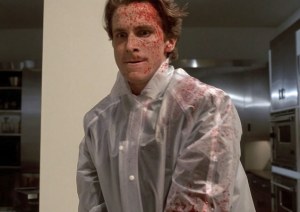 If Bateman blows off steam by blowing off companion’s heads than it only becomes more frustrating when no one believes his random confessions. Haron takes the grisly material of Ellis’ novel and mines it for pure 80s pulp. It only gets better the further it gets as you have so many points to discuss: Is Bateman acting out to prove his existence in a world that doesn’t humor him or others? Is he acting out deep-seeded rage from the actions of the decade on its people? Is he desensitized and so jaded that death does not even fracture him anymore? The questions are boundless.
The hit list of stars in Psycho includes Chloe Sevigny as a nailed home addition, Willem Dafoe as an investigative detective, Jared Leto as an axed co-worker, and sweet Reese Witherspoon as the apple of Bateman’s twisted eye. Everyone has fun in their tongue-in-cheek nostalgia romp through the absurd.
American Psycho should not be confused with the successful teen sex farce American Pie. The only desserts in this film are just, and they’re usually left of the mayonnaise and behind the frozen head in the refrigerator. American Psycho is the thinking man’s slasher movie. A flick that slices, dices, and always entices. It only gets better after you’ve seen it. One of the best films of 2000 for now.
Nate’s Grade: A
Reviewed 20 years later as part of the “Reviews Re-View: 2000” article.
Share this:

Fight Club (1999)
 Fight Club is a movie that will kick you in your teeth. It’s the adaptation of a sort of anarchist handbook by David Fincher, the man who gave us the grisly masterpiece Se7en. Fincher’s latest re-teaming with Brad Pitt is a disturbingly gritty tale of politics and violence.
Ed Norton plays our un-billed narrator through the harrowing tale of fascist propaganda and anti-social behavior. Norton dwells in a world of cubicles and consumerism. He meets Brad Pitt’s Tyler Durden on a flight and the two instantly connect. Norton moves in with Pitt into something resembling the Munster’s house once his own apartment has exploded. Pitt and Norton find the therapeutic realization through fighting. These fights grow larger and build up into clubs where all the guys are fighting to get in to get their head slammed on concrete. These clubs start turning into neo-fascist soldiers of fortune as they try to ambitiously grow and destroy the reality of consumerism. It kind of spins out from there and never returns back.
David Fincher’s direction is ultra slick and highly stylized. He is one of the most lavish and intriguing visual artists of this decade. He really knows how to pump out excitement and vivid hypnotism from striking images and tones strewn apart every inch of letter-boxed form. Norton has the same commanding presence and magnetic performance that he flashed so brilliantly in last year’s American History X. Norton is the one that runs the emotional gambit and shows just how it should be done. Brad Pitt takes on a role none have seen (Does anyone remember Pitt splicing porn images into children’s films with Legends of the Fall?) and once again proves there’s a calculating and superb actor behind the pretty face. Helena Bonham Carter goes leaping against type to play the bumbling Goth love interest with such charm and humor. And Meat Loaf will really surprise as a pathetic breast enhanced friend to Norton.
Fight Club speaks to a world where men feel they have been robbed of what has historically defined them; a world with Oprah, The English Patient, and self-help groups telling them to cry, be kind, rewind. All of the social consciousness has made some men feel less like their upright ancestors. So Fight Club‘s proposition is that to freely express your emotions you need to either be pummeled into ground round or be the one doing the pummeling. The notion is a tad laughable. Fight Club is a flick with so much on its mind to say that it brisks from topic to topic sometimes not dwelling as much as it could. The twist ending is unnecessary and is something that truly comes out from left field.
Fight Club has been criticized for its promotion of violence, but if anyone actually sees the film the violence is gruesomely repellent. No kid is going to walk out of this and think it would be cool to start a Fight Club in their local suburb. The movie is an interesting mirror to our always-on-the brink commercial society, and its push toward a kinder gentler civilization and its effects on the male psyche. Despite some oddities at the end and some fascistic rhetoric, Fight Club is an exciting blend of suspense, action, and dark humor. Go ahead and break the first rule of Fight Club – tell your friends about the adrenaline kick this movie is.
Nate’s Grade: A


 nathanzoebl
You must be logged in to post a comment.