Blog Archives
Life of the Party (2018)/ Breaking In (2018)
 Just in time for Mother’s Day weekend comes two eminently bland, safe, and unmemorable movies that generally waste their female stars. Melissa McCarthy has proven herself one of the most funny and dynamic performers in comedy, but Life of the Party is a listless and groan-inducing back-to-school comedy that feels tonally off, adopting the persona of its tacky, talky, and awkward middle-aged mother. You would think the premise would lead to plenty of R-rated shenanigans, but instead the film adopts a very sedate PG-13 atmosphere, dulling the wild collegiate experience into something so predictable and safe as to be completely inoffensive. It feels like a caricature reminiscent of a feature-length rendition of a Saved by the Bell: The College Years. McCarthy falls back on tired, corny jokes that don’t attempt to be anything else, and the supporting cast is left to gasp and grasp for anything to spark laughs (special credit Gillian Jacobs for doing everything possible as “coma girl”). McCarthy is best when given room to improvise and discover interesting odd angles for jokes, but she also needs a stronger comedic vision, and that’s not going to come from husband/co-writer/director Ben Falcone (Tammy). It feels like they had a general outline for a comedy and, in grand collegiate tradition, pulled an all-nighter and sloppily finished a serviceable draft. I chuckled about four times, mostly involving an exuberant Maya Rudolph and the one clever structural payoff revolving around a much younger fraternal hookup. Mostly, Life of the Party lacks a sense of stakes, credibility, surprises, development, and laughs, though the middle-aged mothers in my preview screening lapped it up, so take my opinion with a grain of salt if the trailer seemed moderately appealing for you.
 On the other side, Breaking In is a mundane, low-budget home invasion thriller that disappears almost instantly from memory. I’m struggling to even come up with enough to say in this review that isn’t just repetitions of the word “boring.” Gabrielle Union (Bring it On) plays a mom who brings her two children to visit the estate of her recently deceased, estranged father. Also visiting is a trio of stupid robbers searching for a hidden stash of money. They take the kids hostage though keep them locked in a room and in little danger. Union’s determined mother must break in and save her children. It’s a thriller without anything genuinely thrilling to experience, as each chase or near miss hums along ineptly and tediously, finding the least interesting conclusion. There are no well-drawn suspense set pieces to quicken the pulse, no clever escapes or near-misses, no intriguing villains with strong personalities, and no entertainment to be had through its strained 88 minutes. There are glaring plot holes, chief among them why doesn’t she just flag down a car and call the police rather than hack it alone. Depressingly, Breaking In is actually directed by James McTeigue (V for Vendetta) who seems to have exhausted any sense of style and excitement he may have had earlier in his directing career. It feels like nobody really cared about the movie they were making, and that lack of enthusiasm and effort translates into one very boring and very poorly written and executed thriller. Union deserved a better showcase but, then again, the audience deserved a better movie too.
Nate’s Grades:
Life of the Party: C-
Breaking In: D+
Share this:

The Raven (2012)

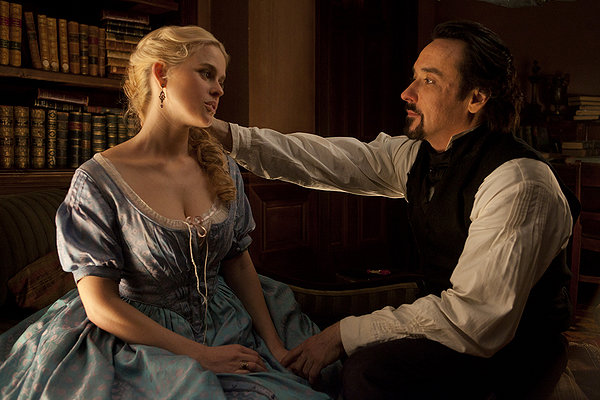
When “The Raven” was released in 1845, it was a literary sensation. I can’t say that the 2012 movie of the same name will be met with anywhere near the devoted fanfare. Edgar Allan Poe (John Cusack) has become embroiled in a deadly criminal investigation. The famous author is penniless, drunk, and depressed, but what else is new? What is new is that some Poe admirer has been stalking Baltimore and killing people in grisly styles fashioned after Poe’s macabre stories and poems. Detective Fields (Luke Evans) recognizes the connection to Poe and enlists the author to aid in capturing the murderer. Poe’s upper-class love, Emily Hamilton (Alice Eve), is captured by the unknown madman and buried alive. Poe must race against time to stop a killer, rescue the girl, and write a new horror-themed story to be published via the killer’s demands.
The Raven feels like an ill fit from the start. What is the point of featuring an American literary icon when all you’re going to do is plop the man into a pretty rote police procedural/serial killer thriller? The deadly flaw of The Raven isn’t its concept; it’s that the finished product didn’t embrace the particulars of its literary mash-up enough. Is it really a good use of Poe to just have him tag along on a police investigation? I wanted this premise to crackle with a devious slyness, a cleverness of genre and concept that the movie seems incapable of producing. You’re taking America’s singular literary voice of the Gothic and macabre and putting him into a game with a deranged fan. That’s a great start. I’m interested in that movie. But there needs to be some follow-through. This should be a battle of wits, an opportunity for Poe to backslide into the murky chasm of his own creations, bearing some pinning of guilt at having birthed a mad killer with the power of his words and imagination. This should be a psychological descent into hell for a man already famously tortured. Instead, the movie just becomes another rote serial killer movie but somebody typed in the name “Poe.” The various corpses, inspired by Poe’s works, just end up being gory, easily telegraphed deposits for clues. We don’t see these people in peril, terrified by the fiendish ye olde Saw-like death traps. We don’t even understand the process of the killer. The movie just ends up becoming one long, tiresome chase from dead body to next dead body, with Poe literary association haphazardly ladled in to tie stuff together. After a while, it feels like somebody took a thoroughly uninspiring serial killer script and just transported it into mid 19th century America. It’s nice to know that some clichés are timeless.
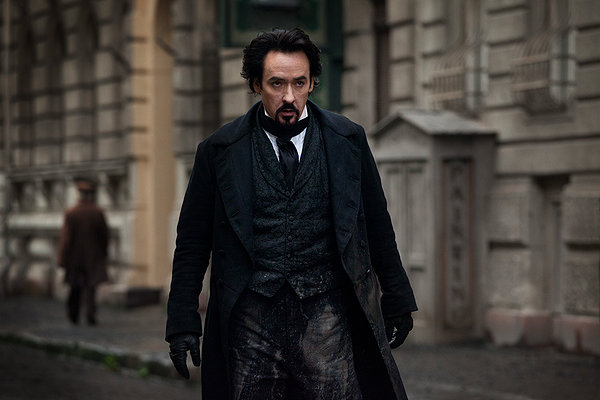 The movie never feels like it works properly, and the potential of its premise is completely unrealized. The murder mystery isn’t really ever given suitable footing to be a mystery, except in that tried-and-true “who’s going to be the bad guy” reveal. There aren’t really any clues left behind. So when characters suddenly come up with epiphanies on their murder investigation, you wish they would at least show their work. For a movie written by screenwriters with names like Ben Livingston and Hannah Shakespeare, The Raven certainly isn’t smart. The Poe stories feel tacked on in an arbitrary fashion instead of being interwoven into foundational elements of the story. Who cares how the characters die if their deaths have no impact on Poe or anyone else? The “how” of the equation becomes inconsequential. The title poem doesn’t even bear any weight on the story. The love interest/damsel in distress character is so bland and underwritten, that it’s hard to really feel Poe’s gnawing sense of urgency. Sidling the gloomy Gus Poe with a puppy-dog love story seems like a poor misunderstanding of the man and his demons. To top it off, the girl isn’t even his cousin (surely the oddest criticism of mine thrown at a movie)!
The movie doesn’t really ever become a convincing thriller either. The pulpier elements are ignored or downplayed, played with stodgy seriousness for a movie this ridiculous (Saw-style death traps in 1849?). Director James McTeigue (V for Vendetta), who after this and 2009’s Ninja Assassin is starting to look like a one-hit wonder, badly misplays the action elements. The dingy cinematography is unnaturally dark, making it exceedingly difficult to understand certain sequences and giving the audience yet another reason to lose interest. The impressive production design is totally mitigated when there’s not enough light to even see it. I understand given the nature of the story that we’d be dealing with lot of shadows and darkness, but this is just one poor looking movie. The only way you’d feel excitement from this movie is if in a fit of amnesia you forgot what you were watching and suddenly thought it might be a different, better movie, only to be disappointed ten minutes later when that sinking feeling reemerges and you realize, no, I am still watching The Raven.
I love me some John Cusack (Hot Tub Time Machine), but this guy is just the wrong fit for the movie. His sensibilities never really gel with the character, so Poe’s sense of melancholy comes across as more haughty boredom. He is not the right fit for the material. Eve (She’s Out of my League) has got nothing to do but look pretty and scream occasionally. The worst crime of all is utterly wasting one of my favorite contemporary character actors, the phenomenally great Brendan Gleeson (The Guard). He plays the uptight father of Poe’s love interest, which means he gets to pop onscreen and glare at Poe while looking worried. It’s a criminal waste of this man’s considerable talents.
 I think the best part of The Raven is actually it’s mostly unseen killer. It’s not because the guy is particularly clever or interesting or even remotely memorable (when they reveal who it is, make sure to pay attention to the constant reiteration of who he is, because if you’re like me, you plum forgot). The reason this guy is good is because of his impetus. He’s ultimately terrorizing Poe so that he can force the author to create more stories. Call it an extreme case of motivation. I can see our studious killer justifying his bad behavior, claiming to give the world new gifts of literary brilliance that we can all share, stories that will last the test of time. Isn’t that worth a few dead bodies, he’d argue. Ultimately, this rationale becomes more egotistical, about flattering the killer and his devious appetites, which is a shame. I’d prefer if the bad guy were more devoted to the cause of helping to shape the Canon of transcendental literature. I almost wish that the movie were told from this skewed perspective. I could have dealt with an entire catalogue of famous authors being victimized under the auspices of producing great literature. What if this one sick person is responsible for wresting the great works of the 19th century out of the authors’ minds and onto the page? I think we all owe this terrible individual a debt of gratitude.
I’m finding myself disliking The Raven the more thought I put into it, which, admittedly, my brain is actively fighting against. It does not want to spend more time processing this bore of a movie; a fun premise never fully realized, a conflict never truly developed, and characters that are the 19th century equivalent of the stock roles you’d find in any mechanical CSI/Law & Order TV episode. So in the interest of literary fairness, I’ve decided to channel the spirit of Edgar Allan Poe for the final word on The Raven:
And The Raven, never flowing, still is going, still is going,
On the pallid screen I silently stare at in unblinking bore,
And its plot is not that smart, missing heart and clues to start,
And it seems like the writers were tasked with an unfriendly chore,
The movie does not work; it’s dull and empty to its very core,
And so I lastly ask does this movie properly entertain?
Quoth The Raven – “nevermore.”
Nate’s Grade: C
Share this:

The Invasion (2007)
 The fourth remake of The Invasion of the Body Snatchers is a more interesting behind-the-scenes story than as a film. German director Oliver Hirschbiegel (Downfall) created a movie that was described as more psychological thriller than action chase movie. The studio and producers scrapped many pieces of the film, hired the Wachowski brothers to rewrite portions of the story and cram in some action, and then James McTeigue (V for Vendetta) directed the reshoots. As a result, the movie is wildly displaced and hacked together and never feels whole. There’s a slow burn of intrigue and mob madness and paranoia that gives way to chase scenes, car wrecks, and a ridiculously contrived happy ending. I’m sorry, but when you do The Invasion of the Body Snatchers, you cannot have humanity win; that destroys the entire point of the story. It’s like having King Kong climb the Empire State Building and deciding to live there and dance for peanuts. Nicole Kidman and her lithe frame seem like an odd choice as humanity’s last hope with a gun. The Invasion flirts with some philosophical ideas about free will, assimilation, and the cost of peace, but then it speeds headfirst into an abrupt finish. This movie is unsatisfying to all parties.
Nate’s Grade: C
Share this:

V for Vendetta (2006)
 Legendary comics author Alan Moore has a particular disdain for Hollywood adaptations. They just haven’t gone so well for this scribble scribe. There was 2001’s From Hell (I may be the only one in the world that actually likes it, Heather Graham’s atrocious cockney accent aside) and 2003’s The League of Extraordinary Gentleman. Moore is even responsible for the creation of the John Constantine character, who had his own 2005 big screen venture. I suppose you could see why he has certain contempt for the movie versions of his much-heralded stories. Now comes V for Vendetta, based on Moore’s 1988 comic and adapted into a screenplay by the Wachoswki brothers. While I may have no idea how close V for Vendetta is to Moore’s graphic novel, I can say that the movie is a smart, superb thriller that dares you to think while you?re stuffing popcorn into your mouth.
“Remember, remember, the fifth of November, gunpowder treason and plot. I see no reason why the gunpowder treason should ever be forgot”
In the future, America has lost its super power status after overextending itself in war. Britain has turned into a hostile totalitarian government, led by chancellor Sutler (John Hurt). Evey (Natalie Portman) works for the state-controlled TV station. One night, while walking out past curfew, Evey is attacked by some undercover cops looking for a good time. A mysterious masked man named V (Hugo Weaving) comes to her rescue. His grinning, bearded mask resembles Guy Fawkes, a revolutionary that tried to blow up the British Parliament 400 years ago on November 5th. V starts taking out high profile government figures and then infiltrates the government airwaves, asking others to rise up against the corruption they see around them. He promises to blow up parliament one year to the day of this message. Finch (Stephen Rea, so expressive with his hangdog demeanor) is assigned to find out who this V is and how to deal with him. In reality, Finch discovers a lot more troubling information about his own government. Evey is linked with V and tracked down for interrogation and potential execution. As the date approaches, Evey must battle her own loyalties and strike out against what she feels is right and just.
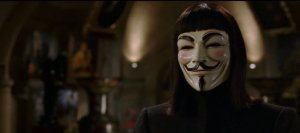 What makes V for Vendetta so exciting is its playground of ideas. This is a dynamically intelligent, complex movie but it never lets the smarts get in the way of a rousing good time. This is a very political movie that’s very relevant today, like the exchange of freedom for security and the use of fear mongering to serve an agenda. I love that the government’s leaders were a rogue?s gallery of corruptible figures; the Bill O’Riley-like TV pundit blowhard, the church leader who just happens to be a pedophile, the scientist whose good intentions justify the worst in human experimentation. V for Vendetta is a thinking man?s comic book movie, one that actually has actual respect for its audience and refuses to dumb down its message. The movie starts at a gallop and never lets up intellectually, and that’s so wonderfully refreshing from a film of any stripes. While I would not classify myself in the camp that views V for Vendetta as an anti-Bush administration screed, I’d have to say the movie does stir people out of a sense of apathy. I was even moved by the film’s hopeful conclusion, which is more than I can say about any other comic book movie (yes, even Elektra).
Director James McTeigue has previously served as the Wachoswki brothers’ assistant director. V for Vendetta is his debut as a director and what an auspicious debut it is. The movie is visually lush thanks to Aliens cinematographer Adrian Biddle (sadly, he died December 2005), but the smartest notion McTeigue accomplishes is putting story above special effects (ahem, George Lucas?). The command McTeigue has as a first-time director is impressive; how many people would be this restrained with all the fancy tools Hollywood has to offer? It’s his restraint and priorities that allow V for Vendetta to excel. And when the film does call for action, McTeigue judiciously uses visual trickery to enhance the scene. A late scene involving slow-mo V taking out a cadre of soldiers while they reload is amazing both in its “hey, look at this!” visual acuity and that it fits perfectly within the narrative. Nothing is self-consciously showy for the sake of wowing an audience, and every beat of action feels organic to the storyline. V for Vendetta is a terrific debut with some great set pieces.
Weaving is awesome as our hero. Since at no point does V ever take off his mask, it wouldn’t have been unheard of to simply hire a stunt guy to play the part and dub Weaving’s voice in later. But no, Weaving decided to be the part and adds so much to the character. He knows when to turn his head, nod, lean to a side, just like a silent film star interpreting the moment through action; it sounds ridiculous but it definitely helps paint a clearer picture of V. Then there’s Weaving’s incredible voice, making V sound like the world’s craziest, coolest Shakespearean lit professor.
Portman has finally made me appreciate her as an actress. She had a long winter between 1994’s The Professional and her 2004 one-two punch of Garden State and Closer, but I now finally see that Portman is a fine actress and not just a promising talent. She’s the heart of the film, the focal point for the audience to journey along, and she’s excellent at every point. I also give her props for having her head shaved on camera (I can only imagine what the eventual porn version will do with this scene).
 I’m left in the cold by this over inflated discussion on how “daring” V for Vendetta is by having the hero of a major Hollywood movie be a terrorist, one that says things like, “Violence can be used for good,” and, “Sometimes blowing up buildings can change the world.” Yeah, sure, but it’s a well-mannered, well-read, cultured terrorist versus a giant evil totalitarian government that kidnaps people, strips them of their rights, and enforces cruelty and prejudice. So exactly how daring is that? Of course audience sympathy is going to fall to the little guy, in this case a terrorist, which is the only hope of shaking things up and righting wrongs in the system. That doesn’t exactly strike me as subversive. This movie isn’t promoting terrorism any more than Munich was when Spielberg allowed the Palestinians to have a voice. The movie is anti-oppression if anything.
My only complaints are minor. The movie gets a bit repetitious in its windup to the climax (oh look, we’ve cut again to the Big Brother round table), and that somewhere along the middle V for Vendetta gets log-jammed with subplots. Everyone has a story to tell in V for Vendetta and we see every personal tale, and after a while it kind of grinds the flow of the story down. However, this problem is sidestepped after awhile and V for Vendetta gets back on track, driving full-force toward its conclusion like a runaway train.
What sounds on paper as something incredibly silly, including a kissing scene involving a motionless clay mask, V for Vendetta plays out with such excitement, visual prowess, and vibrant intelligence; this is a very political movie that?s very relevant today and I loved it all the more for it, but V never forgets to be entertaining at the same time. McTeigue has fashioned together a stirring and fascinating directorial debut, and even though the Wachowski brothers have their fingerprints all over this film, the pretension is kept to a minimum. V for Vendetta is exactly what the Matrix sequels should have been: a pulpy mix of brains and action, not a snore-fest that beats you down before putting on a show. It’s a shame Moore didn’t want his name attached to the finished product, because V for Vendetta is 2006’s first great movie of the year.
Nate’s Grade: A-


 nathanzoebl
You must be logged in to post a comment.