Blog Archives
Havoc (2025)/ Novocaine (2025)

Action cinema has long been one of the most satisfying experiences for the always-insatiable moviegoer, being presented with the thrum of kinetic editing, expert choreography, and visceral photography to produce a sensory thrill. Watching a well-developed action sequence is akin to watching a stupendously choreographed dance, where the movement and struggle are part of the storytelling momentum. Two recent action movies show what can be achieved, one through intensity of the familiar and the other through elevating its concept. Both are fairly enjoyable escapes and reminders that, with the right hook or sense of passion, action cinema can be some of the most gleefully transporting sensory experiences.
One of the best genre filmmakers is Gareth Evans, a man who blew the industry away with his intense Indonesian martial arts epics, The Raid and its even better sequel. After watching those movies, and taking time to catch your breath, you have to wonder why Evans isn’t directing every Hollywood action movie, or at least been tapped to try his hand at juicing some studio franchise with his visionary feel for action. It’s still a mystery to me that Evans has only helmed two movies since 2014. Both of them happen to be from Netflix, and while I don’t pretend to understand the creative machinations behind this streaming giant, if I were them I would give Evans a $20-million budget every three years and tell him to do whatever he wants as long as it involves people getting hurt. At first glance, Havoc looks fairly conventional, a crime drama about corrupt cops and hoodlums fighting over who can get to a target first. You have to keep reminding yourself that Havoc is not The Raid and not aspiring to be, so the fact that it cannot rise to that extreme level of action excellence does not mean it is a failure. It’s not in that upper echelon of action cinema, like your John Wicks, but Havoc is most definitely a step above many of Netflix’s junky action-thrillers with A-listers that inevitably disappoint in their flailing execution.
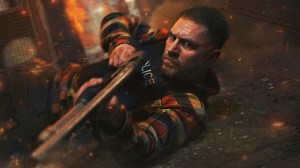
Tom Hardy plays Walker, a veteran cop who works as an enforcer when the money’s right. He’s tired of being a tool to the rich and powerful and looking to get out and be a better family man. You know, the stuff of formulaic action boilerplate. He gets involved in a job gone wrong that leads to a gang war spreading and plenty of hired guns looking to find the son of the mayor (Forest Whitaker). That’s about it as far as the plot. It’s about different groups racing to get what they want first at whatever bloody cost.
Whereas The Raid was a martial arts action extravaganza with professionals at the top of their game getting the platform and material to showcase their amazing skills, Havoc is not that kind of movie; in fact there’s very few moments where the action consists of fisticuffs. This is an action movie built on car chases and mainly gunfights. It’s a cops and robbers kind of action movie, which puts less emphasis on hand-to-hand and more on room clearing. While the accumulated thrills might not be as gratifying as watching professional athletes launch exciting routines, there is still plenty to enjoy when watching finely developed gunfight sequences. The boring approach is simply to convey a shot-reverse shot dynamic: Character A fires a gun, then cuts to Character B being shot or dodging, repeat. Good directors will think about how to better stage a sequence so that each one has its own purpose, its own set of mini-goals, a set of organic complications that keep the conflict roiling, and ways to connect to character. Action sequences should not just be excuses to blow something up. With Havoc, it takes quite a bit to get going, but there are two standout action sequences that make it worthwhile and will satisfy most action aficionados.

The first sequence is a fight in a club that kicks off the movie’s shift to constant scrambling action. It’s about 50 minutes into the movie and all the respective characters have been slotted into their conflicting positions. We know who the good guys are, the bad guys, the goals in opposition, and what the stakes are, and from there the movie just takes off in a sprint until its final blast. The club involves different levels and different factions fighting and mixing, providing a series of changing complications that makes the sequence feel more lively and engaging. There are several inventive moves to avoid gunfire or reach guns, and the cinematography keeps the action centered and easy to comprehend. The best action sequences are planned like moving puzzles, and the more work that is put into the preparation, the more enjoyable the action can become. This club shootout scene finds numerous ways to keep the stakes upended and to place the characters in new forms of danger they have to quickly adapt to survive.
The second sequence is a climactic confrontation at a cabin in the middle of a snowy forest. It’s a prolonged siege sequence where the bad guys are attempting to break through into this secure location and take out our heroes. From this claustrophobic setting, Evans presents the antagonistic intrusions as unrelenting and coming from all four walls and even below as well. The characters have to constantly be moving and reacting to an assembly of threats while their protective walls begin to literally crumble. It is a literal onslaught. I’m shocked the cabin is still standing by the end. It’s an immensely engaging sequence that communicates the frenzy and anxiety of being under constant attack. The gunplay can be brutal and there are satisfying kills and battles between side characters throughout this sequence to avoid the sequence from feeling too repetitive. It feels in many ways like the whole movie has been leading up to this sequence, not just in a traditional linear-plotting fashion but also the viewer has been waiting for the director to fully go off with a celebration of action mayhem. This is Evans unleashing his best, and he’s adapted his creativity to the setting and the action sub-genre, so there’s different moments meant to present immediate gunfire problems and fast-paced responses. In this world, people aren’t all gifted as expert fighters, and thus even our heroes can falter under the harried circumstances.

Short of these sequences, the rest of Havoc has difficulty breaking free from the gravitational pull of its own genre cliches. Evans wrote the screenplay by himself and I’m surprised how flimsy so much of the story and characters come across. With 2011’s Raid, there wasn’t much of a story once the action stopped, but with 2014’s Raid 2, Evans was able to compose an undercover cop story that was just as compelling even when people weren’t getting kicked in the face. He can write colorful side characters that feel like they stepped out of a Tarantino-favorite grindhouse movie. He can write tense sequences that don’t have to rely upon action. He can do so much more than what Havoc provides, so it’s hard not to feel like this wasn’t exactly a passion project. It feels more like a serviceable vehicle to achieve the kind of action that Evans was looking to achieve. Now, if you’ve underwritten a genre movie because your real interest is staging the action, then you would expect there to be more action, correct? Strangely, Evans spends most of those first fifty minutes setting up his story, the same story that is awash in genre stock roles and cliches without much intrigue beyond a one-sentence description. Simply put, if you’re going to stick us with underdeveloped characters, don’t keep us waiting for the action. There’s so many characters in this movie that I think Evans gets overwhelmed trying to set them all up and involve them in the larger story. If they’re only going to be stock roles, why do we need 30 when 10 can do? I think Evans keeps his cast so big so he can unceremoniously bump off so many of them, which can be surprising, but I would have preferred doing more with the space their absence might have provided the narrative. There’s also an odd stylistic choice where any exterior shots are much more stylized, looking more like video game cut-scenes or something out of the realm of Sin City. It’s at odds with the rest of the film’s stripped-down look.
Havoc is a gritty and bloody action movie that can overwhelm at moments and underwhelm at others. The genre grist is pretty familiar, from our troubled antihero lead trying to atone for his past sins, to the dumb kids in the middle of a gang war they don’t understand, to the good-natured partner who has to grow up, so to speak, by getting their hands dirty. You’ve seen variations of these stories before, but the real draw is once Evans works up enough space to really unleash his invigorating action best. It’s a movie I wish was better but it’s functional enough for Evans to do his extraordinary thing. I just want more of his specialty.
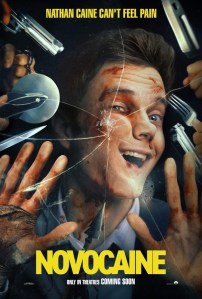
In comparison, Novocaine isn’t going to be defined by stylish choreography or exceptional style. It’s a high-concept action comedy driven by flipping the genre script. Instead of our hero inflicting great pain on his foes, this movie is about a hero enduring amazing amounts of pain. It’s an underdog story where a novice is thrust into an unfamiliar situation and has to utilize his unique disorder, a blessing and a curse, in order to rescue the girl and save the day. It’s a great premise that lends itself to plenty of fun scenarios to fully capitalize on its bizarre potential, and that’s where Novocaine hits a sweet spot of entertainment.
Nate (Jack Quaid) is a shy assistant manager at a small bank in San Diego. He suffers from a unique medical condition where he doesn’t feel the burdens of physical pain. You might think this a luxury but it’s actually a great worry for Nate. Without his body’s alarm system he can stumble into grave danger without even knowing it, so he’s been living an overly cautious life as a result. That all changes when he meets Sherry (Amber Midthunder), a new coworker who takes an interest in him. They go out on a date and really hit it off. Things are looking up for Nate until bank robbers storm his work, kill his boss, and take Sherry hostage. Nate hijacks a cop car and goes chasing after the bandits to rescue Sherry. He’ll undergo lots of trials of pain to win back the girl who makes him feel things.

How do you make a person invulnerable to pain an exciting character? It’s the lingering Superman question, except nobody is going to confuse the character of Nate with Krypton’s orphaned son; if a character cannot feel pain how can we worry over their well-being? Now there’s a reason writers have been able to tell Superman stories for decades, even if the movies often struggle with representing the figure, and that’s because it just forces you to have to think harder. It can be done. With Novocaine, Nate is a hapless naif thrown into an action movie and trying his best to fit in. He lacks physical prowess, weapons training, and tactical planning. However, the only thing he has going for him is his inability to feel physical pain, and the filmmakers routinely find funny and entertaining methods to test how far one could go with this pain threshold. While his body isn’t registering pain he is still taking all the punishment. Nate is nowhere near indestructible, and a running gag becomes how utterly mangled and deformed his hand becomes from event after event (I thought it was just going to be a stump by the end). He takes quite a beating but because of the whole “mind over matter” matter, he’s surprisingly able to persevere where others could not. This allows Nate to become an unexpected hero where the rest of us would pass out from shock. The appeal of the movie isn’t so much the action itself but the ongoing response to all of said action.
The set pieces are what makes this movie so much fun, pushing Naate into action hero mode when he’s clearly awkward and not ready for the promotion. I loved his dry responses to every new injury, from mild annoyance to feigned surprise. There’s a scene where one of the villains is torturing Nate and he has to go along with the charade in order to appease his tormentor and get valuable information out of him. It’s a reverse interrogation where the target is actually trying to manipulate the guy with the pliers. I loved how quickly he could bounce back from whatever trauma, from catching a knife blade first and quickly yanking it out of his hand, to casually writing an address on his hand with a tattoo gun. There is a crafty ingenuity to how the filmmakers can make the best use of this superpower. There are some impressive kills that also made me wince in response, like reaching for a gun at the bottom of a deep fryer, or literally stabbing a person in the face with an exposed arm bone. Novocaine has a delightfully demented sense of humor that keeps everything grounded with mordant laughs even when it’s dishing out the punishment.

Even more surprising, there’s a buoyant love story that genuinely feels sweet that could have benefited from a little more development and attention. Sherry is the one who activates our protagonist and pushes him outside of his comfort zone. He lacks confidence in himself and has been living an overly cautious existence from fear of not being able to respond to his body’s emergencies. The man has been eating his food as liquefied goop out of a fear of choking. She introduces him to the simple joys of eating one’s food before it’s been vigorously blended, like the wonders of pie. Their first date was genuinely charming and I liked the chemistry between both actors. Midthunder has been a favorite of mine since Prey and I want to see her in more varied roles. When the bank robbery commences, I actually had an emotional response to these two being in danger and watching the other being put in danger. Once she becomes a hostage, Sherry is placed as the damsel to be saved, which is disappointing because I liked her contributions to the story and especially what she brought out of Nate. There is a revelation with her later that reorients our understanding of her but I don’t think it was fully necessary. Their budding romance is quite enjoyable and so I wish the story could also continue to develop this connection over its wild series of mishaps.
Novocaine is a great example of a movie that maximizes its unique premise to stand out. It’s structured like a traditional action-thriller but it never takes itself seriously, pushing forward a stumbling protagonist whose real gift is that he’s the human equivalent of a punching bag. This dynamic is ingeniously developed and showcased, and just when I was worrying the premise might get old or become repetitive, the filmmakers find new ways to twist their story into even better twisted results. I wish the female supporting role was more tied into the action and fun, and the villains are a bland blend of overly confident paramilitary goons. Still, the fun comes from Quaid and his light-footed screwball performance anchoring the bloody hi-jinks and demented humor. Novocaine is a fresh reworking of action movie tropes with a twist that allows the audience to heartily laugh at our hero’s pain and pratfalls. It’s the kind of humor and energy that reminds me of the Crank filmmakers. If you’re looking for a winning dark comedy bouncing against the formulas of action movies of old, settle in for some Novocaine and enjoy the pain.
Nate’s Grades:
Havoc: B-
Novocaine: B+
Share this:

Companion (2025)

Confession: several years ago, my good friend and I co-wrote a movie for the Chinese film market that had several similarities with Companion. It was about a robot designed to be everything her owner desires turning on her owner. I’ll freely admit: Companion is better. While the movie doesn’t reveal that its robotic companion, Iris (Sophie Thatcher), is indeed made of circuits and screws until twenty minutes in, there are so many better twists and turns that come later. It begins with something relatively standard, a girlfriend nervous to meet the friends of her boyfriend Josh (Jack Quaid) during a lake house retreat. The film takes a dark turn that forces the characters to question how far they would be willing to go to cover up a crime as well as their own culpability. The second half of the movie becomes a very engaging and twisty cat-and-mouse game with Iris trying to escape from pursuers. Writer/director Drew Hancock (My Dead Ex) had put plenty of thought into the story mechanics of his thriller set pieces, connecting them to character decisions and the desperation of trying to outwit one another. The entire movie is elevated and then some by the terrific lead performance from Thatcher (Heretic, Yellowjackets) who becomes our emotional anchor and Final Girl worthy of rooting for. Thatcher can be heartbreaking one minute, hilariously deadpan the next, like when she’s stuck speaking German, and a tremendous source of empathy as she fights for her survival. Upon my first watch, I felt there might be too many twists and turns right up to the very end, but having re-watched Companion, I appreciate how much Hancock really thinks about move-countermove plotting, making sure that we experience many avenues from this premise. It’s a vicious take-down of viciously exploitative control freaks, with some strong satirical dark humor elbowing you in the ribs. It very much reminded me of 2019’s Ready or Not and would pair well as a double-feature of feminine empowerment amidst horror manhunts. While it might not have much on its mind as far as larger social commentary, there’s enough cooking here to keep me entertained, laughing, wincing, with my eyes glued to the screen to see where exactly it could go next. That’s a rarity. Companion is built different.
Nate’s Grade: A-
Share this:

Scream 5 (2022)
 The fun of the Scream franchise has been its meta-textual commentary, wry jabs at horror, and the guessing game of who the killer culprit(s) could be, and Scream 5 or Scr5am (what it SHOULD be called) is a good-fun B-movie that knows precisely what it wants to be and plays to the strengths of the franchise. We haven’t had a Scream sequel since 2011, and the landscape of horror has changed as well as the landscape of multi-media entertainment. There are new satirical horizons to be targeted. This is the first Scream after the death of legendary horror director Wes Craven, but it’s in good hands with the directors and writer of 2019’s bloody excellent Ready or Not. The fun, knowingly goofy elements are retained, and the filmmakers clearly have love for what they’re sending up. There’s a sequence of languishing shots of a character opening fridge doors and pantry doors and I felt everyone in my theater tense for the eventual reveal of the killer on the other side. Moments like these are the good kind of tension-release giggle that Scream can get away with. The plot is sufficient to gather the “legacy characters” back to the site of the original murders for a new stab at rewriting the movie franchise. There’s even some plot elements that are surprisingly resonant and deeper for a satirical slasher franchise, like tear-filled discussions over loss, abandonment, mental illness, and personal responsibility. There’s a sister-to-sister reconciliation that plays like a straight drama, and it plays well. There’s nothing terribly gruesome or memorable about the kills, and some of the meta-commentary can feel like talking in circles, especially as characters knowingly enact scenes from the original. It’s a copy of a copy, meant to mock Hollywood’s reboots, but it’s still a copy of a copy. Sometimes the knowing winks are obvious, like a shower sequence recreating Hitchcock’s angles, and sometimes the potential homage feels lost in translation. Still, Scream 5 is a fun, ironic, bloody hoot of a movie, and for fans of the franchise a more welcomed return to the creative heights of the original movie.
Nate’s Grade: B
Share this:

The Hunger Games (2012)
 Suzanne Collins’ smash novel The Hunger Games isn’t your normal young adult reading material. Dystopian future, corrupt government, oppressive forces, twisted media culture, and then there’s the whole inhumane concept of children murdering each other for sport. The book trilogy has been consumed by millions of readers, young and old, and inspired rabid devotion reminiscent of other successful publishing franchises like Twilight and Harry Potter. Yes, Battle Royale fans, the premise is not original, but Collins’ book could just as well cite inspiration from The Most Dangerous Game, Lord of the Flies, The Running Man, or even an Outer Limits episode known as “Fun and Games.” Producers are hoping those legions of fans will turn up in droves and start a new lucrative film franchise. Reliably squishy filmmaker Gary Ross (Seabiscuit) was tapped to shepherd the book to the big screen. The Hunger Games movie doesn’t commit any major blunders to screw up a good story, which is good enough for many.
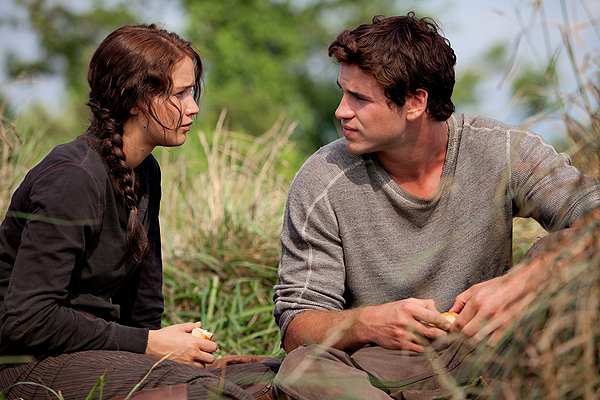
Set in a distant future, the ashes of North America have given way to the country of Panem. It is lead by a Capitol government and ringed by 12 mostly poor districts. Every year the Capitol commemorates the failed revolution of the districts by holding the nation’s favorite televised sport, the Hunger Games. Each district holds a reaping, which randomly draws one boy and one girl aged 12-18 years. These lucky chosen children, known as tributes, are then whisked to the Capitol where they will be placed into an arena and fight to the death. 24 tributes go in and there can be only one winner. In the outlying District 12, day-to-day life is a struggle, and Katniss Everdeen (Jennifer Lawrence) is burdened with providing for her family. She hunts illegally to provide food for her family and to trade for goods that they need. She’s excellent with a bow and arrow. Her hunting partner, Gale (Liam Hemsworth), suggests that they could run away. “We’d never make it more than five miles,” Katniss reasons. The two of them have too many responsibilities to ignore. Then Reaping Day comes, and Katniss’ 12-year-old younger sister Prim (Willow Shields) is chosen as the female tribute. Katniss volunteers to take her place, saving her sister, but throwing herself into a sport where the odds will not be in her favor. Joining Katniss as the male tribute is Peeta Melark (Josh Hutcherson), the baker’s son who has some history with Katniss.
 The tributes are paired with mentors, the oblivious Effie Trinket (Elizabeth Banks) and former District 12 Hunger Games winner Haymitch Abernathy (Woody Harrelson) whose helpfulness is tempered by the fact that he’s drunk often. He advises his newest tributes that they must make the audience like them to earn sponsors, people willing to pay big money to supply the tributes necessary supplies in the middle of the game. The Capitol is full of lush excess, the people donned in cartoonish and colorful garb. Katniss is dolled up and paraded around. She showcases her skills to the Game makers, who will give each tribute a rating that bettors will use. She’s interviewed by TV host Caesar Flickerman (Stanley Tucci) to make an impression. While with Caesar, Peeta reveals that there is a girl he’s had a crush on back home for the longest time – Katniss. The star-crossed lover angle hooks the audience and immediately transforms the dynamic of the games. Katniss is upset, but Haymitch rationalizes that Peeta’s confession has made them more marketable.
Then the dreaded day arrives and the 24 tributes are gathered up, injected with tracking devices, and launched into the outdoor arena to fight to the death. Katniss’ biggest threats will be the tributes from District 1, Glimmer (Leven Rambin) and Marvel (Jack Quaid), and District 2, Clove (Isabelle Fuhman) and Cato (Alexander Lutig). These tributes have trained their whole lives in the deadly arts so that they could volunteer to enter the games, hence why they are dubbed the Career tributes. And they usually win. Once the games begin, Katniss must survive the Careers, whatever surprises the Game makers have, the elements, and win over the affections of the TV audience. Let the games begin.
Firstly, fans can breathe a sigh of relief because The Hunger Games movie is a mostly successful venture brought to visual life. The legions of Collins’ fans celebrating the movie of their beloved book will mostly be satisfied. Collins’ story is still a good story no matter the medium. It establishes its alternative world and the stakes quickly and then it’s off to the killing fields. This is dark and disturbing stuff, far darker than even the darkest days of Harry Potter, and fans will be relived that the movie does not go soft. It’s not the exploitation-vehicle that Battle Royale was. This is trying to tell a story and not revel in the geysers of teenage bloodshed. This is a movie that satirizes reality TV and media culture as much class warfare. Katniss is primed and prepped to manufacture an impressionable image to TV audiences. It’s all about calculation, image control, and the manipulations of the media and audience to produce a star. Here’s a world where the 1% literally celebrate and toast the deaths of the 99%. Here’s a world that takes it cues from the Romans concerning spectator sports. I do wish the movie had channeled more of the book’s accusatory tone against the Capitol citizens, the silent majority complicit in villainy. And of course it was Collins’ point that we, too, the audience could be accountable in our own YA bloodlust.
 This is a story that grabs you and rarely lets go, centered on a heroine that is refreshingly a strong female role model for girls. Bella Swan has nothing on Katniss Everdeen. Here is a heroine that is proactive, resourceful, resolute, compassionate, and she doesn’t need a man to complete her. Sorry Ms. Swan, but Katniss has a lot more important things on her mind than getting a boyfriend. She’s got to provide for her impoverished family and shoulder plenty of responsibility, and that’s before she’s plucked into a death sport. In short, Bella Swan sucks. Katniss Everdeen rules 4-ever.
Since the book was written in first person, we were inside Katniss’ head the whole time. There are disadvantages of leaving that POV, namely that Katniss’ survival skills and cunning can be brushed over. She’s not just fighting the other tributes, she’s trying to think how best to play certain moments, how to appeal to the viewers at home. During the games, the movie jumps back and forth between the action and what I’d like to call Mission Control from Hell, the game makers HQ. This is a smart move that provides a greater antagonistic sense with the book’s unseen game makers. The exposition, mostly handled by Tucci as color commentary throughout the games, is presented in a way that doesn’t feel clunky. I also enjoyed the two sit-downs we get with President Snow (Donald Sutherland), the autocratic ruler of the Capitol, who sees early on the danger of Katniss. He explains that the games are meant to give hope to the poor citizens. “Hope is the only thing more powerful than fear. A little hope is good. A lot of hope is not,” he explains while pruning flowers. It’s nice to have a villain who understands the calculations needed for a proper oppression. It’s also nice to see Sutherland sink his teeth into a role that will only get more enjoyably evil as the films progress. I felt that the tracker jacker sequence, the interviews with Caesar, and the time in the caves were the best-adapted sequences.
Lawrence (X-Men: First Class) is a star, pure and simple. She was the perfect choice to play Katniss Everdeen. The Oscar-nominated young actress brings great steely determination and grit to the Girl on Fire. Katniss isn’t supposed to be a teenage warrior (that would be the Careers), even though she is thrust into that role. She doesn’t celebrate killing. This is not fun for her. Lawrence can play an array of emotions silently, deftly, like her hoarse, wild panic at Prim being chosen, her shell-shocked disorientation at going into the games, her quiet fury at her irresponsible mother and others like the game makers, her budding warmth for Peeta while he rubs a salve over her facial cut. Pages of description can be consolidated in just one pensive, conflicted expression on Lawrence’s lovely face. Lawrence is the heart of the movie and a tremendous presence to ground our sympathy and emotions.
Katniss is a dangerous competitor but she’s also vulnerable. She’s emotionally guarded and thrust into a situation where she has to “pretend” to be in love. Now the romance angle, and the self-awareness on Katniss’ part to give a good show, was a far bigger storyline in the book. In the book, she begins by playing a part and by the end doesn’t know if her feelings are false or genuine. It’s strange that in the movie their this-is-love kiss, meant to make the audience swoon on Katniss’ part, is followed up with nothing but hugs. Maybe the filmmakers thought a romantic angle was in poor taste given the kill-or-be-killed scenario, except that the romance angle is what keeps Katniss and Peeta alive. Want to know the best way to irk a Hunger Games fan? Start comparing the complicated romantic triangle of Peeta and Gale to dismissive terms like Team Jacob and Team Edward.
 The supporting cast performs ably, some better than others. Hutcherson (The Kids Are All Right) is given the most material to work with. He’s a nice kid, strong, but worried about his humanity, and the filmmakers never portray him as anything close to a badass or a helpless baby. Hutcherson shines in the moments where he comes clean with his emotions, like admitting that he has no chance of winning (his mom thinks so too). Peeta’s much easier at charm than bravado, and Hutcherson is a charming guy. I think Banks (Zack and Miri Make a Porno) actually gives the best performance, short of our lead heroine, as the maniacally bent Effie Trinket. Half the performance is the garish outfits, wigs, and makeup, but Banks nails the affluent insensitivity and ignorance of her character. Her forced enthusiasm is good for a few laughs. Harrelson (Zombieland) gives hints about the demons behind his character, a man who has to watch a pair of children under his tutelage die every year as his “prize” for winning. He’s a colorful character in a movie filled with colorful characters, but his sauced sarcasm can sting. Tucci (Easy A) hams it up with great pleasure as the smarmy, inauthentic, over-the-top TV host, Caesar Flickerman. They dolled up actor Toby Jones (Tinker, Tailor, Soldier, Spy) in a bouffant wig and sit him beside Caesar for commentary, but, and I literally counted, he has three lines where he speaks onscreen. Still, I love his oily voice as the games’ announcer.
The movie distills just about everything from the book, plot-wise, so the fans will be sure to see just about every plot event that they’ve developed a mental checklist for. However, this narrative approach, an attempt to satiate the fans that bristle when the movies of their favorite books deviate too much from the source material, blunts the impact of the material. I was astounded at how overwhelmingly rushed and hurried the movie is, spending little time on those variety of plot events, rarely allowing the movie enough room to breathe. With this brisk and brusque pacing, it stops the movie’s vitality. The context and history of important items and people feel clipped, becoming just set decoration. Ross has not done an adequate job of making his movie universe feel richly realized. The significance of the mockingjay, a symbol of perseverance under the oppression of the Capitol, is left unexplained. It just becomes a dinky pin that makes Katniss think about home. The ghoulish mutts have been turned into just a bunch of vicious dogs that eerily resemble the dog demons from Ghostbusters (actually, I’m relieved the mutts were toned down). The contrasts between the impoverished outer districts and the lavish Capitol denizens are nicely showcased thanks to luxurious and weird art direction and costume design; these people took fashion advice from Marie Antoinette and maybe their political outlooks as well (“Let them eat cake… or death”). There are also some passing moments of dark satire as far as the Capitol’s overall stance with the games, and their blasé attitude about the value of human life, though the movie could have and should have pushed harder with its class warfare.
The Hunger Games reminded me of the first two Harry Potter films where the producers crammed in all the plot points they felt fans wanted to see rather than just, you know, adapting it into a good movie. If they wanted to keep everything from the book, plot wise, then they should have followed their convictions and produced a three-hour movie. Imagine The Godfather being cut down to two hours and twenty minutes. Imagine rushing through all that drama. Now I’m not in any way comparing The Hunger Games to The Godfather in terms of quality, but movies need sufficient time to establish their worlds and develop characters. They need time to breathe. The fact that a 142-minute long movie doesn’t have time to breathe is plain inexcusable.
 The characterization, beyond Katniss and Peeta, is extremely limited, and so when he deaths do occur the impact is minimal; only one tribute’s death is given time for mourning, and even this character’s death is limited due to superficial characterization and about two minutes of screen time. I’m not saying that every one of these 24 tributes needs a detailed back-story, but they’ve got to have some personality to them and the movie has to devote some time to develop that; good writing can tell a lot with little. Otherwise they just become somewhat recognizable faces and not characters. Cinna (Lenny Kravitz), Katniss’ stylist for the pre-game publicity in the Capitol, is reduced to being a bland companion. Let me single out the villains, our group of Career tributes. The movies have a long tradition of villains who aren’t given much characterization but are given personality. I need my bad guys to be given an opportunity to make an impression, and no, weapon distinction is not enough. With The Hunger Games, the bad guys just become a series of sneering faces, and these kids (Ludig, Rambin, Quaid, Fuhman) have got some good sneer faces. True, the movie’s entire twisted premise lays enough overwrought tragedy to the entire setup, turning children into killers, and President Snow is the ultimate villain, but the movie should be agonizing, terrifying, devastating, upsetting, and not merely inferential and rushed. I want to feel the deaths. Instead, the movie can’t even be bothered to briefly show the faces of the dead kids during the game’s daily death montage. There are all sorts of kids who were hired to be tributes from districts and I question if they ever got a second onscreen.
I also feel that Ross is, at times, completely wrong for this material. The man behind Pleasantville and Seabiscuit is not the first name you’d think of to tackle a dystopian sci-fi survival thriller built upon the premise of dead children. I almost wish they had hired Paul Verhoeven (Robocop, Starship Troopers), an artist well versed in sci-fi spectacle and subversion. Ross’ misguided visual approach, borrowing a page from the Bourne franchise, can make it hard to enjoy the film. During the opening segment in District 12, as well as the games themselves, Ross will attempt to up the visceral ante with his bobbing handheld camera. Now I’m not one of the people who loudly decry the use of “shaky cam” during action sequences, but before the second minute was over, I turned to my friend and said, “I already hate the shaky cam.” There’s a difference between handheld camerawork, which has some jostle to it, and a deliberately inauthentic docu-drama approach that makes exaggerated and distracting camera bobbling. There are long segments of this movie that is nothing but shaky close-ups cut together. There’s a climactic battle atop a metal structure that is completely incomprehensible to follow. It’s all just a blur of flashes save for two wide shots to thankfully attempt to orient the viewer. When an audience can’t follow the action, it not only kills tension but it also kills investment. The docu-drama visual approach is completely wrong for this movie. When was the last time you saw a dystopian sci-fi movie that had a docu-drama aesthetic? Try never.
 Likewise, to achieve the all-important PG-13 rating, Ross sanitizes the blood sport, utilizing lots of implied violence. The jangly aesthetic works for the duration of the race to the Cornucopia to start the games, as tributes turn a fight over supplies into a bloodbath, communicating the chaotic frenzy. I’m not clamoring for explicit carnage to get its message across, but just seeing children as far-off lifeless heaps is a disservice to the power of the story. Also, I don’t feel like Ross properly takes full advantage of the visual medium. Instead of being told, twice, about mines that will explode if any tribute steps off their platform before the conclusion of the countdown, let’s see it. Since half of these kids are about to become faceless corpses anyway, why can’t one of them lose their balance, fall out of the ring, and blow up? And then we cut to a nearby tribute dusted with pieces of dirt and blood, trying to keep their cool and failing. It would have kicked up the tension and shown the immediate danger that awaits. I don’t want the one-minute countdown to cut around the globe, seeing the different districts watching TV. I want that entire minute spent in the arena, hearing every second counted down, seeing every face of the tributes sick with anxiety and unease, gritting themselves for combat. I want to feel the same sense of doom that they do, not cut around the globe and then have the audio drop out. That’s a sorry way to start the games, even with a PG-13 mandate.
There are heavy expectations for The Hunger Games on all fronts, from studio execs to the millions of eager fans. I consider myself one of their legion. I voraciously read through the trilogy, getting hooked early, and have even helped teach the book as part of an American Literature curriculum. It’s a thrill to watch reluctant readers get excited about the book. The Hunger Games succeeds mostly as the pilot to an exciting film franchise. But having seen the Hunger Games movie twice in 14 hours, and being a huge fan of the book, here are my chief criticisms: the movie is far too rushed, speeding over so many plot points and characters, never getting time to breathe; nascent characterization for supporting characters; the context of so many things is missing; shaky cam overuse to the point of incomprehensible action sequences; dodgy CGI; not taking full advantage of visual medium; intensity a bit muted; and finally, a forgettable score. But, hey, good movie. It just frustrates me because it could have been a great movie, a searing, powerful, provocative, thrilling movie. Good movie will be good enough, especially when it makes more money opening weekend than the citizens of District 12 will ever see in their lifetimes. When you got a fan base as large as this series, the odds will usually be in your favor.
Nate’s Grade: B


 nathanzoebl
You must be logged in to post a comment.