Blog Archives
The Novice (2021)
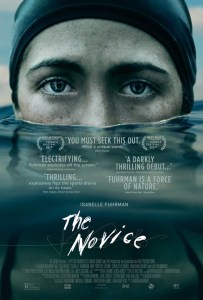 The Novice could be deemed “the Whiplash for rowing,” and that is it in a nutshell but it also distinguishes itself separately from that Oscar-winning 2014 indie. Debut writer/director Lauren Hadaway was actually on the sound editing team behind Whiplash, and that’s her area of expertise with over 40 credits, and right away you can tell her attention to details as far as filmmaking being an immersive experience for the viewer. It’s been nominated for five Independent Spirit Awards, including Beat Feature, Best Director, and Best Actress. It’s the little indie that could right now, though it also seems like the kind of well-received indie that gets forgotten around award season. That would be a shame, because while not quite at the level of Whiplash, this is a hypnotic and visceral and disturbing portrait of competitive obsession.
Alex Dall (Isabelle Furhman) is a freshman for her East Coast university. She joins the crew team with the goal of being the best. Her coaches encourage her competitive spirit but even they try and warn her to take it easier with her relentless training regiment. Nothing else matters to her.
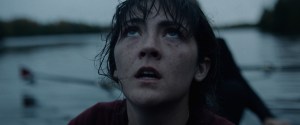 You feel Hadaway’s background in sound design, how she uses it to disorient and produce a rhythm to her movie, the inhale and exhale of pushing one’s self to their physical limit. It’s accompanied by dizzying edits that feel completely matched by their auditory components (Hadaway also served as a co-editor). It’s frenetic and places you in the mindset of our protagonist, whose single desire is to be the best no matter what. That solitary focus blurs out the outside world, so when we get into trance-like states of close-ups, repetitive edits, and slow-motion extensions, we feel trapped inside her restless state of mind. One critic compared the training montages to the drug use montages from Requiem for a Dream, and this is completely accurate. Alex would never view herself as an addict but that’s precisely what she is. Her personal addiction is at winning, and winning at all costs and being the best.
In Whiplash, Miles Teller’s protagonist was a capable drummer that wanted to be excellent. He already had talent and was pushed to the brink by his monstrous teacher/drill sergeant/abusive father figure. Alex throws herself into unfamiliar situations. She is a physics major even though she doesn’t really like or understand the subject. She joins the rowing team even though she lacks any experience whatsoever. And yet, she still sets her sights on the near impossible. She doesn’t want to be the best freshman, and she doesn’t just want to join the varsity squad; she wants to break all the individual records as soon as possible for a team sport. A normal person would view these goals as unrealistic and potentially out of reach, but that’s the point for Alex. It’s the best or nothing, and her toxic win-at-all-costs mentality is even more toxic because she expects to win even in the most unlikely scenarios. It would be like never driving a car and expecting to win the Indy 500. That adds a different dynamic for Alex but it also makes her even more self-destructive and misanthropic.
 The movie becomes a tale of obsession, a downward spiral much akin to an addiction narrative. Alex gradually cuts off all other parts of herself she deems to be a distraction. It’s only small moments where we try and catch a different definition of Alex, the version of her when she might allow herself to relax, but this feels like the “weak Alex” that she’s trying to snuff out, because there shall be no other version of Alex except the one in service to her goal. When she starts having a potential relationship with her T.A. (model Dilone), you think this might be the character’s off ramp, an opportunity for her to settle and realize something else that is meaningful, building an interpersonal relationship. It becomes another distraction to remove. This achieves the artistic vision of showing the mental and physical decline of Alex. Everything in the movie is likewise in service of serving Alex’s grueling goal. However, this also makes her a less dimensional character. If all we know about her is how obsessive she can become, then we’re left to pick up whatever other scraps we’re given to piece together a fuller understanding of her. Perhaps Hadaway doesn’t want any definition beyond Alex’s obsessions. It makes the character less complicated and by extension less compelling, but there is that rubbernecking quality of just watching to see how far she will go before reaching a breaking point. Maybe even death?
This movie would not work as mightily without the committed performance by Fuhrman (Orphan, The Hunger Games). She’s been working ever since she was a child but this is a breakthrough performance for the actress. The intensity of her performance is so conveyed that you might feel like you had a workout yourself. The actress gained ten pounds of muscle over the course of the punishing film experience and athletic training. I had to imagine the movie was shot linearly so they could trace her physical transformation, but I haven’t confirmed it.
Another sound area that greatly elevates the movie is the stirring score by Alex Weston (The Farewell). This is my favorite film score of 2021. It is haunting, moody, and appropriately frantic, with jangling strings and a propulsion that echoes its main character. It has an easy presence of sliding in and out, mimicking the pace of the compulsive training, and standout tracks include the motif “Training” and “Legs Body Arms” and “Seat Race.” Listen to it, folks. Weston has put together greatness and deserves far more recognition than he is being given.
 The Novice could do worse than patterning itself after Whiplash, one of the best films of the last decade. What it lacks in originality and characterization it makes up for in execution, immersing the viewer in the insane obsessions of its lead character. Film has always been an empathetic medium and sometimes it’s a trip into the dark side of the human psyche. Why is Alex this way? It’s unknown. Will she ever break free from this toxic mentality? It’s unknown. Even the ending leaves you with enough ambiguity to wonder what Alex will do now. Is she fulfilled, has she had some important introspective breakthrough, or will she never be satisfied, always finding a new mountain to climb even as her body gets painted in bruises and scars? The Novice is an impressive film debut for Hadaway. It’s not the most in-depth movie from a substance standpoint, but the packaging, presentation, and style give it something extra special.
Nate’s Grade: B+
Share this:

The Humans (2021)
 I was left cold and confused by The Humans. It’s an adaptation of a Tony-award-winning play, by the playwright himself, and I don’t know what all the fuss is about. It’s a sparse movie set during a tense Thanksgiving dinner while a dysfunctional family moves one of their own into her New York City apartment. The conversation style is very natural and the characters behave like recognizable people; however, that doesn’t make them particularly interesting. This was the same issue I had with last year’s Shit House movie, a movie that confused realistic conversations with interesting conversations. Just eavesdropping on people and getting the occasional spark of conflict is not enough. I was relatively bored throughout and then when the movie tries to lurch into paranoia horror I had no idea what was happening. It feels like a dull drama that had no real ending and then someone said, “What if we spent the last ten minutes of this chamber piece conversation walking down dark corridors and inspecting noise?” The acting talent here is tremendous, including Amy Schumer in a rare dramatic role, and it just feels like a waste of their time. I don’t know what proved so appealing to critics here.
Nate’s Grade: C
Share this:

Belfast (2021)
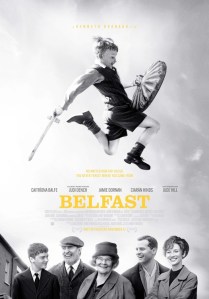
Kenneth Branagh returns to his boyhood home with Belfast, a coming of age story set during the Troubles in 1969 where Protestant mobs were targeting Irish Catholics. The movie is partly autobiographical as we follow young Buddy (newcomer Jude Hill) and his parents (Jamie Dornan, Caitriona Balfe) and grandparents (Cirian Hinds, Judi Dench) dealing with life as their neighborhood block more resembles a war zone. There are dangerous influences and dark intentions on the peripheral, but we’re mostly at kid level, where his days are preoccupied with sitting closer to his crush in school and wanting to impress his older cousin and be accepted. The parental perspective is kept to offhand whsipers and weighty conversations about moving away or staying behind. The black and white photography is gorgeous and exquisitely composed, looking like old family photos come to rich life. The actors are charming and heartfelt, and when called upon deliver emotional fury. The problem with Belfast, and it feels mean to even cite it as such, is that everything is just a little too nice, a little too clean, a little too safe. The childhood perspective doesn’t quite jibe with the political instability at hand. It’s not a Jojo Rabbit where that disconnect is the point for reflection. It’s clearly Branagh’s love letter to his family and native land. It feels like entire scenes have been plucked directly from Branagh’s nostalgic memories. It also feels like the characters are more sweet-smiling composites than real people. It’s all been romanticized with Branagh’s personal nostalgia, reshaping the odd angles and dangling conflicts into something more sentimentally safe, easy, and inoffensively digestible. Belfast is a perfectly enjoyable movie but it feels like a simple TV movie-of-the-week, crowd-pleasing version of a complex story worthy of greater nuance and scrutiny.
Nate’s Grade: B
Share this:

Mass (2021)
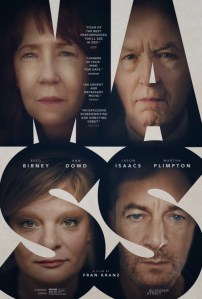 I can completely understand if anyone chooses to ignore the indie movie Mass for its subject matter alone. It’s heavy. I get it. It’s about two sets of parents, one pair (Jason Isaacs, Martha Plimpton) whose child was murdered in a school shooting, and the other pair (Reed Birney, Ann Dowd) whose child was the school shooter. It took me weeks to even work up the courage and proper mood to sit down and watch the movie. I’m glad I eventually watched Mass because it was so emotionally engaging and ultimately cathartic. That’s what I want more people to understand so that they give this hard-hitting indie gem a chance. It’s not all doom and gloom. It’s not all angry finger-pointing and gnashing of teeth. Mass is much more than you expect while being exactly what it sets out to be. It’s a small film brimming with big emotions and an even bigger wealth of empathy, allowing every participant to be a multi-dimensional human being struggling to make sense of the unimaginable that has dominated their life. Mass is one of the best written and acted movies of 2021 and deserves your time and consideration.
As you would expect given this set-up, it’s a lot of powerful conversations and grueling personal details. If you were unfamiliar with the premise, the movie teases out is main scenario like the key info are valuable kernels, and slowly and surely, we get a fuller idea of what has transpired years in the past and what the connection between these two groups of people is. It’s also a terrific setup to build anticipation and dread, so those first few moments face-to-face have the awkward niceties but we’re really waiting for the big subjects to be get their due, and they will, oh boy will they ever. However, if you’re going in looking for blood and easy answers, then this isn’t going to be the witch hunt you crave. I’m reminded of a Ted Talk I watched recently from Sue Klebold, the mother of Dylan Klebold, who was responsible for the Columbine school massacre in 1999. She talks about not recognizing signs, not of homicidal tendencies, but of suicidal tendencies, of depression manifesting as something else. It’s easy to cast blame and formulate our own assessment of parenting failures and ignored warnings, but what if the situation is far more complicated than that? What if the parents of the shooter are just another set of victims, except they never get to be honored as such by the public? They’re often looked at with suspicion, doubt, and culpability, defined by tragedy but transformed to social pariahs (the perspective illustrated so exquisitely and humanely by 2011’s We Need to Talk About Kevin). Where Mass excels is with its mighty empathy. Everyone in this story is a victim. Full stop.
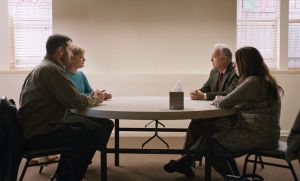 You’d be forgiven thinking Mass is based upon a stage play given its dialogue-driven story and single location setting, but it’s an original screenplay by director Fran Kraz, an actor best known for his comic relief parts in Joss Whedon projects (TV’s Dollhouse, The Cabin in the Woods). I was blown away by the immersive writing and empathy. For the first half of the movie, the parents of the shooter dominate the discussion, as they’re delivering us needed exposition on the day in question but really all the steps beforehand, the red flags that didn’t appear to be so permanent until they were. For every school shooting we read about in the news, the next question is where the parents were or why didn’t they act sooner if they had their suspicions. This is the period of the movie that answers those pertinent questions. The second half is more about the response to this news, culminating in a catharsis of tears and grace, facilitated first through anger. It’s a script structure that feels fully without manipulation, meaning the bend of the conversation occurs in a natural drift and pace. Nobody just blurts out what they want to talk about because the script is in a rush to leap to this next topical area of conflict. Franz is also very generous as a writer, able to make sure each character has their opportunity to shine and making sure we understand each character’s perspective. By the end of it, you should hopefully understand that there are no bad guys here, just victims on different sides of trauma suffering to make sense of tragedy. The monologues in this, beautifully written and performed, broke me each and every time.
Every actor holds their own but Issacs (Star Trek: Discovery) and Plimpton (TV’s Raising Hope) each get their big Oscar moment. It’s always peculiar to watch Isaacs play “normal roles” as we’re so accustomed to seeing him portray snide villains because he’s so damn good at them. Here he’s a grieving father who gets his fiery meltdown moment, and Franz has the great sense to never let his camera off the actor, allowing the full take to just derive from the live-wire emotions of the scene. It leaves the actor shaking and you just might do the same while watching. Isaacs is more the force of anger, while Plimpton is more the force of resolution, seeking an ending for all the heartache that has transformed her marriage. Her plea toward the end of the movie is an attempt at reconciliation that ends a heavy movie on uplift.
 I want to also credit Dowd (Handmaid’s Tale) and Birney (House of Cards) for their performances. They’re the more subdued ones, castigated for their position, afraid to show too much emotion because of the guilt they feel that they should have done more. Both are great, and Dowd’s final monologue, a story about her son she wants to share for better understanding, also had me in tears and especially what it results in. It’s worth it, folks, so stick around through several minutes of dithering discussion over where to find a box.
Mass is a hard movie to watch by design. It’s a delicate subject matter that will prove triggering for some and simply emotionally unpleasant and crushing for most. It’s ultimately a powerful movie about understanding, about shared grief, about empathy and relationships and similarities. It’s brilliantly written, brilliantly acted, and confidently directed. It’s little more than four people in a room hashing out their grief and conflicts, but when the drama is this potent and the characters are this complex, then it’s worth the prolonged discomfort and knots in your stomach.
Nate’s Grade: A-
Share this:

C’mon C’mon (2021)

Writer/director Mike Mills’ latest is a gentle and meandering movie, which is coming to be his indie specialty for me. C’mon C’mon features Joaquin Phoenix (in his schlubby every-man phase) as an audio journalist collecting interviews. He suddenly finds himself watching his young nephew (Woody Norman) after his sister (Gabby Hoffman) has to tend to her husband’s deteriorating mental illness. What follows is a lot of small moments that play quite naturalistic and in wry, nice dialogue exchanges. It’s also kind of sweetly boring. It’s a collection of moments of Phoenix struggling with how to relate to children, what we pass down to the next generation as legacy, and how to try and be a responsible parent and role model for an impressionable youth. It’s all messages and themes we’ve seen in dozens of other heartwarming parenting movies. The draw is the relationship between Phoenix and Norman, who proves to be a wonderfully natural performer, enough so that the movie often feels more observed than written. Their relationship is sweet but I felt like the movie was too often circling the same points and character differences for far too long. Perhaps others will get more out of this, find more to personally relate to, especially those finding themselves caring for children in unexpected circumstances. C’mon C’mon is reflective and compassionate and also kind of a snoozer.
Nate’s Grade: B-
Share this:

The Female Hustler (2021)
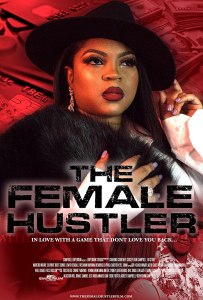
The Female Hustler is one of the top movies on the streaming site Tubi, which is available for free with minimal ad breaks. Anyone can check it out, and congrats to this Columbus, Ohio-made indie thriller written and directed by Columbus native Dom Campbell (Bad Business). He’s getting his feature film projects out into the world and a wider audience and that is definitely something to celebrate. However, I think considering a larger audience will do Campbell better, as The Female Hustler feels too inert to be more than the sum of its already familiar and genre-soaked parts.
Princess (Courtney Godsey) is struggling to save her friend from a pimp and help her brother get a better life. She’s looking for work when her chatty Uber driver, Omar (Campbell too), invites her into his multi-million-dollar identity theft scam network. From there, she rises through his ranks and becomes a threat to Omar’s leadership. We jump forward in time and Princess has become “The Female Hustler” and leading her own top-notch outfit. Omar is looking to take out his one-time protégé and regain his empire, but he might not be the only threat facing Princess.

Made for $50,000 and filmed throughout Columbus, as well as stops in Los Angeles, The Female Hustler has more than a few artistic merits. It’s a gangster genre movie that knows its audience well, which is likely why there are several close-ups of butts within minutes. Campbell recognizes that this movie is going to be less a complicated, nuanced, inter-textual crime story akin to something like The Wire and more like a knockoff of a knockoff of a blaxploitation film. I think a filmmaker knowing their genre and what makes it work is essential to playing to its strengths. The Female Hustler feels like it can walk its walk. I’ve watched enough lower-budget Ohio indies to tell when the photography is a step above, and the FIVE credited cinematographers for this movie at least deliver quality with their quantity. The grimy color grade is solid atmosphere but the crispness of the images and the use of lighting can actually be quite artistic for a lower-budgeted crime flick. The sequences outdoors at night were really good looking. I’ve watched enough barely-lit outdoor scenes that struggled to convey key info. These outdoor scenes have levels of clarity and color and even reminded me of Michael Mann’s digital video thrillers like Collateral and Miami Vice. That doesn’t mean all of the visual compositions feel dynamic; too many shots come across like they were clumsily composed on the spot. It works, but the skill of the camera quality, post-production, and/or camera operators are elevating the many perfunctory camera setups. The movie is packed with modern rap and its bouncy beats give a better sense of pacing and energy, especially when what’s happening onscreen is mostly people fronting poses. A lot of the acting is enjoyable too. I’m not going to say anybody is a star in the making, but the actors can be amusing or charismatic or intimidating when called upon, and Godsey is a worthy lead to build upon.
Where The Female Hustler doesn’t quite work is as a story with enough connective tissue and a satisfying conclusion. I was shocked that there is no ending offered at the conclusion of its 82 minutes. The entire back half of the movie is setting up a climactic confrontation between Princess and her former mentor, Omar, and they each bring their crews together for a fateful summit, and then everyone scatters, a betrayal is revealed from a supporting character, and the movie then rolls credits. I suppose maybe Campbell is intending to make this into an ongoing franchise, a move I would deem dubious given what we’ve been given in this first and so far only entry. However, given everything that transpired in this dawdling movie, there is no excuse to cheat your audience out of any ending. It’s not just that The Female Hustler has a bad ending; it doesn’t even have an ending. None of the storylines have been resolved, nobody has altered their standing, and no wrongs have been righted. It’s confounding that the movie just seemingly ran out of time after doing so little for forty-something minutes of characters making threats and bragging about their successes. The decision on the ending really harms the entire movie, looking backwards. It clearly feels like Campbell had an idea for a movie and little realization how to better develop and see it through. The concept of a woman rising to power through a criminal organization, a dangerous “man’s world” of intrigue and violence, is a fine dramatic template. Watching an underdog take out their obstacles and people doubting them is an inherently satisfying and engaging narrative. That is not really what we get with The Female Hustler, a movie too content to be a longer version of a trailer when it comes to minimal characterization, plot development, and surprising twists and turns.

I can summarize the main plot as three data points: 1) Princess is learning the criminal lifestyle, 2) Princess has become successful under Omar, and 3) Princess is even more prosperous as her own boss. You would expect there to be connective tissue and sequences that served as getting us from one station to another, scenes where Princess learned harsh lessons, or rose to the occasion and surprised her boss or herself, something to note the character development from a novice to a hard-edged leader. There are few of these sequences if any. The second half of this movie almost feels like a resume bragging about Princess’ accomplishments. It’s scene after scene of characters simply relaying the state of things. Naturally, I assumed these exchanges were to ground the audience so we could then chart later changes as what had been gained is now in jeopardy. However, this doesn’t happen and the movie is awash in wheel-spinning exposition. It’s almost comical how scene after scene involves this new character and that new character just telling Princess how good a job she’s been doing. Then we’ll have scenes of Princess nodding along. In some ways it’s reminiscent of little kids in role play, less worried about how things got to be and more about establishment (more “I’m the king of the universe,” and less how it got to be). That’s why this plot feels so bare-bones as to be mistaken as simply a larger version of its trailer. It just feels like we’ve dropped into three stagnant scenarios and stuck with repetitious scenes restating the status quo while we wait for some upheaval or climax that never actually arrives.
I felt that maybe the whole back half was leading up to the final confrontation between Princess and Omar, and when she kills her mentor, it would at least feel like she has moved forward. That’s the basic setup of this kind of story, where the mentor brings in the protégé, then they conflict and then the mentor has to be put aside permanently to fully achieve a higher level of success on their own terms, no longer held back by the definitions of the past. I just watched this basic narrative recently in House of Gucci with Lady Gaga as our change agent. That’s why I’m flabbergasted that The Female Hustler doesn’t so much end as implicitly say, “To be continued?” It doesn’t need to, especially when the movie is only 83 minutes long, especially when the movie hasn’t really done as much with those 83 minutes. We could have watched Omar, in his desperation, strike back at Princess’ empire, chipping away at her power, capturing and killing her valuable team members, and Princess having to process how far she’s willing to go to take out her competition, establishing lines only to question crossing them. It’s like Campbell has assembled his key characters for a crime epic and then merely given them place-holder dramatic scenes and rote dialogue bravado (“You should have had a crash course on me… now you’re a crash test dummy”). It’s a movie with nowhere to go in its imagination.

Why introduce members of Princess’ crew, one-by-one with flashbacks showcasing their skills, if the movie isn’t going to feature these characters outside of this scene? What does it matter to the audience knowing so-and-so is good with money or good with computer hacking if they don’t even contribute to the story afterwards? Why introduce the FBI agents following the criminal goings-on if these guys will never factor in again either? It’s like teasing future conflict that doesn’t ever materialize because Princess never feels in danger. Imagine watching a heist movie that is nothing but recounting 100 members of the crew, their unique skill set, and how they came to be recruited, and then they were never seen or heard again and the movie just ended. What would the point be? What have we accomplished moving a larger storyline forward?
This brings me to my biggest complaint with many Ohio indies, and sadly The Female Hustler appears to have fallen victim too: they are too insular and inaccessible that they seem to have forgotten about playing to an audience, thus only really prove appealing to friends and family of the production. There isn’t a thrilling story, or engaging characters, or a gritty, compelling world here to keep your attention through the overly padded 83-minute run time. I’m happy for local professionals when they can pool their efforts and actually put a movie together, but unless they want it to feel like an inside joke or something only intended for the most limited of viewing spheres, they need to constantly be thinking outside themselves and ask, “Why would anyone care?” The Female Hustler has some technical plaudits that allow it to rise above some of its fledgling peers. I think Campbell is a better director than a screenwriter and would benefit from collaborators in that field. He and his production company Emperium Studios have a spinoff with the brainy kid hacker character in the works, a TV series called A Kid Named Bug, and judging from early pictures, it looks like an entirely different tone for Campbell. Good for him. Keep hustling, young man, and remember to think about movies being intended for an audience, otherwise it’s a very expensive hobby for you and your closest friends.
Nate’s Grade: C-
Share this:

The Tender Bar (2021)
 When adapting a memoir into a movie, it’s important to ask whether the subject has lived an interesting life that people would want to see. With The Tender Bar, based on the 2006 memoir by journalist JR Moehringer, I think the filmmakers lost sight of this. Young JR has elements of an interesting personal experience; his father, a famous radio DJ, has been absent for his whole life yet JR still pines for him while listening to the radio (the father is simply referred to as “The Voice”); his mother goes through chemotherapy for cancer; his grandfather, whom he and his mother have been forced to move back home to live with, is suffering from dementia; his uncle Charlie (Ben Affleck) runs the local bar and pushes JR to read mountains of classic literature in order to become a better writer. Any of those elements could be further explored and mined for relatable human drama and bittersweet coming-of-age lessons. That’s not what The Tender Bar does. Strangely, it cavalierly jumps around these plot points, never really settling on one for long, only braiding them together in a way that feels fleeting and stalled for building momentum. The choice of mixing in non-linear flash forwards and flashbacks (as well as a narrator) complicates matters and feels like the adaptation was struggling to relay the info it needed. Too much of this movie dwells on the least interesting part of this story, namely JR falling in love with a girl in college who repeatedly dumps him. It’s so frustrating to watch especially when we have more interesting scenarios passed up just to watch this dumb kid get his heart broken by this same girl for the umpteenth time. I wish JR had just remained a youngster and we could have focused on his real father figure shaping him, his uncle, and their time spent running the local watering hole. Mysteriously, this movie is directed by George Clooney, who shows no real affinity for the story or its characters. The movie is generally warm and gauzy but bereft of significant personal details to make the drama more resonant. It’s like you took a coming-of-age story and melted it down to its most recognizable base components. The Tender Bar is assuredly a case where the appeal of the novel must have been from the voice of its author. The story, at least presented onscreen, is a wistful shrug of a movie with an above-average Affleck performance. It’s a nice but dull experience, which is likely an apt description of most ordinary people’s lives.
Nate’s Grade: C+
Share this:

In the Bedroom (2001) [Review Re-View]
 Originally released November 23, 2001:
In the Bedroom hits all the right notes of agonizing pain, devastation and loss. The heart of the film is on the grief encompassing Matt and Ruth Fowler (Tom Wilkinson and Sissy Spacek) over the loss of their son. The Fowlers are well regarded in their cozy New England town. Matt is a flourishing local doctor and Ruth teaches a chorus of local high school girls.
In the Bedroom opens with Frank Fowler (Nick Stahl) chasing his older girlfriend Natalie (Marisa Tomei) across an open grassy field. Frank is a budding architecture student home for the summer and thinking of prolonging his time so he can stay together with Natalie. Frank and Natalie have a distinct age divide but also seem to have been given different lots in life. She has a pair of boys from her abusive husband Richard (William Mapother) that she is finalizing a divorce from. Richard is hopeful he can reconcile with Natalie if he just gets another chance, but Natalie is stern in her refusal.
 Ruth sees the relationship as a detriment to her son’s future. She’s even more upset that Matt is so casual with their son dating an older, working-class mother. Frank rushes over to calm Natalie after another of Richard’s outbursts of violence has left her house in shambles. She rushes her children upstairs just as Richard returns back. He manages to sneak in through a back door and confronts Frank in their kitchen, shooting and killing him. What should seem like a clear-cut case begins to unspool. Natalie admits she didn’t actually see the gun fire and the charges are dropped from murder to manslaughter. Richard is released on bail and free to stroll around occasionally bumping into the grieving and outraged Fowlers.
The majority of the film is the aftermath of the murder and the strain it puts upon Matt and Ruth and their marriage. Beforehand jealousy, anger, and bitterness would simply sit but slowly the tension begins to bubble to the surface. Ruth holds resentment and blames the leniency of Matt for the death of their son. Matt tries to get out of the house as much as possible, even if it means sitting in his car in their driveway at night.
One of the most harrowing scenes of In the Bedroom is also its emotional and acting centerpiece. After the mounting frustration with justice, Ruth and Matt explode into an argument that had slowly been building long before their son’s death. This is the first time they have truly talked about the whole situation and accusations fly like bullets in their first emotional confrontation. In the Bedroom could have easily fallen into the area of sticky made-for-TV land, but the exceptional performances all around by the cast and the deft and studied direction never allow it to falter.
Spacek (Carrie, Coal Miner’s Daughter) can begin writing her Oscar acceptance speech right now. Her portrayal of Ruth displays the pride and seething anger, but keeps her human throughout. She exhibits pure, raw emotion that strikes directly inside you leaving a knot in your stomach and in your throat. Her performance is truly breathtaking and so emotionally visceral to watch. Wilkinson (The Full Monty) plays Matt with passive-aggressive doubt and repression. He dominates in any scene he is in and takes the audience on a wide range of emotions. He has a commanding presence and compliments Spacek’s Ruth nicely. Perhaps the greatest thing Tomei (My Cousin Vinny, Slums of Beverly Hills) was known for was miraculously winning an Oscar and dumbfounding a nation. With In the Bedroom she is given the ubiquitous “And” credit at the end of the opening cast list. She has less to work with and less screen time to work it, fully earning the “And”‘ credit she has.
 Todd Field is an actor-turned-director and has appeared in such a wide array of films from Twister to Eyes Wide Shut. Field has layered his film with rich symbolism and an intelligent, patient pace. Most of the action in movies is centered on what is going on in a scene, but the most telling moments of In the Bedroom are what are not going on in the scenes. Field creates such an intimate portrait that the camera almost turns into another character, catching the lingering silences and the burgeoning inner turmoil. Field also adapted the screenplay from a short story by Andre Dubus, whom he dedicates the film to.
In the Bedroom is not going to be for everyone. Some will find it slow and some might even find it boring. As it stands, it is a powerful film on the study of loss that grips you and refuses to let go. You will feel all the blame, jealousy, anger, and pain of this family and for such emotions to resonate from the screen to the audience is a great achievement.
Nate’s Grade: A
——————————————————
WRITER REFLECTIONS 20 YEARS LATER

Twenty years later and it seems like nobody really talks about Todd Field’s In the Bedroom any longer, which is a crying shame. The movie was hailed by critics upon its release in late 2001 and earned five Academy Award nominations including Best Actor, Best Actress, Best Supporting Actress, and Best Picture. Field would then adapt Tom Perotta’s novel Little Children and direct its 2006 adaptation, again earning favorable reviews and multiple Oscar nominations, revitalizing the career of Jackie Earl Haley. And then Field seemed to vanish from view. There are a few dropped projects and a potential upcoming series with Daniel Craig, but Field has been too quiet as a director for over 15 years, and that’s far too long for a man that showcased such immediate natural talent from his very first opportunity in the director’s chair. In the Bedroom was a movie that I wasn’t exactly excited to come back to on my list of 2001 re-watches; it’s a heavy drama about grief and suffering and that’s not exactly the best entertainment remedy during the holidays. I’m happy to have gone back to the movie, as well as cross it off my list, because this return reaffirmed for me just how great Field is as a director, and a screenwriter, and just how vital this indie film feels. It’s the real deal when it comes to authenticity and emotional power, and watching this as a 39-year-old rather than a 19-year-old gave the enduring two hours added heft for its family tragedy.
The plot centers on the spiraling consequences of one death. Frank Fowler (Nick Stahl) is the 18-year-old son of Ruth (Sissy Spacek) and Matt (Tom Wilkinson), upper-middle class and pleasant but pointed. Frank is dating Natalie Strout (Marissa Tomei), an older woman and the ex-wife (though not yet legally divorced) of Richard Trout (William Mapother), a violent and unstable man and also heir to the local canning company. One fateful day, Richard angrily confronts Frank, a gunshot is heard, and Frank is dead. Richard swears it was self-defense, but Natalie is convinced her jealous ex was finishing the threats he had been making about her ever leaving him. The murder happens at the 40-minute mark, and from there the movie becomes a long examination on grief and guilt and blame, where characters drift from scene to scene like ghosts, some avoiding the painful realities of their enormous grief, finding hobbies or distractions, but most unable to fully articulate the resounding pain and emotions brimming under the surface.
 Under Field’s attentive care, there is a palpable dread hanging over every scene. The script allows different bereft perspectives, each person wrestling with feelings of personal guilt. Natalie blames herself for holding onto the relationship, bringing him into her world. Matt blames himself for not calling the police after an earlier fight between Frank and Richard, and he doubts whether he should have pushed harder on his feelings of reservation about the relationship with Natalie. Ruth has escaped into her insurmountable anger and uses it as the fuel to keep her going. The friends and neighbors do their best to be supportive but every conversation or poker game has the danger of veering too close to The Topic, and the awkward but well-meaning silences permeate and become more awkward. It’s a movie about people trying to get on with their lives but not knowing how to reassemble the broken pieces. By itself, that is enough meaty drama worthy of examination by top-notch actors and considerate screenwriting that allows us to really dwell in the beautiful discomfort. Field adds extra degrees of turmoil from the possibility that Richard will be given a slap on the wrists by the indifferent legal system. Richard posts bail thanks to his family’s wealth and even casually strolls through the town like nothing happened, making appearances while Ruth is shopping like her living in an inescapable nightmare. The Fowlers are consistently having their pain poked and prodded and reopened. One friend suggests if Matt has contemplated moving, and he admits he’s considered it, but it wouldn’t change what happened or lessen the pain of having their son’s killer protected by his status.
As you can imagine with that kind of material, In the Bedroom is an actor’s showcase. Wilkinson is the more featured role, and he’s the more laid back one, the one trying to make sense of things as best he can and failing. Wilkinson is terrific in the role and his hangdog expression from scene to scene denotes so much unspoken pain he’s grappling with behind his placid veneer. Just watching this man try and keep his life together is worthy of study. The weariness is harder to note with his performance but more rewarding to watch. Spacek is great herself but playing a role with less dimension. She is the stern voice of outrage and blame, the one who never liked Natalie and always suspected the worst. She has her signature blowup scene that serves as a long-in-the-making emotional confrontation with her husband, who she accuses of hiding from his grief rather than embracing it. However, her character is also painted in an unflattering and I would say unfair characterization. In the heat of their fight, Matt accuses his wife of being so controlling, so unforgiving that her son had no choice but to run away from her. While the character has been presented as cold and disapproving, she’s a victim too. This was Tomei’s confirmation as an actress that her surprise 1993 Oscar victory was no accident. She’s strong in her brief moments, especially when she’s recounting Frank’s murder under oath and realizes her inability to help the case with her conflicting witness testimony. It’s devastating to watch as she processes in the moment the doubt and then utter terror as she realizes that her next words, of honest yet painful reflection, will undermine the case she so desperately needs. I know the slap between Spacek and Tomei got more attention, but this is her clincher.
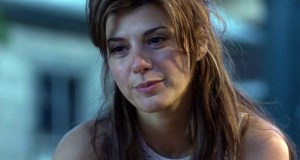 All of this well-wrought examination of grief and guilt is sturdily handled, and it effectively sets up the last fifteen minutes of the movie into its own indie thriller. Finally pushed far enough, Matt takes matters into his own hands to find justice. The entire sequence is played out so deliberately that you might not breathe from the protracted suspense. Field and co-screenwriter Robert Festinger (Trust) have patiently built up these characters and their conflicts with such precision that they have developed genuine emotional stakes and uncertainty for the end. For first-time viewers, I imagine there will be legitimate doubt how the final events will play out. Is Matt being honest with his offer to have Richard run away from town? Is he making his stand in secret to absolve his wife of more pain and to rise to her verbal challenges of being too timid, or is she in collusion and possibly the Lady Macbeth from the bedroom shadows? It’s a long, taut sequence that feels like a fitting culmination of the many little details that have been set up, from character dimensions and motivations to small details that come together so smoothly, like a bridge worker or a friend’s large estate. It’s been twenty years since I’ve seen the movie and it still had my heart elevated, and I knew the ending.
Where In the Bedroom separates itself from the dramatic pack, and where it’s deserving of more attention and notoriety in retrospect, is how remarkably considered and assured this movie is about assembling its details and atmosphere. This is a deeply felt and deeply authentic movie that fills out the innumerable edges of this small coastal town with colorful characters that feel genuine, lives that feel lived-in, details that feel authentic without being obvious, and all without losing focus on the central performers as they struggle with their consuming grief. There are great artistic touches too for emphasis, like when Matt seeks out his lawyer to question points of strategy, and when the officious man retreats back to polite deferrals that fall back on the limits of the judicial system, the camera focuses on tight edits, first the man’s mustachioed mouth, then his fiddling hand in his pocket jangling his keys, a sound that intensifies into that of a jackhammer. It’s a clever and effective means of conveying the fractured, infuriating, dismayed response of Matt. However, most of the movie avoids flashy style that calls attention to itself. The very framing of the characters in the shots is so elegantly composed, making fine use of spaces and windows to help convey extra layers. This is a movie that does not feel like a first-time filmmaker or screenwriter. This same measured assurance can be seen in 2006’s Little Children, an equally well-observed, detail-rich, non-judgmental slice-of-life of small-town ennui. We need more Todd Field movies considering he’s two-for-two with literary adaptations.
 My original review in 2001 has some sentimental value for me. It was one of the first reviews I ever wrote for my college newspaper, The Chimes, in the position of film critic, an official role I held for five straight semesters (2002-2004). It was a goal of mine arriving at school and I saw it through, and this first review reminds me of the next stage of my career in film criticism and of my good times in small-scale publishing. My 2001 review gets some things right but I cringe at how awkwardly it’s trying to grasp for further meaning without understanding how to clarify my explanations. Maybe I was more taken with writing to my college-aged audience, hence why I devote a paragraph to explaining the use of the “And” credit in movie casting. There are some good points here and there, and the distillation of the plot and conflicts is solid, but as I’ve noticed with more than a few of my earlier reviews, the depth of critical analysis is shallower than I would prefer. Also, my hasty prediction that Spacek should “begin writing her Oscar acceptance speech now” was short-sighted, as she lost Best Actress to Halle Berry for Monster’s Ball (see you next in December, movie). In the Bedroom is a movie worthy of your time and a cultural re-examination.
Nate’s Grade: A
Share this:

DeRosa: Life & Art in Transition (2021)
 Angelo Thomas is an impressive young filmmaker. At his college, the Columbus College of Art and Design in Ohio, the man was able to make a $50,000 feature film, 2020’s The Incredible Jake Parker, the first undergraduate film in over 30 years. Now he’s right back with another feature, the documentary project DeRosa: Life, Love & Art in Transition, illuminating the story of artist Felicia DeRosa, a CCAD grad and professor who lived most of her life as a man before accepting herself and coming out as trans at the age of 43. The 65-minute documentary is nicely polished and deeply empathetic and worth an hour of your time to learn more about DeRosa’s harrowing and inspirational life.
The biggest question any documentary must ask itself is whether there is a story here that can support a deeper dive. I suppose this same question should be given to fictional narratives, can it support a film, but documentaries are limited by the experiences of their subjects. Fortunately, with DeRosa, there is plenty to talk about and the hour running time feels more than enough time to sincerely cover one woman’s journey of self-discovery and an evolving love story where two people recognized they were better together no matter the changes. DeRosa is a natural gabber and quite capable of compellingly retelling her story with bittersweet personal insights and wisdom. She’s an easy person to sit in front of a camera and just say, “Go.” It also helps that the production has access to what must have been hours upon hours of DeRosa’s home recordings. She was prolific in documenting her feelings and anxieties at different points. It’s a wealth of resources for the documentary to be able to immediately supply DeRosa at different points of her life’s journey articulating her struggles and anxieties in the moment. It reminded me a bit of the documentary Val, extensively using Val Kilmer’s home movies enough so that it credited him with cinematography. DeRosa is all over the movie and to our benefit.
 As expected, much of the movie examines individual and societal views on gender identity, a subject that is simultaneously becoming more normalized and scandalized. As more and more trans people discuss their personal journeys of discovery and acceptance, our media and arts are helping to build compassion and understanding. At the same time, as gay rights have become more acceptable across the political spectrum, the new focal point for conservative hysteria and political opportunism has shifted to trans rights. No longer is the thought of two gay people getting married the boogeyman for fundamentalist outrage; now it’s the entire idea of trans people using restrooms and playing sports and more or less existing in a public manner. DeRosa’s own experiences may be similar to many who grow up closeted in households and have to pretend to be someone they are not. There is a social good to hearing more stories of those marginalized from our society and finding their strength and advocacy to inspire others to keep pushing forward.
I expected DeRosa’s mother to be disapproving. Upon discovering her young son playing dress up in feminine clothing, DeRosa’s mother went into a frenzy and kept beating her child. As tragic as this setback is, it’s not uncommon. However, DeRosa’s experiences with her mother become even more gut-wrenching when she reveals how, at the age of 13, her mother raped her while remarking how similar they looked like their father. I had to walk out of the room after this awful revelation and pause the movie. It’s heavy and head-spinning and would send anyone into a depressive spiral. I completely understand the reluctance to dig further without seeming to exploit DeRosa’s sexual trauma for inflated drama. That’s the challenge for any documentary filmmaker. How far do you push your subjects and when do you cross a moral line? DeRosa shares therapeutic letters she has written directed to her mother, and years later it’s still a tangle of complicated emotions to process. DeRosa’s mother is left behind as a topic, fittingly, as DeRosa ventures into independence. She gets news that her mother is on death’s door, and DeRosa is the one who must decide whether to pull the plug and end her mother’s life. That’s all kinds of messed up.
 Another aspect of the documentary that stands out is how much compassion and empathy it builds from the complicated relationship with DeRosa’s wife. Gwen comes from a conservative Christian upbringing and her early relationship with her husband is supportive; they’re clearly each other’s person as they’ve only been apart for twenty minutes in the past eighteen years. Hearing from Gwen’s side is more than simply checking in on how the dutiful wife is dealing with her husband’s identity. I recall 2015’s The Danish Girl that seemed to elevate the grieving perspective of the “poor yet supportive wife” over the turmoil of the one actually going through the gender reassignment surgery for the first time in modern history (and lead to Oscar victory for Alicia Vikander). It was intended to be a considerate and compassionate ploy, but the counterbalance also made it so this perspective was the dominant one, a cis gendered heterosexual spouse who couldn’t quite understand but stood by her man as he chose to outwardly transition to a woman. With this documentary, the inclusion of Gwen enlarges the story and she’s by far the best secondary voice to provide insight for DeRosa. She also knows her story is supplemental but also important. She’s supportive of her wife and acknowledges her own questions and processing, but through this journey it’s allowed her to personally reflect upon her own queer identity. Felicia and Gwen, while not filmed together in interviews, are eminently loving of one another, and to watch them speak about one another is a reflection of grace.
As far as documentaries go, this one is professionally packaged for only having a meager budget of $8,000. It’s sharply edited and with a multi-camera setup for its interviews that allows more dynamic visuals and coverage opportunities. The music is sparse but appropriate, and the editing is smooth as it incorporates personal photos and extensive home video recordings to better give voice to the idea or feeling in that moment. This is assembled like a professional documentary and the interview subjects, while only limited to two people, have plenty to say and are engagingly laid back. I wish the movie was a little longer, but as a documentary, an hour’s length of content seems more fitting in our age of endless streaming docus-series. I’m impressed with Thomas’ finesse at going from fictional narrative filmmaking to documentary filmmaking. He proves a natural for the material. DeRosa: Life, Love & Art in Transition is a confirmation that Thomas can adapt his talents to his subjects and aims with skill and compassion. DeRosa is an agreeable hour of your time and proves another sign than Thomas is artistically thriving.
Nate’s Grade: B
Share this:

Double Walker (2021)
 After watching so many nominal Ohio-made indies, it’s a welcomed surprise to come across one that falls into the category of an “almost” movie, and by that I mean one with clear ambition and talent that almost fully works as a legit movie without any lingering qualifiers. Double Walker, filmed partially in Columbus and now given a national digital release, comes so tantalizingly close to being a full recommendation without hesitation. I can see what it’s going for, and with a little more careful development and clarity I think it would have achieved all of its genre-busting goals.
Sylvie Mix plays Ghost, a young woman who appears in a white nightgown in the woods. Who is she? What does she want? She is escorted by a young man into his home, disrobes, and then murders him. We come to learn that this adult woman is the ghost of a deceased child, and she’s chosen to walk the Earth as a spirit to seek vengeance. She’s only able to be seen by believers and sinners, though technically every person is a sinner unless there is an unspecified threshold to pass. The Ghost makes a friend, visits with her grieving parents, and reevaluates what it means to be human.
 The first thing to know about this movie is that it is only 65 minutes long, short of the 80 minutes typically seen as the minimum expectation for a theatrical release. It’s not that far from meeting that goal, though the airy nature of the movie also makes it feel already stretched out. The other thing you should know about the movie is that you could describe it as Promising Young Woman meets The Crow, an avenging angel targeting the bad men responsible for her death, except tonally it’s not really a hard-hitting revenge thriller. It has those elements where our Ghost is stalking her very bad men, luring them into positions of vulnerability, and striking back for justice, but the movie seems more aligned in tone with something more ponderous and poetic like 2017’s A Ghost Story (though absent ten minutes of Rooney Mara eating a pie – thus fulfilling my obligation to mention this dumbfounding cinematic moment whenever I have the opportunity, you’re welcome).
For those people looking for sundry exploitation thrills, seized by the striking central image of its poster, you may be left checking your watch, but I found this middle ground between thriller and art film to be an interesting space for Double Walker to inhabit. The screenplay drops you into its bizarre scenario and unfolds slowly, which I think worked to the film’s potent atmosphere. You don’t really know what’s going on or what the character relationships are like. At first you see a grieving family, and next we cut to a man discovering a pale woman who seems lost in the woods. She comes across ethereal and mysterious. Then there is a murder, and from there we’re trying to identify the character connections and back-story, which comes across at a gentle yet assured pace that trusts the audience to put the different pieces together to form a whole. This works well except for an ending that comes across as too confusing, muddling an already convoluted system of supernatural rules that the movie seems to be undercutting, unless the whole thing is presented as a hopeful but passing dream, and if that’s the ending then I’m going to be quite disappointed. Still, this is a movie at its core more interested with the question over being human, being remembered, and personal identity than as a blood-soaked revenge thriller.
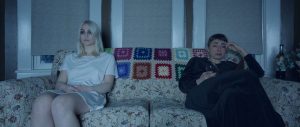 Again, it has its moments of blood, but there’s a somber tone poem quality to the movie that elevates its ambitions and also ties down its ultimate execution. Director and co-screenwriter Colin West is using the structure of an exploitation film to do more than deliver sleazy thrills. He devotes much more time to watching our Ghost character adjust to life as a spirit. The Ghost is the same spirit as the little girl we saw being eulogized in the opening. This presents some awkwardness for the character and the viewer. For the character, she’s gone from the mind of a child to being in the body of an adult, and it’s not determined whether this adult body is what she would have eventually grown into being or whether it’s just a default model. This allows for an even more curious performance as a character that feels alien in their own skin but also fascinated by that change in perspective, like Scarlet Johansson in Under the Skin. I understand the Ghost studying her adult body with curiosity. However, for the viewer, the numerous nude scenes can make you uncomfortable with the understanding that this is a little girl transported into the body of an adult and she is using her sexuality to lure men to their perverted doom. Maybe I’m just more sensitive to this connotation, and “using her sexuality” seems like an overstatement as she’s simply a woman being present with predatory men. I will say the nude scenes are tastefully portrayed where the camera doesn’t feel like it’s going to painful lengths to feature flesh. I was about to accuse the movie of possibly being skeevy with its plurality of nude scenes (does the Ghost need to run out into the woods in the buff?) when I noticed that Mix is also the producer and co-screenwriter. I assume she approved of her depiction.
Because of her newfound identity, and separation from most living beings, Double Walker presents a main character who is trying to form connections but cannot. The Ghost tries to console her grieving mother but is unable to be seen or felt by her. She does meet a kind man (Jacob Rice) at a movie theater who helps her out and who is not looking to take advantage of her. He shares his family’s home movies, which is a slightly strange thing to do so soon with a nearly mute stranger, and compares the images captured on film like ghosts, crystalized memories of people no longer with us. I have thought of this comparison myself and will morbidly watch background extras in old movies and think, “Here they are, alive once more, but likely gone for some time.” The direct connection of ghosts and memory allows the movie another layer to provide additional meaning. However, Double Walker feels more like a stretched out short film than a fleshed-out feature. With a few extra wrinkles and plot development, this could have readily afforded a larger story. Later on, the Ghost makes a rash decision and an innocent is harmed in her path to vengeance. I think that’s an interesting direction and questions the righteousness of her cause, while at the same time the script finds a personal way to make that mistake even more grueling. Again, the script really could have gone into this consequence and pushed the character into more inner turmoil, to question the cost of her mission, and to question her perception of human life. There are areas where the movie could have gone into further deliberation, but they feel short-changed. Double Walker is settled being the extra long version of the movie it presents in its first act.
 This is a very professional looking and sounding movie and probably has the best photography of any Ohio-made indie I’ve watched yet. West also served as his director of photography, and his eye for visuals is crisp and pleasing. The use of light, shadow, foreground and background, composition, movement, it was very deliberate as well as being artistic in a way that didn’t feel like it was overly self-indulgent. West achieves an artistry without making it flashy, and that’s even harder to accomplish. The score and sound design are also polished as well. When the Ghost is luring a victim, the eerie sound is reminiscent of metallic scraping to elicit unease. The costuming keeps our Ghost in white outfits, noting her innocence but also visually connecting you to the associated color of traditional spirits (an also, maybe, A Ghost Story). It makes her standout on the screen. Speaking of that, Mix (Poser) is a natural actor. She has a presence to her and ably communicates the curiosity and otherworldly nature of her character’s dilemma. She doesn’t talk much, nobody really does in this movie, but there’s a melancholy to her that feels more pained than forced. The other actors do well with their minor roles, including other Ohio actors I’ve covered before like Justin Rose (False Flag) and Ralph Scott (Constraint) playing bad men who become ghostly prey.
By the end of Double Walker, I was left feeling almost satisfied, one of those film experiences where you can see the better movie just on the peripheral, the one that was so close. As it stands, it’s an arty and contemplative movie that uses the exploitation formula as a vehicle to explore more existential questions. I wish the movie had developed the story more from the potential on display, and what potential is on display. The filmmakers here feel like they are headed for great things. West has already filmed another movie he wrote, Linoleum, starring Jim Gaffigan and Tony Shalhoub about a science teacher who always wanted to be an astronaut and builds his own rocket ship in his garage. That sounds amazing and it has big names to fill out the cast. I’m rooting for West. This guy has the talent and ability to be a rising indie director and can do Ohio proud. Double Walker could end up being the flawed but promising start to a burgeoning film career. It’s worth watching but be warned that it might not be the movie you anticipate at first glance.
Nate’s Grade: B


 nathanzoebl
You must be logged in to post a comment.