Blog Archives
Skinamarink (2023)
 Before going any further, let me acknowledge that this movie was, in all likelihood, never going to be my thing, so take everything I write next with caution and context. Skinamarink is the latest indie horror sensation and it’s easy to root for. It was made for a pittance, roughly $15,000, and filmed entirely in writer/director Kyle Edward Ball’s family home in Edmonton, Canada, and after being accidentally leaked online in its entirety in late 2022, the movie became a stalwart of TikTok and the talk of indie horror fans, enough so that it earned a nationwide theatrical release based upon its word-of-mouth buzz. This guy had an idea, shot it himself and for extremely little, and now horror fans across the country can gather and watch this man’s efforts. That’s commendable. Ball is living out a filmmaker’s dream, and I congratulate the man on being able to conceive a micro-horror concept that could connect with so many eager horror fans. I hope he rides this wave and is able to make even more movies while still holding to his creative terms. However, Skinamarink was too experimental an experience for me. It’s like having someone describe their nightmare for you in tedious, clinical detail when you’d really like to do anything else. I kept waiting and waiting for anything to materialize. I was just left waiting and bored.
 This is less of a plot or character-driven movie and more one of those horror movies meant to exist on a subconscious dream logic parallel, tapping into something primal. The environment is very limited. We’re stuck inside a home at night for the entire duration of the movie, ostensibly following or adopting the perspectives of two children who wake up in the middle of the night. Something is wrong with their parents, and it sure sounds like there’s another more sinister presence in the home preying upon all of them. We hear noises coming from just out of reach. We see feet and heads but never the faces of people. An old TV continuously blares public domain cartoons that echo through the home. There are some Legos on the floor. Sometimes the doors and windows, and even a toilet, will disappear. Nobody tries to use a phone or leave the house. I was hoping over the 100 minutes that some grander design would reveal itself. Alas, if it did reveal itself, my patience had already been exhausted and so was my brain trying to make sense.
This kind of minimalist tone poem movie is just not for me. I was hopeful that eventually the different mysterious pieces might start forming a more cogent picture of what was happening, or even an understanding of the new rules within this enclosed nightmare universe, but it never materialized. Because nothing really adds up with Skinamarink you could have rearranged any scene without having a deleterious effect. There is no structure, no discovery, nothing to warrant this movie being 100 minutes when ten would have given the same artistic impression. It feels like one of those movies that someone else would watch in another movie that was cursed, a la The Ring. Imagine watching the strange imagery of The Ring cursed video but for two hours. Wouldn’t that grow tiresome? There were some moments that unnerved me, like a rare extended scene of dad imploring the child to look under the bed, and the occasional non-sequitur hushed morsel of dialogue that can creep you out (“That’s why I took her mouth away”). I feel like the entire movie is a giant ASMR experience and would be best watched alone, in the dead of night, and with headphones on for a fully immersive sound design. The movie’s lo-fi style applies to its soundtrack as well, which is constant with hisses and pops like an old record. It’s effective but, like everything else in the movie, becomes less effective or interesting upon its excessive repetition.
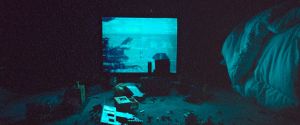 I was reminded of Terrence Malick, another filmmaker whose artistic output doesn’t appeal to me. As I wrote for 2005’s The New World: “[Malick] doesn’t so much involve a plot as he does a large open space for his characters to pontificate about the world around them, mostly through whispery voice over. Malick fans will take in his artistic capture of sight and sound, but the rest of us out there will be scratching our heads, that is, when we’re not falling asleep. Seriously, how do you edit something like this? How does Malick know that THIS shot of a tree blowing in the wind needs to be slotted here, while this OTHER shot of a tree blowing in the wind needs to definitely come later? Malick is a stubborn mystery.” I kept thinking these exact same critical thoughts throughout Skinamarink: how does one even approach editing a movie like this? How do you put this shot of a door at minute 43 but reserve this other shot of a door for minute 56? Because the movie doesn’t build or alter its approach, it feels punishingly monotonous. We’re seeing the same rooms from the same angles, the same TV, the same Legos, and the occasional whisper or growl of dialogue. I guess the repetition could contribute to a growing sense of dread or an inability to escape, and for some I’m sure the movie had that effect. For me, I couldn’t connect on its liminal wavelength.
I think the filmmaker was reasonably trying to recreate a relatable childish nightmare, waking up and sensing something is wrong, the adults cannot help you, or are missing themselves, and there’s no escape to be had as you try to wake up. The lo-fi inventiveness on a very limited budget is admirable, but for me, it would have been just as effective as a clips package. Actually, the entire movie is a glorified clips package, because one scene rarely if ever connects to the following scene, or one shot connecting to the next consecutive shot, so it feels like an endless fuzzy loop. I watched one of Ball’s videos on his YouTube channel, a resource that proved to be his inspiration for the movie, and it was a one-minute short labeled as a nightmare and it consisted of opening one door and pushing inside only to be met with another door, and then the whole thing repeats for a full minute. The point is easy enough to grasp, the futility and helplessness, and even at a minute in length, the video is pushing the bounds of its thin concept to a breaking point. I feel like Skinamarink is the same thing, a concept pushed beyond its breaking point without additional intrigue or substance. I congratulate Kyle Edward Ball and his minimal crew for making a shoestring budget horror hit. It’s just too experimental and lacking narrative traction and substance to be a hit with me.
Nate’s Grade: C-
Share this:

Aftersun (2022)

I feel slightly like a movie philistine for my opinion concerning Aftersun. This indie drama has become one of the critical darlings of 2022, enough so that there may even be some serious Oscar buzz starting to foment. It’s a movie with a strong beating heart and rich in authentic details and naturalistic performances, a movie that feels practically like a home video ripped from the past. However, while I appreciated the artistry on display, I kept waiting for the actual “movie” to form, the reason this story was given its big screen status. Aftersun is a lyrically felt movie but also one I wish had a more sustained plot to better develop its dramatic potential.
It’s the mid 1990s and Sophie (Frankie Corio) is staying at a seaside Turkish resort with her father, Calum (Paul Mescal). Her parents are separated and she has a complicated relationship with her father, who covers up his own spiraling sadness by trying to be the “fun dad.” At eleven years of age, Sophie is feeling that awkward middle-ground of not being a child but still not being fully grown, and over her vacation, she observes her world and father with new eyes.

The strength of the movie is the richness of its characters and world, with each moment feeling like it was plucked straight from the memory of debut writer/director Charlotte Wells. The movie is framed as a home video of Sophie’s and makes clever use of her narrating footage, allowing the perspective to be directed literally by its source. It’s also interesting because there’s a degree of performance for Sophie, as the presence of a camera usually goads people into acting differently, to play up to the camera, and this channels Sophie into being a goofy performer. Off camera, she’s less prone to making jokes and being broad and silly. She jokes with her father, chiding him for his “advanced age” and other such topics, but there’s more hesitancy and relatable awkwardness with Sophie in real life. Her dad says she should go introduce herself to other children at the resort, to make friends and have partners in play, and she scoffs that at eleven she’s “not a little kid anymore.” She wants to hang out with the older teens and eavesdrop on their conversations, not fully aware of their meaning and context, as that hurried desire that young children have to cast aside their childhoods in favor of immediate maturity. There isn’t any defining experience at this resort, no direct humiliation or formative wisdom to point to. It’s more the small moments of a young girl between the different phases of her life. Sophie comes across as an achingly realistic portrayal of adolescence and the yearning for real connections.
The majority of the movie is about the relationship between father and daughter, and I was waiting for the movie to hit me hard, especially as I’ve recently become the stepfather to an eleven-year-old daughter. The relationship is there but there’s nothing too demonstrative of what is going on between these two people. It’s unclear whether this might be the last time Sophie will see her father for some time, or whether the divorce was recent and still a sore subject, or anything of extra significance. It just feels like a vacation, and that’s as it’s presented, and maybe that’s the larger unspoken point of Wells, that the mundane moments only become more cherished in hindsight or when we realize they were the last moments before whatever happened.

I think Wells might suspect the narrative on its own is missing that larger significance, so distributed throughout the movie are flashes from a rave with an older woman, and it’s revealed later that this thirty-something woman is actually Sophie as an adult, and a new parent herself. This juxtaposition then serves as an ongoing film-length Kuleshov Effect. This cinematic effect, named after the Soviet filmmaker from one hundred years ago, reasons that placing two objects together forms an implicit connection or reaction, so seeing a picture of soup and then a man looking forward might convey hunger or a picture of a coffin and then a man looking forward might convey grief. By this juxtaposition, we’re left to infer larger meaning and processing, as older Sophie is looking back on these scenes as distant memories. We’re left to deduce what that means to her, what new insights she has as an adult looking back, and what has happened since, and I’m sure some viewers will find this a tantalizing human puzzle to unpack. For me, it felt like extra homework without the key elements to make the depictions dramatically involved.
The acting is another laudible element that adds to the overall authenticity of the movie. Corio is a star in the making and has a natural screen presence. Mescal (God’s Creatures, Normal People) carries much of the film’s larger thematic weight, and I kept waiting for some small moment that would provide more meaning behind the surface level. Mescal is very good and his dynamic with his young co-star feels heartwarming and genuine. I enjoyed spending time with both of these actors, and while they charmed me, I kept wishing that they had a little more material to flex.
Aftersun is an easy movie to admire and see what Wells was going for, reflecting perhaps some biographical experience and something that every adult can insert themself and think about their own parental relationships, wondering what sort of things they took for granted during those innocent days of childhood and the acknowledgement of the quiet struggles of parents. It’s filmed beautifully and acted with sensitivity and plenty of understatement, the kind of thing that indie film fans and critics vaunt as revelatory filmmaking. It’s a solid movie that only comes to 90 minutes, but it also felt like I was watching a stranger’s home movies without context.
Nate’s Grade: B
Share this:

Marcel the Shell with Shoes On (2022)
 The feature-length movie based upon the short stop-motion films about a mollusk in sneakers, Marcel the Shell with Shoes On might just be the most precious movie of the year. It’s set like a faux documentary where a lonely filmmaker discovers a magical inhabitant in his Air B&B, a very soft-spoken little guy with a heart much bigger than his actual size. Marcel (voiced by co-creator Jenny Slate) is looking for his lost family who were unknowingly absconded when the original couple who lived in the house broke up and gathered their things quickly before storming off. Dean (Dean Flesicher-Camp, also the movie’s director) records Marcel and his innocent little observations on life and the bigger world and posts the videos online, and Marcel becomes Internet famous, for good and bad. The plot of the movie is less important than its overall gentle nature. There’s not a lot that happens in the movie, but you dont mind because it’s really an 80-minute sit-down with Marcel. The entire movie is just so sweetly innocent that it’s hard to resist. It also has some bigger things to say about our place in the world as well as mortality. Marcel has a loving yet ailing grandmother shell (voiced by Isabella Rossellini) who is beginning to lose her lucidity, and it will hit home for anyone who has watching a loved one suffer from mental decline. Marcel the Shell with Shoes On is a perfect little antidote for our modern cynical lives. It’s overwhelmingly adorable and wholesome and winsome and just plain cute.
Nate’s Grade: B
Share this:

Bones and All (2022)
 What do you get when you team up Oscar-nominated director Luca Guadagnino, twee handsome man Timothee Chalamet, and the ravenous consumption of human flesh? You get the new indie drama Bones and All, a literal love story between cannibals. It’s boy-meets-girl-meets-dinner.
It’s 1980s Reagan America, and Maren (Taylor Sheridan) is in high school and not allowed out to parties for a good reason. Her father (Andre Holland) nails her bedroom window shut, and we soon realize why when, at a slumber party, Maren eats one of her friend’s fingers. It’s back on the run except Maren’s father has finally had enough. He leaves her behind one morning with a tape recorder to explain. Maren travels to the Midwest and discovers other Eaters, those afflicted with her same impulses. One of them is the young man Lee (Chalamet), who Maren decides to follow. They can look out for one another, but what’s to be done when the hunger strikes, and how far will they go to feed?
 Bones and All is a doomed Romeo and Juliet romance with its own provocative subversion. I was hooked for the first half of the movie, as the script slowly revealed that these cannibals are born this way and their compulsion may also give them super powers, like the ability to smell their own kind as well as key characteristics, like a last feeding or even when a person may be close to death. The movie plays along the fringes of a monster or superhero formula, where we have people with extraordinary abilities, or a curse they must keep hidden depending upon your perspective, and how this challenges their vulnerability and sense of self. It’s reminiscent of vampirism, the need to feed, so we’ve seen aspects of this kind of story dozens and dozens of times, but the world and rules can still be engrossing to learn. Maren and Lee trade stories of their “first time,” though in this context it’s the first time they fed on human flesh, and it so happens both are with a traumatized babysitter. It’s a morbid bonding experience but such is partnering with a person who shares your unorthodox appetites. I was getting shades of Bonnie and Clyde, with our cross-country duo keeping on the run, and also Let the Right One In, where a man is reluctantly killing in order to feed and protect his ward. There’s also the 2017 French film Raw with a young woman discovering her family trait of cannibalism. The source material of Bones and All is a 2016 YA novel by Camille DeAngelis and the script feels very much like the total of its many pop-cultural and literary influences.
There’s still something compelling here about two oddballs finding a person who understand their unique situation. The addiction analogy is apt and provides an interesting discovery, as both Maren and Lee inherited their eating habits from a parent similarly affected. Maren’s search for her biological mother is a solid direction as it also promises a search for answers. Russell (Netflix’s Lost in Space, Escape Room) is an understated but captivating lead. Her character has never been out on her own and doesn’t know much about a larger world of Eaters, so every encounter is her stretching her boundaries and discovering what she is capable of. She also needs to learn how to better live with her impulses, or whether she even can, and being paired with a more experienced companion allows her to explore those feelings with better understanding. Chalamet (Dune) is part scraggly drifter, part twink prostitute, part deceitful vampire, and part sensitive boyfriend. In other words, he fits right in as a brooding Byronic love interest that Maren questions how close she can allow herself to be in his presence. The us-against-the-world sensibility of young and/or forbidden love is amplified with the extra genre trappings. In many ways, Bones and All feels like a strange amalgamation of Guadagnino’s last two movies, the 2018 gory remake of Suspiria and the 2017 tender gay romance, Call Me By Your Name.
 Where the movie starts to lag is its second half, which is built upon two conflicts that feel inadequately developed. The first, and biggest, is the relationship between Maren and Lee. It’s natural for Maren to be wary of Lee early on, especially with how much is at stake if either one of them. There’s also the danger of being alone with a cannibal, much like befriending a wild animal and always having to keep one eye open. It becomes a guessing game of trust and compulsion, can either control their urges? However, the romantic coupling between Maren and Lee felt very distant, as if the movie intended for them to be these star-crossed lovers and instead both of them looked at each other and shrugged and settled on being friends. It’s not that there isn’t really any heat or chemistry there. I can ignore that when both members are struggling to control how much of themselves they offer to the other. It’s a relationship built upon mutual survival and the occasional make out, but the difference between the two of them is at once emphatically stated and then casually ignored. The big hiccup for a Maren/Lee relationship seems to be that Lee will kill people in order to feed and Maren disagrees with this. You would think over the course of their time together the movie would follow one of two directions: 1) Lee’s willingness to kill for food becomes more extreme and Maren is pushed away, or 2) Maren begins to share in Lee’s willingness to kill and changes her moral outlook. Neither of these really happen, so when Maren considers leaving Lee’s company, I was left wondering what changed. He’s presented as dangerous, but he doesn’t become more unhinged, and there isn’t a point of no return for their relationship. I didn’t feel much when this union was arbitrarily was put on pause.
The other conflict is an external one and a nag. I thought there would be more attention about Lee and Maren having to hide from encroaching law enforcement. Instead, it’s another Eater who becomes a stalker, and this character would have been best served as a one-sequence passing weirdo. The reappearances feel contrived and poorly integrated once the fledgling Lee/Maren relationship takes center stage. There isn’t enough to the character to deliver with multiple appearances. The fact that this character plays such a big role in the second half is a letdown. If Lee and Maren were worried about people coming after them, why not the police tracking them for the murders they leave behind? Why not even a gang of Eaters that have decided there is even more security in number and have no compunctions over eating their own kind? That topic isn’t even explored, whether eating an Eater would be even more compelling. You could even have someone deem themselves a Super Eater who seeks out other Eaters to consume, either because he or she feels they are an even more exquisite taste/addiction, or because they have a self-righteous sense of purpose and feel eliminating other Eaters will protect the innocent they feed upon. It’s not even expressed whether they have to eat living people or if old corpses could suffice. There are different external threats that could have been better developed and integrated, so it’s a shame that the one we have is given so much more attention than deserved.
 With every movie, it’s important to judge what you’re presented rather than what could have been; it would be unfair judging a hamburger at a restaurant for not being a pizza. Still, I felt like the more compelling perspective to tell this cannibal love story was a parent protecting a child rather than as disaffected teenagers. I thought following Maren’s father from raising her and realizing she had a problem but ignoring it until he couldn’t, and then his challenges to reign in her impulses, would be the more compelling and dramatically charged point of view. It doubles down on the theme of what a parent would do for their child, as well as the personal fear of every parent whether they are capably raising the child to be a moral and self-sufficient adult. Then you mix in the possibility of the genetic lineage for cannibalism, and you can have the parent trying to pass down their knowledge to their progeny or the parent feeling immense guilt for bringing this would-be innocent into a situation that may spell their doom. Every time the narrative went back to Maren listening to her father’s audio narration, I felt like I was getting a bigger picture of the weight of the years of raising Maren. I suppose that also might lean a little heavily into a similar Let the Right One In dynamic. I understand that Bones and All is an adaptation of a YA novel and young outsider lovers is par for the course with the genre, so I wouldn’t expect such a radical adaptation even if it feels like a superior story perspective for drama.
Even as things didn’t fully come together for me, I was always interested in Bones and All for its two-hour duration. It’s not every day that genuine artists are putting their all into a love story that also involves chewing the nipple off a dying man. It didn’t really work as a romance for me because I didn’t really feel invested in the coupling of our main characters. There is so much more intriguing dramatic potential here with these story particulars that I can’t help but feel slightly disappointed by the end results hewing very closely to YA staples. More could have been explored in the romance, especially what nourished the attraction and what would compel Maren to rethink her feelings. As a gauzy, young lovers-against-the-world drama, it has its melancholic pleasures and diversions, one of which is that it was filmed primarily in southern Ohio. It was also filmed in Columbus, so I got to point to the screen and say, “Hey, I recognize that Greyhound bus station” (that was the extent of the Columbus filming, one five-second external cutaway). Bones and All can surprise plenty of viewers, and I’m positive many will be swooning from its mixture of romance and depravity, but the bigger surprise for me was that it left me ultimately hungry for more of everything.
Nate’s Grade: B-
Share this:

My Son Hunter (2022)
 I’ll never understand the pathological obsession people have with Hunter Biden and what may or may not be on his laptop. This fixation on President Biden’s son seems so unshakably quixotic, hoping that with each new murky examination somehow, magically, there will be impropriety and criminality if you only look right. This dogged obsession with, at best, a tertiary figure to the true target of conservative ire reminds me of the crackpot theories concerning Vince Foster, a deputy White House counsel who took his own life in 1993. It was ruled a suicide by five investigations, and yet there are still enough people that are unsatisfied with this provable reality and want to see something more nefarious, more suspect, and simply more. Surely Vince Foster must have been assassinated by the Clintons, and especially Hilary, because he knew too much. It’s nonsense but to some it’s the only thing that makes sense. Such is the same with the Hunter Biden laptop, which some have deluded themselves into thinking could have been the difference maker between a President Biden winning by eight million more votes and a second-term for Trump. It’s difficult for the rational mind to fathom how many ordinary voters would truly care about a presidential candidate’s son’s liaisons, especially when that person is a private citizen and not employed in government.
I figured it was only a matter of time before a rapacious conservative media bankrolled a Hunter Biden Laptop Movie, and it seems only natural as Breitbart’s first foray into narrative filmmaking. The movie takes a lot of style and attitude notes from the latter films of Adam McKay, borrowing liberally from the mixture of documentary and cheeky fourth-wall breaking motifs from The Big Short and Vice. I’ll admit it makes for a slightly more entertaining movie, and My Son Hunter wasn’t the complete disaster that I had dreaded. It’s still not a good movie, by far, and its points are leaden and misleading at best and downright false and speculative at worst, but I’d rather watch a conservative movie that attempts to ape better filmmakers. Trying and failing is at least better to watch for 80 minutes than simply preaching to the converted and not even trying.
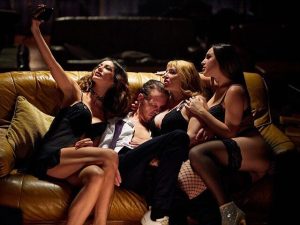 Hunter Biden (Laurence Fox) is drifting through life, parties, and may be the biggest hindrance to a would-be President Joe Biden (John James). Hunter left his laptop at a repair shop but thankfully the media refuses to cover the story, instead downplaying it as a possible Russian disinformation campaign in the last weeks before the 2020 presidential election. Joe can’t have anything go wrong so close to his possible big victory, but Hunter, at least in this not-at-all biased interpretation, seems like a walking catastrophe waiting for his next landmine.
Before even discussing the filmmaking merits, let’s tackle the chief purpose of this movie, which is to defame Hunter Biden and by association Joe Biden. It’s not exactly breaking news that Hunter Biden has lived a troubled life. The man has been upfront about his own struggles with addiction; he wrote about it openly in his own 2021 memoir. Watching Hunter snort anything within reach, party with hookers, and hang out with lowlifes just feels gratuitous because it’s the same characterization over and over. That’s all the movie covers for its first 30 minutes, Hunter partying with strangers and strippers (but still in a demure way where nobody, even before passing out on the floor, removes their clothes). It feels like we’re wallowing in a man’s degradation and it’s unseemly because the intention is not meant to be empathetic. The target audience watching this won’t likely care about Hunter genuinely getting better as a person. That’s not what this expose is for, trying to better understand his humanity and vulnerability. This is merely a roundabout way to taint Joe Biden, a figure too boring by himself, so the critics have to settle for Hunter and his salacious escapades and work on grimy guilt by association.
I can hear some griping that the movie presents Hunter in a more sympathetic light, at least early, with him recognizing his own screw-up nature but feeling powerless to rise above. He also talks about the grief of losing his mother and sister at such a young age, as well as his older brother in 2015. However, any pretense of humanizing goes out the window once big daddy Joe arrives, and Hunter becomes a sniveling sycophant who shrugs his way through life, not just aware of his nepotistic privilege but fully comfortable with his participation in corruption and graft. Any introspection is abandoned and it makes any prior introspection appear phony. It’s hard to square the Hunter in the beginning who talks about the wounds of losing his mother with the Hunter who complains that his dad never supports his art, complete with cutaway to his finger painting. There’s an entire six-minute stretch where Hunter is lectured to, by his stripper named Kitty (Emma Gojkovic) who just happens to be the estranged child of Christian missionaries, about China’s concentration camps for its Uyghur population, and he stares slack-jawed, as if he hasn’t kept up with the news in years (the reprehensible concentration camps for Muslims have been well-documented by the mainstream media). This Hunter is merely a stand-in for vague political corruption, an irredeemable naif that is only meant to make his father appear worse, and that’s also why now that Republicans have won the House, you’ll see a lot more of Hunter Biden’s name in 2023 because, obviously, investigating his previous business handling as a private citizen is the cure for inflation and higher gas prices.
 So what does the movie profess to expose, especially so that had this evil laptop of incriminating evidence been properly adjudicated, then Donald Trump, the most unpopular president in the modern era, would have easily won re-election? It’s a rehashing of what led to Trump’s first impeachment in 2019. Hunter Biden was on the board of a Ukrainian energy company, Burisma, and he most definitely got that position because of his name, and of course this is the only instance in the history of the world where that has happened before to the scions of the rich and famous. When Jared Kushner, who actually worked in Trump’s White House, was offered over two billion dollars by the Saudi royal family upon leaving his taxpayer-paid position, I’m sure it was completely for his unparalleled expertise on Mid-East diplomacy. Anyway, this Burisma position was already investigated internally by the State Department for conflicts of interest, and the Ukrainian prosecutor that Joe Biden pressured to be removed as VP was not threatening to investigate Hunter. This prosecutor was corrupt and refused to investigate Russian-backed assets; he even refused to investigate Burisma. There was no inappropriate arm-twisting to protect Hunter or Joe Biden, as thoroughly debunked during the 2019 impeachment trial. It’s all pretty established, but that doesn’t matter to its target audience, the same group who keeps desperately re-shaking a disparate collection of incorrect election anecdotes to produce a bigger picture like one of those pesky Magic Eye pictures that only “true American patriots” can properly see.
That’s really the majority of the specific accusations against Hunter. It impugns his associates, like Devon Archer who was sentenced for defrauding a Native American tribe in 2022, but too many of the accusations are broad and reaching, much like the Burisma condemnation. Biden did invest in shares of a Chinese technology company, Face++, as part of a larger portfolio, and China has reportedly used this technology to surveil citizens it’s looking to persecute. This is not great, but I wonder how many other venture capitalists have holdings with connections to other similarly sundry applications, especially with technology. I’m not excusing this, I’m just saying this “a ha!” accusation isn’t quite the deathblow the movies seems to assume. If it was, it wouldn’t need a character to literally explain the context of why this is so damning. The larger accusations of bribery and funneling ill-gotten monies back to daddy Joe are weak too, no matter how many times the movie adds titles to tell us, “This really happened” (but it didn’t). So many of these accusations are like Burisma, where it’s a purposely misconstruing of events and a deliberate ignoring of context or corroborating information that would deter their argument.
Hunter Biden isn’t the world’s greatest businessman by any measure. He’s also not the world’s most infamous criminal who fails to be held accountable because of his cushy connections. Hunter Biden hasn’t even been banned from operating a non-profit in New York state because he used a kids-with-cancer charity like a personal piggy bank (sorry, that was Trump’s children). Let it be known by this self-professed progressive, if Hunter Biden is guilty of a crime then prosecute him. Put him in jail. I don’t care. He doesn’t deserve special treatment. But at the same time, if he’s just a guy with problems, he doesn’t deserve this crazy level of unbridled antipathy.
 Following the McKay model, characters will stare directly into the camera for comedic effect, to add additional commentary, like when the movie flatly states, “This is not a true story… except for all the facts.” Of course, the screenwriters have a harder grasp of those stubborn facts. These are the same writers of The Obamagate Movie, which proposes to expose the “Deep State conspiracy to undermine the Trump administration and the fake Russian collusion narrative.” Again, facts are stubborn things, especially when the end of the movie laments when, oh when, will truth matter over lies and the powerful be held responsible for their corrupt actions (were these people just willfully hibernating during the scandal-a-week Donald Trump presidency?). The attempts at humor are often juvenile and stupid, like an opening scene where Hunter has a psychic conversation with a tiny dog while he’s high on drugs, and this is after a cartoon graphic of Hunter’s heart pops onscreen. The jabs against Joe Biden are mostly of the creepy hair-smelling and loony grandpa variety with groan-inducing malapropisms (“Nothing can threaten my erection;” see instead of “election” the dumb man said “erection”). The movie also squeezes in other conservative grievances, like opening with a Black Lives Matter protest and admonishing the media for its portrayal. I think having one of the protesters working as a stripper (to pay off her college loans, she tells us) is meant to be some insult to liberal protestors or even higher education. The same with having a stripper announce her pronouns. Is this the nightmare world the liberals all demand when even the people sleazy men pay to get naked would inform us of their preferred pronouns? I’m surprised they went the entire movie without a trans joke.
I don’t know why Fox (Inspector Lewis, White Lines) would agree to portray Hunter Biden. He doesn’t exactly resemble the man. He looks like a more gaunt version of Ebon Moss-Bachrach (Girls, The Bear). Fox provides the best reason to watch the movie because he’s not acting like he’s in lazy agitprop. Give credit where it’s due, the man gives a dark journey-of-the-soul kind of desperate sheen to this man, that is, until the script just turns him into a shrugging and sulking man-baby. Gina Carano (The Mandalorian) makes a brief appearance as a Secret Service detail to the Bidens, who never missed an opportunity to snidely confide to the camera about how much she loathes these men. John James (Dynasty) doesn’t work as Joe Biden at all, but he seems like he could have been a Sopranos-style goombah goon character reference for Paulie Walnuts. Many of the Eastern European actors who the production utilized from its Serbia filming site seems to have been dubbed over, so I don’t know how much criticism to offer Golkovic as Kitty, the stripper who also happens to be a former lawyer too. She’s a Swiss army knife of uses, including the intended moral uprising the filmmakers would like to believe they can engender.
 I’d like to conclude as a reminder why journalists believed that the Hunter Biden laptop story, which broke in the final weeks of the 2020 election, and was teased by none other than Rudy “Hand down my pants” Giuliani, would be met with skepticism. For an election about competency, a national COVID response, and basic human empathy, it seemed awfully strange that Hunter Biden’s name was coming up again so late, and once more from Giuliani, the man who was caught meddling in American diplomacy so that he could strong-arm Ukraine into pushing a sham investigation to slander Joe Biden. It was all just a bit too convenient, and especially when there wasn’t any corroborating evidence at the time, just one business shop’s word that, no for real, this must be Hunter Biden’s legit laptop. In the end, I doubt any voters could have been persuaded by the laptop, and those that were would have voted for Trump already. Nobody cares about Hunter Biden. And nobody should care about this silly and slimy movie trying to make him into the new conservative obsession. Go after Joe Biden for policy reasons, go after him for his age, but his son? In Joe terms, that’s baloney, man.
Nate’s Grade: D
Share this:

Barbarian (2022)
 It’s rare for a movie to be truly surprising, which is why I would suggest if you’re unfamiliar with Barbarian to try and go in with as little advance knowledge as possible. This is a movie that delights in upending its audience and making them reconsider what they previously thought, re-examining characters and situations with new key pieces of evidence, swapping allegiances and sympathies. It begins ordinarily enough with a young woman, Tess (Georgina Campbell), arriving at her Air B&B rental with a mysterious stranger (Bill Skarsgard) already there claiming it’s his rental. He invites her inside, and she hesitates but follows, and from there the night will go down as one to remember, if she survives it. The joy of Barbarian is how it keeps changing its gears, leaving the audience guessing what could possibly happen next, and the movie will make some remarkable tone and time jumps. Writer/director Zach Cregger (part of the comedy troupe The Whitest Kids U’Know) has made a Jordan Peele-esque leap into the realm of horror with starting results. Cregger really knows his genre goods, and his camera will elegantly frame his visuals while letting the dread compound, as we nervously anticipate what’s to come, often the result of investigating something we know will only lead to bad ends. For a low-budget indie horror movie, the photography and production design work wonders at building suspense and unease. The lingering flaw of Barbarian is that it’s a surprise show, a haunted house ride that doesn’t have much more to it than the entertaining yet finite experience. I don’t think there’s much in the way of re-watchability and many of the plot and thematic elements feel too timidly explored, ladled on haphazardly when they could have earned far more attention, especially with the reveals in the second half. Still, if you’re looking for a delightfully unpredictable and squirm-inducing horror movie that delivers on the WTF moments, then Barbarian is ready for you, whether or not you’re ready for its many deranged detours.
Nate’s Grade: B
Share this:

Satanic Soccer Mom from Ohio (2022)
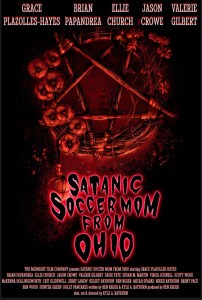
When you have a catchy title like Satanic Soccer Mom from Ohio, you know you have to deliver the goods. This gleefully schlocky suburban satire horror comedy (how many more adjectives you want?) is the follow-up from director/co-writer Kyle Rayburn, an unabashed genre enthusiast. I was granted an advance copy to review this new Ohio-made indie and I’ll try to remain as objective as possible, dear reader, despite the fact that Kyle is one of the nicest men on Earth and even allowed me to film an episode of my rom-com Web series in his own home. Satanic Soccer Mom from Ohio is more low-key than you may be expecting. Its chill vibes and relaxed, ironic humor are more indicative of a stoner hangout movie than something with demon figures and threats of damnation. I think plenty of viewers could latch onto the fun, weird wavelength of an undemanding silly comedy, although there are places I wish Satanic Soccer Mom had gone even further with its spirited sense of creativity.
Annie (Gracie Hayes-Plazolles) is trying to hold it all together in suburban Ohio. Her husband won the lottery and then vanished, and her suburban community is awash in gossip and speculation about what has happened to him. Annie is trying to raise her two kids alone, keep ahead of adult responsibilities like bills and soccer practice shuttling, and holding back from snapping at the clucking hens of the neighborhood, the Karens, lead by chief Karen Green (Valerie Gilbert). It all changes when she accidentally summons a horned demon, Balthazar (Brian Papandrea), who is willing to grant her three wishes at a price, as per proper Faustian bargains.
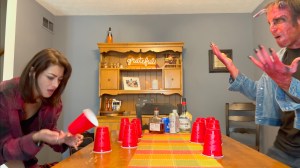
There is a breezy charm to Satanic Soccer Mom from Ohio, a casual, shoulder-shrugging amiability that invites you not to think too hard about the proceedings and just have fun, and if you can connect on that wavelength, then the meandering nature can also be part of that unexpected charm. It’s easy to see the works of Kevin Smith as a reference for Rayburn, but I was also reminded of the hangout cinema of Richard Linklater, where you adjust to the rhythms of characters and their daily lives and interactive camaraderie. Of course, nobody had their boobs literally fall off in Linklater’s world (though there’s still time yet), but it’s that same relaxed tone and feeling that permeates Satanic Soccer Mom. There’s something most amusing about populating your movie with fantastic creatures but keeping a deadpan sense of mundane reality. It’s one of the reasons I enjoyed the short-lived Adult Swim series Your Pretty Face is Going to Hell, a workplace sitcom set in an office literally in hell. If done well, the surprising triviality of the fantastic setup provides its own sly sense of humor. I enjoyed that the movie didn’t have apocalyptic stakes but instead illuminated conflicts very relatable to many: getting over a painful relationship, struggling to juggle the responsibilities of adulthood, fitting in but also knowing when to push back and assert your independence. Having the duplicitous neighborhood Karens be a bigger pain for Annie than an actual demon is a fun reversal. Same as Annie wasting her magically granted wish on ordinary adult requests, like a never-ending cup of iced coffee. The unblinking, roll-with-the-punches attitude of the characters made the movie entertaining even when little was going on from a plot standpoint, and that’s a big boon for an 80-minute indie.
I consider Satanic Soccer Mom from Ohio to be a silly buddy film, and it improves greatly once Balthazar becomes entwined in Annie’s domestic drama. This is also because Papandrea (Feaster Sunday) is the funniest performer in the movie. I loved the bickering dynamic between Annie and her demonic little helper. They reminded me of squabbling siblings, cemented even further during a contentious and competitive game of Mario Kart. This is also the key character dynamic for the movie, the ordinary in conflict with the extraordinary, the protagonist suffering and the relief with the strings attached. The movie is never better when these two are sharing the screen. Plazolles-Hayes (Night Work) has a spunky Parker Posey energy to her, an incredulity to her wide-eyed stares and eyebrow arches that feels earned. She’s the straight woman in a series of crazy developments, and Plazolles-Hayes doesn’t get lost in the craziness. Papandrea is a natural hell-raiser, a mischievous performer who makes the most of his material and elevates it with a grinning desperation that makes it all funnier, like a failing comic on stage. Balthazar is also highly engaging when he’s pretending to be a “normal human,” and his obvious, schticky delivery and mannerisms reminded me of Vincent D’Onofrio’s physical performance in Men in Black. I can still recall the moment he was trying to quickly hide from Annie’s children and just lifted whatever objects were near to badly obscure him (“What are you… four?” Annie berates him). The casual shade Papandrea imbues the line, “Okay… sinner,” is simply award-winning comedy. It’s also a diverting commentary that Annie gets along better with a demon than most humans, though I’m sure there are many among us who could relate. It endears Annie to the audience and proves how unflappable she is despite her troubles, worldly and other-wordly.
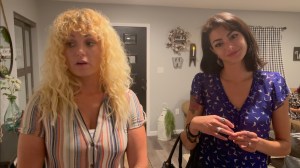
I also want to mention a few other performances that made the most with their screen time. Gilbert (Straitjacket) is so amusingly self-satisfied without becoming a full-blown suburbanite caricature of “Midwest nice.” I especially enjoyed the few moments she dropped the act and revealed the curdled reality behind her sweet-smiling facade. Virgil Schnell (Night Work) is hilarious with how transparently desperate he is to be with another woman, even willing to whip off his shirt to help a woman clean up a slight dab of spilled wine. Ellie Church (Harvest Lake, Jessie’s Super Normal Regular Average Day) is well-acquainted with low-budget horror and provides a welcomed sense of easy-going camaraderie for Annie as her lone friend in town.
As one of those who previously watched Rayburn’s first film foray, 2019’s Men in Black-meets-True Blood caper, Night Work, I can see definite growth as a filmmaker. Both movies were made on shoestring budgets (only $5,000 total) and filmed primarily on a iPhone camera, though the low-budget look isn’t a big point of detraction for either movie. You can’t judge a small indie movie made for $5000 and filmed on the weekends by the same technical standards of bigger movies. You have to accept some tech shortcomings, like the absence of dynamic lighting or polished audio or complex camerawork. There’s very little visual coverage in Satanic Soccer Mom, many scenes composed of a closed shot-reverse shot circuit of edit choices, but it took me out of the movie only sparingly. The rough-around-the-edges DIY aesthetic can provide its own micro-budget charm too, and Rayburn and co-writer Ben Reger (Night Work) are aware enough to write around technical limitations and emphasize ideas and quirky character interactions. He even has a character joke in narration, “That’s what we could afford to show you.” Rayburn is also smart to cast well and get out of the way of his actors. The ensemble feel like they’re gelling on the same comedic wavelength, which is harder to do than most would think, and thus each performer feels in concert no matter the wild turns. The makeup effects for Balthazar are stylish and effective on a budget, and his whole denim jacket and button-heavy attire and punk rock attitude reminded me favorably of Viv from the short-lived but brilliant British comedy TV series The Young Ones, formative to my own burgeoning sense of humor.
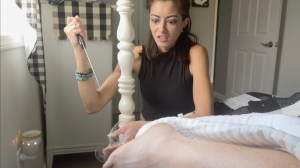
However, even with the emphasis on the ideas, there are enough moments that left me wanting more. I can understand some viewers feeling cold to its blase tone with its fantastical characters. Some viewers will not be able to get over the fact that a woman has a demon wish-granting service and the creativity only goes so far, mellowing in shallow waters for its own good vibes. With all the wish-granting, reality-altering possibilities that a demon represents, it can be something of a letdown for the wishes to be so mundane and minute. One of Annie’s wishes is for her (minor spoiler warnings) to be able to go out in town and pretend to be someone else, so she magically transforms into a different actress (Nickii Rayburn, the director’s wife, so good husband points there) for one raucous night. I can understand that this wish gets at Annie’s distaste for the oppressive negativity of her town, but couldn’t she just have gone to a different bar in a different town where nobody would know her? She could also just wish for the idiots in town to forget about her. It’s the same for why Annie even chooses to hang out with the Karens if she despises their company so much. I understand why the scene exists from a plot standpoint, as another contrast between Annie and the suburbanites she doesn’t fit in with, but then why even bother spending time with these women? There are engaging character aspects with Annie that feel only briefly touched upon, chief among them her complicated feelings about being abandoned by her husband. There’s a nice moment where Balthazar confirms her suspicions and Plazolles-Hayes gets to emote, finally able to process a key point of grief, and it’s one of the few genuine dramatic moments of the movie. However, without prolonged comedy set pieces, the movie would have benefited with more scenes like this for balance. The movie coasts a bit too long without a larger plot direction, so it can feel very scene-to-scene. Then the end includes multiple deus ex machinas, which can make the preceding problems feel too slight.
While I chuckled throughout, the comedy felt too subdued and too easily satisfied creatively. I’m surprised, given the premise, that there aren’t really comedy set pieces. I suppose there’s one, Annie and her pal getting stoned and attending craft night with the Karens, but that’s it. Much of the humor is ribald banter, so much will rest upon the quality of the dialogue writing. It helps having such sharp contrasts for conflict. I laughed throughout but kept wanting the movie to go further, to build off its gags and complications and peculiar turns. One of the dunder-headed Karens flippantly remarks about what could have happened to Annie’s husband, saying, “become a horse man,” and this would have made a fine opportunity to have her continue this weird fantasy tangent, accidentally revealing her own strange sexual kinks, something to separate her from the herd and then shame her back into social submission. That could have been a running gag. Or Bathazar’s one runty horn being a source of insecurity, something he has to defend (“I’ll have you know, plenty of lady demons have referred to my horns as ‘more than adequate.’”). There’s a truly wonderful random gag about the Karens raising money for “Saxophones for the Homeless,” and I was pleading for a visual representation of this concept, with a homeless man shrugging at the useless gift. I often wish there were comedy scenes and jokes that pushed beyond the first idea, taking one joke and finding a deeper, more belly laugh-inducing bit rather than settling for a passing chuckle. I’m talking about scenes where Annie gets stoned and giggles, or the inclusion of a record scratch sound effect to really ensure that a punchline landed and was meant to be unexpected. I wish Rayburn and Reger demonstrated as much confidence with all their jokes as they do their final gag involving an angel and the selected color of her wings (it’s definitely a memorable exit).
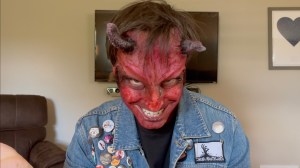
Two movies in and Rayburn is starting to establish a penchant for establishing weird and wild worlds with goofy, profane characters, rich in crude banter and crazy ideas, but worlds that I wish to explore further. Satanic Soccer Mom from Ohio is an amusing and charming movie, especially if one can gel with its overall amiable tone and forgive the inevitable technical shortcomings. I’m far more forgiving of tech issues than I am with narrative and comedy shortcomings, because those are strictly on the creative brain trust fully developing their story potential and exploring the possibilities of their funny. It’s hard not to feel like Satanic Soccer Mom is a solid first draft of a story and could have benefited from a few more passes and polishes to really punch up the comedy and better explore the character dynamics. That stuff isn’t budget dependent. Again, it’s easy to feel the passion everyone had for this project and especially the good times. We need movies that can provide that level of entertainment, no matter their flaws, and Satanic Soccer Mom from Ohio is likely going to be the most feel-good buddy movie ever with this title.
Nate’s Grade: B-
Share this:

Bodies Bodies Bodies (2022)
 Bodies Bodies Bodies is a darkly comic horror indie but the most horrifying aspect is being trapped in a house with these obnoxious Gen Z stereotypes. A gathering of drug-addled teenagers is interrupted by two major events: a hurricane isolating everyone inside the posh Floridian estate, and a hidden murderer among their ranks picking them off. The problem with this would-be Scream scenario is that its screenplay is hampered by tonal anguish; it’s not scary enough to unsettle, and it’s certainly not funny or satirically lancing enough to count. These cringe-worthy caricatures of Gen Z as over-stimulated, over-entitled, and over-offended are hacky and feel like somebody collected a lazy grab bag of generational complaints. Everyone in this movie is annoying or unlikeable or shallow or selfish or plainly insufferable. I know the movie wants to satirize the worst of modern social media-heavy teen friendships, but it feels written by someone who hates Gen Z but without deeper understanding of the foibles of Gen Z struggles. Cultural buzzwords will be thrown out (podcasts, ablest, gaslighting, feelings are facts, appropriation, triggering, etc.) with abandon but it all feels so phony and dubious. The central mystery has some appeal, and there are some performers who make the most of their sketchy characters, like Shiva Baby‘s Rachel Sennet and a well-cast Pete Davidson, but more often the actors are trapped from such limited material, especially Oscar-nominee Maria Bakalova (Borat 2) as our sheltered protagonist navigating this weird world of privilege. The horror elements feel entirely out of balance, utilizing the dark environment and rave glow band-lighting accents for most of its lackluster, murky atmosphere. Bodies Bodies Bodies has some shining moments but far too much down time with inauthentic yet very insufferable characters, and after 80 minutes, I didn’t care who survived because my patience had long been murdered.
Nate’s Grade: C
Share this:

Fall (2022)
 It’s no more, no less than its bald premise, but with the benefit of some nifty aerial photography to heighten viewer veritgo, some seamless special effects, and a streamlined story structure, Fall is serviceable survivor escapsism. The motivation is pretty inconsequential as to why these two young women (Grace Caroline Currey, Virginia Gardner) are climbing an old radio tower, but they do, they reach the top, and then the ladder crumbles below them, trapping them way up high. From there, it becomes a survival thriller that isn’t as dumb as its straightforward title and premise might have you believe. I recall 2010’s Frozen, not the popular Disney musical, but the small indie thriller about a group of characters stranded on an abandoned ski lift. It’s a similar scenario and becomes less of a question over whether they will get down and more how they will endure the elements and simply survive long enough to draw attention to their plight. If you have a fear of heights, there are several deft moments that draw out that anxiety-ridden tension; I even gasped a few times at the movement from teetering positions and leaps. There’s a late twist I wasn’t expecting that I think is handled well, and there’s just enough character introspection to keep things interesting without de-escalating the urgency and tension of the premise. Also, Fall originally had a lot more swearing and 30-some F-bombs and these were eliminated from the use of a Deep Fake A.I. software that swapped the actors’ mouths into contorting new PG-13-approved syllables. I didn’t even notice it, which is a sign of how remarkable the technology has become and how cost-effective (the budget for Fall was only $3 million). There’s little else to this than being a well-developed, well-executed 100-minute thrill ride (you get Jeffrey Dean Morgan for exactly two whole scenes) and when you’re looking for fleeting fun, that’s certainly agreeable disposable entertainment.
Nate’s Grade: B
Share this:

Clerks III (2022)
 I’m at a crossroads with writer/director Kevin Smith. Well, I might actually have already switched sides but don’t want to fully admit it yet even if it’s self-evident. I’ve written about this before but Smith was one of those major cinematic voices that helped shape my sense of indie film and even comedy during my formative teenage years. I became a diehard fan, watched every movie several times and had all their interconnected Easter eggs memorized, and I’ve seen the man in person three times, one time recorded for a college Q&A DVD release. In short, I was most definitely a Kevin Smith super fan. Then over the last five years or so, things began to change, or more accurately my perception of Smith’s movies began to change. The attempts at humor were strained, obvious, and gassed, and it felt like his biting wit and raunch had transformed into mawkish nostalgia. The man in his twenties who made comedies I identified with and loved became a man in his forties with different priorities and a different perspective. He evolved. However, I am no static creature, and I too was evolving, and my fanfare for Smith’s comedy sensibility has transformed into more of a pained grimace. I re-watched Dogma in 2019 and Jay and Silent Bob Strike Back in 2021, as well as its second-banana imitation Jay and Silent Bob Reboot in 2019, and my assessment was only reaffirmed with each movie: I’ve outgrown my old influence. As a big screen storyteller, Smith has become more and more insular, inaccessible, and beholden to eroding fan-service, almost like he too is trying to bid goodbye to his own universe of characters. Maybe that will be the big reveal, Smith putting all his toys back away while he still can.
Clerks III is a return to the old QuickStop convenience store in Red Bank, New Jersey, last seen in 2006 with friends and malcontents Dante Hicks (Brian O’Halloran) and Randall (Jeff Anderson) as the new owners. Clerks II seemingly ended on a moment of triumph, of the guys returning to their roots but also stepping up, assuming ownership responsibilities. However, many can also view the ending as a darker indictment on what the future held for these men. Sixteen years later, what have these men accomplished? That’s the thrust of this third film, following Randal’s brush with death from a heart attack (based upon Smith’s own life-threatening experience). He re-evaluates his life at 50 and yearns to make a movie about his life and his personal experiences, which just happens to be life in service at the QuickStop. He bands together with Dante as producer and they put together a ragtag crew, including old buddies now selling their own state-approved brand of bud, Jay (Jason Mewes) and Silent Bob (Smith), to make their movie.
 In many ways, Clerks III is like a remake of Clerks with the characters of Clerks making their own version of Clerks only thirty years removed from the actual scenes of Clerks. There’s a bit of a snake eating its own tail feeling; many scenes are re-creations of moments from the original Clerks and with the same actors. It’s slightly fun to see even the smaller non-actors come back to recreate these moments, but it also makes the movie feel like an extended high school reunion (“Oh look, that guy lost his hair.”). If you were not a fan of Clerks, well you shouldn’t really be watching the third film in the series, but if you didn’t have an attachment to these characters and this odd world, seeing older versions of former fleeting characters, from the Chewlie’s Gum rep to the angry ruse-baiting video store customer or the woman who manually masturbates caged animals, would feel like flipping through someone else’s photo album, devoid of whatever nostalgic or emotion was intended.
As a lifelong fan of Smith’s filmography, or at least a former lifelong fan now transitioning to accepting a parting of ways, it’s neat to see this reunion of sorts, but it’s also ultimately pointless from a narrative standpoint. Smith is treading the same ground now with irony and distance. Actually, the irony gives way more to sentimentality. It’s not an insult to say that Smith has gotten increasingly softer as he’s gotten older, blunting much of his comedy edge. He comes across as a sincere man who really cares for the people in his life, including these very people that contributed their time and efforts in 1992 to help make a young man’s dream come true. I understand his desire to pay back all the little people, to check back with them one more time, and to have Clerks III serve as a love letter to those who were there from the very beginning. If you’re plugged into this universe, you might smile and you might also feel some of the love.
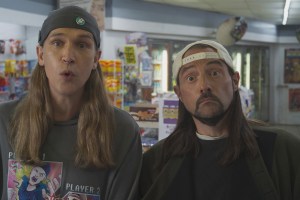 There are famous cameos to balance out the lesser known faces from the original Clerks. You’ll see Ben Affleck hamming it up, Justin Long doing a funny voice, Fred Armisen grasping for something to do, and Sarah Michelle Gellar’s first film role since 2012 and first live-action film role since 2009’s Possession (Gellar was a voice on Smith’s Masters of the Universe animated series on Netflix). The two big additions from Clerks II also return. Trevor Fehrman, returning as the socially awkward coworker Elias, is the funniest part of the movie as his character goes through a spiritual crisis. He feels let down by Jesus and commits himself to Satan, and his runway show’s worth of crazy outfits and cosplays throughout the movie is the funniest joke that never even bears mentioning, which only makes it funnier (he too has his own Silent Bob-esque quiet sidekick played with good spirits by Austin Zajur). Elias was the voice of a younger generation of Internet fandom in Clerks II, allowing Smith his opportunity to criticize modern geek pop-culture, like the Star Wars prequels and Lord of the Rings. That doesn’t really happen in Clerks III despite 16 years of Dante and Randal’s cinematic absence. Smith doesn’t even nibble or good-naturedly rib any pop-culture landscape. Even the jokes about NFTs feel hesitant and wishy-washy and lazy. Smith was defined by his ribald wit and hyper-literate dialogue, and now his comedy has become inane slapstick and pandering nods meant to serve as a replacement for an absent punchline. It’s disappointing how little the comedy registers now.
The biggest addition to the Clerks trilogy was Rosario Dawson, now even more popular as she’s firmly solidified in the Star Wars TV empire. I figured she would have been written out of the franchise as her availability was going to be far more limited. It’s not a spoiler considering it’s revealed within the first minute or so, but Dawson’s character, Becky, who was pregnant with Dante’s child and this presented a new route for his future, is dead. Not only is Becky gone but she died in 2006 from a drunk driver, which means that her unborn child with Dante also died, though this is never touched upon and that seems truly bizarre because much of Dante’s characterization in this movie will be his prison of grief he’s been unable to break from. It’s been 16 years and Dante has not moved on, and I wish more of this was explored thoughtfully. He views himself as a man stuck, now in his 50s, and having missed his off-ramp to another and better life. Without more careful attention, it can come across like a schlub holding onto his grief as a mistaken form of identity. Even that description could be interesting, but you’re not going to get that level of drama in something like Clerks III. Dawson does have a few appearances as a ghostly memory trying to help Dante move on, though if this is the case, I feel like she should be reaching some kind of breaking point after 16 years of effort.
 By the end of Clerks III, it’s clear that Smith intends for this to be the concluding chapter, sending off these characters as reflections of his own film history. The focus of the final act is far more dramatic, as the act of retelling one’s life story as a movie becomes its own way of sharing the love and admiration of a decades-long friendship. I don’t quite think Smith gets to the dramatic heights he’s reaching for, even when some pretty significant and surprising events play out. Too much of the movie is like watching a low-budget remake of Clerks thirty years late, and while I’m a sucker for movies about the making of movies, and those fun found families of creatives banding together, the structural vehicle and conceit for Clerks III left much to be desired. If you remember the scenes of 1994’s Clerks, watching Clerks III is like reliving them as a strange Lynchian dream where the edges are smudged and everything isn’t quite as it should be. At this point, a new Kevin Smith movie is made strictly for the most diehard of fans. I can see that ever-shrinking pool of fans warmly smiling and chuckling from the movie but more in nostalgic recognition of time gone by. It’s nice to revisit these characters, as I’ve been eager to see what life has dealt them since Clerks II. You can feel Smith’s affection for these people, the ones who catapulted him into fame, but the movie is too backward-looking and uninterested in its own comedy as Smith winds down.
Nate’s Grade: C


 nathanzoebl
You must be logged in to post a comment.