Blog Archives
21 Grams (2003)
 21 Grams (2003)
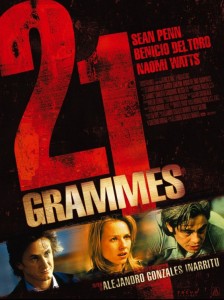
Premise: A mathematician (Sean Penn) in need of a heart transplant, a recovering addict (Naomi Watts) mourning the loss of her husband and children, and an ex-con (Benicio Del Toro) whos found redemption in Jesus, are all linked by a horrific car accident. The aftermath will bring them together out of grief, guilt, and revenge.
Results: The greatest asset 21 Grams has, bar none, is the trio of breathtaking performances. De Toro gives a powerful performance as a man consumed by grief and seeking answers in the unknown. Watts gives the definition of a raw performance. What isn’t cool is the structure, told out of order like the directors first film, the brilliant Amorres Perros, translated: Loves a Bitch. But the mixed-up structure of 21 Grams is needlessly complicated d frustrating, plus it pulls you out of the movie. Im sure theres a rationale reason for it, but the surprises and expectations it produces are minimal. The whole thing would have been better plunked in an old-fashioned linear structure. The sensational performances and intelligent story will stay with you long after the film ends.
Nate’s Grade: B+
Share this:

The Human Stain (2003)
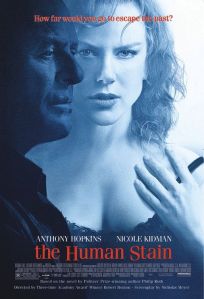 Anthony Hopkins as a black man? Nicole Kidman as a white trash janitor? And the two are LOVERS? This is a movie that is sunk by some lamebrain casting decisions. It’s one of those art pieces that yearns to be something more but just gasps for air.
Nate’s Grade: C
Share this:

Elephant (2003)
 Writer/director Gus Van Sant could never be accused of taking the easy road. He’s been an indie provocateur whose long career has involved Keanu Reeves, Uma Thurman with giant thumbs, villainous weather girls, and Sean Connery uttering the immortal line, “You’re the man now, dawg.” After 1997’s Good Will Hunting made over $100 million, Van Sant had an artistic blank check. He chose to do a shot-for-shot remake of Alfred Hitchcock’s masterpiece Psycho, now with added scenes of masturbation at no extra charge. So, as you can tell, there’s no telling what Van Sant will do next. On the heels of the experimental 2002 Gerry (where Matt Damon and Casey Affleck wander around and that’s it) comes his Cannes-winning portrait of high school violence, Elephant. But is Elephant an influential eye opener, or does it fall short of its artistic intentions?
Van Sant’s exploration on school violence is startling, realistic, and ultimately a failure. Van Sant does a great job of echoing the mundane reality of high school life with long, elegant tracking shots and numbing classical music; however, Elephant merely becomes an overindulgent and pretentious art exercise. There’s little below the surface, and Van Sant’s actors do little in their brief gasps of screen time to empathize with.
 There are some jolting moments of violence but by the time they arrive Elephant has worn out its welcome. Once we’re even introduced to a character and thirty seconds later they’re killed off. It’s hard to get emotionally attached to so many characters we get mere fleeting glimpses of before they are murdered in the name of artistic statement. The horror of high school violence is less jarring when you feel nothing for the characters. Some of the scenes are shocking, but by the time the school shooting actually arrives the audience might actually be feeling pangs of guilt over their reluctant happiness that something finally is going on, even if it is students being murdered by their peers.
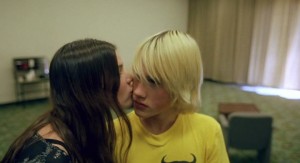
Van Sant also trades heavily in tired stereotypes, from the sexually promiscuous jock, to the nerdy bookish girl, to a trio of bulimic girls used as shameless comic relief. His teen killers watch documentaries about Hitler, play violent shoot-em-up video games, and, of course, have negligent parents. In a very peculiar scene, before the school shooters march off they share a shower and lament that they’ll never be able to kiss a girl… and then they kiss each other. I don’t know exactly what Van Sant is trying to say and I don’t think he knows either.
 This is the longest, most appallingly boring 80 minutes of my life. Elephant’s running time should be brisk, but oh boy does it feel like an eternity. The pacing of the film is practically non-existent. Old women in check-out lanes could move along faster than Elephant. All the drawn out tracking shots give the viewer an eventual idea of the school’s geography, but it also lulls the viewer into a coma. The long bouts of static nothingness set to the soothing classical music might be the downfall for a sleepy audience. Perhaps in the future Elephant will be the cure for insomnia, but right now, in the present, it’s the dullest, most monotonous waste of 80 minutes you could spend in a theater.
Elephant sure takes its time to say a whole lot of nothing. On paper, Elephant could have been an artistic exploration into the reality of high school and the glazed indifference teenagers face in a society of apathy. Instead, Elephant equates cinema verite with real time. It’s not enough we have to watch someone do a film test strip but we have to watch the whole thing in real time. It’s not enough we have to watch one of the school shooters practice piano but we have to watch and listen to the whole thing. It’s not enough to see one inconsequential scene but we have to witness it three different times from alternating points of view. It’s a monumental waste of time for everyone involved, especially the poor audience.
What may be most terrifying about Elephant isn’t that it has no answers for school violence, but that it doesn’t even have the ambition to pose any questions. Van Sant’s followers could have their interest piqued by Elephant, but this film is going to appeal to a very very small number of people (I’m thinking maybe six, tops). Elephant is an artistic overindulgence masquerading as thoughtful meditation.
Nate’s Grade: D
Share this:

Bubba Ho-Tep (2003)
 Bruce Campbell gives a memorable performance as the aging king of rock ’n roll, Elvis, spending his remaining years wasting away in a Texas nursing home. He and a black man (Ossie Davis), who thinks hes JFK, battle a mummy thats feeding on the souls of the nursing home. Its a fabulous premise, pure and simple. The trouble is, Bubba Ho-Tep works well in great bits and pieces but doesn’t have the hold of a feature film. This feels more acquainted to a short film or a TV sketch. There are parts where I was laughing hysterically (Davis has my favorite line: ”They took my brain! Im thinking with sand up there!”), and then there are other moments toward the end where I was catching myself nodding off. Writer/director Don Coscarelli has a cool visual palette of light and shadow, reminiscent of Guillermo del Toro (Blade 2). He also has a wicked sense of humor. The best moments of Bubba Ho-Tep are the back-story involving how the real Elvis swapped places to live a normal life. Campbell is wonderful, and the movie is alive in spurts, but it cant shake the illusion of feeling stretched.
Nate’s Grade: B-
Share this:

The Magdalene Sisters (2003)
 There’s a certain genre of films as well-defined as say, the Western, Film Noir, or even Romantic Comedies. The genre Im speaking of is I-can’t-believe-that-happened cinema. This is a genre made up of little-known true stories where people with power abuse those below them. These include films like Rosewood, Rabbit Proof Fence, Matewan, Mississippi Burning, and just about every movie with a Holocaust setting. These films are intended to antagonize the audience and to get them to ask, How could something like this happen? The Magdalene Sisters is a film that an audience will walk away with very much wondering how something so cruel, amoral, and heartless could carry on in our modern world.
In 1960s Ireland, the Catholic Church was life. The Magdalene Sisters sheds light on the little known work asylums, which were institutions set up to help girls who had transgressed against God. The girls admitted to the asylum, a kind of extreme reform school, are there to work away their sins and reach forgiveness, thus saving their immortal souls. Rose (Dorothy Duffy) had a child out of wedlock. Bernadette (Nora-Jane Noone) was caught by school officials for being too pretty and tempting teen boys. But perhaps the most startling admission is Margaret (Anne-Marie Duff), admitted to the asylum by her own father for the grievous sin of being raped by a cousin. The Magdalene Sisterhood asylum is run by Sister Bridget (Geraldine McEwan), an old nun who subscribes to the cruel to be kind theory in spades. The girls at the asylum toil tirelessly in sweatshop conditions, are physically abused by the nuns, sexually abused by the asylums priest and are left hopeless of escaping. Girls who run away are turned back in by their parents or cooperative police. Some of the women at Magdalene have been there for their entire lives. It seems the only ways out are death or joining the convent. Get thee to a nunnery indeed.
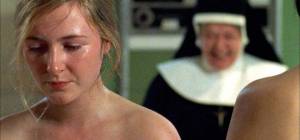
 The Magdalene Sisters is full of sadistic moments that will shock an audience. One of the most disturbing scenes transpires late into the film. The girls of the asylum line up completely nude, shivering and crying. Two nuns, with a nauseating smugness, chortle and play a game seeing who has the largest breasts and the smallest nipples, among other things. When the winner of this sick experiment stands forward and clenches her teeth from crying so hard, one of the nuns asks, ”What are you crying for? It’s just a game.”
The young ladies at the films core deliver magnificent performances tinged with honest emotional devastation. Noone is the standout as Bernadette. She utilizes steely rebellious gazes that speak volumes about her characters resourcefulness. Noone can convey more poignant emotion in the raising of an eyebrow or the biting of her thumb than most starlets can ever hope to express.
McEwan is terrifying as the head nun and head source of torment. Her grandmotherly voice, tinted with an Irish brogue, is enough to send shivers down your spine. She is surely 2003’s greatest movie villain, next to Johnny Depp in Once Upon a Time in Mexico.
Writer/director Peter Mullan keeps the suffering at an almost unbearable level but allows the spark of human resistance to keep us going. His film is one brimming with anger and disbelief; ensuring the audience will experience that same burning anger before the credits roll. Mullan’s passionate story can be deemed one-sided, but then again, what exactly is the other side going to say about the abuse of innocent girls for life-long slave labor? Not much I suspect.
 The Magdalene Sisters is a somber, unflinching look at the abuses of the church as well as the upward battle for equality women faced. This film is tough to sit through. It might be too much for some, especially if they don’t have a strong relationship with the Catholic church to begin with. The decades of abuse The Magdalene Sisters sheds light on is incredible, but it’s also a beginning for healing. Before we can overcome atrocities we must acknowledge them, and this is something I’m sure Mullan is arguing that the Church is failing to do. In fact, the Catholic church has denounced The Magdalene Sisters for its portrayal of church abuses. Something tells me Mullan is not surprised.
Not only is The Magdalene Sisters an eye-opener, it’s also great cinema. The characters, pacing, realistic sharp-eyed direction, and superb acting render it more than just a snuff film. This film is more than watching people mistreated and suffer; this is a film about perseverance and resolve. It’s about the enduring human spirit. I’ll gladly (well, not gladly) watch sequences of misery in order to see human triumph. This isn’t just a sad story, it’s exceptionally well told and acted and it bathes you in the pain of its characters. You feel their heartbreak and tragedy, but you also feel their victory.
The Magdalene Sisters is, without a doubt, the must-see feel-bad movie of this year. Now, there will be plenty out there saying, Why should I pay to see a movie that will make me feel bad? This is my defense: because the movie is so good at having its fears, tortures, and ultimate triumphs resonate that it makes you authentically feel something. And isn’t this the purpose of art, to feel something? The Magdalene Sisters is unflinching, passionately powerful and unforgettable. Just one more item to get your blood boiling: the last of these Sisterhood work asylum closed in 1996.
Nate’s Grade: A
Share this:

Lost in Translation (2003)
 Sophia Coppola probably has had one of the most infamous beginnings in showbiz. Her father, Francis Ford, is one of the most famous directors of our times. He was getting ready to film Godfather Part III when Winona Ryder dropped out weeks before filming. Sophia Coppola, just at the age of 18, stepped into the role of Michael Corleone’s daughter. The level of scathing reviews Coppolas acting received is something perhaps only Tom Green and Britney Spears can relate to. Coppola never really acted again. Instead she married Spike Jonze (Being John Malkovich) and adapted and directed the acclaimed indie flick, The Virgin Suicides. So now Coppola is back again with Lost in Translation, and if this is the kind of rewards reaped by bad reviews early in your career, then I’m circling the 2008 Oscar date for Britney.
Bob Harris (Bill Murray) is a washed up actor visiting Tokyo to film some well-paying whiskey commercials. Bob’s long marriage is fading and he feels the pains of loneliness dig its claws into his soul. Bob finds a kindred spirit in Charlotte (Scarlet Johansson), a young newlywed who has followed her photographer husband (Giovanni Ribisi) to Japan and is second-guessing herself and her marriage. The two strike up a friendship of resistance as strangers in a strange land. They run around the big city and share enough adventures to leave an indelible impression on each other’s life.
 Lost in Translation is, simply put, a marvelously beautiful film. The emphasis for Coppola is less on a rigidly structured story and more on a consistently lovely mood of melancholy. There are many scenes of potent visual power, nuance of absence, that the viewer is left aching like the moments after a long, cleansing cry. There are certain images (like Johansson or Murray staring out at the impersonal glittering Tokyo) and certain scenes (like the final, tearful hug between the leads) that I will never forget. Its one thing when a film opens on the quiet image of a womans derriere in pink panties and just holds onto it. It’s quite another thing to do it and not draw laughs from an audience.
Murray is outstanding and heartbreaking. Had he not finally gotten the recognition he deserved with last year’s Oscar nomination I would have raged for a recounting of hanging chads. Murray has long been one of our most gifted funnymen, but later in his career he has been turning in soulful and stirring performances playing lonely men. When Murray sings Roxy Music’s “More Than This” to Johansson during a wild night out at a karaoke bar, the words penetrate you and symbolize the leads’ evolving relationship.
Johansson (Ghost World) herself is proving to be an acting revelation. It is the understatement of her words, the presence of a mature intelligence, and the totality of her wistful staring that nail the emotion of Charlotte. Never does the character falter into a Lolita-esque vibe. Shes a lonely soul and finds a beautiful match in Murray.
 Lost in Translation is an epic exploration of connection, and the quintessential film that perfectly frames those inescapable moments of life where we come into contact with people who shape our lives by their short stays. This is a reserved love story where the most tender of actions are moments like Murray carrying a sleeping Johansson to her room, tucking her in, then locking the door behind. The comedy of disconnect is delightful, like when Murray receives incomprehensible direction at a photo shoot. The score by Jean-Benoît Dunckel, front man of the French duo Air, is ambient and wraps around you like a warm blanket. The cinematography is also an amazing experience to behold, especially the many shots of the vast glittering life of Tokyo and, equally, its strange emptiness.
Everything works so well in Lost in Translation, from the bravura acting, to the stirring story, to the confident direction, that the viewer will be caught up in its lovely swirl. The film ends up becoming a humanistic love letter to what brings us together and what shapes how we are as people. Coppola’s film is bursting with such sharply insightful, quietly touching moments, that the viewer is overwhelmed at seeing such a remarkably mature and honest movie. The enjoyment of Lost in Translation lies in the understanding the audience can feel with the characters and their plight for connection and human warmth. A work of art like this sure doesn’t come around every day.
Writer/director Sophia Coppola’s come a long way from being Winona Ryder’s last-second replacement, and if Lost in Translation, arguably the best film of 2003, is any indication, hopefully well see even more brilliance yet to come. This is not going to be a film for everyone. A common argument from detractors is that Lost in Translation is a film lost without a plot. I’ve had just as many friends call this movie “boring and pointless” as I’ve had friends call it “brilliant and touching.” The right audience to enjoy Lost in Translation would be people who have some patience and are willing to immerse themselves in the nuances of character and silence.
Nate’s Grade: A
Share this:

The Station Agent (2003)
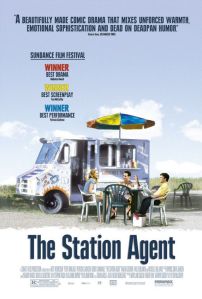 This is the most charming film of 2003, and Im not just saying this because I had an interview with one of its stars, Michelle Williams (Dawson’s Creek). Fin McBride (Peter Dinklage) is a man with dwarfism. With every step he takes every look he gives, you witness the years of torture hes been through with glares and comments. Hes shut himself away from people and travels to an isolated train station to live. There he meets two other oddballs, a live-wire hot dog vendor (Bobby Cannavale) and a divorced mother (Patricia Clarkson). Together the three find a wonderful companionship and deep friendship. The moments showing the evolution of the relationship between the three are the films highlights. Its a film driven by characters but well-rounded and remarkable characters. Dinklage gives perhaps one of the coolest performances ever as the unforgettable Fin. Cannavale is hilarious as the loudmouth best friend that wants a human connection. Clarkson is equally impressive as yet another fragile mother (a similar role in the equally good Pieces of April). The writing and acting of The Station Agent are superb. Its an unforgettable slice of Americana brought together by three oddballs and their real friendship. Youll leave The Station Agent abuzz in good feelings. This is a film you tell your friends about afterwards. Theres likely no shot for a dwarf to be nominated for an Oscar in our prejudiced times but Dinklage is deserving. The Station Agent is everything you could want in an excellent independent movie. It tells a tale that would normally not get told. And this is one beauty of a tale.
Nate’s Grade: A
Share this:

Cabin Fever (2003)
 Throw out all your foolhardy preconceived notions of what you believe to be mans greatest endeavor. Fire, the wheel, antiseptics, flight? Toss them all in a big garbage can, because Cabin Fever is the greatest single thing human beings have ever and will ever create. I hear a select few countering, What about the Renaissance? Oh yeah, did the Renaissance have gratuitous nudity? Wait, scratch that. Did the Renaissance have indulgent nude scenes involving the former Yellow Power Ranger? I think not. Did your fancy-smantzy Renaissance have dogs ripping people apart, backwater yokels who perform kung fu and hobos being set on fire? Thats what I thought. Now who looks like the fool? If I had to live in a Cabin Fever-less world, I would hope it would collapse upon itself, because humanity shouldn’t have to continue without this movie.
 Cabin Fever is a delirious new horror film tweaking all the clichés and expectations of horror. Five friends who have just graduated from college rent a secluded cabin for a weekend. Then their numbers start dwindling through horrific killings. The brutal murderer? A flesh eating bacteria infecting their numbers, ravaging inside them and making flesh fall off like loose cheese on a pizza.
Once the group discovers that one of their friends has become infected they without hesitation quarantine her in a shed. They make failed attempts at getting outside assistance but are pushed back into the hot zone. Their fears and distrust manifest, and what was intended to be a sexual romp in he woods (we all know how that goes in horror flicks) has turned into a microcosm of Lord of the Flies meets Evil Dead II, with a dash of Night of the Living Dead.
What elevates Cabin Fever from similar brainless exercises in mutilating sexually active teens is its self-awareness and constant humor. It plays upon horror staples, particularly the notion of a nation of creepy backwoods folk waiting to take advantage of lost teens. Cabin Fever proudly wears its horror influences on its sleeve. The film is also relentlessly hilarious in its tongue-in-cheek self-awareness. I was laughing all the way through. The film even ends in an inter-racial ho-down with banjos!
The film isn’t so much scary, though it does have a few shares of scares. The film also isn’t as gory as youd believe, but when it shows the gory goods Cabin Fever swings for the fences. Interesting enough, someone on the Cabin Fever crew actually suffered an attack by flesh-eating bacteria in their life and claims the gruesome makeup to be 100 percent authentic.
 Writer/director Eli Roth’s Cabin Fever is a scream. He has an amazing sense of visuals and creates a vivid picture of doom. He displays a sickly entertaining sense of humor, much like Sam Raimi and Peter Jackson did before they went Hollywood. The photography is great, the disgusting makeup is skin-crawling (perhaps a more appropriate term than intended) and the performances are dead-on camp. Each of the characters fits into a horror archetype from innocent girl next-door (who gets infected first), sexy brunette vamp, loudmouth drunkard and nice guy who lacks confidence (Rider Strong of Boy Meets World).
Now some will take umbrage to the fact I’m giving a goo-filled horror flick such a high rating. Cabin Fever is the most fun I’ve had at the movies in some time, and is perfect for getting a group of your friends together to experience. I couldn’t ask for more breezy entertainment from a movie. You know what else your fancy Renaissance didn’t have? People swallowing their harmonicas. I’m pretty sure they didn’t have that. Take that harmonica-less Michelangelo, you hack!
Nate’s Grade: A
Share this:

Dirty Pretty Things (2003)
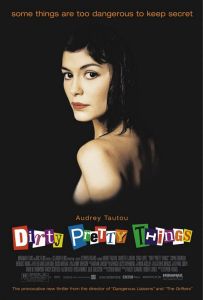 Director Stephen Frears (Dangerous Liaisons, The Grifters) has shown an unflinching eye at the fringe elements of society. In the new thriller Dirty Pretty Things the focus is on the struggling lives of illegal immigrants in over their heads.
The London that Frears displays is the sordid underbelly, the type that hasn’t seen the light in ages. These people are treated like theyre disposable. Those with whatever menial amount of power, even if its a single step higher, prey on these immigrants. ”How come I haven’t seen you before?” one character asks another. ”Because we are the people who are not seen,” he replies.
The heart of the film (you’ll get the pun soon) follows the lives of two immigrants. Okwe (Chiwetel Ejiofor) is from Nigeria and works days as a cab driver and nights as a front desk clerk at a hotel. Senay (Amelie’s Audrey Tatou) is a Turkish housekeeper at the same sleazy hotel trying to stay one step ahead of immigration police. Okwe is instructed to ignore all the salient comings and goings of the hotel. People come to us to do dirty things, says the creepy hotel manager Mr. Sneaky (yes, that is his name). Its our job to make things pretty the next morning. Things get more complicated when Okwe discovers a human heart clogging a room toilet. It seems that for some who check into the hotel, they dont check out. Okwe and Senay become entangled in a bloody scheme that threatens their lives and their immigration status.
Dirty Pretty Things is never boring, sometimes compelling, and more thrilling than you would believe with a plot concerning immigration. The characters earn our attention and emotions with Senay’s vulnerability to Okwe’s tenderness and resolute integrity. They draw us in and we genuinely care what happens as they are snared into the creepy clutches of Mr. Sneaky.
 It’s here that I feel obliged to mention that Steven Knight, the writer of Dirty Pretty Things, is the co-creator of Who Wants to Be a Millionaire?. Just consider the possibilities of future game show creators-turn-thriller screenwriters: Merv Griffin’s hard hitting thriller on the lives of firemen, anyone? It could have the corny tagline, ”There’s only one rule of firefighting – never fall in love.” Maybe this only fascinates me.
Frears’ direction is rock solid. He plays to the best aspects of thrillers, like a suffocating feeling of paranoia but doesn’t suffer the thriller flaws because of such resonant and buoyant characters. Frears is confidant to not overcompensate with his storytelling and lets the grimy locations create his stark mood for him. You can almost taste the stale air.
The acting is exceptional. Ejiofor is amazing. He gives a stellar performance rich in complexity, anxiety, uncertainty, and just plain goodness. He seems to be the last honest man in all of London. There are several scenes you can feel the debate of emotions raging inside him. Tatou, in her first English language role, gives a strong performance, though I’m curious as to where her Turkish accent went. With her penetrating dark eyes and elfin smirk, Tatou is still one of the most adorable actresses on either side of the pond.
Dirty Pretty Things is a searing look at the faceless underprivileged seeking a new life, and those who would deviously prey upon them. The film is a smart, superbly directed, and wonderfully acted thriller. It’s a thriller without weird kids who see ghosts, or lesbians with ice picks, but Dirty Pretty Things is a film thatll stay with you long after the lights go up in the theater.
Nate’s Grade: A
Share this:

Thirteen (2003)
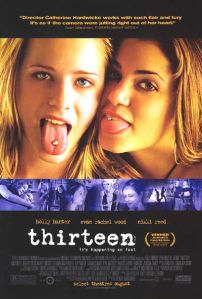 No one said being a 13-year-old was easy. Tracy (Evan Rachel Wood, a dead ringer for a young Jennifer Garner) is a straight-A student living with her mother Melanie (Holly Hunter, nominated for an Oscar). Her family fights to get by with Melanies at-home hair salon. People, usually accompanied by wee kids, stroll in and out of their house like it was a bed and breakfast. Melanie’s previous boyfriend Brady (Jeremy Sisto) has sobered up and settled back into her life, despite Tracy’s wishes.
Evie (Nikki Reed, who co-wrote the film with the director) is that cool girl at Portola Middle School. Tracy desperately wishes to join Evies inner sanctum of friends, enough that shell steal the pocketbook of a stranger to impress Evie. Tracy is taken under Evies wing and learns how to flirt, dress, dance, kiss, and terrify her mother. Melanies concern is a slow simmer, but she cant ignore all the signs of what is happening momma’s little girl. The girls revel in bared midriffs, body piercing, and gallons of shiny make-up. Evie lives with her guardian Brooke (Deborah Kara Unger), herself a sad woman ravaged by booze and pills. When she tells Melanie that Brooke beats her, the maternal instincts overpower her concern. She invites Evie to stay with her family. Evie even calls Melanie mom. More disintegration of Tracy follows.
 Thirteen does exhibit a rare maturity in the displaying of teenage emotions, namely the pull to belong. It also pays incisive attention to our consumer society marketing teen sexuality and the implicit effects. Thirteen creates a more realistic teenager by showing the vulnerability that’s inherent in growing up.
Wood gives a strong performance as her character descends from goodie-good to teen vamp. Her square jaw and lanky frame are physically perfect at displaying a natural young awkwardness. She looks like a teenager I’d see on my block, not what Hollywood is trying to tell me. Wood gets a tad drunk on her characters emotions, like a scene where she tries to scare her mother by lurching forward and cooing, “No bra. No panties.”
Hunter’s depiction of Tracy’s mother is out to lunch about her daughter. This makes the character seem earnest yet stupidly naïve, and after the 200th request of we need to talk is met once again with a closed door, the audience begins to think that Melanie has some deep-seated issues herself.
The direction by first timer Catherine Harwicke starts off as annoying with self-gratifying camerawork. The handheld camera swoops in and out attempting to establish a fluid realism. She also utilizes muted or exaggerated colors to express Tracys highs and lows. What started as self-congratulatory direction actually warmed me over, and I began to take notice of how lovingly Hardwicke stuffs her frame and utilizes lighting. It seems like she could have a career ahead of her as a director.
Though the acting is strong and the direction grows on you, Thirteen never really rises above its ilk of cautionary tale. It’s your basic story set-up of good girl meets bad influence, gets bad, distances family and old friends, experiences highs and then crashing lows, usually capped off with some kind of lesson learned. This is Thirteen in a nutshell. Tracys change from good girl to pubescent trash occurs at an unbelievably fast speed.
 You could make an argument that the film is trying to be daring and shocking, but this whole ”what’s wrong with kids today” routine has been done better in lesser films, like Larry Clark’s Kids. Even though Clark has a fixation for lingering on nubile bodies, his film portrays wayward teenagers and their hedonistic behavior without the constraints of trying to frame sympathetic characters. Thirteen hedges its resources; it cant be fully shocking if it keeps trying to make us like the characters, thus giving glimpses of remorse and doubt. In today’s world, I dont think its shocking anymore to see 13-year-olds engaged in drugs and sex, especially after witnessing kids killing kids in the brilliant City of God earlier last year.
Thirteen is a noble effort but fails in any attempt in functioning as preemptive wake-up call. The acting is quite capable (Wood appears to be headed for junior star status) but the film is ultimately unimpressive. Perhaps the only way to be shocked by this movie is if you’re a negligent parent with a disposable income. It would be worth a rental, but there’s nothing overpowering enough in the film to justify full movie ticket price. While I was watching Thirteen I kept recalling a piece of dialogue the grandfather in Fargo said: You let him go to McDonalds at this hour? They do more than drink milkshakes, I guarantee you that. In the end the message of Thirteen is simply this: one bad apple can spoil the bunch.
Nate’s Grade: C+


 nathanzoebl
You must be logged in to post a comment.