Blog Archives
The Matador (2005)
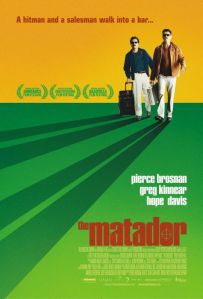 This is an adequate movie that doesn’t really resonate because at its heart it feels like a lot of interesting ideas and characters that are languished with a sitcom plot. I never thought Pierce Brosnan’s performance as the aging hit man was as funny as the film thought it was. The Matador is actually a more interesting movie than funny or amusing. The movie doesn’t go deep enough; the story isn’t as refined as it could be, and there are so few set pieces that this flick could have worked as a play. The end feels a bit too tidy and asks Greg Kinnear’s ordinary husband character to act out of character. There?s an extended talk in The Matador between Kinnear and his wife and Brosnan upon his unexpected visit, and it feels like a sitcom like the wacky neighbor next door has come over and hatched a hilarious scheme. I enjoyed the characters but they really just sit and stew in a really weak story. The characters are richly drawn but have nowhere to go.
Nate’s Grade: B-
Share this:

Crash (2005)
 A searing look at race relations and a powerful human drama at that. This flick has some of the sharpest memories I’ve had from any movie all year, particularly the relationship between a Hispanic locksmith (Michael Pena) and his daughter and a special invisible cloak. Their first scene, where he talks her out of hiding under her bed, is one of the most beautifully written short scenes I have ever witnessed. A late scene involving the two of them knocked the wind out of me completely and is the most vivid moviegoing moment of all 2005 for me. Every character has at least one great moment, though time is not spaced equally amongst this large ensemble. Crash has the intriguing practice of introducing near every character spouting some kind of racist diatribe, and then the movie spend the rest of its running time opening you up to these characters and getting to like them. Writer/director Paul Haggis has such a natural ear for terse, realistic dialogue that can really define characters with such brevity. A fine movie, despite the overarching coincidences.
Nate’s Grade: B+
Share this:

Me, You, and Everyone We Know (2005)
 This movie is going to affect people very differently. Writer/director Miranda July, a note performance artist, has created a world of people fumbling for human connection. It’s deeply arty, meaning that meaning will be considerably different per viewer. For whatever reason, I was able to ride July’s artistic wavelength and enjoyed the series of oddball characters and weird vignettes, like a chain of cars keeping a goldfish alive atop one of their roofs. The film deals frankly with sexuality and involves teens experimenting, but the film exists in a world where sexuality still had its curiosities and detached humor, truly like a kid’s point of view. This movie has two of the most profoundly romantic moments of any film I’ve seen all year, but they are just moments. Me, and You, and Everyone We Know is a movie built around moments. There are enough of them for me and I appreciated July’s unique voice.
Nate’s Grade: B+
Share this:

Hostel (2006)
 Eli Roth is a name that excites me. After watching his 2003 debut Cabin Fever, it was love at first sight. My friends were skeptical but one by one I convinced them that Cabin Fever was a campy, jaunty, unapologetically hilarious good time. I’ve made Roth disciples out of my fellow human beings. Naturally, I was looking forward to Roth’s follow-up, Hostel. I had heard the rumors that the flick was based on a true story of a South East Asian website, though said site can no longer be confirmed. Whatever the muse may have been, Hostel‘s got the added cache of Quentin Tarantino’s name slapped aboard as a “presenter” thus ensuring to the young male demographic that Hostel should be, “frickin’ sweet.” While not reaching the rapturous entertainment heights of his debut, with the grisly Hostel, Roth proves that he’s no flash in the pan.
Over in Amsterdam, Paxton (Jay Hernandez, Friday Night Lights) and his best friend Josh (Derek Richardson, Dumb and Dumberer) are living it up. They’re on the hunt for pot, poontang, and an endless array of good times and cheap thrills. They’ve got big wallets and big appetites. They’ve befriended Oli (Eythor Gudjonsson), an Icelandic horn dog willing to be their guide throughout their most excellent European adventure. While locked outside their stay, the trio learns of a mythical youth hostel all the way in Slovakia. The girls are buxom, beautiful, and go absolutely wild for boys with foreign accents, particularly Americans. This is an opportunity worth salivating over for our trio. They book a train for Slovakia and it looks like this hostel could be the Playboy Mansion of the former Soviet bloc. The women are frequently naked, open to most any suggestion, and eager to please the American visitors.
 Ah, but things are not what they seem. The young Americans check in but they don’t check out, at least in one cohesive piece. Our Slovakian sirens are leading their horny backpackers to their doom. Tied with the hostel is a large, empty warehouse that a lot of high-pitched, ear-splitting screams seem to waft out of. Inside is a dungeon where those willing to pay the right price can torture, mutilate, eviscerate, and kill a person. Can Paxton, Josh, and Oli even hope of surviving such a place?
Even for a horror movie, Hostel has a lot of nudity. Normally this wouldn’t bother me but the film does seem to be topped with an incredible amount of sex scenes and nudity during its sloshy build-up to the horrors that await. Many will cry “exploitation!” or “gratuitous!” and, though I’d agree with both, I must remind all fans of the genre that the bedrocks of horror are exploitation and voyeurism. Let me theorize why Hostel‘s first half is as it is. Sex and violence in horror movies are always linked, particularly the violence as retribution for wayward sexual indulgences. So then, if the second half of Hostel is a sickeningly display of cruelty, torture, and mankind at its most heartlessly gruesome, wouldn’t it make sense, in retrospect, to up the ante on the debauchery in the first half to even out the tone?
One of the most interesting elements of Hostel is how it makes you root for the ugly Americans. The first half of the film shows Paxton, Oli, and to a far lesser degree Josh, as booze hound backpackers interested in tasting the wares, be it through illicit drugs or illicit encounters with the local ladies. They?re stomping through Europe in an arrogant, obnoxious, near-reprehensible fashion trying to score some cheap thrills. Eli Roth doesn’t intend for an audience to align themselves with these tail-chasing characters, except for the more sympathetic Josh. And then once the boys enter Slovakia and become the cheap thrills themselves, Hostel turns on the surprise factor. After profoundly disliking these misogynistic party animals, we root for them to survive. This goes against most modern horror, particularly slasher flicks, where the audience is rooting for the grisly demise of its empty-headed horny teenage cast. The audience hungers for death and titillation. In Hostel, we’re presented with boorish backpackers and, despite everything prior, we really want them to succeed and get rescued from their dungeon of horrors. The last act only confirms this further. I don’t know about your theater, but mine was rollicking and roaring as they rooted for the home team to pull it out.
 Truth be told, the set-up is a bit overly long, though nowhere near as boring and comatose as Wolf Creek (maybe Roth was smart to put in the nudity). In Wolf Creek, we watched a group of uninteresting “characters” drive around and get lost for a whole friggin’ hour. That movie went from boring to “oh, is something happening?” to over. At least Hostel had movement and relevance to its set-up, including characters and situations that will be repeated later. Some of it is a bit heavy-handed, especially with the sex/violence link and a blowtorch torturer repeating, “Get your own room,” but Hostel finishes with a grand flourish. Roth weaves back different storylines and characters in clever ways and serves the audience vengeance on a platter, and we just gobble it up. I was jumping in my seat, pumping my fist, and, forgive me, shouting at the screen during Hostel‘s final act. It’s somewhat paradoxical for me to be disgusted by violent retribution so recently with Spielberg’s Munich and then a week later to be relishing it. I credit the tones of the films. While Munich is contemplative and realistic, Roth’s Hostel is a squirmy, over-the-top, dark comedy with some moments of cringe-worthy horror. Hostel‘s fabulous finish may erase any lingering doubts you had over the very Euro Trip opening.
Roth has a great sense of visual flavor with his shot arrangements but he also knows when to draw upon our dread. Hostel is really more of a survivalist thriller than a horror movie. Sure, torture and gore is prevalent but a lot of the violence and gruesome makeup is unexpectedly played down in limited appearances. This isn’t the shocking sadistic movie that outcries have made it to be. Without a doubt, I think Eli Roth is the most promising name in horror. Cabin Fever is one of my all-time favorite good-time flicks, and now with Hostel, Roth has proven that he can work miracles with a small budget and a giant, depraved imagination. Hostel is more disturbing than horrific but Roth knows exactly what chord to strike, what scenes to hit, and what sounds to echo to make you want to cover your eyes.
Roth’s best attribute, besides a pleasing visual sensibility, is his twisted sense of humor. Cabin Fever was more humor than horror, and also took an extended set-up before the gore was unleashed, but Hostel makes the flip and is more horror than humor. That’s not to say Hostel is without its dark, jovial jollies. Roth seems to approach his gore, outside of the torture sequences, with a macabre absurdity, like a character slipping on dismembered fingers only to chainsaw their leg off, or a character pretending to be dead and gets a severed hand placed on his face. Somewhere, Peter Jackson and Sam Raimi are nodding their heads in approval. Surely Tarantino is amused. Granted, Cabin Fever was more of a tongue-in-cheek fever dream homage to 70s horror, but Hostel has its share of twisted humor which elevates it far above most recent horror, either the boring and meandering (see: Wolf Creek) or the single-mindedly shocking (see: High Tension). This is what excites me about an Eli Roth horror movie: his lively, warped, depraved sense of humor. If people claim that Roth is one sick bastard, then I must also be one sick bastard for finding his movie funny and highly amusing in spurts.
 There are so many moments that I loved, from the opening cleaning-up, to seeing the Slovakian sirens on their day off sans make-up and totally trashed, to the Bubblegum kid gang, to the Takashi Miike (Audition) cameo, to knowing that killing an American is the most expensive option, to seeing the ins and outs of a facility dealing in murder for money, to seeing the equivalent of the Dunkin’ Donuts guy (“Time to chop up the bodies…”), to the madcap, fist-pumping race to the finish. There?s so much Hostel does right, not just as a horror movie but simply as a movie itself. I wouldn’t mind taking another trip to Hostel with a big group of my less-than-squeamish friends. Oh who am I kidding, horror movies are more fun when you see them with the squeamish.
Eli Roth has crafted a dirty, depraved, but highly amusing horror film. Hostel is full of surprises, from an overly long set-up that couldn’t have more female nudity if it tried, and actually making an audience root for the survival of the ugly Americans when things get dicey. The premise may be sickeningly realistic but the rest of the movie is on an overdrive of macabre fun. Roth’s twisted yet gleeful sense of humor is what makes him unique, and his attention to atmosphere and compounding dread is what will make him successful. There’s no faster rising horror name, in my mind, than Eli Roth. Hostel may not fully be the down-and-dirty horror film its ads have made it out to be; it’s certainly more of a thriller with a heaping helping of gore. This is one experience well-worth booking, especially if you have a strong stomach and a dark sense of humor. I can only imagine that the tourism industry for Slovakia is about to drop precipitously.
Nate’s Grade: B
Share this:

Wolf Creek (2005)
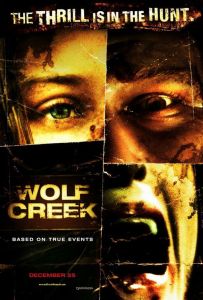 It comes across as choose-your-own-adventure horror, each with their own vignette and then starting back. Wolf Creek is very uninspired. The only thing it has going for it is the fleeting gimmick of an Australian take on American horror staples. In many horror flicks, there’s always that nation of creepy yokels waiting to take advantage of visitors off the beaten path. Now, this is Australia’s version. The film’s biggest sin is that it spends an agonizing 60 minutes before anything happens. The set-up is protracted and the characters are uninteresting, bland, and mostly just sketches of ideas. It takes forever to get the horror going and once it arrives I’ve already checked out of the movie into a coma. Wolf Creek lacks any subtext or commentary, some of the saving graces of the horror industry. The whole thing is an exercise in tedium, with some splashes of gore at the end. This movie takes too damn long to get to the goods. There’s nothing suspenseful in that 60 minutes and little has any meaning later (why do their watches and car stop?). Wolf Creek is derivative, possibly exploitative being based on a true story (what it shows is mostly speculation), and really boring. Casual horror fans should stay home.
Nate’s Grade: D+
Share this:

Broken Flowers (2005)
 Just as VH1 has been described as “TV to do other stuff to,” so is Broken Flowers a movie to do other stuff to. There’s so little that goes on, and at such a lackadaisical pace, that you could really iron your pants in another room and keep up with the film. You really feel Don’s (Bill Murray) apathy. Not good. There are plenty of moments of just watching someone stare. I was a big fan of Murray’s understated work in Lost in Translation, but here he’s understated to the point where he’s fading into the background. Admittedly, I am not a Jim Jarmusch fan, but the whole movie is underplayed to its detriment. The premise of Broken Flowers is really good, but it lacks any follow-through. I would rather see a Winston movie, Don’s eccentric neighbor who imagines himself as an amateur detective. It felt like a Robert Altman in the sense that a giant talented cast was assembled for two-line parts. The musical score is annoying because it repeats the same jangly 30 seconds over and over. It fits with the tone of the film. Broken Flowers is underplayed to the point of irrelevance.
Nate’s Grade: C
Share this:

Capote (2005)
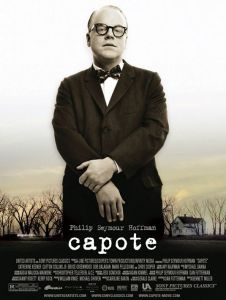 This is a really solid, probing movie about human relationships and the oversized personality of famous author Truman Capote. It’s a very illuminating character piece on its titular star. We see many different facets of his character; part of the connection is because Phillip Seymour Hoffman is so flat-out brilliant in his portrayal of Capote. He’s got that unmistakable nasal voice down, but Hoffman excels at the little things of character, his command of a crowd, his inflections, his physical movements, his ability to look exhausted and pained but embarrassed and prideful at the same time. Capote shows you why everyone wanted to rub elbows with him with how he tells a story and whips up an audience. This is another in the trend of warts-and-all biopics, and you see how calculating he is (he says he never lies). Every confession he offers is manipulative and meant for self-gain, like when he tries to get a witness to talk or get the Kansas P.I. to show him the murder photos. You see how the wheels work within this character. And then Capote shifts as he delves further into the case into his unlikely relationship with Perry Smith. Capote keeps them alive by providing money for their attorneys so he can get more for his book. But there can be only one ending to provide closure to his book — their death. There are several wonderful exchanges of dialogue between Smith and Capote and their quiet, smiling lies they give each other. All we see of Smith is the polite man who draws and read poetry in his jail cell, and the bond growing between him and Capote. The film’s climax eradicates any sympathy built and we see the unpredictable, unmerciful nature of violence. Capote really hammers home the dichotomy of persona, with each side playing the other. The cast is splendid and everyone makes their small roles click, particularly Catherine Keener as novelist Harper Lee and Chris Cooper as the Kansas P.I. What’s even more surprising is that Capote was even better the second time I saw it. There’s so much to find in this excellent character piece.
Nate’s Grade: A
Share this:

Waiting… (2005)
 I have always respected restaurant workers; it’s just how I’ve been brought up. Short of elephant in vitro fertilization, being a waiter has got to be one of the hardest, most thankless jobs on the planet. The waiter (or server, the popularized non-gender specific term) is always the last responsible for food and the first to bear the brunt of a customer’s wrath. They’re easy targets. Their livelihood is also dependent on the idea of common decency in mankind. For these tortured, put upon, overlooked lot comes a new comedy aimed to ease the pain. Waiting… is a balls-out (pun very much intended) gross-out comedy that will make you a better, more sympathetic tipper (I generally start at 20 percent).
Welcome to the wonderful, family-friendly world of Shenaniganz. It’s another day of business for the restaurant staff and another day of enduring the slings and arrows of unruly customers. Monty (Ryan Reynolds), the leader of the pack, escorts a newbie (Freaks and Geeks‘ John Francis Daley) through the rules and customs of the Shenaniganz family. The cooks (Dane Cook, Luis Guzman) like to get randy at work, the bus boys (Max Kasch, MTV’s Andy Milonakis) like to hide in freezers and toke up, and the wait staff (Anna Faris, Justin Long) are all dating each other. Meanwhile, Dean (Long) is mulling over whether to take the manager’s job offered to him by his buffoonish boss (David Koechner). He feels his life is going nowhere and he’s stuck in a dead-end job. And there’s a store-wide game where workers try and get other people to inadvertently look at their genitals. God I hope this doesn’t go on when I order my food.
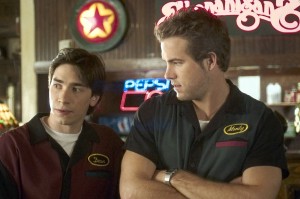 Bishop (Chi McBride) tells two other characters, “You guys are so one-dimensional.” It’s like the movie’s doing my job for me. Waiting… is stocked with underdeveloped characters that don’t even seem used properly. They all have one characteristic of note, from the white wannabe rappers to the bitchy self-loathing server that’s been there longer than anyone else. There’s a lesbian bartender and by the end of the movie that’s still the only thing you know or feel about her. Dean’s girlfriend (Kaitlin Doubleday) has nothing to add to her character, nothing to really say, no personality, she’s just “the girlfriend.” Waiting… has so many lame, poorly developed characters that go nowhere and shed little purpose or personality. It’s a general waste of talent, especially Faris and Guzman.
Reynolds is a charming and gifted comedic actor. He’s got the rat-a-tat-tat delivery down cold and adds a great polish to dialogue that ordinarily wouldn’t seem funny. He can seem at once jerky, knowing, charming, distasteful, and funny. Consider Reynolds a Vince Vaughn Jr. in the making. Long is supposed to play a character dissatisfied with his bearings in life, yet he comes across as disinterested in being in the movie. You almost expect him to shrug his shoulders and just say, “Whatever.” Long too is a very capable comedic actor but he needs far broader roles (Dodgeball) than something where he has to shuffle his feet and mope a lot. As stated earlier, Waiting… really wastes most of its talent by stranding them in thankless roles that don’t give them much to do or add. Koechner is the bright spot as a clueless, leering buffoon of a manager who keeps trying to connect with “the kids” and score with some as well.
 The story feels the same way. For a 90 minute movie so much of this feels unbearably plodding. Waiting… sets up the life of a restaurant well but then can’t find much to do. The story feels formless and the characters can?t provide any direction because of their limitations. The plot seems like a group of anecdotes looking for structure. Even the comedy is rather uninspired and bland. Waiting… attempts gross-out guffaws but just ends up becoming, well, kind of gross. Dropping food and serving it doesn’t exactly register on the Ha-Ha meter no matter how many times the act is repeated. The gross-out apex comes when vengeance is heaped upon a very hostile customer with an assembly line of new “additions” to her order. In this one instance the gross-out is transcended because the audience cares about the situation. Most of the humor is juvenile and not even good at it; the penis-showing-game is inherently homophobic and a running gag with little payoff. The best joke in Waiting… is the film’s production design; Shenaniganz looks nearly identical to those homogenized chain restaurants dotting the landscape. If you stay throughout the entire end credits you’ll discover that all the crap on the walls is actually an elaborate, Rube Goldberg-esque device.
Waiting… is a very knowledgeable film about the food service industry, what with writer/director Rob McKittrick spending years and years in restaurants. I think the only way you could seriously enjoy this comedy, while sober, is if you have experience working in food service. My fiancée has spent years as a server and she identified more with the characters than I ever could. There are scenes in Waiting… that are a server’s fantasy, like when Dean returns his measly one-dollar tip back to his customer. The movie is a safe release for people in the field, much like Office Space. McKittrick even thanks Kevin Smith in the closing credits, but Waiting… doesn’t have an iota of the wit, intelligence, and comedic savvy of Clerks. This is a bargain basement comedy that will largely appeal to fellow restaurant slaves yearning to have their beaten voice heard.
Waiting… is an aimless comedy with no characters to feel for, little personality beyond its knowledge of the restaurant environment, and a cast done in by one-note roles and bland gross-out jokes. Reynolds walks away with his dignity and adds a comedic polish to some otherwise ordinary jokes. Mostly, the film feels like a waste of time, energy, and talent. Waiting… will definitely appeal to people who have felt the wrath of working in food service, but objectively this is one comedy that just doesn’t order up any laughs.
Nate’s Grade: C
Share this:

Inside Deep Throat (2005)
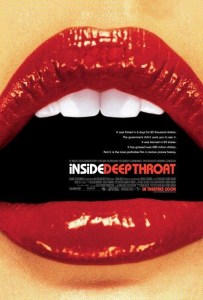 I find that there are generally two requirements that make a really great documentary: 1) have an interesting story, and 2) have an interesting way of telling it. I’ve seen documentaries on ripe topics squandered because of the dull and unimaginative ways they tell their tales. The skilled documentary team behind The Eyes of Tammy Faye and Party Monster has set their sights on a little smut film that changed the world in the early 1970s. Deep Throat was a “dirty movie” made for peanuts (25 grand) that ended up becoming the most profitable film of all time, eventually grossing more than $600 million. The story behind its meteoric rise, cultural acceptance, and damnation hits both requirements, thus making Inside Deep Throat a sensationally entertaining documentary.
It all started in 1971 when Gerard Damiano wanted to make an inexpensive pornographic film. Back in those days, many aspiring filmmakers actually got their start in porn (Wes Craven admits it). Damiano was in the planning process when he was visited by a man who wanted his girlfriend, Linda Lovelace, to appear in the eventual porno. He swore his girlfriend could do the most amazing trick. Lovelace demonstrated her trick, the full swallowing of an erect penis. Damiano was dumbstruck. He was determined not just to involve Lovelace but to base an entire film around her stunning ability. Deep Throat was written in three days, filmed in six days, but the furor it would bring would be irrevocably long lasting.
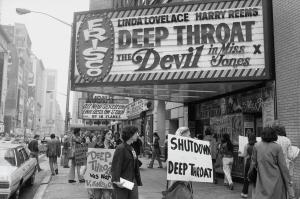 Deep Throat, as many of the crew will happily report, is not exactly a good movie. In fact, some call it the worst pornographic film of all time. Lovelace’s character found sex joyless, that is, until a doctor (Harry Reems) discovers that she has her clitoris all the way in the back of her throat. Thus to orgasm she has to swallow head-on (oh the double meaning). When the crew actually witnessed Lovelace’s cavernous abilities firsthand, they too were flabbergasted. But they wouldn’t be alone. Inside Deep Throat makes smart use of archival footage to prove how mainstream a small smut flick became. We see clips of Bob Hope and Johnny Carson cracking jokes about the film, and most amusingly of all are one or two interviews with little old ladies who “wanted to see a dirty picture.” Deep Throat crossed over and people went out in their Sunday finest to watch a hard-core porno.
Inside Deep Throat is rated NC-17 and with good reason. We do get to see Lovelace strut her stuff and the film almost playfully teases an audience with anticipation. We hear interviewees discuss their amazement; we see a close-up of Reems face as he gets pleasured. By the time the scene in question is shown uncut, we’re eager to witness this feat of fantastic fellatio ourselves. Let’s be honest, you can?’t have a documentary about Deep Throat‘s impact without showing the goods.
Filmmaking duo Fenton Bailey and Randy Barbato have a very visually satisfying way of telling their story. Images tear across the screen and animation pops, all set to what must amount to most of the soundtrack to Boogie Nights. The glossy visual flair reminds me of the swirling, near-pop-out book imagery of The Kid Stays in the Picture. The pacing of Inside Deep Throat is near break-neck, with the film clocking in at just over 90 minutes. I wish that the filmmakers had spent more time on their subject and gone more in depth into certain areas like Lovelace’s turnaround from girl next door goddess to anti-porn crusader back to fifty-something nude model (she was killed in a car accident in 2002).
 The cultural splash Deep Throat made is interesting enough, but the meat of the story is in the battles that would ensue. Damiano openly talks about how the mob controlled the early porn industry. He admits that he refused his share in the millions out of fear that he might have had his legs broken, or worse. There’s a long tangled web of mafia influence in the proliferation of Deep Throat. It was banned in over 30 states, but everywhere it went it became a hit. A Mafioso says that they were making so much money that they had to count it by the pound. Mob hits would materialize over the film’s profits and territory.
Even more fascinating, the U.S. government, to no one’s surprise, declared the film indecent. They couldn’t prosecute the director, or the distributors (unless they liked sleeping with the fishes), or anyone really making money off of the success of Deep Throat. So what’s a stubborn government to do? They prosecuted Reems for his involvement in a pornographic film. It was the first time an actor was ever prosecuted for his participation in art after the fact. Celebs like Warren Beatty and Jack Nicholson came to Reems’ aid, fearful of what might happen if a government could retroactively punish artists. Sadly, Reems was found guilty and sentenced to years in prison and was really never the same afterwards.
But instructional films on sexuality were still okay as far as government was concerned, and we see clips of them in all their medical film hilarity (apparently some positions are not meant for the obese we’re told). These were acceptable because they were meant to help and inform, whereas porn is meant to entertain.
The film’s interviews comprise some of its best and worst moments. Most of the Deep Throat crew is in their 60s or 70s now, and hearing them talk about porn and sexual acts does make you titter a bit. The crew provides funny anecdotes and some of the juiciest material. However, the film also curiously interviews people like Dick Cavett and Bill Maher. The expected talking heads are here like Dr. Ruth, Camille Paglia, John Waters, Hugh Hefner and Larry Flynt, but they regularly don’t have anything insightful to say.
 Inside Deep Throat goes back and forth with its objectivity. It’s obviously pro-freedom of speech and doesn’t mind ridiculing the government agents who tried taking Deep Throat down (oh the double meaning). Particularly telling is an FBI agent who wishes that terrorism could be tidied up so that he could finally get to the real importance, which is stopping people from seeing pornography. One of the main points of the prosecution of Deep Throat was that it “wrongly” purported the idea of a clitoral orgasm (I think many will find some error with this judgment). It’s easy in retrospect to chide government officials ruling on inaccurate information or just plain ignorance. It may be too easy for some viewers, but for me it’s fair game to lambaste any idiot trying to strip me of my Constitutional rights.
Inside Deep Throat is an engrossing if light-hearted look at a moment in time. Some of the seedier elements feel skipped over, but this is a documentary on a fascinating subject told with a pleasing visual style. Don’t be put off by the NC-17 rating or the subject matter. Inside Deep Throat is more than a behind-the-scenes featurette on a wildly successful porno. It’s a fast, funny, and greatly entertaining time capsule of an era where boundaries were still being pushed, both by artists and by censors. And in today’s FCC-fearing landscape, maybe not everything has changed since Deep Throat brought porn into the mainstream.
Nate’s Grade: B+
Share this:

Primer (2004)
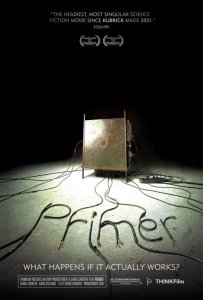 I was intrigued about Primer because I had been told it was classy, smart sci-fi that’s so often missing in today’s entertainment line-up (see: Sci-Fi channel’s Mansquito). It won the Grand Jury Prize at the 2004 Sundance Film Festival and the critical reviews had been generally very positive. So my expectations were high for a well wrought, high brow film analyzing time travel. What I got was one long, pretentious, incomprehensible, poorly paced and shot techno lecture. Oh it got bad. Oh did it get bad.
Aaron (Shane Carruth) and Abe (David Sullivan) run a team of inventors out of their garage. Their newest invention seems promising but they’re still confused about what it does. Aaron and Abe’s more commercially minded partners want to patent it and sell it. Aaron and Abe inspect their invention further and discover it has the ability to distort time. They invent larger versions and time travel themselves and thus create all kinds of paradoxes and loops and confusion for themselves and a viewing audience.
Watching Primer is like reading an instruction manual. The movie is practically crushed to death by techno terminology and all kinds of geek speak. The only people that will be able to follow along are those well-versed in quantum physics and engineering. Indeed, Primer has been called an attempt to make a “realistic time-travel movie,” which means no cars that can go 88 miles per hour. That’s fine and dandy but it makes for one awfully boring movie.
 Primer would rather confound an audience than entertain them. There is a distinct difference between being complicated and being hard to follow. You’d need a couple volumes of Cliff Notes just to follow along Primer‘s talky and convoluted plot. I was so monumentally bored by Primer that I had to eject the DVD after 30 minutes. I have never in my life started a film at home and then turned it off, especially one I paid good money to rent, but after so many minutes of watching people talk above my head in a different language (techno jargon) I had reached my breaking point. Primer will frustrate most viewers because most will not be able to follow what is going on, and a normal human being can reasonably only sit for so long in the dark.
I did restart Primer and watched it to its completion, a scant 75 minutes long. The last 20 minutes is easier to grasp because it does finally deal with time travel and re-staging events. It’s a very long time to get to anything comprehensible. I probably should watch Primer again in all fairness but I have the suspicion that if I did my body would completely shut down on me in defense. Some people will love this and call it visionary, but those will be a very select group. It’s not just that Primer is incomprehensible but the film is also horrifically paced. When you don’t know what’s being said and what’s going on then scenes tend to drag because there is no connection. This movie is soooooo slow and it’s made all the worse by characters that are merely figureheads, dialogue that’s confusing and wooden, and a story that would rather spew ideas than a plot.
Writer/director/star Shane Carruth seems to have high ambitions but he has no empathy for an audience. Films can be dense and thought-provoking but they need to be accessible. Richard Kelly’s Donnie Darko is a sci-fi mind bender but it’s also an accessible, relatable, enjoyable movie that’s become a cult favorite. Carruth also seems to think that shooting half the movie out of focus is a good idea.
I’m not against a smart movie, nor am I against science fiction that attempts to explore profound concepts and ideals. What I am against, however, is wasting my time with a tech lecture disguised as quality entertainment. Primer is obtuse, slow, convoluted, frustrating and pretentiously impenetrable. After finally finishing Primer I scanned the DVD spine and noticed it said, “Thriller.” I laughed so hard I almost fell over. The only way Primer could be a thriller is because you’ll be racing the clock for it to finish.
Nate’s Grade: C-


 nathanzoebl
You must be logged in to post a comment.