Blog Archives
Submarine (2011)
 Submarine is the latest coming-of-age story, this time set in 1980s Wales, and while not breaking any new ground, it manages to be witty, stylish, and a completely winning portrait of a unique kid and his unique view of the world.
Oliver Tate (Craig Roberts) is a 15-eyar-old kid with two life goals. He’s like to romance the rebellious loner Jordana (Yasmin Paige) and, if possible, lose his virginity in the process. Oliver is also on a mission to save his parent’ marriage. Jill Tate (Sally Hawkins) has been drifting from her husband, Lloyd (Noah Taylor), a marine biologist who has been in a depressive funk for years. Jill’s old boyfriend, Graham (Paddy Considine), has moved in next-door and begun to insert himself back in her life.
Submarine is going to be something of an acquired taste. It’s almost drowning in whimsy, following the numerous affectations of its main character. Fans will say that the movie borrows liberally from Wes Anderson’s 1998 film, Rushmore; non-fans will just say the movie cops to outright theft. Like Rushmore, this movie follows the coming-of-age trials and tribulations of an intelligent but lonely outcast, a wiseacre beyond his years. What sets this movie apart is that we taken on the point of view of Oliver. He often refers to his life as if it were a movie, noting dramatic moments that would be accompanied by dramatic music, and a solemn moment that would feature a crane shot rising above the ground but if the budget were low he’d settle for a slow zoom out (the actual movie chooses the slow zoom). “I have turned these moments into the Super-8 footage of memory,” he remarks. Oliver is a student of pop-culture, an early Rob Gordon (High Fidelity), and as such blurs the line between reality and the movies. He will routinely point out film tropes ad then indulge in them. We are each the stars of our own stories. In this manner, Submarine separates itself from the idiosyncratic, miniaturized-doll house world of Anderson’s films or the fanciful magic realism of Jean Piere Jeunet (Amelie). For me, the multitude of quirks were appealing instead of insufferable because we were inside the mind of Oliver, seeing his world through his unique worldview. This brings rationale for the whimsy.
 Oliver is both an unreliable narrator and a flawed protagonist, a fantastic development. So often coming-of-age tales are mainly autobiographical (this one is based off a book by Joe Dunthorne), and as such the authors usually portray themselves as individuals whose chief fault is that they are naïve. Some life experience will shatter their innocence, usually a girl, and thus they will grow and learn. With Submarine, Oliver gains our sympathy by being clever but then he tests it with the compromises he makes to fit in. He engages in some very mean bullying all to win over Jordana. He’s trying to seem so mature, using advanced vocabulary to provide the illusion of adulthood, but really Oliver can’t comprehend the subtleties of social cues. Just when Jordana appears to be opening up and looking to him for need, that’s when he botches it, acts kind of awful, and then justifies it in his head, like so many of us will do with our mistakes. Still, I never stopped rooting for this kid. I was rooting for him and Jordana to work out. So hard was I yearning for these two loner oddballs to have their happy ending, I think I pulled something (my dignity?). We can see Jordana through Oliver’s infatuated eyes, but then we can also see deeper, see the vulnerability that comes forward that Oliver might be blithe to. Paige (The Sarah Jane Adventures) is a true breakout star and it’s easy to see why Oliver is so infatuated with the charming lass. She’s bruised but approachable, risky but relatable. We can see the connection building between these two, and we want it to continue (maybe that’s my own high school experience speaking out). The youthful romance is sweet and unconventional without seeming like a coming-of-age folly, something that Oliver is supposed to learn some gallant life lesson.
The other plot development, the rocky relationship between Oliver’s parents, is less resonant but it does provide for some fine moments of humor. The new neighbor, Graham, who practices martial arts and believes himself to be a New Age mystic, healing people by sensing their aura colors, just feels like a leftover Napoleon Dynamite. It provides Considine (In America) a springboard to act goofy, which he’s quite good at. The goofiness of the character, however, cuts into the credibility of being a threat to steal away Jill. She may be caught up in this guy’s tiny bubble of fame, but there’s no way she would leave her husband for this doofus, even if her husband has been suffering from depression for years. Oliver’s attempts to reignite his parents’ marriage are plenty hilarious, but they’re also informed with a sweet, if misguided, earnestness. He loves his parents and wants them to stay together. He doesn’t want a ninja mystic for his new dad. Fortunately, Oliver’s attempts to sabotage Graham are kept to a minimum and restrained enough not to resort to cheap slapstick or gross-out humiliation. Maybe it’s the distinctive point of view steering the narrative, but the potential doom of the marriage never feels as portentous and heartbreaking as Oliver’s hope at wooing Jordana.
 Debut director Richard Ayoade, who also adapted the screenplay, utilizes every visual trick in the book to tell this story. If the main character weren’t so amusing, and his plight so interesting, all the visual artifice might be exhausting. Instead it keeps the movie lively, crafty, and constantly wonderful to observe. Ayoade’s also quite a talent when it comes to screenwriting. He smoothly captures the very mannered speaking style of Oliver. Then there are just lines that make you laugh out loud from the sheer absurdity of misplaced teenager awe: “He wasn’t even considered hard until the Watkin twins famously stabbed him in the back with compasses. He said nothing; showed no discomfort as his shirt blossomed with blood poppies. His stoicism reminded me of the brave men who died in the First World War.” Ayoade, best known for his starring role on The IT Crowd, will probably soon have a lot more offers to direct features once people get a gander at Submarine. The man’s a natural storyteller and will be snapped up by Hollywood in no time flat.
Finally, the movie’s lead actor needs to be good, better than good, if this movie is going to rise above the din of precocious, coming-of-age cinema. Roberts (Jane Eyre), hollow eyed and just a little “off” looking, handles the material with ease, never letting his performance transform into a series of tics strewn together. Oliver is straight-laced throughout, letting the peculiarities of his imagination and worldview seem ordinary. Roberts doesn’t get overwhelmed by the material and makes a strong impression as a more literate, less rebellious, more anxious, less despondent Welsh version of Holden Caulfield (okay, so maybe that allusion doesn’t hold).
Submarine is an unfailingly entertaining vehicle full of quirk and humor and surprising heart. Oliver’s relationship with Jordana is sweet and mildly touching. I was surprised at how emotionally invested I was in their romance. The movie is also refreshingly low in angst, resorting more to Oliver’s comic anxieties and insecurities. It certainly owes a debt to Anderson’s Rushmore, but Submarine is so good, so thrilling in its creative voice, that it can stand outside the mighty shadow of Anderson and his indomitable influence.
Nate’s Grade: A-
Share this:

The Myth of the American Sleepover (2011)
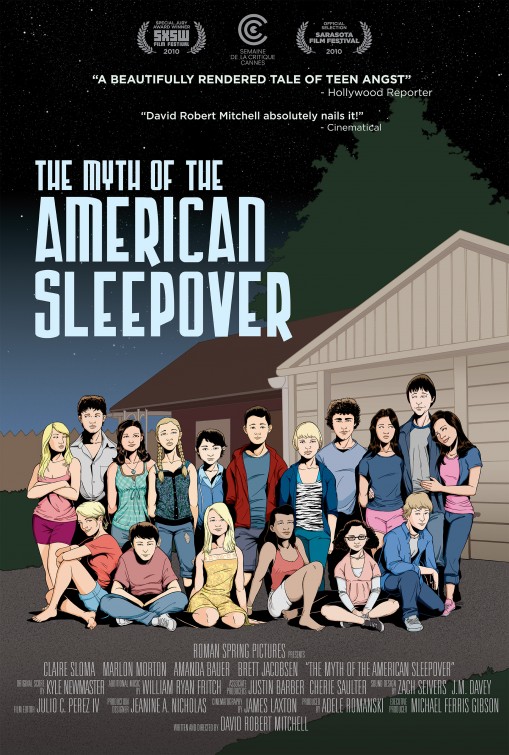 The curiously titled Myth of the American Sleepover owes as much to American Graffiti as it does to the works of John Hughes. This sprawling teenage opus by debut writer/director David Robert Mitchell resonates with all the beautiful aches and joys of adolescence, wonderfully understated but brilliantly realized. I fell in love with this movie.
Set over the course of one night in suburban Michigan, a slew of teenagers try and make the waning summer days worth remembering. Claudia (Amanda Bauer) is the new girl in school and invited to the cool gal’s (Shayla Curran) slumber party. She learns her boyfriend slept with the cool gal and plots a little boyfriend stealing of her own. Rob (Marlon Morton) is obsessed with a pretty blonde girl he once shared a look with in a supermarket. He is scouring the neighborhood, going from party to party, looking for her so he can reveal his true feelings. Scott (Brett Jacobson) is unsure of whether he wants to finish his final year of college, now the site of a painful breakup from his longtime girlfriend. One day while walking the halls of his former high school, he comes across a picture of him with twin sisters, Ady (Nikita Ramsey) and Anna Abbey (Jade Ramsey). He heads out to the University of Michigan, where the twins are enrolled, convinced he could win one, or both, of them over. Maggie (Claire Sloma) is navigating between the middle school sleepovers of her peers and the world of the cooler upperclassmen. She’s been nursing a crush on an older boy (Douglas Diedrich) who worked at the community pool all summer, and will find the courage to make a move.
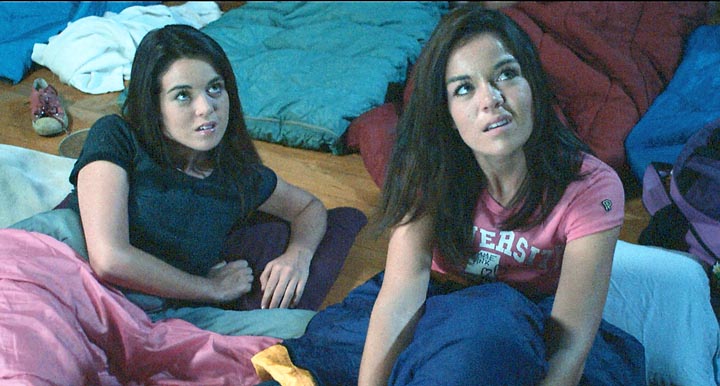 Unlike other coming-of-age entries, this is a movie that forgoes scatological comic setups and other Big Events meant to mark the passing into adulthood, like the loss of virginity, college admittance, or the prom; instead, Sleepover tackles a subject much more honestly and with tremendous naturalism. The level of detail is outstanding; set in what seems like the late 80s or early 90s, I was astounded at all the nostalgic artifacts of adolescence brought back to life. I kept going, “Oh yeah, I forgot about those,” or, “That’s totally something that me and my friends did.” I loved that the movie shows different social spheres and age ranges, so we go along with the late teen house party but we also get see a middle school/junior high sleepover that involves girls staying up late, talking about boys, and eating large bowls of chips. Obviously not everyone will have this reaction, but it just shows the commitment to recreating a very specific time, place, and sense of being. These feel entirely like real teenagers, and their troubles and desires are achingly articulated. You feel the powerful sense of yearning throughout, where the nudge of a knee, the closing distance between two hands that can cause your insides to fill up with a thousand butterflies. Sleepover is about teenagers grappling with emotional connection and personal identity, but it never drags out a soapbox or breaks from its verisimilitude. Every single character in this movie, even the ones meant to be seen in a questionable light, is deeply empathetic. Being an ensemble, you’ll gravitate to different characters and their pursuits, but the movie balances a nice mixture of storylines, cutting back and forth to build a graceful picture of the uncertainty of adolescence.
I found this movie to be so charming, so overwhelmingly affecting, and poignant without slipping into mock sentimentality, which would have been easy. It’s been a big year for nostalgia, but nostalgia is the “least authentic of all feelings,” according to Enrique de Heriz. It’s easy to sit back and say, “Oh I remember that too,” and feel the tingle of some wistful pull from the past, the yearning for a bygone time and place that has magically transformed in your mind into some idyllic spree. Does anyone remember those times, before there was an Internet, and cell phones, and social media, when you got together with your friends to witness the shared experience of a movie with female nudity (this might just be a guy thing), or when you didn’t know if you’d see your crush ever again? The Myth of the American Sleepover does, and so do I. In the words of Lou Reed: “I don’t like nostalgia unless it’s mine.”
 Indeed, it seems like the film exists in a bit of a cultural time warp, where sleepovers were the social apex and holding hands and making out were considered victories worth celebrating. There are no computers or cell phones, thank God. If you excuse the casual and extensive teenage drinking, Sleepover is a rather wholesome film. I was wary that some storyline might take an unexpected dark turn, especially with all the alcohol and hormones, but the movie maintains its sweet appeal without fail. While ostensibly existing in a late 80s/early 90s, I believe this movie is timeless and can be felt effortlessly by people of any age. The pains of adolescence and the anxiety of growing up, not to mention the peculiarities of the other sex, are universal. There is a superb scene where Rob and the girl who secretly likes him pass each other accompanied by friends. We get both sides of the story cut together; he tells his bud that one night he kissed her and then they made out. “It was a pretty good day,” he admits. She says she spent all night trying to get him to hold her hand and then just gave up. We instantly know that her side of this tale is far more accurate, but then this small exchange tells us even more about Rob, his fumbling attempt to be seen as cool with girls. Later, this same girl gives Rob a pep talk about unrequited crushes; she wonders if a person thinks hard enough about an individual, if they’ll know. Like most men, Rob misses her real meaning, but I’m happy to say that this story is tied up in such a sweet manner that I got choked up. The emotions of Sleepover are genuine and genuinely felt, no big overtures or outbursts, but the quiet moments of realizing who you are, who you like, and what you are and aren’t willing to compromise. It all feels utterly real and relatable.
The one storyline that seems to stand out amongst the rest of the panoply of sleepovers is that of Scott. He’s a college junior and at least three years outside the social realms of the majority of the other characters. You can’t help but feel at the start that he doesn’t belong and his presence, in a movie primarily about 14-15-year-olds, might feel a tad icky. Scott’s misguided attempt to get over his ex-girlfriend seems like some strange leftover plot from a sitcom. The fact that he’s trying to drown his sorrows in twin sisters almost seems skeevy. However, he comes clean early and opens up to reveal startling vulnerability, thanking the twins for a memory that would be incidental to them but has meant so much to him. It is this memory that gave him hope. The twins reveal that one of them had a huge crush on Scott back in high school, wishing he would one day reciprocate. But they won’t tell him who. He has to guess. The fact that this setup is actually a push toward personal growth and maturation is a great revelation and a relief.
 The cast of unknowns may be low when it comes to star-wattage but they lend the film another degree of authenticity. I wouldn’t say a single participant in this movie is a bad actor, though their characters are often understated, which under the wrong guidance can lead to blandness. None of these characters are exceptionally verbose or opinionated, which leaves the impression that they are thinly drawn. However, the characters coexist within the impressionistic nature of the film; it’s like a coming-of-age movie with the tone poem ambitions of Terrence Mallick. They are not as memorable or as sharp as the characters from Dazed and Confused and American Graffiti (Rob’s pursuit of his blonde dream girl, and his several near-misses, screams Graffiti homage), but the goal is a disarmingly sweet authenticity, allowing the viewer to discover relatable moments throughout the ensemble. I will say that Sloma imparts the biggest impression as the pieced, platinum pixie-gal feeling out the level of interest in her crush. I think we’ll be seeing more of Bauer and her cherubic, Scarlet Johansson-etched features as well.
The Myth of the American Sleepover is a sincere, observant, insightful, gentle, and overall wonderful little movie, brimming with life and the rocky experiences of growing up, but mostly it will make your heart sing. The details and small gestures feel completely believable; building an ode to youth that feels earnest without being sentimental and knowing without feeling like a know-it-all. There wasn’t a moment in this movie that didn’t leave me smiling, chuckling to myself, and feeling immersed in this innocent, heartfelt, exuberantly youthful world. The pleasures of Sleepover are small but numerous, and I don’t mind admitting to tearing up at several points, shaking in anticipation, and celebrating the personal triumphs of the cast of characters. The Myth of the American Sleepover made me feel like a teenager all over again, nervous, anxious, excited, and beguiled by the imprecise negotiations into adulthood. I’m sure some people will find this movie boring or too embryonic, a coming-of-age tale crystallized in dewy emo-earnestness. For me, I fell in love with this movie. It filled me with joy. I know it will do the same for others; Sleepover just needs a little tenderness and an open heart. The movie and its homespun magic will do the rest.
Nate’s Grade: A
Share this:

Coriolanus (2011)
 William Shakespeare’s little-known play has a surprising amount of cultural relevance: attacks on the border, suspension of civil liberties, political scheming, populist uprisings and riots, and a military elite arguing against the principles of appealing to the uneducated, mob-ruled masses. Plus Ralph Fiennes, taking on the hat of director for the first time, sets the play in modern-day. It seems like a struggle between Scotland and England, judging from the two mortal enemies, Coriolanus (Fiennes) and Tulius Aufidus (Gerard Butler). So it’s the Scotland/England struggle, termed ancient Rome, but set in what looks like the war-ravaged Balkans. Hey, at least Fiennes gets to have a nose in this film. The Shakespearean verbiage is certainly beautiful to hear, especially coming from the mouths of excellent thespians, notably Fiennes, Brian Cox, and Vanessa Redgrave. The actors achieve that synergetic level of excellence where it feels like they were always meant for the parts. Butler acquits himself well though his character sort of disappears unless needed by the plot. The elements that work best reside in Coriolanus’ refusal to play the game of political optics, neither serving a crowd of ignorant peasants he feels should remain out of the political process or the wily, double-crossing, self-serving politicians inflaming populist unrest. The movie sets itself up for some serious wrath to befall Rome, and besides the Greeks (and Koreans), nobody does revenge like this guy Shakespeare. We’re chomping at the bit for a cataclysm of death, but then the plot just sort of skips to a hasty conclusion, ditching the wrath. It makes you realize that, except for the intriguing title character, this isn’t one of the bard’s better plays. The characters are hard to empathize with, their conflicts too repetitive without deeper insight, and an ending that would be best described as a bit of a rush job. Still, even Shakespeare’s lesser work towers above most writers’ best material. Fiennes does a fine job as director, choosing lots of disorienting close-ups to communicate the rage of his character. Coriolanus is an interesting stab at something more, it’s just that sometimes it swings and misses.
Nate’s Grade: B
Share this:

11/11/11 (2011)
 Here’s a lesson for you. Not all elevens are the same. Case in point, the apocalyptic horror film 11/11/11, picking this eleven-friendly doomsday. That’s because there are two movies released in 2011 that have this exact same concept. The other movie was written and directed by Darren Lynn Bousman, the man behind three Saw films and Repo: The Genetic Opera. That one, actually released on 11/11/2011, has a bit more publicity to its numerological case. The only thing separating the two movies is their choice of numerical separation. You see there’s the direct-to-DVD 11/11/11 and the theatrically released, Bousman-directed 11-11-11. It’s dashes or slashes, folks. I’d have to imagine that the dashes movie is better than this, the slashes movie, just on Bousman. But then again, expecting a better movie from the guy behind the middle section of the Saw franchise might be asking for too much. Still, I’d have to assume that a blind monkey could make a movie better than 11/11/11, a horror movie that could only scare you with how bad it is.
The basic plot is that a family moves into a new home. Jack Vales (Jon Briddell) is teaching a college course, taking over for a professor who killed himself. The professor’s widow just happens to live next door, and she’s batty. Melissa (Erin Coker) has found out that she’s pregnant again. The town’s doctors are keeping her sedated an awful lot. Then there’s 10-year-old Nathan “Nat” (Hayden Byerly) who is turning eleven on November 11, 2011, and it seems like everybody wants to celebrate. The neighbor lady knows the truth: on that date (Veteran’s Day?) the gates of hell will open and Nat is the key. The boy must be stopped, though there is a whole nest of Satanists trying to arrange events so that Nat does bring about the end of the world as we know it.
 To call this movie low-rent is a disservice to grungy pornographers, exploitation peddlers, and inept amateur filmmakers. This movie is pathetic on just about every conceivable metric of filmmaking. First off, the premise is vague. We have this magical date looming, but what exactly happens? We’re told later that hell will open and maybe it’s the apocalypse or the rise of Satan or whatever. The kid, Nat, which by the way is the most annoying nick-name for somebody named Nathan (what was wrong with “Nate”?), is never made clear what role he will take. He’s the key to this whole deal but is Satan going to take over his body, as we see when he does some dastardly “no no” activities, or is Satan going to use him to release himself from hell? It’s never made clear, like much in the film, so the screenwriters make sure to cover their bases. Nat’s a demon child. Nat’s possessed. Nat’s scared of what’s under his bed. Nat’s mute. Nat can see into the future. Nat’s everything you need him to be. You’ll watch this movie constantly scratching your head, trying to get a feel for the rules or the boundaries of the narrative, grasping for nothing.
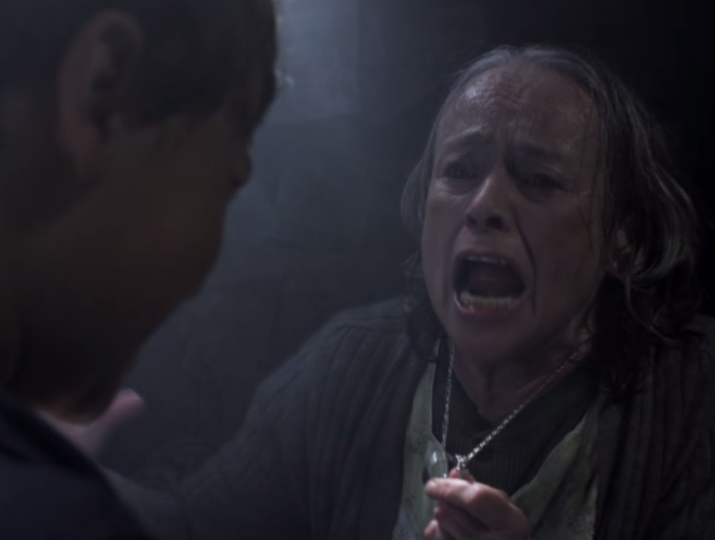
What you will be able to identify is the stupidity, which this movie has a never-ending supply of. Let’s tackle this numerological boogeyman thing head on. The shaky premise of 11/11/11 is that on that fated day the devil will rise up and… something. I’ll let the crazy old neighbor lady explain it best: “11 is God’s perfect number. One plus zero equals one [Editors note: Then shouldn’t one be the perfect number?]. Eleven is Satan’s number, it shows his arrogance, one more than God. Don’t you see? 11! Your son must die!” Well, I don’t need to hear anything else, pass the sacrificial blade this way. So I guess 666 just became passé and now 11 has become the new Satanic number of choice. Has anyone ever heard about this change? You know what, I’ll even go with this stupid idea. Let’s say what she said is true, so why does that mean that the year 2011 is the ultimate date of Armageddon? What about 1911, or 1811, or the first year 11 AD, or, God help us all, the year 1111? If eleven is Satan’s favorite integer then he missed a golden opportunity with that savory Middle Ages palindrome. Never mind the fact that our calendar is actually years off, but I’ll just assume that 11/11/11 takes place on its stated date even if people don’t know when that was. As a result of this numerological fanaticism, we’ll see lots and lots of clocks with some form of 11, like the very appearance of this number is meant to fashion fathomless dread. Oh no, the clock says it’s 11:40! Oh no, the clock says it’s 3:11! The clock face you dread the most is your own watch indicating that this movie is still not over. I thought we covered this numbers-are-evil nonsense with The Number 23. Once again, we have characters bending over backwards to try and make numbers fit into a pre-ordained pattern, supposedly enlightening us on all the spooky coincidences. So we have a character saying stuff like, “Flight 92 on September 11. 9 plus 2 equals 11.” Let me try: Wal-Mart has a special on PopTarts for $3.99. If you buy two, now 2 times 4 is 8, plus 10, divided by 8, times .5, and take the square root of who gives a shit?
 What else is stupid in this movie? Where do I start? The conspiracy of Satanists feels like a terrible rip-off of Rosemary’s Baby, as these people form the worst neighborhood watch imaginable. They’re scheming to get Nat to unlock the End of Days, so they all do their checking up on the Vales family and eliminate any neighbors who say too much. This cozy little neighborhood is replete with death, including the fact that the Vales home was the scene of a massacre. One skittish neighbor informs Jack and Melissa that somebody had an “accident” on the block. “Is he okay?” Melissa asks. “Well, he fell and got impaled on his fence. So, I’d say… no.” I kid you not, that’s his exact wording. This skittish neighbor is also murdered later. This band of secret Satanists includes the new Vales nanny, Denise (Aurelia Scheppers, looking like a poutier Denise Richards). This new nanny murdered the other prospective nannies, which is one way to move ahead of the competition. This nanny is bad news. She teaches Nat all sorts of bad behavior, from frying butterflies with glass to hurling rocks at joggers. And the dumb kid does it with glee, making me lose all interest in whether or not he is Satan’s seed/host/whatever. Then Denise gives the kid a birthday present – an old, spooky-looking comb. To demonstrate, in case Nat is unfamiliar with comb technology, she drags the teeth across her arm and draws blood. Then she gives it over to him to do the same. What? What kid is like, “Oh, wow, a way to ritualistically injure myself? That’s the best birthday present an eleven-year-old could want.” I’m pretty sure the kid would have liked an Xbox over a strange demonic comb. And wouldn’t you know it, this comb makes a return appearance when our Satanic neighborhood watch collects to conduct their business in, I kid you not, a station wagon parked on the side of the street. It’s literally a station wagon with eight or nine people crammed in it, and it’s there all hours of the day.
Then there’s our crazy neighbor lady, whose name I can’t even recall. The screenwriters want us to distrust her from the beginning, and that’s fairly easy when we see how weirdly creepy she’s behaving. She’s obsessed with luring young Nat into her shed, and she keeps offering promises of toy trains, glasses of (poison) lemonade, and promises of cool, fun things. If only she knew a comb was all it would take. This woman is trying to lure Nat with all the verve of a child molester. She’s frantic to kill Nat, even calling Jack at work to lecture him on the necessity of killing his son. Why does the Satanic neighborhood watch let this woman slide on by when they kill any other neighbor for the slightest slip-up? Anyway, this woman just so happens to have a machete in her shed and you can imagine what happens from there.
One more scene of ridiculousness, please indulge me. After Jack sees his son covered in bloody scratches, he accuses the nanny and has her arrested. In a scene of great hilarity for myself, we cut to a scene where the cop and nanny are already in the home, and Denise is dressed like she’s going out for a night on the town, and she’s twirling her hair in her fingertips. The image is so absurd. She gets arrested and thrown into the cop car. “You’re going to regret this,” she warns. Then, magically, wasps come out of a crevice in the side door and the car fills up with a swarm. The cop tries swatting them away and drives headfirst into a telephone pole. I need to note that the editing is so bad in this scene, cutting back and forth between the cop swatting and the car swerving, that the shots never match, so it seems like the longest reaction shots. The car crashes and mysteriously this has caused Denise to magically remove her handcuffs. She strolls out of the car, down the street, and then the car takes its cue and promptly explodes. If this wasn’t dumb enough, we then see different shots of characters around the block reacting to the explosion, heard over and over. One of the Satanic neighbors, still sitting in the damn station wagon, has adept hearing: “That must have been that cop car.” You see, her sense of hearing is so sharp that she can distinguish the make, model, and employability of the car via explosion. Just imagine how useful/useless she’d be in a Michael Bay movie.
 If 11/11/11 was just a supremely dumb movie it might work as camp, but it’s also inept as a scary movie. I don’t think director/co-writer Keith Allan could find an interesting looking shot if it held up a giant “11” sign. There is nothing scary about this movie whatsoever. All the shots of things with 11, it just doesn’t work, yet Allan keeps hitting it ad infinitum, mistakenly believing that while not effective on attempt 51, perhaps it will become effective on attempts 52-68. There’s a scene where Jack is standing watch at his son’s bed and the camera takes turns focusing on every stupid stuffed animal in the room, and Allan’s brilliant idea is to play a sound of the animal as we see its stuffed iteration. The stuffed bear is followed by a bear growl, etc. The fact that this series of animal noises continues for over a minute shows that Allan has no concept of what can scare or even what can entertain. His handling of actors is atrocious, as every single actor just bounces around the place, unmoored, unsure of what direction to take, so they take the wildest one. The actors are either monotone and flat or over-the-top, never believable for a second. Then there’s the “gotcha” ending which makes no sense considering Melissa is only three months pregnant and very much incapable of giving birth to a child, even if that unborn child is an unholy demonic terror.
11/11/11 is a date that will live in infamy, birthing this laughably awful, painfully ridiculous, atrociously inept movie, even by low-budget direct-to-DVD standards. The only entertainment you’ll find with this movie is the derisive sort, yukking it up over the unintended comedy bonanza that awaits. The movie is vague, silly, and overwhelmingly dumb, beholden to an inane numbers conspiracy that doesn’t hold up to scrutiny. I know my expectations should be kept at the minimum when dealing with this kind of movie, but that doesn’t mean I just ignore and excuse every artistic blunder, especially when I feel assaulted by them. 11/11/11 did bring on the apocalypse, and every audience member has left to go to a better place – the bathroom. Bousman should take some comfort knowing that the production house behind this movie, The Asylum, is somewhat notorious for rip-offs. I give you The Asylum releases: Battle of Los Angeles, Paranormal Entity, Transmoprhers, and The Day the Earth Stopped. 11/11/11 can hold one more numerical distinction: it’s the worst film of 2011.
Nate’s Grade: F
Share this:

Atlas Shrugged: Part One (2011)
 Billing itself as part one of an intended trilogy, Atlas Shrugged is an adaptation of Ayn Rand’s famous 1200-page book on the merits of self-interest. Rand has become resurgent in the last few years, a favorite author of the Tea Party, as her anti-government, anti-regulation, anti-union, and anti-poor perspective has found a new legion of fuming followers. I can’t imagine anyone else buying a ticket to the big screen version of Atlas Shrugged, a resoundingly tiresome and didactic enterprise. If this is what Part One brings, I can already predict the extensive yawning exercises I’ll have to do to get in shape for Parts Two and Three.
In the not too distant future, America’s airline industry has ground to a halt due to rising gas prices ($35 a gallon we’re told). The country has gone back to rail and leading that charge is Taggart Railway, lead by Dagny Taggart (Taylor Schilling). She’s trying to save her company from her lazy brother, James (Matthew Marsden), who wants to rely on bribery and his Washington friends to get by. Dagny wants to join forces with steel tycoon Henry Reardon (Grant Bowler), who has staked his company’s future on special new extra shiny steel. Other companies want to block Dagny and Reardon’s efforts, relying on Washington to write strict laws penalizing the rich and successful and spreading the wealth around to those less unfortunate. At the same time, powerful businessmen seem to be vanishing and the only connection seems to be the identity of John Galt, a mysterious capitalist with an offer no rugged man of industry will refuse.
 Maybe Atlas shrugged because he got tired of how unbelievably boring this movie is. Oh my goodness, I was rolling my eyes and checking my watch every five minutes. The vast majority of this film involves ideologues disguised as characters talking about esoteric business practices. A full 80 percent of the dialogue has to be about railways and steel and this manufacturing and ore mines and… I’m sorry I fell asleep in the middle of writing that sentence. Seriously, this movie could be a cure for insomnia. It’s so crushingly boring that it makes you wonder how anyone could ever pick up Rand’s novel and think, “This deserves to be a film.” There are segments where characters will talk this corporate gobblety-gook in unbroken reams, the actors behaving like androids. Now technical talk is not necessarily a one-way ticket to snoozeville, as political and corporate dramas can be quite invigorating in the right hands (see: Margin Call). It helps when you have a story, but with Atlas Shrugged all we have are mouthpieces for a political ideology. Regardless of political opinion, the movie fails because it never makes the story feel like it matters. The dialogue is perfunctory, labored, and inert, bogged down with lazy philosophical jabs. It’s all tedious expository dialogue with no room for character. Who wouldn’t want to watch a movie completely around the conflict of whether a train will get its steel tracks? That’s it. You wouldn’t know any of this mattered without the helpful inclusion of an overly enthusiastic dramatic score. Who cares about any of this junk? If you’re looking for the most high-profile movie of 2011 to talk about the infrastructure dynamics of railways, your long wait ends here.
Dagny and Reardon are supposed to be our heroes, the champions of the not-so-little guy, and thus we’re intended to root for their romantic coupling. Never mind that Reardon is married because, in that age-old point of rom/com rationalization, his wife is a bitch. The two have one of the most robotic lovemaking scenes I’ve seen in recent memory, and this flash of sexuality and a few dirty words are the sole reason this film earned a PG-13 rating. These characters remain one-note and vacant, including icy heroine Dagny casually admitting, “I don’t know how to feel.” And then there’s Reardon, who admits, “My only goal is to make money.” What better antagonists than unfeeling heads of huge corporations who just want to be left alone so they can make their untold millions? What a great entry point for the empathy of the audience. None of these characters grow, change, learn, or even seem to reflect recognizable emotions beyond venom-filled anger. The villainous government stooges act shady, plotting the downfall of those laudable titans of industry, but it all just becomes indistinguishable chatter, villains clucking to themselves.
 Set in the near future of 2016, this adaptation feels strangely dated, most notably in its ascent of railroads. There’s some ham-handed throwaway line about the cost of gas being so high so America just reverted back to the good old locomotive. I find this deeply implausible. It would have made more sense to actually make this a 1950s period piece, the original setting of Rand’s novel. We’re constantly told about the instability in the world via newscasters and announcers, but we don’t ever see the effects of this world in crisis. Mostly that’s because we’re hobnobbing with the rich in their boardrooms and cocktail parties, but there’s a scene where Dagny exits her limo and walks in a huff down the streets, which are empty of those dirty hordes of bottom-dwellers we’ve been hearing about. Apparently a world in crisis has done little to upset the disadvantaged, or the cities have just been very adamant about cleaning up the riffraff. The world depicted does not seem realistic. Would the country so easily go back to train travel where Dagny’s super train can cross 200 miles in a single hour? What about international freight and travel? I guess that still has to run on all that precious petrol. I’d assume that by 2016 the world will still be an interdependent, globalized economy, so I would think that the United States would face more dramatic tension than the oversight over a railroad company.
I’ve noticed that when it comes to a mostly conservative, mostly Christian fan base, the quality of movies is almost irrelevant. Movies like Left Behind, The Omega Code, Fireproof, or the recent Courageous are not expected to be good movies by traditional standards. They are sermons packaged in the guise of popular entertainment, which means that the artistic particulars come second to the message, and often do. Atlas Shrugged seems to fall into this same category. The production is very low budget, hence all those conversations in offices, and the CGI that is utilized looks pretty chintzy. The acting is profoundly bad, with Schilling (TV’s Mercy) giving a flat, monotone performance throughout, closer resembling a well-dressed mannequin than a human being. And naturally subtlety goes out the window in favor of reconfirming the belief system of the people buying the tickets. I have no issue with movies that adhere to an ideology, whatever that may be, as long as the message doesn’t get in the way of telling a good story. Atlas Shrugged is not a good story, not even close, and the message can be all too bludgeoning at times, like when Dagny incredulously remarks, “What’s with all these foolish altruistic notions?” The movie seems to be bristling with anger and many a character spits venom at the very idea of government involvement, unions demanding safe working conditions, and regulation in any form, red meat for the Tea Party faithful. Without that red meat, or the film’s strident message, there would be no reason to watch this mess.
 And now I’ll shed my objective reviewer cap briefly to get on my own little soapbox and denounce the dangers of Randian politics. To be fair, I’ve never read an Ayn Rand book and honestly have no inclination of ever reading one of this woman’s polemics. I just feel I have better uses of my time than reading a justification for sociopathic greed. Rand’s extreme philosophy has been described as reverse Marxism, wherein the social elite is being sucked dry by the lechers of the world, those who do not contribute to the value of society. And for Rand the only value is money. The world, Rand posits, would be a better place if man would only think of himself. I fundamentally disagree with this notion. Remember that part in the bible where Jesus gives money to the rich and tells the poor to suck it up? Rand’s self-involved philosophy seems like a round of consumerist Calvanism, rehashing a skewed religious perspective that was popular with the upper classes because it provided celestial reasoning why the rich were so rich and the poor were so poor. You see God wanted you to be rich, that is why you were born into a wealthy family, and he wanted all those miserable poor people to suffer. To help out the poor would therefore be blaspheming God’s infinitely unknowable plan. The basic plotline of Atlas Shrugged, though only teased in Part One, is that the rich will get tired of being burdened by societal constraints and up and leave us all. Here’s a good question: if all the billionaires in the world were to vanish, do you think everything would grind to a halt? Would we all be so out of luck without the super wealthy telling us what to buy? It’s like the reverse of 2006’s social satire A Day Without a Mexican, proposing that the American economic engine would be severely stalled if all the undocumented workers were to vanish. Under Rand’s narrow line of thinking, the rich are that way because they are the best and brightest, the innovators. Nowhere in that equation does Rand leave room for the rich being rich due to lies, cheating, nepotism, and rigging the system for the continued benefit of a select few. I’m not meaning to begin a screed here, but I think the 2008 economic meltdown proved what happens when business is left to regulate itself. The economic collapse also proved that just because you’ve got some letters in your title (CEO, CFO, etc.) does not mean you’re the smartest egg. Cronyism and a scoiopathic desire to look out for one’s self-interest above all else is what brought the world on the brink of economic collapse. For me, recent history is a rejection of Rand’s theories, not corroboration. Okay, soapbox put away.
Atlas Shrugged the film seems almost like an unintended ironic statement on Ayn Rand’s belief of the superiority of the individual. That’s because movies are a profoundly collaborative medium, where many hands toil away to create a work of art. It is not the result of one man or woman but the results of hundreds of men and women working together, each knowing their role, playing their part, and working toward something greater than individual self-interest. Huh, how about that? It pretty much doesn’t matter that Atlas Shrugged is a powerfully boring, braying, incoherent, tedious chore that is merely a message disguised as a movie. The intended audiences will more than likely hail the final product, ignoring “details” like the talky exposition-heavy dialogue, horrible acting, laughable special effects, and plodding pacing, and overall poor production. The Rand faithful are not going to this movie to be entertained, they are going to see their beliefs reflected upon the big screen. The overall quality of Atlas Shrugged is an afterthought to them. I just wish it wasn’t an afterthought to the people making the movie.
Nate’s Grade: D
Share this:

Young Adult (2011)
 The basis for the movie Young Adult sounds like writer Diablo Cody settling a few sore scores. You’d think winning an Oscar for Best Original Screenplay for 2007’s Juno would have sufficed. Reteaming with her Juno director, fellow Oscar-nominee Jason Reitman (Up in the Air), the duo takes aim at the bitchy, stuck-up, popular girl that seemed to rule the school. Young Adult is much more than a vicarious act of vengeance on mean high school adversaries. It’s a revealing, awkward yet compelling dark comedy about the perils and pitfalls of arrested development.
Life hasn’t turned out exactly the way Mavis Gary (Charlize Theron) would have thought. The former high school queen bee has left her small town for life in Minneapolis. She’s the ghostwriter for a successful series of young adult books, a series that is coming to an end. She’s divorced form her husband, facing financial ruin, and living alone with her tiny Pomeranian, Dolce, her only friend. Mavis decides to forgo writing the last book in the cancelled series and instead return to her hometown the triumphant mini-celebrity she knows herself to be. She’s determined to find her old boyfriend, Buddy Slade (Patrick Wilson), and win him back. The fact that Buddy is married and has a newborn baby is no real impediment to Mavis’s crazy plan (“Hey, I’ve got baggage too,” she reasons). Once home, she runs into Matt Freehauf (Patton Oswalt) in a bar. Matt and Mavis went to high school together, though she has long forgotten the likes of him. Matt’s claim to fame was that a bunch of jocks in high school savagely beat him thinking he was gay. Matt sees right through Mavis and the two of them become an unlikely pair as Mavis plots and schemes her way to victory.
 Young Adult is one of the most enjoyable squirmiest times you can have at the theater. Much of its humor, and it is very funny, is built around the pained awkwardness of Mavis’ self-involved, self-destructive mission. My friend was nervously fidgeting in his seat the entire time (he may have just had to go to the bathroom). The sense of dread is palatable; we’re watching a slow-moving car crash, waiting for the inevitable to hit. Every scene carries the apprehension of, “What is she going to say/do next? Is this it?” And yet Cody’s sharp, pointed writing makes the film compulsively watchable. We dislike Mavis, an irredeemable character who doesn’t even try to be likeable, and yet by the film’s conclusion most audience members will likely feel more pity for Mavis than outright hatred. I’ve had some friends ask me if Young Adult was anything like Bad Teacher, another movie about an abrasive, selfish, unlikeable bad apple. This movie is different. This movie is actually good. Mavis is not some wacky cartoon character, and Reitman has kept his reaction shots to a minimum, abstaining from having to remind us via public reaction how inappropriate Mavis can be. Unlike Bad Teacher, this grown-up meanie feels all too real, and her actions come across as believably threatening. This woman could do some serious damage on her way to massage her damaged ego. The movie never condones her actions, though Reitman and Cody make a point of piling on against Mavis. This woman is an ugly wreck, and Cody’s writing and Theron’s gutsy performance speaks volumes. Cody’s writing isn’t the hyper-literate, stylized dialogue we’re accustomed to from Juno. The dialogue and characters are eerily recognizable, miles away from the cuteness of Juno’s sunny, optimistic fairy tale inhabitants. Young Adult is a more nuanced, droll, mature work that deserves as much recognition as Juno and cements Cody, in my mind, as one of the most thrilling writers today (I can almost forgive her for Jennifer’s Body. Almost).
Along with all the bleak comedy, Young Adult lands a surprising number of poignant dramatic blows. Cody has crafted an exacting character study on a severe case of arrested development. Many of us can relate to knowing that one gal in high school, the pretty, popular one who had everything in life handed to her. In Young Adult, Cody shows the devastating consequences of a lifetime of entitlement and zero introspection. Mavis secretly knows that she’s past her prime, that all the people she left in her Podunk town have moved on to richer lives while she’s stayed in the same holding pattern her whole life. Some part of her has never left high school. She’s an emotionally stunted woman trying to live out the fantasy of one of her undervalued books (her misreading of the end of The Graduate into a love-conquers-all message is rather telling). Mavis’ life is hardly the stuff of Champaign wishes and caviar dreams, but to the people of her hometown, life in the “Mini-apple” is the Big Time. There’s a fabulous scene where Mavis goes into a bookstore and sees her series on a clearance stack. The bookstore employee tells her they don’t sell and will be most likely sent back to the publisher. Mavis takes out her pen and autographs one, informing this minimum-wage peon that she is the fabled author of the series. She’s expecting fawning admiration. The employee flatly tells her, “If you sign them, we can’t send them back to the publisher.” In her disgust, she tries to sign as many as she can as an act of defiance. Later in the movie, Cody sheds light on Mavis’ family life, offering intriguing clues for how this woman became so broken. Her parents just seem to shrug off Mavis’ admission of alcoholism, like they’re used to their daughter acting out, even if she might really be crying out for help. She’s a fascinating character to watch crash and burn.
What gives the film its most potent sense of heart (Grinch-sized though it may be) is the unlikely yet compelling relationship between Mavis and Matt. Unlike Mavis’ perceived slings and arrows, Matt has suffered real trauma from high school. His bones were shattered from that brutal beat down and he’s left to limp with a crutch. He hasn’t been able to mentally leave high school behind completely himself, but then again he has a constant reminder. Mavis is strangely her most open with Matt, possibly because she doesn’t view him as a threat or a credible alternative (the joys of high school revisited – the pretty gal ignoring the existence of the lower classes). He’s portrayed as the film’s voice of reason, voicing concern over Mavis’ kamikaze narcissism. Together they form what could charitably be described as a friendship. She seeks him out to talk at odd hours of the night and he’s straightforward with her. He thinks her plan is nuts, but he’s also secretly enjoying his unexpected friendship with the queen bee of high school, albeit twenty years later. “Guys like me are made to love girls like you,” he confides to Mavis. Oswalt has shown some dramatic skills in the underappreciated sports fanatic flick, Big Fan. With this movie, Oswalt gives an achingly felt performance, the most empathetic character in the whole movie and a joy to watch onscreen in a high-profile role that fits him like a glove.
 But the true star of the film is Theron, who gives a fully formed and entrancing performance as someone who is as ugly on the inside as she is beautiful on the outside. Her character could have easily slipped into being an unsympathetic monster; someone the audience wants punished (like Cameron Diaz’ character in Bad Teacher). But the actress finds her own twisted, tricky way to center the character. Every detestable glance, every pained inhalation, every rigorous attempt at seduction, it feels like the character coming alive before our eyes. Theron has dissolved into the abhorrent mess that is Mavis Gary. She’s convinced that Buddy could never be happy with such a mundane life in a mundane town (“There’s a restaurant that’s a Pizza Hut, Taco Bell, and KFC in one building” she says incredulously). Her perspective is so deluded that you start to see the manufactured world Mavis has so cautiously built around herself as a defense from reality. She watches wall-to-wall reality TV, the perfect metaphor of our times concerning the idolization of idiocy and self-absorption. She may not be likeable but she’s definitely compelling, and Theron is so good as that-girl-from-high-school all grown up, that she might even win over some slight sympathy by the film’s end. At one point, the inner fear of Mavis reveals itself, and she expresses her confusion about the attainability of happiness. Why can others find happiness with so little, and she cannot find it with everything that she has?
Young Adult is a dark comedy of squirm-inducing, uncomfortable bleakness and a drama of surprising poignancy and depth. It’s the good kind of uncomfortable, the kind where you can’t look away or leave the vicinity of your seat. Theron and Oswalt are fantastic. Cody’s gift with words, teamed up with Reitman’s gift with actors, makes a beautiful combination even when the end product is charting the misery or a miserable person. The measured tone is kept from start ot finish, meaning even when the movie appears on the precipice of life-lessons and Mavis might turn her life around, it pulls back. There will be no hugs and gained wisdom with this movie, a crackling comedy that’s also one of the best pictures of the year. Take that, popular girls who never gave me the time of day.
Nate’s Grade: A
Share this:

Tucker & Dale vs. Evil (2011)
 This delightful indie comedy turns old, creaky horror conventions upside down, and in doing so becomes one of the most surprisingly enjoyable, surprisingly sweet little movies of the year. The titular Tucker (Alan Tudyk) and Dale (Tyler Labine) are a couple of hillbilly buddies going out to a cabin for a relaxing weekend of fishing. Their vacation is ruined by a group of snotty college coeds who are convinced, via a chain of misunderstandings and ignorance, that Tucker and Dale are out to kill them. The judgmental college kids go on the offensive and they keep getting killed through macabre accidents. The movie aims to show the “other side” of horror movies, from the mistakenly creepy redneck perspective. Tucker and Dale are a loveable pair of guys who react with genuine horror about all the trail of death that follows them (they think the college kids are a part of a suicide cult). The movie will play best for fans of horror that will recognize all the references and satire. Even if you’re no fan of the bloody, grisly stuff, Tucker & Dale vs. Evil is a clever movie that provides plenty of chuckles. You may not roll in the aisles with laughter, and the film’s aim is a tad slight, but the sweet, bumbling nature of the titular duo will keep you consistently amused.
Nate’s Grade: B+
Share this:

Martha Marcy May Marlene (2011)
 Unsettling but testing, the film Martha Marcy May Marlene is more than a mouthful. It’s about a gal, Martha (Elizabeth Olsen, younger sis to billionaire twins Ashley and Mary-Kate), who enters a creepy cult, and then in due time runs away to live with her detached older sister (Sarah Paulson). Writer/director Sean Durkin cleverly jumbles the timeline, so we follow two parallel storylines: Marcy May (her new identity) entering the cult and Marlene (her identity after fleeing?) adjusting back to the real world. At heart is Olsen, who gives a star-making turn as the troubled heroine fighting back prior programming. We get flashes of what cult life was like under charismatic leader, Patrick (John Hawkes, goin’ country once more). The sections concerning the cult are creepy but not exaggerated to break the film’s fragile realism. It’s uncomfortable stuff with lots of ritualistic raping. The film moves at a slow, deliberate pace, echoing Olsen’s dueling transformations. She’s having trouble readjusting but she can’t open up about her experiences for fear that she’ll endanger others. The film cranks up the paranoia and looks to be coming to a head when … everything just stops. End credits. Martha Marcy May Marlene feels like ¾ of a movie until you stop and think that we’re trapped in her omnipresent paranoia and that she will be essentially broken for life. While I wanted Durkin to find a way to reach that conclusion that felt conclusive and fulfilling, the ending, while abrupt, does feel appropriate. Olsen is terrific and expresses so many complex emotions even through her veneer of emotional reserve and mistrust. She has a bright future ahead of her. She’s no longer “the other Olsen sister.” Now she’ll be the “talented Olsen sister.”
Nate’s Grade: B
Share this:

The Tree of Life (2011)
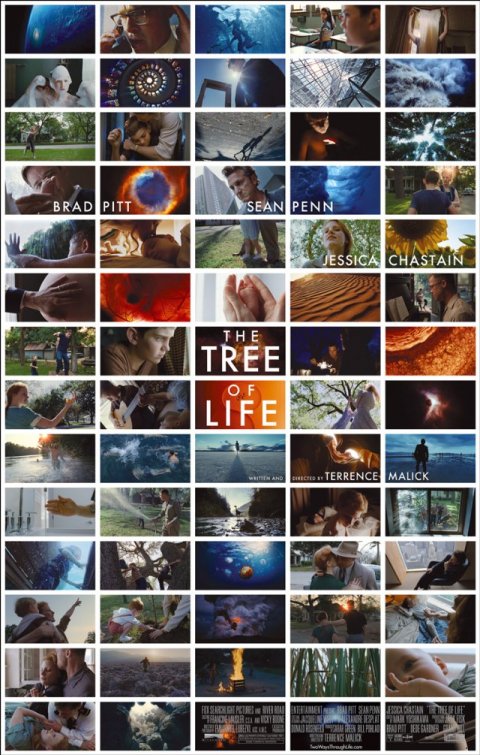 If a Terrence Malick film (The New World, The Thin Red Line) is the closest thing cinema has to creating a religious experience, turning the theater into a church, then I choose to worship elsewhere. After four movies I can decisively say that I am not a Malick fan. The man is more interested in making ponderous nature documentaries attached with pretentious, whispery, obtusely poetic voice over. The man is not interested in narrative filmmaking. The Tree of Life, the inexplicable winner of the Cannes Palme d’Or, is less a movie than an impressionistic experience inside a dying man’s brain. It feels like all the synapses are sizzling, memories and fantasies bouncing around and melding. We see a 1950s childhood and a pushy father (Brad Pitt), but then we also see mom (Jessica Chastain) floating at one point, and Malick also manages to squeeze in a 15-minute sequence charting life from the Big Bang to the end of the dinosaurs. What? The Malick faithful declare their man a singular auteur, a man who uses cinema to explore the unanswerable questions of life, the universe, and everything. Terrific. However, most of these edits are only a couple seconds, and with little narrative momentum the scenes drag and drag, and every Malick minute feels like a thousand hours. Sean Penn, as the adult son, probably filmed his stuff during a pee break from another movie; it’s that short. The film is a technical marvel, the cinematography making tremendous use of different light levels, but that’s all this movie is for me — pretty pictures. It’s yet another frustrating, pompous, punishing “film,” a term I’m being generous with, from Malick. The Tree of Life moves so slowly and intractably that I wondered if literally watching grass grow would be a better use of my time. Sorry Malick disciples, I guess I am a movie secularist.
Nate’s Grade: C
Share this:

Insidious (2011)
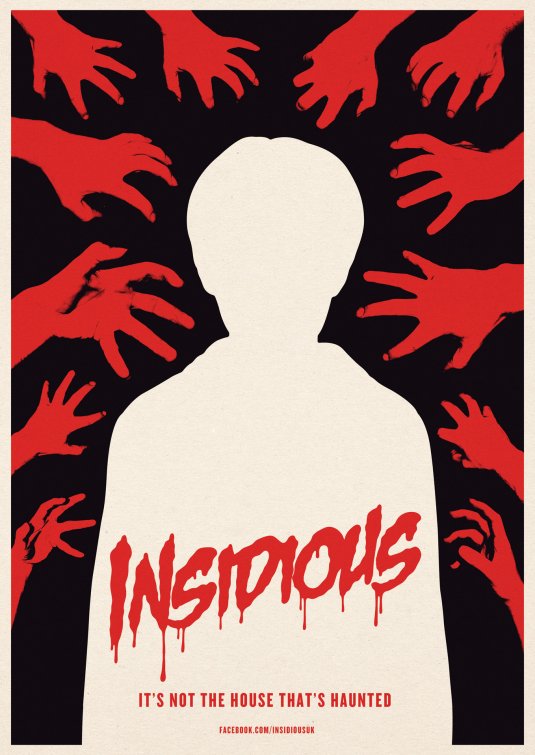 Insidious is like a fresh coat of paint on the old haunted house movie. Director James Wan and writer Leigh Wannell, the team that birthed the grisly Saw franchise, are working in a completely different realm of horror, tying together familiar genre elements (creaky doors, séances, possession, demons with a lipstick fetish?) into one seriously effective spine-tingler. This PG-13 frightfest is well paced and methodically constructed, giving you pause whenever a character ventures offscreen. It finds a way to make old fears scary again. Wan and Wannell find ways to get under your skin. The final act lacks the precision of the rest of the movie, settling on too many explanations and a jumble of action, but the movie works. There are plenty of memorable, deeply creepy images afoot, the score of shrieking violins is a great addition to the ambiance, and the characters seem, given the outlandish scenario, fairly realistic and relatable. Rose Byrne and Patrick Wilson make a rather sweet married couple. Insidious is something of an old school horror film, using clever tricks and avoiding obvious clichés while building a genuine atmosphere of trepidation. The movie got me to yell at my TV, which is an achievement in itself for a horror flick. I lost my sense of place and reverted back to a participant, spooked at what may be lurking in the dark. Not too bad for PG-13.
Nate’s Grade: B+


 nathanzoebl
You must be logged in to post a comment.