Blog Archives
The Purge: Election Year (2016)
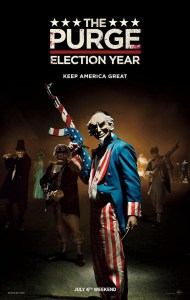 What once seemed like a premise fit for ridicule has become a franchise I actively look forward to now and swallow whole any incredulity. The Purge: Election Year is something of a lateral move from its predecessor, Anarchy, as it’s not an improvement but it’s still a fun and thrilling entry that provides just enough satisfying gonzo political commentary to temper its action. Finally with the second movie I got the Purge movie I wanted, experiencing the event itself outdoors, and Election Year continues this trend. We follow a small group of minority characters trying to survive the night, escaping from one location to another as they encounter a menagerie of weird, murderous citizens trying to make America great again. A presidential candidate (Elizabeth Mitchell) wants to do away with the barbarous Purge practice, and so this makes her a top target during that 12-hour free-for-all. Her head of security, and lone source of protection after an ambush, is played by Frank Grillio, returning from Anarchy and reminding you early and often just what a great action hero he can be. I enjoyed the ongoing shaping and texture of writer/director James DeMonaco’s kill crazy world, whether it was “murder tourists” coming over to America to experience consequences-free killing, the idea of a religious ceremony deifying purging, and even stuff I know is pure trailer candy, like an all-girl gang dressed in creepy masks, princess dresses, and chainsaws. There is some seriously unsettling imagery and moments, though the presence of a white supremacist hit squad dilutes some of the film’s tension simply by being a constant antagonist chasing down our heroes. There aren’t as many new set pieces to further illuminate the depravity of this world as there was with Anarchy. Still, there’s more than enough nasty bite in this franchise. How is this franchise not been turned into an open world survival video game yet? I wonder why everybody just automatically wants to murder during the Purge. I would just probably cheat on my taxes (don’t audit me IRS for this statement!).
Nate’s Grade: B
Share this:

Swiss Army Man (2016)
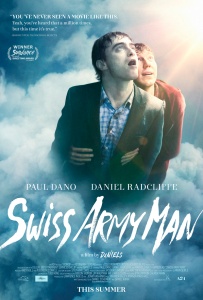 Swiss Army Man shouldn’t work as a movie, and in fact it will only work for a narrow swath of the world’s audience. There were plenty of walkouts during its Sundance premiere. The triumphant riding of a powerfully flatulent corpse in the film’s opening ten minutes should seal the movie’s fate. How does a movie survive such a juvenile, taste-obliterating moment, and one that is meant as an introduction to the film? Amazingly, stupendously, Swiss Army Man delicately walks that narrow tonal path and succeeds wildly, rapturously, and produces the rarest commodity in Hollywood, something daringly different and excitingly new. I fully anticipate that sizeable portions of readers are going to have an immediate and repellent response from just reading the plot synopsis, and I can’t blame them. I will do my best to try and explain why the movie worked so well even if I know this will be a fool’s errand for many, but if I can convince one more human soul to give Swiss Army Man a chance, then I’ve done the Lord’s work.
Hank (Paul Dano) is stranded on a desert island and about to hang himself when a dead body (Daniel Radcliffe) washes ashore. Unfazed, Hank is still determined to end his life, that is, until he can no longer ignore the farting of the body. That’s when he gets an idea and uses the power of the farting corpse to ride back to the mainland. Hank drags the corpse with him finding unique benefits, like his retention of drinkable rainwater. He’s still stranded and it’s at this point that Manny, the name he gives the corpse, begins speaking and inquiring about the world and what it means to be human.
 Swiss Army Man is a disarming buddy comedy that weirdly yet miraculously deepens as it goes, becoming a genuine relationship drama that touches on the profound and philosophical. For the first act, the movie is an unconventional survival drama with Hank finding peculiar yet helpful uses with his savior, the dead corpse. It’s a guy lugging around a dead body at the end of the day. I was wondering if this was really a story that was more suited as a short and didn’t have the substance to merit a feature-length runtime, and that’s when the magic realism steps up and when Manny comes into focus. This is easily one of the most oddball buddy comedies ever. Manny is an innocent, a proverbial babe in the woods, and doesn’t know much about himself and the world, and Hank becomes his teacher. Through this process he’s forced to examine his own life from an altogether different perspective and actually starts to vocalize and come to grips with his own life’s shortcomings, insecurities, and frustrations. It’s through Manny that Hank is able to open up and examine what it means to be human. Their interaction becomes a truly rewarding and emotionally honest buddy film where one of them just happens to be a talking corpse that farts a lot. Manny wants to learn about the world and to feel what it means to be alive, and it’s this new path that emerges that gives the film a new life.
You would expect something this strange to be drenched in irony or pushing the audience to laugh at the characters, but you would be completely wrong. Swiss Army Man is one of the most earnest movies you will ever see. It is completely genuine, heartfelt, sincere in every crazy detail, and it’s what gives the movie its emotional resonance. It treats the relationship between Hank and Manny with credibility. It’s a movie about celebrating and claiming ones weirdness, told from a movie that is proudly offbeat. Hank feels left out by normal social interactions. He’s the typically withdrawn and awkward Dano character we’ve come to expect from his catalogue of films; however, rarely has he seemed this artfully articulated. He’s a man who has some deep-seeded neuroses and fears, including farting aloud in public, and he’s using his ongoing experiences with Manny to exorcise some of these past failings, to become the determined, self-actualized man he wants to be. There’s a touching part where Hank talks about the poor relationship with his father; the two have signed up for one another to get birthday e-cards via email. That’s the extent of their connection at this point, and yet Hank remarks that even if he were to die his father would still get a birthday card from him in perpetuity. It’s a small little thing but it hits and makes one think about the impact and legacy we’ll have after we’re gone for good. Are we more than just an occasional birthday card? The fact that the movie utilizes a climax that incorporates farting in public as an emotional catharsis is amazing, but what’s even more amazing is that this moment is completely earned and gratifying.
Another aspect of Swiss Army Man that kept me specifically amused is the clever use of ambiguity. As the fantastical plays out with even-keeled realism, it’s easy and expected to believe that much of what we are witnessing is all in the mind of Hank. He’s projecting his needs and hopes onto this analogue for a friend that also represents himself. That’s why Hank uses Manny to relive personal experiences and to try and get them right. Then the third act comes along and causes you to question even more, putting the behavior of Hank into a muddier realm that makes you wonder if he’s this innocent wounded heart we had come to know previously. Then there’s Hank’s fixation over the pretty girl (Mary Elizabeth Winstead) he gravitated to on his bus rides. He looks to her as a goal, something he can return to once finally rescued and returned home. As he plays out his brief experiences with her, dressed as her, with Manny in the position of Hank, a faux courtship ensues. Hank, as her, and Manny, as stand-in for Hank, and it’s weird and wonderful and not afraid to accept the homoerotic qualities of its implications. This is a love story ultimately but a unique kind of love, and it’s up to the audience to determine what that means exactly. Is it romantic, bro-mantic, or simply a dude coming to terms with his own life in a very unusual therapeutic manner? The writer/directors The Daniels (Dan Kwan, Dan Scheinert) don’t outright tell you how to think or feel throughout any of this movie, which is a blessing. They present a complicated world with complicated and broken people doing their best to try and make their own sense, and they invite the audience along on this beguiling journey and just ask that they be patient and open-minded and then come to their own conclusions.
 The music is a wonderful element that is also another facet of the characters, layering in even more whimsy and character depth. The music is often accompanied by Radcliffe and Dano, their mutterings and ramblings becoming syncopated and layered into a soothing collage of sound. They’re providing their own soundtrack to the movie of their life. Early on Hank describes the music from Jurassic Park as the proper accompaniment for life’s big moments, with a little nestling of nostalgia as well. It’s especially enjoyable to listen to either of the guys break out into their rendition of the majestic Jurassic Park theme. It’s silly and sweet but it also gets at the psychological element of Hank being outside himself, seeing his life as a movie and he as its lead. He also hums what he remembers of “Cotton Eyed Joe,” which reappears throughout with comically incorrect and changing lyrics. The music is another reflection of the characters and it imbues the scenes with an extra sense of whimsy that helps to maintain its magic realism tone.
Radcliffe (Harry Potter and the… everything) and Dano (Love and Mercy) are terrific together and Radcliffe gives a tour de force physical performance. The way he’s able to contort his body, malign his posture, make use of stilted facial expressions is amazing. This goes leagues beyond the simple slapstick of Weekend at Bernie’s. The way he’s able to convey a character and a performance through this crazy decaying prism. Manny wants to help people, is eager to learn, and it makes his character so endearing, and then you remember he’s a corpse who might just be a figment of Hank’s diseased imagination. Radcliffe completely lets go of vanity and delivers one of the best performances of the year. Dano is in more familiar territory but shines again, serving as a dry comic foil for Radcliffe. The two of them form a highly entertaining and winning buddy team.
Swiss Army Man is a unique film experience and one that shouldn’t work. It’s filled with juvenile body humor. Its key supporting role is a dead body. It’s about a guy who may or may not be a stalker living in a fantasy world in his own head. This should not be, and yet like Manny himself, miraculously it has been birthed into existence and we are better for it. Every time it feels like the movie is heading for a more conventional direction that will weigh it down, be it a love triangle or some slapdash “he was dead the whole time” twist ending, it calmly steers away. This is a wonderfully humane, touching, earnest, and emotionally affecting movie, one that, yes, also involves farting. The body humor stuff is a reflection over confronting what we feel uncomfortable with and why that is, what social conventions tell us is in poor taste, tell us to box ourselves in and play by the rules. Here is a movie that gleefully plays by its own rules. It’s not going to be for everyone but if it’s for you, like me, there might not be much else that can rival its cinematic highs. Even if you think you will hate this movie, see it. See it just to have seen one of the strangest and most beguiling movies of the modern era. See it and judge for yourself. I’m still awed at how life affirming and profound a movie with a farting corpse can be. Swiss Army Man is a labor of love, an explosion of feeling, and a declaration to stay weird.
Nate’s Grade: A
Share this:

Midnight Special (2016)
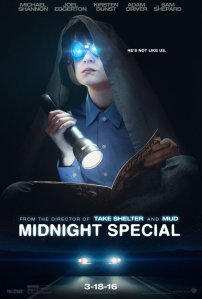 Jeff Nichols should already be a household name after Mud and Take Shelter, and with his new movie Midnight Special, the man has done nothing to break his incredible record of success with making deeply personal, ruminative, thrilling, and brilliant films. Midnight Special is a better and more earnest love letter to the cinema of Spielberg than Super 8 was. A young boy exhibits strange and supernatural powers. The religious compound he came from looks at him as a prophet. The government thinks he might be a weapon. Two different groups are on the hunt for this boy, and that’s where Nichols drops us right into the middle of, respecting the intelligence of his audience to catch up and figure things as they develop. In some ways it reminds me of Mad Max: Fury Road, an expert chase film that establishes its characters naturally as it barrels onward. The acting is wonderful all around and Nichols does a great job of finding small character moments that speak volumes, giving everyone time in the spotlight. The various twists and turns can be surprising, heartwarming, funny, but they stay true to the direction of the story he’s telling and grounded in the simple, unyielding anxiety and love of parents for their child. Michael Shannon (Nichols go-to collaborator) is directly affecting as a humble but determined father risking everything for the well-being of his son. The concluding act left me awed and felt something akin to what I think Brad Bird may have been going for with Tomorrowland. This is a thoughtful science fiction movie that allows its characters space to emote, its plot room to breathe, and yet still thrills and awes on a fraction of a Hollywood budget. It shouldn’t be long before some studio finally taps Nichols to jump to the big leagues of a franchise film, but if he wanted to keep making these small, character-driven indies on his own terms, I’d die happy.
Nate’s Grade: A
Share this:

Hardcore Henry (2016)
 Hardcore Henry is an action movie told entirely through the eyes of its silent protagonist. Some critics and fans are calling it the future of movies. Director and co-writer Ilya Naishuller strapped a team of stuntmen with facial camera masks and filmed entirely on GoPro Hero 3 cameras taking in every punch, kick, and jump. It’s an ambitious filmmaking gamble that dares to be something different, but is it worth the effort?
Henry wakes up in a science lab. Estelle (Haley Bennett) informs him/us that she is Henry’s wife and is upgrading him with a bionic arm and leg. Unfortunately, his voice hasn’t been implemented yet. Akan (Danilla Kozlovsky), a menacing albino with telekinetic powers, breaks into the lab and kills everyone but not before abducting Estelle. Henry is battered and left for dead. His only assistance comes from Jimmy (Sharlto Copley), a mysterious and helpful man who tries to direct Henry toward his mission of saving Estelle and thwarting Akan.
The draw of this movie is its propulsive and immersive visual playground, putting the viewer in the mind of its title hero as he narrowly escapes scrapes, scales buildings of dizzying heights, and kills a whole lot of bad guys with brutal efficiency. Its POV experience makes the hardcore violence all the more immersive, though after a while I was wishing we could change things up (more on this below). I must applaud director Naishuller and his crew of limber stuntmen for the sheer creative ingenuity of their stunts and action. With a relatively small budget ($10 million, or roughly the budget spent on bagels on the last Transformers flick), the ambition behind this movie can be startling, and the development of some of its more bonkers action sequences can provide a sky-high jolt of adrenaline like few movies match. The action is also very violent, with heads being blown off, limbs being snapped, bodies bent in two, eyes gouged and used to rip heads in half (this one still confuses me from a mechanical front), and near relentless bloodshed that sometimes even requires our hero to wipe it from his face. For those hungry for near non-stop action shaped to be the equivalent of a living first-person shooter game, Hardcore Henry might do enough to strap in and deliver the goods.
 I have a confession dear reader: I experienced a fierce bout of motion sickness from this movie unlike anything I’ve ever encountered in a theater. I’m usually rather immune to shaky camera movements and found footage movies. I remember reading about people getting sick and throwing up during screenings of The Blair Witch Project not because of its content but simply from its handheld camerawork. I have never had an issue up until now. After 20 minutes of Henry, I had to sit much further back in my theater. The continuous whipping camerawork caused me a great wave of nausea. I even had to leave the theater for five minutes in the middle of the movie just to re-calibrate my brain. I would warn people about sitting too close to the screen but ideally this movie’s proper place is really your home television. You can choose to take my review with some degree of skepticism thanks to this admission, but no movie ever got to me and forced me out of the theater from motion sickness before. Henry now has that dubious honor.
The gimmick does start to lose its novelty and I wanted to break free from the claustrophobic first-person perspective as well as its paper-thin story. I started thinking there were as many restrictions to the first-person perspective as benefits. It really hampers the hand-to-hand combat choreography, which often just feels like flashes and blurs, herky-jerky editing that doesn’t immerse so much as obscure. This seems to be more of an issue for the first half than the second, which relies more heavily on small arms battles. Chase scenes aren’t added by bobbing up and down from the first-person perspective. You just aren’t able to focus on the object or person of pursuit. I also don’t understand why the entire movie relies upon a fish-eye lens either, which isn’t exactly a normal part of human vision. Its distorted images, subtle but accumulative, added to my overall motion sickness. However, the worst aspect of Hardcore Henry is easily its story or what amounts to its story. This is a movie that looks like a video game and feels like a video game, except somebody else is playing it. The very opening plays out like a video game introduction cut scene, establishing the damsel in distress and the chief villain. From there it’s a series of levels and checkpoints and tips from allies and weapon upgrades and boss battles and interchangeable bad guys. The various Jimmy incarnations pop along to guide you and dole out exposition as required, and there’s even an escort mission involving keeping the real Jimmy alive while his avatars fight off the onslaught of goons. There are several scenes of the villain randomly popping up to deliver exposition, usually on a screen that suddenly comes to life. The eventual plot twists should also be rather predictable. If there is ever a video game version of this movie it should simply be a straight port of the Henry’s plot and thrifty execution.
This chosen plot structure would be less irksome if the movie provided a story or characters to follow. There’s a reason the protagonist is a mute. He is not a person but an indestructible killing machine running on a cheat code. He lacks larger goals other than flee, kill, and save the girl. Estelle is a one-note damsel in distress, a pretty face that we don’t feel a sense of history with. The villain is as completely replaceable as our hero. He’s a telekinetic albino and your guess is as good as mine about anything else. He has no personality beyond one single mode of menacing. He’s a villain that is completely defined by his outer appearance and special abilities. Simply put, he is a super lame villain, which makes the final showdown between Akan and Henry a very limited payoff. I still don’t understand how exactly Henry was able to defeat Akan and his telekinetic powers. It’s like Henry just arbitrarily overcomes them for no discernible reason, as if Henry grabbed some kind of invisible power-up. There’s no really clear reason why just about anything happens for most of the movie. It’s a chase movie where Henry has to outrun or out-murder his faceless enemies while getting objectives from Jimmy, who is easily the movie’s lone entertaining character. For the first half, you keep watching new and different incarnations of Jimmy invariably find you as if drawn by some cosmic magnet. Copley is effortlessly amusing as he goes full tilt Peter Sellers, playing the different characters with comic absurdity and droll black humor (my favorite was World War I Jimmy). There’s a genuine musical number that had me giggling. After a string of nadir-redefining miscalculated performances, it’s nice to be able to say that Copley delivers a fun and entertaining performance for the right reasons. Of course he also has the most screen time by far, so that’s probably also a clear factor. This is a movie that has prioritized the immersive action experience, but after the novelty wore off I was left with listless characters and a poorly articulated story stretched thin from breathless, bloody action set piece to set piece. It was less a movie and more a 90-minute viral video.
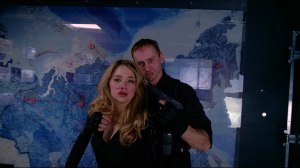 Hardcore Henry is a kinetic, propulsive, adrenaline-fueled immersive experience that ultimately is a bit too immersive and narratively flimsy. This isn’t a movie. There aren’t any characters to care about and the story is really the thinnest of tissue to connect from one action sequence (or game level) to the next, stopping at points for free-flowing exposition, weapons upgrade, or a checkpoint. It’s less a fully functioning movie and more of a visual experience, and whether that experience will ultimately justify its gimmick will depend on your threshold for the first-person POV and its scarce story. Here’s what I don’t understand about people saying Hardcore Henry is the future of movies. It’s an immersive experience but movies are already a medium that we can get lost in and transported, no first-person perspective necessary for our empathy to kick in. The recent cinematic action highs, like Snowpiercer and The Raid 2 and Mad Max: Fury Road and Edge of Tomorrow, all delivered exuberant thrills without having to strictly see through their protagonist’s eyeballs. Action moviemaking is more than a you-are-there visceral immediacy; it’s about building new worlds and blowing them up in fantastic ways. I did not feel pushed to the margins of any of those aforementioned film titles. I was completely absorbed and marveled at their ability to entertain and build payoffs. The idea is that Hardcore Henry is all payoff but if you want to wax philosophical, it’s more like an action movie’s pornographic cousin, cutting out the “boring bits” like developing characters that we care about, establishing setups, creating organic complications, and wrapping it all together in the blanket of a story that provides greater audience satisfaction. Those movies are more than just a stuntman’s sizzle reel; they’re movies. Hardcore Henry is only an experience, and it was an experience I wanted to turn off.
Nate’s Grade: C+
Share this:

Jem and the Holograms (2015)
 Jem and the Holograms was one of the biggest bombs of 2015. It was pulled from theaters after only two weeks in wide release. That practically never happens. What made it so terrible? Well to start with, it seems to have jettisoned everything that fans of the original 80s Saturday morning cartoon might recognize in an attempt to appeal to a new generation. It missed the campy tone of the series, instead inserting lots of unearned serious drama that veers wildly, while trying to set up Jem as an inspirational leader. But really, it just sucks. It sucks a lot. If you’d like to learn more in vivid detail then please continue reading, but for those who desire the truly outrageous, you’ll only find the outrageously bad.
Jerrica (Aubrey Peebles) is a shy performer until her younger sister Kimber (Stefanie Scott) uploads a song of hers to YouTube. Within hours, everyone wants to know who “Jem” is, which is just Jerrica donning a pink wig. A shady music exec (Juliette Lewis) snatches the girls up and forms a band with Jerrica’s foster sisters, Aja (Hayley Kiyoko) and Shana (Aurora Perrineau). The girls immediately make a splash but they find themselves fighting against the influences of the industry that wants to tear them apart.
 Jem is a very confused movie and it’s a very stupid movie, and its most stupid mistake is completely abandoning any appeal this otherwise out-of-time 80s pop-culture relic might have had with its nostalgic core audience. If you grew up with the cartoon on Saturday mornings, like millions of American kids (including my sister), then you’ll be surprised to discover that the movie version bears little resemblance to its source material. I’m not saying that every property has to be slavish to its origins, and there are certain elements that just will not work as a movie that are unquestioned in the realm of cartoons; however, why even make a Jem movie if it hardly resembles Jem the TV show? That would be like producing a Brady Bunch movie and have them be a ragtag crew aboard a salvage ship in space that comes across a mysterious alien entity (honestly, I’d watch the hell out of that, but I’m not what you’d describe as a “normal” audience). Unless your name is Charlie Kaufman, that’s probably not a route you want to experiment with and purposely turn away your core fanbase. I think the time is right for a silly throwback to the 80s that celebrates and lovingly tweaks the culture of that era. The Jem dynamic was a fantasy alter ego where girls could cut loose. What did the producers of the Jem feature film give us? It’s a pretty bland rags-to-riches story in the era of instant YouTube celebrity and every single moment feels phony, sappy, and calculated. Hell, the “Holograms” of the title aren’t even mentioned until the very end and it’s literally just an incidental stage decoration for the band.
The story is pap to leap from one musical montage to another, and when Jem does try and remind you that these singing sisters are supposed to be, you know, characters with, like, feelings, it uses the full misplaced force of a sledgehammer. The characters are components of a thinly veiled checklist to lure in a wide audience of pre-teen girls. There’s Jerrica who is musically talented but shy. Her sister Kimber is obsessed with sharing everything on the Internet. Then there are the foster sisters of Aja and Shana, giving the unit a diverse ethnicity and little other dimension. These girls are annoyingly one-note, each defined by a key interest. Oh, Kimber records everything and can be pushy. Does she herself have any other hopes, dreams, fears, and conflicts? I can’t even remember between Aja and Shana which was the gearhead and which was the budding fashion designer. Does it even matter? These aren’t characters on screen deserving your attention and empathy; they are the deposits of focus-grouped research and they are ciphers for pre-teen wish-fulfillment fantasy. I’m not going to pretend that the characters on the Jem cartoon could rival the likes of Tolstoy, but at least they felt integrated in an appropriately goofy universe. These ladies feel like placeholders that are waiting to be filled in later. They’re glorified backup performers who occasionally get to quip or cry. They are human beings in a generous sense but they are not characters.
 The message of the movie seems to be about finding your voice, and believe it or not Jem becomes a symbol to inspire millions of others, though inspire them to what ends is never specified (modern John Hinckley?). “Jem is anybody who has something they want to express and they need the courage to be heard,” Jerrica proclaims to a sold-out crowd, and it was at this climactic moment that I wanted to vomit. The movie wants to project the success of one poorly written teenager as a movement, giving agency to others, but what exactly did Jem do? She got a recording contract, made some flashy music videos, and then bested the evil record exec and still gets to play with her sister bandmates. Excusing the this-could-be-you aspect of her tale being plucked from obscurity, what exactly is there to inspire anyone? During Jem’s first show, which is crammed with people that are far too old to be rollicking fans of a band of 16-year-old girls, the power goes out while they perform “Youngblood.” What will the girls do? Jerrica gets the crowd to whip out their cell phones to illuminate the small music club, then they direct the crowd into a series of foot stomps for percussion (did the power kill the drums?), and as Jerrica opens her mouth to sing, she sounds EXACTLY like she did from the microphone. Her voice curiously sounds identical to the same voice being run through a sound system and a mixing board. Does nobody in this club take this as strange? There is nothing truly, truly outrageous about these bland performers.
The structure of this movie also drove me mad, compounded by being 118 goddamn minutes long. Why is this movie two measly minutes short of a full two hours? Why is this movie only 39 less minutes than The Revenant? If ever there was a 90-minute movie, it’s Jem and the Holograms. It’s not like the screenplay is filled with so many important plot moments. Before the thirty-minute mark there are two dress-up montages, and the second act break involves the girls upset with Jem because she was forced into a solo career to save their childhood home from being foreclosed. It’s hilariously overwrought and then, I kid you not, less then five minutes later the girls all reconcile and forgive one another. There was still 40 minutes to go at this point! How? There’s even a post-credit scene setting up a sequel with a rival band. Another pointless throughline is Jem’s search for hidden clues left behind by her deceased father. He apparently was building a robot that communicates through music (mostly beat boxing… sigh) and programmed messages for his daughter to grow up and find. Why does the father have to be this obtuse about telling his daughter he loves her? His final fatherly words of wisdom include the eyeroll-inducing cliché, “You were my greatest creation.” Can the guy not write a letter instead of organizing a scavenger hunt guided by a robot that resembles the alien from Earth to Echo? Is this what good parenting looks like?
There’s another aspect of the editing that I want to single out for ridicule. Throughout the film, we’re constantly cutting homemade YouTube footage into scenes to amplify them. This makes sense when it’s a montage of fans talking about their love for Jem, this makes far less sense when the movie uses a guy drumming on his knees to score a silly heist sequence. Yes, the movie outsources moments of its musical score to a musical mélange of online artists, repeatedly inserting them into the action in distracting manners. It’s further proof of the failure of the movie to tie in Internet culture and the democracy of music in any meaningful way. It’s literally background music.
 Let’s also talk about the music of Jem and the Holograms, which, dear listener, for the purpose of this review I’m re-listening to. It’s not like the music is awful. In fact it sounds fairly indistinguishable from much of the pop music currently airing on modern radio stations. They even name-check “Quentin Tarantino” in one song, so there’s that. The songs are competent and won’t make your ears bleed but they don’t exactly stand out, which further complicates the illusion of the movie. The fawning praise from online commentators is overdone and unearned. Here’s the deal: if people go crazy over some artist, the reality better meet the hype. If you have a poet who everyone adores, then they better have some breath-taking poetry. If this reality is not met, meaning if the art is qualitatively mediocre or unmemorable, then it takes me immediately out of the movie. I’ll even deconstruct Jem’s rise to fame. Jerrica records a simply acoustic song and sings her tune of sadness, “Alone Out Here.” Immediately after Kimber uploads it, the YouTube likes go through the roof and the next morning she’s a star. The song is pretty and Peebles has a nice voice that conveys emotion well. It’s a nice song, but in no way is it star-making more than any other the thousands of other girls-with-guitars on YouTube. My proof: the total number of views for “Alone Out Here” is… 33,000 (the tune with the most views is what I would call the best, “The Way I Was,” at 132,000). That’s not exactly scintillating numbers speaking to making connections with a larger fanbase. The best song in the movie isn’t even theirs; it’s Marian Hill’s “Got It.”
Jem and he Holograms is the kind of inspirational movie that will inspire nobody, a musical coming-of-age film with terribly and terribly underwritten characters that are a note-note collection of adjectives and different fashions (this one has colored hair, oooo). The music is passable but nothing that justifies the rocket success and intense devotion we witness on screen. The story is so emotionally sappy yet phony, the structure maddeningly padded out and given the idiotic daddy scavenger hunt, and the editing insertion of cutaway clips of YouTube artists drove me mad. After an hour I realized what I was watching: the Josie and the Pussycats movie absent any of the social satire. This movie makes Josie and the Pussycats look like Doctor Strangelove.
Nate’s Grade: D
Share this:

Lazer Team (2016)
 What makes a disappointing comedy? It’s a question I kept thinking about while watching the sci-fi comedy Lazer Team from the online comedy collective better known as Rooster Teeth, responsible for the longest running online Web series, Red vs. Blue. These are people who know how to be funny. They have a fine resume of shorts to prove their comedy bonafides, but what was it about their first foray into features that diminished their funny? I’ll try my best to provide a critical autopsy for the case subject of Lazer Team, a disjointed and disappointing buddy comedy that died on screen.
A concerned alien species has sent a warning to Earth. A hostile alien race is heading toward our planet with the intent to conquer, pitting their champion fighter against a champion from Earth. This gladiatorial showdown inspires Earth’s military and scientists to train a select warrior (Alan Ritchson) from birth for this mission. The problem is that the wrong people get hold of that alien technology. Disrespected sheriff Hagan (Burnie Burns), his old high school has been pal Herman (Colton Dunn), redneck moron Woody (Gavin Free), and insufferable quarterback Zach (Michael Jones) come across a downed alien ship that they happened to knock out of the sky with drunken fireworks. Each of the foursome puts on a piece of the alien armor, which attaches permanently. Herman gets a pair of super fast boots, Woody a helmet that instantly makes him smarter and British, Zach an arm canon, and Hagan a retractable shield. The bickering idiots are forced to work together over the fate of the planet, and the warring alien species has sent a few of its parasitic infantry to retrieve the special suit.
 To be fair, Lazer Team is not an atrocious comedy that singes your eyeballs with pain, something along the likes of InAPPropriate Comedy or any Friedberg/Seltzer suckfest. You can tell that the Rooster Teeth squad understands the tenets of comedy and what makes for a good joke, which is what makes their final product all the more baffling. For my pal George Bailey, there’s nothing worse than a bad comedy (his worst film for 2015 was Mortdecai). A comedy has one job to do and that is to make people laugh. This should be obvious but you’d be surprised at how often this principle seems to get lost. Rarely does a larger budget make a comedy funnier, a lesson learned the hard way over and over again with Hollywood. With Rooster Teeth’s first movie, they wanted to make a throwback to the sci-fi buddy comedies of the 80s. They raised almost two and a half million dollars via the crowd-source site Indiegogo, a record until Broken Lizard’s Super Troopers 2. It feels odd to say that what amounts to a meager budget by most productions could be at fault for the ultimate disappointment, but I think it leads into the chief problem of the movie: prioritizing the action over the humor.
It’s not uncommon for the comedy to get obliterated by the action in action-comedies, but from a comedy collective I was hoping for more emphasis on the ha-ha and less on the kablooey. Lazer Team has a solid comic premise that pays homage to a pastiche of 80s inspirations and pop-culture. I wanted to laugh. I think I even compelled myself to give it some pity laughs, but after 40 or so minutes a realization could no longer be ignored, and that was that Lazer Team just wasn’t that funny. The enthusiasm of its key cast members and their amiable nature go a long way to disguise the threadbare nature of too many of their first-draft jokes. The foursome never stretches beyond the entrenched lines of their formulaic archetypes. You come to expect specific jokes delivered from them, assigned by type in a way that reminds me of TV’s The Big Bang Theory. The character will rarely surprise you, which is also because their character arcs are so transparent. Hagan will atone for his failure to act and protect Herman while Herman will learn to move on from a past misfortune. Zach will learn to be less selfish. Woody will… well he doesn’t so much have an arc because he’s instantly made smarter thanks to the lien tech. The expected is a deathblow for comedy; if you can anticipate the joke, it’s rarely funny. Lazer Team so rarely subverts your expectations, playing things too safe.
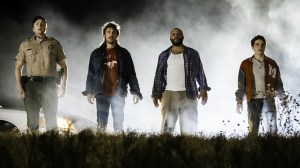 The central conflict of four losers learning to work together as a team to save the world is rife with comic possibilities, even with the locked-in archetypes, but there’s far more attention spent on the sci-fi action and special effects. It’s a low budget film but there are plenty of action set pieces and special effects, many done in-house by the Rooster Teeth team. The effects range in effectiveness but are generally passable and even impressive at turns, especially with properly calibrated expectations. The problem is that the action sequences that are eating up so much creative space aren’t remotely memorable. There’s one car chase in the middle of the film where it feels like the guys have found a tone that works, one where the action incorporates the comedy and they work. For a fleeting moment I thought, “Maybe the whole movie will resemble this new shift.” The other problem is that it feels like the Rooster Teeth squad was stuck with how to get this story to feature-length. Structurally, this thing sure feels padded with additional set pieces that lurch and fail to justify the added time, especially the ex-wife cabin sequence.
The acting foursome is the best aspect of the movie and their amiable interaction is the one thing that Lazer Team has that got me through to the end. These actors know how to sell jokes, when to mug, and their amped-up enthusiasm helps sell the lesser material. I wish this foursome had a better script. Imagine something more low-key in concept that involved less explosions and more emphasis on utilizing their comic talents? I wish less time had been spent on Jones’ obnoxious egotistical quarterback and more on Free’s redneck-turned-British genius, a setup that seems to have far more potential than just being an expositional device. The slobs vs. snobs approach only gets the movie so far, and after that we have to care about the characters, and I just didn’t. Because of how one-note the characters are it’s hard to care about them. After your good will depletes with the actors, you’re left with a bunch of running around but little funny.
Lazer Team is a movie that’s hard to hate, especially if this kind of genre comedy is a favorite launching ground for jokes. It’s nowhere near as wretched as The Watch but it can’t come close to the sci-fi comedies that influenced the Rooster Teeth creative unit. What’s even more frustrating is that these guys have the talent to tell an original and hilarious movie and are creative enough to engineer some fun sci-fi set pieces. They have the talent and expertise to do better than this, to do better than Lazer Team, a movie that is too safe, too predictable, too padded, too formulaic, and just not funny enough. I demand more from people who specialize in comedy.
Nate’s Grade: C
Share this:

The Boy (2016)
 The scariest thing about The Boy is how much potential it wastes, foolishly abandoning a horror direction that was eerie, supernatural, and with one leg rooted in a psychological breakdown, and instead cheerfully dives headfirst into an unwanted new direction of cheap campy thrills. I haven’t seen a decent movie unravel with this high-speed velocity and tone-shift since Danny Boyle’s Sunshine, an intelligent sci-fi vision that decided, hey, let’s just make the entire final act a slasher movie in space. The Boy is about an American nanny who travels abroad to care for an elderly couple’s young son Brahms, a son who happens to be a porcelain doll. There are rules to be followed and consequences if they are disobeyed. I liked that our heroine (Lauren Cohan, The Walking Dead) doesn’t try and ignore what she’s seeing for a majority of the movie and instead embraces the unusual circumstances, testing Brahms and discovering more. It kept the film moving in more engaging directions rather than denying the obvious and padding out its run time. I wish that the script opened up more about the domestic violence that haunts our heroine, literally and figuratively, but for a solid hour I was fairly entertained by the supernatural parlor games and lead performance by Cohan. Then the last act occurred, which just swiped away all the good will. I groaned aloud when the shift happened. I won’t go into detail but suffice to say it feels distinctly like two different movies clumsily grafted onto one another at the behest of exec. What once could be excused or forgiven in a supernatural realm cannot when trying to ground the story in reality, and it only unleashes a horde of nagging questions that don’t add up, especially concerning Brahm’s parents and the implications of its ending. The Boy is a cautionary tale about leaving well enough alone, understanding the strengths of your spooky story and tone, and committing to the best idea rather than one that “surprises” while laying waste to your larger story.
Nate’s Grade: C
Share this:

Carol (2015)
 Have you ever watched a movie that was so understated you wanted to jump into the onscreen world and push the characters around? That’s exactly how I felt with Carol, an unrequited lesbian romance set against the closeted and intolerant era of 1950s America. Carol (Cate Blanchett) is a rich wife who meets Therese (Rooney Mara), a department store employee who assists with her Christmas shopping. They are both drawn to one another in the strange way that love works, and their possible relationship could jeopardize Carol’s custody of her young child. Because of the time period, so much of this romantic liaison is internalized and thus we get longing looks, small gestures that are meant to speak volumes, and plenty of starting and stopping, leaving the audience to fill in the blanks. I don’t have an issue with unrequited romances but Carol is one that feels like its entire world, painstakingly recreated, has been placed under glass for study. There’s no passion evident throughout the movie and I was left wondering what exactly Therese saw in Carol and vice versa. Neither woman has a particularly strong personality, though that could be a side effect of having to live publicly as a different person. I couldn’t get into them as characters and so felt little interest in seeing them together, which made the constant circling and nervous indecision even more belabored. Blanchett and Mara are quite good and director Todd Haynes (I’m Not There) handles the material with respectful subtlety, I just wish that Carol could have shaken off some of that subtlety and given me a better reason to care about these women. It’s understated to death.
Nate’s Grade: C+
Share this:

Macbeth (2015)
 It’s a mighty task to boil the Bard’s classics down to a tight yet meaningful running time and maintain a degree of cinematic quality. You don’t just want to film a stage play with the mighty parameters of film, and yet giving in to the visual majesty means less time for Shakespeare’s stirring words and complex characterization. Woe unto thee who attempt an adaptation. It requires more skill than thou would believe. I had hopes for the latest version of Macbeth from its top-shelf cast, Michael Fassbender as the titular ambitious murderer-turned king and Marion Cotillard as his wife and co-conspirator. It didn’t take long for my hopes to be dashed. First, the good: the rolling hills of Scotland are lushly photographed, and the concluding battle is set amid a roaring hellish fire and flying embers that makes for a stunning backdrop. The actors are fairly fine. If you couldn’t tell from this faint praise, there’s not much to credit as an achievement with this Macbeth. It’s strangely narcotized and often listless. It doesn’t help that the actors speak 80% of their dialogue in whispers or mumbles, even when they discover the former king has been murdered. Director Justin Kurzel (the upcoming Assassin’s Creed movie, also with Fassbender) falls back on monotony, whether it’s an overabundance of mist, similar and low-rent locations, and a plodding score that feels like scorpions are in your mind. Some of the changes are also for the worse, especially making Lady Macbeth more “sympathetic” and neutering one of Shakespeare’s great characters. She no longer sleepwalks and instead confesses her unshakable guilt to a cross. Also Macbeth is haunted by the ghost of his dead son with the witches. And there’s some brief inclusion of awkward sex amidst monologues. The final showdown comes at the 90-minute mark and the entire proceedings feel rushed and yet miraculously boring. Even the bloody violence is pretty tame considering its R-rating. If you’re looking for a truly cinematic Macbeth that enlivens Shakespeare, check out the Masterpiece Theater version with Patrick Stewart adapted into a 1930s Stalinist era. Now that was brilliant. Kurzel’s version of the “Scottish play” is one that only signifies disappointment.
Nate’s Grade: C
Share this:

Knock Knock (2015)/ The Green Inferno (2015)
 Whatever happened to Eli Roth as a director? In 2003, I watched Cabin Fever and was instantly smitten with the twisted new talent on the horror scene. His sense of humor reminded me of Sam Raimi and Peter Jackson before they went Hollywood from their splatterfest beginnings. He directed two movies after, Hostel and its sequel, and while I found Part Two to be underwhelming in execution, I was quite a fan of the original Hostel. It further cemented that it felt like Roth was going places. Most of those places were as an actor or a producer. Roth has acted in more movies (two Quentin Tarantino flicks) than he’s directed since 2007’s Hostel: Part Two. His name was attached to and then departed other projects, notably an adaptation of Stephen King’s Cell, and then it felt like he just vanished altogether. Roth has re-emerged with two films bearing his name as director, The Green Inferno, which premiered in 2013 at the Toronto Film Festival, and Knock Knock. After having watched both movies in one day I can say neither was worth the wait.
Knock Knock concerns Evan (Keanu Reeves), an architect, a former world-famous DJ (?), and family man. His wife and children have left for the weekend so that dear old dad can finally get some work done. Then one rainy evening a knock knock comes upon his chamber door. Two soaked coeds, Genesis (Lorenza Izzo) and Bel (Ana de Armas), politely ask if they can dry off inside. They’re supposed to meet at a friend’s house and have gotten lost. Evan is hospitable to a fault and indulges with them in conversation. The girls are flirty and very interested in a sexual dalliance with Evan, and finally he gives in. The next night Evan is ready to move on and pretend like nothing happened. However, Genesis and Bel are refusing to leave, and they have a design to punish and humiliate Evan for his martial indiscretion.
 The premise is a mixture of Fatal Attraction and a home invasion movie, and there is potential here for a slowly escalating thriller or a comically degenerating farce that surprises with its dips into darkness, like 2013’s Cheap Thrills. Alas, Knock Knock is an unbalanced and unintentionally funny morality play that is so poorly executed, ham-fisted, and awkwardly developed that it’s more horrifying mess than horror. The first act of the film is a bit overwrought with making sure the audience knows exactly what kind of temptation trap Evan is falling under. Every line has an innuenduous ring, every flirtatious line an extended second of awkward eye contact, and every innocuous moment begins to feel like the forgotten detail in one of those absurd Letters to Penthouse fantasies (“You’ll never believe what happened to me…”). You can see the better film that has been crushed to death under the rush to make something tawdry, complete with both girls soaping up their bodies in a joint shower and then jointly pleasuring Evan to eliminate the last of his denials. If you felt the slowly escalating sexual tension, the desire, and yearning, and then weighing the consequences, the movie would have been a far more compelling moral dilemma and character piece. Instead, the girls are over-the-top in their seduction routines and once Evan gives in it all gets even worse. It’s not so much relatable or an interesting ethical conflict as it is the in-between scenes for a soft-core porn biding its time. For what it’s worth, the gratuitous nudity is a bit shrift.
At no point do Genesis or Bel feel like actual human beings; they are unhinged one-dimensional lascivious cartoons with ridiculous and guffaw-inducing motivation. As soon as the morning comes, Genesis and Bel have transformed from seductive and coy young adults to infantilized and highly sexualized bratty teenagers. Our reintroduction involves both ladies filling the kitchen with breakfast supplies and throwing food around, laughing obnoxiously, and practically bouncing off the walls. Their initial adversarial one-upsmanship includes mooning Evan while he’s on a Skype call and drawing penises on his wife’s art. When a concerned neighbor stops by I was hoping for something a little more serious and dangerous, but they can’t even do that, which is what makes their late turn into would-be murderers to be completely unbelievable and forced. It’s so forced that Reeve’s sputtering monologue of incredulity pretty much sums up the point of view of any rational viewer. They play dress up and appear to have some psychosexual daddy issues, possibly resulting from childhood abuse or molestation, but at no point do they come across as a credible menace. Then there’s the concluding justification for their acts of retribution and it’s so lame and uninspired and a cop-out that you wish Roth had committed to the direction the film had been steering toward.
 That’s the biggest failing of Knock Knock is that it could have worked as a thriller if Roth and co-writer Nicolas Lopez (Aftershock) had fully developed their scenario. There’s a fine story of events spinning out of control as one man gets in over his head trying to cover up his indiscretion. Evan doesn’t really grapple with his guilt because everything is manifested as an external threat. He becomes a literal hostage to his guests but they don’t ever turn the screws in a manner that belies a plan or even a sharper point. The first act should have been setting up storylines that would further complicate this hostage scenario with people dropping by and more opportunities to be caught. Rather than playing as a slow-boil hostage thriller or a be-careful-what-you-wish-for morality play, Knock Knock more approaches a failed farce. The film even lacks any visual polish or carefully constructed set piece to stand out from the bargain bin of cheap horror thrillers, and Chile does not convincingly double for California either.
Roth has been a filmmaker who found dark and creative ways to mix humor into his horror, but Knock Knock is one where his signature humor doesn’t feel intended. First off, the behavior of Genesis and Bel is wildly over-the-top, screechy, and just insufferable. Izzo and Armas are way too broad and way too unhinged without any sense of mooring from Roth as a director. It’s just not fun to watch. Their batty babydoll shtick isn’t funny or sexy or dangerous. The tone cannot find a balance or commitment. There are lines of dialogue that are howlers and then there are moments that are played without the right sense of pacing or delivery and they can transform something inane into something dreadfully funny. It’s hard to describe in words but Reeves’ strident yet flat delivery of “I’m a happily married man” after being bamboozled by two naked and nubile young women is hilarity in itself. Then there’s the final scene (spoiler alert) that rests upon a struggle to eliminate a damning social media post. The resulting action and Reeves’ resultant scream to the heavens left me doubling over with laughter, more so because this is part of the misguided climax to a misguided movie. Suffice to say the moments that seemed intended to be comedic fall flat and the ones that are not, at least in their primary and secondary purpose, are the ones that produce hearty derisive laughter.
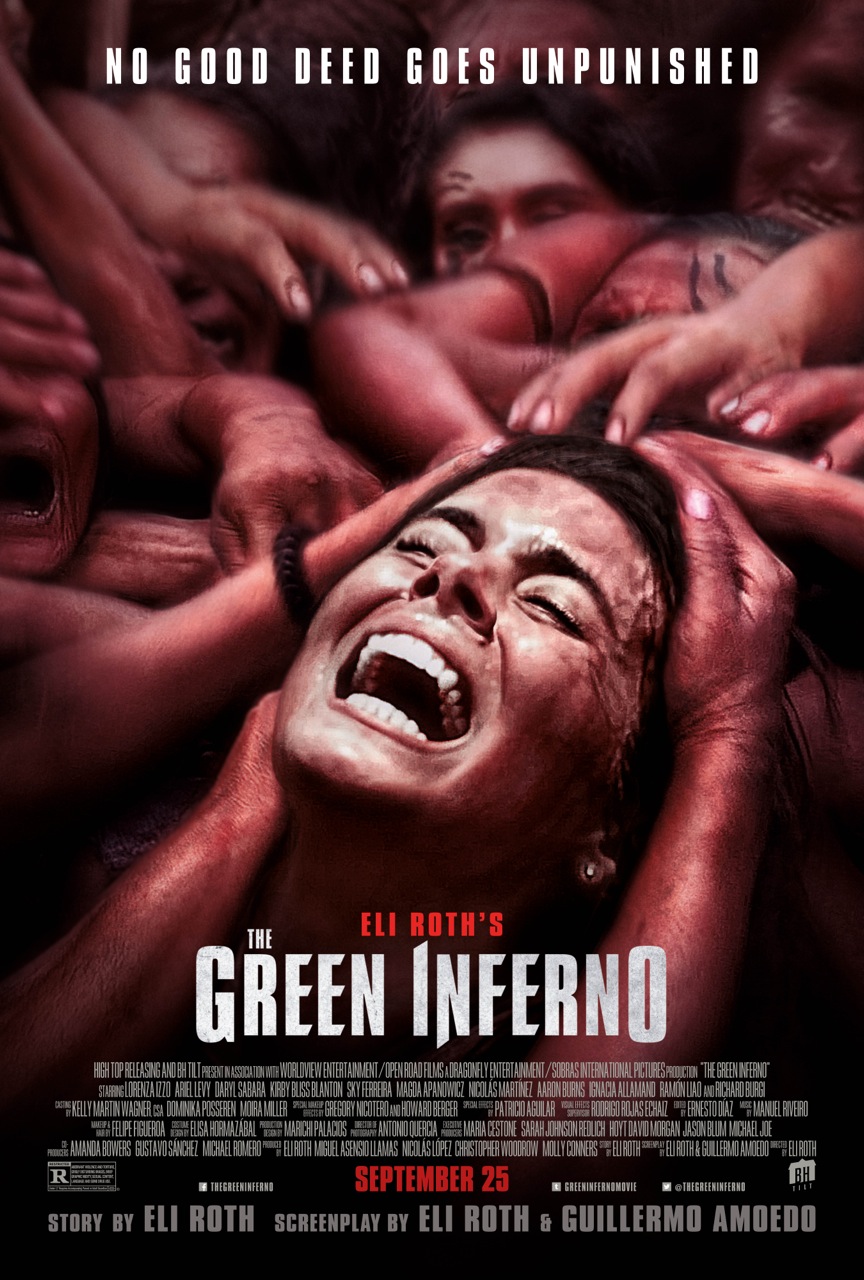 At least Roth’s other 2015 release knows exactly what it wants to be, which is a stomach-churning gore-fest homage to one of cinema’s most notorious movies, Cannibal Holocaust. From an early college lecture about female genital mutilation, you know exactly where Roth is leading this story. Unlike Knock Knock, you get a sense of Roth’s passion for the material here, and while much of that material is the systematic exposure of other people’s guts, it’s at least treated with the right amount of horror and dread. In grand slasher tradition, our poorly developed characters are but bodies to be sacrificed for our sickening amusement, but at least this is where Roth comes alive with creativity. The plot is fairly bare-bones: a group of activists from a liberal arts college travel to the Amazon jungle to protest the local government tearing down acres of forest that rightfully belong to native communities. After having successfully staged their protest, the activists’ plane goes down in the jungle and the cannibalistic natives collect the survivors and do what they do best. While it takes a bit too long without layering in mystery or essential plot, or even ironic counterpoints to fold back upon, once the students meet the hungry villagers, the movie becomes everything it was intended to be, one gory torture sequence after another. There are some memorably gross and uncomfortable moments. Similar to Roth’s Hostel, sometimes the threat of torture is worse than a grisly death. When the practices of female circumcision come roaring back as a plot point, you won’t be able to stop squirming in your seat in appropriate trepidation of what’s next.
 The Green Inferno might prioritize its colorful slaughter but at least Roth puts something approaching a survival story in play to fill in the gaps. The first human sacrifice is so methodical that it serves as a grandly grotesque statement to better motivate the other survivors. Izzo (Roth’s wife) appears as the movie’s version of the Final Girl, so we’re anticipating that she’ll be able to escape somehow. The villagers keep our characters locked in cages and slowly we get a greater sense of their routines and eating habits. There’s a clever use of marijuana to purposely drug their captors. While there is an overwhelming sense of doom and futility, partially just by knowing what kind of movie this is, I’ll credit Roth that the movie doesn’t feel repulsively nihilistic. It may feel genuinely repulsive for other reasons, but you still hold onto a small glimmer of hope that at least some of these college students might maybe make it out alive. Maybe.
There’s also the elephant in the room when it comes to the cultural depiction of a bunch of savages feasting upon primarily white Americans. It’s certainly not an enlightened or nuanced analysis of another culture and it brings to mind some rather ignorant and racist imagery of old where the “backwards natives” were seen as dangerous and uncivilized villains more in common with wild animals than human beings. The villagers in the movie are all bathed in a blood-red skin dye as if they were to be recognized as devils and otherworldly demons. I can’t fathom that a village of this size comes across enough wayward humans to keep itself nourished. It’s hard to get a read on what commentary Roth has in mind. Is he playing into xenophobia or is he sending up the ignorance of the college activists who think getting to the front page of Reddit is a major accomplishment? I can’t tell and this indecision on Roth’s part doesn’t help the movie. It’s easy in slasher cinema to root for the charismatic killer to mow down our gullible and dumb teenagers, but it’s also easy to find a survivor to root for against all odds. I can’t tell which side Roth was more interested in highlighting the plight of. The ending doesn’t clarify this either.
 By no means am I saying that The Green Inferno is a conventionally enjoyable movie, but if you’re a gore hound looking to slurp up your next bloody feast, then this might hit the spot. It’s an uncomfortable and too often tedious film, and some of the character setbacks just seem mean-spirited or unnecessary, like a character literally defecating in a corner for what feels like a solid minute with Farrelly Brothers sound effects (even the natives point and laugh). This is not a pleasant filmgoing experience, nor is it particularly articulate with its social commentary, but the thing that The Green Inferno accomplishes is in its sense of grisly purpose. It’s not groundbreaking or even particularly artistic but for its select audience of horror aficionados, I feel like there is enough to merit watching. Unlike Knock Knock, which doesn’t know who its audience is, The Green Inferno knows all too well, beholden to their bloodlusts, and thus too limited to attract wider appeal. Then again any film that can be thematically linked to Cannibal Holocaust wasn’t exactly going to be targeting the masses. After a long drought behind the camera, these two releases have shown me that Roth’s interests have become a bit more base, his skills a bit more ramshackle, and his sick sense of humor a bit more misapplied. After Cabin Fever and Hostel, I had high hopes that Roth would follow in his mentor Tarantino’s footsteps and rise above genre trappings as an artist. With news that Roth will produce a Cabin Fever remake for 2016, well I think my hopes for the man have gone up in smoke.
Nate’s Grades:
Knock Knock: D
Green Inferno: C


 nathanzoebl
You must be logged in to post a comment.