Blog Archives
Get Out (2017)
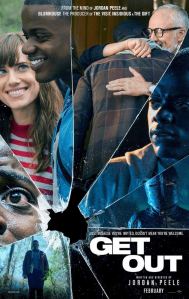 After years as a brilliant sketch comedian, Get Out is Jordan Peele’s first foray into horror, and if this gifted comic mind only wanted to make suspense thrillers from now on, that would be mighty fine. This is the first horror movie in years that left me buzzing, feeling charged and anxious, anxious to share with others so they too can feel the full effect of this live wire of a movie. It may be my favorite theatrical horror film since 2012’s The Cabin in the Woods, and what they both have in common is a knowing understanding of their genres and expectations, a delicately balanced sense of tone, and a funhouse of darkly clever surprises. This is a movie rich with commentary, suspense, payoffs, and it all begins by exploring the dread-filled everyday existence of African-American men in this country as a waking horror movie that cannot be escaped.
Before even going further, I advise most readers to go into Get Out with as little knowledge as possible, which I understand means delaying reading this review. I can accept the loss of eyeballs knowing that more people will go in with an even greater ability to be surprised (I’ll avoid significant spoilers below, so fear not, dear reader).
Chris (Daniel Kaluuya) is visiting the parents of his girlfriend for the first time. He’s worried that Rose Armitage (Allison Williams) hasn’t mentioned that he’s black. She assures him that her rich, wealthy, and liberal family won’t care in the slightest. Rose swears her parents are the least racist people she can think of. Dean (Bradley Whitford) is a retired brain surgeon, Missy (Catherine Keener) is a hypnotherapist who volunteers to help Chris stop smoking, and Rose’s younger brother, Jeremy (Caleb Landry Jones), is obsessed with martial arts and lacrosse. They also have black housekeepers, which Dean says he hates how it looks. It isn’t long before Chris’ sense of unease starts to make him rethink this weekend getaway and whether or not something sinister is under the surface.
 Early on, Peele tips his hand to the sharp social and genre criticism. In the opening scene we watch Andrew (Lakeith Stanfield), a young black man, walking around lost in a tony suburban neighborhood. He checks his phone for an address when a lone car drives past him, stops, and turns around, pulling up next to Andrew and idling, blasting the old song “Run Rabbit Run.” He takes one look at the situation and immediately turns around, heading in the opposite direction. “Not today,” he says to himself, clearly providing voice to the audience’s apprehension. And yet, he’s incapacitated, and abducted by masked assailants. Even self-awareness and avoidance will not be enough for this man to survive if captured within the crosshairs of modern White America. He becomes another horror victim just like we might see splashed across the news all too often.
Peele’s biting social commentary is ever-present but it never outpaces the genuine fun and entertainment from his genre storytelling. It’s a condemnation of the fallacy of a post-racial society and an exploration of the uncomfortable burdens African-Americans are disproportionately expected to bear in general. Rose’s family is all too happy to show off how seemingly inclusive they are. Rose’s father confesses, with no legitimate conversational prompting, that he would have voted for Obama a third time (trust me, there’s a lot of people in the camp, Dean). Yet he seems to enjoy awkwardly inserting recitations of “my man” while also trying to openly explain why he has eerily subservient black housekeepers. Rose’s antic brother seems to hungrily size Chris up as a physical challenge to battle, openly admiring his “genetic gifts.” Despite their self-styled liberalism and protests to the contrary that race doesn’t matter, the family can’t help but treat Chris like an other. Race “doesn’t matter” to people who have the position where it might not matter, the same going for those who elect to be “color blind.”
This stifling sense of condescension and pandering is best exemplified in a deeply awkward sequence where Chris is introduced at a party to the whole older majority-white neighborhood. One man informs him he likes Tiger Woods. Another says being black is hip. A woman squeezes his muscles in transparent lust. Another asks what the “African-American experience” is like and whether Chris feels being born black is an advantage. All through this meet-and-greet gauntlet, Chris is holding his carefully crafted smile, trying to shrug off the mounting discomfort, and being told not to make a big deal out of it. After all, these are well-educated liberals, the “good ones.” They can’t be racist too.
 Get Out is also an excellent example of a movie that straddles a precise tone to perfection. Peele has a carefully refined comedy sensibility, but I was genuinely awed in his ability to go from sardonically funny to creepy funny to just plain creepy. There’s an increasingly heightened sense of dread from the get-go. It’s like any other horror premise where our protagonist goes into the house they shouldn’t and combats a host of horrors be they supernatural or superhuman. In this case, the scary scenario is white people. There’s a general off feeling about the Armitage estate and this is best encapsulated with their hired help, Walter (Marcus Henderson) and Georgina (Betty Gabriel). They seem to be in a robotic daze, smiles plastered to their faces, their tone of voice disquietingly calm and meticulous. Even the antiquated and culturally incongruous vocabulary they employ contributes to their unsettling vibes. Something is wrong here. There is a remarkable scene where Chris speaks with Georgina, and she hovers closer to him to apologize. Peele keeps the camera locked on his actor’s faces in extreme close-ups and he has a damn good reason for it. Gabriel (The Purge: Election Year) tries to reassure him all is normal and in one mesmerizing moment the camera fixates on her as she repeats “no,” each time a different reflection, her eyes tearing up as she tries to fight back subverted emotions. It feels like you’re watching twenty emotions and impulses fighting for dominance behind an impassive mask of compliance. Peele magnificently finds ways to keep his elements intensely upsetting while still finding room to laugh and break tension and increase tension.
While more a suspense thriller than a traditional horror film, Peele proves himself shockingly adept at a genre that I would have assumed outside his comfort zone. The shot arrangements and the natural development of tension shows clear knowledge and affinity for the horror genre; Peele knows when to hold onto a moment for extra suspense, when to pull back, and especially when to litter the camera frame with something to draw the eye. Peele has a great eye for his troubling, surreal visuals. When Chris is hypnotized and instructed to “sink into the floor” it’s like he’s falling into an inky void while his consciousness plays out on a square, like his life is a movie only he can watch from a distance. You feel the helplessness but it’s also a beautiful and beautifully unnerving image. There are a few jump scares accompanied by loud musical stings but the far majority of the movie is the overwhelming discomfort and dread marvelously kept at a continual simmer. I was squirming in my seat for long stretches and started backpedaling in others, and I can’t remember another movie in years affecting me that well. It’s partly the terrific execution of his genre elements but also partly because I liked the protagonist and had no idea what would happen to him next, which is the foundation of all horror. The last act cranks up the genre elements but Peele has brilliantly structured his script, laying out all the pieces he’ll need that provide an array of payoffs when we’re breaking for the finish line. This is a movie that knows how to satisfy all audiences, rest assured.
The actors are pitch-perfect and Kaluuya (Sicario, Black Mirror) delivers a star-making performance. He has to wear his own mask to deal with the small and large iniquities of whether or not these people are sinister or whether they’re just oblivious cretins. Chris is a black man expected to mind his manners and to laugh away the casual ignorance afforded by the oblivious privilege of others. He can never be unaware as the lone black man in a sea of white faces. It’s a position I think many people in the audience will be able to relate to and hopefully others can empathize with. Kaluuya has some standout emotional sequences where he digs deep to show the real depth of a character others fetishize or dismiss. Kaluuya is also British and you’d never know it. The Armitage family clan are each their own slice of weird. Whitford (The Cabin in the Woods) is exploding with thinly veiled smarm and great comic awkwardness. Keener (Capote) is chilling in her icy WASP den mother role with her weapon of choice, and hypnotic aid, being a literal silver spoon. Williams is like her blithely privileged character stepped out of HBO’s Girls, and her flippant attitude to Chris’s perspective belies something familiar and darker. The other best actor in the movie is LilRel Howrey (The Carmichael Show) who play’s a friend to Chris that works for the TSA. He’s a reliable and reliable crude source of comic relief but he’s also our ally on the outside, and he behaves like an intelligent investigator trying to save him. I was actually applauding his sensible steps to see through the sinister conspiracy.
 It’s been hours since I saw Get Out and I’m still buzzing from the experience. I was unprepared for how genuinely unnerving and invigorating the movie was as a horror thriller, character piece, but also as a trenchant social satire on race. Jordan Peele has established himself as an immediate visionary in the world of horror, taking the black protagonist who might usually be the first to get killed in a Hollywood slasher flick and widening the boundaries of horror. The real-lie horror film is day-to-day existence in the United States as a person of color. Get Out was conceived in the Obama era but has even more renewed resonance under the beginnings of the Age of Trump. I remember people saying that America now existed in a post-racial world, but we live in the kind of world that takes a call for innocent black lives to stop being executed by police officers and transforms it into All Lives Matter. It’s a hazardous world and Peele has created a marvelous movie where the insidious, ever-present force that cannot be escaped is not a maniac with a chainsaw or some cranky ghost, it’s white society itself. As the news has indicated, from Trayvon Martin to Sandra Bland and numerous others, there isn’t exactly a safe territory to escape to. Danger and death can come at any moment as long as a larger society perceives black skin as a threat first and a person second. Get Out is a timely movie but also timeless, thanks to how brilliantly conceived, developed, and executed Peel’s movie performs. This will make my top ten list for the year. Simply put, stop whatever you’re doing and go out to go see Get Out as soon as possible.
Nate’s Grade: A
Share this:

Split (2017)
 It’s hard to even remember a time when writer/director M. Night Shyamalan wasn’t a cinematic punching bag. He flashed onto the scene with the triumviri of Sixth Sense, Unbreakabale, and Signs, what I’ll call the Early Period Shyamalan. He was deemed the next Spielberg, the next Hitchcock, and the Next Big Thing. Then he entered what I’ll call the Middle Period Shyamalan and it was one creative and commercial catastrophe after another. The Village. Oof. Lady in the Water. Ouch. The Happening. Yeesh. The Last Airbender. Ick. After Earth. Sigh. That’s a rogue’s gallery of stinkers that would bury most directors. The promise of his early works seemed snuffed out and retrospectives wondered if the man was really as talented as the hype had once so fervently suggested. Then in 2015 he wrote and directed a small found footage thriller called The Visit and it was a surprise hit. Had the downward spiral been corrected? With a low-budget and simple concept, had Shyamalan staked out a course correction for a mid-career resurgence. More evidence was needed. Split is the confirmation movie fans have been hoping for. An M. Night Shyamalan movie is no longer something to fear (for the wrong reasons), folks.
Split is all about Kevin (James McAvoy), a man living with twenty-three different personalities in his head. One of them, Dennis, kidnaps three young ladies, two popular and well-adjusted friends (Haley Lu Richardson, Jessica Sula) and the introverted, troubled teen, Cassie (Anna Taylor-Joy). The girls wake up locked in a basement and with no idea where they are and whom they’re dealing with. Kevin takes on several different personas: Barry, a fashion designer, Hedwig, an impish child, Patricia, a steely woman devoted to order, Dennis, an imposing threat undone by germs. The altered personalities, or “alters” as they’re called, are preparing for the arrival of a new persona, one they refer to as simply The Beast. And sacrifices are needed for his coming.
Right away you sense that Split is already an above average thriller. This is clever entertainment, a fine and fun return to form for a man that seemed to lose his sense of amusement with film. The areas where Split is able to shine that would have normally doomed the Middle Period Shyamalan are in the realms of tone, execution, and ambition.
 Very early on, Shyamalan establishes what kind of feeling he wishes to imbue with his audience, and he keeps skillfully churning those sensations, adding new elements without necessary breaking away from the overall intended experience. You’re meant to be afraid but not too afraid. It’s more thriller than outright horror. There is a level of camp inherent into the ridiculous premise and in watching a grown man act out a slew of wildly different personas populating his brain. Shyamalan swerves into this rather than try and take great pains to make his thriller a more serious, high-minded affair. His camera lingers on the oddities, allowing the audience to nervously laugh, and he allows McAvoy extra time to sell those oddities. It’s especially evident in the introduction of the Patricia alter ego, where McAvoy uses a lot of faux grave facial expressions to great comic effect. Shyamalan no longer seems to fear being seen as a bit silly. Shyamalan even knows in some ways that he’s making a genre picture and an audience expects genre elements or the reversal of those elements. At one point, Dennis insists that two of our girls strip to their underwear because they’re dirty. I shook my head a bit, believing Shyamalan to sneak in some PG-13 T&A. Except it’s just enough for some trailer clips. Shyamalan’s camera doesn’t objectify the teen girls even after they run around in their skivvies. He doesn’t have to indulge genre elements that will break the film’s tone. He also doesn’t have to overly commit to being serious. He can be serious enough, which is the best way to describe Split. It treats its premise and the danger the girls are in with great seriousness, but the movie still allows measures of fun and intended camp. The cosmos themselves don’t have to be responsible for all of time’s events to click together to form his climax. It can just be a young woman trying to escape a psycho thanks to her wits and her grit.
Execution has also been a nagging problem of the Middle Period Shyamalan (affectionately his Blue Period?). I may be one of the few people that thought 2008’s Happening had some potential even as is if another director with a better feel for the material and less timidity embracing the full possibilities of an R-rating had been aboard. With Last Airbender and After Earth, both movies were exceptionally bad from a number of standpoints, but Shyamalan’s botched execution of them made the anguish all the more realized. You walked away from both disasters and openly wondered why Shyamalan was given such large-scale creative freedom and at what point the producers knew they were sunk. With Split, Shyamalan has pared down his story into a very lean and mean survival thriller anchored by a mesmerizing performance from McAvoy. The story engine kicks in very early, mere minutes into the movie. The man doesn’t even wait the usual ten minutes or so before introducing the inciting incident. This Shyamalan has no time to dawdle, and the rest of the movie lives up to this pacing edict. It’s efficiently plotted with the girls in a position of discovery and learning their surroundings, the different alters, and how to play them against one another. Each piece of info builds upon the last. It’s a survival thriller where you think along with the characters, and their decisions make sense within the internal logic and story that Shyamalan commands. There are scattered interruptions from our subterranean terror, mainly exposition from Kevin’s shrink and some hunting flashbacks from Casey’s childhood with her father. I figured they would show Casey to be similar to the feisty heroine from You’re Next, revealing her as a fiendishly clever and capable survivalist that the villain underestimates to his great peril. It’s not quite that but the flashbacks do serve a purpose, a very dark purpose, and a purpose that could lead to some very uncomfortable personal implications others may interpret.
 Shyamalan’s ambition has often exceeded his reach when it came to his post-Signs oeuvre. The man never seemed like a great fit for the fantasy and sci-fi blockbusters that Hollywood was hoping he’d sprinkle his “Spielberg scion” magic all over. The number of moving parts seemed to overwhelm and his worst instincts took over. To be fair, Shyalamlan is also to blame as his ego became inflated and he started chasing after his cinematic windmills convinced he was creating great works of art. In Lady in the Water, he inserted himself as the writer that will eventually save all of mankind. That’s a step above arrogant. And he reserved time in that fishy-woman-out-of-water misfire to literally eviscerate a crotchety film critic because the man obviously held no grudges. My point is that when Shyamalan’s stories got too big so did his sense of himself. He lost limitations and people reeling in his excesses and wayward plotting. Even Shyamalan’s early successes are smart examples of how to get the most bang for your buck. Unbreakable is his “comic book movie” and that has like one fight scene. Signs left most to the imagination. Shyamalan has always been a better filmmaker when he holds back and embraces the limitations of his situations, finding more resonant creative solutions. Shyamalan has blossomed under the Blumhouse model, a factory for cheap high-concept thrillers in the $1-10 million range. With that kind of minimal budget, it forces Shyamalan to be very economical with his filmmaking and very meticulous with his storytelling. It worked for The Visit and it especially works with Split. This is a movie that emphasizes its strengths, storytelling and performance, and a large-scale budget is not essential for those elements to flourish. You want to know Shyamalan’s cameo this time? It’s a computer tech literally billed as “Jai, Hooters lover.” We’ve certainly come down from savior of the human race, and it’s a welcomed sign (no pun intended).
The movie would be so much less without the intensely captivating performance from McAvoy (X-Men: Apocalypse). A character with multiple personalities totaling twenty-three, with twenty-four on its spooky way, must be an actor’s dream. McAvoy loses himself in the sheer playfulness of the part. The characters are distinct down to his poise, posture, the way he carries his body, subtle facial expressions or movements that he’s keyed into specific altered personalities. It’s a lot more than silly voices. It’s a shame that this kind of performance will never really get the recognition it truly deserves. This is an Oscar-worthy performance from McAvoy as he transforms himself again and again. The man finds several different ways to be creepy and menacing, never overdoing the same note. It’s an astonishing chameleon-like performance and definitely deserving of future awards consideration, and we’re in the general cinematic dumping ground of January. I would like to also call attention to Taylor-Joy (The Witch) and her resourceful and thoughtful performance. She’s playing a scared and scarred young woman but a fighter worth rooting for who rises to the many challenges. She’s a Final Girl you can love.
Split is a solid and atmospheric thriller with a killer crazy performance by James McAvoy. The movie flies by, drawing you into its clutches, and the ongoing twists and turns feel organic. There really isn’t so much a twist ending as a culmination of flashback implications. The end has an uncomfortable implication in its resolution, but that’s the worst of it. As long as his head doesn’t get too big, I could welcome Shyamalan cranking out fun mini-budget thrillers in the Blumhouse model. It could be the beginning of a, dare I say, Shyamassaince. I’m sorry (I’m not sorry).
Nate’s Grade: B+
Share this:

Moonlight (2016)
 What Moonlight achieves is both something different and familiar and amounts to nothing less than watching the birth of human identity on screen. The film chronicles three formative experiences at three different times of a man’s life, each serving as its own one-act play examining our protagonist and his tortured sense of self. The results are breathtaking and deeply immersive, allowing the formation of a human being to take place before your eyes in such magnificent artistic strokes. This is a sensitive, sincere, beautiful movie that serves as an indie coming-of-age tale sliced into three significant parts. I was completely under its sway within ten minutes, finding its perceptive perspective and nuances to be convincingly naturalistic. I felt like I was watching a documentary of a young black man’s life told with ferocious realism, or at least a loosely fictionalized version of a life informed by fully authentic personal experiences. It’s a somewhat ineffable quality for slice-of-life movies but they live or die on whether the film carries an unforced sense of realism, telling larger truths with small details, each piece coming together to make the world and the character feel fully formed. Moonlight pulls you immediately into its orbit thanks to its authentic drama and observations.
The three segments compliment one another as they build toward a young black man’s understanding of his homosexuality. We’ve seen movies before where characters undergo sexual awakenings and from gay perspectives; it’s practically a cottage industry unto itself in independent film. However, rarely have we seen this story from people of color. The expectations of accepted masculinity are entrenched at a young age, where “Little” (Alex Hibbert) is chided by, among others, his own mother Paula (Naomie Harris) for the “swishy” way he walks. It goes without saying that being gay is not exactly widely accepted in the Miami projects of the 1980s. This conflict of what makes a man is wonderfully symbolized with Juan (Mahershala Ali), an unexpected father figure that takes “Little” under his wing along with his girlfriend, Teresa (Janelle Monae). The kid wants to know how he can know if he’s gay because it’s certainly something he doesn’t want. Juan doesn’t pressure the boy or make big speeches about what it means to be a young black man in America. Instead, he tries teaching him to accept himself and provides an alternative home that serves as a refuge during his mother’s long absences and crack-withdrawal tirades. There’s a lovely moment where Juan teaches “Little” how to swim, and it’s touching in how recognizably father/son the activity is, how much trust is involved and vulnerability, and how the film doesn’t need to oversell the subtext. Juan definitely becomes the father figure that Chiron lives up to for the rest of his life. This first segment is dominated by their relationship but also Juan’s sense of responsibility. He’s making a living through selling drugs, including to “Little”’s own mother. In a very memorable and heated moment, Paula angrily calls out Juan for thinking he would make a better parent given the moral culpability of his own actions to her habit.
 The second segment zooms ahead to when Chiron (Ashton Sanders) is a teenager in high school and subjected to hostile bullying. The schoolyard taunts from his youth have morphed into something more ferocious and toxic, as a collection of bullies torments Chiron and looks to rob him of his personal connections to others. The central focus on the middle segment is about the growing relationship with Kevin (Jharrel Jerome), the childhood friend who Chrion crushes on. Their closeness takes a leap one fateful night that Chrion will always remember. It’s an awakening and a confirmation of self, and it’s only after having this fulfilling outlet cruelly taken from him that Chiron finally lashes out, with lifelong repercussions. It’s an explosion we can see coming and one that feels fully set up. The second segment feels more familiar because of the age range and it’s the one with the dawning of sexual realization, a story situation we’ve seen before. What elevates it is that it’s a fairly direct carryover from the beginning segment, which means the personal issues have magnified for Chiron. His relationship with his mother has become even more frayed as he’s grown, and what once was name-calling and questions over his maturation has become confirmed. Her addiction has become even stronger and she’s harassing her own son for whatever meager money he’s given from Teresa, his surrogate mother figure. Chiron is struggling to make sense of his feelings in an upbringing lacking support and clarity. You could examine the conclusion of this segment as an empathetic cautionary tale, as we see the years of abuse and measured choices that lead to that confrontation.
The final segment is where Moonlight transforms into a late blooming unrequited romance that should steal your heart if it’s still functioning. “Black” (Trevanta Rhodes) is a fully-grown adult that has seemingly followed in the footsteps of Juan in a life of low-level crime. He’s hardened both emotionally and physically. The muscles will provide an intimidation factor missing during his youth if anyone questions his sexual leanings. He’s burrowed into himself and the role he feels he must accept, but all of that changes the instant he gets an apologetic and searching phone call from Kevin (Andre Holland). Now working as a chef at a diner, Kevin reaches out to his old friend though even he can’t fully explain why. This reawakens “Black”’s longing and he works up the courage to travel back to Miami to surprise the friend who meant so much to him. Their reunion is treated like the culmination of a romance that you may not have realized had you completely. After two segments of setup and years apart, you may find yourself projecting your thoughts to the screen, trying to compel these two men together. It’s an extended sequence that moves at a gradual pace, a fitting tempo for a character racked by insecurities and suppression. By going forward he’s taking a big risk, putting himself out there, and we desperately hope “Black” finds a sense of support. It’s the segment where “Black” finds resolution with the major conflicts that have defined his life, and the climax of the movie is a deeply tender moment where an emotionally reserved man reaches out to another and lets his firmly fixed guard down in the process.
 I don’t usually go into such a detailed plot synopsis with my reviews because I like to hit the basics and let the readers experience the story for themselves, but the pleasures and artistic triumphs of Moonlight are in how fully immersed and felt the movie becomes. By telling the story in three noteworthy sections, Moonlight provides an impressionistic statement about the formation of personal identity, specifically a young man growing up black and gay in a hostile environment to both. The movie also blows apart the argument made for 2014’s Boyhood about how truly necessary it was to watch one young actor play the same part for 14 years. Here we have six different actors playing two different characters at three different points in time and the impact is no less great. Here is a movie that doesn’t need a gimmick to have a larger emotional impact on its audience.
Director/co-writer Barry Jenkins has a marvelously fluid and natural feel for his camera, swinging around the parameters of a scene to make the world feel more charged with energy. Jenkins is a born filmmaker and knows how to squeeze the most out of his scenes with gorgeous cinematography and an eclectic musical score that feels traditional with classical orchestration like churning strings layered and rearranged into something arrestingly new and yet still personal. There aren’t many overly stylized choices, rather Jenkins tells his story with uncommon poise and treats one man’s life like an opera, like the greatest story never told on film, like a life of complexity worth the deep dive. There’s a classical lyricism to the presentation that reminded me of the works of Todd Haynes (Carol). There’s one scene where Paula is strung out on crack and finds her son in the middle of a joyous high. Her face fills the frame, absorbing all of Chiron’s world, and her euphoria is inter-spliced with jarring speed ramps in editing, meant to convey the mania and peace that pumps through her veins in this fleeting moment. It’s a stylistic device that isn’t overplayed and has genuine purpose. Jenkins is restrained from self-indulgences and keeps every aspect focused on reflecting the inner life of his lead.
The very talented company of performers makes the movie even more powerful. Ali (Hidden Figures, Luke Cage) is creating serious awards buzz and it’s deserving, though every actor in this movie is deserving of notoriety. Ali plays a man trying to do right by his own sense and he lets you see the troubles that wash over him. Should he insert himself into this young boy’s life? Is he in a position to set an example? Ali has such paternal strength and tenderness while still displaying doubts and regret, hardly deifying this found father figure. Harris (Spectre) is wonderfully horrifying and heartbreaking in her role and has some big moments that convey her given completely into desperation. She’s offended that others would deign replace her but does little to reclaim her title of mother and provider. Holland (Selma) has a world-weary smooth sense of wisdom to him, and his unassuming charisma helps unlock his friend’s true feelings. The three actors who portray “Little”/Chiron/”Black” are each exceptional, giving different performances and interpretations, further supporting Jenkins’ artistic thesis.
 Moonlight is a beautiful film told with such delicate care and a resounding sense of authenticity and personal detail. It swallows you whole and leaves you with the impression of a human life observed with tenderness, intimacy, empathy, and grace. It’s about the people and experiences that help guide us onto the paths we take, and while there’s a sense of heartache as we think of what might have been, there’s also the serenity of accepting what has been and what can still be. Jenkins proves himself a superb talent who doesn’t lose sight of his artistic goals with extraneous artifice. There’s a lilting, lovely lyricism to the movie that elevates Chiron’s life into feeling like poetry. This is a life we so rarely get to see given such an artistic and honest examination without condemnation or judgment. It’s the story of a man embracing his identity and overcoming isolation and suppression. This disadvantaged young man is worth your emotions, your sympathies, and your attention. Moonlight is an alluring and heartrending film that manages to be deeply personal and universal at the same time. It’s sublime.
Nate’s Grade: A
Share this:

Hot Bot (2016)
 What seemed like a mere rip-off of Weird Science instead became one of the most uncomfortable, unfunny, and downright soul-destroying 86 minutes of the year. Two nerds, clearly patterned off the archetypes from Superbad, stumble upon a sex robot escaping the dirty-minded clutches of a senator (Larry Miller, why?). At first the boys think they’ve run over and killed a sexy lingerie-clad living Barbie, so they elect to take her back home to dispose of the corpse. This is also the part where the “Jonah Hill”-esque guy debates defiling her dead body… and this is before they know she’s a robot. The characters are powerfully unlikable but even worse are exasperatingly unfunny. The comedy is too often obvious and toothless, luxuriating in bad improv from actors given not enough of a script and far too much leeway. The vulgarity is lame and for a raunchy sex comedy the material is weirdly chaste, trying to insert a dissonant romance for our Hot Bot and nerd. The premise is so ripe for comedic potential that it’s almost baffling how much they blunder. It’s about as baffling as comprehending that this cheap-looking, sloppily executed dreck is made by the Polish brothers, a pair of indie auteurs responsible for much more thoughtful and adventurous cinema like Twin Falls Idaho and Northfolk. I didn’t know these guys were even capable of making something this bad and this pathetic. Watching this movie saps the life out of you as only a bad comedy can. It’s disheartening to watch ordinarily funny people strut and fret with weak material, and Hot Bot is the weakest of material. The movie can barely put together enough material for a feature-length narrative, and even that is inflated by the end credits outtakes that prove making the movie wasn’t any funnier than watching this unfortunate and miscalculated mess. This movie will serve as a dark reminder for everyone who worked on it as they try and pay penance for the rest of their lives to eliminate the awfulness that they helped bring into this world.
Nate’s Grade: D-
Share this:

The Lobster (2016)
 When people decry the relentless slate of sequels, remakes, and redundancy from the Hollywood assembly line, they’re looking for something original and different, and there may be no movie more different this year than Yorgos Lanthimos’s The Lobster. David (Colin Farrell) is the newest guest at the Hotel, a place for singles to find their true love. He has 40 days to fall in love with a compatible mate or else he will be transformed into an animal of his choice (hence the title, David’s choice). The people at the hotel are all in competition to find their mate. Outside the confines of the hotel, in the woods, are dreaded single people, those who ignored the rules of society. They are to be feared and hotel guests are rewarded for capturing wild singles on weekly hunting trips. One way or another, David is going to have to decide his place in society as a person or animal.
The Lobster is daringly different, wildly imaginative, and drops you into the middle of its cracked, alternative landscape and expects you to pick things up as you go. It’s something that the writer/director already achieved with chilling, car-crash fascination in Dogtooth, a dark parable about extreme parental protection that crossed over into abuse. This is a world that opens with a distraught woman driving a long distance just so she can shoot a donkey in the head. Who is this woman? Why would she purposely murder this animal? Why is she so emotionally invested? And with that jarring act of peculiar violence, we’re off. We’re never told how this world came to be, it just simply is. There isn’t any extensive exposition save for one initial sit down David has with hotel management to determine what animal he’d like to turn into at the end of his stay if unsuccessful in love. There’s a genuine sense of authenticity to this deeply weird place and the characters all play it with straight-laced absurdity, which makes the satire land even harder. It sells even the most bizarre aspects, like the ongoing visual incongruity of wild animals just trotting around the background. You can sit back and think, “I wonder what that peacock’s story was, or that donkey, etc.” Its abnormal background pieces that add to the context of the world. I loved discovering new little wrinkles and rules to Lanthimos’ world that made perfect sense within its parameters. In a world where coupling is the only goal, of course masturbation would be a punishable crime. I enjoyed that there are other means guests have to stay at the hotel, chief among them hunting down the loners in the woods, which allow the more awkward or anti-social guests added time at the expense of others. Even in a world this bizarre, there are people who are making their own way, including the revolutionaries in the woods (more on them later). The movie is exceedingly funny and so matter-of-fact about its peculiarities to make it even funnier.
 The movie straddles the line between skewed ironic romance and cynicism, so I’m not surprised it’s rubbed people the wrong way. This can be a pretty dark movie and that’s even before the violence against animals/former people. It’s certainly written from the point of view of someone who is single and those currently in that category will likely relate the most to the film’s strident social commentary. “It’s no coincidence the targets are shaped like single people,” a man says in reference to target outlines. The pressures can seem absurd in their own regard, and the film has a clever concoction where the “happy couples” are merely two people who share a superficial physical trait. These two people are near-sighted. These two people get nosebleeds. These two people have a limp. Even the characters are named after their physical depictions, like The Limping Man and Short-Sighted Woman. It’s not exactly subtle but the satiric effect is still effective. The hotel manager says, to a newly cemented couple, “If you encounter any problems you cannot resolve yourselves, you will be assigned children, that usually helps.” The humor can be very dry and very dark, never stopping to inform you where to laugh. There’s a sad woman played by Ashley Jensen (TV’s Extras, Ugly Betty) who is desperate for companionship, offering sexual favors to any man who might just alleviate her loneliness. She is ignored and often threatens to kill herself, and then one day she does it by jumping out a hotel window, but she’s not successful. It’s one more dark, awful ironic point of suffering for this woman, and she screams in agony while others ignore her, including a clearly affected David, still trying to play indifferent to win over the hard-hearted woman he sees as his best way out of the hotel. It’s a hard moment to process but one that made me admire the film even more for the cold courage of its convictions.
Supplementing the dark satire is an off-kilter romance that emerges halfway through the film once David escapes the hotel. He finally meets up with the source of our narration, the Short-Sighted Woman (Rachel Weisz). It’s here that the movie shows glimmers of hope for the hopeless as David and this woman are drawn to one another. They’re in a world of outcasts but the rules of those in the forest do not allow coupling. They reject the expectations of the ruling order, and so they must remain resolutely single. the only time David and the Short-Sighted Woman can be open with their affection is when they go undercover into the city, posing as a couple, and getting a chance to kiss with abandon, all as a cover of course. They build up their own secret non-verbal language to communicate their feelings, much like a couple builds its own personal shorthand and inside jokes. The loners are only to listen to music individually and dance the same, but David and the Short-Sighted Woman synch their CD players to listen to the same track, to simulate like they are sharing a dance together even if not in proximity. It’s here where The Lobster becomes a beguiling and surprising love story and one where the heartless may grow a heart, watching two odd people find one another in such an odd world. However, Lanthimos does not let this emergence of romance blunt his message. The loner leader (Lea Seydoux) suspects coupling in her group and goes to some pretty drastic lengths to test the fortitude of feelings between David and his secret girlfriend. It’s like getting cold water dumped on the runaway spell of optimism. The fitting ending is left in ambiguity for the audience to determine whether they were meant to be after all.
It’s also in the second half of The Lobster that the movie loses some of its grandeur and momentum. We’re introduced to a new primary setting with new rules to adapt to and a new order to follow, and there’s a general interest to discovering another competing area of this landscape with a diametrically opposed social order. They punish people by mutilating parts that come into affectionate contact with another person. We see a couple with bandages around their red, swollen mouths, and then the reference of the “red intercourse” makes your imagination fill in the horrific blanks. David has left one regime dictating his life to another regime dictating his life, but they just aren’t as interesting. It feels like the film is starting to repeat itself. I would say the second half world building isn’t as compelling as the first but that’s why the romance emerges, something for the audience to root for. Now that he’s finally found someone he connects with they’re not allowed to be together. There’s never a shortage of irony in a Lanthimos movie.
 The actors are perfectly in synch with the strange rhythms of this world, and Farrell (Fantastic Beasts and Where to Find Them) and Weisz (The Light Between Oceans) deserve special attention for their committed performances. Farrell gained 40 pounds for the role, which seems to have translated right into his stint on season two of HBO’s True Detective. He’s a schlubby guy that’s still mourning the deterioration of his marriage and larger society is insisting he get over it. He has only 40 days to recover or he’ll be plucked from the ranks of humanity. There’s great sadness tinged in his nonchalant responses to the absurd realities of this world, and Farrell keeps finding ways to make you laugh and wince. Weisz is our placid voice into the strange new world and it helps establish a sense of grounding as well as connection to her character when she eventually emerges. She injects a palpable sense of yearning to her character, especially once David is in reach and they begin their relationship. It’s got the cute romantic comedy staples but on its own terms, and seeing Weisz smile warmly is a pleasure in a morbid movie.
The Lobster is a romance for our age and an indictment of the romance of our age, an era where the swipe of a finger on an app is the arbitrator of contemporary dating. It’s a satire on our fixation of coupledom and being in relationships even when they’re not sensible. It’s a cracked fairy tale that punctuates the romantic love we’ve watched distilled to an essence in Hollywood movies. It’s a surreal and dark movie that manages to become emotionally moving and poignant, leaving on a note of uncertainty enough for different factions in the audience to interpret as either hopeful or hopeless. The Lobster is a unique movie with a singular artistic voice that dominates every shape of the narrative, the characters, and the boundaries of this fantastic alternative world. I imagine my depth of feeling for the movie will only grow the more I watch it. This isn’t an overwhelmingly dark or unpleasant movie without the presence of some light. It’s not an overly off-putting movie without an accessibility for a curious audience, whether those people are single or in happy relationships. The movie is inventive, transporting, but still relatable, rooting the nexus of its weirdness on the same awkwardness and anxiety everyone feels with the prospects of prolonged romantic courtship. If 2016 was a year that celebrated the oddities of cinema getting their due, then The Lobster is a captivating and unusual creation deserving of its spotlight and surefire future cult status amidst lovers of the weird.
Nate’s Grade: A
Share this:

Nocturnal Animals (2016)
 Fashion designer Tom Ford made a big splash with his debut film, 2009’s A Single Man. It was a gentle and introspective character study of a middle-aged gay professor determined to end his own life. It was lush, full of feeling, and anchored by a deeply humane performance from Colin Firth. In short, it is everything that his follow-up Nocturnal Animals is not. This is a movie overflowing with vacant artifice that is mistaken for profundity.
Susan (Amy Adams) is an art gallery owner and living a posh life with her second husband, Hutton Morrow (Armie Hammer). She gets an unexpected present in the mail from her ex-husband Edward Sheffield (Jake Gyllenhaal). He’s sent her his newest manuscript, a departure from his usual works. It’s dedicated to Susan. With Hutton away on business, and philandering with a mistress, she dives into the story. It tells the story of Tony Hastings (also Gyllenhaal) and his wife (Isla Fisher) and teen daughter (Ellie Bamber) traveling through west Texas. They run afoul of some contemptuous locals lead by the sadistic Ray (Aaron Taylor-Johnson), who kidnaps Tony’s wife and daughter. Left for dead, Tony teams up with a terminally ill police officer, Bobby Andes (Michael Shannon), to hunt down Ray and make him suffer for his crimes. As Susan continues reading, she goes through a mixture of emotions trying to determine what her ex-husband is trying to communicate to her within the subtext and metaphor of his sordid story.
 I grew increasingly restless with Nocturnal Animals because it failed to justify its excessive dawdling and vapid artistic pretensions. This is a movie that doesn’t really know what it wants to be so it dabbles in many different genres, none of them fully convincing or worth the effort. It’s a high-gloss erotic thriller, it’s a gritty exploitation film, it’s a morally compromised revenge thriller, and it’s a subtle relationship drama amidst the upper crust of the L.A. art scene. It’s none of these. It’s two primary stories, neither of which justifies the amount of time spent on what amounts to so little. The worst offender is the frame story with Susan, which amounts to watching Amy Adams read for two hours. She takes a lot of baths and showers in response (symbolism!) but most of the cutaways and time spent with Adams is to merely watch her react. It’s like she’s a nascent studio audience handcuffed to tell us how to feel with her reactions. Would you have known that you should feel bad during onscreen death if we didn’t cut back to Susan also feeling bad and concerned? It amounts to emotional handholding and it’s grating, also because Susan is an terrible character. She’s conceited and thinks she is owed better, which is why her mother successfully pressured her to dump Edward, a man well below her self-styled station in life. Her second marriage is crumbling apart and part of her sees Edward’s out-of-the-blue note as a potential romantic rekindling. That’s right, this is a person who reads a revenge opus that may be all about seeking cosmic vengeance against her, and she thinks to herself, “Ooo, I think he like likes me after all.” Her self-involvement is rewarded in the end but the ambiguous ending is more just missing in action. Ford’s film just peters out and leaves you hanging, just like its heroine.
Edward’s manuscript is easily the best story and even that is only by default. It’s an easier story to get involved with because of the simple story elements that naturally draw an audience in, namely a revenge fable. The initial altercation with the family and Ray’s crew lasts almost a half hour. Specifically the roadside confrontation itself is a solid ten minutes and it just goes round and round, repeating its overdone sense of menace. I wasn’t dreading the horror to come but more so getting impatient for it to be over. Without depth to the characters or escalating stakes and complications, it all just amounts to a Texas hillbilly repeatedly threatening a cowering family for ten solid minutes. The vengeance in the second half of the movie is just as predictable and too drawn out. Edward schemes with Bobby Andes to take justice into his own hands, but the movie takes far too long to reach its predictable conclusion, which still manages to be so drawn out that I was screaming at the screen for the inevitable to finally happen. When the movie ended I felt a rush of relief to go along with my general sense of perplexity.
Nocturnal Animals has the illusion of highbrow art mixing with lowbrow thrillers but it lacks the substance of the former and the courage of its convictions for the latter. Ford’s mercurial taste in costuming and set design shows in every moment with Susan, as the sets feel exquisitely designed and the cinematography designed to encapsulate this. It’s a good-looking movie but there’s not enough under the surface. It’s all empty window dressing to disguise the vapid whole at its center. Let’s tackle the opening credits, which will most certainly capture your undivided attention. It’s a foursome of overweight women dancing naked and in slow motion, their large bodies bouncing and jiggling to the self-serious musical score. Eventually it’s revealed that these women are part of an installation exhibit in Susan’s art gallery, and that’s when you get a tip-off just how hollow and attention seeking the movie will be. The gallery consists of overweight women lying face down on raised platforms. That’s it. No wonder her gallery isn’t doing that well (note: not a fat-shaming comment but more a comment on the lazy application of its sense of “art”). You get a sense that Ford comes most alive in the scenes where he can arrange figures and images, not so much the demands of storytelling.
 I can already hear supporters saying I just don’t get it; no, I got it because there’s very little to understand with Nocturnal Animals. It’s a story-within-a-story so we’re already training our brains to look for parallels but they aren’t obvious so they’ll be more metaphorical. I kept waiting for it all to tie together in a substantial way by film’s end, and sorry but it just doesn’t (spoilers ahead). Edward has a whammy of a day when he discovers 1) his wife is pregnant, 2) she’s aborted his child, and 3) she’s in the arms of her new boyfriend, and he discovers all of this standing in the rain for further symbolism. He has a grievance against Susan, though we’ve been suspecting it for some time. His manuscript is a revenge thriller about a family murdered and how a weak man finds the strength to seek justice and retribution. The parallels are fairly obvious there, and the fact that there are only so many characters in the story-within-a-story means there are few options to play the analogue guessing game. I’ll just claim that Ray is meant to represent Susan since he/she is the murderer of Tony/Edward’s family. There’s a reason that Tony’s family all share Susan’s red hair. He dedicated the book to her, after all, and said she was who made it all possible. From there you could argue whether Tony represents Edward’s real past, weak and remorseful, whereas Bobby Andes is meant to represent how he wishes he could be, decisive and strong (end spoilers). That’s about all the parallels you’re going to find because the story-within-a-story only involves a very tiny number of characters. There just isn’t much to go on here and yet Ford’s movie stretches and drags and just keeps going until it reaches its predictable destination. There isn’t any more depth here than straightforward avatars and even those are lean.
I was debating a question with my friend Ben Bailey while we watched this movie, and that’s whether the stakes are removed somewhat when you know that a storyline within a movie is fictitious. Knowing that Tony is a pretend person, does that eliminate some of the tension and investment in his storyline? I recognize this is a distinctly meta question considering that a majority of film characters are fictitious by nature, but I do think there’s a different set of standards for the people of the story-within-a-story. I don’t remember feeling less for the characters in A Princess Bride, The NeverEnding Story, or Adaptation. My only conclusion is that I just did not care a lick for any of the characters in Nocturnal Animals, whether they were fictional or twice fictional. They didn’t deserve my attention just because pretty people were playing them. They didn’t deserve my attention because Big Bad Things caused them to experience Big Emotions. Combined with the ponderous plot and the emaciated substance, the dull characters and the overwrought acting they inspire are a recipe for audience detachment. I can’t help but shake my head as other critics trip over themselves to shower this film with overly enthusiastic plaudits. Nocturnal Animals is a tiresome exercise in lazy symbolism, patience-demolishing pretension, and emptiness masquerading as contemplation.
Nate’s Grade: C-
Share this:

Collateral Beauty (2016)/ Manchester by the Sea (2016)
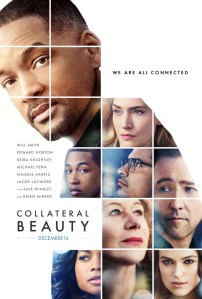 Trauma and grief are common colors in the palette of screenwriting. Wounded men and women overcoming loss and sorrow allow us all an opportunity to learn and heal through someone else’s personal pain and suffering. It’s the movie theater as therapist’s office with art serving as catalyzing event to help those in need. When 2006’s United 93 was released many critics thought it was too soon for a dramatic recreation of the events of 9/11. First, there’s never a right estimation for how long the world of art should wait to respond to shared tragedy, but I argued that United 93 could function as a facilitator for healing for select moviegoers. It helps to be able to live vicariously through fictional characters on screen, and it makes us smile when they overcome those obstacles and give hope to the rest of us. Two new movies have taken very different paths to explore responses to trauma onscreen. Collateral Beauty is a star-studded affair built from a screenplay that sold for an estimated three million dollars. Manchester by the Sea premiered at the Sundance film Festival and blew away audiences with its understated and unsentimental portrait of loss. One of these movies goes big and miscalculates badly and the other delivers one of the better, more emotionally involving films of the year. I think once you hear the premises it’ll be clear which is which.
In Collateral Beauty, Howard (Will Smith) is an advertising guru still reeling two years later from the unexpected death of his six-year-old daughter. He’s become a hermit who furiously rides his bicycle into traffic to tempt fate. He shuns his old friends and minority partners, Whit (Edward Norton), Claire (Kate Winslet), and Simon (Michael Pena). He also writes angry letters to the concepts of Death, Time, and Love to note his general displeasure. Major accounts are lost because of Howard’s seclusion and now it looks like the whole company might go under unless they accept a stock buyout. Howard refuses to sign off on the purchase, which forces his trio of friends to hire struggling actors to play “Death” (Helen Mirren), “Time” (Jacob Latimore), and “Love” (Keria Knightley). These three personified concepts will converse with Howard to provide an unorthodox therapeutic breakthrough. The actors will be paid handsomely and they relish the challenge. If that doesn’t work, they will record his public feuds with the actors, digitally erase the actors, and make it seem like he’s gone crazy with grief. Along the way, Howard gets closer and closer to talking about his loss in a support group run by the saintly Madeleine (Naomie Harris), a woman also suffering the loss of her child. If the universe is all about making connections, Howard is on a collision course with the fates.
Few films have dropped in estimation so precipitously in my mind as Collateral Beauty. To its credit, while you’re watching the movie you don’t notice as many of the misguided manipulations from prolific screenwriter Allan Loeb (Things We Lost in the Fire, Just Go with It). You’re aware of their presence but they don’t remove you from the movie, that is, until you extend further thought on the full implications. Allow me to simply vocalize in print the Christmas Carol-esque premise of this “feel good” holiday movie.
“A group of wealthy advertising executives scheme to get their grieving mentor and friend declared mentally incompetent so they can sell their company. They hire duplicitous actors to pose as metaphysical concepts, engage with Howard in public, and then they will digitally erase the presence of the actors, making it look like Howard fits the lazy man’s definition of crazy. And these people are the heroes.”
The characters give plenty of rationalizations for why they’re forced to set up their supposed friend, mostly about saving the company and saving jobs. Simon especially needs the money and medical insurance with where he’s headed. Howard is spiraling and they worry that he will take down everyone with him. That’s fine, but why do they resort to the outlandish and ethically dubious practices that they do? The hiring of actors seems like a helpful therapeutic exercise on the surface, unless you stop and think about a grieving man badgered by an antagonistic universe. Howard is already exemplifying mentally unsound behavior so I don’t know why the public spats are required. The digital erasure constitutes explicit fraud and it feels so much grosser. It’s an expensive step to provide visual evidence of a man having a nervous breakdown. They could have simply recorded Howard in his office for a week while he builds elaborate domino structures just to watch them topple (symbolism!). Even the characters call-out one another for this gaslighting trick. On another note, won’t Howard eventually find out? What if some enterprising digital effects editor has a moral crisis and confesses? This is the equivalent of false documents forged to push the rich old lady into the booby hatch so her scheming relatives could abscond with her vast fortune. It’s even more egregious when Collateral Beauty presents these characters as the heroes. Yes they have different degrees of guilt but that is tamped down by their moral relativism justifications. It makes it a little harder to swallow all that outpouring of cloying sentiment later. These murky and misguided manipulations will symbolize much that is wrong with the movie.
I hope the audience is prepared for Smith to be sidelined for much of the movie because Howard is more a supporting character in someone else’s story. Howard is really more a catalyst than a fully developed character. He grieves, he suffers, but his point is how his grief and suffering affect others, which is a strange tact to take. His journey is quite similar to Casey Affleck’s in Manchester by the Sea. He must come to terms with loss, accepting the cruelty of that reality in order to move forward and let others in. Moving on doesn’t mean we forget, especially when that trauma is a loved one’s loss, and Howard holds onto that pain for so long as a means to still feel his daughter’s presence. It’s an acceptable character conceit but it flounders in the movie because EVERYONE simply talks at Howard. Smith’s asked to be teary-eyed and mute for most of the picture. Any significant breakthroughs, developments, or even passing of information occurs from others applying meaning to this sad silent man who must not remain sad.
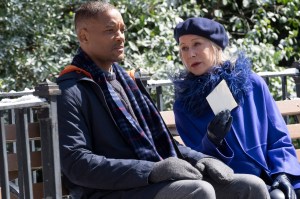 As a result, the movie pumps up the supporting characters and pairs them with one of the actors. “Death” relates with Simon for him to accept his declining health and to allow his family to know. “Time” relates with Claire over her worry that she’s sacrificed starting a family by prioritizing her career (this is another film world where nobody puts serious consideration into adoption). I need to stop and question this particular storyline. Doesn’t it feel a bit tacky and outdated? It’s also, by far, the storyline with the least attention; we literally see Claire glance at a sperm donor brochure and website for a scant few seconds and that’s it. Then there’s “Love” who relates with Whit to try and get him to repair his relationship with his rightfully angry young daughter after Whit cheated and broke up his marriage. “Love” literally just goads Whit to actually try being a parent and accept some responsibility for his failings. That’s it, and she has to use the incentive of a date to convince him to try and be a better father (Whit sloppily hitting on “Love” definitely lays a plausible peak into why exactly he’s divorced). “Death” and Simon play out the best mostly because Mirren is impishly amusing, and also benefits from naturally being Helen Mirren, and Pena’s character is given the most sincerity. He has the most at stake personally and setting things right for his family is taking a toll. Loeb has given each actor something to do, and the talents of the actors are enough that I was distracted from the overall machinations at least until the very end.
For most of its relatively brief running time, Collateral Beauty has kept to its own form of internal logic and avoided blatantly manipulative calculations for heightened drama. Sure Pena’s first instance of movie cough is an obvious telegraph to more astute members of the audience, but it makes some sense since this is less our real world and more the well-sculpted Movie World. Then the final ten minutes play out and the movie doesn’t just skid, it steers into this skid of counterfeit sentiment. I’ll refrain from spoiling both of the major reveals but they both serve to make you rethink everything. It’s not one of those eye-opening twists but more something my pal Eric and I were dreading in our seats, mumbling to ourselves, “Please please don’t.” These final two reveals are completely unnecessary. They disrupt the tenuous reality of the movie and the balance of tones becomes a mess. It also divulges how overly constructed the screenplay really was, designed to lead an audience to these chosen end points that don’t engender catharsis. It’s about pointing out how clever the screenplay was rather than the emotional journey, a movie in service of its twists. Neither twist serves strong narrative purpose other than to be out-of-the-blue surprises.
 Let’s get to that ungainly and clunky title. It’s a nonsense pairing of words that’s meant to sound profound but is really just confusing and remains so even though the characters repeat this clumsy phrase like eight times. There’s a conversation where it appears in every sentence, as if repetition alone can make this phrase/idea successfully stick. It doesn’t. I think I understand what it means, or at least what Loeb was going for, but I’m not sure. Madeleine talks about making sure to see all the collateral beauty in the universe, but is this merely a more obtuse way of restating Wes Bentley’s floating plastic bag declaration in American Beauty? Is it a more pretentious way of saying to stop and smell the roses? Here’s where I thought it was going with its meaning: “collateral” in this sense means accompanying and instead of accompanying damages we’re focused on the accompanying beauty, therefore a contemplation of the possible unintended helpful ramifications. This was going to make sense for Madeline since she uses her personal tragic experience to reach out and help others heal through their own tragedies. It’s the long ripples of human kindness reaching out far beyond our initial actions. And maybe, juts maybe, Howard and Madeleine would become romantically linked through coping with their similar heartache and find one another. However, the movie’s real ending torpedoes this interpretation. What we’re left with is a clunky pairing of words that still makes little sense by film’s end.
Collateral Beauty is probably the best-looking Hallmark movie you’ll see at the theaters this holiday season. It’s a gauzy and manipulative endeavor packed with movie stars doing their sad and redemptive best before hopefully cheering you up. There’s nothing that can’t be overcome with a good group of friends who only want what’s best for you while they take part in a criminal conspiracy to defraud you of your business stakes. That’s because even the most nefarious of behaviors can be forgiven with the right actor to provide a twinkle of the eye, a little swooning musical score to tell the audience how and when to feel, and the backdrop of lightly swirling snowfall. It’s a universe that refuses to allow Will Smith to stay sad and so it intervenes. Collateral Beauty has its draws, namely its core of great actors who each find some point of emotional grounding to their character’s plight. The finest actor in the movie is Harris (Moonlight) who radiates tremendous empathy and a bittersweet serenity. I’d watch the movie from her perspective. To Loeb’s credit, the movie is more grounded and less fanciful than its premise could have lead. It doesn’t sink to the depths of a Seven Pounds (“Do not touch the jellyfish”). Waterworks are shed all around, hugs are evenly distributed, and I’d be lying if I didn’t feel a lump or two in my throat by film’s end. However, its emotional journey doesn’t feel anywhere as revelatory as Manchester by the Sea.
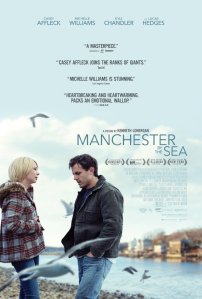 Lee Chandler (Casey Affleck) is living out an ordinary existence as a Boston apartment complex maintenance man. His routine is rudely interrupted when he receives news that his older brother Joe (Kyle Chandler) has fallen deathly ill. On the car ride north to Manchester, Joe passes away. Guardianship of Joe’s 16-year-old son Patrick (Lucas Hedges) is entrusted to Lee much to his shock. “I was just supposed to be the back-up,” he says to himself to little avail. Lee wants to move back to Boston with his new ward but Patrick refuses, pleading that he already has a life in town he enjoys. Lee is itchy to leave because of his painful associations with his hometown, tracing back several years to a fateful night of tragedy he shared with his current ex-wife, Randi (Michelle Williams). Lee takes on the mantle of parent while trying to ignore the trauma he’s doing his very best to ignore with every fiber of his working-class Bostonian being.
The first impression from writer/director Kenneth Lonergan’s movie is just how achingly authentic it feels. We drop in on the lives of these hardscrabble folks and glean important details as we progress, better forming a clear picture as to why they carry such pain with them as penance. In simplistic terms, it’s a two hour-plus journey to reach a point where the main character can openly cry. It’s also much more than that. It’s an incisive character piece on grief and tragedy, a surprisingly funny movie, and an effortlessly engaging movie that swallows you whole with its familiar rhythms of life. There is no formula here for Lonergan. Each fifteen-minute sequence opens the movie up again for further re-examination, especially a middle passage that is truly devastating. It provides compelling evidence why Lee has decided to become a recluse drifting through life. It’s not that Lee is lonely; he’s actively disengaged from all communities and connections. There are three different potential openings with women who seemed flirty and interested that Lee could have capitalized upon, or at least pursued, but he does not. A woman spills a beer on his shirt and squeezes closer to apologize, pleading to buy him a drink. He coolly looks away, ignoring her, and instead chooses to wait until closing time so he can get into a drunken fight instead. Lee would rather feel pain than momentary pleasure.
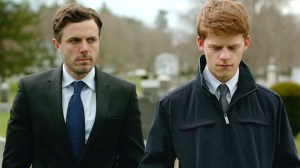 The movie is also a poignant father/son relationship told in waves, with as much humor as emotional breakdowns. Lee is trying to fix the situation the best way he can as if it was another clogged drain. He’s thrust into a parental position that he doesn’t feel fits. It’s not that he’s actively evading responsibility as he does try to accommodate his nephew, even driving him back and forth and covering for one of his two girlfriends to sleep over. Lee cannot work in his hometown because of his own lingering pain and also because nobody will give him a job thanks to the reputation he carries. For a long while it feels like Patrick isn’t even registering the death of his father except for his distress at the thought of his father’s body remaining in a freezer until the ground thaws for a burial. He’s trying to live a normal teenage life filled with activity like band practice, hockey practice, and juggling some alone time with his two girlfriends. He seems like a normal teenager with a normal teenage attitude, and that flies in the face of our expectations. Hedges (Kill the Messenger) provides a nice dose of awkward comedy to keep the movie from drowning in sadness. The burgeoning relationship between Lee and Patrick takes on new familial elements and dynamics and each is feeling out that new role. This movie is more than an elegant bummer.
Lonergan has only directed two movies prior to Manchester, both of them insightful, complex character studies with meaty parts for game actors. 2000’s You Can Count on Me cemented the wide appeal and remarkable talents of Laura Linney and Mark Ruffalo. Then his follow-up, the criminally underseen Margaret, ran afoul with producers who wanted to trim its near three-hour running time. It was kept in limbo for five long years until 2011 where it met with a degree of fervent critical fandom, including yours truly. Manchester began as a starring vehicle for producer Matt Damon, but when scheduling conflicts got in the way, the project was reworked with Affleck in the lead and Lonergan told the story his creative impulses desired without studio interference. As a big fan of his previous directorial outings, I’m not surprised by the gripping results. He lets an audience draw conclusions from the impressions and pieces he offers, notably with Patrick’s mother (Gretchen Mol) who he refers to as “not an alcoholic anymore.” There isn’t one big obvious scene but we’re given enough pointed clues about Patrick’s history with his mother and why Lee is adamant that his nephew does not live with his mother. The history of characters and their relationships follow this model, layering in further meaning as we continue at a safe distance in our seats. Things aren’t spelled out as they are allowed to breathe, the furtive connections becoming perceptible in time like a message written in the fog of a window. Lonergan has great affection for his characters and their flaws, insecurities, and struggles. This was evident in Margaret where the title character (vividly played by a pre-True Blood Anna Paquin) was a teenager exploding with emotions, opinions, and thoughts and Lonergan celebrated her for this fact. I appreciate Lonergan’s refusal to paint in broad strokes with all of his characters.
 This is Affleck’s (The Finest Hours) movie and while good the more extroverted performers around him overshadow him. Affleck can be a gifted actor as evidenced with The Assassination of Jesse James by the Coward Robert Ford. He has a quiet intensity and a habit of burrowing inside himself to discover something raw and different. His performance feels like he’s trapped in a PTSD shield that saps the life from him. He’s drifting through his life and waiting to die, simply put. Because of his taciturn nature he doesn’t garner any sizeable monologues to spill out all his feelings. He has to use little moments and the nuances of choosing his words carefully. When he tells Patrick “I can’t beat it” those words are loaded with meaning that he can only convey in subtext. When he stops to process that Randi has gotten pregnant from another man we notice the subtle registration of pain and regret, a twinge of memories he’s trying to hold back. Affleck’s performance is very subdued for most of the movie but it’s in the final act where he cannot maintain his well-manicured bubble of resistance to the outside world. When Lee does start to cry, it will earn every ounce of your sympathy.
Williams (My Week with Marilyn) is more presence than character in the movie, but when she does stay long enough she leaves an emotionally gut-wrenching impression. I understand that “gut-wrenching” is a pejorative term but it’s really one of the more uplifting moments in the movie. That’s because her character’s reunion with Lee isn’t one of enmity but reconciliation, allowing her to make amends and say plenty of things that she’s been holding back for years. It’s an unburdening and once Williams starts it’s hard not to feel the flow of tears coming from your own eyes. She is a one-scene wonder, reminiscent of Viola Daivs in 2008 for Doubt, nominated for Best Supporting Actress and well deserving a win for one brilliantly acted scene. Fitting then that Davis looks to be Williams’ chief competition for Supporting Actress this year. I invested even more in this scene because the power of Randi’s emotional honesty almost pulls Lee out. He’s shaking, his voice cracking, and trying to stick to saying the customary conversational tokens that have gotten him through to this point. He’s avoiding confronting reality but the sheer emotive force of Randi almost pushes him to that genuine breakthrough.
If there is one noticeable drawback to such an exquisitely rendered film, it’s that it follows the narrative structure of real life perhaps a bit too faithfully. Life doesn’t normally follow a three-act structure with clearly defined character arcs and a carefully orchestrated system of measured payoffs. While Manchester by the Sea isn’t exactly an automatic entry in mumblecore paint drying, it’s certainly less indebted to familiar story structure, which does affect the overall motor of the story. You don’t have a strong sense of its overall direction, an end point, and while the pacing isn’t glacial it can start to feel bogged down in those wonderful New England details of everyday mundane life (how many times do we need to see Lee driving?). There are also probably more flashbacks than necessary to flesh out the characters in an implicit manner. If the movie wasn’t 137 minutes I might accuse it of padding its running time. It doesn’t take away from the overall enjoyment of the film but you feel a certain loss of structure and payoff. In contrast, Collateral Beauty is entirely reliant upon plot machinations and a formula serving a very Hollywood-styled ending. Sometimes maybe an audience would prefer a little more of a driving force and a little more oomph for an ending. While certainly lacking in just about every factor, I’d say that Collateral Beauty does feel more climactic with its conclusion than Manchester, which sort of rolls to a close that makes you say, “Oh, I guess that’s it then.” Sometimes realism can profit from a judicious nudging. Then again with Manchester it’s more the journey and Collateral Beauty is all about the destination.
 While ostensibly being about two men overcoming the loss of someone close to them to function in everyday society once more with meaningful personal relationships, there’s quite a wide divide between Collateral Beauty and Manchester by the Sea. One represents a more calculated and morally dubious reflection of trauma as a theatrical game leading to Big Twists that are meant to leave an audience swooning from the magic of reconciliation. While fairly grounded on its own terms for a far majority of its time, Collateral Beauty can’t help itself and steers into a ditch of bad plotting, made even worse by the fact that it puts so much significance on its preposterous final destination. It manages to cheapen the movie as a whole in retrospect as an elaborate parlor trick that rivaled what the ethically challenged heroes of the tale were perpetrating. On the other side, Manchester by the Sea is a carefully observed and intimate portrait of grief and the consequences of self-destructive detachment from a larger world of compassion. The acting is terrific and lived in, authentic to its core and stuffed with meaningful details that Lonergan leaves to his audience to formulate. However, some of its indie auteur sensibilities do have a somewhat negative impact on the pacing and ultimate conclusive nature of the movie. It’s not that the film is open-ended; it’s just a “life goes on” kind of ending that doesn’t exactly inspire the strongest feelings of satisfaction. Grief will always be a topic that attracts filmmakers and especially actors because of its inescapable drama, stakes, and general relatabilty. I only implore any readers that if you’re trusting filmmakers with two hours of your emotion, make sure they earn that privilege.
Nate’s Grades:
Collateral Beauty: C
Manchester by the Sea: A-
Share this:

Jackie (2016)
 Jackie (Natalie Portman) is still reeling from the loss of her husband, President Kennedy (Caspar Phillipson). In the weeks that followed the assassination in 1963, her life was a whirlwind of change. She was leaving the White House while another administration took control of her husband’s office and agenda. She was leaving a life of glamour and privilege and it all came to a halt. Bobby Kennedy (Peter Sarsgaard) is worried about the Kennedy policies getting lost as well as his own potential presidential prospects. Lyndon Johnson (John Carrol Lynch) is worried about asserting his own control. While trying to work through her grief, Jackie must protect her husband’s legacy among all the well-wishers, political vultures, and craven opportunists.
We’re left with an immersive, impressionistic look at America’s most famous first lady since it’s hard to distinguish the layers of performance from the woman herself. She was used to adopting the façade of what the public expected of her, how her husband’s friends looks at her with desire and dismissiveness, and the differences between her private life and her public persona. It’s a fascinating glimpse into the interior space of a famous woman that so many people think they know well because of her glamour and television appearances, but do they really? Her identity is in free fall. She gave up everything for this man and now he is gone and her cherished position is gone. It’s said each first lady leaves her stamp on the office, and now Ladybird Johnson is already itching to undo that stamp, erasing Jackie’s presence and supplanting it. Will these last few days define her and will they define her husband? While dealing with raw grief, Jackie also takes the position of being the first to protect her husband’s legacy. While planning the particulars of the funeral march and exact burial site, she’s really framing his place in the greater annuls of history, tragically cut short and questionably memorable. His life has been taken from her and now the only thing she can do is protect his place in history. The funeral details and conflicts they consign the new Johnson administration to are interesting, as is Jackie’s simmering disdain for the Johnsons, but it’s more than just placation; Jackie has an underrated knack for theatrical optics. The country is in mourning, just like its (former) first lady, and she offers a spectacle as an outlet. Some term it vanity and even Jackie admits that many aspects were for her, for her grief, for her rage at the world and her doubters, for her wounded soul searching for meaning. She wanted the American public to see her in mourning but she wanted just as much to see them in mourning too.
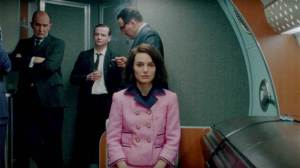 Eschewing the standard cradle-to-grave biopic, as well the noveau approach of using one clarifying moment to better examine and sum up the person (see: Selma, Steve Jobs), Noah Oppenheim’s script is a triptych, a hypnotic exploration that zips along non-linear but thematically-tethered memories. It’s a more interesting approach because we’re not locked into a linear progression of plot events, though the immediate aftermath and her interview with the Newsweek reporter (Billy Crudup) serve as the directional compass. It also provides a clever conceit for meta-textual levels. We have scenes that lay as direct conflict with the public Jackie and the private Jackie, and we have scenes that lay into the different levels of performance, from her show model tour of the White House furnishings and fixings to putting on the brave face to speak to her children. Director Pablo Larraine (No, Neruda) shoots the movie in a style reminiscent of its 1960s time period, with a film stock that blends the difference between documentary and recreation, further adding another stylistic level to the proceedings. The various threads of connectivity are so much more interesting to dissect with this storytelling approach and it makes the movie a much deeper and more contemplative experience to unpack.
There’s a scene in the middle of Jackie that stood out to me. During a night of drinking, Jackie puts on the record for the Broadway production of Camelot and wanders the large empty spaces of the people’s house. For my younger readers, the Kennedy administration was dubbed by many as “Camelot,” first coined by Jackie, out of a sense of its idealism, youth, and inspirational promise to change the world into a nobler place. It’s practically a mythical time and the real people get lost amidst the romantic spectacle. Nowadays, our presidents can often be the same mythical figures as the kings of old, figureheads whose humanity and details we iron out and soften as we eulogize and entomb them. The music echoes through the different chambers but there’s no one to hear it, no one to enjoy it, the vast emptiness communicating much of Jackie’s anguish. “There will be great presidents again but there will never be another Camelot,” she says. That moment is left as a passing memory, a picture of nostalgia that will only have its realism dampen in time as it becomes enshrined in American myth making. Amidst all her privilege and esteem, there is an existential sense of loss for Jackie and the nation as a whole into the turbulent 60s.
The other rich aspect is that we are watching a woman process her grief in real-time and it can often put a lump in your throat. I challenge anyone not to feel an outpouring of empathy when Jackie has to explain to her two very young children why daddy isn’t coming back from Dallas, having to explain something horrendous to those so innocent. In some scenes it feels like Jackie is numb to the world around her, focused on the little things as an escape from her horrible reality and its trauma. We do get a recreation of that fateful day in Dallas twice. The first is the immediate aftermath with Jackie bloodied and protected by the Secret Service, keeping her at a distance from us too in the audience. The next is a closer view inside the car as we’re with Jackie when the awful event happens, and the sudden shock of gore is still a disturbing gut-punch no matter how much you anticipate the moment. We watch her crazed instincts trying to collect the pieces of her beautiful and broken husband, stressing she was trying to keep everything together, figuratively and literally. The scene plays out longer and it serves as an emotional climax to the film, a frank reminder that for everything people believe they know about this woman, at heart, for all her riches and fame and privilege, she is simply a human being trying to make sense of death. It’s this final moment in the car that reminds us.
 This is an acting showcase and Portman (Black Swan) excels, delivering the best female performance I’ve seen this year at the movies. It’s an Oscar bait dream role and she nails it. She goes beyond mere imitation though Portman does an excellent job of that. Thanks to critic/blogger Jeffrey Wells for this great quote about the imitable real-life Jackie from author Tom Wolfe’s novel, The Right Stuff: “She had a certain Southern smile, which she had perhaps picked up at Foxcroft School, in Virginia, and her quiet voice, which came through her teeth, as revealed by the smile. She barely moved her lower jaw when she talked. The words seemed to slip between her teeth like exceedingly small slippery pearls.” Portman stunned me early with her exquisite recreation of Jackie and then she stunned me moments later with the depth of emotion she was able to convey in the scene where she stares into the Air Force One mirror, dabbing her husband’s blood from her face as her eyes are swollen with tears. Lorraine favors plenty of exacting close-ups to watch the array of emotions play across her face. She has moments of strength, moments of pettiness, moments of heart-tugging lows and weakness, and Portman is always fascinating, holding your attention rapt as you study her study. It’s a mesmerizing performance and one that deserves to earn Portman her second gold statue.
Jackie is a movie that has stayed with me for days after I’ve seen it. The exceptional and empathetic work by Portman is the first thing I recall, and then the thematic and symbolic relevance of the storylines as they fold on top of one another, providing a hypnotic and immersive portrait of a very famous woman who sought and spurned the spotlight. As far as I’m concerned this is the definitive film presentation of Jackie and Portman’s searing performance is the dazzling standard that won’t be beat. You walk away having additional appreciation for this woman but also further curiosity. The movie doesn’t expressly state who she is as a human being, providing a range of personas, some that conflict with one another, and allows you to put it all together for your interpretation. It’s a bold gambit and a fitting gesture for a woman defined by others’ perceptions.
Nate’s Grade: A-
Share this:

Miss Sloane (2016)
 Miss Sloane is an intelligent and exacting political thriller that should appease fans of the genre who enjoy a good arm-twisting from a powerful manipulator, in this instance the towering and intimidating full force of Jessica Chastain. She plays the titular Sloane, the best lobbyist inside the beltway, and a woman who leaves the comfort of her firm for the challenge of taking on the gun industry to help pass a reform bill. From there it’s an underdog tale powered by the winds of moral righteousness and given a tough-talking yet flawed hero that will burn down whatever she can, including her own reputation, to win. The biggest draw is the performance from Chastain (Zero Dark Thirty) as she gets to yell at people for approximately two hours and look good doing it. It’s a game of persuasion and leverage and D.C. voter politics, and she makes the constant stream of information accessible while providing a focal point for our interest. It’s a pretty information heavy film with a minimal of supporting characters that stand out (Gugu Mbatha-Raw as a school shooting survivor-turned-team member is the notable exception). With her victory never in doubt no matter the odds, the movie establishes that it exists in a parallel world where actual gun control reforms can be advanced. In the wake of doing nothing from Sandy Hook, this must be a fantasy world. Director John Madden (The Debt) keeps the tone as cool and calculated as his heroine. The script by Jonathan Perera is plenty smart though the final act relies upon some unbelievable shenanigans that betray its sense of pragmatic realism. Still, the cunning gamesmanship of a pro working the levers of power for a worthy cause allows for some liberal fantasy indulgence. Miss Sloane is a suitably entertaining thriller that whisks you away and says even “bad people” have a purpose in our broken political system.
Nate’s Grade: B
Share this:

La La Land (2016)
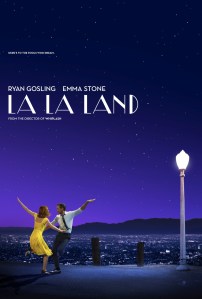 I understand that the year 2016 has been, charitably put, unkind to many people and why we all could use a little escapism around this time of year. Writer/director Damien Chazelle made a big Oscar splash with 2014’s Whiplash to make his passion project, a sincere musical that recreates the style of classic Hollywood. La La Land is a stylistic throwback that has enchanted critics and seems destined to compete for some of the biggest awards this season. Just imagine how much better it would be if it was great.
Chazelle and company certainly knows how to make an impression. The opening number transforms an L.A. traffic jam into a full-blown song-and-dance explosion, with commuters exiting their cars and coalescing into a teaming mass of jubilation on the freeway. It’s a moment that is sincere and full of energy and promise. The brightly colored commuters come together in long unbroken shots with a widescreen camera that dives and dips and leaves plenty of space for the audience to appreciate the dancing. This is a movie that wants you to see all of the rainbow-colored performers while they strut their stuff. It’s here that we’re introduced to Mia (Emma Stone), a part-time barista and struggling wannabe actress, and Sebastian (Ryan Gosling), a jazz musician who dreams of opening his own club at a historic site. These two dreamers resist each other but of course destiny has another plan. A highlight is a flirty sequence set atop a Hollywood Hillside overlooking the purplish dawn. Mia and Sebastian sing how beautiful this scenic view would be if only they were with someone they loved, playfully antagonizing the other into a dancer’s rivalry. The dancing is mischievous and fun and performed in wide angles to soak in the movements. It’s easy to get caught up in Chazelle’s early swell, a transporting experience that extols the virtues of classical musicals by the likes of Vincent Minnelli, Gene Kelly, and especially Jacques Demy’s The Umbrellas of Cherbourg. Chazelle fills out his frame like a painter. There’s an infectious love for Old Hollywood that tries to alchemize its influences into something new and old, and for a good while Chazelle is able to maintain this fizzy, effervescent experience and remind you of the soothing joys of a good movie musical told with finesse and brio.
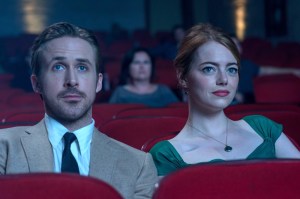 Then after about forty-five minutes the fizz gets a little staler and that’s when I felt the gnawing emptiness underneath all the Old Hollywood homage. It reminded me of 2011’s Best Picture winner, The Artist, as a movie that is more affectionate imitation than genuine substance. As I wrote in my review for The Artist: “The entire affair has such a slight feel to it; the movie is a confection, a sweet treat that melts away instantly after viewing. If you strip away all the old Hollywood nostalgia, there is very little substance here.” It’s all mimicry of the highest order but Chazelle hasn’t put enough authentic feeling into his imitation. There’s a fealty to the sources of his inspiration that Chazelle is replicating, and his screen pops with coded visual reminders (look, it’s Gosling leaning off a street lamp), but it fetishizes the inspirations rather than building from them. Quentin Tarantino is transparent about his outré influences but he doesn’t forget to tell an engaging story too. It’s in the movie’s dispiriting second half that it becomes all too clear just how little substance there is to our lovers as well as the industry satire. This is miles away from Singin’ in the Rain, folks (my favorite film musical, for the record) and more the same old broadsides about the industry: they’re shallow, they’re inconsiderate, they swallow up the dreamers, they “worship everything and value nothing,” as Sebastian put it. It’s not like the movie is telling you anything you haven’t heard before, and that’s fine but it limits any impact. It also seems to exist in a universe where minorities are mere background players to prop up the dazzling lives of the beautiful white leads. Imagine the enjoyment if some of that snappy industry satire was reserved for its less progressive casting practices. Can you imagine this kind of movie starring Tessa Thompson (Creed)?
Affection can only go so far because eventually the gravity of your characters, their relationship, their goals and dreams and relatability will need to kick in, and it doesn’t. I think this is because the first forty-five minutes are the typical rom-com story of the boy getting the girl. It’s the portion where the movie weaves its old Hollywood spell and courts us too, and it’s fun. And like bad relationships, once it has you La La Land feels like it has to do less work. Chazelle has to manufacture a series of pity problems (more below) to push his lovers apart and question whether these two star-crossed kids might make it after all. If the beginning half is the swirling romance that reverently celebrates old Hollywood, the second half is the attempt to “ground” the film in a sense of realism. It feels too late tonally to switch gears and it undercuts the first half. It might sound contradictory but if La La Land was just going to be a trifle then I wish it went all-in rather than half-heartedly trying an “edge” of harsh reality to mix the sour with the sweet. Just because the movie sets up the dreams of its characters, puts them together, and says not so fast doesn’t mean that Chazelle has properly set up this nascent melancholy.
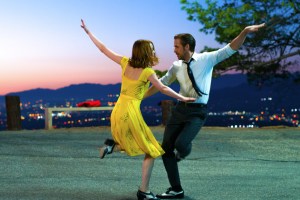 Mia and Sebastian are not particularly strong characters. The unified star power of the lead actors is enough to disguise this fact for a majority of the movie and maybe for some the entirety. They don’t have anything of import to say beyond their dreams and their jobs that are presently in the way of achieving said dreams. I couldn’t tell you anything else about these characters. For Mia and Sebastian, the world is divided into those who are pure and those who are impure, the real artists and the phonies, and the dichotomy will rankle anyone who has interacted with more than their share of hipster. Sebastian is a music snob who wants to impress upon the world the importance of jazz even as it shrugs indifferently. Nobody gets it, man. He’ll fight the good fight no matter what because Sebastian’s fight is Chazelle’s: taking outdated material and exporting value to a new generation. The characters serve the plot and exist to entwine and then be dutifully pulled apart. It’s hard to invest in the characters when they won’t show who they are and why they should be together. Maybe that’s the point ultimately, a rich meta commentary on how attenuated the central courtships in movies themselves are, or the fleeting relationship between film and audience, or maybe I’m just hoofing as hard as the leads to insert more meaning here.
The second half paddles into what my friend Ben Bailey affectionately termed White People Problems: The Musical. I won’t fully concur but the conflicts are too forced and the characters become whiney. Sebastian rejoins a pop band where he doesn’t feel 100 percent creatively fulfilled because he isn’t performing “true jazz.” The band is also popular and this causes friction because he has “sold out” on his dream, as if toiling during for any period of time is giving up. I guess you must be single-minded or it doesn’t count. Their combined egos won’t allow for different variations of success. La La Land pretends to endorse the dreamers but does it really? The only dreamers who seem to count are Mia and Sebastian. What happened to Mia’s lively group of roommates and friends from the beginning party? What about the nebbish screenwriter the movie mocks for an easy laugh? There are no significant supporting characters in this movie; the universe belongs to Mia and Sebastian. They’re not as insufferable as the characters from Rent but it’s definitely a detriment. Look at the characters in Fame, a group of hungry teenagers who came from all walks of life and circumstances to try and achieve their titular dream of stardom.
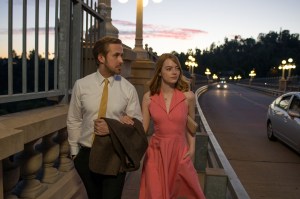 The limitations of its doe-eyed leads present some issues. Stone (Birdman) is smashing in the movie but part of that is because, aside from some song-and-dance choreography, the movie asks very little of her other than to be cute, a trait Stone has in natural abundance. There are two standout scenes for the actress. The first is an audition where she pretends to be a mistress getting the “sorry, I can’t do this” phone call from the man she thought had loved her. The sheer variety of emotions that Stone is so able to quickly convey on her face, in her tremulous eyes, and posture are remarkable. Of course the problem is that she’s too objectively good to keep getting blithely rejected by cold-hearted casting agents. The second is a musical showcase where Stone belts out a story about how her aunt inspired her to be a thespian. Stone is effortlessly captivating but she deserves better than to be foil to a grumbly Gosling. I feel that Gosling is one of those actors who can be amazingly talented when plugged into the right role and with the right director (see: Half Nelson, The Believer, The Big Short). He has an easygoing charm that all-too easily morphs into smarm without the right guidance or motivation on his part. Sebastian feels like a scowling grump who wants to bludgeon the world with his point of view. It feels more like he’s in it for submission. Gosling’s performance left me wanting someone else to play his part. They were so strong on screen in Crazy, Stupid, Love but that sizzling chemistry of old is gone here. They feel inert together, amplified by Gosling’s antiseptic performance. They’re both rather limited singers, very thin of voice, and that does hurt a musical. The songs by composer Justin Hurwitz and lyricists Benj Pasek and Justin Paul are exceptionally milquetoast. They’re all slight renditions on the same blandly pleasant tune. They evaporated from my memory by the time the end credits started rolling. Moana has nothing to fear come Oscar time from these at-best competent compositions.
If imitation is the highest form of flattery, then Chazelle’s anodyne musical is brimming with appreciation and adoration for the world of classic Hollywood, and that alone will be effectively transporting for many film critics and select audiences bred on a diet of Fred Astaire and Ginger Rogers. La La Land is an airy confection but one that dissipates all too easily after viewing thanks to the limited characters, the limited singing, the limited dancing, the limited songs, and the lack of overall substance independent from imitation. It has its lovely moments and Stone is an ingénue worth loving, though not as much her slim character, a dreamer who dreams the dreams of a dreamer. The breezy and bubbly first half doesn’t really mesh with the second half. I think it’s telling that Mia and Sebastian’s “love theme” is a sad plaintive piano trinkle. As the characters get more sullen and sour, the fizzy fun fades away and it starts to feel like a New Year’s Eve hangover that left you addled and warm but only in a vaguely ephemeral sense. If it leaves you toe tapping and giddy, I’m glad. I’m already mentally prepared for it to practically sweep the Oscars, as they do love celebrating their own importance. La La Land is a movie musical that is stuck looking backward that it loses its own footing.
Nate’s Grade: B-


 nathanzoebl
You must be logged in to post a comment.