Blog Archives
I Love You, Daddy (2017)
 After years of rumors, highly influential comedian and television guru Louis C.K. has admitted that the sexual allegations against him are indeed true. Several women recently came forward in a New York Times article citing C.K. as asking them to watch him masturbate, forcing women to watch him masturbate, or masturbating over the phone with an unsuspecting woman. Right now in the new climate of Hollywood, it appears that C.K.’s comedy career is at a standstill if not legitimately over. And strangely amidst all this was the planned release of a little movie he wrote, directed and stars in called I Love You, Daddy, about a famous Hollywood director with rumors of sexual indecency. The movie has been pulled from release but not before screeners were sent to critics. I don’t know when the general public will get its chance to watch I Love You, Daddy, but allow me to attempt to digest my thoughts on the film and any possible deeper value (there will be spoilers but isn’t that why you’re reading anyway?).
Glen (Louis C.K.) is a successful TV writer and producer. He’s starting another show and Grace (Rose Byrne), a pregnant film actress, is interested in a starring role and perhaps in Glen himself. His 17-year-old daughter China (Chloe Grace Moritz) takes an interest in a much older director, Leslie Goodwin (John Malkovich), with a troubled past. Glen idolizes Leslie Goodwin but isn’t comfortable with the interest he’s shown in his underage daughter.
 It’s impossible to resist the urge to psychoanalyze the film especially considering it’s otherwise a fairly mediocre button-pushing comedy. The biggest question that comes to mind is why exactly did C.K. bring this movie into existence? He hasn’t directed a film since 2002’s blaxploitation parody Pootie Tang. It didn’t even come into being until this past June, when C.K. funded it himself and shot it over the course of a few weeks. What about this story was begging to be brought to life, especially with C.K. as its voice? He didn’t have to make this. He brought this into the world. Given the controversial subject matter, C.K. must have known that the film would at minimum reignite the long-standing rumors of his own sexual transgressions. So why would he make I Love You, Daddy? This is where the dime-store psychiatry comes in handy, because after viewing the finished film, it feels deeply confessional from its author. It feels like C.K. is unburdening himself. I cannot say whether it was conscious or subconscious, but this is a work of art where C.K. is showing who he is and hoping that you won’t realize.
This is very much C.K.’s riff on Woody Allen movies and Woody Allen’s own troubled history of sexual impropriety; it’s an ode to Allen and a commentary on Allen (C.K. had a supporting role in Allen’s Blue Jasmine in 2013). It’s filmed in black and white and even follows a similar plot setup from Manhattan, where Allen romances a 17-year-old Mariel Hemingway. It’s about our moral indignation giving way to compromise once our own heroes are affected or whether or not our own lives can be benefited. The stilted nature of human interaction among a privileged set of New Yorkers is reminiscent of Allen’s windows into the world of elites. It’s an approach that C.K. doesn’t wear well, especially coming from his much more organic and surreal television series. The movie is trying to find a deeper understanding in the Woody Allen-avatar but never really does. I grew tired of most of the conversations between flat characters that were poorly formed as mouthpieces for C.K.’s one-liners and discussion points (and an N-word joke for good measure). Leslie is an enigma simply meant to challenge Glen on his preconceived ideas. Leslie isn’t so much a character as a stand-in for Woody Allen as stand-in for C.K.’s own fears of hypocrisy and inadequacy. And that begets further examination below.
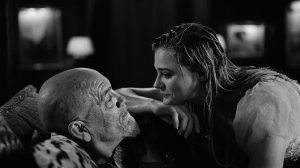 In retrospect, looking for the analysis, there are moments that come across as obvious. C.K. has generally played a thinly veiled version of himself in his starring vehicles. Here he’s a highly regarded television writer and producer who seems to keep making new highly regarded television series. There are too many moments and lines for this movie not to feel like C.K. is confessing or mitigating his misdeeds. One of China’s friends, a fellow teen girl, makes the tidy rationalization that everyone is a pervert so what should it all matter? Sexuality may be a complicated mosaic but that doesn’t excuse relationships with underage minors and masturbating in front of women against their will. Glen says that people should not judge others based upon rumors and that no one can ever truly know what goes on in another person’s private life. There’s a moment late in the film where Glen is irritated and bellows an angry apology with the literal words, “I’m sorry to all women. I want all women to know I apologize for being me!” I almost stopped my screener just to listen to this line again. In the end, Glen has a fall from grace and loses his credibility in the industry. He’s told by his producing partner, “So you were a great man and now you’re not.” And the last moment we share with Glen before the time jump that reveals his fall from grace? It’s with China’s “everyone’s a pervert” friend and after she confesses that she once had a crush on Glen when she was younger and that she finds older men sexy. After a few seconds, he slightly lurches toward her like he’s going to attempt to kiss her and she recoils backwards. Glen interprets the moment very wrong and tries to make an unwanted move on a much younger woman. Yikes.
There’s also a supporting character that twice visually mimes masturbating in public. Yeah, C.K. literally included that gag twice. For a solid twenty minutes I didn’t know if Charlie Day’s character was real of a Tyler Durden-esque figment of Glen’s outré imagination. Day plays an actor with a close relationship with Glen. He’s not like any other character and seems to speak as Glen’s uncontrolled sense of id, urging him into bad decisions. During one of those furious masturbatory pantomimes (not a phrase one gets to write often in film criticism, let alone the plural) Day’s character is listening to Grace on speakerphone. This is literally the same kind of deviant act that C.K. perpetrated on a woman detailed in The New York Times expose. It’s gobsmacking, as if Bill Cosby wrote a best friend character that would drug women at a party he hosted, and Cosby wrote this after the rape allegations already gained traction. Double yikes.
 As a film, I Love You, Daddy feels rushed and incomplete. The editing is really choppy and speaks to a limited amount of camera setups and shooting time. Locations are fairly nondescript and the entire thing takes on a stagy feel that also permeates the acting. C.K.’s television work has revolved around a very observational, natural style of acting and a style that absorbs silence as part of its repertoire of techniques. I Love You, Daddy feels so stilted and unrealistic and it’s somewhat jarring for fans of C.K.’s series. The actors all do acceptable work with their parts but the characters are pretty thin. You feel a lack of energy throughout the film that saps performances of vitality. There’s a method to the reasoning on presenting China as an empty character until the very end, which speaks to Glen’s lack of understanding of who his daughter is as a person. The overall storytelling is pretty mundane, especially for C.K. and the topic. He seems to open conversations on topics he believes don’t have easy answers, like age of consent laws, statutory rape, and judging other people based upon their reputations, and then steps away. The film wants to be provocative but fails to fashion a follow-through to connect. There aren’t nearly enough nuances to achieve C.K.’s vision as saboteur of social mores.
It feels like C.K. might have anticipated having to come forward and accept the totality of his prior bad behavior, and maybe he felt I Love You, Daddy was his artistic stab at controlling the reckoning he knew would eventually arrive. I would only recommend this movie as a curiosity to the most ardent fans of C.K. comedy. I Love You, Daddy delivers a few chuckles but it’s mostly a mediocre and overlong Woody Allen throwback companion piece. It’s harder to separate the art from the artist when that artist has complete ownership over the vision. As of this writing, I can still watch Kevin Spacey acting performances and enjoy them for what they are, mostly because he is one component of a larger artistic whole. In C.K.’s case, he writes, directs, stars, and it’s his complete imprint upon the material. I consider 2016’s Horace and Pete to be of nigh unparalleled brilliance that I wouldn’t hesitate to call it a modern American theatrical masterpiece that could sit beside Eugene O’Neill. So much of C.K.’s material was based around his brutal sense of self-loathing and now the audience might feel that same sensation if they sit down and watch I Love You, Daddy. Unless you want to do like I did and unpack the film as a psychological exercise of a man crying out, there’s no real reason to watch this except as the possible final capstone on C.K.’s public career.
Nate’s Grade: C
Share this:

The Florida Project (2017)
 Director Sean Baker has become one of indie cinema’s most probing, humanist voices for the outliers of our society. His previous films looked at aspiring adult film industry performers, transsexual prostitutes, and now with The Florida Project, an assortment of low-income and homeless families. The film has been buzzed about by critics for months and has started to pick up some serious awards traction. The film does an admirable job of illuminating a childhood on the fringes of society. I just wish it had done more.
Moonee (Brooklyn Prince) is a young child living in a rundown motel miles from Disney World. Her mother, Halley (Bria Vinaite), relies chiefly upon hustling Disney tourists to make money. Bobby (Willem Dafoe) is the manager of the motel. He’s sympathetic to the families turning their stays into homeless residency, but he also needs rules to be abided and rent money paid. He’s concerned about Halley’s choices and how they are impacting, and will impact, the life of her daughter. Over the course of a few weeks during the hot summer, Moonee’s life will never be the same.
 The Florida Project is a slice-of-life drama from the perspective of a young child, and to that end it’s quite immersive and empathetic. Little Moonee and her group of friends feel extensively real, so much that I wouldn’t be surprised if director/co-writer Baker just turned on his camera and simply said, “Go,” and sat back. Much of the movie, and perhaps even half, is watching Moonee and friends play, explore, and interact with a larger world that they don’t fully understand. There are heavier realities kept at the peripheral. Moonee doesn’t know that she and her friends are living in poverty. She doesn’t know that her fun mom is actually an irresponsible parent. She doesn’t know that the weird guy watching them play that Bobby forcefully removes is very likely a pedophile. She doesn’t know the illegal activities of her mother to make ends meet. This limited perspective is also the same given to the audience. A mother/daughter photo session that seems innocuous and a little sweet is later revealed to have seedier ulterior motives. We follow Moonee on her jaunts to investigate the rundown neighborhood, and somehow in that missing time Halley has gained money for rent. It’s not quite a whimsical, romanticized version of life in poverty like the misguided yet critically beloved Beasts of the Southern Wild. Instead, it’s more a selective perspective that focuses on the innocence and imagination of children but without romanticizing the reality of poverty. It’s like a different coming-of-age film where future versions of characters would look back and think about all the things they didn’t know when they were just kids.
Baker and his production do an excellent job of making you feel the day-to-day reality of modern poverty and the struggles of people to simply exist and without condemnation. Halley would be charitably described as a bad mom, and yet she finds ways to provide for her child even if they jeopardize her custody. Halley is far too immature to be responsible for another human being, but not all of the other women are that way. Other women in the purple motel find legal means to provide and they take a concerted interest in the well being of their children. Halley’s adult friend is able to hold down a stable waitress job. Halley is too unruly, immature, and careless to do the same. Halley’s last job was working as a stripper, though she never tries getting a job at what I have to assume are a plethora of competing strip clubs adjacent to the commercial Disney tourist empire. This is very much a visual document of systemic poverty that illuminates the hardscrabble lives of people on the fringes of society trying to stay afloat. It’s rich in details like the knowing swapping of residents between local motels for one day a month to skip past residency declaration laws. It’s an interesting hidden world that feels rarely given this kind of caring close-up.
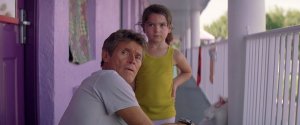 Baker has a great talent at finding non-actors who have great acting potential to essentially play versions of themselves. From Starlet, Tangerine, and now Florida Project, Baker has a tremendous gift for discovering people. There is an absence of mannered performance tics; the characters feel real because the actors are acting very naturally. These unsupervised kids are behaving like bratty kids. Brooklyn Prince is phenomenal as Moonee and a born performer. She has an innate charm that left me laughing often. Her improvisation is terrific although some of her lines definitely out themselves as being the written ones (“I can always tell when adults are about to cry”). Vinaite (Harmony Korine’s upcoming Beach Bum) is aggravating and yet you still wish that at some point she would turn it around or come to some latent epiphany. Halley feels, infuriatingly, very authentic in every one of her moments. She is dooming her child to a comparable trapped life of limited appeal and escape, but she can’t help herself and only focuses on the immediacy of life when life is so transitory and pessimistic. Dafoe (Murder on the Orient Express) is the moral center of the film and you feel his genuine unease in every pained glance. He has to hold his authority but he’s still very sympathetic for the motel’s collection of people that modern society has easily forgotten about.
With that being said, I understood what Baker and The Florida Project was going for and I found it to be underwhelming because there wasn’t much more than an established world. This is a movie with a very loose definition of plotting. After a while, without a better sense of plot momentum, it all starts to blend together into redundancy. It doesn’t help when many of the scenes can be less than ten seconds long. Here’s Moonee and her pal eating ice cream. Here’s Moonee and her friend running in the rain. Here’s Moonee and her friend hugging. Here’s Moonee in the bathtub. It becomes a lower class triptych of establishing its world and mood, but a little goes a long way. All of that could have been established and sustained in the first act, and then the story could have launched into a greater sense of change. I may lose some hipster critic cred points but as it continued I was partly wishing that the movie had been more conventional. Perhaps Bobby becomes more involved in the life of Moonee, taking custody of her while her mother was missing or going through social services review. He’s already a quasi-surrogate father figure so why not better explore that dynamic? The characters lack a depth to them, partially because we’re following children just being children, partially because we have characters drifting through life. It’s still lacking.
 This was another example of an indie film sacrificing character and story to the altar of realism. I wrote a similar complaint in my 2012 pan of Beasts: “But all of these setting details do not take the place of an involving story and characters we should care about. I felt sorry for the various residents and their lot in life, but I never felt attached to any of them. That’s because they’re bland and simplistically drawn, but also because Beasts doesn’t bother to do anything else other than create its rich, tragic, harsh world. It’s authentic all right, but what does all that authenticity have to add to genuine character work? Artistic authenticity is not always synonymous with telling a good story.”
Immersive and genuine, The Florida Project is awash in details for a way of life rarely given this much attention and empathy. The acting is very natural and the young children especially behave recognizably like young children. Keeping the perspective of the film attached to the child is an interesting gamut as it keeps some of the harsher aspects of this world and the people from the same kind of direct exposure. It allows the film to have a degree of innocence without romanticizing poverty as some kind of fairy tale. It was a perfectly fine movie that I just happened to want more from, in particular a non-redundant story with more significant plot events and characters that felt multi-dimensional and developed over the engagement. I kept waiting for more and was simply left waiting. Even the symbolism of being on the outskirts of Disney World, the materialistic “happiest place on Earth,” felt barely toyed with. The Florida Project is a good start to a good movie but it needed continued refinement and attention to be something more than an inquisitive magazine article brought to careful cinematic life.
Nate’s Grade: B-
Share this:

The Killing of a Sacred Deer (2017)
 Greek filmmaker Yorgos Lanthimos might just be the most perversely ingenious creative mind working in movies today. After Dogtooth and The Lobster, I will see anything that has this man’s name attached to it, especially as a writer/director. Lanthimos’ latest, The Killing of a Sacred Deer, is a challenging revenge thriller, a macabre comedy, a morality play, and a generally uncomfortable watch that is just as alienating as it is totally brilliant.
Steven Murphy (Colin Farrell) is a heart surgeon with a loving family that includes his wife, Anna (Nicole Kidman), teen daughter Kim (Tomorrowland’s Raffrey Cassidy), and young song Bob (Sunny Suljic). Then there’s Martin (Barry Keoghan), the lonely son of a patient who died on Steven’s operating table. He won’t leave Steven alone and doesn’t understand boundaries, even trying to hook up Steven with his lonely mother (Alicia Silverstone, yep you read that right). Martin even takes an interest in Kim. However, once Steven’s son falls victim of a mysterious illness and becomes paralyzed, Martin makes his true intentions clear. He’s poisoned all three of the Murphy family members and they are destined to die slowly unless Steven kills one of them. He has to choose which family member’s life to take with his own hands, or else they all die.
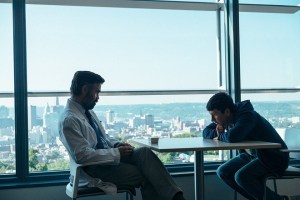 It’s hard for me to think of whom exactly to recommend this movie to because it is so intentionally off-putting. It’s intended to make you awkwardly squirm and question what you are watching. This will not be a fun watch by most accounts unless you’re a very select person who has a dark sense of humor and an appreciation for something different. Lanthimos seems to be purposely testing his audience’s endurance from the start. We open on several seconds of black to test our patience and then an extended close-up of real open-heart surgery. My pal Ben Bailey had to shield his face from the screen. From there, the movie defies your expectations at most turns and digs further into its depths of darkness. This is one of those movies where you wonder whether it will go “there” and it most assuredly goes there and beyond. One minute you’ll be cringing, the next you’ll be cackling, and the next you’ll be deeply unsettled, and then maybe back to laughing if you’re like me. Much like Lanthimos’ other movies, his deadpan sense of comedy is his prescription for an absurd world. It’s a movie where you have to actively work to adjust to its bizarre wavelength, but if you can, there are rewards aplenty. I can’t stop thinking about it.
Unlike The Lobster, this doesn’t exist in a completely parallel universe but more of a cracked, heightened version of our own. Lanthimos’ breakout film, 2009’s Dogtooth, dropped the audience into a strange world and expected us to catch up. This is similar. The flatly comic conversations become a sort of absurdist poetry. Everyday moments can be given one extra strange beat and become hilarious. Scene to scene, I didn’t know what would happen. The movie allows its story to properly breathe while finding room for its characters to discover intriguing diversions and insights, like Martin’s recollection of how he and his father eat spaghetti the same way. There’s an unusual sexual kink that involves giving oneself completely to another that makes more than one appearance, enough to question the connection between them. The very geneses of that kink I think alligns with a character’s god complex, but that’s my working interpretation. It made me rethink about the aberrant concepts of sexuality in Dogtooth, a.k.a. the nightmare result of helicopter parenting. The handling of pubescent sexuality, and the idea of incorrectly applying information learned from other settings, is just one more tool to make the audience uneasy. Killing of a Sacred Deer exists in a closer approximation of our world in order for there to be a better sense of stakes. Somebody is going to die, and if Steven cannot choose then everyone will die. This isn’t a fantasy world but a real family being terrorized by a demented and vengeful stalker. This gangly teenager is more terrifying and determined than just about any standard slasher villain.
 This is a modern-day Greek tragedy literally inspired by an ancient one. Prior to the Trojan War, Agamemnon was hunting and killed one of the sacred deer belonging to Artemis. The angry goddess stranded Agamemnon’s ships and demanded a sacrifice in order for the winds to return. He had to choose one of his family members to kill, and Iphigenia got the short end of that one. Euripides’ classic work gets a fresh retooling and Lanthimos is not one to merely stand on ceremony. He smartly develops his premise and takes it in organic directions that feel believable even given the ludicrous circumstances. That is Lanthimos’ gift as a storyteller, being able to make the ludicrous feel genuine. After the half-hour mark, where Martin comes clean, the movie really takes off. Does Steven tell his family and how much? Does he take matters into his own hands to convince Martin to stop? Is he actually culpable for the death of Martin’s father? Once the reality becomes clear and people starting getting increasingly sick, the movie becomes even direr. Steven is given the unenviable position to choose life and death, though he frequently shucks responsibility and only continues to make matters worse. Once his family comes to terms with the reality of Martin’s threat, they each try different methods to argue their personal favor to dear old dad. They vie to be father’s favorite or, at least, not his most expendable loved one. It’s a richly macabre jockeying that had me laughing and then cackling from the plain absurdity. Lanthimos presents a tragedy and forces the audience to simmer and contemplate it, but he doesn’t put his characters on hold either. They are adapting and have their own agendas, mostly doing whatever they can to campaign for their lives at the expense of their family (Vin Diesel’s Fast and Furious character would loath this movie with a sleeveless fury).
The end deserves its own mention but fear not dear reader I won’t spoil it. It’s a sequence that had me literally biting my own hand in anxiety. I was pushing myself backwards in my chair, trying to instinctively escape the moment. It’s the culmination of the movie and feels entirely in keeping with Lanthimos’ twisted vision and the depiction of Steven as a weak man. There’s a strange sense of inevitability to it all that marks the best tragedies. I don’t know if I’ll sit through a more intense, uncomfortable few minutes in 2017, and yes I’ve seen, and appreciate, Darren Aronofsky’s mother! of difficult 2017 sits.
As much as this is a thriller it also feels just as much a satire of overwrought Hollywood thrillers. The killer isn’t some shadowy evil genius. He’s just a very determined teenager in your neighborhood. There are several moments that are difficult to describe but I know Lanthimos is doing them on purpose as a critique of thrillers. At the end, a character shakes a generous heaping of ketchup onto a plate of French fries, and we’re meant to get the lazy metaphor of the sloshing ketchup as spilled blood. However, under Lanthimos’ heavy direction, the shot holds longer, the accompanying soundtrack becomes an operatic crescendo, and the whole thing turns comic. Lanthimos has to know what he’s doing here, commenting on the lazy symbolism of dread in overwrought thrillers. There’s another instance where Martin has severely bitten into Steven’s arm. Martin’s apologetic and promises to make it right and then proceeds to bite a chunk of flesh out of his own arm and spit it onto the floor as an offering. That would have been creepy enough but then Lanthimos goes one step further. “Get it, it’s a metaphor,” Martin explains. It’s one in a series of moments where Lanthimos goes a step further into pointed genre satire. It’s possible I’m reading too much into the rationale behind some of these oddities but I don’t really think so. It seems too knowing, too intentional.
 The Killing of a Sacred Deer is a movie that invites discussion, analysis, and just a general debriefing in the “what the hell did I just watch?” vein. This is a movie experience that calls upon the full range of human emotions, and sometimes in the same moment. Lanthimos’ modern Greek tragedy serves up a self-aware critique of its own genre, as he puts his personal stamp on the serial killer thriller. This is also an alienating film that doesn’t try to be accessible for a wider audience. It almost feels like Andy Kaufman doing an experiment replicating Stanley Kubrick (and it was filmed in Cincinnati). Even if you loved Lathimos’ most high profile work, The Lobster, I don’t know if you’d feel the same way about Killing of a Sacred Deer. It wears its off-putting and moody nature as a badge of honor. I found it equally ridiculous and compelling, reflective and over-the-top, sardonic and serious. Dear reader, I have no idea what you’ll think of this thing. If you’re game for a demanding and unique filmgoing experience and don’t mind being pushed in painfully awkward places, then drop into the stunning world of Lanthimos’ purely twisted imagination. Killing of a Sacred Deer just gets better the more I dissect it, finding new meaning and connections. If you can handle its burdens of discomfort, The Killing of a Sacred Deer is one of the most memorable films of the year and also one of the best.
Nate’s Grade: A-
Share this:

Bong of the Living Dead (2017)
 I’m in a movie. That’s a pretty vain opening sentence but I wanted to get it out of the way. I was one of the very fortunate horror fans to attend the Nightmares Film Festival, which in two short years has already vaulted to being one of the top film festivals in the nation. I came to see the premiere of Bong of the Living Dead, a stoner zombie comedy that filmed in my hometown of Columbus, Ohio back in 2013 (oh what a simpler time). I had the good fortune to be a zombie extra, and wouldn’t you know, my shambling, bloody, stupid self made the final cut. I mention this not out of braggadocio but out of a desire for transparency. I am friends with many of the people in front of and behind the camera on this movie. I have personal connections to the production, Backwards Slate, and I’ve worked with several of the actors on other projects and plan to work with them again. I am going to write the most objective review I can for the film, as you would expect of me dear reader, but you should know of my potential personal biases. I was really dreading writing a review if the movie sucked. Happily, Bong of the Living Dead is still an enjoyably fun comedy even if you regrettably don’t happen to know anyone involved.
The zombie apocalypse is coming to Clintonville, Ohio, and our group of stoner friends has been waiting their entire lives for this moment. Childhood friends Hal Rockwood (Dan Alan Kiely), Christ Moser (Eric Boso), Tara Callahan (Laura E. Mock), and Jon Lance (Dan Nye) spend most of their time smoking pot and pontificating on the minutia of zombie pop culture. Christ is trying to hook up with a spacey new girl, Danielle DeWitt (Cat Taylor), and Tara and Jon seem to have something unspoken between them. Dr. Kate Mitchell (Tiffany Arnold) has been hearing strange cases of an infection passed through biting. Sure enough, the dead rise up and feast on the flesh of the living, and our stoners barricade themselves inside their house and gear up for the onslaught to come.
 This feels like it was plucked out of the 90s, and I do not mean that as a criticism at all. It feels like the kind of movie Kevin Smith would have made in his geeky prime (a mischievous recitation of randy porn titles seems wholly inspired from Smith). The core idea allows genre satire as well as genre self-indulgence: what if a group of pop-culture savvy potheads became embroiled in the zombie apocalypse? They speak in rapid-fire, hyper-verbal references because that’s how they process the world, as one long catalogue of pop-culture footnotes and influences. These characters are downright giddy with the prospect of finally getting to live within the realm of some of their favorite horror cinema, plus the added bonus of violence without a wider set of consequences. They get to be the stars of their own movie now. Except, to the credit of writers Tim Mayo and Max Groah, they don’t even know that they’re still the bit players. They oversleep a zombie cleanup mission and wake up late into the morning to discover much of their neighbors having already taken care of the task (one of them makes the entrepreneurial step of starting a zombie-aided car wash). Hal can’t hide his disappointment: “The whole point of the zombie apocalypse is that there’s not supposed to be any people around.” The apocalypse isn’t what it’s cracked up to be, and so the characters retreat and sulk, their knowledge of pop-culture raising their expectations to a level that could not be fulfilled.
It’s this clever undercutting of genre expectations where Bong of the Living Dead breaks from the mold of other zombie comedies. These characters are obsessively aware of zombie lore, and it’s a safe bet that a majority of the audience will have a loving knowledge base as well. They quickly accept their world-ending situation and it barely fazes them, perhaps still too inured by the inoculating effect of comparing it to the movies. It keeps the reality of the horror at a safe distance. Even while boarding up windows they can’t help but argue the merits of fast zombies versus slow zombies. A character makes a meta reference to breaking out a weapon that has never before been mentioned, and it was a big gut-busting laugh. Another clever undercutting is when the film transforms into more of a drama in the last act. I don’t know if enough has been established to make the leap from the Act One cartoon versions of the characters to the Act Three dramatic versions, but it was an interesting and unexpected development.
There’s one scene in particular that really exemplifies this dramatic pivot best while still undercutting the genre expectations (some spoilers). After all the close calls and zombie bashing, a character collapses and convulses not from having been bitten but simply from an ordinary and common medical emergency. The other characters are helpless and we watch the fear permeate the scene as everyone comes to the awful realization that this person is going to die from and there’s nothing that can be done. The panic in people’s eyes is genuine. This moment is without setup but I think it works better that way, placing the audience in the same confused and helpless position as the other characters. Groah, as director, gives the scene its necessary breathing room. In this world people can still die in ordinary, everyday ways, and death is not something that’s cool and distant. It’s terrifyingly real.
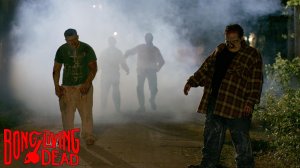 The loose, genial vibe of the overall production seeps into the script as well, especially during the lackadaisical second act that involves a lot of our characters just sitting around. Bong is a movie that finds time for little comic arias that other movies would blithely skip over. The loose feel allows the movie to find extra weirdness. There’s an ongoing run of silly media satire that reminded me of Paul Verhoeven’s social commentary. There’s a glib news anchor (Ralph Scott) trying to make the most of the dour news cycles, an opportunistic politician (Vidas Bardzukas) already promising to protect his constituency, a spookily spastic exercise host, a Spanish shopping channel host making love to the camera with his eyes, and a series of cheesy barbarian movies called Swords and Bitches with an evil whip-wielding arachnid queen (Brianne Jeanette). Bong of the Living Dead is chock full of little comical asides that you wouldn’t expect to be so good.
Though it’s also during the second act that I wish more had been going on. I wanted more examination on the difference between their perception of a zombie apocalypse and the reality they’re stuck with. I wanted a bit more setup for the payoffs, like maybe revealing that smoking pot slows down the zombie virus, etc. I wanted more of the VHS-quality flashbacks with the perfectly cast younger versions of the main gang. There aren’t as many central plot elements to make the bridge from start to finish. For much of the middle period, our characters kind of just sit around. They hang out, debate cereal superiority, and even go to the last remaining video store on Earth. It feels a bit like the movie is stuck in neutral, which might have also been the point to communicate the characters’ general malaise. I understand the absurdity of asking for more plot in a stoner comedy but this isn’t any ordinary stoner comedy, as its dovetail into heavy drama indicates. The first act is a lot of fun, the third act is effectively dramatic, but I wanted a bit more connective tissue. The characters could have been better developed (what exactly do they do when not smoking?) but I still cared when things got serious.
The performances across the board are good to great, with every actor, no matter how small the part, finding their specific comedic lane to work within. The biggest breakout performer is definitely Kiely (Axe Giant, Horrors of War) who is, to put it in a topical and never-to-be-dated analogy, the Tiffany Haddish of this particular Girls Trip. He goes above and beyond the call of duty to keep you entertained. Hal is the character that gets the most excited about the zombie apocalypse. The other characters are interesting but fairly subdued for the most part, as one would expect prolific stoners to behave. When Hal first sees a confirmed zombie, his wide-eyed expression is like a child on Christmas morning, and it’s the biggest applause moment for the film. Kiely is a live wire of energy that jolts every scene he’s in. His eyes speak a devilish madness. He reminded me of Jason Lee’s raucous debut in Mallrats, a full force that sweeps you away. After watching Bong of the Living Dead, you’ll wish every movie had a Dan Kiely in it.
 The rest of the ensemble find their moments, giving all the other moments to Kiely and his glorious beard. Arnold (Born Again, Seven Hells) is playing the most straight-laced of all the characters, a doctor trying to make sense of the irrational. Arnold has an instant screen presence and poise that causes you to sit up and pay attention. Her softer moments shared with Hal also help provide a nice antidote for the no-nonsense doctor. As much as Kiely is the draw of our attention, it’s Arnold that is often the one who grounds the picture. Boso (Underground 35) relentlessly pushes his character outside the box of socially awkward outcast. There’s a heaviness he feels from the consequences of getting close to others, and he doesn’t know fully how to deal with his frustrations with himself and the apocalypse, so he embraces his darker, nihilistic impulses. Boso is such a memorable film presence that it feels like he stepped off the set of a Richard Linklater film. Cat Taylor has a charming sense of daffy innocence to her. You can’t tell whether she’s dazed, cheerful, or not altogether there, and it fits very well for her character joining the group. She reminded me of Hannah Murray from the BBC’s Skins series. Nye (Harvest Lake, Dark Iris) is movie star handsome and has some sharp moments of comic aloofness. The romantic undercurrent he shares with Mock (The Tribunal) allows both of them something at stake that the audience can invest in. Nye and Mock have good heated exchanges that wake up the audience and allow each actor to effectively broaden their character range.
And then there are the little performances that make the most of their abbreviated screen time, like Ralph Scott’s (Stitches) wonderful clench-jawed bravado, Bardukas’ (The New Mr. Phillips) hilarious loose-elbow springiness in front of a green screen, Bill Koruna’s (The Shoes) crotchety neighbor, Ben Brown (After) as a powerfully self-loathing jock jerk who is wonderful fun to hate, Sarah Starr as a ditzy and easily bored sex object prone to gratuitous nudity, and the entire team inside the Conan-esque barbarian videos are a hoot for how committed they are to being silly. Just thinking about the Spanish home shopping host and his faces makes me smile and giggle to myself.
Bong of the Living Dead is a shaggy, scrappy, loose and lively zombie comedy with a charm all its own. It’s reliably fun and finds hidden gems of comedy from its deep supporting cast of oddballs. The main characters do fine work pushing at the boundaries of their stock archetypes, with Kiely as the wild man standout. There’s a definite love for the material here, over zombies and dumb comedies and the bonds of friendship. It’s evident in the care taken to creating a movie that doesn’t seem like it was churned out of a Hollywood assembly line, or something calculatingly checking the genre boxes (though the nudity does seem to linger a bit long…). Not everything always works but it’s a movie that tries a multitude of options. Bong of the Living Dead zigs instead of zags, undercutting the characters and our own expectations, finding ways to surprise as well as elate, and that includes going all-in on drama toward the end. It’s a silly movie that just might make you feel something by the time the credits roll. I don’t know what the release plans are for this homegrown horror flick, so stay alert for it on the horizon. Toke up, Backwards Slate Productions. You’ve earned it.
Nate’s Grade: B
Share this:

It Comes at Night (2017)
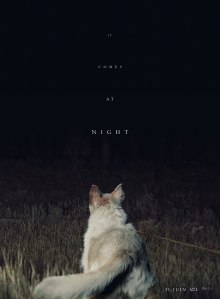 Like an earlier harbinger of the potential pitfalls of mother! marketing as something it’s not, the vaguely apocalyptic drama It Comes at Night is a paranoid thriller that is so bleak and absent resolution that you’ll wonder why anyone bothered. It’s not a bad film, and actually writer/director Trey Edward Shults has a knowing command on how to raise and develop tension with very precise camerawork and visual composition. The slow inspection of offscreen noise is still ready to build tension. The story has promise. Joel Edgerton is the father of a family trying to eek out an existence after the spreading of a deadly plague. He has a strict series of guidelines to protect his family members and keep them secure. This is put into jeopardy when he meets another family and invites them into his home. The rest of the film follows the slow dismantling of trust and the rise in suspicion and how it ruins both families. That’s essentially the movie. There is no “it” of the It Comes at Night. The post-apocalyptic element is at best tertiary to the plot, and the titular warning seems odd considering sickness can arrive at all hours. I think the reason audiences seemed to froth wildly at the mouth over this movie is due to its grossly misleading marketing. I re-watched the trailer and all of the supernatural imagery, which is extensively highlighted, is from dream sequences, and one dream sequence within a dream sequence. There’s a moment where the grandfather’s dog runs off into the woods at barks at an unseen force. You hear strange sounds but you never see anything, and this becomes just another unresolved, underdeveloped element. This is more a Twilight Zone parable about the destructive nature of man. The look of the film is moody, the performances are good, but I felt underwhelmed by the end and questioned the point of it all. It Comes at Night is okay. I can’t see what people loved and I can’t see what people hated, though I can see more of the aversion.
Nate’s Grade: C+
Share this:

Brigsby Bear (2017)/ Dave Made a Maze (2017)
 One way to stand out in a crowded marketplace is to differentiate your movie by making it weird and whimsical. Just being different can grab your attention, and Brigsby Bear and Dave Made a Maze are definitely different. Both of these indie films attracted attention for their unusual concepts and lo-fi designs, banking on a sense of nostalgia for a homemade style of art that’s a little rough around the edges. These might be two of the strangest films that will be released in 2017.
James (Saturday Night Live’s Kyle Mooney) is living underground with his parents, April (Jane Adams) and Ted (Mark Hamil). He does his homework, listens to his parents about never going outside, and anxiously waits every new episode of Brigsby Bear, a children’s fantasy TV show starring a Teddy Ruxbin-looking bear that teaches life lessons. Eventually we discover that April and Ted are not, in fact, James’ parents. They abducted him when he was a baby. The FBI raids their compound and returns James to his biological family, the Popes (Matt Walsh and Michaela Watkins as mom and dad, Ryan Simpkins as younger sis). James just wants to know when the next episode of Brigsby will come out. Unfortunately for James, Brigsby isn’t real. Ted produced the show on a nearby sound stage. He’d even occasionally hire other actors. James is the world’s most knowledgeable fan of a TV show no other person knows one iota about. He’s determined to give it a proper ending and recruits family, friends, and neighbors to make the ultimate Brigsby movie.
 I was pleasantly surprised at how effectively Brigsby Bear was at being cheery and sincere. I was expecting, given the premise, an ironic riff on nerd culture or obsessive fandom, and Mooney and company instead decided to play things very seriously. They take a fantastic premise that seems begging for derisive commentary and choose to find a human story within the absurd. That’s much more commendable and harder to achieve. As I’m aging, I’m becoming more and more appreciative of sincerity over irony (part of this is also that our modern age is inundated with irony). I was reminded of last year’s Swiss Army Man, an alarmingly strange movie with Harry Potter’s farting corpse and went for sincerity without any whiff of detached irony. Brigsby Bear isn’t at the same level of artistic accomplishment and lasting power as Swiss Army Man, but it’s an unconventional and touching movie that earns its quirky-yet-feel-good emotions.
It’s easy to see where this story could have exclusively dwelt in psychological darkness. James was abducted as a child and raised in a strange environment that makes him emotionally stunted and grossly ill prepared for the real world outside his reclusive safe space. The movie could have understandably dealt with James’ crippling sense of loneliness, betrayal, and inability to assimilate since his sense of self were cultivated by a fake children’s TV show. He could have easily been the creepy oddball who makes people uncomfortable. Instead, they made him the goofy oddball who makes people smile. His childlike sense of wonder is in tact and frees him from self-doubt. James is remarkably cheery for having his world turned upside down, and the movie follows his lead. This movie could have been another perplexing Dogtooth and instead it’s more accurately reminiscent of those old Mickey Rooney “we’re putting on a show” pictures. I was waiting for a moment of artificial conflict, a darker plot turn late into the film where perhaps it’s revealed that Ted was a molester. There’s 700 episodes of Brigsby Bear so I figured a few of them would reveal disturbing clues about something even worse. The film never does take that darker turn and instead stays upbeat to the very end.
 As he adjusts to his new home, the movie serves as both a delayed coming-of-age movie and a love letter to the power of creativity and how it can build community. With James transported into the outside world, much is made over his awkwardness with human interactions and his complete lack of guile. He gets his first kiss with a girl, and shortly after his first handjob, and wonders if that means they have to get married. It’s a sweetly naïve reflection. We watch the growing pains of James as he starts to make friends and become more confident in himself, which is a surefire way to win over an audience. James isn’t held up for ridicule. People want to be part of his project. He’s overcoming adversity and triumphing through the transformative power of art. There’s a joy in watching characters find themselves anew, and James serves as the catalyst. This person knows how to do special effects. This person used to act when they were in college. In his heartfelt attempt to provide closure to the Brigsby series, and possibly a chapter in his life, James’ project takes on a life of its own that brings people together. It shows how the community of art can be an empowering venture that can freely inspire the best in others.
The movie doesn’t become overly reliant upon nostalgia either. I figured it would be an ode to 80s television and culture but it really just uses that as backdrop. The world building of the show of Brigsby is bizarre and entertaining every time it’s included, especially when you comprehend the propaganda messages that Ted is sneaking in like, “Curiosity is an unnatural emotion.” The sense of wonder and whimsy doesn’t overwhelm the movie and its poignancy. Director Dave McCary (Saturday Night Live) makes the most of the retro pastiches while still serving the story. James could just have easily been obsessed with any show or ongoing work of art. The content of the show is unimportant. It’s about facilitating his growth into a person comfortable and confident with whom they are. By the end of the film, I was fighting back tears as the full assembly of characters watches the finished product of their labor. You watch them smile, laugh, take a sense of pride in their communal efforts, and they can see the world as James does. It’s a whole-heartedly pleasurable movie with surprising currents of emotional uplift.
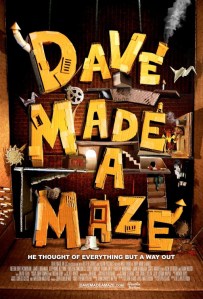 With Dave Made a Maze, the titular Dave (a beardless Nick Thune) is lost in a maze that he built in the apartment he shares with his beleaguered girlfriend, Annie (Meera Rohit Kumbhani). This maze consists of a cluster of cardboard boxes taped together. In time, a group of their friends and even strangers have assembled to admire the maze. Dave warns them not to enter but they do so anyway, and once inside they realize that the maze is considerably bigger and byzantine, and everyone expectedly gets lost. Annie and a documentary crew travel (lead by James Urbaniak) deep into the maze to rescue Dave. They all must confront booby traps, a Minotaur, thirty-something existential ennui, and the unsettling realization that the maze is expanding all on its own.
The real star of Dave Made a Maze is the fantastical environment inside the maze. The resourcefulness, imagination, and implementation of such a bizarre vision on such a limited budget is incredible. Each new room offers a new opportunity for the surreal. The characters stumble from room to room in mixtures of awe and bemusement, and the audience will feel the exact same way. Production designers Trisha Gum and John Sunner, and Art Director Jeff White, come from a world of animation, and they’re meticulous attention to detail pays off to an astonishing degree. In a just world, they would be nominated for an Oscar. There’s a DIY inventiveness that carries an irresistible charm with it, re-purposing everyday items to create a unique and whimsical world. Even when people are being gored to death and dismembered it adheres to the whimsical tone. The blood is replaced by red yarn, confetti, and silly string. The movie smartly underplays the lack of consistent logic within the world of the maze, and so weird things can just happen at a moment’s notice, like the main characters turning into puppet versions of themselves made out of paper lunch bags. There’s even a half-finished maze within the maze, which draws derision from the tired and frustrated people just seeking a way out. Some of the weirdness feels too half-formed and self-conscious, but the movie has an Eternal Sunshine quality where each new location provides another enjoyable opportunity for potential discovery.
 Where Dave Made a Maze runs into problems is when you realize there isn’t anything beyond that sense of invention. There isn’t a larger thematic core to this movie and the characters remain, at best, background players elevated to starting status. Most of these characters are jokes but they don’t even supply much in the way of jokes. The closet to a substantive theme is simply an arrested development fable where the man-child is struggling to finish a laboring artistic accomplishment, he feels humbled and humiliated, and his strained relationship with his accommodating girlfriend will always come together in the clincher. Dave lashes out that he didn’t feel like an adult at 30, so maybe he retreated to the halcyon days of childhood, or maybe it was a nostalgic retreat. Whatever the case may be, the movie suffers from an inevitable lull once the giddy novelty of its DIY fantasy starts to wear off. There’s one sequence where Dave and Annie have a circular conversation that just keeps going, and I’m sure if the filmmakers weren’t so desperate for material that it would have been trimmed down significantly.
Even at 76 minutes before credits, this is a movie that feels stretched beyond the limit because it’s lacking greater consideration to story. There are jokes that feel like they should be funnier too, like a latecomer to the maze who sets off the traps that Dave warns about earlier. This should be a fun structural payoff, allowing us to see both sides of the rooms. It doesn’t really work out that way, and the bumbling latecomer becomes another relatively unmemorable and undeveloped body on screen taking up space. The documentary crew conveys some mild satire as the crew leader keeps prodding others into saying what he needs for his movie, but even this inclusion feels more like a transparent device to get the characters to talk through plot points. Another misfire is the curious lack of stakes. The movie has a light-hearted charm but then doesn’t ever quite make up its mind on the danger being confronted. Real friends die for real. By the end of the movie, they do not come back even after the maze is kaput. They are really dead. Yet the film plays the stakes at a low simmer and the survivors just sort of shrug and move on. The film gives me little reason to be attached to any of these people, alive or dead.
 Whimsy is a fleeting feeling that’s hard to conceive and harder to hold onto. Both movies take whimsical premises that cater to the peculiar but only one delivers something of lasting substance. Brigsby Bear is a charming, heartfelt, and exceedingly sincere movie about an oddball finding his place in the world through the power of the creative process. He is transformed through his love of art and how that serves as the foundation for community. Whereas Dave Made a Maze is a lo-fi curio that I can admire more than enjoy. It’s missing crucial elements that make its journey worth the effort, beside its imaginative and scrappy production design. Both movies are charged by the power of the imagination to transport the ordinary into the extraordinary. Brigsby remembers to use its flights of imagination and whimsy to tell an engaging and ultimately touching story. Dave Made a Maze has cool sets and some infectious silliness. If you see one story of a man-child escaping into a world of nostalgic imagination and inviting friends to tag along, make it Brigsby, a film that uses whimsy to still tell compelling human stories.
Nate’s Grades:
Brigsby Bear: A-
Dave Made a Maze: C+
Share this:

mother! (2017)
 Now I know why there weren’t any promotional screenings for mother! in the lead-up to its national release. Director Darren Aronofsky’s highly secretive movie starring Oscar-winners Jennifer Lawrence and Javier Bardem was marketed as a horror thriller, a claim that is generous at best and dishonest at worst. This is not Rosemary’s Baby by a long shot. It’s a highly personal, livid, and visually audacious think piece on mankind, so it’s no surprise that general audiences have hated it and graded it with the rare F rating on Cinemascore (a shaky artistic metric, granted, but still a dubious honor). Aronofsky is a polarizing filmmaker who routinely makes polarizing works of art, so the stupefied outrage is not surprising. mother! is a challenging film that demands your attention and deconstruction afterwards. It’s not a passive movie going experience. I’m still turning things over in my brain, finding new links and symbols. mother! isn’t for everyone or even many. It requires you to give into it and accept it on its own terms. If you can achieve that, I think there is enough to be gained through the overall experience.
Lawrence and Bardem are husband and wife living out in the country. He’s a poet going through serious writer’s block and she’s remodeling the house in anticipation of a future family. One day a stranger (Ed Harris) comes by looking for a place to stay, and Bardem invites him into his home. The stranger’s wife (Michelle Pfeiffer) soon follows, looking for her husband. These uninvited guests awkwardly make themselves at home, testing Lawrence’s politeness and the bonds of her marriage. More and more strangers follow, flocking to Bardem and the home, and their unpleasantness only grows, pushing Lawrence into further states of agitation, desperation, and shock.
 The first thing you need to know before sitting down to watch mother! is that it is one hundred percent metaphorical. Nothing on screen has a sole literal intention. The movie is clearly Aronofsky’s statement about mankind’s harmful tendencies, as well as a larger potential indictment, but this is a movie that exclusively traffics in metaphor. Accepting that early will make for a much better viewing experience. It took a solid thirty minutes for me to key into the central allegory, and once I understood that lens the movie became much more interesting (this was also the time that more unexpected visitors began complicating matters). I was taking every new piece of information from the mundane to the bizarre and looking to see how it fit into the larger picture. I would genuinely recommend understanding what the central allegory may be before watching the film. Looking back, I can appreciate the slower buildup that, at the time, felt a bit like an aimless slog awaiting some sense of momentum. Even the significant age difference between Bardem and Lawrence is addressed and has a purpose. mother! is the kind of movie that gets tarred with the title of “pretentious,” and yeah, it is, because if you’re devoting an entire two-hour movie to metaphor, then you’re going to have to be a little pretentious. Terrence Malick movies feel like obtuse, pedantic navel-gazing, whereas mother! felt like a startling artistic statement that had a legitimate point and was barreling toward it with ferocity. It invited me to decode it while in action, keeping me actively alert.
When dealing in the realm of metaphor, much is dependent upon the execution of the filmmaker, and Aronofsky is one of the best at executing a very specific vision. Black Swan and Requiem for a Dream are both excellent examples of Aronofsky putting the viewer in the distressed mental space of the characters, utilizing every component of filmmaking to better communicate the interior downward spiral. With mother!, Aronofsky attaches his camera to Jennifer Lawrence for the entire movie; we are always circling her or facing her in close-ups, always in her orbit. She is our tether. When she walks out of a room, we follow, trying to listen to the conversations going on without us. When the revelers and mourners show up, we experience the same confusion and irritation as her. The film builds in intensity as it careens toward its hallucinatory final act. It’s here where Aronofsky unleashes his targeted condemnation with extreme vigor. It’s one confusing moment cascading upon another, strange images that ripple like a nightmare. There are some pretty upsetting and offensive acts meant to provoke outrage, and Lawrence is always the recipient of much of that cruelty. Like a Lars von Trier film, Lawrence plays a heroine whose suffering serves as the film’s thematic underpinning. Aronofsky’s commitment to his vision is complete. He doesn’t leave anything behind.
 Existing as a highly metaphorical work of art, there are numerous personal interpretations that can be had from mother! although, even with that said, one interpretation seems very obvious (spoilers to follow). This is first and foremost a Biblical allegory with Bardem portraying God and with Lawrence as Mother Earth. They live by themselves in tranquility but God is bored and unable to find solace. That’s when Ed Harris (Adam) and then Michelle Pfeiffer (Eve) show up, and all of God’s attention is soaked up with these new people, who bring their warring sons (Cain and Abel) and then more and more strangers. The people won’t listen to Mother Earth’s requests and warnings, and after trashing her home and breaking a sink that causes an explosion of water (Aronofsky Noah meta reference?), she and God kick them all out. She says afterwards, “I’ll get started on the apocalypse.” It’s Aronofsky’s retelling of humanity’s existence from a Biblical perspective up until the fiery, vengeful end. From here there are all sorts of other symbols, from Jesus and the Last Supper, to the spread of the Gospels, and the corruption of God’s Word and the subsequent cruelty of humanity. These newcomers are selfish, self-destructive, ignorant, and pervert the poet’s message in different ways, caging women into sex slavery, brutally executing divided factions, all while God cannot help but soak up their fawning adulation. God finally admits that Mother Earth just wasn’t enough for him, like a spouse coming to terms with her husband’s philandering. He’s an artist that needs an audience of needy worshipers to feel personally fulfilled. Ultimately it all ends in fire and ash and a circular return to the dawn of creation. For viewers not casually versed in Biblical stories, the film will seem like an unchecked, unholy mess.
This is going to be a very divisive movie that will enrage likely far more viewers than entice, and this result is baked into Aronofsky’s approach from the start. Working in the realm of allegory doesn’t mean the surface-level story has to be bereft of depth (Animal Farm, The Crucible, and Life of Pi are proof of that). However, Aronofsky’s story just feels pretty uninviting on the surface, lacking stronger characterization because they are chiefly symbols rather than people. There are recognizable human behaviors and emotions but these are not intended to be recognizable people. This limits the creative heights of the film because the surface isn’t given the same consideration as the metaphor. If you don’t connect with the larger metaphor and its commentary, then you’re going to be bored silly or overpowered by artistic indulgences. Everything is, ironically, a bit too literal-minded with its use of metaphor. The movie’s cosmic perspective is, to put it mildly, very bleak. It can be very grueling to watch abuse after abuse hurled upon Lawrence, so it doesn’t make for the most traditionally fun watch.
 mother! is a movie that is impossible to have a lukewarm reaction to. This is a shock to the system. Aronofsky’s wild cry into the dark is a scorching cultural critique, a condemnation on the perils of celebrity and mob mentality, and a clear religious allegory that posits mankind as a swarm of self-destructive looters that are as ruinous as any swarm of Old Testament locusts. It’s an ecological wake up call and a feminist horror story. It’s an artistic cleave to the system that’s meant to disrupt and inspire debate and discussion. This is going to be a movie that affects a multitude of people in different ways, but I feel confident in saying that fewer will connect with it and its dire message. Motherhood is viewed as martyrdom, and Pfeiffer’s character sums it up best: “You give and you give and you give, and it’s just never enough.” It’s about dealing with one-sided, usury relationships, surrendering to the insatiable hunger of others who are without appreciation or introspection. It’s not a horror movie like It about scary clowns. It’s a horror movie about how we treat one another and the planet. Aronofsky can confound just as easily as he can exhilarate. mother! is a provocative, invigorating, enraging, stimulating, and layered film that demands to be experienced and thoroughly digested.
Nate’s Grade: B+
Share this:

Wind River (2017)
 With just two finished movies attached to his resume as screenwriter, Taylor Sheridan has enjoyed immediate success. Sicario and Hell or High Water were both some of the finest films of their respective years. Sheridan has a classical sense of structure but he also pumps his big, bold Hollywood dramas with meaningful commentary and substance to communicate a systemic rot from within, whether it is the spiraling war on drugs, the rapacious banking industry, or an entire enclave of people that are ignored as an act of historical penance. When you come to a Taylor Sheridan movie, you leave feeling full on a banquet of superior screenwriting. Wind River is his next feast.
A young Native American woman, Natalie (Kelsey Asbillie), is found barefoot and dead in the snow on a Wyoming reservation the size of Rhode Island. A confluence of law enforcement officers investigate while questioning who has rightful jurisdiction, the state police, the Native police, or FBI Agent Jane Banner (Elizabeth Olsen). She’s frustrated that, while the coroner will confirm she was raped the night of her death, Natalie is not being dubbed a homicide because of the cause of her death. Jane seeks out the assistance of Cory Lambert (Jeremy Renner), a wildlife hunter for the Fish and Game Department who watches out for predators. He knows the land, he knows the people, he personally knows Natalie’s family, and he knows the loss of a daughter. Cory agrees to help Jane discover who is responsible for the murder and seek justice and, possibly, vengeance.
 This is a deeply felt character-driven mystery that examines the lingering damage and defenses of a group of people often left on their own and often forgotten. Sheridan is quickly establishing himself as cinema’s finest voice when it comes to a twenty-first century cowboy ideal, the taciturn, wounded man soldiering onward in an unfair world. Sheridan has a commanding sense of place and character, but his perspective rarely connotes judgment. He’s more an observer, a therapeutic device for his characters to finally express themselves and their brokenness and how the world made them this way. He can be downright poetic but his instincts are for a large canvas with Hollywood thespians. He writes meaty, distinguished, and humane characters all around, not just for the leads. One of the hallmarks of Sheridan’s writing is how precise and generous he can be with his stable of supporting actors. As the story develops, we see just how the death affects the small community, a community struggling to hold itself together anyway through poverty, drug abuse, and limited work opportunities (according to a 2012 New York Times feature, life expectancy on the reservation was 49 years). There is a pervading sense of hopelessness that carries over the land. The people in this movie feel real, lived in, and haunted, and the location feels exactly the same. The ending text leaves a stark reminder of this feeling like a world on our peripheral: no statistics are kept for missing Native American women. Nobody has any sense how high that figure could be.
The leading man of Wind River is Renner (Arrival) but the real star is his character, a gritty and experienced wildlife hunter with an abiding reserve of unresolved issues pertaining to his own teenage daughter’s murder. He has some beautiful monologues in this movie, exquisitely written by Sheridan to showcase characterization and back-story. The first is when he helps his grieving friend by sharing the routine he went through with his own personal loss, specifically how forgetting the person, and the pain of their loss, is the worst thing one can do to honor them. “Take the pain. It’s the only way to keep her with you,” he says. Renner delivers his best performance since 2010’s The Town and it’s one that asks him to slow things down. This isn’t a flashy role, and even though there are some stunning monologues, it’s a role that asks for more understatement. Sheridan has a clear favorite archetype but he finds ways to make each person distinct.
Elisabeth Olsen’s (Ingrid Goes West) character is intended as the audience entry point into the land and history, so as such she will suffer as the rookie who always seems to be out of her depth. This is exemplified by just about every assailant getting the drop on her, even after a meth head answered the door by spraying her with pepper spray. To her character’s credit, other characters befell these same missteps but they aren’t the next most significant character. She’s an outsider trying to find her footing in delicate territory. Olsen is the one asking questions often, pushing others to explain, which usually means much of her performance is reactive, with characters uncorking those fantastic monologues. However, her best moment is during the end, when Cory is talking her through a traumatic recovery. It’s so obvious that he’s saying the words he always wish he could have said to his daughter, and so the psychological projection becomes too much for Jane who breaks down sobbing, serving as therapeutic vessel for empathy. It’s a powerful scene and the closest thing to catharsis the movie has to offer.
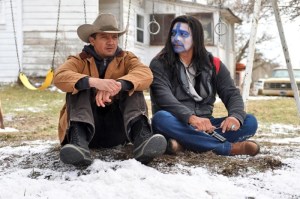 As such, the story is more a reflection and outlet for the characters, but it’s also an intriguing mystery until Sheridan decides to just throw up his hands and explain everything. Until the third act, the central mystery of who killed Natalie is filled with curious and dangling questions that are made all the more interesting from the unique setting and circumstances. Her lungs exploded from the cold after she ran, barefoot in the snow, for six miles for help before collapsing. That’s an interesting aspect I’ve never considered before when it comes to environmental dangers. Tracing back the events of her last night, Sheridan opens up an analysis on the precipitous lives of small-town America, except it’s a Native American reservation that’s sovereign from America. It’s an engrossing look into a culture and way of life few ever see. It’s a very unique setting that unfurls gradually over time, allowing the viewer to engage with the people, their fraying community, and the pain endured. And then the film hastily introduces its obvious culprits, shifts into an extended flashback sequence that explains everything, and zooms right into its tense climax. It all still works, don’t get me wrong. You’ll feel the mounting dread gnaw away at you during that flashback, and you’ll feel the rush of adrenaline during the shootout, and the sense of vindication by its conclusion. However, Sheridan was doing such a fine job at parceling out his elegiac story before that it almost feels like he quickly looked at the time and decided to rush into the finish.
This is also Sheridan’s first time behind the camera as director and he acquits himself well enough. A distinct sense of style doesn’t emerge but his directorial instincts follow his screenwriting strengths; the man knows when to get out of the way. The conclusion has a nasty snap of tension to it and the action hits its marks with power, having given quite the windup. Sheridan is best at directing his actors, who as stated above, give strong, emotive performances that linger with you. Wind River doesn’t prove that Sheridan has more to offer from a directing chair, but it does provide a baseline for a start to grow. I imagine from here on, having built up a reputation for writing critically acclaimed adult thrillers that big name actors flock to, that Sheridan will be directing the majority of his favorite scripts. He might not have the visual acuity or sense of vision that a Denis Villeneuve has, but he’ll reliably deliver strong performances from capable actors. He’ll also be the best steward for his stories, and I need so, so many of them.
Nate’s Grade: A-
Share this:

Lady Macbeth (2017)
 Cool, calculating, impassioned, and razor-sharp in its shrewd storytelling, the period film Lady Macbeth is worthy of the title of Shakespeare’s manipulative anti-heroine. Katherine (newcomer Florence Pugh) is recently married and expected to fulfill her wifely duties. Except her husband demands she stay inside and he also wants nothing to do with her physically. While away, she strikes up an affair with Sebastian (Cosmo Jarvis), one of the servants hired to tend the estate. She finally feels desired but also free, able to do what she wants and without the stifling control of patriarchal forces. There are three impediments to Katherine continuing to enjoy her status and relationship, and each one requires another step into moral turpitude. Lady Macbeth does a very effective job of developing taut tension born out of its premise. Every plot point naturally leads to another, creating more frisson and conflict. It pushes an audience into an uncomfortable position of deciding how far their sympathies will align with our put-upon protagonist. The ending is fitting but will likely produce a lot of heavy sighs and foot shuffling out of the theater. Pugh delivers a star-making performance in a role we’ve seen often in nineteenth century literature, the oppressed woman yearning for autonomy of body and mind. However, this isn’t an unrequited romance of furtive glances and pearl clutching, this is a meaty psychological thriller seeped in murder. Pugh expertly portrays a fascinating figure, a woman capable of cruelty to stake her claim in a cruel world. She commands the screen. A great reoccurring image is Katherine sitting on a settee and going through breathing exercises, as if to get into character for what she must do. Lady Macbeth (based upon the Russian novel Lady Macbeth of Mtsensk) is a tightly wound psychological thriller that brings a darker, absorbing carnality to the bonnet drama.
Nate’s Grade: B+
Share this:

A Ghost Story (2017)
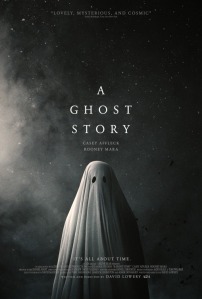 Ever wanted to see Oscar-nominated actress Rooney Mara eat a pie? Odd question, I realize, but apparently one that writer/director David Lowery felt compelled to answer. With the success of last year’s utterly heart-warming Disney remake of Pete’s Dragon, Lowery secretly made a low-budget movie with Casey Affleck and Mara, reuniting two of his actors from Ain’t Them Bodies Saints. The end result, A Ghost Story, literally involves a deceased Affleck stalking the screen in a long white sheet with two eyeholes. Lowery’s tone poem of metaphysical grief will likely alienate just as many people as it dazzles, and I fall squarely in the former camp. This movie is arthouse bluster.
This is a twenty-minute short stretched beyond a breaking point to fit a feature-length running time. It’s an impressionistic movie in the guise of the works of Terrence Malick, small and earnest and far more concerned about mood than story. That’s fine but if you’re going the impressionistic route I need scenes that aren’t self-indulgently laborious and constantly striking the same note. The majority of this movie is beautifully composed shots that eventually reveal the ghost standing in the background. It becomes a game of guessing when the camera will reveal the ghost’s presence. I understand that grief and loneliness is going to naturally deserve a slower pace to get a sense of the melancholic loss, but a slow movie that keeps delivering the same imagery is monotonous. The metaphors get old. The only thing holding the audience together is the time-traveling quest for the ghost to retrieve the note Mara’s character slipped into a door jam. It’s a long mystery that will ultimately prove an unworthy payoff. If Lowery is intending for the audience to feel the same sense of boredom and isolation as the ghost, that’s fine, but the movie dwells in this same emotional space with too little variance or further insight.
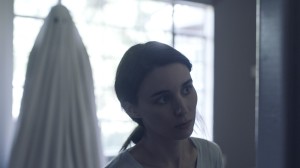 And this is where I have to come back to the pie as a symbol of the film’s self-indulgence. I have felt the urge to walk out of other movies but never acted upon them. I was minutes away from walking out on A Ghost Story, and it was the pie-eating scene that almost pushed me to bail. The idea of binge eating your feelings is a suitable metaphor for grief, and it works on its own initially, as she sniffles and holds back tears with every bite. And then she keeps eating. And then she keeps eating. The scene goes on for like ten minutes, uninterrupted, and with no further commentary. You are literally watching Mara eat a pie in real time and then throw up. After the sixth or so minute of pie consumption, I started laughing out loud, and then other people around me joined in. What can you do? Just as Mara’s character overindulges to the point of sickness, this scene pushes the beleaguered audience to the point of running out of the room gagging.
This would be different if the movie gave Mara anything really to do besides swallow her feelings. She has a few more scenes of the humdrum of moving on, painting the house she shared with her loved one, and then leaving. It seems like an awful waste of Mara’s talents but I would say the same thing for Affleck. I’m sure not having to memorize any lines after the ten-minute mark and getting to emote entirely through physical expression could be fun for an actor. It’s practically a throwback to silent film thespians. However, he’s just kind of there, like living furniture. I understand that part of grief is feeling like you’re a forgotten being and that time is infinite and punishing. I understand that sadness can feel numbing and cut to the bone. I get the mood; I even get the central metaphor of the de-contextualized ghost in a sheet just hanging around old haunts, unable to do much else, disconnected from the world and unable to move on or make sense of things. My issue is that this approach relegates the actors to stand-ins, squeezing the characters into intentionally bland ciphers for audience relatability. They are not allowed to be characters because somehow this would detract from the artistic appeal or message.
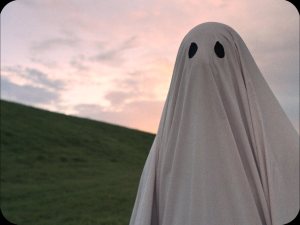 It’s frustrating because A Ghost Story has ideas, images, and moments that intrigue, beguile, and have a poignant power. It’s when the film expands beyond its limited parameters that it becomes its more interesting shape. As the ghost attempts to keep watch over Mara’s character, time moves much faster, to the point that a mere walk from one room to another can be the expanse of months. The triptych sequence of being unmoored through time, as everything speeds by so quickly, accentuates the helplessness of the ghost as well as the isolation. It’s like the world and life itself is outgrowing them, forgetting them, and leaving them further and further behind. There are also other ghosts and our ghost has a subtitled dialogue with them. It sounds silly but it’s actually one of the most sublimely affecting moments in the film, an idea that actually hits its intended mark. Take this exchange: “I’m waiting for someone,” “Who?” “I don’t remember.” Then the other ghost goes back to waiting, forever hopeful, forever clinging onto something that has long since evaporated, where even the memory, the concept of the idea of why has also vanished. Late into the movie the ghost starts going backwards and forwards in time, to a distant future of Bladerunner-like neon high-rises, to the nineteenth century to track a family of westward settlers. The abrupt careening through time says more about the ghost’s existence and it keeps things fresh. If this movie was a total wash, I could write off Lowery’s curio as self-important navel-gazing, but there are kernels of ideas, or moments, that stand out and demand a better presentation for better effect
A Ghost Story will definitely strike different people differently. It’s a deeply personal, poetic, and, if you’re not properly attuned to its metaphysical funeral procession, pretentious and pondersome film that wears out its welcome long before the end credits. I found the substance to be spread too thin over such a longer running time than this execution deserved. If you’re going for an impressionistic evocation, then the scenes need to be paced better. If you’re going for a mood of loneliness, then latch onto the character better and let’s follow Mara’s character as she rebounds and grows old. If you’re going for an existential horror movie, then present more confusion and terror and less of the same visual metaphors on constant repeat. If you’re going for Rooney Mara eating an entire pie in real time, then, well, actually you’ve succeeded. Congratulations. A Ghost Story is going to be one of those movies that critics fawn over that leaves me shrugging.
Nate’s Grade: C


 nathanzoebl
You must be logged in to post a comment.