Blog Archives
If Beale Street Could Talk (2018)
 Barry Jenkins’ follow-up from his Oscar-winning masterpiece Moonlight is an affecting adaptation of James Baldwin’s novel exploring a larger picture of the African-American experience through the life of one family under pressure. It’s a beautifully tender movie that aches with human feeling, tragic and joyous. We follow a young couple where Tish (Kiki Layne) is pregnant and Alonzo “Fonny” (Stephen James) is in jail for a crime he did not commit. Jenkins jumps around in time, providing mirrored juxtapositions that enliven the emotional outpouring of the scenes on screen, adding a sense of dread at the hardships we know await and a extra compassion for the good times while they last. Regina King is so outstanding as Tish’s mother, who goes out of her way to gather evidence to free Alonzo, that I wished she had more to do than her handful of big Oscar moments. There’s a racist cop that comes into the picture and is easily sidelined again. Many moments follow this lyrical, free-floating structure, zipping from one memory to another, which nicely presents a fuller picture with less. However, it also makes the film feel like it doesn’t fully come together by its very end and whether all of the assorted moments and insights are as helpful. It presents a case study of criminal justice reform and reminder that this family is only but one example. The intimate cinematography is gorgeous and the use of color is spellbinding. The music by Nicholas Britell is also highly involving without being overbearing. If Beale Street Could Talk might not have the awe-inspiring power and artistry of Moonlight, but it’s a moving, compassionate, and beautiful movie that confirms Jenkins as one of the greats.
Nate’s Grade: B+
Share this:

Truth or Dare (2018)
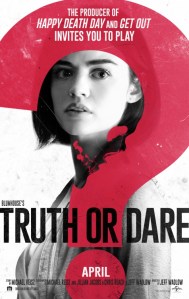
A group of college friends spend Spring Break south of the border and stumble into a deadly game of… truth or dare? Blumhouse has spun gold out of just about any high-concept horror property but can it make Truth or Dare work? Here’s the truth: nope.
This is a powerfully dumb movie that caused me to yell at the screen several times, shake my head even more, and contemplate my own life choices. The entertainment level is related to every befuddling choice this movie makes, and it makes many of them. Take basic dramatic opportunities that it weirdly pushes aside. One character is gay and hasn’t come out to his father yet, so the demon-inhabited game dares him to come out. Rather than watch this genuinely dramatic moment play out, Truth or Dare has it all take place entirely off-screen. Hilariously, the gay student comes back and recaps the audience what they missed (“Yeah, I came out to my dad, and he said some things, and we’re good now.”). Imagine if an action movie did something similar (“Hey, yeah, so I jumped out of a flaming helicopter onto that skyscraper and then scaled down only using my pants as a makeshift rope”). That’s bad writing no matter the genre. Take another scene where Olivia (Lucy Hale) tracks down the old Mexican lady who supposedly started the curse. She gets there but is told by the granddaughter to wait outside. So she does. Then we cut to a later scene where the granddaughter says, “She has agreed to see you.” Why did we need that first scene denying them entry? If all it does it kill mere seconds in the running time, why is it even included? This scene also involves the granddaughter being coy when Olivia asks to speak to the old lady. She cut out her tongue long ago and the granddaughter knows this but is just being a jerk. These are basic storytelling miscues that Truth or Dare doesn’t seem capable of overcoming.

We must talk about these silly demonically possessed faces. Oh the faces. It looks like a bad Snapchat filter promotion. I am convinced some studio exec saw a Snapchat filter and said, “Hey, we can make a horror movie based on that” (Look out for the upcoming dogface filter horror movie in 2019). The faces are so dumb. They pinch into pained rictuses, big eyes, and triangular, pointy chins. It’s not a creepy image at all. It’s like a bad special effect trying to turn the cast into caricature. Then they even directly address it, as one character literally cites the look as a “Snapchat filter.” Don’t hang a lampshade on it, movie, and make us all realize that even you know how dumb and derivative you are. The accompanying scary modulated voice is also worth a hoot. The end credits even end on the demonic voice challenging the audience to a game of truth or dare. Joke’s on you, movie, because nobody stuck around for the end credits of this one (except for me). The faces are never scary, are always goofy, and always funny looking, and that’s all we get.
The scariest thing in Truth or Dare is the uproariously bad dialogue. These are actual lines of dialogue spoken in the movie: “The game followed us home from Mexico.” Oh? “We’re not playing the game, it’s playing us.” Uh huh. “I dare you to get on the pool table and show everyone your pool cue.” Oh, PG-13 movie, how naughty of you. “I know things have been a little Bette and Joan since Mexico.” No, movie, you do not earn referencing Bette Davis and Joan Crawford or even Bettie and Joan from Mad Men.
The characters might be as bad as the cringe-inducing, laughable dialogue. Our protagonist is kind of a terrible human being (spoilers to follow). Olivia is obviously in love with her best friend Markie’s (Violett Beane) boyfriend Lucas (Tyler Posey), blurts out her best friend’s cheating ways to the whole world, will eventually sleep with the best friend’s boyfriend (more on that later), and then also reveals a painful secret regarding her best friend’s deceased father, namely she is indirectly responsible for his death, suggesting he kill himself after he tried to sexually assault her. All of these abuses are targeted at her best friend, and yet she constantly keeps trying to say, “You have to trust me,” as if these cruel torments should be waved away. It’s so one-sided and directed at one person, her ostensible best friend, that it becomes comical. At one point Markie has a gun to her head and screams she has nothing left. “You have me,” Olivia says, and I wanted Markie to pull the trigger right then because this was after Olivia told her everything. Hale (TV’s Pretty Little Liars) has a fixed expression of confusion with her large doe eyes, which don’t require that much in the way of adjustment for the Snapchat filter face. I don’t think we’re supposed to care about any of these characters, including our eventual Final Girl played by Hale. I was rooting for the demon to bump them off in bulk.

The mysteries of Truth or Dare are exasperating and demand further analysis, which I will ably try and perform for you, dear reader. First off, the rules of this game are very sketchy and feel rather arbitrary. A demon will jump around participants but needs more contestants, like the Ring cursed videotape. Eventually more players will be roped in but the old players are still part of the game, I guess, which means there’s no escape. This all started because some demon was released from its containment pot at an abandoned monastery, and it just so happened there was a group of teens playing truth or dare. So the evil demonic spirit said, “Hey, why not?” and adopted the game as its own? What if they had been playing spin the bottle or “Head’s up 7 UP”? I am almost certain, given the cannibalization of the horror genre, there has to be an evil spin the bottle movie somewhere (a cursory Internet search found a 2011 film with the premise). I feel like the other demons at Hell High pick on this particular demon and with good cause.
When given a choice between answering a question and doing some dangerous dare the choice seems obvious. The game seems to know this as well, which is why halfway through the characters are not allowed to choose “truth” any longer. This seems like cheating. The game is called “truth or dare” and not “…or dare.” By removing the choice it stops becoming a game. Admittedly, most human beings will tap out of horrible truths to reveal after a while unless you happen to be a politician. After a while it will just resort to making people talk about their Internet search histories. When these people have to blurt out painful truths, why do they scream them? Could not whispering achieve the same results? There’s the question of what constitutes finishing a dare as well. Since one’s life is on the line, it’s important to see the dare through. There’s one scene where the game dares Olivia to have sex with her best friend’s boyfriend. I don’t know about you, but if somebody said, “an evil force says I must have sex with you or else I’ll die” it would be a real mood killer. Regardless, they strip off their clothes and take the wanton opportunity given to them (Her: “You’re just doing this because you have to” Him: “No, you do. I’m doing this because I want to”). Except in the middle of their coitus the dare demon returns and possesses Olivia, challenging Lucas to pick next. Has Olivia finished fulfilling her dare? What constitutes “finishing” when it comes to sexual congress? The dares also escalate to an arbitrary degree, often robbing the player of a real chance to see it through. When the demon dares you to kill one of two people and the previous dare was far less significant, then it feels like the movie is compensating for a lack of developing thrills. If I go, “I dare you to eat that cheese,” and then next, “I dare you to rip it out of your intestines,” it feels like too much too soon. Alas, demon party games and pacing.

Then there’s the would-be solution, which as you could assume also doesn’t make much in the way of logical sense. They can rope the demon itself into the game if they reach the hallowed spot where the game began and time things right. the demon has the ability to alter your vision and hearing, so it can already alter your reality to its whims to whatever ends it wants. When the rules are arbitrary and you’re dealing with a supernatural presence that flouts mortality, what good is any of this going to do? It’s like the kids from a Final Destination movie scheming to have Death killed by Death. This isn’t the only movie to offer false hope as far as defeating a supernatural curse, like with The Ring and It Follows. Actually a lot of the plot is similar to It Follows. Just watch It Follows.
Truth or Dare is a thoroughly entertaining and thoroughly bad movie. It’s not scary and it’s not effectively dramatic. It’s confusing and capricious and hilarious. And yet, it does find that ineffable groove to come across as something in the “so bad it’s good” echelon, something I wouldn’t mind watching again with a group of friends and some adult beverages at hand. Truth or Dare is this year’s Bye Bye Man. I dare you to watch it.
Nate’s Grade: D
Share this:

Vox Lux (2018)

I don’t know what this movie was trying to say about anything. Vox Lux stars Natalie Portman as the adult Celeste, a survivor of a school shooting as a teen who became an international pop star in the months after. Is there something writer/director Brady Corbet wants to say about the transformation of tragedy into mass entertainment? The dulling effect of an entertainment industry to grind up human beings and re-purpose them into shiny, inauthentic, easily marketable figurines? I don’t know. I warily thought as we open on an upsetting school shooting, “I don’t know if the final product will justify this tone,” and it doesn’t. There are decisions that feel like they should mean something, like having the same actress, Raffey Cassidy (Tomorrowland), play both young Celeste and her eventual teen daughter, but what? It feels like an idea looking to attach to an interpretative message. Then there’s a modern terrorist group dressing like one of Celeste’s iconic music videos. She distances herself from the violence and even publicly challenges the perpetrators. This will obviously come back and mean something, drawing upon her own beginning stages of fame derived from the bloodshed of others, right? Or during her big concert the terrorists will invade and attack her, bringing the main character face-to-face with the ramifications of hubris. None of these things happen. Instead, Portman enters the scene at the 45-minute mark and proceeds to lash out at others, lament her parenting deficiencies, gets drunk, and then puts on her show. That’s it. It’s like Vox Lux forgot to be a movie for the final 20 minutes and just becomes a numbing series of EDM pop dance numbers. Portman is actually very good and digging deep into her anxious, entitled, and spiraling pop star, rounding out her dimmed humanity when Corbet cannot. There’s a solid storyline here between the adult Celeste trying to reconnect with her teen daughter who she’s been neglecting. This isn’t it. The pretension level of the pedantic exercise made me think of Lars von Trier as filmed by Darren Aronofsky. Skip it.
Nate’s Grade: C-
Share this:

Roma (2018)
 Alfonso Cuaron won a bushel of Oscars for his last groundbreaking project, 2013’s lost in space epic, Gravity, and one of the most daring and innovative filmmakers working in cinema had what every artist craves — cache. He could do whatever he wanted with his earned credits. And so Cuaron told a personal story about growing up in Mexico City, a love letter to his own nanny. Roma follows the life of Cleo (Yalitza Aparicio) for most of the year 1971, through her ups and downs and the loping rhythms of domestic life. This review is going to come across sounding far more critical than I intend. It’s mostly because I’m trying to deduce why my own experience with Roma was not the rapturous, transformative experience that my fellow film critics have sang. It’s a good movie but I’m trying to pinpoint why it kept me from fully engaging, or what within me stopped from engaging further. I think it stems from the central intent of the film and its overall perspective that proves too limiting for my tastes.
But first the good and the exquisite. Roma is a lusciously photographed and composed movie that brilliantly recreates the time and place of Cuaron’s childhood with stunning black and white photography (Cuaron serves as his own cinematographer for the first time). There are moments that are stupendously put together, pulled directly from Cuaron’s impeccable memory. Sometimes these even stem into the surreal, like a forest fire that features a man in holiday costume singing to himself while life and the flames rage on behind him, the chaos of the moment centered on a beautiful focal point. There’s an extended sequence of a car trying to park down a narrow driveway that becomes a symbol of unchecked manhood. There’s a riot that feels like it is being captured live, even though your brain tells you it’s the work of hundreds of people all coordinated to bring about Cuaron’s vision. There’s even a subtle (maybe not so subtle) nod to Gravity at the local movie theater. There is one family relative who garishly hangs the heads of dearly beloved dogs from the past as if they were hunting trophies. It’s a peculiar and striking detail and something that carefully tells you more about a side character. Then Cuaron cleverly cuts to the current canine being pet, establishing the connection of present and future as well as past and present, an achingly affecting theme throughout the film, trying to better understand our beginnings and the people who impact us.
 You can tell he has great affection for the women often responsible for the upbringing of children in rich homes. Cleo is the main character of Roma and given humble life by first-time actress Yalitza Aparicio. She’s very passive and selfless to a fault, but her actions demonstrate the care she has for the family she works for, especially the younger children. The emotional thrust of the film is Cleo’s unexpected pregnancy. She’s single, young, and worried it might cost her employment. It’s a difficult decision and the would-be father, a friend of a cousin, seems to want nothing to do with this new responsibility. There’s a moment late in the film, filmed in Cauron’s signature long takes, that breaks your heart, forcing the audience into Cleo’s position where she is struggling for meaning as an agonizing reality sinks in. Aparicio shows that she is more than capable of communicating larger emotions when given the opportunity.
And yet, I kept waiting to be truly transfixed, and waited, and ultimately I found myself enjoying Roma but more as a lyrical long form memory piece from someone else’s life than as a functioning drama. This is a love letter to Cuaron’s childhood nanny (it’s dedicated to her by name) and it’s a recreation of his childhood memories, which makes it deeply personal and lovingly realized from the basis of plucking fully formed moments and bringing them to startling life. The visual arrangements, movements, and bustling activity of life feel beautifully reconstructed. The problem starts to be that the movie feels like a series of moments rather than a larger story, and the argument for many will be that this is by grand design, that Cuaron is intending to comment upon the nature of life and memory through the smaller details, the kind that find their sticking places in our senses, and I do not dispute this intention. However, the end result can approach feeling like watching someone else’s dream of their past, a collection of home movies. The entry point for an audience member is going to be narrower because we didn’t live these memories.
Roger Ebert said that cinema was an empathy machine and with the right storyteller an audience should have no problem being able to experience a plethora of emotions and experiences from a wealth of characters in an array of circumstances and settings. The added problem with Roma is that Cuaron purposely chooses an outsider perspective but also choosees to film it as an outsider. Cleo is an outsider presence, which is a good starting point for drama and contrasts. She’s an indigenous Mexican, working poor, and the family member who isn’t really family. She floats through different communities feeling like she doesn’t fully belong, reminded of what sets her apart and unable to fully immerse herself in her surroundings. She’s left her family, her old way of life to move into the city and be a surrogate parent, and when she becomes pregnant she has to question her commitment to having her own child. The character of Cleo has great potential for human drama, though Cuaron seems to idealize her and hold her as a romantic symbol of his childhood, like he’s trying to do right by her legacy and memory. She’s a little too simplified, a little too selfless, and a little too opaque for the lead of a movie.
 Being an outsider is a good starting point for a story, allowing insight and criticism. This perspective is nullified by Cuaron’s storytelling and filmmaking choices to make the audience feel like a passive observer. Cuaron favors long wide shots that keep the viewer at a relative distance, both literally and figuratively. We’re soaking in all the details of the scene but those details are set dressing and visual compositions (Cuaron even imported his family’s old furniture). We don’t delve deeper into this realm because we are observing it from afar, from the added distance of time. It’s like a museum piece of a middle-class Mexican family’s life, safe for consumption and minor consideration before an audience is free to move onto the next exhibit. There’s a compassion that almost feels clinical, like the artist too afraid to spoil their art. I have no doubt how meaningful the movie is personally for Cuaron but he curiously forgoes the tools to make it more accessible, more open to others to empathize, and more meaningful for people who unfortunately didn’t have a Cleo.
Roma is a gorgeous movie that is handsomely made and lovingly dedicated to the people who often go unseen and undervalued in a lifetime. It’s elegantly photographed and often has the feel of a living dream built from Cuaron’s childhood memories. It’s well intentioned and with obvious artistic flair. However, when it was all done, all 135 minutes, I felt surprisingly unaffected. It’s a movie of moments, some of them vivid and others lyrical, but the outsider perspective and filmmaking choices made it hard to find an entry point and to fully engage in Cleo’s plight and the characters as a whole. So much more attention seems to be placed upon recreations of time, place, and people that were meaningful to Cuaron, but that doesn’t make them meaningful to me without added efforts. Roma is a quality movie with quality production and an okay story that holds back the intended reach.
Nate’s Grade: B
Share this:

The Favourite (2018)
 As soon as I saw the name Yorgos Lanthimos attached to the royal costume drama The Favourite I knew it would be one of my most anticipated films of 2018. I’m not naturally a sucker for these kinds of movies without some interesting new angle (Mary Queen of Scotts, we’ll meet soon), but Lanthimos has quickly become one of my favorite (favourite?) voices in cinema, rivaling perhaps even the esteemed Charlie Kaufman. His movies are so wonderfully weird and tonally distinct. A Lanthimos joint, if you will, is two hours of surprises and expanding the surreal with assured foresight. He’s earned such a highly regarded reputation as far as I’m concerned that I’ll see any movie with his name attached in any creative capacity. The Favourite is a different kind of costume drama.
In the early 18th century, Queen Anne (Olivia Colman) is leading her country through a protracted conflict with the French that is weighing heavily on everyone. Lady Sarah Marlborough (Rachel Weisz) is the Queen’s childhood friend, close confidant, and secret lover. She’s also perhaps the real power behind the throne, directly influencing the Queen to enact her own bullish policies. Harley (Nicholas Hoult), leader of a parliament, is worried about the country going bankrupt from the military expenditures. Enter Abigail (Emma Stone), a cousin to Sarah and someone seeking to save her once proud family’s name. She rises through the ranks and becomes a rival for the Queen’s affections and a threat for Sarah to maintain her position of power in the court and with the Queen.
 What distinguishes a Lanthimos experience is the development and commitment to a distinct vision and the sheer unpredictability. You really never know where the man’s films will go next. One minute you’re following a man struggle to find a romantic partner, and the next they’re talking about turning people into lobsters. One minute you’re watching a family deal with a creepy stalker, and the next people are debating which family member should be killed in the darkest family game night ever enabled. Even though Lanthimos did not write The Favoruite, it still feels of his unique, deadpan, darkly comic worlds and his fingertips are all over it. The story is already playing fast and loose with the history (it’s pretty unlikely Queen Anne was a lesbian, despite the centuries of character assassination from Sarah) so its curiosity where it might go next is electric, especially when it shows some bite. This is a movie that’s not afraid to be dark, where characters can behave badly, testing our sympathy and allegiance as they fight for supremacy. I love how unapologetic the characters are in their pursuits. They will scheme and manipulate to whatever extent works and demonstrate abuse of power for power’s sake (poor bunny). “Favor is a breeze the shifts direction all the time,” says Harley. “Then in an instant you’re back sleeping with a bunch of scabrous whores.” The ensuring two hours of palace intrigue and political gamesmanship is given a sordid boost from the historical deviations, making the political more personal and even more intriguing. I cackled often throughout with the amazingly witty one-liners and curt insults as well as the wonky asides and tonal juxtaposition. It’s a funny movie for offbeat audiences who enjoy offbeat humor.
This is a costume drama that is radical amongst the stuffy world of prim and proper Oscar bait involving kings and queens and the ostentatious royal courts. I’d say it reminds me of Stanley Kubrick’s Barry Lyndon and how it broke from the long film tradition of costume dramas, but I’ve never watched Barry Lyndon, my lone Kubrick omission (what, do you have three hours to spare?). Lanthimos has an anachronistic visual style that allows The Favourite to feel modern and different as it plays in familiar terrain. What other Oscar drama can you expect to see a modern dance-off in the queen’s court? The visuals make use of very stylized deep photography with the use of fish-eyed lenses and a locked camera position even while panning and moving. It’s not exactly the colorful, punk rock aesthetic of Sofia Coppola’s Marie Antoinette but it gives the film a dreamlike, odd sensibility. It’s a nice visual pairing that achieves the same effect as the screenplay by Deborah Davis and Tom McNamara; it piques your interest, drawing you closer with each moment.
 Lanthimos requires a very specifically attuned ironic wavelength that comes across as purposely deadpan, muted to better make the bizarre as the mundane. It’s a type of acting that can be very restrictive unless an actor can tap into that specific rhythm. The three women that top line The Favourite are each terrific. Colman (taking over Queen Elizabeth from Claire Foy in Netflix’s The Crown) is the standout as the temperamental monarch. Her favor is the prize and at some level she knows that people are playing games with her. It’s hard to know what degree of self-awareness Queen Anne is capable of considering she is beset by maladies both physical and mental (she really did lose 17 children in her lifetime, a dozen of them miscarriages). Because of all of this, the unpredictable nature of the Queen matches the unpredictable nature of the film, and one second she can be childish and defiant, the next playful and warm-hearted, the next manipulative and pushy, the next easily cowed and embarrassed. It’s a performance that has definite comic high-points as she howls at her servants and confuses her confidants, but there are layers to the character that Colman digs into. Sure she can be volcanic in rage or extremely funny when giving into the Queen’s whims, but it’s the degrees of sadness and vulnerability that creep through that round out the performance and person.
Weisz (Disobedience) has already starred in one kooky Lanthimos film (The Lobster) and easily slips into those peculiar comic rhythms again like a nicely fitting dress. Hers is the “fall” of the rise-and-fall tale, so she begins self-satisfied and ends humbled, except under Weisz she is never truly humbled. Her spirit does not break regardless of her unfortunate circumstances, including at one point being held hostage at a brothel. Even when she knows she must write a gracious letter she can’t help herself, composing drafts that keep veering into profane insults. Weisz is deliciously deadpan and never abandons the confines of that narrow acting range required for a pristine Lanthimos performance. Stone (La La Land) is the freshest face of the troupe as the underestimated young companion who rises through the ranks thanks to her cunning. Stone adopts a solid British accent, which is helpful, but her intonations are perfectly suited for Lanthimos. There are small, stranger moments where the character is breaking the facade with the audience to reveal an eager peculiarity, an imitation of a monster that’s random, or the most delightfully dismissive “yeah, sure” snort in the history of film. Stone is a versatile talent with comic bonafides, so it’s fun and satisfying to see her expand her already impressive, Oscar-winning range.
 This is a movie that does not work without a distinct vision, sure handed direction, and pitch-perfect acting, all seamlessly working in tandem to create such a finely crafted dark comedy that can go in many perversely entertaining directions at a moment’s notice. Lanthimos and his cadre of award-worthy actresses have great, prankish fun playing dress up in their fancy locations and making a costume drama with a dash of anarchic farce. The Favourite doesn’t quite rise to the top of my own list of Lanthimos favorites (I’d probably rank it a noble third) but it’s still a razor-sharp, sardonic, unpredictable, and wonderfully, vibrantly weird movie worth celebrating.
Nate’s Grade: A
Share this:

Death of a Nation (2018)
 Conservative documentary filmmaker, and modern-day snake oil salesman, Dinesh D’Souza is, for all intents and purposes, stuck. His series of “alternative fact” disingenuous documentaries stretching back to 2012 have lambasted a cavalcade of conservative political targets, many of them grossly exaggerated, relying upon a core audience of ticket-buyers who were essentially looking for a vaguely academic cover for their crackpot theories that would otherwise bring them scorn at the Thanksgiving dinner table. Then in November of 2016 Donald Trump miraculously won the presidency and the Republican Party now controlled both houses of Congress. D’Souza no longer had “anti-colonialist with daddy issues” Obama or “Saul Alinsky demonic disciple” Hillary Clinton to kick around any longer. D’Souza’s last documentary, 2016’s Hillary’s America, barely even touched upon Trump, possibly because even D’Souza thought Trump was not destined to see the Oval Office unless part of a public tour.
D’Souza used to represent the loony fringe, but now a member of that conspiracy-minded, anti-intellectual underbelly has ascended all the way to the presidency. D’Souza’s debased theories aren’t just parroted by the trolls of the Internet any longer, the president now repeats them verbatim. In an unexpected manner, D’Souza had catapulted to being mainstream, and now I don’t think he knows what to do with himself, his platform of agitation against the powers that be trying to reshape the “real America,” and his future as a huckster. With Republicans presently in charge of the government, whom will D’Souza complain is thwarting the “real patriots” (I apologize, I’m going to go through a year’s supply of air quotes with this review, I can already sense it) from making American great again? His latest pseudo-intellectual, pseudo-documentary Death of a Nation portends his struggle (a subtle reference? You be the judge, dear reader).
 Donald Trump is president of the United States. This is an inescapable fact. But even with all that executive power he seems to be stymied by the threat of radical liberalism, or so argues D’Souza. The Democrats are aligned with none other than Hitler (oh, we’ll be getting to that claim later) and they are poised to lead this country into ruin. “How do nations die?” D’Souza solemnly intones, as is his custom for his voice over narration. “Tell a lie big enough, and tell it frequently enough, and it will be believed.” Astonishingly, he’s using that old Hitler claim NOT to refer to a president who has, as of this review’s writing, lied over 6,500 times since his 2017 inauguration according to the running record by The Washington Post, a.k.a. “fake news.” Over the course of an hour and forty minutes, D’Souza attempts to recycle a flawed thesis from his other alarmist movies about how the Democratic Party is destroying the foundations of the country, conveniently ignoring their minority status and most of objective reality.
Once again, D’Souza falls back to a crooked mirror of historical distortion in an attempt to defend racism, xenophobia, and general incompetence, this time connected to that of President Trump. For D’Souza, it’s not Trump who is racist, but the Democrats are the real racists. It’s not Trump who is sexist, but the Democrats are the real sexists. He trotted out this “nuh uh” line of defense with Hillary’s America where he shoddily sought to recast 150 years of historical policy to declare the Democrats the real racists. With his new film, D’Souza doubles down on the same flimsy claims that he stripped free of supportive context, you know, like the fact that both parties were racist for decades because your average American just so happened to be racist. D’Souza declares that the party of Lincoln is still the one black voters should be supporting, blithely ignoring more pertinent examples of policy for the last fifty years. D’Souza’s rhetorical contortions are strained to the breaking point and amount to him saying African-Americans should support the GOP because Abraham Lincoln freed the slaves and Woodrow Wilson was racist. What’s the better track record for civil rights, the last 50 years or the middle of the nineteenth century? D’Souza even denies the existence of Nixon’s “Southern strategy” despite the fact that we have LITERAL audio recordings of Nixon and aides discussing this strategy in detail and by name. Too often the only way to believe much of D’Souza’s flaccid arguments is by performing your own homemade lobotomy.
D’Souza ties himself into knots trying to mitigate the racism of our current Commander in Chief, a man who called Nazis “very fine people,” has re-tweeted anti-Semitic tweets, who frequently refers to Hispanic immigrants and asylum-seekers as an “invasion,” refers to African and Caribbean countries as “shit holes,” and consistently goes after African-American critics in much more personal terms, castigating their intelligence, referring to them as “dogs,” and all the things a not-so racist person probably would refrain from doing. “We knew we weren’t electing a choir boy,” D’Souza intones, his feeble attempt to hand wave away all the personal failings and possible criminal activities of the president. It’s the same broad excuse that the White House press office has exhorted, that in electing Trump as president that the voters (never mind it wasn’t a majority of voters) have declared their general apathy to any number of scandals that arise (“Look, the voters made their voice known when they elected Trump and don’t care how many babies he eats on live television…”). You can’t separate the two; you can’t approve the policies but disapprove of the man. You can’t choose to ignore who he fundamentally is, which is likely why D’Souza ignores as much of Trump’s actual words and deeds as possible.
 The epitome of D’Souza’s slimy, bad faith arguments, and a fuller picture at the depths he will lower himself, is when he directly declares that Adolf Hitler was really a liberal. Wow. That’s bold. Ignore Hitler’s antisemitism, anti-communist, anti-homosexual actions, castigation of foreigners as evil and stealing work from “real proud Germans,” rescinding of personal liberties, an independent press, and checks and balances, and his general anti-democratic policies, you still have a man whose ideology was built upon white supremacy and a racist belief in genetic superiority. Does that sound more like Bernie Sanders or like Jason Kessler, the organizer of the Charlottesville rally where, according to our president, “very fine people” chanted, “Jews will not replace us,” and ultimately killed a woman protesting their presence? D’Souza interviews white nationalist/neo-Nazi, Richard Spencer, and D’Souza even tries to somehow label him and the “Unite the Right” marchers of Charlottesville as liberals. They are self-described Nazis!
I would ordinarily chalk up D’Souza’s slimy re-litigation of labels as another sign of his moral repugnance and move along, but this is deserving of additional attention. This isn’t just academic. We have a genuine spike in hate crimes targeting Jewish citizens, most recently a Pittsburgh synagogue where a man murdered a dozen under the belief that Jews, with the thanks of conservative boogeyman George Soros, were funding the migrant caravan (“invasion”). This is but one example of a mentally distraught, angry, and dangerous individual resorting to violence having been fed on a stream of twisted lies and racist rhetoric meant to agitate and divide. It was only a month ago that explosives were sent throughout the mail with the attempt to eliminate Trump’s perceived enemies. D’Souza and his ilk are not simply harmless kooks bilking a willing audience in search of some veneer of prestige for its baser inclinations. This stuff is serious now. When elevated to the platform presented through Trump’s presidency, these words can have serious consequences. I’m not applying a one-to-one system of blame, as every person is responsible for his or her own direct actions. However, D’Souza is knowingly stoking fires and accelerating resentment within his core, secluded audience. When D’Souza plays fast and loose with the history around Hitler, at turns mitigating the man’s actions as well as smearing modern-day political figures with the hackiest guilt-by-association tactics, he is doing the work of the white nationalists for them.
 It makes it harder to watch and merely criticize Death of a Nation as a work of film. I could critique its poor production values, insistence on including footage of D’Souza walking around important locations and looking forlorn, as well as its corny insistence on stock footage meant to represent a beer ad’s rendition of what constitutes America. I could rightfully complain that once again D’Souza brings things to a halt so he can showcase his wife singing. I could make fun of the stodgy dramatic recreations. I could write an entire essay on the logical fallacy and open insult of comparing Donald Trump to Abraham Lincoln, let alone smashing their faces together as the key poster art. I could laugh at D’Souza crediting himself as playing some small part for electing Trump. I could complain of D’Souza’s tortured, leaning style with interview subjects, desperately trying to coax them into saying the hidden phrase he’s in search of. The careful way he handles Spencer is bizarre, as if he didn’t want to upset the white nationalists who might buy tickets. The technical merits of this movie are beyond the point, not that there was much merit to them to begin with. It’s all about his fallacious arguments.
A funny thing happened weeks before the release of this movie in the summer of 2018. President Trump officially pardoned Dinesh D’Souza for his federal campaign finance crimes, sparing him a felonious record (though the rub is to accept a pardon one must accept guilt too). Is it possible that this entire film project was conceived as a means of flattering Trump and working forward the possibility of a pardon for its filmmaker? After three movies of disingenuous gambits, I wouldn’t put anything past D’Souza. He is, after all, the same man whose 1995 book declared the end of racism yet he routinely tweets racist missives (try and find some innocent meaning in his reference to Obama as a “grown up Trayvon”). Death of a Nation is what D’Souza plans to do with his mighty megaphone, and it turns out it’s blame others and fall back on the same old bromides for his reactionary base. I’m sure in two more years he’ll be fired up again to warn us all about the dire threat not re-electing Trump will pose to our nation, but hopefully by that time the nation will have tuned him out for good.
Nate’s Grade: F
Share this:

Blue My Mind (2018)
 I cannot overstate how much I simply hate this movie’s title, Blue My Mind. It bothers me so much. I have an antipathy toward puns as humor in general, but to name your movie a pun is a startlingly bad decision. Who let this happen? Who let a horror movie, without any sense of humor, have a pun-laden title? Whoever did this should be fired, and if it’s writer/director Lisa Bruhlmann, then she should have her final grade revoked (the finished film served as her thesis work for her film school). Blue My Mind is another in the burgeoning sub-genre of pubescent transformative features. The Canadians struck rich gory glory with the Ginger Snaps series where young women turned into werewolves. This Swiss movie replaces the werewolf story with a mermaid, which brings to mind an unsettling re-creation of Splash as bizarre body horror. It’s too bad that Blue My Mind feels like the first draft of its freaky concept and proves ultimately unsatisfying.
Mia (Luna Wedler) is 15 years old, the new girl at a new school, and anxious to fit in with the cool kids, chiefly the mean queen Gianna (Zoe Pastelle Holthuizen). Mia is also undergoing some very radical changes. She’s craving salt water, eating the fish out of her parent’s fish tank, and noticing that her toes are starting to merge together with webbing. She’s confused and angry and desperate to hide her secret from her friends and family.
 In a movie built upon the concept of girl-turns-into-mermaid, you would think there would be a lot of creepy and fascinating body horror episodes. It would be the primary conflict and primary secret. For far too long with Blue My Mind, the mermaid transformation is kept as an afterthought to a docu-drama approach to rebellious adolescence more akin to a Thirteen than David Cronenberg. Horror has long been parlayed as a metaphor for the strange and confusing time of puberty, having one’s body morph and change against your will, feeling like an outsider, a freak. The coming-of-age model also works as a vehicle for some unconventional urges, as demonstrated as recently as last year in the visceral French horror film Raw, about a young woman finding her sense of self awaken with cannibalistic desires. Both Raw and Blue My Mind (the title still makes me hurt on the inside) function as sexual awakenings linked to monstrous appetites, both literal and figurative, that the women don’t know how to control or if they should even attempt to. The genre dabbing is what separates both movies from their ilk. This is what makes Blue My Mind all the more frustrating because the mermaid aspects are poorly integrated until the final 20 minutes, and even then it’s sadly too late. It’s like the filmmakers decided that their one unique element wasn’t so special after all.
The majority of this movie is Mia acting out to try and fit in with her new pals. They smoke, they skip school, they shoplift; they’re your classic bad influences that a typical bourgeois family would disapprove. Mia’s parents don’t understand why she’s acting out and what has happened to their little girl. There’s some tension over whether Mia is their biological child considering what she’s undergoing. This curiosity pushes Mia to investigate her family’s history but it too is left incomplete, another dangling interesting idea unattended. A solid hour of this movie is simply Mia sneaking behind her parents back, experimenting with her new friends, and testing her boundaries. It’s effective, though there are moments that hint at something more that’s never developed, like her sexual predilections that take on an extreme variety. There’s a scene where the girls trade choking each other out for an oxygen-deprived euphoric high. If I was being generous, I’d say it was connected to Mia learning to enjoy not breathing through her lungs and setting up a transformation for gills. But I’m not that generous. It comes across as a dangerous kink that tempts Mia but then is forgotten. Much of this hour hinges on the audience caring about the relationship forming between Mia and Gianna, and I couldn’t because I think the film was too indecisive on what Gianna represented. She’s not a terribly complex character but what does she mean to Mia? Is she a genuine friend, a figure of sexual desire, a cautionary tale, a rival? Blue My Mind seems to emphasize a sexual awakening for Mia and attaches Gianna as the recipient of those confused feelings. If these two were meant to serve as the key for audience empathy, we needed more scenes with them developing as characters rather than repeating rote rebellious teen hijinks.
 When Bruhlmann does focus on the mermaid transformation, the film is inherently fascinating and consequently aggravating, as you imagine what a better version of this premise could have afforded. There is some wonderful makeup prosthetics to reveal Mia’s skin peeling from her legs, leaving behind shiny black gamines that reminded me of Under the Skin. When the boys catch a glimpse of her hidden physical afflictions, they assume she has some STD and slut shame her. She takes scissors and personally slices the membranes fusing her toes together, and I had to cover my eyes it was so squirm inducing. The final transformation is a bit underwhelming until you remember that this was a student film that managed to get an international release. The technical specs are very professional, especially the sun-dappled cinematography by Gabriel Lobos. Bruhlmann captures the internal feelings of her characters very well in a visual medium, relying upon Wedler to do a lot of heavy lifting that the screenplay refuses to perform. You feel her revulsion with herself and yearning for connectivity, something universal for every teenager struggling to claim their sense of self in an indifferent world. Fortunately Wedler is an impressive young actress that might break your heart, if only her character was allowed to open up to the audience better. It’s a movie that toys with ideas, moods, and purpose.
Blue My Mind is a story about a young girl turning into a mermaid against her will and the movie decides that this is a secondary story element. The implementation of metaphor in horror is a common storytelling device to communicate the horrors of the everyday. Throw in the coming-of-age self-discovery angle, as well as a sexual awakening, and it’s tailor-made for some strange transformations that excite and terrify the protagonist. It’s just that Blue My Mind takes its metaphor a little too absentmindedly. By putting the mermaid body horror in the background rather than the driving force, the film mistakes our interest and pushes forward a group of characters not ready to handle that level of scrutiny. I feel like Blue My Mind wastes the potential of its premise and the acumen of its actors. This movie could have been better and instead it settles for the familiar even amidst the weird and fantastic. Blue My Mind isn’t as bad as its painful title but it certainly won’t blue you away.
Nate’s Grade: C+
Share this:

Mid90s (2018)
 Jonah Hill’s directing debut is a small slice of 90s cinema that’s heavy on sense of time and place, light on plot, but filled with youthful authenticity. We follow a young kid (10? 12?) as he ingratiates himself with a group of older teen skaters. He wants to emulate these cool kids and dedicates himself to being a skateboarder. There are some intra-group conflicts and jealousies that play out as our protagonist becomes part of the gang. He gets exposed to smoking, drinking, and girls at house parties. There is one sequence at a party where a teen girl (15? 16?) takes our young hero into a bedroom to deflower him, and I instantly became anxious and needed to know the ages of the characters onscreen (it’s never verified). Our main character also happens to be one of the more boring people in the film, almost by design. He’s a blank page for the audience to project onto, and he’s trying so hard at such a formative age to emulate the older teens that it makes sense to leave him less defined. Hill hired professional skateboarders and taught them acting, and they act like professional skateboarders. In fairness, they act like recognizable teenagers, and Hill’s natural ear for dialogue rings true for this time of life. The movie takes a few turns into After School Special territory but doesn’t seem to deal with the consequences or resolutions of those dramatic events, which makes the film feel both more realistic and less fulfilling. Our hero takes a lot of injuries, some of them bleeding-head related, but nothing seems to come from them except the growing admiration of his peers. The home life storyline is worrisome and vague. Our protagonist has a physically abusive older brother (Lucas Hedges) who resents him and a single mother (Katherine Waterston) who seems irresponsible in not doing something about her youngest son being gone well into the morning hours. Even our protagonist seems to have penchant for self-harm, something that will presumably lead to problems down the line. In the meantime, mid90s is a pleasant and mostly entertaining, seemingly autobiographical experience. It gets by on enough for a watch.
Nate’s Grade: B
Share this:

Can You Ever Forgive Me? (2018)
 Melissa McCarthy adopts the Oscar bait route of pre-approved credibility, which usually means playing a tragic, self-destructive real-life figure, stripping away any sense of vanity, and working with an up-and-coming indie film director (Diary of a Teenage Girl‘s Marielle Heller). The recipe is alive and well in the consistently entertaining, but only for so far, Can You Ever Forgive Me? which traces the life of literary author Lee Israel, a biographer who nobody wants to read, that is, until she starts “discovering” lost letters from the likes of Noel Coward, Dorothy Parker, and other famous authors. In total, Israel forged 400 letters and sold them to private collectors and archivists until the FBI charged her with fraud. Because of the relatively low-stakes nature of her accidental jaunt into criminality, the “how” is less interesting than the budding friendship formed between Israel and a malcontent bawdy barfly/partner in crime (Richard E. Grant). Their rapport is wonderful and they truly seem to be having a ball with their ill-gotten gains, yet they still maintain a vulnerability even to the very end. In many ways this film does for McCarthy and her standard barrage of caustic, anti-social characters what Punch-Drunk Love did for the Adam Sandler introverted goofball sad-sack barely concealing his explosive rage. It’s a grounded deconstruction on that familiar movie archetype we’ve seen from a popular comic actor. There are some interesting aspects about Israel’s lonely life, like a timid female bookshop owner who circles around a potential romance with Israel, but it’s really a two-hander of a movie between Grant and McCarthy. Can You Ever Forgive Me? is a slight character-driven drama with comedic elements, but McCarthy shows that she has the acting chops to play multi-faceted characters in any genre if given the right opportunity.
Nate’s Grade: B
Share this:

Unfriended 2: The Dark Web (2018)
 Ditching the supernatural threat for something even scarier, Unfriended 2 follows the original film’s found footage-as-computer screen storytelling model but takes a dark dive into the Dark Web of the Internet, a playground for all kinds of shady criminal activities. A group of ethnically diverse friends gathers online to play a cross-country game and run afoul of a very vengeful man who wants his laptop back. Apparently our protagonist, Matias (Colin Woodell), stole it at a lost and found to better work on his sign language reading app to communicate with his deaf girlfriend. It was touches like that where the movie felt far more developed than I was expecting. The movie builds a nice sense of momentum and dread as the friends get further and further into uncovering the Dark Web conspiracy of for-hire snuff films and sex trafficking, and at every point there are moments they could turn away and avoid their doomed fates. The suspense sequences are well thought-out, like where the group has to quickly adopt a façade playing a game while a wifi connection is in play, and as soon as it goes out they breathlessly communicate their next desperate plan of action. There is one great kill and a few nifty twists and turns, especially as things get even more dangerous for our characters. Writer/director Stephen Susco finds ways to keep his film visually engaging and still character-centric in the decision-making, avoiding the escalations from feeling contrived and artificial. I enjoyed myself right up until the end, though the film does become more preposterous as it goes. The Dark Web as a whole is vague enough to be whatever the horror audience needs. The movie doesn’t have much to offer in the way of online culture commentary beyond a pretty standard “be careful what you wish for” warning. The characters aren’t terribly dimensional but they held my interest and contributed in small but meaningful ways. With Unfirended 2, it’s a fitting and palpable story engine for a clever thriller. If you enjoyed the recent indie hit Searching, check out some of the Unfriended films too.
Nate’s Grade: B


 nathanzoebl
You must be logged in to post a comment.