Blog Archives
Promising Young Woman (2020)
 “I’m a gentleman,” says a man at his bachelor party, trying to bashfully turn down any sexual antics with the women paid to entertain him and his friends for one boozy night. He’s also trying to indicate he’s “not like those other guys” and genuinely respects women. He gets it. “Well,” says the woman in the shiny fetish outfit, “I’ll have you know in my experiences that ‘gentlemen’ can often be the worst.” This line summarizes Promising Young Woman, a revenge thriller in a post-Me Too era that is unsparing to all those who would proudly say, “Well, I support women.”
Cassandra (Carey Mulligan) was the top of her class at med school. Then her best friend was sexually assaulted at a party while she was inebriated, which allows the university to paint her as guilty and the accused as blameless (“What do you expect when you get drunk?” kind of victim-shaming). Years later, Cassandra has never been the same. She poses as a drunk at clubs and waits for her knight in shining armor to take her home, and often these modern men of chivalry prove to be creeps looking to take advantage of women and in needing of some harsh medicine.
 This is a movie that walks a fine line to stay out of the shadow of becoming just another exploitation film with a higher gloss. I was yelling at the screen early about the choices men were making with susceptible women in their care. Admittedly, it plays upon that icky genre and taps into our inherent feelings associated with it as well as vengeance thrillers, and writer/director Emerald Fennell (TV’s Killing Eve) smartly subverts our expectations and loyalties. We want Cassandra to achieve her righteous vengeance regardless of the moral or psychological effect it has upon her because vengeance is satisfying. We want to see bad people who have escaped punishment suffer, but Fennell challenges the audience to see how far we’re willing to go for this goal. There are moments where it appears that Cassandra is going to go the extra step to antagonize her targets, and this might involve facilitating other innocent women into potential danger. It’s a sharp turn that asks the audience how badly they want to hold onto that righteous sense of indignation. Do all ends justify the means? Now I won’t confirm whether or not Cassandra follows through for the sake of spoilers but this is one very knowing movie about how to make its audience uncomfortable. Obviously, dealing with the subject of sexual assault and predatory men, it should be uncomfortable because of the nature of the subject, but Fennell has a wicked sense of when to twist her audience into knots. She doesn’t let anyone off the hook easily and that includes her heroine and those close to her. Nobody looks clean here. It makes for a truly surprising experience. When I say that Promising Young Woman makes some bold choices, it really makes some bold choices. There were points I was sighing heavily and others where I was stunned silent. It brought to mind No Country for Old Men. The commitment that Fennell has to her excoriating artistic vision is startlingly provocative and effective.
One early scene stood out to me and let me know that Promising Young Woman was going to have more on its mind than bloodshed. Cassandra is walking home from a night out in her same soiled clothing and eating a sloppy hotdog with ketchup running down her body. A group of construction workers watch her and begin yelling from across the street, harassing her with unwanted sexual advances while they yuk it up. Cassandra stops, turns her head, and simply stares them down. She doesn’t glare at them or shout at them; all she does is look in silence. The workers get quiet very fast and then after several seconds they become angry and defensive, uncomfortable from her attention, and they walk away insulting her. Didn’t they want her attention? Weren’t they boasting? By merely drawing her focus onto these men and making them mildly reflective of their behavior they became uncomfortable and elected to leave. This scene only plays out for like twenty seconds and yet it serves as a symbol for what Fennell has planned with the rest of her thriller. She is going to take what you want and make you re-examine it with a fresh perspective that might just make you rather uneasy and disgusted with yourself.
The first half of the movie establishes a routine that explains what Cassandra has been doing since dropping out of med school. She’s never been able to move on from the trauma of her past and so she seeks out new potential perpetrators to inflict pain upon or scare straight through tests. By the second incident, we adjust to her formula and lie in wait for Cassandra to strike back. She’s the smartest person in the room and it’s deliciously enjoyable to watch her enact her plans. This avenging angel routine runs into a roadblock when she reunites with a friend from med school, Ryan (Bo Burnham), a pediatric surgeon. They share a meet cute that involves Ryan drinking a coffee that Cassandra has spit into as a declarative sign of his interest (trust me, I’m making it sound far creepier than it plays onscreen). They go on several dates and have a palpable romantic chemistry together. This is aided by Fennell’s excellent dialogue, which can be cutting when it needs to and also supremely charming when it wants to be. It’s a peculiar rom-com but on its own terms, including unashamedly reclaiming a forgettable Paris Hilton pop song with full sincerity. At this point, Promising Young Woman is sizing up a choice between following vengeance and following romance. It’s a formulaic fork in the road and Fennell completely understands this, as she’s also testing the audience how much they are willing to sacrifice to see Cassandra check off her guilty names. This storyline doesn’t feel like a cheap alternative either. I liked Ryan and Cassandra together. However, Fennell stays true to her poison-tipped plans and this storyline becomes another chapter in her larger thesis on the condemnation of “boys will be boys” rationalization.
 There is another scene worthy of being hailed because it goes against your and the character’s expectations (some spoilers). Cassandra tracks down the lawyer responsible for defending the university and discrediting her friend once she came forward with her rape accusation. Alfred Molina (Spider-Man 2) is this man and he’s quite antsy because he has been waiting for months for a visitor he anticipated would inevitably arrive. He’s been let go from his firm after having what they refer to as a “psychotic break” and what he refers to as a crisis of conscience. He’s made a career over sliming victims’ reputations, a fact he confesses has been made infinitely easier by modern technology. “We used to have to go digging through the trash,” he says, “But now all we need is one picture on Facebook of the girl at a party and you’ve got jury doubt.” Cassandra is taken aback by how eager this man is, not for absolution which he believes he will never earn, but to be punished. It’s not like a weird fetish but a genuine accounting of what he feels he deserves. It’s a short scene but it challenges Cassandra and the audience about the potential of redemption and forgiveness. This is what she wants after all, people to account for their part in the injustice that happened to her friend and to make amends for their guilt.
Mulligan is ferocious and on another level with this performance. She’s listed as a producer so I assume she had a personal connection with the material because she feels so aligned with the character that she can make you shudder. Mulligan has been an enchanting and empathetic actress since her breakout in 2009’s An Education, the source of her lone Oscar nomination. I’ve never seen her quite like this before. She has a natural sad-eyed expression, which made her perfect for Daisy Buchannan in the new Great Gatsby. With this role, she’s taken those natural sad-cute instincts and carved them out and replaced it with bile. Mulligan gets to play multiple false versions of Cassandra as she adopts disguises and personas to dupe her prey. This also makes the viewer subconsciously question which version they see is the real Cassandra. Is it a distortion upon a distortion? How well can we ever get to know this woman? I think Mulligan is most deserving of her second Academy Award nomination for this bracing, incendiary turn.
This is Fennell’s directorial debut and it will not be her last time in the director’s chair. Her command of pace and visuals can be sneaky good, framing figures to squeeze in potent symbolism as well as ratchet up tension and discomfort. The visuals can also be comedic poetry, like the opening images of men in khakis gyrating and thrusting on a dance floor. She also demonstrates supreme restraint where needed. The sexual assaults of past and present are never visualized but they are not mitigated either. She also has a tremendous ear for music. This soundtrack is sensational from the club bangers to the old timey country ditties. It feels as exceptionally selected as any Wes Anderson or Quentin Tarantino movie soundtrack. The score by Anthony Willis is deeply emotive with its use of strings and cello. They deliver a cello cover of Britney Spears’ “Toxic” and it’s as if the filmmakers made this choice specifically for me.
 If there is one slight downside, I’d have to say many of the supporting characters are under developed. There are plenty of famous faces in this enterprise, like Adam Brody, Laverne Cox, Clancy Brown, Connie Britton, Max Greenfield, Chris Lowell, Jennifer Coolidge, Christopher Mintz-Plasse, but most of them are deposed for a scene and then vanish. It starts to feel like a series of guest appearances from actors as they’re passing through town. Alison Brie (Happiest Season) has a longer and slightly more nuanced part as a former college friend who betrayed Cassandra when she needed her most. This character, along with Birtton’s school dean, illustrate that just because you happen to be a woman does not automatically mean you will be a helpful ally. I view it less as a snide “girls can be bad too” equivalency and more an indication just how insidious and prevalent rape culture can be and condition people into gross excuse-making complacency. I will say that it was nice to have Clancy Brown play a normal dad role and he was sweet too.
Beware, men of the world, the next time you size up a pretty young thing who looks meek and helpless. Promising Young Woman wears the skin of an exploitation movie but it’s so much more. Fennell has created a tart, twisted, and powerful film that is coursing with righteous fury. It’s a female revenge vehicle but with far, far more ambition than simply providing tingles to baser instincts. The artistry here is special and transforms the iconography of exploitation movies into a contemplative and jolting experience. Promising Young Woman is a definite conversation-starter and the first thing you might say upon its conclusion is a breathless exclamation of, “Wow.”
Nate’s Grade: A-
Share this:

I’m Your Woman (2020)
 I’m Your Woman does for the gangster/crime genre what You Were Never Really Here did for the loner revenge thriller, namely demystify popular tropes and find a humanity often missing below the surface. We’ve been inured to gangster cinema for decades and love following the criminal antics of bad men without fully thinking about the collateral damage on the periphery of their story. I’m Your Woman imagines a typical crime story but from a very human perspective, focusing on the wife who has to deal with the confusion and fallout from her husband’s misdeeds. It’s a refreshing and modern take that works as moody paranoia thriller just as much as it does a subversion of them.
It’s the 1970s. Jean (Rachel Brosnahan) is married to a man who she knows does some very bad things. One day Eddie (Bill Heck) comes home with a baby that he declares is theirs. Where did this baby come from? Jean cannot say but she chooses to raise this child as her own son. Another day, her husband goes out with some friends and never comes back. One of his associates barges into her home in the middle of the night, bloodied, and tells her that Eddie is gone and she needs to likewise be leaving in a hurry. He tasks Cal (Arinze Kene) to drive Jean and her baby out of town, watch over her, and wait until the heat dies down or everyone else just ends up dead.
 And with that, the movie is off to a gallop and Jean doesn’t know what’s happened to her life, only that it’s bad, and she doesn’t know where her husband may be, or even if he’s alive, but she’s told that people will be coming for her to get to him or to punish him, and so she must be whisked away in the middle of the night into hiding. We as the audience are left very much in the dark with Jean, and this precious little information allows us to very strongly feel her paranoia and anxiety. Every scene when she’s been left alone and sees a car coming closer, every knock on the door, it raises the suspense because your mind, like hers, is questioning everything. Admittedly, some will find this to be rather boring and a lacking perspective, but I thought the approach of director/co-writer Julia Hart (Stargirl) was to highlight the perspective of a character often taken for granted and forgotten in gangster cinema and its celebration of doomed antiheroes. We’re used to criminals neglecting their molls, and I’m Your Woman declares its allegiance right in the title. We’re on the run with this woman, trying to make sense of the plight as we go, and being trapped in a position of limited information is an intriguing and relatable dash of realism.
There are violent outbursts from time to time, but much like You Were Never Really Here (the two of these movies would make a good double-feature, folks), the violence is far from glorified and often denied to the viewer. Much of the violence is depicted off-screen and we watch Jean stumble upon its awful consequences, again linking up with the perspective of a bystander to the careening violence and mayhem from her romantic attachment to a life of crime. There’s a mass shooting inside a club that is deeply unnerving because of our limited perspective. We’re tethered to Jean and hear the off-screen gunshots getting closer, the screams of civilians, and the camera keeps running without a cut as she dashes down a long corridor but cannot find an exit. She ducks into a phone booth and we watch armed men pass by. She waits and makes her escape, tripping over bleeding bodies, and the camera continues in one ongoing take. It’s nerve-wracking but it also denies us coherency or clarity which makes it so much scarier (I was having visions of what people might have gone through with the Pulse nightclub massacre). Given its subject, there are moments of sudden, shocking violence but often it’s to disorient us and not as some delivery system of satisfaction. It would be very easy to follow a more traditional formula for Jean where being thrust into fending for herself turns her into a steely killer that lays waste to the men hunting her as finds her own means of authority. That was essentially the plot of last year’s The Kitchen, a fairly mediocre and disappointing movie about threatened mob wives. That’s not this movie. Jean doesn’t become a ruthless mob boss. She certainly attains an agency that she didn’t have at the start of the film and a well-earned resilience, but she’s always a grounded, frantic, and relatable person trying to keep their wits and not serve up a witty retort.
 Because much of the movie involves the protagonist in wait and picking up small pieces of information to reform her sense of self and her dire circumstances, the digressions had better be worth it. I fully believe I’m Your Woman is going to be a divisive movie and it will entertain likely as many people as it leaves cold. I found the small digressions to be interesting and doing their part to strip away the movie world heroics and trappings, allowing people to simply act like recognizable people. There are little things that stand out, like a kind neighbor simply recognizing how exhausted a new mother looks, or a method of soothing a baby passed down from father to son, or the discussion of making a child laugh being the clincher for parental ties. There’s a lovely moment halfway through where Jean and Cal are stopping at a café. She delivers a monologue about her unexpected child, about her inability to carry a pregnancy full-term, about her prior miscarriages and her divining what that means about her involvement in crime, and it’s one of those moments where it feels like a character is just baring their soul. Jean is so vulnerable, so remorseful, but also so lost yet hopeful of what being a mother could mean for her, a title she says she tries to downplay but had really been her heart’s desire. I enjoyed getting to spend time with Cal and those he links Jean up with later. There’s a found family aspect of dislocated people trying to navigate the hand they’re dealt without pity or commiseration. When the movie stops to take a breath, that’s when it kept solidifying its growing authenticity for me.
Brosnahan (The Marvelous Mrs. Maisel) is a fine anchor. She has to constantly be alert and anxious, as well as exhausted, so even when she’s at rest her character can never fully be rested. It means that even during the quiet moments alone, Bosnahan is giving the viewer a terrific sample of non-verbal acting prowess. I appreciated that Jean isn’t stupid. She’s ignorant insofar as she lacks crucial knowledge, but throughout I’m Your Woman she responds to potential threats and suspicions in ways you would hope and avoids more than a few disasters. Brosnahan also has an easygoing chemistry with Kene (How to Build a Girl) that makes them a winning team.
I found I’m Your Woman to be a refreshing take on crime stories by re-examining life from a character very often left behind while the men run their schemes and accrue their violent demise. It’s an interesting character study of a gangster’s moll and what living with the consequences of a bad marriage can involve. There’s terror and bloodshed but it never feels sensationalized or glamorized. Our heroine proves herself capable of surprising those who discount her, but that doesn’t mean she transforms from a scared, confused, and desperate person into an action hero. The filmmakers have brought a reflective and humanist take on the gangster genre, and your appreciation will likely also benefit from familiarity with the genre and its tropes. If you’re subverting expectations, knowing those expectations is somewhat essential to the desired effect. I’m Your Woman is worth your time if you ever wondered about the life of so many of those underwritten, possibly stock supporting roles in a gangster movie and asked about their interior lives.
Nate’s Grade: B+
Share this:

Ammonite (2020)
 Fair or unfair, my mind kept comparing Ammonite to 2019’s Portrait of a Lady on Fire, another period film about repressed women, furtive expressions of forbidden love, and isolation-fueled intimacy, and Ammonite was inferior in every regard. In all fairness, Portrait of a Lady on Fire was one of the best films of 2019 and deeply emotional, romantic, and sumptuous. It would be hard for many films to compete in direct comparison, and as such Ammonite can’t compare.
In 1840s England, Mary Anning (Kate Winslet) is a nationally renowned paleontologist. She spends her days digging up fossils along the rocky shore of her small town, caring for her aging mother, and keeping to herself. Her life is turned upside down when Charlotte (Saoirse Ronan) becomes her boarder while recuperating from some melancholia following a miscarriage. Charlotte wants to learn from Mary but Mary is more annoyed, and yet the two lonely women find a kinship in one another that turns into a romantic courtship neither knows where it will lead.
Repressed romances work best when you feel the connection between the characters, a growing hunger or desire, and you’re compelling them together from afar. This was the case for me with Portrait of a Lady on Fire. This was not the case for me with Ammonite. I cannot tell you why either Mary or Charlotte fall for one another. Neither is a very interesting character, especially Mary, who is very private and closed-off. She’s been hurt in the past with a previous gay romance (an underused Fiona Shaw) so likely gun-shy about risking vulnerability once more. There are mentions about her career and the satisfaction it provides but much of it is kept as generalized motivation, a woman making a name for herself in a man’s world. Charlotte is recoiling from a personal tragedy and an absent husband, but why do these two feel any spark of romance for one another in this oppressively drab setting? There’s more intense heat between Winslet and her fossils than with Ronan. It feels like we’re only at this point out of boredom and a lack of better options.
 For a movie about repressed passions, Ammonite is decidedly grey. This muted color palette and tone extends to everything about the movie. It’s all grey skies, grey pebbles, grey shores, grey bonnets, grey leggings, grey carts, grey houses, grey this, grey that, irrepressible grey. This dreary life is effectively conveyed and saps the movie’s energy. The characters go about their dreary lives that you, as the viewer, are begging for some renewed life to emerge. We’re begging for these characters to find something with one another because the world, as depicted, is bereft of life and excitement. To that end, the movie has established a favorable threshold to succeed and yet it still falls short.
This stark, stately, and tight-lipped style of writer/director Francis Lee (God’s Own Country) smothers the resulting romance and drama at play. These two women should be able to unwind with one another, open up, become their true selves the rest of the world is denied, something that cannot be manifested separately. They should be more interesting together, plain and simple. This person should unlock something within. I don’t feel like I gained any more insight into either Charlotte or Mary when they were together. Part of this is because it takes so long to get there and also because their coupling seems, in retrospect, to be completely surface-level in personal meaning. Looking back from its completion, it appears that each woman seems to misread the other person and what their intimacy has meant. I’ll credit the filmmakers for at least tacking on a resolution that amounts to more than “woman returns to husband and they can never ever be together again because Evil Patriarchy.” There is an ending but it’s not that much better than the two of these women sadly parting knowing they’ll never see one another again and that this brief time together will remain precious. I don’t know if I’m supposed to leave with the impression that Charlotte and Mary have the opposite conclusion. While they likely enjoyed the companionship and sex, as the camera seemed to, it seems like maybe both women are realizing that’s where it stops. If this was the intended goal, that’s fine, but don’t set up the entire estate of your storytelling upon this romance if it’s meant to fizzle. This ends up becoming the latest film example of Women Looking Sad in Bonnets.
 I’m sorry dear reader but I was growing bored with this movie. In comparison, I was spellbound with Portrait of a Lady on Fire and found its awakened passions to be luminous and directly tied to two interesting characters. Charlotte and Mary are quite boring. Again, they have potential to be interesting; any lesbian romance set in the 1840s certainly has potential for appealing drama. I was asked by my girlfriend, who herself was giving voice to an argument carrying on social media, why there must be no shortage of forbidden queer romances, and why can’t gay audiences just have movies where gay characters can fall in love and be comfortable being gay? It’s a legitimate question, though my only answer is that these period piece queer tales inherently involve internal struggles given the secrecy and consequences that make for ready drama for big-time actors. There’s also the fact that Mary Anning is a celebrated paleontologist and recognized superstar in her field and there is no evidence that any of her close female friendships were anything more than that. I’m fine with rewriting historical figures as queer and changing things up (I heartily enjoyed the queer revisionism in The Favourite) as long as it still makes the people interesting. Imagine taking a historically celebrated female paleontologist, making her gay, and then somehow making this character even more boring? How do you even do that?
Winslet (Steve Jobs) does a fine job of looking and acting glum. My trouble was trying to determine what points of life were recognizable with her character. How does one acknowledge what this change agent is doing to her when she’s, by nature, so insular and shut off? Winslet is one of her generation’s finest actresses and can do so many amazing things, and yet her guiding directorial note must have been, “Can you dial it back even more?” There’s a fine line between subtlety and just being lifeless. Ronan (Little Women) has even less substance to work with. At first, her character is suffering and lonely, but she leaps at companionship with abandon. Her character doesn’t seem like she’s wild or reckless or impulsive in any other regard. She stops wearing black when she embraces her feelings for Mary (Get it? She’s no longer in mourning). Still, Charlotte’s ultimate view of the world is one of privilege but this doesn’t inform her character until the very end. Ronan does her part making an audience believe she’s lovesick for Mary, but feeling it is another matter, and even an actress of Ronan’s caliber cannot accomplish this with this flagging script.
Ammonite is so drab, so passionless except during its sweaty sex scenes, that you’d be forgiven for wondering why anyone would even bother making this story come alive in the first place. If you’re all about furtive gestures and glances and the color grey, well you might be in luck. Look, I’m just going to be blunt. If you’re even remotely thinking about watching Ammonite, just seek out and watch Portrait of a Lady on Fire. It’s superior in every regard and a forbidden romance that is actually, surprise surprise, romantic and full of evocative feeling. Plus it’s French, so automatically more romantic. Watch that instead.
Nate’s Grade: C+
Share this:

Alan and the Fullness of Time (2020)
 I don’t think I’ve come across a movie with a title as curious in recent years as Alan and the Fullness of Time. This Ohio-made indie was created for a predominantly Christian marketplace so, fairly or unfairly, I went in expecting more emphasis on the message than the storytelling. I figured the titular “fullness of time” would be a larger lesson about using the time God has given you, seizing the day and such, or maybe even related to time travel (no such luck). What I got certainly felt like it was far from the fullness of its own meager running time and ideas.
Alan (Brooks Harvey) is a normal teenage boy except he isn’t. His parents belong to a Christian sect that has for generations plotted to protect a special savior. Alan wants to live a normal life, hanging with friends and going to parties, but he is thrust into a war between heaven and hell. After an attack at home, Alan is on the run to learn about his identity and accept his destiny.
This movie is maddeningly unclear in just about every aspect of storytelling. It feels like you’re watching a Mad Libs version of a story with missing blanks where there should be essential information. It seems like Alan is a classic Chosen One archetype along the lines of a Christian Harry Potter or Percy Jackson. Writer/director Markus Cook (The Deceived) repeatedly reminds the viewer how important Alan is in the larger scheme and how special he is but this is never fully explained except in very general terms meant to apply to any person watching, contributing to the idea that every life is important. That works as a comforting message but it doesn’t work explaining why Alan alone is so special. Likewise, if he’s so special and in hiding, why was he allowed to leave the house or go to a public school? The character would be far more compelling if he was a recluse not allowed to leave the house because his parents were overly protective with good reason. Sending the Chosen One that demons are looking for to a public school just seems careless (not an indictment on the quality of education). For that matter, why do these demons even bother waiting to attack? The Act One break involves demons attacking Alan’s parents and forcing him on the run, but if they’ve already infiltrated his school and are posing as his friends, why are they waiting? These are the kinds of things that add up and make a plot feel careless and under developed, and it starts early and often with Alan.
 This lack of clarity extends beyond the first act and muddles so much of the conflict and characterization. After Alan’s parents are harmed, why does he not go to the police? What reason would he have for hiding at his school? He doesn’t know his fellow students were demons, at least not in a fully confirmed way of this hidden world of monsters. For that matter, why is Alan on the run and there is national media attention given to what happened to his parents? What reason does he have to not resort to the police? It would make far more sense for the demons to frame Alan for the violence at his home. That way he would have a reason not to turn to the authorities and make him feel more isolated and hunted. He would be limited seeking out help and refuge. This would also better explain why anyone even remotely cares about finding this kid from a media standpoint. I can’t imagine round-the-clock media updates on where the son of one crime has been if he is not clearly the chief suspect. Alan spends much of the rest of the movie learning about his parents’ hidden life and his own part in a larger war, but the world-building is far too vague for a story involving hidden conspiracies of good guys and bad guys. I think the movie is presenting an alternate world where some Christianity is outlawed by the government but this too is flagrantly unclear. Are these people being persecuted for their beliefs? It doesn’t feel like it onscreen aside from a few snarky comments from Alan’s teenage peers about his perceived boring life (and remember, they were really demons). Regardless, there is a branch of the NSA (or some other acronym) that is being run by a a centuries-old demon with Jedi mind trick powers, and yet even this is unclear too. What are the rules here? What are the limitations? What are the objectives? What are the stakes? If you’re presenting a “hidden world” story with powerful creatures and faith as a weapon, then we need a lifeline to grasp.
Alan is a fairly boring blank of a character. He’s angry because he keeps moving schools and feels like he doesn’t fit in, but once he’s on the run Alan becomes a receptive set of ears for people to fill him in on the power of faith, God, and his divine place in the world. Will Alan triumph? You know the answer but I can’t exactly explain it beyond him simply having more faith. Frankly, this character is not interesting enough to warrant a franchise. Even his vague powers as a Chosen One are not interesting enough to warrant further adventures. The most interesting character, by far, is Weston (Lucas Bentley) and he could have been cut completely from the narrative. He’s introduced early, apparently trying to escape to… the Chinese border for… reasons I’m still unsure about from the opening that literally begins with footage and audio of 9/11 (this inclusion is never fully earned and, at best, quite tacky). He was part of the same splinter group that Alan’s parents belong to, but Weston lost his faith after his wife was killed. He seems like he’s on a redemptive arc, the old gunslinger being called into one last battle to save a youth and find something worth fighting for. This doesn’t exactly happen but this setup made Weston the character I knew the most about, who had the most accessible struggle, and who could have easily been the lead perspective of the movie rather than the vacant Alan.
I think the filmmakers were going for a combination of an indie Christian YA character and their own version of a Jason Bourne spy thriller (you better believe I’m trademarking the term “Jesus Bourne” for future franchises). This would not have been the first indie to treat a Christian protagonist as a fugitive being hunted down for their beliefs, an externalization of a self-persecution complex I’ve never personally understood when a majority of Americans identify as some form of Christian. This scenario plays into the fears of its ready-made audience and it at least also provides a ready-made story for danger and intrigue. Rarely, however, have I seen a Christian indie that seems so taken with providing the “other half” of a Bourne movie, and by that I mean the desk jockeys clacking keyboards. With every Bourne movie, there is the Chief Chaser and his or her team of NSA agents manning banks of computer terminals and tracking down the whereabouts of our target. In normal spy thrillers, these moments provide scene changes and exposition, but they can also ratchet up tension as we, the audience, know how much closer these antagonists are getting to our hero. With Alan and the Fullness of Time, there are numerous check-ins with the agent half of this pursuit but it never raises tension or provides helpful clarity about the world or this agency. Part of this is because the boss Malkam (no first name, just… Malkam) is established as supernatural too early. Do the other agents know they’re working for a demon? Detective Lowell (Brittany Picard) pushes back occasionally saying they are misusing their government office, but nobody else seems to give much mind. I even think the end involves a siege of a church with literal gunshots and people killed, but again, the movie is too vague to clarify whether or not this escalation and the consequences made much sense.
 It’s not like there wasn’t room to better develop this story, its world, the history and lore, and the characters. Alan and the Fullness of Time clocks in at 82 minutes, but for my online screening, the first three was an introduction by the lead actor, and if you wanted to discount opening credits and a minute of closing credits before a mid-credits sequence (why?), that means that Alan is actually approximately 76 minutes of material. There was more than enough space there to better flesh out, well, anything. If it was a concern about budget limitations, I don’t fully accept that because budget doesn’t limit how well you write for characters and conversations. The movie concludes with “Alan will return” and the promise of a sequel with a very Percy Jackson-sounding string of subtitles, Alan and the Rulers of the Air. If I had paid good money to watch this movie, I might be chuffed that the movie wants to carry over into a sequel when they didn’t even have enough material for 76 paltry minutes.
The dialogue can often be painful and stilted. For an action movie, there isn’t very much action. Most of the scenes from the Act One break onward are people chatting in cars, people chatting in churches, people chatting in homes, people chatting on the street. That would be great opportunities for the needed clarity and characterization lacking. It doesn’t help when these conversations include clunkers like, “At least we have that in common – dead parents. At least half of mine.” Dear reader, that line made me outwardly wince in pain. At another point the villain shows up with armed guards and says, “This is real lead and real brass, and they will pump you full of it.” Alan says he doesn’t have time and another character says, “Time has you, Alan. It has all of us. And it’s squeezing.” In reference to his school friends, who I remind you were demons that harmed his parents, he says, “They’re not my friends anymore.” Well, that’s good to know given the circumstances. Alan turns on a turncoat and says, “You sold me out. No wonder you can’t call us family.” I was a little worried about the implications of the line, “If you can pray, then you can fight.” At the conclusion, a character asks Alan how to teach her how to fight, and he hands her a bible, and we cut to credits. These are just the examples that stood out to me of bad dialogue. If we’re left with these characters and their thoughts, it is apparent that the filmmakers just were not equipped to provide them with appealing words to speak.
I don’t blame the performers because it feels like they were all following the same poor direction. Everyone in this movie is so subdued that I thought they would slip into a coma. This is intended to be a spy thriller, a chase movie, a world where demons can take human form and hunt the Chosen One, and nobody seems to be acting like it’s urgent. This does a tremendous disservice to establishing and maintaining tension. It completely saps the energy out of the movie. If the characters aren’t anxious or worried, then why should we be watching them? It’s too early to land a verdict on Harvey as an actor as this is his debut. I hope the future adventures of Alan provide the actor a better showcase and more energy. I want to single out one actor who was only onscreen for a few minutes but left quite an impression. In a movie filled with vague evildoers that seem too low-key, Kira Wilson (The Right to Remain) is definitely felt as the spooky principal to Alan’s school. She has a fun malevolence that is missing from the other bad guys and I can tell the actress is enjoying her wicked side. We could have used more of her.
 I will credit the filmmakers for making a film that looks and sounds like a professional movie. The cinematography by Josh Bedsole doesn’t have a lot of focus depth but it looks crisp. The persistent hand-held camerawork provides an extra dose of energy to the proceedings and is another reminder of the film’s aspirations to be its own Bourne-style escapade. It’s a low budget movie, all things considered, but it doesn’t feel glaringly so that it’s distracting or compromising. The best part about the movie is the score by Josh McCausland and Jake Halm that adds excitement when it’s not being felt otherwise from the writing and direction. At points the electronic-infused score even reminded me of the work of Trent Reznor and Atticus Ross.
Alan and the Fullness of Time doesn’t really justify your own investment of time. When you don’t provide enough explanation for your world when it’s different, when you don’t make it clear what the rules and limitations are, and when you don’t produce relatable and engaging character arcs, then you’re not really making a movie and more so making an inaccessible puzzle for the audience to piece together for their own fledgling entertainment. Alan and the Fullness of Time is not exactly an audience-friendly movie, despite the fact that its core audience will likely ignore its storytelling pitfalls because it admires its core message. I can feel the lack of storytelling finesse, as if the filmmakers shrugged and said, “It only has to be good enough to get us the next one.” I’ll even admit that the clips for the upcoming sequel look much more enticing and action-packed, but I haven’t been given enough from the first movie to hold out faith the second will deliver. This could have been Jesus Bourne, people.
Nate’s Grade: C-
Share this:

Shithouse (2020)
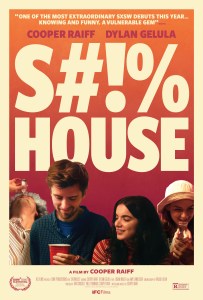 This should have been a winner for me. I’m a fan of mumblecore dramas that drop you into people’s ordinary lives. They’re character-driven and built upon naturalistic dialogue that can still be compelling and revealing of its participants. However, Shithouse seems to have found that middle zone between stylized dialogue and naturalistic dialogue; throughout the 100 minutes, the movie involves ordinary people sounding like they’re having real conversations, which means they are generally boring. If you were eavesdropping on these people in real life you would leave. There’s a fine difference between natural but still plot-driving and engaging dialogue and dithering dialogue that holds to the awkward starts and stops of real life but fails to keep your attention. Just because the scene feels realistic does not mean it is the same as being interesting. Writer/director Cooper Raiff stars as Alex, a college freshman with a serious case of homesickness. He spends one long night with his RA, Maggie (Dylan Gelula), and it feels like maybe these two will connect and become romantic. The problem with Shithouse is that it feels like each half-hour is its own different movie. The first is introducing an emotionally fragile young man having difficulty adjusting to collegiate life away from his family. The problem is that I didn’t care about Alex and I didn’t find him being mopey intriguing. It took too long to open him up. The next part is the film’s best and it’s Alex and Maggie spending hours together walking, chatting, having little adventures on the path to burying her dead turtle. It’s the best part of the film and where I felt the movie was starting to coalesce, even with a protracted setup. This is the Before Sunrise part. However, the next morning, Alex and Maggie seem to have very different views of their long night and eventual hookup. He’s overloading her with messages and she’s being distant and indifferent, and this is where the movie becomes like 500 Days of Summer, holding up for scrutiny the romantic aspirations of those grown up with the media of pop-culture happy endings. Had Raff left us in this direction, I could even argue that his structure served a larger point of condemning his protagonist’s viewpoint. I might not enjoy it but I could mildly respect it. However, Shithouse then undoes this part with a resolution set two-plus years in the future that doesn’t feel earned and is tonally disjointed from this prior section. If this was the intent, then why did Raiff even prolong us with this extended morass of missed Instagram messages and angry outbursts over misreading what the night meant to both parties? Regardless, there are glimmers and moments in this gentle little movie that worked, that hit upon a deeper truth, but mostly you’re stuck with dull people having boring conversations.
Nate’s Grade: C+
Share this:

Hillbilly Elegy (2020)/ Feels Good Man (2020)
 Hillbilly Elegy is based upon the memoir by JD Vance and in 2016 it became a hot commodity in the wake of Trump’s surprising electoral ascent, with liberals seeing it as a Rosetta Stone to understanding just how so many working-class white people could vote for a billionaire with a gold toilet. The movie, directed by Ron Howard (Apollo 13) and currently available on Netflix, follows an adult JD (Gabriel Basso). He’s a Yale law candidate forced to go back home to Middletown, Ohio after his mother Bev (Amy Adams) lands in the hospital for a heroin overdose. It’s 2011, and Bev has been fighting a losing battle with opioids for over a decade, costing her a string of boyfriends and jobs. JD’s homecoming isn’t quite so rosy. While he can take comfort in fried bologna sandwiches and his sister (Haley Bennett), the town is not what it once was. The factory has closed, poverty is generational, and his mother is one of many struggling to stay clean. In flashback, we watch MeeMaw (Glenn Close) take in the young JD (Owen Asztalos) and raise him on the right path. JD must decide how far the bonds of family go and how much he may be willing to forgive his mother even if she can never ask for help.
The subtitle of Vance’s novel was “A Memoir of a Family and a Culture in Crisis,” and it’s that latter part that got the most attention for the book and critical examination. Many a think piece was born from Vance’s best-selling expose on the hardscrabble beginnings of his personal story along the hills of Kentucky and the Ohio River Valley and his recipe for success. Given his libertarian political leanings, it’s not a surprise that his solutions don’t involve a more interventionist government and social safety nets. According to Vance’s book, he saw poverty as self-perpetuating and conquerable. It was the “learned helplessness” of his fellow Rust Belt inhabitants that Vance saw as their downfall. For me, this seems quite lacking in basic empathy. You see these people aren’t poor because they’ve been betrayed by greedy corporations, indifferent politicians, a gutted infrastructure and educational system in rural America, pill mills flooding Appalachia with cheap opioids, and a prison system that incentivizes incarceration over rehabilitation. For Vance and his like-minded fellows, upward mobility is a matter of mind over matter, and these working-class folks have just given up or won’t work as hard as before.
 Now, as should be evident, I strongly disagree with this cultural diagnosis, but at least Vance is trying to use his own story as a launching point to address larger points about a portion of America that feels forgotten. The movie strips all of this away. Screenwriter Vanessa Taylor (The Shape of Water) juggles multiple timelines and flashbacks within flashbacks as Vance follows the formula of prodigal son returning back to his home. The entire draw of the book, its purported insights into a culture too removed from the coastal elites, is replaced with a standard formula about a boy rediscovering his roots and assessing his dysfunctional family. At this rate, I’m surprised they didn’t even time it so that Vance was returning home for Thanksgiving.
Removed of relevant social commentary, Hillbilly Elegy becomes little more than a gauzy, awards-bait entry meant to uplift but instead can’t help itself from being overwrought poverty porn. If we’re not looking at the bigger picture of how Appalachia got to be this way, then Vance becomes less our entry point into a world and more just an escaped prisoner. Except the movie doesn’t raise Vance up as exceptional and instead just a regular guy who pulled himself up by his bootstraps through will and family support. I’m not saying he is exceptional, I don’t know the man, but this approach then ignores the reality of why so many others just aren’t following his footsteps of simply trying harder. Without granting a more empathetic and careful understanding of the circumstances of poverty, Howard has made his movie the equivalent of a higher-caliber Running with Scissors, a memoir about a young man persevering through his “quirky, messed up family” to make something of himself on the outside. This reductive approach is meant to avoid the trappings of social commentary, and yet in trying to make his film studiously apolitical to be safer and more appealing, Howard has stumbled into making Hillbilly Elegy more insulting to its Appalachia roots. Systemic poverty is seen as a choice, as people that just aren’t trying as hard, that have given up and accepted their diminished fates. Never mind mitigating economic, psychotropic, and educational circumstances. I imagine Howard wanted to deliver something along the lines of Winter’s Bone, unsparing but deeply aware of its culture, but instead the movie is far more akin to a sloppy compilation of Hallmark movies and catchy self-deprecating bumper sticker slogans. Seriously, about every other line of dialogue feels like it was meant to be on a T-shirt, from “Where we come from is who we are, but we choose every day who we become,” to, “There are three types of people in this world: good Terminators, bad Terminators, and neutral.” Well, maybe not that last one. The insights are fleeting and surface-level, with vague patronizing along the fringes.
The personal story of J.D. Vance takes the center stage and yet he’s the biggest blank of characters, and what we do get isn’t exactly that encouraging. I think we’re meant to engage with his triumph over adversity, but he has such disdain for his background while clinging to it as an identity, and this intriguing dichotomy is never explored. Vance as a character is merely there. His awkward experiences relating to the rich elites are just silly. He calls his girlfriend (Freida Pinto) in a panic over what fork to use at a fancy dinner table, as if this perceived social faux pau would be the difference between getting a law firm gig. He’s supposed to feel like an outsider, both at home and away, unable to escape his past that defines him, but the movie doesn’t even make Vance feel alive in the present. Most of the movie he is just there while big acting takes place around him. He listens to the life lessons bestowed upon him, good and bad, and it makes him the kind of man that when he grows up will join Peter Thiel’s venture capital firm, so hooray? I sighed when the movie established the stakes as he needs to get back in time for his big lawyer job interview, a literal family vs. future crossroads. The movie treats its frustrating main character as a witness to history rather than an active participant, and his personal growth is what? Coming to terms with the limitations of his mother? Accepting himself? Leaving them all behind to survive? I don’t know. There is literally a montage where he gets his life back on track, starts getting better grades, ditches his no-good friends, and heads out into the world. This could have been a better articulated character study but instead Vance comes across as much a tourist to this downtrodden world and eager to return to safer confines as any morbidly curious viewer at home.
 I simply felt bad for the actors. This is the kind of movie where subtlety isn’t exactly on the agenda, so I expected big showcases of big acting with all capitals and exclamation marks, and even that didn’t prepare me. I watched as Amy Adams (Vice) worked her mouth around an accent that always seemed elusive, with a character that veered wildly depending upon the timing of a scene. Almost every moment with Bev ends in some alarming escalation or outburst, like when a new puppy ends with Bev declaring she will “kill that dog in front of you,” or a ride back home descends into a high-speed promise of killing herself and child out of spite. This woman is troubled, to say the least, and her addictions and mental illness are what defines the character. With that guiding her, Adams is left unrestrained and usually screaming. There’s just so much screaming and wailing and crying and shouting. It’s an off-the-mark performance that reminded me of Julianne Moore in 2006’s Freedomland, where a usually bulletproof actress is left on her own in the deep end, and the resulting struggle leans upon histrionics. Was I supposed to feel sympathy for Bev at some point? Does the movie ever feel sympathy for this woman who terrorizes and beats her child? The broad portrayal lacks humanizing nuance, so Bev feels less like a symbolic victim of a larger rot of a society abandoned and betrayed and more a TV movie villain.
Close (The Wife) disappears into the heavy prosthetics and baggy T-shirts of MeeMaw, but you could have convinced me the character was a pile of coats come to life. Truthfully, MeeMaw is, by far, the most interesting character and the story would have greatly benefited from being re-calibrated from her painful perspective. She’s the one who bears witness to just how far Middletown has fallen since her and PawPaw ventured as young adults with the promise of a secure new life thanks to the thriving factory. She’s the one symbolizing the past and its grip as the present withers. She’s the one who has a history of abuse only to watch her daughter fall into similar patterns. Think of the guilt and torment and desire to rescue her grandson for a better life and save her family. That’s an inherently interesting perspective, but with JD Vance as our mundane lead, MeeMaw is more a slow-walking curmudgeon taken to doling out profane one-liners and grumpy life lessons. Close is easily the best part of Hillbilly Elegy and deserved more attention and consideration. A moment where she clings to JD’s high-scoring math test like a life raft is heartfelt and earned, more so than anything with JD.
 Another slice of America that feels forgotten and angry is on display with the documentary Feels Good Man, a.k.a. the Pepe the Frog documentary. Who is Pepe? He’s a cartoon frog created by Matt Furie as part of a comic series of post-college ennui between four friends. The character was adopted by the commenters on the message board 4Chan as their own symbol, and as their memes spread and became more popular with mainstream suers, and that’s when the 4Chan warriors had to do something drastic to save their favorite frog. They began transforming Pepe into a symbol of hate in order to make him toxic for outside use, and then the irony of their attempts at reclamation faded away and Pepe became a real symbol for Neo-Nazis and white supremacists. The character is currently listed on the Anti-Defamation League’s list of symbols of hate. The movie explores this evolution and de-evolution of Matt Furie’s creation and serves as a cautionary tale about the scary shadows of Internet culture and the nature of reclaiming meaning and intent with art.
Firstly, is there enough material here for a full-fledged documentary? We’re talking about a cartoon frog filling up the memes of Internet trolls. Is that enough? I think so, though I wish the movie shed even more critical scrutiny upon the 4Chan fringes of the Internet that have become a toxic cesspool of alienation and recrimination. These are people that self-identify and celebrate their social isolationism. The acronym N.E.E.T. stands for NOT Employed, Educated, or Trained and is adopted by many as an odd badge of honor. We even see home video footage of people sharing their personal lives in cluttered, trash-strewn basements. These are people electing not to engage with a larger functioning society and yet also feeling hostile to those that choose otherwise. Maybe it’s all a big joke to them, so why even bother; maybe it’s a defeatist mentality that plays upon social anxiety and learned helplessness. Maybe it’s just a noisy, nihilistic club that doesn’t want anything for themselves other than to disrupt others. The interview subjects from the 4Chan community are few but offer chilling peeks into this subculture. They see the world in terms of a very high school-level of social hierarchy, and the people who are pretty, successful, and having sexual relationships are the “popular kids” keeping them down. I think in terms of a Venn diagram, that incels and these NEET freaks are a flat circle. It almost feels like Vance’s cultural critiques of his poor Appalachia roots syncs up with the disenchanted 4Chan kids. This self-imposed isolation and self-persecution stews into a hateful mess of resentment. It’s not a surprise that several mass shooters have partaken in 4Chan and 8Chan communities.
 This scary subsection of Internet culture has been left to fester and it went next level for the 2016 presidential election. The trolls recognized their own sensibilities in Donald Trump, a candidate whose entire presidency seemed on the precipice of being a bad joke. The alt-right celebrated the man and used Pepe as a symbol for Trump’s trolling of norms and decorum, and the 4Chan message boards became an army of meme makers to steer Internet chatter. It’s hard to say what exactly the cumulative effect of these memes and trolling efforts achieved, in addition to the successful efforts of Russian hackers and a media environment that gave Trump billions of dollars in free airtime, but the 4Chan crowd celebrated their victory. “We memed him to the White House,” they declared. From there, Pepe became a synonymous symbol of a newly emboldened white supremacist coalition and any pretenses of ironic detachment dissolved away.
The rise and mutation of Pepe makes up most of the movie, and it’s certainly the most fascinating and scary part of Feels Good Man. However, there is a larger question about the ownership of art and interpretation that the movie presents without conclusive answers. Symbols are a tricky thing. They’re not permanent. The swastika wasn’t always associated with Hitler and Nazis. A pentagram has significantly different meanings depending upon a Wiccan and conservative Christian audience. Feels Good Man examines Furie as a humble albeit slightly naïve creator. He’s a nice guy who just can’t get his head around what has happened to his creation. How far does the artist’s intent go when it comes to credible meaning? At one point, Furie tried stemming the negativity by killing off Pepe in a limited comic, but it didn’t matter. The 4Chan followers simply remade him as they desired because at that point Pepe was their own. He has been built and rebuilt over and over again, that no one person can claim interpretative supremacy. Furie’s version of Pepe might be gone but there are millions of others alive and well. This gets into the nature of art and how every creator in some regard must make amends with letting go of their creation. Once it enters the larger world for consumption, they can steer conversations but art can take on its own life. The last third of the movie follows Furie taking action to enforce his copyright law to push back against the more outlandish uses of Pepe the frog, including from InfoWars’ Alex Jones, the same man who told us the government was making frogs gay for some unexplained conspiracy. Jones makes for a pretty easy villain to enjoy seeing defeated, and the conclusion of the movie involves dueling taped depositions between Furie and Jones over intellectual trademarks and free speech. It makes for an easy to navigate victory for Furie to end the movie upon, but is this larger war winnable? I have my doubts and I don’t think the trolls of the darker reaches of the Internet are going away.
I also want to single out the beautiful animation that appears throughout Feels Good Man, giving a visual representation to Pepe in a manner that’s like trying to give him a say in his own intent.
 So, dear reader, why did I pair both of these movies for a joint review? I found both of them as investigations into a sliver of America that feels forgotten, left behind, stuck in ruts outside their control, and resentful of a changing culture they see as exclusive to their hard-hit communities. I thought both Hillbilly Elegy and Feels Good Man could provide me, and others, greater insight into these subcultures and perhaps solutions that can make them feel more seen and heard. The problem is that Elegy doesn’t provide solutions other than “pull up your bootstraps” and Feels Good Man involves a destructive coalition that I don’t want better seen and heard. Both movies in their own ways deal with the nature of how very human it can be to retreat to their safe confines of people who too feel ostracized, hurt, and overwhelmed. I have pity for the people of the Rust Belt, the hillbillies experiencing generational poverty and hardships, though “economic anxiety” is not simply a regional or whites-only worry. I have less pity for the basement trolls of 4Chan trying to celebrate school shooters because it’s somehow funny. I’m amazed that so many talented people were part of Hillbilly Elegy and had such high hopes. For all of its full-tilt screaming, the movie is thoroughly boring and formulaic. Given the nature of an elegy, I was expecting Howard’s movie would be more considerate of its people, but their humanity is lost in this pared-down characterization, and the tragedy of society failing its own becomes an inauthentic Horatio Alger story of the plucky kid who went to Yale and became a real somebody. Feels Good Man might not be the best documentary but it feels more authentic and owns up to its inability to answer larger questions about human behavior, art, and interpretation. Both of these movies will prove horrifying to watch but only one is intentionally so.
Nate’s Grades:
Hillbilly Elegy: C-
Feels Good Man: B
Share this:

You Can Count on Me (2000) [Review Re-View]
 Released November 17, 2000:
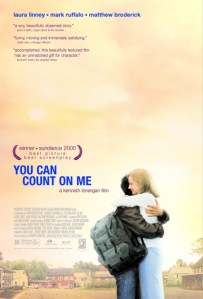
Kenneth Lonergan has had quite an up and down year. He started the year co-writing the atrocious What Planet Are You From? and writing The Adventures of Rocky and Bullwinkle to ending it with the character ensemble piece that ran away with an armful of awards at Sundance. Lonergan uses subtle moves to create a vivid mosaic of small town America and family relationships with You Can Count on Me. In film, quite often do we see the relationships of sisters or brothers (maybe too often). Rarely, though, do we see a thorough drama hinged upon the relationship of a brother and sister. Both torn by their genders yet always drawn together. You may kid, and get angry, but when danger arises you will always come to the defense of your sibling. It’s this seperational friction yet togetherness that creates the brother-sister bond.
Laura Linney and Mark Ruffalo are brother and sister who years ago lost their parents to a horrible automobile accident when they were young. Forced with the battle of growing up with grief, each goes their separate way. Ruffalo is branded the “difficult” rebellious one, yet deep down he knows that his publicly deified sister is just as much the rebel. Linney is a single mother dealing with the pressures of raising her son (a Culkin kid) and working in her town’s bank branch headed by her new boss (Matthew Broderick). Her brother reappears in her life suddenly and the two learn a little form each other. With her brother she can rely on someone else to watch her child and experiences another flash of the mischief that she had to forfeit from her childhood in order to raise her younger brother. Ruffalo provides the male figure her son is lacking and begins to shed the boy’s over protection and opens him up to the world. One experiences responsibility, one experiences release. but do either learn? That is a good question.
 Lonergan crafts a subtle texture that allows his characters to breathe and grow but not necessarily learn. His modest character-driven picture may make you think of Made for TV but its a slice of life that’s immersible. It’s hard to find a film that is subtle, at its own pace, and restrained when it needs to be.
Linney is fantastic as the sister that breaks loose and winds up sleeping with her boss with reckless childish rebellion. Her performance is an Oscar nomination lock as her character runs the emotional gamut. Ruffalo is amazing and establishes himself as one to surely look out for. his mannerisms and expressions are wonderful and his demeanor is reminiscent of Marlon Brando.
You Can Count On Me is a wonderfully affecting story about people who are more complicated then simple plot synopsis will allow. Lonergan has crafted something of an anomaly in modern cinema: a film that takes its time, doesn’t answer any questions, but makes us feel all the better after seeing it.
Nate’s Grade: B+
——————————————————
WRITER REFLECTIONS 20 YEARS LATER
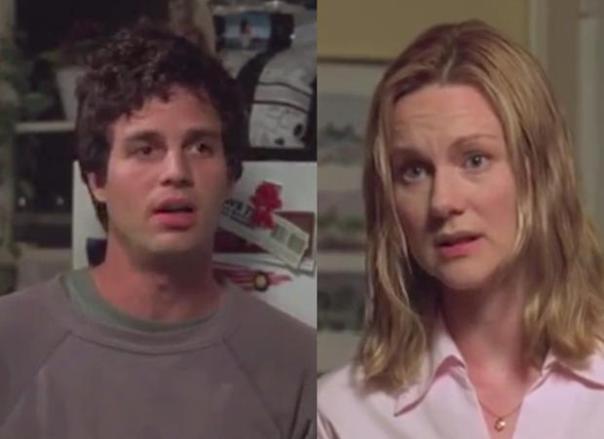
You Can Count on Me was a breath of fresh air in 2000. It was an impressive star-making performance for Mark Ruffalo, who would go onto three Oscar nominations and be the Hulk people actually wanted to see. It was a showcase for Laura Linney, her biggest big screen role to date and earned her an Oscar nomination, her first of three. It was the first personal movie by writer/director Kenneth Lonergan, a playwright who had become one of Hollywood’s popular writers for rewriting studio projects trapped in hell. Lonergan was nominated for Best Original Screenplay, losing to Cameron Crowe’s Almost Famous, and then finally winning the same award for 2016’s emotionally devastating Manchester by the Sea. It’s strange to recall that the biggest name involved with this small, character-driven indie wasn’t any of these three but Matthew Broderick, drafting off his mordant turn in Alexander Payne’s Election. This is one of those slice-of-life movies where the characters are the driving force of the plot, where the small connections and mistakes are the ones that resonate most. And yet, I didn’t see it back in 2000 but I did upon my re-watch, there’s a degree of broad sentimental contrivance as well, an element missing in Lonergan’s latter efforts, including possible masterpiece, 2011’s Margaret.
 We follow the lives of two very different and not so different siblings coming back together. They’ve been orphans since they were children and had to rely upon one another. Sammy (Linney) is the responsible one with the good job and a young son she’s raising on her own. Terry (Ruffalo) is the irresponsible one who gets into fights, can’t keep a job, and served a little time in jail he was embarrassed to tell his sister about. He comes back initially for some quick money, to the disappointment of Sammy, and then sticks around longer and longer, bonding with his nephew and going through old and new arguments with his sister over his life decisions and direction.
It doesn’t take long to realize Lonergan’s striking ability to compose naturalistic dialogue that has pinpoint precision when it comes to characterization. Watching any pairing of characters has the wonderful effect of the best plays, where that intriguing combination of character interactions is like an exciting chemical reaction, creating something new and welcomed. Every conversation then takes on meaning to see how the character interactions change or influence the participants. It means that Lonergan is generous and judicious with his details. A dinner meant to be celebratory can become a re-airing of grievances and disappointments. A night out hustling pool can go from being a bad idea to becoming a male bonding experience that has to stay a secret. The characters are so richly observed and developed that You Can Count on Me is implicitly saying to its audience, “Hey, no matter the scene, you can count on me.”
The relationship between Sammy and Terry is the most emotionally resonant and complex, with each of them defying the easy characterization they’ve been assigned as Good Kid and Bad Kid. He’s resentful of his sister and her judgement when he thinks she can be just as irresponsible. She’s resentful of her brother and his immaturity and inability to put down roots, bumming around and getting into the same old scrapes. Coming back together, each reconnects on a personal and family level where they may be combustible but they realize how much they need and love one another. A final heartfelt goodbye between them, while waiting for a bus to take Terry away, becomes an awkward but affecting moment because they really don’t know when their paths will cross once again. Sammy sure hopes it’s sooner, as her young son has grown attached to Terry. I think deep down Terry hopes it is as well and likes the comfort and support offered from this family that has an open spot in waiting for him on call. He’s ostensibly leaving to make things right with his girlfriend (or ex-girlfriend? It’s unclear since he’s been away) and has grown as a person from the experience of being an uncle. He’s not at the end of his arc, wherever that may eventually lead, but he’s moved closer on that journey. That’s a good summation for all the characters. There aren’t clearly designated arcs but nudges along a very human path to growing and learning.
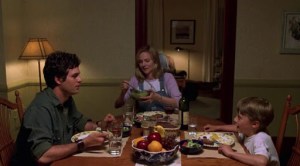 Ruffalo (Spotlight) instantly grabs your attention. His performance almost has a shy obstinance, like he doesn’t want to be seen by the viewer, tired of the judgement he knows is coming, and he’s constantly retreating inward in defense and score-settling. He’s so immersed in the character that the actor dissolves entirely. His commitment to character is immediate. There was a reason he was drawing comparisons to Marlon Brando upon release. Linney (Love Actually) is terrific as well as the flabbergasted older sibling tired of having to play parent to her rebellious brother. She has many moments of exasperation with her brother, the men of this small town, her ineffectual boss she has a short-lived affair with. She’s drifting just like Terry but doesn’t realize it; Sammy vacillates between wanting to settle down with a nice boring guy who says he loves her. She’s been stuck fulfilling responsibilities for so long that her brother’s return allows her to cut loose a little bit, to be bad again, to make careless and selfish choices. Linney serves as a strong anchor for us as well as an example that being an adult doesn’t mean being in control.
Where You Can Count on Me slightly falters, and not by much, is the inclusion of storylines that feel a bit too maudlin and TV-movie-of-the-week. There are two tracks of emotions in the movie, subtle and overt, and it’s become clearer which is which upon re-watch twenty years later. I almost feel like Lonergan included some of these parts because they made selling his indie easier to studio executives. The affair Sammy has with her boring yet sleazy boss (Broderick) offers no real insights beyond Sammy’s capacity for self-destructive whims. She keeps coming back to this weak man, maybe because there’s no future with him since he’s married and his wife is pregnant, and maybe because she knows she can drop him. I started groaning whenever her boss called again, so desperate for one more last time, and that is likely the point. It’s watching someone continue down a path we all know should be avoided. It also explains how she might have ended up with her son’s father, played by Josh Lucas (villain in 2003’s first Hulk movie). Terry decides the little kid deserves to see his father and the unannounced visit doesn’t end well. The bad dad denies he is even the father, they get into a fistfight, and the little kid gets to feel abandoned all again. These broad dramatic moments stick out amidst the more subtle and naturalistic movements throughout. It’s not enough to drag down the whole of Lonergan’s enterprise but they feel like discordant notes in an otherwise sumptuous symphony where all the players are working in impressive synchronicity.
 Looking back at my original review in 2000, it hits a lot of the same observations that came to me in 2020 re-watching the movie. The complexity of the characters, the unobtrusive direction, and the naturalism of top performers is as evident back then as it is now. It’s easy to see what drew such celebrated actors to bring life to these people. Lonergan gained confidence as a writer/director and held true to his visions, including a five-year struggle with producers over his ambitious artistic intentions for Margaret that brought in none other than Martin Scorsese to play as elder statesman deal-breaker. His works have become more intimate and insular. Looking back on his first film, which Lonergan even has a small acting role as the town pastor, is like watching the first steps of an artist who would later sprint. You Can Count on Me is a funny, poignant, and engrossing character piece on sibling rivalry and small-town conformity, but it’s also got a few issues that Lonergan would shed later in his career. Come to see a young Ruffalo tear through scenes and Linney match him moment-for-moment.
Re-View Grade: B+
Share this:

Kajillionaire (2020)
 If you’re not familiar with quirky writer/director/performance artist Miranda July, she specializes in a special kind of weird that borders on surreal and also a surprising emotional poignancy. It’s been 9 years since her last feature film, The Future, and she’s back with what might be her most narratively focused and accessible yet still wonderfully weird movie yet. We follow a family of grifters (Richard Jenkins and Debra Winger as the parents) and their day-to-day struggle to con, skim, or steal enough money to get by to the next day. Old Dolio (Evan Rachel Wood) is their only child, and her role in the family is thrown into question when a new member joins their team. Melanie (Gina Rodriguez) has connections to a raft of senior citizens so desperate for attention that, if they all pose as Melanie’s family, they should be able to con these old folks of possessions they can resell. From there, the movie becomes a push-and-pull relationship between Old Dolio and the influence of her shifty family, and she questions her place in this fringe unit and whether her parents actually love her or see her as another means to get a score. Kajillionaire is loose in plot but populated with interesting characters who feel fully realized by July’s writing. She’s so good at studying human behavior and capturing it that the quirky details all feel so genuine and meaningful. Even Old Dolio’s name is a reminder of her parents’ opportunism and problematic parenting skills. She was named after a homeless man who won the lottery under the hopes that he would be grateful and put her in his will (he ended up spending his fortune on experimental cancer drugs). That’s the difference with July. A silly name could just be a disposable oddity, but for her it’s a reflection of a character’s worth and history. There are moments in the movie that achieve a level of artistic transcendence where every piece is humming beautifully together, like one moment where a dying elderly man off-screen directs the grifter family to pretend to be like his own flesh-and-blood family. They play pretend at domesticity, each assuming a doting role, and the tranquil scene of a fake family feels beautifully attuned. The moments stand out more than the whole but July’s empathetic appreciation of human fallibility keeps her from ever condemning Old Dolio’s scheming parents too much. Even the very end finds a way to turn betrayal into a message of humility. Wood (Westworld) drops her voice several octaves, wears baggy clothing, and looks extremely awkward when it comes to human contact. Rodriguez (Annihilation) is the voice of the audience and her test of how far she’s willing to excuse the selfish behavior of this clan of cons. Her burgeoning friendship and maybe more with Old Dolio is a rewarding enterprise for the characters and the audience. Kajillionaire is a gentle little movie that plays at a low-key range of human emotions yet it can still be deftly funny and surprising and heartfelt on its own unique terms. With Miranda July, she makes weird entrancing and human.
Nate’s Grade: B+
Share this:

Worst. Christmas. Ever. (2020)
 I implore all filmmakers to be cautious about titling your movies. When you use absolutes in your titles, it’s laying forth a claim that you better be able to back up, and when you also present easy-to-apply summations of your movie in the title, it’s another dare I hope you’re capable of meeting. Nobody should name their movie Waste of Time and make a pointless and lazy movie because you can already see the summary blurb that awaits. In the case of the new low-budget Ohio-made comedy Worst. Christmas. Ever., you better be plenty funny to avoid the obvious put-down, “Worst. Christmas. Movie. Ever.” Unfortunately, while this low-budget movie has energy and bad taste to spare, it’s woefully short on ideas, jokes, characterization, and fun.
It’s Christmas Eve in East Jesus, Ohio and Sophia (Raychael Lane) has learned that she is pregnant. Her loser boyfriend Trey (Leonardo Mancini) is the father, though he doesn’t seem like a good prospective parent as he’s shiftless and cheating on her with Madison Fatcheck (KateLynn Newberry). Sophia doesn’t know what to do and definitely can’t tell her mom and stepdad. We interact with different bizarre locals, drug dealers, trigger-happy cops, crazy relatives, and an ex-con mall Santa (Craig Brophy) who breaks into homes. Over the course of one long crazy night, Sophia must decide what she wants to do with her life and the possible new life inside her.
 There is a grand tradition of the irreverent anti-Christmas comedy, a holiday setting brimming with sentimentality. Whether it’s A Christmas Story or Gremlins or Bad Santa, there’s something appealing about undercutting all that holiday good cheer with a little irreverent fun. The problem with Worst. Christmas. Ever. is that writer/director Johnny Chechitelli (a credited writer for FOX Sports and UFC fights) settles too often on the easiest joke, that is, when there are jokes. Sometimes it feels like the film has just gone on auto-pilot, like an improv session gone awry. That drifting, directionless feel pertains especially to the characters, which are uniformly boring. There are some strong archetypes that have potential, especially a lecherous Santa up to no good. There are just too many disposable characters cluttering this narrative that seem to exist in their own alternate universe movies with too few jokes. The world of East Jesus, Ohio feels wacky but without forethought. This is the kind of movie where a former overweight girl has the last name Fatcheck, and apparently this factor is what defines her character. There are small moments of satire but they’re never really honed into a more coherent or clever message. The stepfather plays a violent video game as an armed Jesus shooting Santa Claus to death. A rap song about a bad Santa seems to revel in gaudy cliches without providing commentary or entertaining contrasts. The treatment of African-American characters seems to play tragedy as cheap comedy, setting them up for traumatic police encounters that lack commentary on racism or ignorance. Sophia goes off on a team of carolers for their religious beliefs, but the movie seems too timid to go further with mocking Christmas rituals or religious hypocrisy. There are ideas here, not all of them good, but rarely do the ideas evolve into sustained plot beats or jokes.
Let’s analyze one scene in particular and why it doesn’t work from a comedy standpoint and what could have been done with a little more attention. Sophia and her pal Noah (Chase Crawford) go to her boyfriend’s house. Sophia is defending him but Noah says he’s likely just sitting around and getting high. When they peek through the window, they find Trey sitting around with marijuana, and Sophia tries to excuse it, not wanting to admit that Noah’s negative characterization was correct. Then he smokes a pipe and a scantily clad Madison Fatcheck comes in and nuzzles up beside him. Trey sees Sophia watching and freaks out. I ask you, dear reader, where was the joke? The fact that Trey is a loser is already assumed, so that reveal isn’t enough. What could have happened was Sophia’s pained attempts to continue denying the obvious reality. Rather than catch her bad boyfriend with drugs and then a new girl, this scene could have been extended to make things even more ridiculous. He had drugs, but Sophia was saying maybe he was just sorting it, and then he’s using the drugs, and Sophia says well at least it’s not hard stuff, and then he breaks out a hypodermic needle and she says, well maybe he just needs an insulin shot. It’s a comedy scenario that prospers from escalating desperation and absurdity. It could have been funny. Instead, we’re given maybe one joke, which is obvious, and little else. There is a lack of creativity when it comes to the comedy construction throughout Worst. Christmas. Ever.
 There is a difference between a gross-out gag and something that is simply gross. Making your audience experience discomfort can be a useful resource for comedy, but you have to be aware of what the returns are for the indulgence. I’m reminded of a scene in Seth MacFarlane’s A Million Days to Die in the West where Neil Patrick Harris defecates into a cowboy boot. He’s humiliated, it’s extended, and the joke lands, but then McFarlane cannot help himself and has to show a two-second insert shot of the messy feces inside the boot. The joke would have worked best without literally getting into the muck. Think back on Dumb and Dumber with Jeff Daniels and his epic diarrhea sequence atop that unfortunate toilet. It’s all in the performance and the cascading and noxious sound effects. The Farrelly Brothers didn’t need to put us in the bowl. This brings me to our Worst. Christmas. Ever. because I think its uses gross shock humor to cover for its poor comedy efforts. This happens early with Sophia throwing up in a Salvation Army collection bucket. That alone works as a joke, but then the director puts us in the vomit and uses this image to put his credit onscreen. There it is, he seems to say, I’m the guy responsible for this mess. There’s another scene where a character pees into a toilet and we just watch multiple seconds of a stream of urine and then on the floor as well. I kept thinking that maybe the movie would come back to this, that taking so much time to set up pee on the floor would lead to an accident later, but nothing happened. I guess just the sight of urine was supposed to be funny, just like the sight of vomit in a bucket was supposed to be funny. This lazy ethos pervades the movie and is dispiriting.
There are crude animated sequences in Act One that I initially had hopes for. It’s a stylistic touch to separate the movie but it could also have been a smart way around larger set pieces that would have been too expensive. These are mostly confined to Sophia’s flashbacks about her dead father and then this device is never seen again after the 20-minute mark. The six-minute segment about her bad drug addict father using the last of his money on drugs, then robbing a convenience store to also use on drugs is simply not a story demanding six minutes of our time. It’s not funny and it’s not informative and it gets tiresome and repetitive. This same information could have been conveyed with Sophia through a monologue of why she hates the holidays and it would have had a more immediate and lasting emotional impact than an animated interlude. The animated segments reminded me of MS Paint but with more detail. The style is fine but the purpose is questionable. The story we get through the animation isn’t necessary other than it provides an additional six-plus minutes of running time to desperately get us to a feature-length.
 This brings me to the fact that this 80-minute movie is really only a scant 63 minutes long. The end credits begin shortly after the one-hour mark and from there we’re treated to short additional scenes for resolution and then bloopers and then an extended music video of our rapping Santa. The actual credits move at a snail’s pace to reach that magical 80-minute runtime. This is the problem with a scattershot narrative that doesn’t seem like it’s going anywhere. One could argue that Worst. Christmas. Ever. is not the kind of movie beholden to character arcs and great strides in personal growth but you still need to do something with the time you have as a storyteller. For a comedy, we need more escalation than some dead bodies by the end. There needs to be amusing complications, there needs to be struggles, and there needs to be variation. Worst. Christmas. Ever. has the feeling of watching several short films that have been stitched together with minimal care. The consequences feel as throwaway as everything else in this movie. There is a dearth of satisfaction by the end because it’s missing all the important things like clear goals, meaningful character development, and culminating gags built around careful setups and escalation. I was a bit flabbergasted by the movie essentially giving up at 63 minutes but also grateful for the end.
It’s my duty to find some highlights to praise for Worst. Christmas. Ever. and I think the cast is generally a strong asset. Given the low-budget nature, not everyone is quite so polished, but the amateurism actually adds an authenticity to the proceedings of making a real small-town indie in Youngstown, Ohio. Lane (To See the Moon in the Morning Sky) has a wholesome appeal as our protagonist. Brophy creates a welcomed impression as a sleazy Santa, and his rap skills aren’t too shabby either. The entire rap video sequence is actually one of the best in the film. The song production is more accomplished than I would have expected given the low-budget. By far the actor I enjoyed the most was Wantatah (The Con) as the stepfather. His performance is the one where the actor melts into the character and you see the least amount of “acting.” He just is, and it’s entertaining to watch his grumpy incredulity and then inebriated disasters. I hope Wantatah can get even more work from here that takes advantage of his fine comedy instincts and commitment.
 I’m not going to lie, Worst. Christmas. Ever. was a difficult movie for me to watch. Even at little over an hour, I struggled to keep my attention and I rarely laughed. More often I was befuddled at the sloppy attempts at comedy that too often settled on shock value and bad taste because it couldn’t be bothered to actually think about jokes. There’s a difference where poop is a funny joke and when it’s just gross, and this movie doesn’t quite comprehend that distinction. Frankly, there just isn’t enough going on here to merit your time. From a comedy standpoint, there’s little to leave you satisfied. I laughed more from Killer Raccoons 2. From a character standpoint, there are weirdos who get their individual scenes but the main character’s unplanned pregnancy feels like an afterthought for how little it pushes the other characters. Imagine Juno if nobody paid attention to Juno’s pregnancy. From a production standpoint, there are definitely limitations given the lower budget and the wintry Midwestern climate but this doesn’t lead to necessary creative ingenuity. This is more a premise and an attitude than it is a full-fledged movie. Worst. Christmas. Ever. peaks at its poster.
Nate’s Grade: D
Share this:

Moondance (2020)

I didn’t even plan on writing this review. I knew of the indie musical Moondance because I was familiar with several crew members who worked on the $500,000 project and watching their pictures on social media, but when I discovered it had been filmed entirely outside the state of Ohio, primarily in Kalamazoo, Michigan, I decided to exclude it from my mission to professionally review Ohio-made indies. As of this writing, it was available on the website Tubi for free with ads, so I started it on a whim to show my girlfriend what I had intended to watch, and then I kept watching, and then I didn’t want to continue but I felt compelled to, and now I feel compelled to dissect this movie as best as I can, even with its tangential connection to the Ohio indie film scene. Moondance is a confounding experience for a lover of big screen musicals because it’s a musical that doesn’t really want to be a musical, a comedy that doesn’t know how to do comedy, and a drifting drama bereft of characters to root for and reasons to cheer.
The story is familiar. We have our boy, in this instance Oscar (Jonah Robinson), a composer suffering writer’s block, and he meets our girl, Abby (Carolyn Rabbers), a dancer. Oscar is instantly smitten and tries tracking Abby down, while his “best friend” Pat (Sam Jones) schemes with his very David Rose-esque assistant Sean (Brandon Stewart) to have her for his own. In between these shenanigans, Cooper Flannigan (credited as “Self”) appears to be a hipster friend of Oscar but also the god of this universe as he routinely breaks the fourth wall and is played by the actual writer/director.

I have to give credit for anyone having the gumption to try and create a low-budget musical. That’s a tall creative order and unfortunately Moondance can’t quite match its toe-tapping ambitions. There are only four songs in the entire musical before the end credits (I’ll get to those later). By the 45-minute mark, I had only experienced one legitimate song-and-dance number and I was wondering if the reality of this movie had simply abandoned being a musical. There are a couple additional dance numbers as one would expect with Abby being a dancer, some set to performances from musicians, but for the first hour there are only two honest-to-goodness moments where characters break out into song. Why is there no opening musical number that introduces the different characters and their different perspectives, stations, plights, goals? That would be an economical way to establish the world and its players. There seems to be real hesitancy onscreen with embracing its musical identity. The musical numbers are meant to give us insight into the characters who can’t help but blurt out their feelings, and yet during the requisite boy-and-girl-on-the-outs part, there is no musical number. There isn’t even a musical number for their growing affection for one another. We’re missing a love theme, and for a romance-heavy musical that’s meant to evoke the feeling of Old Hollywood, that seems like a massive oversight.
The staging and performance of the musical numbers, when they do appear, can also be underwhelming and counter-productive. From a choreography standpoint, much more emphasis is placed on the background players including a superfluous “intermission” dance. There is one number where the key characters do little more than literally ride a bicycle in a circle, and I would argue this is the best number in the film. There is more dancing than singing and that seems the primary reason why Rabbers was chosen as the lead female role. She certainly has talent as a dancer. As a singer is another matter. I feel unkind even articulating this but for a musical it needs to be said: Moondance would have been better off dubbing Rabbers. Her singing voice is just not there. I don’t see any harm to the production if the filmmakers had dubbed her singing. Another issue is that Abby’s dancing feels a bit too chaotic and chaotically edited. There’s a moment of sorrow where she dances out her feelings, but the choreography isn’t conveying the emotions of the scene any differently than a previous dance for us to compare with, and the editing isn’t helping, until it concludes with her pounding a wall in frustration and falling into a crumple on the floor. The camera could have locked onto her face, so as she moved and performed the emphasis was on her emotional state and what the dancing signifies. Whether it’s the lackluster songs, singing, and the nascent choreography that needs to communicate more personality for the big players, Moondance stumbles as a musical.

From a comedy standpoint, let me focus on one small scene that I think exemplifies the pitfalls of comedy construction that Moondance suffers from throughout. We start a scene with Oscar and Cooper at an ice-skating rink watching a curling team practice. Oscar opens the scene by declaring, “22 dance studios!” to tell us he has struck out trying to find Abby, and then for good measure he repeats the line to better establish his bafflement. “What am I supposed to do now?” he asks Cooper, who asks whether Oscar has considered the possibility his dream girl doesn’t exist. “No, I haven’t considered the possibility she doesn’t exist,” Oscar replies, weirdly echoing the exact wording just to hammer this home for the audience. He sees Cooper distracted, sighs, and says, “I’m going to go to the bathroom, or the parking lot or… something.” He then leaves and then Cooper addresses the camera and informs us on the mechanics of the sport of curling. This will never come up again in the entire movie. So, dear reader, let’s deconstruct this scene. It begins with Oscar stating his futility. He repeats his line twice. His friend offers no help, makes a reference to Oscar’s mental state, not a joke but a reference, to which Oscar simply repeats the assertion rather than supply a joke response or anything that can be constituted a response. Because of this, Cooper has nothing funny to build off from, so he asks a simple “what next” and rather than supply a joke that showcases Oscar’s pitiful state, he offers two suggestions, neither of them funny, then doesn’t even provide a third suggestion, instead giving up and not even following the age-old comedy rule of three. From there, Cooper informs us about something that will not matter and is not funny. Why does this scene even need to exist if even the characters can’t be bothered to come up with jokes?
I was dumbstruck by the ineffectual comedy throughout Moondance. This is the kind of movie that has characters devise a stakeout and disguise themselves in bear costumes for no reason. Do they do anything in these costumes? No. The joke, I assume, is that they’re in funny costumes. This is akin to a character walking into a room with a silly hat, and the director saying, “Hey you, look at this comical hat being worn. Isn’t it so unlike normal hats? A normal person would never wear a hat like this. What a cut-up to wear this hat. Are they going to do anything differently because of this hat? Well, no, but what a silly hat, right? Please laugh.” Just stopping at this conception and doing nothing else is not comedy. There need to be setups, payoffs, subversion, running jokes, subversion of running jokes, something, anything. There is a stark sense of desperation throughout Moondance when it comes to its sense of humor. Take for instance a dinner where the group is hob-knobbing but then the girls meet below the table to share their real thoughts under the excuse of retrieving a fallen fork. Why not repeat this setup, making it more outlandish and obvious as you go? Why not present one perception, above table, of the girls, and one below where they are their true selves and confessing distaste? There are moments where it feels like the writer/director just had little grasp on humor and lost track of opportunities. The jokes are rarely accessible; it feels like you’ve entered into a private conversation and are left to put the pieces together. Sean is definitely slotted as “comic relief” but he feels overexposed. I was confused what his relationship was supposed to be with Pat. Is he the assistant, lover, or friend? Eventually I learned that he was Pat’s brother, but why did I have to fight so hard to understand this fact? The writing doesn’t make it easy for the audience to follow along, and this extends to its comedy writing. The fourth wall breaks are tone-breaking but, again, not funny. They feel included just as a fun way to include the crew in the movie, which, again, feels like a private party indulgence. The comedy of Moondance is primarily dormant. It’s over-compensating a lack of funny on the page by asking its actors to dial up their performances, so all the unfunny dialogue and antics now just seem like they’re being performed by crazy people on illicit substances.

If this movie was going for satire, I think it missed it by a wide margin. I don’t know why we have a character with godlike powers and this is treated like a lame party trick. Why not refocus the entire movie from this perspective and have Cooper be the god of a rom-com musical universe, and he’s the only one who knows he’s in a movie, and he’s pulling out every stop to get his chosen guy and chosen girl to get their big happy ending. That way it would play upon our knowledge of genre tropes and bring something fresh, while utilizing the fourth wall breaks as essentially strategy planning and introducing a team of helpers that would see through his efforts. Instead, we get the jovial character of Cooper who strolls around and offers few insights into the nature of romance or the nature of romance movies and our association of them. He feels like a magic hobo. I sense the homage to the Old Hollywood musicals and the big band accompaniment for all those jazz hands and hoofing, but it’s more intention than actuality. It’s going through the motions, and without enjoyable characters and an engaging story, it’s an homage that ends up empty.
My final criticism might be the one that made it the hardest for me to embrace Moondance, and this is how aggressively unlikable nearly all of the characters come across. In a romantic musical, you can have less than stellar singing, dancing, and even songs but your audience needs to care about the people onscreen. You need to feel the desire for them to get together, find their happiness, and at a basic level, you have to enjoy spending time with your core group of characters. Otherwise you’re stuck, and dear reader, stuck is what I felt with these people. I never cared about Abby and Oscar getting together because I never found them to be remotely interesting. Oscar is a bland protagonist. The only thing we know about him is that he writes symphonies. He immediately becomes obsessed with Abby to the point that, even before he ever speaks his first word to her, he declares Abby “his girl” in a creepy act of possession. He’s in love with her but cannot explain why. Would have been perfect for a song there to articulate his new feelings, right? We know even less about Abby. She’s a dancer and wants to save an old dance studio, but anything else? Well during a scene where she lunches with a friend, she has a giant burger as her meal. Does she eat it? No, but just being seen with this pound-plus of beef is meant to do the work the screenplay hasn’t and imbue useful characterization. She’s not some prim “just east a salad” kind of girl, oh no, give her a honking burger. To my best estimation, Abby and Oscar go on two dates (one of which she apparently has harassed a waiter, and this is supposed to be endearing?) so when they part ways before Act Three, this short-lived breakup doesn’t exactly feel as earth-shattering as the characters try to convince us. We’re simply not invested. Rabbers and Robinson (Jack Jonah) don’t have strong chemistry together but it’s not their fault. The script gave them nothing to work with and no points of characterization to better define them as people or make either of them interesting to watch.

The character of Pat is pompous and entitled and I don’t know how anyone would remotely take his involvement in what is angled as a love triangle with any seriousness. He is a terrible character and a terrible person and he just seems to exist in a daydream of privilege. What does he do all day? He buys expensive paintings for his… Rubens parties (again, another point of accessibility made challenging for the audience when this is referenced without context and it took my third stab at understanding what it meant to gain clarity). Later in the film, he monologues to his paintings before setting them ablaze, and it’s played like the mental break of a serial killer, and it’s so tonally off to induce whiplash. Pat’s the cartoonish fop character that would be presented as the rich buffoonish bad boyfriend in any other movie, and yet here he’s supposed to be the best friend to Oscar, yet we see no behavior that communicates their close personal relationship. This is a trenchant problem throughout Moondance, the screenplay constantly having to tell you of something rather than show you. It’s like watching characters thrown into an improv game and grasp for any fragile means of escape from scene to scene.
With all of these words spent in constructive critique, it might seem like Moondance is without notable artistic merit and that is not the case. The photography by Greg Kraus (The Curse of Lilith Ratchet) is well lit and at its best when it has plenty of movement to give a sense of energy that is usually flagging from the page and performances. The smoky jazz number makes fun interplay with shadow to better establish an evocative mood. The musical productions are heavy with big band sounds and brass instruments, enough so that I started wondering if anyone has done a ska indie original musical. The opening segment involves a band performing in a studio space and it was a pleasant experience to set a tone. The musical performances are solid. The musical compositions are competent if unmemorable. I don’t know why the production didn’t just fully go the jukebox musical route with local artists if we were only getting four original songs (though the titular “Moondance” song lyrics were a bit childish, reminding me of the Hokey Pokey). Hey, they got TV’s Adam Conover (Adam Ruins Everything) to be a brief narrator, a role that seems even less necessary when Cooper is breaking the fourth wall repeatedly as a would-be guide for the audience since he’s already our stand-in god.

Moondance ends on a two musical numbers, the first a kind of curtain call on a theater stage that allows every character, including the dry cleaner guy, to get a sendoff and also break the fourth wall. Afterwards, Cooper addresses the audience and acts as emcee through the various departments and crew members who worked on the movie, with the camera moving in and out of rooms with an impressively agile tracking shot, and ending on several spirited dances, one of which serves as the still image on the Tubi page. The problem is that this is, easily, the most involved musical number and it’s reserved for the end credits. I can imagine Cooper and the filmmakers thought they were ending on a high note to say a fun goodbye to their audience, but by reserving it for the end credits that roll over the scene, it makes it harder to read the credits that are spaced so far apart and it makes it harder to pay attention to the song and dance because of the rolling credits. Why not go split-screen? For me, this sums up the misapplied application of Moondance and its throwback ambitions. It’s not whimsical. It’s not charming. It’s not funny at all. There aren’t characters to care about. The musical numbers are too few and far between. The potential hook to separate this, its satirical behind-the-scenes god at play in a musical world, is not incorporated in a vital and clever manner. Moondance is a strange passion project because it’s hard to feel any passion for this story and characters. It pains me to be as blunt as I am but there are too many issues to go ignored. I wish everyone with the production good luck in the future. This will stand as an artifact of bewilderment for me. See it for yourself on Tubi and whether it casts a bewitching spell on you, dear reader, or leaves you just as confused and disappointed.
Nate’s Grade: D+


 nathanzoebl
You must be logged in to post a comment.