Blog Archives
If I Had Legs I’d Kick You (2025)
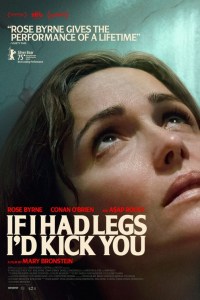
I have been told by numerous friends and other critics that If I Had Legs I’d Kick You falls in that dreaded entertainment zone of the “difficult watch.” These are usually made up of admired movies tackling challenging subjects in unflinching ways, movies that are easier to admire than love. I was girding myself to finally watch If I Had Legs (this will be the reference for the title from here out because, frankly, I’m too lazy to type out an extra three words every reference), I found it pretty despairing, especially for women, especially for parents of young children, and especially for those suffering or who have suffered through some degree of post-partum depression. This movie is a sensory immersion into the frazzled, anxious, and punishing existence of our heroine, just trying to catch her breath or get a break in a universe that seems cruelly engineered to only provide stressors. It’s a truly phenomenal movie giving bristling life to the perspective of writer/director Mary Bronstein (Yeast), with stylistic and surreal touches that reminded me of Charlie Kaufman or even Franz Kafka. The tragi-comic absurdity, as well as the unrelenting existential anxiety, is meant to provoke a primal, wince-inducing response, eliciting sympathy for the countless mothers coasting hour-to-hour looking for a little oasis of relief. If I Had Legs is one of those rare feel-bad experiences that I not only admire but I think I actually love.
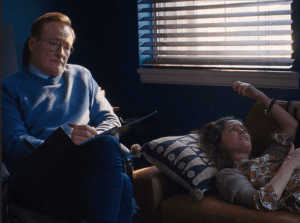
Rose Byrne plays Linda, a forty-something woman being pulled in every direction. Her young daughter is suffering from a physical malady that requires her to have a feeding tube, and she needs to gain weight in order to have the tube removed, but the child can’t gain weight because she doesn’t want to eat, and this obstacle is compounded by the hospital telling Linda if the child doesn’t meet her goal weight, then it’s a reflection of neglect, and Linda herself will have to attend parenting classes. The child is also, let’s put this nicely, very high-maintenance and attention-demanding. There’s also Linda’s husband who is away at sea and generally unhelpful and curt whenever caught on the phone. Linda also has a therapist (Conan O’Brien) who is likewise generally unhelpful and seems disdainful even talking to her. Then the roof of her apartment explodes with a torrent of water, and now Linda and her daughter have to live out of a local motel, further exacerbating all of their personal problems. It’s forty minutes in when the movie reveals Linda’s profession and I genuinely gasped: she’s a psychiatrist with her own very demanding clients to counsel. It’s not easy being Linda, but then again, there are plenty of Lindas in the world just waiting to catch a break.
This movie is a lot. It’s a lot to process, and it’s very deliberately using disorienting creative decisions to test your limits. The sound design is an especially effective dynamic that raises anxiety. Bronstein never shows you the face of Linda’s daughter, at least not until the very end of the movie, and there’s a stark reason for this. Our identity is Linda, and this voice that keeps coming in, frequently interrupting, occasionally screaming, and often compounding the stress of her mom, is designed to be viewed as a primary source of agitation. We don’t see the daughter because in this vision she doesn’t exist as a character but more as a burden. We view the child as Linda perceives her. There’s a trying sequence where Linda’s client leaves her baby behind and vanishes, forcing Linda to cart around a crying baby while frantically looking for the mother. The soundtrack of a crying baby is like a direct line to your nervous system that something is wrong and all you want is for the child to be soothed, but it keeps going for nearly five minutes straight, with that screechy wailing eating away at you one cry at a time. I can readily imagine my wife watching this movie and just turning it off after ten minutes.
The movie is packed with these creative decisions, all designed to make Linda’s perspective that much more empathetic and exhausting. For those tut-tuting Linda viewing her daughter as a burden, I’d ask for some grace, but also the movie doesn’t withhold criticism from its protagonist. She can be selfish as she’s spiraling, even seeking comfort in bad places. It would be harder to endure if the perspective was purely Job-like, wherein Linda relentlessly suffers because the universe is indifferent, or God is unhappy and spitefully targeting this poor woman. It does feel like everything is going wrong, but that’s also because we’re anchored in Linda’s perspective. Seeing things from her daughter’s perspective would make for a fairly different movie, but that’s not what this movie aspires to be. It’s not meant to be balanced, it’s meant to convey a very specific viewpoint, and that perspective feels like everything is stacked against you. In one key moment, what my pal Eric Muller dubbed Byrne’s “Oscar clip moment,” she unloads on her therapist and desperately pleads for someone to just tell her exactly what to do, to have responsibility and uncertainty stripped from her life. She wants a clear direction and the relief of knowing what to do, something that is rarely so clear in the adult world. It’s hard not to feel for Linda in the movie unless you’re actively trying to reject the vision of the director. If I Had Legs is a movie deliberately designed to be overstimulating and upsetting, so it’s going to be a select audience willing to wallow in the discomfort for the insight offered. I can see plenty saying, “Yeah, I live this, so no thanks.” I get it. After becoming a parent myself, my tolerance for emotionally-draining media certainly lowered. However, I think there’s ample artistic accomplishment to be savored with If I Had Legs that is worth treading the discomfort.
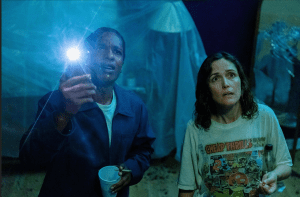
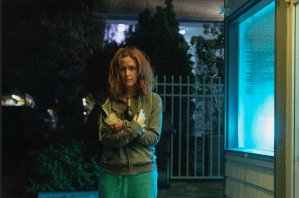
Byrne has been playing around the world of comedies since 2010’s Get Him to the Greek (a peak candidate for “most canceled cast” of the modern era, Byrne excluded) that I forgot how great she can also be in dramas. This is my favorite female performance of 2025. She is astounding. It’s smart to hire an actress of Byrne’s caliber, someone capable of finding the dark humor and exasperated guffaws of a life that feels like an assembly line of slaps to the face. The camera also rarely leaves her orbit, tacitly tying our sympathies, and it takes a lot to command the screen knowing your face is often going to be the measured focal point of every reaction to every slight and surprise and shock. She is the face of beleaguered motherhood, and it’s hard not to relate to at least a dozen moments of this nuanced and transcendent performance.
I don’t believe that If I Had Legs is unforgivably bleak; it’s certainly intense and agitating, but in order to make my finer point I need to spoil the end of the movie. However, dear reader, I truly don’t believe this is a movie that can be ruined through spoilers. So much of its appeal is the execution of such a specific vision, and to give one’s self over to that voice and its effect cannot be diminished through prior knowledge. It’s about the experience. Consider yourself warned, folks. Throughout the movie, the hole in Linda’s apartment ceiling becomes a sort of metaphor for her experience, an empty void. She dreams about losing herself inside the void, giving herself to the emptiness, and it’s easy to make a connection to darker impulses of self-destruction. This comes to a head at the very end, when Linda literally tries to run into the ocean to escape the troubles of her life, and the sea won’t have it, repeatedly throwing her back onto the shore. Even her attempt to escape ends up in tragic-comic slapstick. But it’s here where the movie switches gears, and we now see Linda’s daughter for the first time just as Linda is promising to be better for her. This changing of perspective effectively communicates Linda seeing her daughter, actually seeing her as a person rather than a nuisance, a peripheral voice of need and stress. The movie ends not on the harried breathing of Linda trying to calm down but on the hopeful smile of her daughter, and it might be misplaced optimism after a movie that feels plenty pessimistic, but I viewed this as a meaningful change. Even after all her struggles, even after her mistakes, there’s still the desire to do right for your loved ones, to improve.
I originally wanted to do a double review, pairing If I Had Legs with Die My Love, the newest Lynn Ramsey movie that explores the inexplicable loneliness of post-partum depression with Jennifer Lawrence trying to reconnect with her body, her sense of self, and the world as it was and is. I felt beforehand that the movies would have the connecting themes of the difficulties of motherhood, and they do, but I feel both movies are so tonally different in approach and execution that they deserve to be judged separately. If I Had Legs I’d Kick You might just be that hard-to-stomach film-experience so many have warned about (don’t expect the hamster to last long), but it’s such a transporting, exhilarating, and deeply humane vision executed to a remarkable degree of vibrant life. It’s personal and yet easily empathetic. It’s an unflinching and unsentimental portrayal not just of motherhood but of the difficulties of maintaining sanity in a world that often feels indifferent to your needs. It’s a difficult movie to watch, yes, but that doesn’t mean it lacks value and impact. If you’re brave and willing to wade through the deliberate discomfort, If I Had Legs is a remarkably good bad time at the movies.
Nate’s Grade: A
Share this:

Train Dreams (2025)
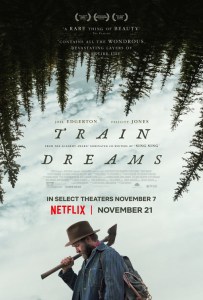 What a superb, tender, and deeply humanistic portrayal of life through the eyes of one man, Robert Granier (Joel Edgerton), a logger in Idaho in the early twentieth century. His life isn’t too different from the lives of many. He wants to spend more time with his wife (Felicity Jones) and child, less time away for months on end for logging, and he has difficulty making friends in his profession of hard work and inherent transience. He feels more connection to the natural world, of which he is felling one tree at a time. The nature of the script, adapted from the 2011 novella by author Denis Johnson, is episodic, people coming in and out of this man’s personal life. The narrative feels like a collection of memories, jumping back and forth in time, connected by ideas and imagery like we do in our minds, and providing a sum total for a life lived. There’s an inherent solemnity and awe to the movie, whether it’s about the transcendence of man’s place in the world, the march of progress, or merely the pull of tragedy and love that seeps into our core being. There is a personal tragedy that defines Robert, and it is devastating to experience and process with him. Director/co-writer Clint Bentley (one half of the same creative team behind last year’s Sing Sing, one of the best movies of 2024) uses this character to represent the totality of the human experience, making the movie feel deeply felt and empathetic even decades removed from its subject. That’s because logging isn’t the movie. It’s about the people, places, and experiences that define us. William H. Macy hasn’t been this good in years. You give me a wise, elegiac narrator in the spirit of Assassination of Jesse James by the Coward Robert Ford, with such pristine details readily supplied, and I’m already a sucker for your movie. The only thing holding back Train Dreams for me was that post-tragedy doesn’t get the attention I think it deserves. You’d expect the second half of the movie would be the process of grieving and coming to terms, and in essence it is, but the movie is far less direct about its processing, which I felt was a minor misstep for an overall great movie.
Nate’’s Grade: A-
Share this:

Keeper (2025)
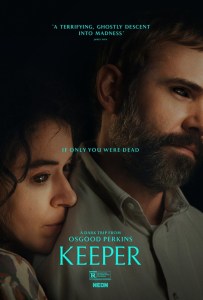 Director Osgood Perkins is becoming an indie horror household name for Neon with three releases in less than 18 months, each wildly different in approach. Granted, Keeper is more in league with Longlegs than The Monkey, which for me is the less appealing comparison. There really isn’t a whole lot to Keeper in style, theme, or execution. It stars Tatiana Maslany (The Monkey, She Hulk) as a woman visiting her boyfriend’s family cabin in the woods. He leaves for extended periods of time and she starts seeing weird visions of dead women and strange and sinister specters. Until the reveal with fifteen minutes to go, the movie is all ponderous atmospheric noodling, with Maslany slowly losing her mind. There’s a few nifty images but the eventual connection to all this mumbo jumbo is pretty outlandish while at the same time feeling pedestrian, delivered with an unintentionally funny expository speech spelling out everything. All this slow burn anticipation for that? I wish there was more concentration on the main character’s personal psychology beyond lingering doubts she has over whether her boyfriend might be cheating. That’s a fairly humdrum conflict given everything (just go home, girl) and makes the character more a mitigating reflection of him rather than her own character with her own issues and history. Some of the eventual monster designs are nightmarish and memorable but for me it was too-little too-late. I wanted better for Maslany and a horror movie that had more going on under the surface to justify its dithering atmosphere. Keeper is a poorly paced and ultimately thin horror movie better left alone and forgotten.
Nate’s Grade: C
Share this:

Hell of a Summer (2025)
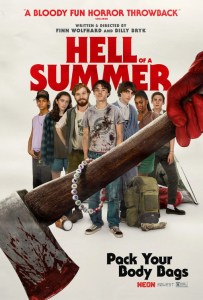 You’ve likely seen this kind of movie before, and co-stars/co-writers/co-directors Billy Bryk and Finn Wolfhard (yes, the Stranger Things actor has directed a movie by age 19) are counting on that. Hell of a Summer is a summer camp slasher movie with horny camp counselors trying to score before they get murdered by a masked assailant. The tone, however, is decidedly more heightened and goofy, aiming for more of an unassailable offbeat comedy like Wet Hot American Summer. It works because the horror/thriller elements, and the general mystery of who is the real killer, are never really that compelling, clear pastiche but no more than that. The real entertainment value comes from the silly characters navigating familiar teen troubles like relationships, growing independence, and the scary uncertainty of being an adult, with a heightened seriousness amidst the ridiculous, approaching camp-levels but without being obnoxiously self-aware. That’s why I credit Wet Hot American Summer as its primary influence. There’s a loosely experimental yet admirably confident air to the presentation. Even when the jokes aren’t landing or the pastiche is getting old, I held out with hope that another strange moment might catch my fancy in short order, like Wolfhard being obsessed with the hydration of his peers, or Bryk having a crisis of self-doubt when people suggest the killer is targeting the “hottest counselors” and he’s not been targeted yet. It makes for a silly, inoffensive bauble of a movie with clear affection for its genre influences. If you can’t get on the movie’s comic wavelength, it will make for a slog of 90 minutes. Hell of a Summer might make you smile enough to warrant one pleasant viewing, and who knows, this might just be the beginning of Finn Wolfhard, directing titan.
Nate’s Grade: C+
Share this:

He’s Coming to Get You! (2025)
 Kyle Rayburn might just be one of the nicest human beings you’ll ever meet, and he’s admirably unafraid of pursuing his dreams, whether it’s starting a chicken wing food truck or making micro-budget horror comedies in central Ohio. The man has gusto, and it shines through the seams of his hardscrabble yet charming earlier cinematic efforts, Night Work and Satanic Soccer Mom from Ohio. Each of Rayburn’s movies is filmed for under $5000 and shot on an iPhone. He’s in a production groove, promising the next adventure during the credits of his latest completed movie (coming up next: Slam Hounds), and his latest cinematic salvo is the evocatively-titled He’s Coming to Get You!, a title that William Castle surely would have nodded in solemn approval. It’s more or less The Crow by way of Sam Raimi, who even gets name-checked in the movie, a supernatural-fueled revenge thriller with goofy slapstick and self-aware references. It’s a fairly entertaining beginning and ending to a movie that, unfortunately, at just an emaciated 51 minutes in length before end credits, lacks the development for a satisfying exploration between start and finish.
George Russo (Scott Baker, Sulphur for Leviathan) is turning thirty-three and looking forward to a night of cavorting with his long-time girlfriend, Aja (Alyss Winkler, Space Babes From Outer Space). A team of sex traffickers (Jason Crowe, Seth McGuffin – yes, that is his real last name) is determined to capture Aja for their boss. They mug the happy couple and shoot George in his face, killing him and kidnapping Aja. An occult bookstore owner (Grace Plazolles-Hayes) resurrects George through the power of voodoo. He’ll be alive for the remainder of the night, enough time to track and rescue Aja. He’s also a “pain sponge,” meaning that he can take lots of physical punishment and keeps on going, the Energizer Bunny of vengeance, if you will. Can he rescue his beloved before it’s time once again to shuffle from the mortal coil? Will he be able to inflict maximum justice while also trying out some long-sought kung-fu moves?
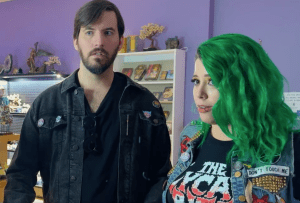 From that description, you can see how the premise would suffice as a movie for He’s Coming to Get You! (it’s never going to be normal in my brain to type a period after the punctuation in the title). There’s something inherently appealing about revenge stories, and you add a supernatural element that doesn’t just level the playing field for our undead underdog but gives them a key advantage, and we’re hooked. It really is The Crow with a better sense of humor, or, well, any sense of humor. Along those lines, giving our avenging crusader a sense of humor that would fit into Army of Darkness is a great boon. The heavier aspects of the movie like murder, assault, and trafficking are mitigated by having a main character who has definite Bugs Bunny by way of Bruce Campbell energy. It’s the filmmakers way of saying to the audience not to get too worried because the results will be more like an amiable, goofy hangout.
After three movies, I can say that Rayburn and his co-writer/producer Ben Reger love making movies that are, first and foremost, concerned with imparting good times no matter the twisted material. I laughed out loud a few times, like when a thug, seconds before his imminent death, replies forlornly, “I never saw Pari.” I laughed at George attempting a kung-fu move and then berating himself, “Nope, felt wrong the second I tried.” There’s a pair of bumbling cops (played by Rayburn and Reger) that you can tell they have such affection over, even if they seem like the most incompetent cops on the beat. It all encapsulates a certain teenage boy ethos of rock and roll, scatological humor, babes, and cartoonish violence. The infectious vibes of the movie are back and appealing, a feature that can elevate low-budget movies with obvious limitations. It’s the same with the mumblecore movies of the 2010s, low-budget slice-of-life movies buoyed by strong characters and sense of place. There is no budget on engaging storytelling. It’s the same with Rayburn and Reger’s collaborations. Whatever the premise, theirs is a universe you’ll want to make pit stops for the irreverent good times and weirdness.
 And that brings me to my biggest hesitation with He’s Coming to Get You!, mainly that in its final form it comes across more of a proof of concept for a bigger movie than feeling like a complete feature. This is primarily because of its length and the rushed development skipped over for an abbreviated Act Two. The total running time before end credits is 51 minutes, but if you subtract the opening credits that play over the montage of George getting up for the morning, that’s an additional three and a half minutes, taking the running time to a paltry 48 minutes or so, fitting an hour of network TV rather than a feature-length film. From a structural standpoint, George is killed at the 21-minute mark, resurrected and sent on his mission at the 31-minute mark, foils the bad guys by the 46-minute mark, and then the movie ends at minute 51. That’s it. It’s hard not to feel a little cheated; the “coming to get you” part of the title is only 15 minutes. Imagine The House on Haunted Hill but you’re only on Haunted Hill for all of ten minutes.
The movie is sprinting through potential plot and further world-building that would help to make its storytelling feel more original and engrossing. Once George is resurrected, he is given great powers but there aren’t any notable rules on the powers besides the fact that they, and he, will expire upon morning. The villains never really have a chance to even process their new adversary as he just shows up, kills them, and then wins the day on his first attempt. The absent struggle and creative development hampers some of the fun, like the movie was in a rush to call it quits over practical considerations. After George is resurrected, there’s one other group he gets to test his new powers on before it’s already time to eliminate the people who killed him. In The Crow, the main character targeted the gang of killers one-by-one, with them learning about this new threat gradually and planning counter-moves. The way it plays out in this movie is all too easy. It’s like an acknowledgement that an audience won’t want to watch a full movie of a supernatural hero getting everything he wants too easily, but the answer isn’t to just shorten the movie, it’s to better develop the premise and ensuing conflicts and challenges and unique world-building. I’d rather watch a version of this movie where George has to figure out his powers and has certain rules and limits than a speed-run to the finish without any interesting challenges, organic complications, or surprises.
 There is one moment toward the very end of He’s Coming to Get You! that I feel is emblematic of the positives and drawbacks of the development, but it involves some mild spoilers since it concerns the conclusion, so be advised, dear reader. Aja and George are reunited and finally get some privacy in the bedroom. Aja has been promising quite a bevy of sexual activity for George’s birthday. They’re finally alone, she performs a strip tease, then she crawls into bed and the movie cuts to them just talking and laughing. I thought that was a nice subversion. They have one final night together, so why spend it on physical copulation when you could wile away the hours talking to your favorite person, hearing their laugh, reminding yourself why you love them before they’re gone for good? Besides, having sex with a resurrected dead body, who has been stabbed and beaten throughout the movie, might make for an extremely upsetting final memory of your lover. Plus there’s the whole possible joke of being unable to control blood flow since, you know, blood doesn’t flow anymore anyway. I thought this was clever and sweet. Then it’s revealed that George and Aja did indeed have their sex off-screen and this is just post-coital pillow talk rather than a subversive replacement. Oh? Oh well then.
After three movies, I can start to catalogue the Kyle Rayburn film experience: silly comedy cul-de-sacs, low stakes regardless of circumstance, celebration of schlock, amiable vibes, actors having fun regardless of experience, lo-fi visuals, minimal if any coverage beyond shot-reverse shot edits, and underdeveloped stories. This has been my chief criticism with each of Rayburn’s previous movies, that they benefit from fun ensembles and intriguing premises but that more work could have been done to better realize the potential of each. I often walk away from these movies thinking we got the first draft onscreen. He’s Coming to Get You! is the most real world setting in a Rayburn vehicle, so there aren’t as many interesting characters or details to the world to cover some of those plotting shortcomings, so the vacancy becomes more notable and damaging to the entertainment. It’s easy to graft onto the relaxed, schlocky wavelength of the movie but by the end I felt a little shortchanged in creativity and execution, missing a movie middle. I’m happy Rayburn is following his dreams and has built a staple of returning players. He’s Coming to Get You! has enough going for it that I wish the team had dug in more. I only wish that whatever the next three or four projects prove to be, that Rayburn and his team take more time to really work through their particular story conventions to make them the best version they can be, not just completed.
Nate’s Grade: C+
Share this:

Sorry, Baby (2025)
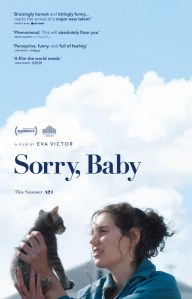
Sundance favorite Sorry, Baby takes several serious subjects and provides its own little bittersweet treatise through a character study of one woman navigating her complex feelings after being assaulted by her college professor. Written, directed, and starring Eva Victor, the movie feels like a combination of one of those small-town slice-of-life hangouts and something a little more arch and peculiar, but it still coasts on its vision and authorial voice. Victor’s portrait rings with honesty and empathy as her character, Agnes, wants to live a “normal life” but doesn’t quite understand what that might be. Her best friend is pregnant from a sperm donor, she’s adjusting to her workload as a literary professor at her alma mater (in an ironic twist, she occupies the same office as her former mentor and attacker), she’s flirting with the possibility of a romance with a nice neighbor (Lucas Hedges), and she just adopted a stray cat. The present, suffused in indecision and depression, is juxtaposed with flashbacks to her before, immediately after the assault, and the infuriating aftermath. This is where some of Victor’s darker sense of humor arises, like when Agnes is consoled by university officials who tell her there’s nothing they can do because her attacker has resigned but, hey, they’re also women, so, you know, they get it. Sorry, Baby walks a fine line between making you wince and making you want to laugh. It’s an impressive debut for Victor on many fronts, though I wish I felt like it amounted to something more emphatic or emblematic. It can feel more like a lot of self-contained scenes than a full movie, like Agnes going through jury selection before being excused when she has to confess her own history and her conflicted view of her attacker. I really enjoyed the concluding monologue Agnes gives to a newborn, explaining that the world she’s just entered will probably eventually hurt her but that there’s still good people and goodness that can be found. It’s heartfelt but in-character and feels completely on her own terms. Sorry, Baby is a little slow and a little closed-off, but it also deals with trauma and perseverance in a manner that doesn’t feel trite, condescending, or misery-prone.
Nate’s Grade: B
Share this:

Good Boy (2025)
 This is the first movie I can think of that might have a vested interest in opening its title with something usually reserved at the very very end of credits: the animal cruelty disclaimer. It seems barbaric now, but decades ago, film productions didn’t give much care for the care of their animal actors. In the old days, especially at the height of Westerns, horses would just die by the dozens and sometimes be literal cannon fodder like in 1980’s Heaven’s Gate. Nowadays, productions are monitored for animal cruelty and make every effort to tell their stories without harming anyone, human and animal. Good Boy is a novel take on a familiar horror concept. It’s a haunted house movie about a nefarious life-sucking specter. It’s also completely told from the point of view of the family pet. It’s a common horror trope to have the animals sensing supernatural danger before their respective owners finally wise up, it’s another to base your entire movie on that perspective. That’s what director/co-writer Ben Loenberg put together over the course of three years, training his dog Indy to be the star of his debut feature film. While the film feels more like an empathy experiment than a fully developed movie, it’s an interesting twist that made me rethink familiar horror movie staples. Here’s a helpful spoiler to set your minds at ease: the dog lives, folks.
Indy is a golden retriever and just the bestest boy. His owner, Todd (Shane Jensen), is going through a lot. Todd is suffering from a fatal illness and has returned to his grandfather’s home in the country. Todd’s sister is worried over his deteriorating mental and physical state and also believes that the old family home is haunted by a sinister presence that contributed to their grandfather’s demise. What’s a dog to do?
 It’s an interesting choice to have a dog as our main character because it’s both limiting as well as coursing with dramatic irony. Firstly, we know it’s a movie, and the dog is just a dog and doesn’t know its owners are making art by being purposely weird. So many animal performances are like candid camera exercises (cue think pieces arguing that the dog could not really give consent to being terrorized for art). Telling your story from only what a dog is privy to will naturally limit the extent of the story. We can overhear snippets of conversations to draw inferences but the movie is making a value judgement that its audience will fill in the blanks of its familiar ghost story. This is the filmmakers at peace with their story being hazy and familiar and underdeveloped. They’re sacrificing clarity for adhering to their artistic vision, but because it’s the whole relevant sticking point of the movie, I think they made the right call.
Alas, the dog is a limited perspective to tell a realistic story. However, the sense of dramatic irony is what helps add layers to the viewing. We see the dog know more but also simultaneously less than the humans. It senses the ghostly presence that the humans are ignorant of, but it doesn’t know why humans do their human things any more than any other non-human creature (we are puzzling). It makes for an experience where we are aware of what the dog knows but also simultaneously aware of what the dog doesn’t know. It makes for an interesting experience allowing the audience to empathize with our poor pooch but also recognize the dangers that it doesn’t and recognize the dangers that it’s trying to warn its owner over.
The perspective is a gimmick, sure, but it reminds me of last year’s In a Violent Nature, another indie horror project that took a familiar premise and turned it on its head through a canny choice of point of view. In that movie, we were presented the teenage slasher movie but from the beleaguered perspective of the zombified behemoth stalking the woods and trying to run into those mischievous teens. It was an experimental turn for a sub-genre that had been done to death by the conclusion of the 1980s, and that choice of perspective made it more reflective and contemplative as the viewer was forced to reconsider our relationship with these kinds of movies during the extended walks. Good Boy doesn’t go that philosophical distance, but its change of perspective refreshes the old tropes of the haunted house story.
 Is Good Boy scary? Not really, but I actually don’t think that’s the point of the exercise either. The purposely underdeveloped story rests on familiar tropes, which cues the audience to place their attention less on the plot, rules, and explanations and more on empathizing with the dog. Because of this creative choice it can create tension whenever we feel like the dog is confused, alarmed, or threatened. While the filmmakers do a decent job of crafting a potent sense of mood with such a low-budget, I doubt few will characterize the movie as genuinely scary. However, what’s scary is what might happen to this good boy and his own emotional fragility trying to understand forces and choices beyond his capacity. I will say to the horror aficionados who also happen to be ardent animal lovers, there is another ghost dog that used to belong to the dead grandfather who met a tragic end, but other than that, Indy isn’t truly harmed. Still, I found the resolution to the movie, including the very final image, unexpectedly poignant and a reminder that dogs are so inherently loyal that we honestly don’t deserve them as a species.
Dogs are inherently empathetic beings, just ask any dog owner, so it’s easy to sympathize with this little guy trying to do his best to be the good boy he is. He just wants some pets and to cuddle with his human. He doesn’t know his owner is suffering from a chronic lung condition. He doesn’t know the strange man in black ooze creeping along the shadows isn’t another strange person. Our dog just knows things aren’t right. Naturally, without narration, our protagonist is going to be limited by what he can emote, and yet the filmmakers do a superlative job of getting the best performance out of their four-legged star. Through the judicious editing and planning, it really feels like this little guy is giving a performance, enough so that animal lovers might squirm occasionally in their seats. When the ghost is taking over Todd and he’s mean to Indy, I felt so bad for this little guy (he doesn’t know it’s all pretend). There are some wonderfully expressive close-ups, and while it’s entirely the Kulushov effect and I’m projecting meaning into a performance that isn’t actually there, that’s also the intention of the filmmakers. They are cajoling their non-verbal star and creating the performance through carefully crafted setups and edits, and it works.
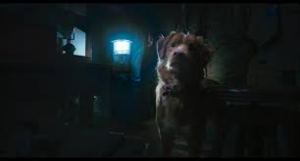 Good Boy isn’t the first movie with “man’s best friend” as its lead (Lassie, Rin Tin Tin, Benji, etc.) nor is it the first movie asking us to think from a non-human perspective. Its familiarity is the point, and it asks us to think of the tried ghost story but from the perspective of the curious canine. The movie is probably as long as it can be at 70 minutes without feeling truly punishing or significantly complicating its world building. I can’t fault people for viewing Good Boy as more of a gimmick or experiment than a fully engaging movie. It’s not going to be for everyone by the nature of its limited perspective and development; not everyone is going to be captivated watching a dog react to things for an hour. It didn’t fascinate me like In a Violent Nature but it did make me rethink the familiar, and to that end it’s an overall success and confirmation that you should always trust the animals when they sense something hinky.
Nate’s Grade: B-
Share this:

Friendship (2025)
 If you’re a fan of Tim Robinson’s brand of weird, cringe-inducing comedy that can accelerate in intensity or abrasiveness at a moment’s notice, then Friendship may indeed be the comedy of the year for you. I’ve never watched Robinson’s popular Netflix sketch comedy series, so consider me a novice to the man’s style of locked-in irony and chagrin. To say I “enjoyed” Friendship would be inaccurate. It exists on a comedy plane where I can mentally step back, assess the particulars, and often the sheer commitment to the bit, and think, “This is schematically funny.” Do I actually laugh out loud? Rarely. It’s a comedy that might be easier to admire for its jaunts into sudden weirdness and discomfort then it is to say you love the movie. Robinson plays a boring middle-aged man starting a new adult friendship with his new neighbor, played by Paul Rudd. It’s a comedy of errors as Rudd wises up to how weird and potentially unstable his newest friend can be, and he decides to end their brief friendship. Imagine taking a broad studio bromance like I Love You, Man, also starring Rudd, and mixing it through the perspective of Big Fan, the obsessive loner drama. There are a few amusing sidesteps, like when Robinson’s wife (Kate Mara) literally gets lost in the town’s system of sewers, or when he tries licking a psychedelic toad only to hallucinate a trip to Subway and feeling cheated from a better trip. The actors are all on the same wavelength, committed to selling the jokes by pretending no such jokes exist in this universe. I laughed occasionally but mostly shrugged my shoulders, hoping it would hit a new gear that never came.
Nate’s Grade: C+
Share this:

Opus (2025)
 Ever want to watch a second-rate version of The Menu and be left wondering why you didn’t just watch The Menu? That was my main takeaway watching the indie horror/comedy (?) Opus, a darkly satirical look at the music industry and specifically cults of personality. John Malkovich plays Alfred Moretti, an exalted and reclusive musical genius who has earned numerous awards and built a devoted fandom. He’s invited six special guests to a listening party for his new album, the first since his mysterious retirement. It just so happens that party is at his compound and the guests are tended to by a cult of devotees. From there, people start to go missing and weirdness ensues. I was waiting throughout the entirety of Opus for something, anything to really grab me. These are good actors. It’s a premise that has potential. Alas, the movie is uneven and under developed and I found my interest draining the longer it went. The music satire isn’t specific or sharp enough to draw blood or genuine laughs. The weirdness of life on the compound is pretty bland, with the exception of a museum devoted to Moretti’s childhood home that is explored during the climax. The characters are too stock and boring, not really even succeeding as industry send-ups. The music itself is also pretty lackluster, but the movie doesn’t have the courage to argue that the cult has formed around a hack. In the world of Opus, Moretti is an inarguable musical genius. We needed the main character, played by Ayo Edebiri (The Bear), to be an agnostic, someone who doesn’t get the appeal of this musical maven and can destruct his pomposity. Alas, the obvious horror dread of the followers being a murder cult is never given more thought. It’s fine that Opus has familiar horror/cult elements (The Menu, Midsommar, Blink Twice, etc.) but it doesn’t do anything different or interesting with them. It’s obvious and dull without any specific personality to distinguish itself, and if maybe that was the argument against the cult leader, I might see a larger creative design. Instead, it all feels so listless. When the weird cult movie can’t even work up many weird details about its weird cult, then you’re watching a movie that is confused about themes and genre.
Nate’s Grade: C-
Share this:

Together (2025)
 With co-dependency as its anchor metaphor, Together is a body horror movie asking the question how intimate you’d ever want to be with your beloved? It’s a relationship drama about two people that should probably break up and move on but are clinging to some sense that they need to stay. Real-life married couple Dave Franco (The Disaster Artist) and Alison Brie (Horse Girl) play pretend couple Tim and Millie who relocate to the small-town countryside and come across a mysterious sinkhole belonging to an abandoned New Agey church, as one does. After Tim, in his desperation, drinks the water out of a pit that looks like it was designed by H.R. Giger, his body and mind are hijacked with the compulsion to be as close as possible with his long-time girlfriend. Now the two of them are fighting strange impulses, like swallowing one another’s hair, or trying to physically meld their bodies together. Can they learn more about their predicament and the history of this symbiosis before they are forced together forever?
 Considering its premise, there is plenty of potential here for grandly gross body horror. There are certainly some squirm-worthy and disgusting moments of vivid imagery that could induce nightmares. I’m not even talking about the direct body horror moments. Seeing a man swallowing a majority of your ponytail in his sleep might make you gag like it did me. Things get more wild after an hour and stay that way to the end, as the couple has to thwart their bodies from literally fusing together. The sticky skin-to-skin, or eyeball-to-eyeball sequences are dreadfully unnerving, but the imagery of them literally being dragged by invisible forces across the ground to one another like literal magnets is less horrifying and more absurdly ridiculous. That’s the rub. There’s some terrific body horror grotesquery here, and writer/director Michael Shanks has a sneaky way with dread, building things to a monumental point and then cutting away. However, some of the other aspects of this curse come across as far goofier, like the aforementioned being dragged across the floor. For some it might come across as terrifying, the whole supernatural exaggeration of being out of control of your own body, but it reminded me of Tenet where it looked like characters were just rolling around on the ground in a supremely silly way when it was supposed to be “backwards time.” There are also some middling jump scares relating to Tim’s trauma with his parents that, I guess, is the explanation for why he has intimacy problems. Still, if you’re coming to Together for the outlandishly gross potential of its premise, there may be enough to sate your curiosity for macabre oddities.
Together is more a movie about a couple who should retire. There’s far more about the struggles and pains of this relationship than weird body horror. She wants to get married, he doesn’t. She wanted to move for a new job, and he did not. She wants to have regular sex, he hasn’t wanted to for months for unspecified reasons (unresolved childhood traumas?). The relationship is very one-sided and unlike 2019’s Midsommar, which was about a poor woman realizing it was time to kick her no-good boyfriend to the curb, or burn him alive via cult intervention, this movie is more about Millie wearing down Tim’s defenses. He’s connecting with her again but it’s through this metaphysical compulsion that he can’t fully explain. He’s expressing real physical interest but he’s still finding ways to reject her, which just drives her crazier. One minute they’re trying to resolve their intimacy issues, and the next they’re working together to slice their arms apart. There are some memorable discomforts, like having to physically dislodge after some vigorous yet impulsive bathroom stall sex. That sequence made me uncomfortable for several reasons. The film’s shock value and tone flirts with darker humor without committing. The final shot of the movie is also a bit silly, and while it achieves the articulation of the movie’s main theme, the concluding imagery is more like, “Oh, well, okay then.” It might even produce a few guffaws. It’s not quite the lasting image I think the filmmakers wanted to go out on. It made me think of Kevin Smith’s man-becomes-walrus horror film, Tusk, where it ends and you go, “Oh… well, they did it, all right.” Some things are better in theory than finally visualized where they come across as anticlimactic.
 That’s the other thing with Together, it’s practically bludgeoning you with its obvious theme, having every other line relate back to codependency. Multiple times you will hear, “It would be better to separate now. It will just be harder the longer we wait.” Can you get how this will be applied in multiple contexts? These are characters that feel stuck. Get it? Franco and Brie have an easy-going chemistry and an innate ability to find the darker humor amidst all the body horror splicing. I might argue their chemistry is too good considering they’re supposed to be a couple that shouldn’t really stay together and have passed their relationship expiration date. I don’t think you should want them to stay together considering this relationship is killing the both of them, now very literally. I was surprised there wasn’t more combustion to how this complicates their interactions and mobility. If this is a relationship that has had its rocky points and toxicity, you would think something this unnatural and against their autonomy would produce some friction (no pun intended). I suppose you could examine the entire movie as an analysis of how easily people will subsume themselves in order to stay in something even they would admit isn’t healthy. I’m not going to pretend The Substance was subtle either, but that movie was more fable and mixing in its over-the-top elements with verve, rather than fitting them into a relationship dirge.
Right before its nationwide theatrical release, Together was accused of plagiarism by another filmmaker who approached Franco and Brie with a similar concept in 2020. Shanks has defended his film by saying he registered his first draft back in 2019, and the producers of Together, including Franco and Brie, have dismissed the claim. I haven’t read the competing script, nor do I pretend to be an insider on this matter, but it’s easy for me to see how this concept could have been independently generated by dozens of screenwriters and aspiring body horror gurus. It’s taking its theme and making it quite literal, forcing the challenged couple who shouldn’t be together to literally, physically, irrevocably be together. It’s all pretty straightforward, which makes Together a workable but limited body horror experiment. I liked it, as much as one can like a movie where characters have to forcibly unstuck their genitals, but I found myself wanting a little more from Together. The added Tim back-story spooks feel out of place, the ongoing mystery of what happened to a previous backpacking couple is over represented, and the theme is so obvious at every turn that the metaphor is in danger of being stripped bare. Its concept is undeniable, and the body horror imagery can be aces, but the development and execution could have been a little more, well, together.
Nate’s Grade: B-


 nathanzoebl
You must be logged in to post a comment.