Blog Archives
The Passion of the Christ (2004)
 The Passion of the Christ is a retelling of the last 12 hours of Jesus Christ’s life (perhaps you’ve heard of him?). In these final hours we witness his betrayal at the hands of Judas, his trial by Jewish leaders, his sentencing by Pontius Pilate, his subsequent whippings and torture and finally his crucifixion. Throughout the film Jesus is tempted by Satan, who is pictured as a pasty figure in a black hood (kind of resembling Jeremy Irons from The Time Machine if anyone can remember). The Passion spares no expense to stage the most authentic portrayal of what Jesus of Nazareth endured in his final 12 hours of life.
For all the hullabaloo about being the most controversial film in years (and forgive me for even using the term “hullabaloo”), I can’t help but feel a smidgen of disappointment about the final product. The Passion is aptly passionate and full of striking images, beautiful photography and production values, and stirring performances all set to a rousing score. But what makes The Passion disappointing to me is the characters. You see, Mel Gibson’s epic does not devote any time to fleshing out the central characters. They are merely ciphers and the audience is expected to plug their feelings and opinions into these walking, bleeding symbols to give them life. Now, you could argue this is what religion is all about, but as far as a movie’s story goes it is weak. The Passion turns into a well-meaning and slick spectacle where character is not an issue. And as a spectacle The Passion is first-rate; the production is amazing and the violence is graphic and gasp-inducing. Do I think the majority of people will leave the theater moved and satisfied? Yes I do. But I can’t stop this nagging concern that The Passion was devoid of character and tried covering it up with enough violence to possibly twist its message into a Sunday school snuff film.
 For my money, the best Biblical film is Martin Scorsese’s 1987 The Last Temptation of Christ (also a film mired in controversy). Last Temptation, unlike Gibson’s spectacle, was all about Jesus as a character and not simply as a physical martyr. Scorsese’s film dealt with a Christ consumed by doubt and fear and the frailties of being human. But the best part is the final 20 minutes when Jesus is tempted, by Satan, to step down from the cross and live out a normal life. Jesus walks away from the cross, marries Mary Magdalene, fathers children (this is where the controversy stemmed from but they were married) and dies at an old age. Jesus is then confronted by his aging apostles who chastise him for not living up to what he was supposed to do to save mankind. Jesus wakes up from the illusion and fulfills his mission and dies on the cross. Now, with the story of Last Temptation an audience has a greater appreciation for the sacrifice of Jesus because they witness his fears and they witness the normal life he forgoes to die for man’s sins. There is a sense of gravity about what Jesus is sacrificing.
With The Passion Gibson figures if he can build a sense of grand sacrifice by gruesomely portraying the tortures Jesus endured. Even if it is Jesus, and this may sound blasphemous, torturing a character to create sympathy and likeability is the weakest writing trick you can do. Yes Jesus suffered a lot, yes we should all be horrified and grateful, and yes people will likely be moved at the unrelenting violence he endured, but in regards to telling a story, I cannot feel as much for characters whose only characterization is their suffering. Sure, The Passion flashes back to some happier moments of Jesus’ life, which I like to call the Jesus Greatest Hits collection, but the movie does not show us who Jesus was, what he felt (beyond agonizing pain) or the turmoil he went through in finally deciding to give up his own life for people that despised him. The Passion is not about character but about spectacle.
So let’s talk about the violence now, shall we? Gibson’s camera lovingly lingers on the gut-churning, harrowing, merciless level of violence. But this is his only message. It’s like Gibson is standing behind the camera and saying to the audience, “You see what Jesus suffered? Do you feel bad now? FLAY HIM MORE! How about now?” What was only three sentences of description in the Gospels takes up ten minutes of flogging screen time. Mad Mel has the urge to scourge. After an insane amount of time spent watching Jesus get flayed and beaten the violence starts to not just kill whatever spiritual message Gibson may have had in mind, but the violence becomes the message. The Passion does give an audience a fair understanding of the physical torture Jesus was subjected to, but the movie does not display Christ as fully human, enjoying life and love, or fully divine. The only thing The Passion shows us about Jesus is that the son of God sure knew how to take a whuppin’. For Gibson, the violence is the message and the point is to witness what Jesus endured. Some would call that sadistic.
 The actors all do a fine job and it’s impressive that everyones’ lines is in two dead languages (Latin and Aramaic, though for the life of me I can’t tell them apart). But the acting is limited because of the nature of the film. Had there been more moments of character the acting would come across better. As it stands, the acting in The Passion is relegated to looks of aguish or looks of horror, interspersed with weeping. Monica Bellucci (The Matrix sequels) really has nothing to do as Mary Magdalene but run around in the background a lot. Jim Caviezel (Frequency, Angel Eyes) gives everything he has in the mighty big shoes he tries to fill. It’s too bad that his Jesus spends most of the screen time being beaten, which kind of hampers his acting range.
Now let’s address the anti-Semitic concerns. Let’s face facts; you are not going to have a film about the crucifixion of Jesus and have some Jews coming off in a good light. Just as you would not have a film about the Holocaust and have some Germans coming off in a good light. It is unavoidable. The Passion does portray a handful of Jewish religious leaders as instigators for Jesus’ eventual crucifixion, but there are also Jewish leaders who denounce their actions and just as many people bemoaning the torture of Jesus as there are calling for it. Who really comes off looking bad are the Romans. Excluding the efforts to make Pilate look apprehensive, the Roman soldiers are always seen kicking, punching, whipping, spitting on Jesus and laughing manically with their yellow teeth. How anyone could watch The Passion and come away anti-Semitic and not anti-Italian is beyond me.
And like I said before, most people will be extremely satisfied with the film because it’s hard to find a person who doesn’t have an opinion on Jesus. Gibson is counting on audiences to walk in and fill in the holes of the character so that The Passion is more affecting. Gibson’s film is worthy spectacle, and despite the vacuum of character I did get choked up four separate times, mostly involving Jesus and his mother. The Passion is a well-made and well-intentioned film that will hit the right notes for many. I just wish there were more to it than spectacle. I really do.
Nate’s Grade: C
Share this:

Kill Bill Vol. 1 (2003)
 Breathtaking and stylistically amazing. That’s all there is to it. Can’t wait for part two.
Nate’s Grade: A
Share this:

Cabin Fever (2003)
 Throw out all your foolhardy preconceived notions of what you believe to be mans greatest endeavor. Fire, the wheel, antiseptics, flight? Toss them all in a big garbage can, because Cabin Fever is the greatest single thing human beings have ever and will ever create. I hear a select few countering, What about the Renaissance? Oh yeah, did the Renaissance have gratuitous nudity? Wait, scratch that. Did the Renaissance have indulgent nude scenes involving the former Yellow Power Ranger? I think not. Did your fancy-smantzy Renaissance have dogs ripping people apart, backwater yokels who perform kung fu and hobos being set on fire? Thats what I thought. Now who looks like the fool? If I had to live in a Cabin Fever-less world, I would hope it would collapse upon itself, because humanity shouldn’t have to continue without this movie.
 Cabin Fever is a delirious new horror film tweaking all the clichés and expectations of horror. Five friends who have just graduated from college rent a secluded cabin for a weekend. Then their numbers start dwindling through horrific killings. The brutal murderer? A flesh eating bacteria infecting their numbers, ravaging inside them and making flesh fall off like loose cheese on a pizza.
Once the group discovers that one of their friends has become infected they without hesitation quarantine her in a shed. They make failed attempts at getting outside assistance but are pushed back into the hot zone. Their fears and distrust manifest, and what was intended to be a sexual romp in he woods (we all know how that goes in horror flicks) has turned into a microcosm of Lord of the Flies meets Evil Dead II, with a dash of Night of the Living Dead.
What elevates Cabin Fever from similar brainless exercises in mutilating sexually active teens is its self-awareness and constant humor. It plays upon horror staples, particularly the notion of a nation of creepy backwoods folk waiting to take advantage of lost teens. Cabin Fever proudly wears its horror influences on its sleeve. The film is also relentlessly hilarious in its tongue-in-cheek self-awareness. I was laughing all the way through. The film even ends in an inter-racial ho-down with banjos!
The film isn’t so much scary, though it does have a few shares of scares. The film also isn’t as gory as youd believe, but when it shows the gory goods Cabin Fever swings for the fences. Interesting enough, someone on the Cabin Fever crew actually suffered an attack by flesh-eating bacteria in their life and claims the gruesome makeup to be 100 percent authentic.
 Writer/director Eli Roth’s Cabin Fever is a scream. He has an amazing sense of visuals and creates a vivid picture of doom. He displays a sickly entertaining sense of humor, much like Sam Raimi and Peter Jackson did before they went Hollywood. The photography is great, the disgusting makeup is skin-crawling (perhaps a more appropriate term than intended) and the performances are dead-on camp. Each of the characters fits into a horror archetype from innocent girl next-door (who gets infected first), sexy brunette vamp, loudmouth drunkard and nice guy who lacks confidence (Rider Strong of Boy Meets World).
Now some will take umbrage to the fact I’m giving a goo-filled horror flick such a high rating. Cabin Fever is the most fun I’ve had at the movies in some time, and is perfect for getting a group of your friends together to experience. I couldn’t ask for more breezy entertainment from a movie. You know what else your fancy Renaissance didn’t have? People swallowing their harmonicas. I’m pretty sure they didn’t have that. Take that harmonica-less Michelangelo, you hack!
Nate’s Grade: A
Share this:

We Were Soldiers (2002)
 Randall Wallace and Gibson last teamed up on Braveheart and came away with a bushel of gold statuettes. Their latest collaboration is a Vietnam war flick called We Were Soldiers based upon the novel by Lt. Col. Hal Moore and photographer Joe Galloway. It details the chaos of the battle at Ia Drang where 400 US soldiers were surrounded in a valley by 2000 North Vietnamese fighters and held their own for three long days.
The opening chunk of We Were Soldiers concerns the domestic side of the soldiers. Lt. Col. Hal Moore (Mel Gibson) is a man of great honor and battlefield heroics complete with five kids and a determined and loving wife Julie (Madeleine Stowe). Does anyone have any problems identifying the hero yet? Moore has been commanded to assemble an inexperienced band of soldiers and mold them into the 7th Cavalry division. His men include new father Lt. Jack Geoghegan (Chris Klein), helicopter pilot Maj. Bruce Crandall (Greg Kinnear) and grizzled veteran Sgt.-Maj. Basil Plumley (Sam Elliott). They’ve been called in to be apart of one of the first strikes of the Vietnam War in 1965. Gibson rallies the troops and they head toward the East. What followed could be deemed a suicide mission as the 7th Cavalry and other divisions were surrounded by the advancing Vietcong and fought to the teeth for their survival.
Director Randall Wallace (who last directed and adapted for the screen Man in the Iron Mask) is a director that doesn’t know a thing about subtlety in his mess of patriotism. Wallace just doesn’t hammer his points and views; he’ll bludgeon you to death with them. Gibson ensures his men that he will be the first one into battle and the last to leave. Sure enough, as the helicopter is setting down we see a big close-up of Gibson’s boot hitting the earth and a thunderous echo follows. The point has been made. Wallace also manages to squeeze in a bit where he can skewer the media. A horde of reporters show up at the end of the battle, ducking at any noise they hear, and stick their mics in Gibson’s face asking absurd questions like “How do you feel about the loss of your men?” Oh Wallace, you are such a shrewd satirist.
 The violence in the film is incredibly graphic, as with the tradition of most recent war movies like Black Hawk Down. The violence almost reaches a sadistic level where we see slow motion shot after shot of people with a geyser of blood spewing from head wounds. The blood flows freely and often but loses its impact. I would even go as far as saying that much of the violence in ‘We Were Soldiers’ is overkill under Wallace.
The makeup that accompanies some of the battle wounds is surprisingly disappointing (as is a lot in the film). One character, after an accidental blast from napalm, has half his head looking like a burnt marshmallow. The shoddiness of the look inspires more laughs under your breath than gasps.
The battle of Ia Drang shows reactions from both sides of those fighting. Every now and then the film cuts back to the Vietnamese side in their underground lair. The leadership over explains all their strategic movements in large flailing gestures. It’s like a cheap play-by-play for the audience. We Were Soldiers also follows the recent trend of trying to humanize the enemy. But these attempts are easily seen as the hollow politically correct handouts that they are. One scene shows a Vietnamese soldier writing in a book to his honey back home. It’s nice to see clichés transcend ethnicity.
 The film succumbs to the usual war movie clichés and Hollywood formula. The problem with making a supposed “emotional” Vietnam movie is that the definitive Vietnam movies concerning the madness of battle (Apocalypse Now and Platoon) and the crippling after-effects (The Deer Hunter and Born on the Fourth of July) have already been made. We Were Soldiers portrays Vietnam before the politics got in the way and concentrates on the courage of the men who dutifully entered into battle at the heed of their country’s call. I can’t help but feel that the men who bled and died in that battle don’t deserve a better movie.
Gibson as Moore gives a stoic performance and adds a level of humor to the figure, but there’s no questioning the mettle of this soldier. Gibson’s character is almost an exaggerated propaganda action figure. Moore’s courage is unquestionable and that’s the way they want it. Madeleine Stowe is a terrific actress but is generally wasted here. Most of the movie she spends her time hugging people while wearing some horrible Cher wig and looking eerily like Hillary Swank in The Gift. Chris Klein looks entirely out of place, as does his wife played by curly-coifed Felicity actress Keri Russell. Greg Kinnear spends the entire movie sitting in a helicopter chair barely seen. They could have saved some money and hired an extra.
We Were Soldiers is an okay film but it should have been much more. Gibson elevates what could have been worse but Wallace isn’t doing the film any justice. Wallace is too heavy-handed with his direction and flag-waving message and seems to have his film begging to be taken seriously. We Were Soldiers can pass the time all right, but there are better things you could do then watch this force-fed old-fashioned narrative.
Nate’s Grade: C
Share this:

Hannibal (2001)
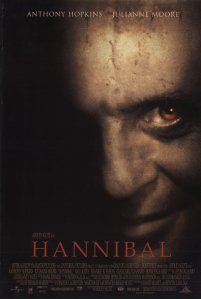 Trying to sequelize Silence of the Lambs is surely harder than trying to sequelize The Blair Witch Project. The novel Hannibal by Thomas Harris I don’t think will be confused as a necessary burst of creative ambition, and more of a chance to cash in on the love of Hannibal Lector. Though I’ve not read a line from the book from what I’m told the movie is faithful until the much hated ending. Starting a film off a so-so book isn’t a good way to begin, especially when you lose four of the components that made it shine Oscar gold.
 The element that Silence of the Lambs carried with it was stealthily gripping psychological horror. It hung with you in every closed breath you would take, surrounding you and blanketing your mind. I mean, there aren’t many serial killer movies that win a slew of Oscars. Lambs excelled at psychological horror, but with Hannibal the horror turns into a slasher film more or less. What Lambs held back and left us terrified Hannibal joyfully bathes in excess and gore.
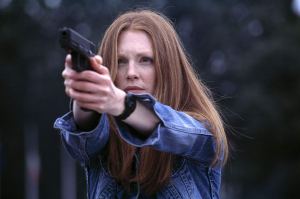
Julianne Moore, a competent actress, takes over from the ditching Jodie Foster to fill the shoes of FBI agent Clarice Starling. Throughout the picture you know she’s trying her damndest to get that Foster backwoods drawl she used on the original down. The problem for poor Moore though is that her character spends half of the film in the FBI basement being oogled by higher-up Ray Liotta. She doesn’t even meet Hannibal Lector until 3/4 through. Then again, the title of the film isn’t Starling.
Anthony Hopkins returns back to the devil in the flesh and seems to have a grand old time de-boweling everyone. Lector worked in Lambs because he was caged up, like a wild animal not meant for four glass walls, and you never knew what would happen. He’d get in your head and he would know what to do with your grey matter – not that he doesn’t have a culinary degree in that department in this film. Lector on the loose is no better than a man with a chainsaw and a hockey mask, though he has a better knowledge of Dante and Florentine romantic literature. Lector worked bottled up, staring at you with dead unblinking calm. He doesn’t work saying goofy “goody-goody” lines and popping out of the shadows.
 Since the director, screenwriter, and female lead didn’t show up for the Lambs rehash, it feels a tad chilled with Ridley Scott’s fluid and smooth direction. The cinematography is lush and very warm.
Gary Oldman steals the show as the horribly disfigured former client of Lector’s seeking out revenge. His make-up is utterly magnificent and the best part of the film, he is made to look like a human peeled grape. Oldman instills a Texan drawl into the character yet making him the Meryl Streep of villainy.
Hannibal is no where near the landmark in excellence that Silence of the Lambs was but it’s not too bad. It might even be good if it wasn’t the sequel to a great film. As it is, it stands as it stands.
Nate’s Grade: B-
Reviewed 20 years later as part of the “Reviews Re-View: 2001” article.
Share this:

The Patriot (2000)
 For all the controversy this flag-waving picture is garnering over historical accuracy, turning British commanders Nazi-like, ignoring slavery like Spike Lee said, people forget it’s a well tuned and fairly touching and always exciting movie.
The battle sequences are shot with great suspense and visual expertise. The gore flies often, as this would be a very gory war indeed. On a personal note this movie has had the best squib hits (blood shot explosions for those who don’t know) I’ve ever seen. But the main focus isn’t the war, it’s merely a back drop for the story of a family man Benjamin Martin (Mel Gibson) avenging the death of one of his sons and being pulled into the war fighting for a purpose. Mel Gibson gives a wonderful performance as the troubled father man afraid of his past sins and what the future may bring. His thoughts are never on the enemy but on his children he loves dearly. Heath Ledger (10 Things I Hate About You) plays Gibson’s oldest son Gabriel and is the break-out star. His acting is as sharp as a bayonet and the future looks very promising for this Aussie actor.
The most necessary quality a movie must have to pull for the hero is a hissable villain, and The Patriot has a villain that will likely be the best (worst?) of the summer and possible year. Well known British stage actor Jason Isaacs gives such delight in every snarl and evil grin that Tavington, his character, exudes. You can peer into his eyes and see evil — and that’s great acting. He truly relishes his actions. With a wonderfully bad villain it only pulls more emotional heft to the story written by Saving Private Ryan‘s scibe Robert Rodat on a personal mission to pen a movie about every major American war.
The Patriot isn’t spot free, especially after a multiple tomahawk attack. Some of its characters are sloppy and the end is rather predictable and somewhat cheesy that the two men do battle as the focal point of the entire war. And you might just laugh when Gibson races back to the front of a quivering line and waving the flag to inspire the troops. There’s also many unnecessary and stupid sub-plots. Some work like Gabriel’s love story, some don’t like the one black man entering the unit to fight for his freedom met with the usual hostility.
The Patriot is a movie filled with excitement, great direction, and worthy characters. So do something for your nation and plop down seven bucks and see this movie.
Nate’s Grade: B
Share this:

Final Destination (2000)
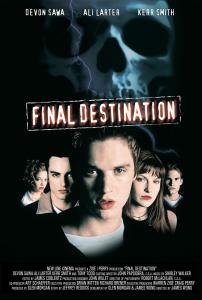 “A group of teens prepares for a field trip overseas to Paris when one gets a panic attack screaming of their impending doom. He’s taken off along with a group of reluctant others. And then the plane explodes and they are the sole survivors. Except they haven’t cheated death, only delayed it. Death’s got prerogatives and is tracking them down one by one to recapture the souls it let slip out.” Ladies and gentlemen, there you have the BEST premise for all of the year 2000.
Final Destination may seem like another teen horror pic but it’s a clever slash above its insipid competition. No fisherman is chasing them, no pop-culture references fall from their lips — they’re being stalked by death itself. How do you escape death? Death just doesn’t come in the form of a knife but sets up its dirty deeds in everyday household objects in elaborate schemes that would seem like coincidences. The way death dispatches its teenagers is truly ingenious – he must love his work.
After seeing Final Destination it made me paranoid of everything around me somehow managing an attempt to kill me. The movie stays with you after you see it and sticks in your system quite well. It’s got some truly clever and jump moments, plus adding some scary moments of its own. Final Destination is a great movie that deserves to be selected from the mush of teen horror placating our theaters.
Nate’s Grade: B+
Share this:

Sleepy Hollow (1999)
 Tim Burton’s latest is a ravishing world of intrigue and brooding awe. The action is note-for-note in Washington Irving’s classic revamped into a Burton Murder She Wrote episode. Sleepy Hollow has plenty of mystery to its credit as well as suspense and fantastic staging. The sets and mood will draw the viewer into a luscious world of cinematic delight. Beautiful to watch, and Burton scores again, though it lacks the depth his other movies had. And what the hell is with Walken’s teeth?
Nate’s Grade: B


 nathanzoebl
You must be logged in to post a comment.