Blog Archives
A Christmas Carol (2009)
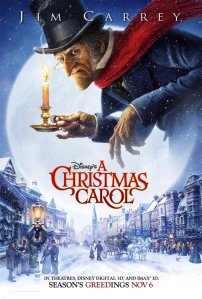 I still am at a loss over the appeal of the motion-capture system that director Robert Zemeckis fancies as of late. The creative mind that gave us classics Back to the Future and Who Framed Roger Rabbit? has embraced a technology that straddles the middle between live-action and outright animation. Motion-capture attaches electronic nodes to actors and digitizes their movements and facial features to later be conceptualized by computer wizards. And to this I say… so what? It seems like a whole slew of unnecessary work that adds little else than a vague starting point. Why not let the animators start from scratch? Why hamstrung creative professionals because Cary Elwes was feeling like making a certain gesture as “Portly Gentlemen #1?” I just don’t get it. To me, the motion-capture system is stranded in some artistic netherworld where it isn’t live-action and it isn’t animation. Zemeckis has cranked out his third mo-cap baby this decade, a retelling of Charles Dickens’ famous Christmas Carol. Why Zemeckis thought an old holiday chestnut would work best in this format, I’ll never know.
Cold-hearted Scrooge (Jim Carrey) is set to be visited by three spirits on a very magical Christmas Eve. The old man goes through Christmas past, present, and future to reevaluate his life and the true meaning of “peace on earth and good will toward men.” You know the drill, folks.
I like A Christmas Carol. I do. So do plenty of nice people. There’s a reason this oft-told tale still manages to resonate with generation after generation and that?s because it’s a good story. Of course it’s also an extremely familiar story to just about anyone outside of a womb at the moment. I expected Zemeckis and his crew to use their technology to jazz up the old story and give it a fresh new life on the big screen. Despite a handful of excursions flying through ye olde London, the extra slathering of special effects doesn’t enliven this holiday tale. I remember having great fun with Zemeckis’ previous motion-capture movie, 2007’s Beowulf (which does not play nearly as well in 2-D). That movie played around with the 3-D environment to great effect and made you feel apart of the experience. In contrast, A Christmas Carol does shockingly little with its depth of field, rarely placing distance between the foreground and the background. It’s a fairly lackluster 3-D experience. Maybe I wasn’t relaxing my eyes the right way, though I did notice how conscious I was of trying to elevate the 3-D experience myself. My disappointment is magnified by the fact that Zemeckis has been a pioneer for the 3-D playbook that Hollywood has now dubbed as the savior of the theater going experience.
 I wonder if Disney execs imposed limitations on the use of the 3-D immersion, not wanting to scare children by making them feel like they’re in the middle of a ghost story (there are some spooky moments already). The whole draw of motion-capture, and animation, is to transport an audience untethered by the limits of traditional practical filmmaking. This newest incarnation of A Christmas Carol fails to justify its existence. Why should I pay to see the most familiar story of modern day if there isn’t any new offering? At least The Muppet Christmas Carol gave me something different. And it had Muppets.
When I was younger in the mid 90s I was a huge fan of Carrey’s rubber-faced antics. I quoted Ace Ventura verbatim with my fellow seventh graders in 1995. So I understand the attraction of having him play multiple parts, but why exactly in a Dickens story? It’s not a comedy unless it’s adapted into one, and Zemeckis hews very close to Dickens and mostly recites the tale word-for-word. Scrooge isn’t funny, the ghosts aren’t funny, so why hire a renowned comedian to portray them all? This is a straight-laced adaptation and as such not the best use for Carrey’s talents. Is the move any better because Carey played all three ghosts? Is the movie any better because Gary Oldman gets to play Bob Cratchett and voice Tiny Tim? Is the movie any better because Elwes is credited for five inconsequential roles? Celebrity vocal casting is rarely effective in animation and so it seems the same in motion-capture.
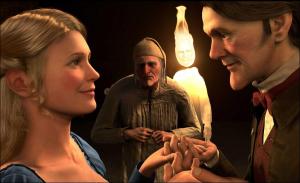 The technology has improved from the dead-eyed zombie children days of Polar Express, but it still seems like little more than less refined animation to my eyes. The movements are more fluid but the color palate is subdued into amber hues and candlelit locales. It doesn’t exactly use all the technological tools in the toolbox. It’s like a five-star chef toasting a Pop Tart: a waste of potential. I didn’t care for the skewed proportions on people either. Scrooge has a wiry frame with long spidery limbs and a triangular torso, and his character design kept reminding me of Jack Skellington. It’s too otherworldly considering nobody else comes across as a garish caricature in design form. The character designs for the three spirits are also fairly underwhelming. The Ghost of Christmas Past is a wispy flame. The Ghost of Christmas Future is nothing but a shadow. Is there a connection here? Otherwise, a shadow is pretty lame for the one ghost that can get really inventive and scary. Really, a shadow? I can do that myself without the aid of computers. And was it Carrey’s shadow to make it officially motion-capture? Because God forbid no other shadow could do or give the same performance of being draped over shapes.
I actually had to vehemently fight the urge to nap during A Christmas Carol. Maybe it was my poor sleep from the night before, maybe it was the fact that the 3-D glasses make everything darker (they still manage to hurt my eyes after prolonged use), but it was likely due to the fact that Zemeckis added a coat of polish to a holiday classic but declined to find purpose for doing so. Does this story get better with zooms through London, or Scrooge being shrunk and chased by demonic horses? It all seems like folly to me, like somebody’s idea to goose literary classics. Can you imagine Jane Eyre being shrunk and climbing through the walls of her Victorian era home? It all seems like an annoying distraction. Zemeckis? A Christmas Carol is exactly what you’d expect, which means you’d be just as well to flip through the TV channels and find any number of Christmas Carol versions. The Muppet Christmas Carol might even be on. Give that one a try instead. It even has some nice songs. And it’s got Muppets.
Nate’s Grade: C
Share this:

Ghosts of Girlfriends Past (2009)
 I maintain that no story has been redone, recycled, re-purposed, and parodied more so than Charles Dickens’ classic holiday tale, A Christmas Carol. Dickens’ tale of redemption aided by supernatural ghosts and time travel has appeared in everything from Muppets to the Odd Couple. Statistically, the odds are good that right now as you read this very sentence television is airing some adaptation of this story right now. I suppose it was only a matter of time before Dickens got reduced to a romantic comedy setup. Ghosts of Girlfriends Past is a charmless and mostly empty movie that makes you pine for the comparative masterpiece of A Muppet Christmas Carol.
Connor Mead (Matthew McConaughey, playing himself for the thousandth time) is a hunky fashion photographer for Vanity Fair magazine and, boy, is he in-demand. Everyone wants his photo services and every woman wants to rip his clothes off. Connor is a notorious womanizer and he travels to the country to attend his younger brother Paul’s (Breckin Meyer) wedding. Connor is intent on dissuading his brother on the prospect of marriage, which Conner dubs archaic and he feels love is “comfort food for the uneducated and lonely.” It just so happens that Connor’s ex-girlfriend from way back, Jenny (Jennifer Garner), is the maid of honor at the wedding. She hasn’t seen her dubious ex for some time, but that doesn’t stop him from trying to make his move. Jenny and Connor were childhood pals, but an early bout of heartbreak led Connor to become the disciple of his Uncle Wayne (Michael Douglas), a boozy playboy who taught the kid everything he knew about bedding the babes. During Connor’s stay, the ghost of Uncle Wayne informs him that three spirits will visit to showcase Connor’s checkered past, present, and dodgy future, Dicken’s-style.
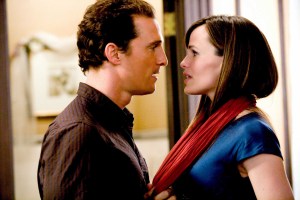 The movie is wholly unbelievable even for a contrived romantic comedy. The central romance between Connor and Jenny rests on the silly notion that after ten years apart, a lifelong selfish jerk can sweep his former girlfriend off her feet during a single crazy weekend. Connor’s redemptive arc is lackluster at best, and the movie just mimes the steps it feels that it needs to take to turn its lead insensitive jerk character into a sensitive jerk character. It doesn’t work. I refuse to believe for one second that a pretty, smart, confidant doctor such as Jenny would allow herself to get so completely suckered in by Connor’s “Baby I’ve changed” speech. It’s insulting and degrading. The compressed timeline reflects poorly on Jenny’s decision-making. The expedited timeline makes every human action seem far-fetched. There’s a scene where Connor opens a champagne bottle in the kitchen. The cork flies out and knocks one of the legs loose on the multi-tiered wedding cake. The cake is about to slip over when Connor slides in to stabilize it. Instead of redistributing the weight via the available legs, he tries reaching for the out of reach champagne bottle with his foot (the size of the bottle and the cake leg are not even close). A more believable situation would involve Connor trying to reach the fallen cake leg, not a champagne bottle, but alas. To make this example even worse, the filmmakers set up the disaster of a fallen wedding cake and then amazingly fail to show the goods. We only see the smashed aftermath. This is a comedy fundamental: set-up food disaster, let audience witness ensuing food-related disaster.
Ghosts of Girlfriends Past also doesn’t have one redeeming or marginally realistic female character. I would expect, given Garner’s star power and the natural importance of being the romantic lead, that Jenny would come across as a reasonable woman or someone worth fighting over. Sorry, Jenny is a powerfully underwritten character and Garner is left without much work other than serving as a reservoir of reaction shots. Seriously, that’s her main purpose in this movie; she is a cutaway image. Sandra (Lacey Chabert) is a shrieking high-maintenance shrew of a bride. The other female roles are largely one-note misogynistic fantasies (thanks male screenwriters Jon Lucas and Scott Moore). The trio of bridesmaids is gossipy chatterboxes and eager to get laid. Connor’s introduction to his future mother-in-law (Anne Archer) involves him casually groping her breasts, much to her prosaic approval. Connor has an irresistible way with the ladies, which makes everything without a Y chromosome want to sleep with the man. A young famous pop singer watches Connor dump three women simultaneously on an Internet conference call, insult them, and then she still strips off her clothes to bed the cad. She even states, “I don’t even know why I’m doing this,” and continues along. I’m just as confused what power Connor holds over the fairer sex because to me he’s just a twit.
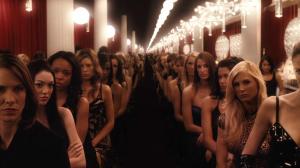 Here’s a telling example about how obvious this movie is written from an unenlightened male perspective: the central relationship dilemma is that Connor is afraid of cuddling. In the past, Jenny asked him to stay and cuddle but that was the breaking point, so he bolted. All of these women somehow manage to fall head over heels in love for a guy who willingly goes through women likes changes of underwear. It makes all the women comes across as emotionally needy, insecure, vapid bubbleheads who will sacrifice everything, including self-respect and dignity, to get a taste of McConaughey’s back sweat. Ghosts of Girlfriends Past is not a flattering movie for either sex.
The tone of this movie never finds an authentic and satisfying balance. Being a half-hearted tale of redemption during the period of a weekend, the movie crams in plenty of gooey sentimental claptrap. You’ll listen to characters talk about the true meaning of friendship, tear up over family memories, and then someone will make an inappropriate sex joke. There is a high level of semi-racy sex jokes that populate the world, appearing at odd moments, destroying any assembling emotions. Ghosts of Girlfriends Past will pretend like it’s building to something that actually matters and then it will throw it all away for a cheap sex gag — har har. There’s a moment where Douglas is illustrating how much ire Connor has wrought with visual metaphors. It begins to rain and he says that the downpour is made up of all the tears shed from ex-girlfriends and flings. Then it starts raining ripped pieces of confetti, and this we are told is all the tissues used. And then comes all the used condoms, and we watch Connor try and take cover before the aerial assault of used (and presumably “filled”) contraceptives annihilates him. It’s kind of gross and tonally disjointed from the rest of the sappy, happy PG-13 storyline.
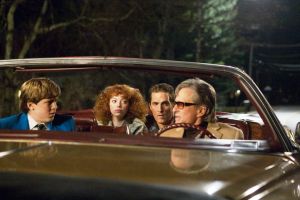 The movie is at its most amusing when it’s riffing on the expectations of following the Christmas Carol model. Connor is quite aware of the tried-and-true formula, so his comments along the way provide the movie’s only genuine laughs outside of Douglas. Really, Douglas’ character is the most entertaining character, and I kept wishing that the film would follow him even after death. Wouldn’t it be interesting to watch the life of a ghost involved in a Christmas Carol scenario? I imagine it would be a bit like a play rehearsal. I would enjoy seeing the behind-the-scenes work that goes into the scenario. I want to see ghostly foremen plot out unique scenarios for a list of real-life Scrooge cases, I want to see the ghost tryouts, I want to see the mechanics involved in the spiritual setup for this whole process. I enjoyed watching Uncle Wayne hit on his fellow spirits. But I suppose that approach would be too literary and break away from the cozy confines of the stillborn romantic comedy genre. And to prove that it is indeed a romantic comedy by the numbers, Ghosts of Girlfriends Past even includes the last minute dash to stop the romantic party from leaving via some method of transportation.
Ghosts of Girlfriends Past manages to squander every opportunity it has to be a better movie. The central idea could have worked but the execution is exceedingly lazy, charmless, and degrading to women in particular. The comic scenarios miss out on better laughs, and some of the better laughs are obvious and just around the corner, but the film routinely falls back on being a sexual farce. The characters don’t feel remotely like people and Connor is a terrible lead character with unfunny dialogue that reduces women to disposable pleasures. His transformation is contrived even for a romantic comedy. I’m not saying a cad character could not make for an entertaining lead here. Clearly Douglas is the best character, and his sleazy 1970s swinging sexpot has a fun Bob Evans vibe. Every moment he’s onscreen the movie comes alive in a new way, and Douglas is an actor that knows how to make lecherous appealing and appalling at the same time, like what Michael Caine pulled off in Alfie. This movie pales in comparison. Ghosts of Girlfriends Past should have been visited by the most important spirit of them all – the Spirit of Screenplay Rewrites.
Nate’s Grade: C-
Share this:

An American Carol (2008)
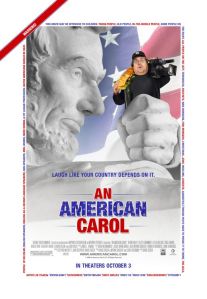 Being a conservative in Hollywood is like being a gay Republican – tough business. Director David Zucker has a notable history with comedy, having helmed Airplane!, the Naked Gun series, and the back half of the Scary Movies. He says that he converted to conservatism in the wake of 9/11, and Zucker actually wrote and directed a short for the 2004 Republican National Convention that was deemed too edgy for the Grand Old Party. Conservatives have also garnered the reputation for not having the best sense of humor, and Zucker’s An American Carol will do little to change this belief.
Michael Malone (Kevin Farley) is an egotistical, fat, liberal documentary filmmaker whose latest work is titled, “Die You American Pigs.” Catchy, ain’t it? Malone wants to abolish the Fourth of July (would we just skip to July 5th?) and plans to protest a Trace Adkins concert for the troops. A batch of inept Islamic terrorists want to bomb the concert and decide into tricking Malone into assisting their goal. He will score them media passes to get onstage at the concert venue. Following the Charles Dickens’ playbook, Malone is first visited by the spirit of his idol, John F. Kennedy (Chriss Anglin), who horrifies Malone by saying war is sometimes necessary (really, conservatives are trying to reclaim Kennedy?). Three spirits will visit him although he spends almost all of his time with the ghost of General Patton (Kelsey Grammer). The ghostly general takes Malone on a trip to see what the alternative versions of U.S. history had the country avoided war at all costs. Malone stays defiant until he meets up with the Angel of Death (also Trace Adkins, because?) and sees the error of his “America-hating” ways. I don’t want to spoil things too much but the movie ends with an expanded Trace Adkins concert saluting the brave men and women in the armed forces.
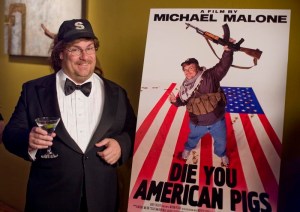 Some from the opposing political viewpoints will find An American Carol to be infuriating. To those angry few I say get over it, because this movie is simply too lazy to get angry over. It barely reaches 77 minutes before the credits roll. Zucker and company tend to stretch their canvas too broadly, to the point that they aren’t exaggerating to lampoon but setting up cheap jokes. Michael Malone is fat. Michael Malone smells. Michael Malone falls down. Liberals hate America and want the terrorists to win. It’s so easy to write this material because there’s nothing topical or nuanced or even socially relevant. The movie beats reliable figures of conservative agita. When the movie tries to slam college professors as being dippy hippies brainwashing teens about the insurmountable ills of America, it just gets dumb (those people spend 10-15 years studying in a specialized academic field). There is no teeth to any of this satire because it’s all just recycled caricatures with the wit ground down. There isn’t anything of true satirical substance here. I don’t even get some of the satire, like the ACLU is depicted as a cluster of zombies with briefcases. What does that mean? Needless to say, the skewering of Arabs is mostly cartoonish and offensive. The flick constantly makes fun of the documentary art form, saying they are inferior to “real movies.” Because Michael Moore has an Oscar does that mean that the history of documentary film has to be slandered as being nothing more than transparent propaganda (at an awards ceremony, the top documentary is honored with the “Leni Riefenstahl Award”)? Marginalizing an entire art form seems rash, especially considering that Moore’s Fahrenheit 9/11 grossed over $220 million worldwide. As of this writing, An American Carol, a “real movie,” has grossed seven million and counting.
The film deals in distasteful absolutes. Every idea is presented crudely in black and white. By the film’s standards, being anti-war and anti-troops are inseparably linked. In my mind, and this might be crazy, but it seems to me that the most pro-troops one could be would be hoping for them all to return home alive and healthy. An American Carol attempts to justify the ongoing War in Iraq, though it conveniently only ever flashes to combat in Afghanistan, the war that a majority of the public agrees with. It makes a case that war is sometimes necessary, though it has to flash back to Hitler and World War II to find a morally justified military engagement that everyone can feel god about. I agree that war is sometimes a reasonable option, but the movie paints all pacifists as wimpy appeasers. George Washington (Jon Voight) even steps in at one point to argue for the necessity of war in reference to the War on Terror. Did the filmmakers forget that Washington spent great expense to keep the nation out of foreign wars in his two terms? Isn’t it also condescending and objectionable to have Washington say freedom of speech is misused when it goes against the government? I think the Founding Fathers would realize the importance of freedom of speech, including offensive speech. Isn’t it also somewhat ironic to use slave-owners as mouthpieces for the merits of freedom? An American Carol says that disagreement is the same as dissent; so refusing to support one’s government blindly during a time of war is traitorous. Criticism is not anti-American. It’s insulting to all rationale human beings. Zucker and crew make their case look just as myopic and dismissive as those they choose to ridicule.
The acting neither hinders nor helps the material. Farley is a game comedian but he cannot do much with such lightweight material. There are several celebrity cameos including James Woods, Dennis Hopper, Bill O’Reilly, Mary Hart, David Alan Grier, Gary Coleman, Leslie Nielsen, Zachary Levi, Kevin Sorbo, and Paris Hilton. When Zucker is calling favors into the likes of Paris Hilton, you know things cannot be solid.
 Here’s the problem. It’s harder to satirize from a conservative point of view. Conservatism believes that the status quo is best or that things were better back in the day. Liberalism believes that society can always improve, so a liberal point of view would tweak the present situation in order to call attention to remaining improvements. A conservative point of view would make fun of that possible change. This is the same reason why documentaries, like it or not, typically have a more progressive bent, and it’s because the filmmakers are presenting a case for change or outrage. Why would anyone devote himself or herself for years to create a film that says the world is peachy? Now I’m not saying that conservatism and humor are conflicting concepts, but it just makes it harder to be smarter. Making fun of Good Night, and Good Luck is not trying hard enough. How dare George Clooney make a film about the media cowering and failing to question our elected leaders and have it be applicable to today’s world.
The Zucker gag-a-minute spoof style doesn’t necessarily translate well to political satire. I wasn’t expecting much with An American Carol. When they exploit 9/11, taking Malone to the wreckage of the World Trade Center to make its case, well the movie stops being a satire and just implodes. It hits its tired targets with a sledgehammer. The satire is extremely lazy, the slapstick is dumb, and the movie specializes in being obnoxious, coloring the world in two extremes. This isn’t satire. This is just cheap and petty. Seriously, making fun of Michael Moore is like four years too late. Moore is a figure worthy of satire but the best that the movie can come up with is he’s fat and hates America? That he’s angry because he couldn’t get girls when he was younger and all those studly military recruits did? That’s not satire, that’s just excessive name-calling. An American Carol presents a new low for Zucker and I think even he knows it. On the DVD commentary track, Zucker, co-writer Lewis Friedman (BASEketball), and actor Kevin Farley basically lambaste the final product, often criticizing their own movie. The derisive commentary track is more enjoyable than the film itself.
Nate’s Grade: C-
Share this:

The Eye (2008)
 This is a punishing and blandly mediocre movie, one that cannot inspire any strong feelings whatsoever. It’s a limp remake of a Korean horror movie where a blind woman gets an eye transplant and starts seeing ghostly creatures. The glossy American version stars Jessica Alba as said blind woman and watching her bump into furniture would have been more entertaining. The production values are competent, though the characters exist in a strange world where ordinary apartment buildings are designed like labyrinths. The horror elements are mostly of the “Boo”-variety and The Eye does little to establish whatever rules govern its spiritual universe. Why would closing a door stop a ghost in its tracks? It’s a ghost! The flick follows the tired plot device that ghosts have unfinished business and need flesh-and-blood humans to fix it. Come on ghosts, you’re dead, you got plenty of time on your hands. Eventually the movie transforms into a non-scary road trip to Mexico (there’s no way Alba would have gotten an international eye transplant) to learn about the poor eye donor’s unfortunate demise. This then leads into a contrived scenario where Alba must use her combined ghostly glimpses to save lives. The ending is just kind of pathetic as well. The Eye has a few nice stylistic touches, like what goes down in a Chinese restaurant, but the movie seems to exist as young male wish fulfillment. And by that I mean the concept of a beautiful woman who is blind and therefore doesn’t realize how beautiful she is. It’s the only way the majority of men can ever legitimately fantasize about having a shot with Jessica Alba.
Nate’s Grade: C
Share this:

Ghost Town (2008)
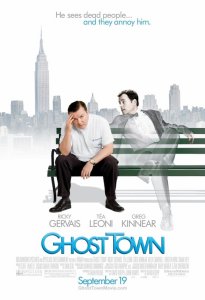 It seems the genesis for this flick was like someone asked what The Sixth Sense would be like with jokes (or someone rented Topper and said, “Why not again?”). The idea of a misanthropic man who sees dead people is elevated by the sheer comic genius of star Ricky Gervais. The famous British comedian is better known across the pond for his dry, sarcastic wit and penchant for awkward, pained comedy, but Ghost Town is a great mainstream introduction to the comedic chops of this squat Englishman. The film follows a familiar trajectory and even introduces a romance for the man who loathes other people, but Gervais and co-writer/director David Koepp make it worthwhile and endearing. I could watch Gervais and his beaming co-star Tea Leoni crack each other up for hours. The comedic premise is finely explored (there are more than enough scenes of people looking odd at Gervais talking to himself). The movie tilts toward being a supernatural romantic comedy in the second half but manages to stay snappy and character-driven. It’s a sweet movie with some nice comic jabs that don’t dwell on nastiness. Ghost Town is a charming and engaging light comedy that might cause a few sniffles in between chuckles. I have a warm place in my heart for this movie.
Nate’s Grade: B
Share this:

Over Her Dead Body (2008)
 This is abysmal comedy from beginning to end. It peaks in the second minute when Eva Longoria’s shrewish character is killed by a large angelic ice sculpture. It’s all down hill from there, my friends. Longoria stars as a deceased bride who won’t let her still-living fiancé (Paul Rudd) find happiness. The bland comedy could have more accurately been retitled, “Cockblock from Beyond the Grave” (it was at one time titled Ghost Bitch). I have no idea why Rudd is apart of this travesty and seeing him do his trademark smirk and shoulder shrug just made me weep. The comedy is nails-on-the-chalkboard obvious. There is nothing smart, clever, or interesting within any of this movie’s 95 minutes. Writer Jeff Lowell (John Tucker Must Die) felt the need to direct as well because surely there was no one else on this planet that could handle this. Longoria is powerfully obnoxious and egotistical until her last-minute personal epiphany that others deserve to be happy too. What did Rudd ever see in this ghost bitch?
Nate’s Grade: D
Share this:

The Orphanage (2007)
 The haunted house spook sub-genre has mostly delivered fairly pedestrian results (Oh no, it’s only a cat), but let The Orphanage stand as undeniable proof that with patience and talent the haunted house can still be scary as hell. The film takes its time to establish a truly unnerving atmosphere where even genre clichés like creepy kids in creepy masks become compelling and scary. The haunted house usually revolves around some form of a mystery, and The Orphanage is able to tap out an interesting tale that provides plenty of emotional depth. The mystery unravels at a nice pace and the film grows in intensity and dread. Plus, the movie doesn’t spell out everything and respects the viewer’s intelligence. Invariably, this film will be compared to The Others, another superior chiller also from a Spanish filmmaker, especially given the conclusions reached by the end. But debut director Juan Antonio Bayona certainly makes a strong impression with his subtlety and ability to transform conventional creaks and surprises into effective thrills. I’d be happy to sit through more haunted houses if they were all as good as The Orphanage.
Nate’s Grade: A-
Share this:

The Invisible (2007)
 Forget whatever the advertising and the trailers had you believe this film was about. Instead of watching a ghost solve the mystery of his own death, almost all of The Invisible consists of following an obnoxious kid mope about. There is no mystery from the start because the audience witnesses exactly what happens, knows exactly who the murderer is, so much of the film is just waiting for other characters to piece things together. It’s the cinematic equivalent of sitting on your hands. The plot holes are massive and people have the irritating habit of acting out of character or being moronic (why does the best friend, who inadvertently got his friend killed but was not an accomplice, say nothing to the police?). When the film tries to shoehorn in a laughably contrived romance between murderer and murderee, I was about ready to kill someone myself. Whole sections and characters could be wiped out and nothing would be too altered. The ending is a cop-out and makes little sense given the facts of the case (it’s never really a murder, which makes the advertising even more wrong). Watching The Invisible feels like you’re chained to an annoying emo kid who won’t shut the hell up. This is one lame, snooze-worthy supernatural After School Special.
Nate’s Grade: D+
Share this:

American Haunting (2006)
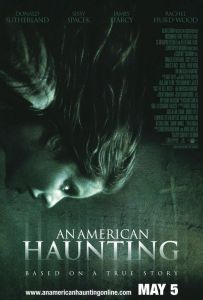 Courtney Solomon made one of the worst movies I have ever seen, 2000’s abomination Dungeons and Dragons. It is bad on a rarely seen cataclysmic scale. The shot selections were awkward, the handling of the actors was cringe-worthy, the story lightweight but ridiculously stupid, and the special effects were like something a third grade diorama contest could best. Dungeons and Dragons holds my record, in all the many films I’ve seen, as having the worst line readings of all time. Fortunately, the film is one of those so-bad-it’s-hilarious entries to stop it from being an absolute wash. Now six years later Solomon is back with An American Haunting. Normally his name alone attached to a movie would guarantee my avoidance, but I checked this out for you, dear readers. Let’s just say Solomon has a looooooong way to go before he even reaches the competence of Uwe Boll
In 1818 Tennessee, the Bell family moves into a new residence. John Bell (Donald Sutherland) has cheated an outcast woman on her land loan. This woman, branded a “witch,” curses the Bell family. Things are fine for a while, but then young Betsy Bell (Rachel Hurd-Wood) is being attacked by an invisible spirit night after night. Her father and mother, Lucy Bell (Sissy Spacek), are powerless to stop the haunting. Before you can ask, “Why don’t they let their daughter sleep in a different room?” they’ve reached out to a preacher and schoolteacher (James D’Arcy) romantically curious with Betsy. No one can stop this haunting and John Bell searches to gain atonement for his sins to spare his family.
 So, let’s get this whole thing straight, spoilers be damned. An American Haunting is marketing itself as a film based on the only medically credited murder to a ghost. Never mind how you verify that, just go with it for a second. This couldn’t be any more wrong. We learn at the end (“learn” wouldn’t be the right word since the film requires voice over to explain itself) that Betsy had been raped by her father. But wait, it gets better. Betsy had subconsciously developed a protector spirit to guard off further molestation and to punish her father. So right there the ghost in An American Haunting isn’t even a ghost, just the angry manifestation of an abused girl. There is one death accredited to the ghost, that of John Bell. However, the movie presents his wife poisoning him, not the ghost. So then the murderous ghost is neither. Plus, one has to wonder how shocking John’s loss is if he was willing to kill himself to lift the curse from his family. How believable is a “true account” of a medically documented haunting death when people were blaming demons for things for ages? I mean, there must be written accords from medical professionals of the day attributing the Black Plague to man’s sins. Just because an official said so centuries in the past does not make it medically sound today. If that were true no one would last through puberty without flogging themselves to death (and I did NOT mean it like that). An American Haunting is not true, is not about a ghost, and isn’t about a ghost committing murder.
Writer/director Solomon has made some strides in his filmmaking, but the results are still laughably the same. He’s gotten a better feel for actors and … that’s about it as far as improvement goes. An American Haunting is a creaky old timey ghost story that couldn’t scare a soul. It feels more attune to a 1970s made-for-TV flick. Solomon cribs all his scare tactics from Spook 101, which means lots of stagy jumps and creaky noises. The most annoying decision Solomon makes is that when he wants to convey the point of view of our ghost, he quickly swoops the camera down and up, spinning around the room like a paper airplane. I’m surprised more ghosts don’t get motion sickness if this is how they roll. You’ll either grab your stomach from the camerawork or the story.
 Solomon’s story is just painfully uninteresting. Some good actors do their best to liven up a pretty run-of-the-mill haunting tale. An American Haunting is insufferably boring and lame. The first half is also exceedingly repetitive, as we watch the spirit creep into Betsy’s room and beat the daylights out of her. I don’t know how many times Solomon expects us to still be entertained, let alone scared, by just repeating this scene verbatim. Apparently, if a ghost keeps smacking you it won’t wake up the people sleeping right beside you. I always did wonder. An American Haunting is lackluster and boring, but it’s the arbitrary current day scenes that open and close the film that makes it truly awful. A modern-day mommy discovers Richard’s diary of the haunting and sits herself down for a good read. Then once she gets to the end she sends her little daughter off to spend time with her ex-husband/daughter’s father. And then Betsy’s protector spirit pops up in the car, looking very sad as she’s driven away. An American Haunting is trying to make us connect that the modern-day woman’s husband is molesting her daughter, but the movie expects you to make a lot of jumps to get there. I don’t think “spirit pointing” will hold up in the court of law. And truly, if the Betsy protector spirit was really trying to be helpful, shouldn’t it be less vague and just spell it out? These modern segments feel tacked on and needless if the whole of the film is spent on the 19th century ghost story. An American Haunting requires gobs of text at its conclusion to explain that it was, technically, a ghost story by its new and expanded definition.
The only nod I can give Solomon and his tale is that they cover my number one complaint of all haunted house movies: why the hell don’t the people just leave? Your house is haunted with the spirits of the damned, so you’re just going to wait it out? MOVE people. Find another place to live! An American Haunting features a spirit that can travel outside the bounds of its house and attack carriages, no less.
An American Haunting is marketed as a true-life ghost story, the only in our nation’s history where a murder was credited to a spirit. However, this movie doesn’t have the foggiest idea how to scare an audience beyond stagy high school theatrics. It’s not a ghost story, unless you swallow whole the film’s flimsy recanting of what a ghost is, it doesn’t feature a murder by haunting, and it isn’t even true, unless you can additionally swallow ye olde folksy, biased medical accounts. I’m sorry, but I don’t buy this. This movie isn’t so bad that it’s funny; it’s just boring. People as a whole should steer clear from this dull, amateurish fright flick. The only screams you’ll hear during An American Haunting are unintentional laughter.
Nate’s Grade: D
Share this:

Silent Hill (2006)
 Video games will never be translated into a good movie. There, I said it. I caught some grief before by this opinion. Think about it. Unlike say comic books, video games are dependent on user interactivity, on game involvement, and not necessarily story or character. A video game requires an audience to be interactive, whereas movies require an audience to be passive, letting a story envelope around them and take them some place. Video games just aren’t structured in a way that lends itself to storytelling. Just look at some recent results: House of the Dead, Alone in the Dark, Doom, Bloodrayne, Double Dragon (remember that movie?), Mortal Kombat 1 & 2, Street Fighter, etc. Granted three of those are Uwe Boll films, but what does it say when the best video game adaptation yet was Super Mario Brothers?
Now comes Silent Hill based on the very popular horror video game series. The screenplay is written by Roger Avary, who used to be Quentin Tarantino’s writing partner and wrote and directed one of my all-time guilty pleasures 2002’s Rules of Attraction. I guess I foolishly expected more, but with Silent Hill what I got was further fuel to my theory that no video game will make a good movie.
Rose (Radha Mitchell) and her husband Christopher (Sean Bean) are very troubled about their adopted girl, Sharon (Jodelle Ferland). She has the habit of sleepwalking and uttering “Silent Hill” repeatedly. So what’s a 21st century mother to do? Look up Silent Hill online, put her tyke in the car, and drive to the ghost town herself, much to the dismay of her husband left behind. It seems that Silent Hill was a town in West Virginia that had a horrible coal mining accident in the early 70s, killing many and condemning the town. We’re told the fires are still burning underground to this day. Along the way, a roadside motorcycle cop (Laurie Holden) gets suspicious of Rose and chases her. They crash their vehicles along the road and wake up to falling ash. Rose’s daughter is missing and she looks inside the nearby Silent Hill, a presumably deserted town. Then there are routine air sirens warning of an approaching darkness. The world changes form and nasty creatures come to life, like disjointed bodies, charcoal-skinned children, and malevolent evil spirits. It’s about here where I’d just say, “Oh well. I can adopt again.”
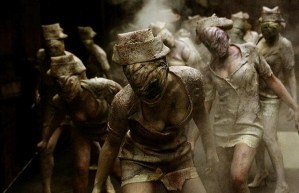 The movie is paced and structured like a video game, which means it’s just as tedious to sit through. The first two acts of Silent Hill center on Rose going from Point A to Point B, finding clue that leads her to a new point, and repeating this tiresome exercise. There?s a scene where there’s a giant hole in the floor and Rose has to navigate across scattered beams to get to the other side. It’s portrayed exactly like a video game level, as are most of her encounters. Worst of all, the movie follows a code of logic that dares to only exist in video games. Why does Rose instinctively know she needs to reach inside the mouth of a corpse to find a sign? How does she know a hidden room lay behind a portrait? Why does Rose know that light attracts the “Thriller” dance team/nurses with potato sacks on their heads? How come the evil presence that basically created this limbo world of the undead cannot penetrate a church? The plot is mostly incoherent and intentionally surreal, but that doesn’t excuse the fact that the story is just plain awful.
Silent Hill completely collapses once the third act begins. It was plodding up until that point, but now the film becomes downright ridiculous and painful. We’re amongst a crazy group of fundamentalist witch burners that, for whatever reason, dress in hazmat suits to venture outside their grounds. It’s at this point that the surreal nature stops and we find the answer to our questions: another vengeful spirit from beyond the grave. Ho hum. The protracted climax goes overboard and practically rapes the stellar ending of Carrie. Also, Silent Hill expects its Big Reveal to be shocking or surprising, but it cannot be anything except redundant because the film spelled it out an hour ago.
The dialogue is howl-inducing. There’s a moment that Rose says, “Don’t worry honey, everything’s going to be okay. You’re going to be alright.” And this immediately precedes the little girl watching the religious cult burn someone’s face off. There’s another moment, more than an hour in, where Rose says, “Something bad happened here.” You think? All of the dialogue can be fitted into two categories: either expository or instructional. It’s like to be true to a video game they also decided to lift the terrible dialogue as well. The plot meanders for the longest time, allowing Rose to visit place to place, and then Avary decides to bludgeon his audience with a 5-minute chunk of exposition meant to clarify everything up to that point.
The acting is pretty bad. Mitchell gives a valiant effort and has a nice scream, but she can’t escape the dead weight of the dialogue and total lack of characterization. Bean is entirely wasted and his “American” accent seems to waver quite a bit for such short screen time. Holden is more a fetish figure fantasy than a character, evidenced by her tight leather pants being the first thing we ever see of her. Still, it’s somewhat interesting seeing the romantic lead from 2001’s The Majestic kickin’ some unholy ass. It’s hard to say if any actors of any caliber could have redeemed the film, but this collection of thespians doesn’t even try to put a polish on the dialogue. You can tell because the howler lines are still howlers.
 Lest I forget, this thing is OVER two hours long. There’s no reason Silent Hill should even be teetering over 100 minutes, especially for a film as sparsely plotted as this one, that is, before Avary’s exposition head rush. I don’t know why the filmmakers included the pointless subplot involving Christopher on the search for his wife. The subplot adds no deeper insight, affords no opportunity to help shape the plot, and only serves to whisk the audience out of the moment and remind them how pointless Silent Hill is quickly becoming. And is it ever pointless.
Director Christophe Gans (Brotherhood of the Wolf) has a great taste for visuals, Silent Hill‘s only positive marks. Some of the images in this movie are truly horrifying and have, reluctantly, stuck in my head days afterwards. The Pyramid Head man, with a 20-foot sword, makes little sense but is a jarring and memorable image. When those loud sirens sound there is a slight amount of dread, but really it’s more of a morbid curiosity at what kind of hellish transportation will happen next. The excellent production design and cinematography also contribute to the film’s eerie, striking, sometimes suffocating atmosphere. But, alas, an interesting visual palate cannot save a slow, dimwitted, inane movie. Otherwise What Dreams May Come may have worked. But it didn’t.
Silent Hill is pointless, plodding, incoherent, far too long and far too boring. The bad dialogue, acting, and plot don’t seem to help matters either. Gans creates a moody atmosphere with some powerfully nightmarish imagery, but that’s the only thing Silent Hill has going for it. Whether it be a man with a Pyramid for his head ripping the flesh off someone like a coat or a little demonic girl dancing in a literal blood shower, Silent Hill has its small potent visual moments. However, these small moments of visual potency cannot make up for the giant black hole of suck. This movie is simply dreadful and designed too faithfully as a video game adaptation, which means the same gaps in logic and pacing are present. I certainly expected better from Avary. I told my friend Dan that I was embarrassed we’d forever know we saw Silent Hill on its opening night, so much so that I bought him food after the show to make up for dragging him along. This is the first movie I’ve ever attended where I heard booing afterwards from my audience. I would have joined them but I was too busy getting out of the theater as soon as the end credits rolled.
Nate’s Grade: D


 nathanzoebl
You must be logged in to post a comment.