Blog Archives
The United States vs. Billie Holiday (2021)
 The good news is that Andra Day is a surefire star. In her debut performance, the singer makes a bold impression as Billie Holiday, with her raspy voice, sterling stage presence, and powerful singing. Day was nominated for an Academy Award, just as Dianna Ross was for her own film debut, also playing Holiday in 1972’s Lady Sings the Blues. The highlight of this movie is a tight close-up of Day singing “Strange Fruit,” her anti-lynching protest song, written by a Jewish schoolteacher, a song that incensed the U.S. government and essentially began the woe-begotten War on Drugs with a racist task force targeting Holiday as their first victim to make an example of. The moment is filled with rising emotions and barely held restraint and the sheer power of Day’s performance communicates the danger and anger of this politically-charged song that earned such controversy. However, the rest of the movie is a bit of an unholy mess, as director Lee Daniels (Precious) takes his signature campy, over-the-top style and cannot say no to any creative decision in his mind. I don’t know what’s harder to grasp, the clashing tones or timelines, as the movie literally and figuratively jumps all over the place, at one instant having Holiday on top of the world, and another being beaten by a parade of one-dimensional and nearly indistinguishable abusive men, to waltzing through heroin hallucinations, and cuddling close with an FBI informant (Trevante Rhodes) who is definitely a fictional character. Like the recent Judas and the Black Messiah, we divest time from the star to the men who betray her, but none of these louts and schemers are worth that precious time. It becomes an uncomfortable misery montage as we watch Holiday get abused, shoot up, cry, get harassed by the police, and repeat endlessly for 130 minutes. I don’t know if maybe Daniels was trying to make me feel like I was on drugs while watching but the antic, unfocused, and careening narrative and energy levels certainly made me feel dizzy and nauseated. An then there are ridiculous moments where I just wanted to laugh, like the backroom of racist government agents saying lines like, “This jazz music is the devil’s work. That’s why this Holiday woman has to be stopped.” This is based on a chapter of a book about the early War on Drugs, not Holiday’s biography, and it feels very much like her own identity and significance is being strung along just to be a martyr for the evils of government persecution. The movie paints her chiefly as a victim and then seems to glorify in victimizing her, and it all feels so garish and ghoulish and misguided. Billie Holiday deserves an amazing movie but she’ll just have to settle for an amazing performance in an otherwise melodramatic mess of a movie.
Nate’s Grade: C
Share this:

Pan (2015)
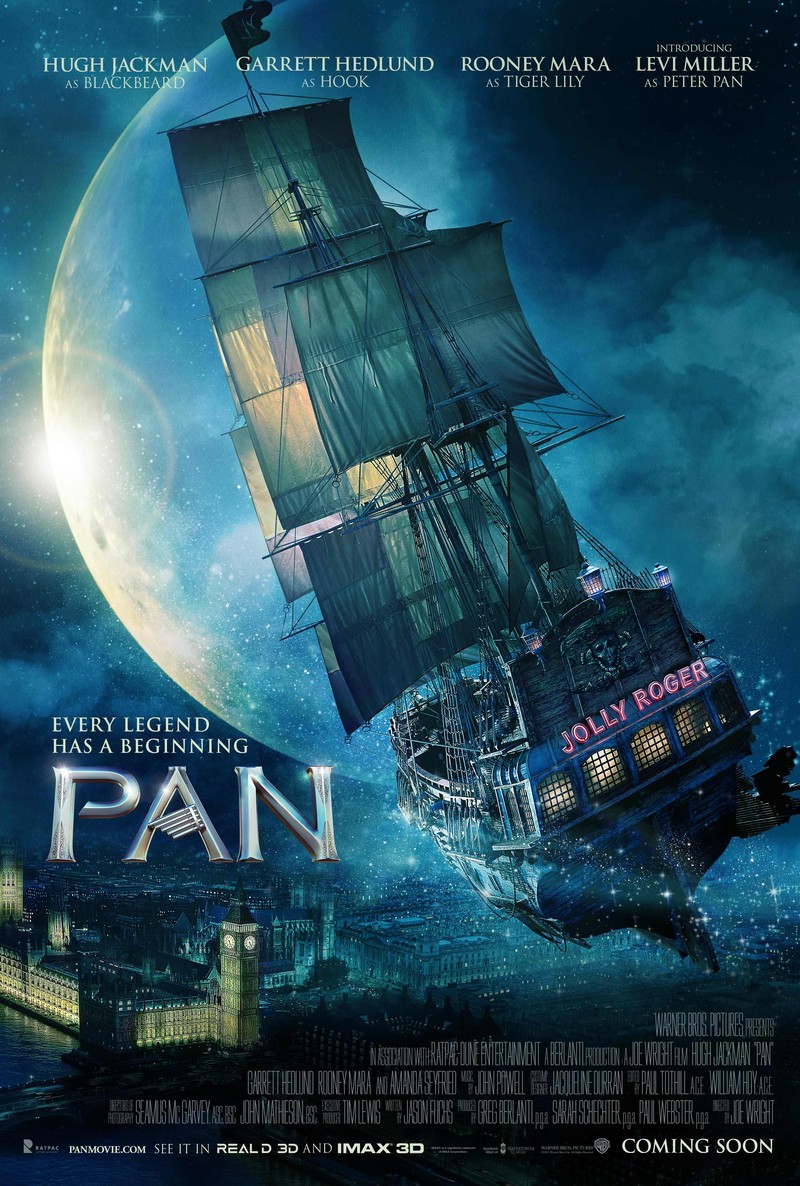 Reminiscent of the Patton Oswalt bit concerning The Phantom Menace, often fans rarely need the “before” when it concerns the characters they love; did anyone really need to know what Peter and Hook were up to before they became mortal enemies? Pan attempts to tell the story before we know it about how Peter Pan became the character we know. It was originally planned for a summer 2015 release and was pushed back until the fall, ostensibly for more time to finish visual effects. the studio, Warner Brothers, pulled a similar move with Jupiter Ascending, and we know how that turned out.
Peter (Levi Miller) is an orphan living in London during World War II. He and a few of his best parentless pals are abducted in the middle of the night by a group of pirates and their flying pirate ship. He’s taken to Neverland to work in the mines belonging to Blackbeard (Hugh Jackman), who has an addiction to fairy dust. During a scuffle, Peter discovers he has the ability to fly, though he can’t exactly master it. There has been a prophecy that The One would be able to fly and they would topple Blackbeard. Peter and another miner, James Hook (Garrett Hedlund), escape, finding their way into the land of the “natives,” which includes Tigerlily (a miscast Rooney Mara). The “Pan” has been prophecized to help lead their people and discover the bridge into the world of the fairies, and Blackbeard won’t stop until he finds the source of his pernicious pixie smack.
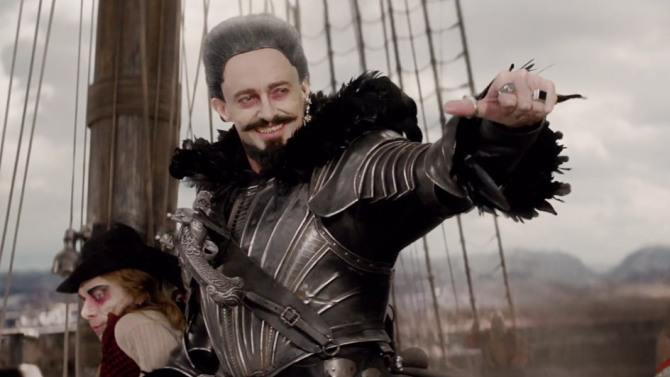 Who exactly is Pan intended for or what story needed to be told prior to our introduction to the world of Neverland? The first act sets the stage for the miscalculated tonal mishmash that never truly settles: we jump from a cruel orphanage, with Peter comically plucky, to the horrors of the London bombing during the Blitz, to a bunch of pirates kidnapping the orphans (tacitly with the approval of the evil head nun running the orphanage), and from there we’re whisked away across space to a mine of slave workers digging for pixie dust minerals who serenade their pirate slave lord with the lyrics to Nirvana’s “Smells Like Teen Spirit” for… some reason. Is this a movie intended for younger children and families? Is it intended for teenagers? The tone veers wildly, sometimes within the same scene, going from serious and gritty to colorful and ridiculous. It’s a campy experience that makes me wonder who exactly was supposed to enjoy an attempt to open the Peter Pan mythos, a world that is generally shallow.
At no point does Pan justify its existence beyond a flimsy corporate attempt to take a familiar world and expand upon it for sweet franchise money. When you get down to the world of Neverland, at least as represented on film, what exactly is there? There are pirates, “natives,” mermaids, and fairies, and that’s about it. They all kind of exist in their own individual movie that fails to blend together, making the new groups of characters feel like little more than a new theme park attraction before moving on to the next autonomous ride. The fantasy figures themselves just aren’t that interesting because there just isn’t much to them beyond superficial descriptions. I suppose then that this would allow plenty of opportunity at world building to take these familiar staples and give them greater depth, and that’s Pan’s biggest missed opportunity. Far too often, the movie feels on Fantasy autopilot and what we’re given is the old clichés of the Great Prophecy and the Chosen One meant to bridge worlds, etc. the events in the film do little to explain how Peter became Peter Pan, besides learn to fly. The problem with the prophecy trope is that it robs characters of agency in place of just accepting their capital-D destiny.
You learn nothing new about Peter or Hook as people, and the nods to the greater Pan lore are annoying at best with how unsubtle and clunky they are. The movie doesn’t even lay the groundwork to explain what conflicts will eventually drive Peter and Hook apart. Peter is a bland hero who is defined by the mystery of his absent mother and her own lineage. He’s special because his mom was special and if he just believes hard enough then perhaps he can be even more special. It’s pretty simplistic stuff. The references to the Pan lore always seem to stop the movie dead in its tracks. The relationship between Peter and Hook isn’t explored in any capacity other then they appear to have both escaped together and been running side-by-side. It’s a relationship not out of bonding but out of sheer proximity. The concluding lines are literally Peter saying, “We’re going to be friends forever,” and Hook replying, “What could possibly go wrong?” Oh my goodness is that one hacky groan-worthy wink to the future.
 Pan is made serviceably watchable from director Joe Wright and the campy performance of Jackman. Wright is a premier visual stylist in cinema though his artistic instincts can lead him to try and smash as many ill-fitting square pegs as he can into round holes, last evidenced by the 2012 Anna Karenina adaptation that made all the world a literal stage. The visuals are often splendid to behold and Wright has a wonderful feel for color hues. The final act feels climactic and visually alive in ways the movie doesn’t even deserve, and Wright’s vision, weird as it can be at points (Nirvana?) gives the movie an energy that keeps its worth an initial viewing. For a movie filed with fantasy realms, I enjoyed the scenes in the orphanage and with the wicked head nun the best (is she knowingly selling the boys into slavery on a magic pirate ship or is it just extreme negligence on her part?). The other aspect that at least held my attention was Jackman. In a movie filled with bland and the occasionally bizarre performance, Jackman offers an anchor to lean upon. It’s not a good performance by normal circumstances but it provides a sense of life and feels in place. Hedlund (On the Road) is amazing in just how strange his rakish Harrison Ford-esque performance persists. Why didn’t anyone tell him to stop? His speaking voice fascinated me and I spent the entire moving trying to figure what it sounded like and my best description is Heath Ledger’s impression of Al Pacino.
While not being a colossal disaster of artistic self-indulgence, Pan is a disappointing and mostly tedious experience because of its failure to capitalize on expanding upon the Neverland universe and exploring what should be formative experiences to central characters. If this was going to be a crazy artistic romp then it needed to be crazier. If you’re going to have two brief anachronistic songs, then do more or at least draw in more influences from other timelines. If you’re going to be a straight-laced pilot for a budding fantasy franchise, at least give us more flights of fancy and wonder. Make us fall in love with this world or at least some of the characters. Instead Pan uses the audience’s pre-existing association with the characters and the environment in place of doing anything meaningful with a story. Peter becomes Peter Pan, so he doesn’t have to be a character he just has to be the pre-Pan Peter. The same for Hook and Smee and Tigerlily and that’s really the only characters worth mentioning until those Darling children come visit. I thought I was going to ridicule Pan with the glee I had taking apart Jupiter Ascending but I couldn’t muster much effort. It didn’t feel like the Pan filmmakers did either.
Nate’s Grade: C
Share this:

Inside Llewyn Davis (2013)
 “There’s no success like failure. And failure’s no success at all,” Bob Dylan wrote. He could have been talking about any number of characters in the oeuvre of master filmmakers Joel and Ethan Coen. Losers and has-beens and could-have-beens fascinate the brothers, and their newest film certainly follows this model. Llewyn Davis (Oscar Isaac) is a struggling musician in the 1961 Greenwich Village, New York folk scene. He rotates crashing with various friends, unable to scrounge up enough money to ever pay his own way. His musical partner recently killed himself and Llewyn has been trying to get traction with his first solo record. His world gets even more complicated when Jean (Carey Mulligan) reveals that she’s pregnant; the baby’s father may be Llewyn or Jean’s husband and fellow performer, Jim (Justin Timberlake). Llewyn can’t catch a break.
Inside Llewyn Davis is a classic Coen creation, a character study of a misanthropic loser trying to find direction in a comical universe of indifference. I greatly look forward to every Coen picture and that’s because nobody writes characters like they do. There are no throwaway characters in a Coen universe. Even minor characters like the elevator Attendant or Manager’s Secretary are given sparks of personality, each fully formed figure creating a richer canvas. There is great pleasure in just listening to their characters speak, in natural cadences yet elevated with grace. Inside Llewyn Davis is no exception. Their storytelling is always rife with wonderful comic surprises and pit stops. The Coens are such brilliant technical craftsmen, that every shot is gorgeously composed, even without longtime cinematographer Roger Deakens (to give you an idea how old this movie was, Deakens was busy filming Skyfall). The music, supervised by O Brother maestro T. Bone Burnett, is impeccably performed and quite lovely to the ear, if you’re into folk music arrangements. If you’re not, well, it’s going to be a long movie experience.
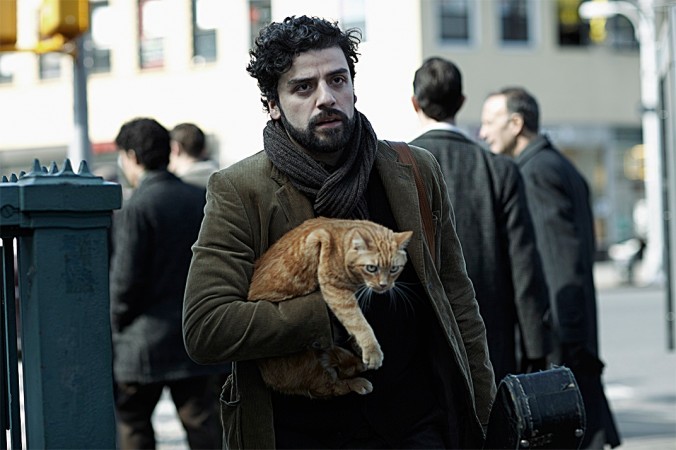 But here’s the problem with Inside Llewyn Davis: the film will likely turn off most people. It’s not a comforting movie by any means. We’re stuck following a self-destructive struggling musician bounce around couch-to-couch, chasing dreams that will never seem in reach. And Llewyn is a tough character to love. He’s surly, careless, selfish, egotistical, and also jaded. And he’s just about the only character in the movie. Most of the other famous faces are fleeting supporting players. Only Mulligan (The Great Gatsby) is given a plurality of scenes to expand her perturbed character, and even those may not be enough. Much like Llewyn’s musical direction, this is a one-man show, and he’s not cuddly. But an unlikable protagonist is not uncommon. The Coens tease so many different directions for Llewyn to go that it’s likely that audiences will feel some degree of disappointment where the film does end up. It’s a circuitous path, proving Llewyn is the architect of his own fate, but at that point audiences may not care. They may just be happy to watch Llewyn punched in the face. The plot is pretty light, running into a series of various self-contained scenes, and there isn’t much in the way of closure. I’ve watched the film twice and while I appreciate it more I’m certain that Llewyn Davis will leave a majority of people feeling cold, more so than even A Serious Man.
Unlike former Coen creations, notably in A Serious Man and Barton Fink, our titular character is the architect of his own misery. He is a musician that identifies with an older class of folk artists, something that strikes him as genuine and touching the soul. He cannot stand artistic compromise. He won’t even accept a winter coat from his music manager. He wants no handouts. He chastises Jean about her and Jim’s attitudes toward the business, calling them “careerist” and “a little bit square.” To Llewyn, to sell out is the worst crime. Jean says that they’re just doing what they can to raise up the musical ranks, and maybe the songs aren’t top-notch, like a catchy but instantly dated novelty song about the Space Race (the sure-to-be Oscar-nominated “Please Mr. Kennedy”), but they’re commercial, they’re finding an audience, they’re making inroads, partially as a husband/wife act and partially due to their own physically attractive appearances, and it frustrates Llewyn greatly. A great example is early in the film a young Army vet on leave performs a wonderfully pure song with a beautiful voice. Llewyn scoffs at the mawkish nature of the tune. “He’s a great performer,” Jim advises. Llewyn takes umbrage at the distinction; a performer is not the same as a musician. The people getting ahead are the performers, the sellouts. One of Jean and Jim’s rising hits, “500 Miles,” lyrically suggests it was an old slave song that has been repackaged and homogenized for safe consumption. Llewyn is going to stick to his guns and make it on his own terms, with expected results. Late in the movie, after Llewyn performs before a record exec (F. Murray Abraham), so aching and affecting as he puts it all into the song, the exec simply responds: “I don’t see a lot of money here.” However, the exec offers Llewyn a chance to be in a trio he’s putting together, if he cleans up and knows how to keep to the background. It’s a real opportunity. Just not for Llewyn.
It all comes down to legacy and Llewyn contemplating what his will be. His singing partner is now defined by his death, finding cruel irony in their song, “If I Had Wings.” His father is known for his long dedication to the Navy, but now he sits alone in a nursing home, a prisoner to his own infirmary and defeated mind. A road trip partner, the pompous jazz musician Roland Turner (a royally hilarious John Goodman), seems like a Ghost of Christmas Future visit from a possible future Llewyn, the artist who’s an iconoclast only in his own mind. Throughout the film, Llewyn is beset with choices, different options he could take, one in particular stemming from a revelation involving an old girlfriend. And yet, much like the thematic nature of folks songs, we’re told, Llewyn looks for something new with something old, be they routines, goals, or occupations. The folk music scene is on the cusp of change with a more commercialized pendulum swing, as evidenced by a surprise new performer at the Gaslight in the closing minutes. Llewyn is contemplating his life beyond the world of show business and where he goes next.
 And if there is a sad aspect to the Coens’ tale, it’s that Llewyn really is a talented musician. This is a breakout role for Isaac (Drive, Robin Hood) especially when you consider that he did all his own singing and guitar playing. It’s one of the most astonishing musical performances by an actor I’ve ever seen in a movie. The level of craft at command, the different slivers of passion he carefully puts into the performances, the trembling emotion, the merging of himself with the song. There’s a reason the Coens open the movie with Isaac performing the full rendition of “Hang Me, Oh Hang Me.” It crystallizes right away where the man’s talent level is, both the character and the actor. We’re left to then wonder why he hasn’t found his place in the industry, and the rest of the film is the explanation. This is the first film since perhaps 2007’s Once where full-length performances of songs really do move the story forward (I’m obviously excluding traditional musicals). Some have labeled the heavy use of song as lazy, distracting from an undercooked narrative, but I can literally go through every song in the film and justify its existence. Each tune, and the performance and performers, gives insight to character, plot, and state of mind.
Inside Llewyn Davis is an easy movie to admire but a harder one to love, unless you’re a fan of the Coen brothers or folk music in general. The protagonist is unlikable, his struggles his own doing either by hubris or integrity, the plot is rather loose with scattered supporting characters, and the film ends on a somewhat lackluster note that feels inconclusive. But then I keep going back to the richness of this world, the pop of the characters, the lyrical beauty to the unvarnished songs, and the concept of folk music as its own sense of purgatory (here me out, folk fans), the idea that we seek something new with something old, and so we follow in circles, like Llewyn’s onscreen journey. Isaac gives such a strong performance that you almost wish his character could catch a break. Almost. This is another technical marvel from the Coens, filled with their dark humor and their sense of cosmic melancholy, but Inside Llewyn Davis may ultimately find some strange sense of uplift as Llewyn continues to hold to his ambitions even as the world around him is changing, losing sight of artists like him. As long as we have the Coens, the Llewyn Davis’s of this world will get their due in one form or another.
Nate’s Grade: A-
Share this:

Tron: Legacy (2010)
 In 1982, TRON was a movie ahead of its time. It took place in a world inside the world of computers, which couldn’t have been that advanced back then. But “ahead of its time” and good are not the same things. Arguable one of the most influential science-fiction films in terms of design and CGI, the original TRON was a financial dud for its film studio. All this makes it so curious why Disney would spend upwards of $200 million dollars on a fancy, shiny, big-budget sequel to a movie people didn’t really give a damn about before. TRON: Legacy looks to capitalize on a generation of geek nostalgia. At least it doesn’t fare as poorly as the Star Wars prequels.
Sam Flynn (Garrett Hedlund) is 27 years old and the lead shareholder of Encom ever since his father, Kevin Flynn (Jeff Bridges), mysteriously disappeared in 1989. Kevin had found a way inside the world of computers, which he called The Grid. He studied it and based his company’s arcade games on what he found. Then after saying he was going to break the world of gaming wide open, he vanished. Then in 2010, Alan Bradley (Bruce Boxleitner, a sight for sore eyes) visits Sam with a message. He got a page from a number that’s been disconnected for over 20 years. Sam ventures into his father’s old arcade/workstation and gets zapped inside the world of computers. Now he’s amidst all those racing light motorcycles and flying disc battles. The slinky program Qorra (Oliva Wilde) rescues Sam from the gladiatorial battles. Inside this realm, the Grid is run by Clu (CGI Bridges), a digital doppelganger of Kevin Flynn. Sam is reunited with his dear old dad and together they try to escape this digital prison and stop Clu.
 Never have I felt more like an old man than after watching TRON: Legacy. All the special effects dazzled, but after a while it felt relatively empty and insubstantial. But what did all those gleamy flashes of light and snazzy 3-D effects do, ultimately? Distract from the void of a story. I consider myself a fairly intelligent individual, able to follow complicated narratives and appreciate complex storytelling. And yet, when the lights came back up in my theater, I said, “There is a lot that I never understood.” The setup is relatively painless, but where the movie grinds to a deadly halt is for an exposition-heavy 20 minutes in the middle after our second big action sequence. When father and son are reunited they get to talking, and talking, and talking some more about God knows what. I think my brain shut off from all the stilted dialogue. Every character seems to stop and unload a pile of exposition. Even though the characters seem to explain so often, you always feel like you’re still missing something important. You still feel left out. But after this dreadful slog, suddenly there’s Michael Sheen (Frost/Nixon) to save me from my stupor exactly like he did at the end of the turgid Twilight film, New Moon. He brought me back to life, but after his campy, cane-guitar rockin’ sequence of battle, I was trying to get caught up on the parameters of plot and setting. But then the film just flew from one set piece to another and I was forever lost. I couldn’t tell you why anything happened in the last hour of the movie. It just seemed like one thing was following another without any sense of logic or foresight. I got the idea of the need to escape this virtual world and that there was a special doorway to make this happen, but after that it all became an unintelligible chain of ones and zeroes.
The incoherent screenplay by Lost scribes Adam Horowitz and Edward Kitsis is a bleak vehicle for special effects. TRON: Legacy will certainly melt your eyes but it leaves the brain cold and overlooked. The rules of the TRON universe are never adequately explained. When Qorra suddenly drives a vehicle off the Grid and says, “We can do this, they can’t,” you’re forced to just shrug and go with it. Why is Clu trying to kill Sam and his dad when he’s pretty much had the run of things for 20 years? What exactly is his plan for world domination? He thinks his electro-tanks will be able to take out the military powers of the real world? Do these programs have free will or does their engineering trap them? Why would they gather at a stadium to cheer the death of other programs in violent sport? All of these walking/talking computer programs got me thinking about The Matrix and how much more creative and effective and overall better that movie was with storytelling. There are some token nods to character, mainly Sam’s reunion with his long lost pop, but this is a movie designed to mesmerize with flashing lights rather than story and character. I would find this somewhat acceptable if I wasn’t bored so much, let alone paid an extra four bucks for the luxury of being bored in three dimensions.
 But if special effects are what you want, TRON: Legacy delivers big time. The sleek production design is married seamlessly with the flashy, techno-oriented effects inside the computer world. Watching the floating spaceships and zooming racecars is a luscious, exhilarating rush to experience. The visual style obviously has to hew close to the first film in 1982, which seems to handcuff the imagination of the crew. We’ve made gigantic leaps in the world of movie special effects but we’re stuck with characters in glow-in-the-dark jumpsuits and cityscapes that look at like half-finished neon outlines. I haven’t seen a 3-D movie since two-time reigning king of the world James Cameron’s Avatar, but I would readily advise people to see TRON: Legacy in 3-D if available. It gives the film that extra whiz-bang quality. This is not just a cheap grab at extra cash where the studio throws a 3-D rush on a film late in the game. The 3-D, which kicks in when Sam travels inside the computer world (like the change into color from the Wizard of Oz), feels more immersive without resorting to hurling countless objects at the audience. The greatest 3-D effect, bar none, is Olivia Wilde (TV’s House, Year One). Director Joseph Kosinski has a steady background in computer effects, and it shows. His handle on actors is another matter entirely.
But the biggest misstep with the special effects occurs with the 1980-version of Bridges. Whenever we get a glimpse of this Bridges of old, whether it’s from Clu or a brief and distracting scene in the film’s 1989 opening, it’s another opportunity for the movie to remind you of its lack of authenticty. The de-aging technique still needs some serious tinkering. What it does is make an actor look like a plastic doll, with dead Polar Express zombie eyes. It’s creepy and off-putting and every time you see the de-aging effect it rips you out of the movie. Watching young Bridges take on older, current Bridges would have been more interesting if we had an entire digital rogues gallery of Bridges characters. Imagine the Dude and his drunken, self-destructive country singer from Crazy Heart involved in digital games of combat.
 There are some nice action sequences that begin to touch imaginative possibilities of this unique world. The flying disc duels are interesting enough for the time being. The first few disc battles make fine use of the unique features of the boomerang-esque weapon. The motorcycle battle where the ribbons of light/exhaust create a wall is still a great idea for battle of wits at high-octane speeds. It just never fully materializes. The edits don’t occur in that hyperkinetic Michael Bay fashion that discombobulates the senses; however, I never really grasped the geography of the action realms. In order for the viewer to appreciate the action and the moves and counter-moves, we need to understand the arena and boundaries of the setting. With the cycle chase, it just seems like they’re all appearing at random. An action sequence is less satisfying if it doesn’t seem like it’s building and making use of the particular surroundings. The moody score by electornica duo Daft Punk gives the film a thematic lift, though having them score with a full orchestra feels like hiring Yo Yo Ma and forcing him to play a trombone.
TRON: Legacy feels at times like a super-sized Light Bright meant to dazzle and distract from the gaping void at heart. The story merely exists to get the characters from one place to another. The leaden exposition pretty much destroys the film’s momentum. It becomes plodding and tiresome. It would be like if Luke Skywalker sat and listened to 20 years of history rather than actually, you know, doing something. It’s been 28 years since the first TRON and the world has gotten far more computer savvy, and the jargon from the first flick would be readily understood. TRON: Legacy doesn’t feel like you’re in a computer, just whatever weird alternative universe. It seems like the real legacy of TRON ends up being hollow special effects.
Nate’s Grade: C


 nathanzoebl
You must be logged in to post a comment.