Blog Archives
Ballerina (2025)
 It’s a John Wick spinoff that tests whether or not the franchise can extend itself without John Wick. Then the producers got a little nervous and re-shot the movie extensively, adding extra John Wick (Keanu Reeves) scenes and even a clunky title to remind all those forgetful viewers: From the World of John Wick: Ballerina (not to be confused with, From the World of Jurassic World). Taking place between Wicks 3 and 4, Ballerina follows another formidable assassin kill lots of people until finally toppling a boss at the top and fulfilling their personal vengeance. The aforementioned dancer is Eve (Ana de Armas) who is the daughter of assassins and whose father was killed by assassins so she trains to be an assassin and thus kill the assassins that assassinated her father for wanting to step away from being an assassin. The plot is less important than the action combat, and while Ballerina doesn’t rise to the rhapsodic levels of action nirvana from its franchise forebears, it does have consistently entertaining action choreography and development. It’s a good movie with a few moments of greatness, like a kitchen battle that makes clever use of everything in range and a climactic flamethrower vs. water hose battle for the ages. I enjoy that Eve is still vulnerable. She’s deadly but she still makes mistakes, can slip and fall and make the wrong moves in fights, providing the sequences better stakes and intrigue over how she exactly will overcome her latest obstacles. de Armas (Blonde) takes up where she left off in 2021’s No Time to Die and proves herself an adept physical performer of action. It’s a decent mid-tie action movie that throws more world-building nonsense at the wall that you can tune out. There are other Wick cameos from Ian McShane, Angelica Huston, and the late Lance Reddick who died in 2023. Ballerina can scratch that John Wick itch (now with extra John Wick) for fans but I don’t know if it deserves a second dance.
Nate’s Grade: B-
Share this:

Hereditary (2018)

Hereditary has built up a great roaring buzz from film festivals and its oblique marketing. Numerous critics are hailing writer/director Ari Aster’s debut film as one of the scariest movies of a generation. The studio, A24, which has built up a fine reputation for art movies and genre fare, is releasing it. Except A24 has some trouble when it comes to its horror thrillers. Last year’s It Comes at Night was similarly beloved by critics yet audiences generally disliked it, angered by the misleading marketing that framed it as a supernatural horror (there was none, no titular “it” to come at night). I wonder if A24 learned their lesson and that’s why the trailers and ads for Hereditary have been intentionally hard to follow. After watching Hereditary and feeling let down, I wonder if A24 is in for another disparity between critics and audiences. This is a sloppy, unfocused film with little sense of structure, pacing, or payoffs. It’s a movie of moments and from there your mileage will vary.
Annie (Toni Collette) and Steve (Gabriel Byrne) are ordinary middle-class parents living with two teenage children, the older Peter (Alex Wolff) and the younger Charlie (Millie Shapiro), a girl given to peculiar habits. Following a tragic accident, the family is struggling to come to terms with their loss and their new lives. Annie seeks out comfort from a group meeting, and that’s where she meets Joan (the great Ann Dowd) who shows her how to contact the spirits of the dead via a handy incantation. From there, Annie tries to establish a connection to the realm beyond and possibly unleashes a spirit targeting her family.

With the rapturous critical acclaim that Hereditary has garnered, I was expecting something far more engrossing and far less sloppy. Structurally, this movie is a mess. It feels very directionless from a story standpoint, like the movie is wading around and blindly looking for an escape route into the next scene. Rarely will scenes have lasting impact or connect to the following scene; you could literally rearrange the majority of the scenes in this movie and not affect the understanding whatsoever. That’s, simply put, poor screenwriting when your scenes lack a more pertinent purpose other than contributing to an ongoing atmosphere of paranoia (more on that later). I’m struggling to make broader connections or add lasting thematic relevance to much of the plotting, and that’s because it feels so convoluted and repetitious for so long, until Aster decides it’s time to throw the audience the most minimal of lifelines. There is a moment late in the second act where a character finds a convenient exposition dump by looking through a photo album and a book that is literally highlighted. That at least explains the intent of the final act, but even as that plays out, by the end it’s still mostly confounding. The film ends with another exposition dump, this time as voice over, and I got to thinking that if it wasn’t for these two offhand moments you would have no idea why anything is happening. I had a friend whose girlfriend had been bugging him for Hereditary spoilers for months, so I carefully explained the movie to them as precisely as I could. By the end, he told me, “I still don’t get it.” Yeah, I didn’t get it either and I was actively trying.
There is a type of horror fan that will lap up Hereditary, namely the kind that places the creation of dread and atmosphere and memorable moments above all else. If you’re a gushing fan of David Lynch movies or Dario Argento and their sense of strange dream logic, you’ll be more ready to prize the sum rather than the whole of Hereditary. The aesthetics are pleasurable thanks to crafty production designer Grace Yun (First Reformed) and the moody photography from Pawel Pogorzelski (Tragedy Girls) that maximizes the space and draws out the anticipatory dread. There are effective moments where I gasped or squirmed, but there were also moments where I wanted to laugh. The key term is “moments.” Without a structure, sense of development, and attachment to the characters and their lives, Hereditary left me chasing fleeting entertainment.

Now when it comes to horror moments, I’ll again admit that everyone’s mileage will vary. Some people will watch Hereditary and be scared stupid. Others will shrug. That’s a deeply personal response. I can look at a movie like A Quiet Place and point to its intricate structure and execution to explain why its suspense was so affecting and satisfying. With Hereditary, because all it supplies is moments, I can’t explain why something will work or won’t for a person. Maybe you have a thing against headless corpses. Maybe you have a thing for jump scares (there are more than a few). Maybe you have a thing for invisible girls making clicking noises with their tongues. Then again maybe you’d enjoy a narrative that gave you a better reason to care and that organically built meaningful scares through tangible circumstances.
If you can hang onto the final nightmarish act, that’s when Hereditary is at its best, finally picking up a sense of momentum and finality. The first forty-five minutes of this movie more closely resemble something like Manchester by the Sea, a family unit becoming undone through grief and guilt, simmering grievances just under the surface. It’s well acted, especially by Toni Collette (Krampus) as a mother barely escaping the pull of her boiling anger at her son and the universe as a whole. She gets a few quality moments to blow up and it feels like years of painful buildup coming out. The awkward family interaction is chilly but missing greater nuance. It has marked elements that should bring nuance and engagement (Personal Tragedy, Mental Instability, Blame, Guilt, Obsession), but with Aster’s undercooked screenplay those elements never coalesce. This is a movie experience that is never more than the sum of its spooky parts. Byrne (The 33) is essentially just there, and the fact that the 68-year-old actor has two teenage children is a little hard to swallow. Wolff (Jumanji: Welcome to the Jungle) does a fine job of showing his deteriorating mind late in the movie. The problem is that these characters just aren’t that interesting, so when the supernatural acceleration creeps in, there’s already a ceiling as far as how much we, the audience, will care about what befalls them. What are the stakes if you don’t understand what’s happening and don’t genuinely care about the central characters?
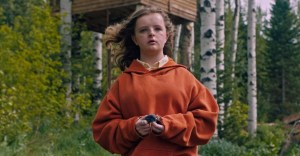
My pal Ben Bailey chided me after seeing Hereditary that I was trying to do the movie’s work for it by looking for deeper connections and foreshadowing clues. Is there some greater meaning for the headless women motif? Is there a larger reason why the dollhouse God imagery is prevalent? Is there a reason, after finding out about the haunting, that the family still leaves their beleaguered son alone? Is there a mental illness connection or is it all a manifestation of hysterical grief? The English teacher discusses the Greek tragedy of Iphigenia (see: a better movie following this model, 2017’s Killing of a Sacred Deer) and whether being predestined for sacrifice is more tragic than choosing your own self-destruction, and is that a glimpse at thematic relevance in a way that seems almost half-hearted? The problem with a long, incoherent story built upon a heaping helping of creepy imagery and atmosphere is that it can often fall into the lazy trap where the filmmaker will just throw up their hands as if to say, “Well, it’s up for interpretation.” I don’t mind a challenging movie experience (I was on the side that enjoyed, if that’s the correct term, Darren Aronofsky’s mother!). I can appreciate a movie that’s trying to be ambiguous and ambitious. However, the pieces have to be there to form a larger, more meaningful picture to analyze and discuss, and Hereditary just doesn’t offer those pieces. It’s an eerie horror movie with its moments of intrigue and dread but it’s also poorly developed, too convoluted, and prone to lazy writing and characterization. I’ll highlight it for you, Hereditary-style: if you’re looking for more than atmosphere and tricks, seek another horror movie.
Nate’s Grade: C
Share this:

Assault on Precinct 13 (2005)
 It seems that in American cinema, we have a long history of people being holed up in one location and fighting off outside forces. There’s instant drama in fending off forces that outnumber you, and Hollywood knows this. There are historical dramas (The Alamo), fantasy flicks (Lords of the Rings), and nearly every other horror movie (Night of the Living Dead) that have a central conceit of the good guys being outnumbered and with no place to go. Assault on Precinct 13 (a remake of the 1976 John Carpenter cult film) is the latest in this mini-genre. The film has big stars like Ethan Hawke, Laurence Fishburne, Gabriel Bryne and a mustachioed Brian Dennehy (there really should be no other kind) but even star power with facial hair can’t stop Assault on Precinct 13 from feeling run-of-the-mill.
On New Year’s Rockin’ Eve, Sergeant Jake Roenick (Hawke) is left to tidy up precinct 13, which will be shut down in days. The precinct secretary (Drea De Matteo) and seen-it-all veteran Jasper (Dennehy) will keep Roenick company. But alas, they have more company than they expected. A bus transporting prisoners makes an emergency stop at the precinct because of a blizzard. The bus has three small time criminals (John Leguizamo, Ja Rule, Aisha Hinds) and one very big fish, crime kingpin and cop killer Marion Bishop (Fishburne). Late in the night the precinct is besieged by a team of dirty cops led by Marcus Duvall (Byrne). It seems Duvall and his squad of corrupt cops have had many deals with Bishop, enough that they can’t let him live. Jake takes command of the precinct’s motley crew, prisoners included, and attempts to have everyone work together to fight off the invading forces.
 Hollywood upped the budget for this remake but they also upped the plot holes to match the firepower. How are the bad cops going to explain all those dead police officers in commando outfits? There’s likely enough forensic evidence everywhere to point a finger at the long arm of the law’s involvement. I suppose they could have burned the whole place down when they were done, but to paraphrase that great philosopher Ricky Ricardo, “Luuuuuucy, you got some ‘splainin’ to do.”
The acting is a non-issue. Hawke and Fishburne get to trade cool glances, Matteo gets to shake her Sopranos Joisey accent, and Dennehy gets to eat any scenery that isn’t bolted to the ground. I have no idea what Leguizamo was going for. His disturbed junkie performance reminded me of Mr. Ed, because whenever he spoke it looked like Leguizamo’s lip was being pulled up by an invisible string. Some may call this acting; I call it fun to watch.
Assault on Precinct 13 is constructed from so many familiar action elements you may think you’ve seen this movie before. Hawke plays a cop haunted by a bust gone wrong that, surprise, killed his partners. When the siege does go down, of course everyone can pick up a weapon (even a 1920s Tommy gun) and instantly become a trained marksman. There’s the whole “who can we trust” plot element that spurs Mexican standoffs between the cops and the crooks. All the characters are stock types, from Hawke’s reluctant hero, to Matteo’s saucy secretary, to Dennehy’s single-minded hothead to Fishburne’s calm and collected criminal mastermind badass. When a character opines a theory that someone on the inside is really working for the dirty cops, you should be able to immediately follow the falling anvils.
 Even when it comes to the action, Assault on Precinct 13 is too familiar. Because nothing interesting is going on inside the precinct, the audience relies on the spurts of action for their money’s worth. It all gets a little bland after awhile. Cops try breaking in. They get shot. They try breaking in with more cops. They get shot. Granted, replace “cops” with “monsters” and you have 30% of horror movies. There needs to be escalating action and some overall cause and effect with the plot, especially with action movies set in one isolated locale. In Assault in Precinct 13, rarely does the previous moment matter because both sides seem to shrug and move on. The only notoriety director Jean-Francois Richet brings to the action is a peculiar fetish for long takes of fresh head shots. He does enjoy the slow trickle of blood out of a bullet to the cranium (I counted 5 times; turn it into a drinking game at your own danger).
Assault on Precinct 13 is indistinguishable from what Hollywood pumps out every day. The characters are stock, the dialogue is short but stale, the plot holes seem to swallow the film whole, and, most tragically, the action seems meaningless except when paring down the cast (there’s a ten-minute whirlwind that cuts the good guys in half). People hungry for action might find something worthwhile but most will probably walk out of the theater with the same shrug the actors seem to exhibit. Assault on Precinct 13 is a routine action flick that replaces escalation with excess.
Nate’s Grade: C
Share this:

Stigmata (1999)
 From the director of Blank Check comes the latest religious up-in-arms controversial picture billed to your local theater. While being wrongly labeled a horror flick, this movie is nothing to get excited over if you take your religion seriously. Because this movie sure doesn’t, and the only ones that will be influenced by this hour and forty minute music video of blood would simply be the gullible.
Patricia Arquette plays Pittsburgh’s young and nubile atheist hero and the finest hairdresser in town, when she isn’t bleeding over her customers that is. Well the party girl gets in touch with some rosaries and has violent seizures and fits, as well as experiencing strange wounds and lashes akin to the wounds of Christ. Faster than you can say “Mulder and Scully where are you?” the Vatican dispatches priest Gabriel Byrne to investigate the bizarre goings on. What he soon discovers turns him into a believer and turns the Catholic church scared that Christ is coming back and brandishing some mean hickory. Paddlin’ line starts west of Rome.
It’s not that the idea is totally repellent or half-baked, but the movie is turned into an MTV video with legs. With all the hyper-editing and pounding electro music from Pumpkinite Billy Corgan you’ll be thrashing in your seat having a violent seizure yourself. The over stuffing of cuts and more blood than a Red Cross drive can’t cover up a head scratcher of a storyline.
The script has so many glaringly logistical problems stacked up everywhere trying to present themselves as pious dogma. Stigmata is merely the recreation of Christ’s wounds, not soul possession. How in the world Arquette becomes the working girl version of Linda Blair is beyond logic. The movie also perceives that stigmata can be transmitted by touch. It’s not an STD people, we don’t need pamphlets trumpeting safe religious reenactments in schools do we? But the biggest hole is not the notion there’s a Catholic conspiracy hiding valuable works of Jesus that may be a threat to their job security. After all the fuss and the build up the hidden passages and books are nothing more than a basic Sunday School lesson. Is this what everyone’s shaking in their gowns over? I’ve seen more religious danger in a Denny’s breakfast menu.
Stigmata is a glitzy and loud poison pen letter to religion. It’s got an incomprehensible storyline and wastes the great actor Jonathon Pryce for the role of a villainous Catholic Cardinal always within reach of his cell phone. Stigmata is an example of what the movie industry is serving out these days: all style, no substance if any, and without any semblance of common sense. So of course it’s destined to make a killing at the box-office.
Nate’s Grade: C-


 nathanzoebl
You must be logged in to post a comment.