Blog Archives
Hillbilly Elegy (2020)/ Feels Good Man (2020)
 Hillbilly Elegy is based upon the memoir by JD Vance and in 2016 it became a hot commodity in the wake of Trump’s surprising electoral ascent, with liberals seeing it as a Rosetta Stone to understanding just how so many working-class white people could vote for a billionaire with a gold toilet. The movie, directed by Ron Howard (Apollo 13) and currently available on Netflix, follows an adult JD (Gabriel Basso). He’s a Yale law candidate forced to go back home to Middletown, Ohio after his mother Bev (Amy Adams) lands in the hospital for a heroin overdose. It’s 2011, and Bev has been fighting a losing battle with opioids for over a decade, costing her a string of boyfriends and jobs. JD’s homecoming isn’t quite so rosy. While he can take comfort in fried bologna sandwiches and his sister (Haley Bennett), the town is not what it once was. The factory has closed, poverty is generational, and his mother is one of many struggling to stay clean. In flashback, we watch MeeMaw (Glenn Close) take in the young JD (Owen Asztalos) and raise him on the right path. JD must decide how far the bonds of family go and how much he may be willing to forgive his mother even if she can never ask for help.
The subtitle of Vance’s novel was “A Memoir of a Family and a Culture in Crisis,” and it’s that latter part that got the most attention for the book and critical examination. Many a think piece was born from Vance’s best-selling expose on the hardscrabble beginnings of his personal story along the hills of Kentucky and the Ohio River Valley and his recipe for success. Given his libertarian political leanings, it’s not a surprise that his solutions don’t involve a more interventionist government and social safety nets. According to Vance’s book, he saw poverty as self-perpetuating and conquerable. It was the “learned helplessness” of his fellow Rust Belt inhabitants that Vance saw as their downfall. For me, this seems quite lacking in basic empathy. You see these people aren’t poor because they’ve been betrayed by greedy corporations, indifferent politicians, a gutted infrastructure and educational system in rural America, pill mills flooding Appalachia with cheap opioids, and a prison system that incentivizes incarceration over rehabilitation. For Vance and his like-minded fellows, upward mobility is a matter of mind over matter, and these working-class folks have just given up or won’t work as hard as before.
 Now, as should be evident, I strongly disagree with this cultural diagnosis, but at least Vance is trying to use his own story as a launching point to address larger points about a portion of America that feels forgotten. The movie strips all of this away. Screenwriter Vanessa Taylor (The Shape of Water) juggles multiple timelines and flashbacks within flashbacks as Vance follows the formula of prodigal son returning back to his home. The entire draw of the book, its purported insights into a culture too removed from the coastal elites, is replaced with a standard formula about a boy rediscovering his roots and assessing his dysfunctional family. At this rate, I’m surprised they didn’t even time it so that Vance was returning home for Thanksgiving.
Removed of relevant social commentary, Hillbilly Elegy becomes little more than a gauzy, awards-bait entry meant to uplift but instead can’t help itself from being overwrought poverty porn. If we’re not looking at the bigger picture of how Appalachia got to be this way, then Vance becomes less our entry point into a world and more just an escaped prisoner. Except the movie doesn’t raise Vance up as exceptional and instead just a regular guy who pulled himself up by his bootstraps through will and family support. I’m not saying he is exceptional, I don’t know the man, but this approach then ignores the reality of why so many others just aren’t following his footsteps of simply trying harder. Without granting a more empathetic and careful understanding of the circumstances of poverty, Howard has made his movie the equivalent of a higher-caliber Running with Scissors, a memoir about a young man persevering through his “quirky, messed up family” to make something of himself on the outside. This reductive approach is meant to avoid the trappings of social commentary, and yet in trying to make his film studiously apolitical to be safer and more appealing, Howard has stumbled into making Hillbilly Elegy more insulting to its Appalachia roots. Systemic poverty is seen as a choice, as people that just aren’t trying as hard, that have given up and accepted their diminished fates. Never mind mitigating economic, psychotropic, and educational circumstances. I imagine Howard wanted to deliver something along the lines of Winter’s Bone, unsparing but deeply aware of its culture, but instead the movie is far more akin to a sloppy compilation of Hallmark movies and catchy self-deprecating bumper sticker slogans. Seriously, about every other line of dialogue feels like it was meant to be on a T-shirt, from “Where we come from is who we are, but we choose every day who we become,” to, “There are three types of people in this world: good Terminators, bad Terminators, and neutral.” Well, maybe not that last one. The insights are fleeting and surface-level, with vague patronizing along the fringes.
The personal story of J.D. Vance takes the center stage and yet he’s the biggest blank of characters, and what we do get isn’t exactly that encouraging. I think we’re meant to engage with his triumph over adversity, but he has such disdain for his background while clinging to it as an identity, and this intriguing dichotomy is never explored. Vance as a character is merely there. His awkward experiences relating to the rich elites are just silly. He calls his girlfriend (Freida Pinto) in a panic over what fork to use at a fancy dinner table, as if this perceived social faux pau would be the difference between getting a law firm gig. He’s supposed to feel like an outsider, both at home and away, unable to escape his past that defines him, but the movie doesn’t even make Vance feel alive in the present. Most of the movie he is just there while big acting takes place around him. He listens to the life lessons bestowed upon him, good and bad, and it makes him the kind of man that when he grows up will join Peter Thiel’s venture capital firm, so hooray? I sighed when the movie established the stakes as he needs to get back in time for his big lawyer job interview, a literal family vs. future crossroads. The movie treats its frustrating main character as a witness to history rather than an active participant, and his personal growth is what? Coming to terms with the limitations of his mother? Accepting himself? Leaving them all behind to survive? I don’t know. There is literally a montage where he gets his life back on track, starts getting better grades, ditches his no-good friends, and heads out into the world. This could have been a better articulated character study but instead Vance comes across as much a tourist to this downtrodden world and eager to return to safer confines as any morbidly curious viewer at home.
 I simply felt bad for the actors. This is the kind of movie where subtlety isn’t exactly on the agenda, so I expected big showcases of big acting with all capitals and exclamation marks, and even that didn’t prepare me. I watched as Amy Adams (Vice) worked her mouth around an accent that always seemed elusive, with a character that veered wildly depending upon the timing of a scene. Almost every moment with Bev ends in some alarming escalation or outburst, like when a new puppy ends with Bev declaring she will “kill that dog in front of you,” or a ride back home descends into a high-speed promise of killing herself and child out of spite. This woman is troubled, to say the least, and her addictions and mental illness are what defines the character. With that guiding her, Adams is left unrestrained and usually screaming. There’s just so much screaming and wailing and crying and shouting. It’s an off-the-mark performance that reminded me of Julianne Moore in 2006’s Freedomland, where a usually bulletproof actress is left on her own in the deep end, and the resulting struggle leans upon histrionics. Was I supposed to feel sympathy for Bev at some point? Does the movie ever feel sympathy for this woman who terrorizes and beats her child? The broad portrayal lacks humanizing nuance, so Bev feels less like a symbolic victim of a larger rot of a society abandoned and betrayed and more a TV movie villain.
Close (The Wife) disappears into the heavy prosthetics and baggy T-shirts of MeeMaw, but you could have convinced me the character was a pile of coats come to life. Truthfully, MeeMaw is, by far, the most interesting character and the story would have greatly benefited from being re-calibrated from her painful perspective. She’s the one who bears witness to just how far Middletown has fallen since her and PawPaw ventured as young adults with the promise of a secure new life thanks to the thriving factory. She’s the one symbolizing the past and its grip as the present withers. She’s the one who has a history of abuse only to watch her daughter fall into similar patterns. Think of the guilt and torment and desire to rescue her grandson for a better life and save her family. That’s an inherently interesting perspective, but with JD Vance as our mundane lead, MeeMaw is more a slow-walking curmudgeon taken to doling out profane one-liners and grumpy life lessons. Close is easily the best part of Hillbilly Elegy and deserved more attention and consideration. A moment where she clings to JD’s high-scoring math test like a life raft is heartfelt and earned, more so than anything with JD.
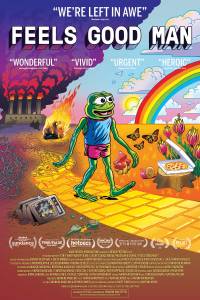 Another slice of America that feels forgotten and angry is on display with the documentary Feels Good Man, a.k.a. the Pepe the Frog documentary. Who is Pepe? He’s a cartoon frog created by Matt Furie as part of a comic series of post-college ennui between four friends. The character was adopted by the commenters on the message board 4Chan as their own symbol, and as their memes spread and became more popular with mainstream suers, and that’s when the 4Chan warriors had to do something drastic to save their favorite frog. They began transforming Pepe into a symbol of hate in order to make him toxic for outside use, and then the irony of their attempts at reclamation faded away and Pepe became a real symbol for Neo-Nazis and white supremacists. The character is currently listed on the Anti-Defamation League’s list of symbols of hate. The movie explores this evolution and de-evolution of Matt Furie’s creation and serves as a cautionary tale about the scary shadows of Internet culture and the nature of reclaiming meaning and intent with art.
Firstly, is there enough material here for a full-fledged documentary? We’re talking about a cartoon frog filling up the memes of Internet trolls. Is that enough? I think so, though I wish the movie shed even more critical scrutiny upon the 4Chan fringes of the Internet that have become a toxic cesspool of alienation and recrimination. These are people that self-identify and celebrate their social isolationism. The acronym N.E.E.T. stands for NOT Employed, Educated, or Trained and is adopted by many as an odd badge of honor. We even see home video footage of people sharing their personal lives in cluttered, trash-strewn basements. These are people electing not to engage with a larger functioning society and yet also feeling hostile to those that choose otherwise. Maybe it’s all a big joke to them, so why even bother; maybe it’s a defeatist mentality that plays upon social anxiety and learned helplessness. Maybe it’s just a noisy, nihilistic club that doesn’t want anything for themselves other than to disrupt others. The interview subjects from the 4Chan community are few but offer chilling peeks into this subculture. They see the world in terms of a very high school-level of social hierarchy, and the people who are pretty, successful, and having sexual relationships are the “popular kids” keeping them down. I think in terms of a Venn diagram, that incels and these NEET freaks are a flat circle. It almost feels like Vance’s cultural critiques of his poor Appalachia roots syncs up with the disenchanted 4Chan kids. This self-imposed isolation and self-persecution stews into a hateful mess of resentment. It’s not a surprise that several mass shooters have partaken in 4Chan and 8Chan communities.
 This scary subsection of Internet culture has been left to fester and it went next level for the 2016 presidential election. The trolls recognized their own sensibilities in Donald Trump, a candidate whose entire presidency seemed on the precipice of being a bad joke. The alt-right celebrated the man and used Pepe as a symbol for Trump’s trolling of norms and decorum, and the 4Chan message boards became an army of meme makers to steer Internet chatter. It’s hard to say what exactly the cumulative effect of these memes and trolling efforts achieved, in addition to the successful efforts of Russian hackers and a media environment that gave Trump billions of dollars in free airtime, but the 4Chan crowd celebrated their victory. “We memed him to the White House,” they declared. From there, Pepe became a synonymous symbol of a newly emboldened white supremacist coalition and any pretenses of ironic detachment dissolved away.
The rise and mutation of Pepe makes up most of the movie, and it’s certainly the most fascinating and scary part of Feels Good Man. However, there is a larger question about the ownership of art and interpretation that the movie presents without conclusive answers. Symbols are a tricky thing. They’re not permanent. The swastika wasn’t always associated with Hitler and Nazis. A pentagram has significantly different meanings depending upon a Wiccan and conservative Christian audience. Feels Good Man examines Furie as a humble albeit slightly naïve creator. He’s a nice guy who just can’t get his head around what has happened to his creation. How far does the artist’s intent go when it comes to credible meaning? At one point, Furie tried stemming the negativity by killing off Pepe in a limited comic, but it didn’t matter. The 4Chan followers simply remade him as they desired because at that point Pepe was their own. He has been built and rebuilt over and over again, that no one person can claim interpretative supremacy. Furie’s version of Pepe might be gone but there are millions of others alive and well. This gets into the nature of art and how every creator in some regard must make amends with letting go of their creation. Once it enters the larger world for consumption, they can steer conversations but art can take on its own life. The last third of the movie follows Furie taking action to enforce his copyright law to push back against the more outlandish uses of Pepe the frog, including from InfoWars’ Alex Jones, the same man who told us the government was making frogs gay for some unexplained conspiracy. Jones makes for a pretty easy villain to enjoy seeing defeated, and the conclusion of the movie involves dueling taped depositions between Furie and Jones over intellectual trademarks and free speech. It makes for an easy to navigate victory for Furie to end the movie upon, but is this larger war winnable? I have my doubts and I don’t think the trolls of the darker reaches of the Internet are going away.
I also want to single out the beautiful animation that appears throughout Feels Good Man, giving a visual representation to Pepe in a manner that’s like trying to give him a say in his own intent.
 So, dear reader, why did I pair both of these movies for a joint review? I found both of them as investigations into a sliver of America that feels forgotten, left behind, stuck in ruts outside their control, and resentful of a changing culture they see as exclusive to their hard-hit communities. I thought both Hillbilly Elegy and Feels Good Man could provide me, and others, greater insight into these subcultures and perhaps solutions that can make them feel more seen and heard. The problem is that Elegy doesn’t provide solutions other than “pull up your bootstraps” and Feels Good Man involves a destructive coalition that I don’t want better seen and heard. Both movies in their own ways deal with the nature of how very human it can be to retreat to their safe confines of people who too feel ostracized, hurt, and overwhelmed. I have pity for the people of the Rust Belt, the hillbillies experiencing generational poverty and hardships, though “economic anxiety” is not simply a regional or whites-only worry. I have less pity for the basement trolls of 4Chan trying to celebrate school shooters because it’s somehow funny. I’m amazed that so many talented people were part of Hillbilly Elegy and had such high hopes. For all of its full-tilt screaming, the movie is thoroughly boring and formulaic. Given the nature of an elegy, I was expecting Howard’s movie would be more considerate of its people, but their humanity is lost in this pared-down characterization, and the tragedy of society failing its own becomes an inauthentic Horatio Alger story of the plucky kid who went to Yale and became a real somebody. Feels Good Man might not be the best documentary but it feels more authentic and owns up to its inability to answer larger questions about human behavior, art, and interpretation. Both of these movies will prove horrifying to watch but only one is intentionally so.
Nate’s Grades:
Hillbilly Elegy: C-
Feels Good Man: B
Share this:

Immortals (2011)
 Director Tarsem Singh has only made two movies but is widely regarded as one of the finest visual artists working in the film medium. He’s made tons of commercials, which is apt because his first feature, 2000’s The Cell, felt like the world’s longest perfume ad. While amazing in its design, the movie was incredibly stupid. I haven’t seen his other feature, the more personal work The Fall, a movie that nobody wanted to make. It’s probably because they regrettably saw The Cell. Now the guy seems downright prolific, with a Greek mythology action movie in release and next year an update on the Snow White fairytale, the first shot in the Great Snow White Duel of 2012 (Kristen Stewart stars in the other, next summer’s Snow White and the Huntsman).
In 1200 B.C., King Hyperion (Mickey Rourke) is marching an army across Greece, laying waste to city after city. He’s looking for the mythical Epirus Bow, believed to be the only weapon capable of unleashing the titans, who were imprisoned after a war with the Olympian gods. Mankind’s only hope is Theseus (Henry Cavil), a strapping young lad born into low class. His real father is Zeus (Luke Evans) who keeps tabs on his spry son by posing as a wise old man (John Hurt). Phaedra (Freida Pinto) is a virgin oracle, a priestess who has been granted prophetic visions. Theseus rescues her and other prisoners of Hyperion. Together, they must find the bow and convince their countrymen to fight against the overwhelming forces of Hyperion. In the meantime, Zeus has sworn death to any god who interferes in the affairs of man and helps Theseus on his important quest.
 One word I feel accurately that sums up the experience of watching Immortals is… “viscera.” This movie is obsessed with filming the destruction of human bodies in the most gloriously beautiful ways possible. The violence and gore are given an intensely operatic boost. One moment involves a god zips around the slow-moving mortals, smashing one head after another with his humongous war hammer. The scene plays out at a slower speed, allowing the explosions of glistening blood and skull to fill the screen, each a mesmerizing fireworks display of human goo. The visuals are often a balletic, phantasmagorical, Grand Guignol display of human carnage. When you watch this at home, you may need a squeegee to clean your TV. It’s mesmerizing to watch, getting lost in the painstaking yet sumptuous visuals, even when it’s buckets of spaltterific gore. There’s one scene involving a sledgehammer that’s guaranteed to make every male in the theater uncomfortably cross his legs. The final image is also memorably striking – the sky filled with thousands of battling titans and Olympians, suspended high in the air and hacking and slashing away (Grecian weather report: 50 percent chance of blood showers. Bring an umbrella).
Tarsem never skimps out when it comes to the look of his movies. Immortals looks like a living Renaissance painting; the director of photography should be credited to Caravaggio. Unlike Tarsem’s earlier films, this movie does not take place within the realm of imagination, but that doesn’t hamper the movie’s aesthetics. Taking a cue from the golden-hued Greek/Roman epics of recent year, notably Zack Snyder’s 300, the film exists in a heightened reality. We’re dealing with mythology after all (more on the specifics of that later). The iconic imagery of Greek mythology is all there, stunningly realized in lavish CGI and a production design that is frequently jaw dropping. The action sequences are resolutely exciting, with special mention for the climactic gods vs. titans battle. The gods, decked out in spiffy gold armor and capes, bounce off the walls aided by Matrix-style moves and slice and dice their wicked immortal brethren in creatively gruesome ways. It’s a thrilling sequence that almost makes you forget the movie’s catalogue of sins.
The movie plays fairly fast and loose with the Greek lore. The Theseus of legend was mainly known for slaying the ferocious Minotaur, the guardian of a great labyrinth. His father was Poseidon, not Zeus. Some versions even have Phaedra falling in love with Theseus’ son from his first wife (Theseus was a busy boy, taking after his father). These details, and more, may seem inconsequential but if they’re going to be so loose in the adaptation, why even bother keeping the name Theseus? Immortals does have an interesting albeit brief bit where the Minotaur is seen as a human warrior wearing a bull mask made of barbed wire. Short of the gods and titans, there isn’t any depiction of the supernatural occurring on Earth. The monsters and mythic creatures are absent, leaving some Greeks to question the validity of the gods. The movie takes an unexpected twist early by declaring, in a self-serious tone, that immortals can… die. It seems that the gods just discovered one day that they could kill each other. I would have liked to be there for that discovery (“Yeah, go ahead and lick that electrical socket.”). The film lays out that the titans and the gods were one in the same, it’s just that the winners of the battle of the heaven called the losers “titans.” If they’re the same then why do the titans act like feral monkey creatures and look like ashen, Hindi gods (no disrespect, one billion Hindus)? Have they simply gone wild after being locked away in such a unique prison? When they fight, the titans move at the speed of mortals, not gods. I also believe the titans were supposed to be considerably larger.
 But as enchanting as the visuals are, there are still the other senses that are criminally malnourished. The screenplay by brothers Charlie and Vlas Parlapanides is about as bare-bones as you can get. It’s your basic hero’s quest, trusting young stud Theseus with finding a magic item and stopping a bad man. If that sounds plainly generic then congratulations, you’ve seen more than one movie with men in togas (Animal House does not count). Mysterious parentage? Check. Close relative that dies early to spur vengeance motivation? Check. Noble sacrifices by members of his team? Check. Eventual intervention of the gods? Check. What I just described could also have been the plot for 2010’s joyless Clash of the Titans remake. What’s up with Zeus and these noncommittal gods? He refuses to get directly involved in the affairs of man, but if King Hyperion releases the titans (should have gone the long route and unleashed the Kraken) then the Olympians are jeopardized. It seems like they have an interest in giving Theseus a mighty assist. The magic item, a bow that creates unlimited arrows when plucked back, is pretty much a forgotten relic. It gets used, I kid you not, exactly three times in the entire movie. All of this fuss over a super weapon that the characters can’t be bothered to utilize. They’d rather fight it out with a traditional bronze sword. What exactly does it mean to be immortal when even the gods can die? King Hyperion says he’ll be immortal by essentially raping a nation of women, keeping his bloodline alive for centuries (the Genghis Kahn defense, your honor). But if having kids is being immortal, I think we’re setting the bar pretty low.
The Phaedra character is so underwritten that she almost comes across as a parody of the role of women in these guy-heavy action spectacles. As portrayed, Phaedra is the definition of convenience. She doles out a prophetic vision to save the day, provides some grade-A eye candy thanks to the splendor of Pinto (Slumdog Millionaire), and even casually slips into Theseus’ bed for a deflowering (sorry guys, it’s clearly a body double). She will be haunted by visions of the future until the moment she loses her virginity. Let’s stop and think about this. Having one member of your team be able to SEE INTO THE FUTURE seems like a decisive tactical advantage. I understand the lure of a naked and willing Pinto, but Theseus needed to think beyond the needs of his little Greek. In an abrupt and off-putting turn, Phaedra is never really dealt with in any capacity after this seismic bout of lovemaking, nor do she or Theseus talk about what has transpired. She just provided some casual sex while the hero was recuperating and then checked out. Her major prophetic vision of Theseus and Hyperion joining sides is also just forgotten, turning out to be a letdown.
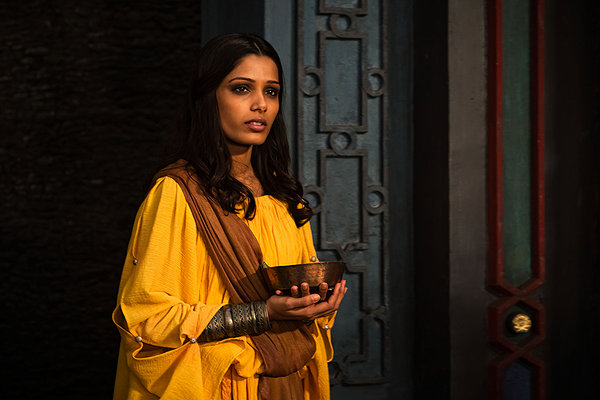 The actors were basically hired for their visual appeal, and to that end they succeed. Cavill (TV’s The Tudors), tapped to wear Superman’s cape in 2013 by Zack Snyder, is suitably buff and hunky. His performance is rather flat, no matter how many times he makes his eyes go big with anger. In contrast, Rourke (Iron Man 2) will chew whatever scenery he can find. His flamboyantly costumed villain at one point seems to wear a lobster claw on his head. He wants to punish the gods because they refused to intervene when Hyperion’s wife and child were slaughtered. When the gods do intervene to save Theseus, that’s when the character should go off the rails. Rourke just plays it in the same sleepy menace. Pinto gets to stare off into the distance regularly and pray. It’d be a stretch to say that the material challenges any of these actors.
Immortals is a testosterone-soaked action movie that feels like it minored in Art History. The production design, CGI, and practical special effects, all attuned to the extraordinary vision of Tarsem, makes for a brilliant looking movie with several sequences of memorable carnage. But we entered the age of “talkies” since 1927, and Immortals suffers when it concerns dialogue, story, characterization, and acting. The movie is a pretty loose adaptation of Greek mythology, falling back on a rote hero’s quest and leaving plenty of narrative dead spaces for the visuals to fill in the interest. Even a movie as visually resplendent as Immortals can only go as far as its story will allow. In this case, Immortals might just be the best-looking piece of borderline mediocrity you’ll ever see in your life.
Nate’s Grade: C+
Share this:

Rise of the Planet of the Apes (2011)
 I owe the makers behind Rise of the Planet of the Apes a huge apology. I have been vocally dismissive of a new Apes film from the first moments I heard about the project. I just thought rehashing this material was a stupid move. Then I heard James Franco (127 Hours) was going to be the lead, and I sighed. Then I saw the trailers and verbally impugned them in my theaters. Upon the conclusion of the trailer I yelled, “You can still shoot them!” and my criticism drew applause from those around me. The concept that we suddenly made apes smarter and they could now enter the Bronze Age, brandishing spears, didn’t overwhelm me. Just because the apes suddenly had tools didn’t seem like enough to topple mankind from the top of the evolutionary ladder. So in the months and weeks ahead I sneer, jeered, and overall dismissed Rise of the Planet of the Apes. And then the reviews came out and they weren’t just good, they were ecstatic. I went begrudgingly into the theater, waiting to hurl my own feces at the screen (figuratively, of course). Then I was completely taken aback by how much I unabashedly loved it.
Will Rodman (Franco) is a young scientists working hard at create a miracle cure for Alzheimer’s. His corporate company has been testing their drugs on chimps to mixed results. One day a promising ape, made smarter by a dose of ALZ 112, goes bananas and is put down by security. The lady ape left behind a baby ape that has taken on traits from the ALZ 112. Will takes the little chimp home to care for the “company property.” But then he ends up adopting the chimp, which his ailing father (John Lithgow) names Caesar. Due to the super drug, Caesar shows remarkable intelligence and looks to be getting even stronger. It looks like Will might have found his cure, and his boss (David Oyelowo) will make billions. But then complications ensue, as they always do, and Caesar is taken to an animal preserve facility run by a crooked father/son team (Brian Cox and Harry Potter’s Tom Felton). Caesar is mistreated and distraught to adjust to a life in pens. He makes plans to escape but then decides to rally his fellow imprisoned apes to a greater cause with the help of some of the ALZ 112.
Even through Franco is the headliner he’s really nothing more than a supporting character, a catalyst. The real star of the movie is undoubtedly Caesar the chimp. After about he 45-minute mark, Franco is reduced to making frowny faces while he scowls, trying to ascertain where his favorite monkey is. His dialogue is mostly reduced to different iterations of yelling Caesar’s name in different locations (the guy even manages to smirk in his sleep in one scene). But the major surprise is that Caesar is not only a compelling leading character but also a well-developed one at that. This is a living, breathing character brought to life thanks to top-notch computer wizardry and the talents of Andy Serkis, the leading authority for soulful motion-capture performances. Caesar may be the greatest single special effect of all time, not because of its life-like quality (it’s close, but again the creature’s features seem too waxy). But the reason Caesar is so impressive is because of the depth of emotion that can be read onscreen. This is a textured performance where you can read varying emotions through the looks of eyes, the twitching of facial muscles, the biting of lips. The emotions are genuinely recognizable; he flashes guilt, anger, frustration, heartache, disbelief, betrayal, fear, shame, just about everything in the book. From a DNA standpoint, chimps and humans share 96 percent of the same genes, so it’s understandable that we can relate to the plight of our distant relatives. Serkis is responsible for providing the groundwork for CGI creations like Gollum and King Kong, so he’s the world’s go-to guy when it comes to providing a framework for animators (Robert Zemeckis, why have you never called this guy?). It’s an amazing special effect accomplishment and works side-by-side with the storytelling to make Caesar a complicated, interesting, and deeply empathetic hero. He’s a terrific center for the movie and a figure that you root for, even with the tacit understanding that cheering on the apes’ escape is also tantamount to cheering the decline of the human race. But by God, during the apes-run-amok climactic sequences you are cheering for mankind’s downfall hardcore.
The Planet of the Apes saga (six films) is, let’s be honest here, rather abysmal. Everybody loves the first movie but the quality sharply drops from there, with four sequels in four years each managing to answer the depressing question, “Can this thing really get any worse?” The 2001 Tim Burton “re-imagining” was just embarrassing and filled with loopy logic (how can the apes take over Earth’s past when Marky Mark crashes on a DIFFERENT planet in the FUTURE?). Given that, the filmmakers behind Rise of the Planet of the Apes did not have to achieve much to separate themselves from the monkey-stank of the sci-fi franchise. The film serves as a prequel to the series but it’s easily the best film since the original. Easily. For one, the storytelling is not overwhelmed by the allegory of sci-fi packaging. The world is decidedly our own and the problems the characters grapple with are fairly relatable. Will may be responsible for the annihilation of the human race but his motivation is pure – he wants to save his ailing father. That’s a believable motivating force that would push the character to action over caution, testing his special serum without fully examining all the side effects. You know what they say about the road to Hell (my friend Eric Muller always suspected Franco would be linked to the end of civilization)? But in a Planet of the Apes movie there is a wealth of thoughtful human drama. Animal rights are one of the more obvious messages the movie deals with, but the film takes a character-driven approach following the animal himself. You care about these characters and when one CGI ape was cradling a dying CGI ape, I swear I was getting choked up over those computer pixels. That’s how emotionally involving this new Apes film can be. It’s refreshing to have a Hollywood action film that has more on its mind than blowing stuff up all good like.
 But when the action shapes up, mostly during a stirring man vs. apes climax, the film easily delivers. The nimble screenplay by Rick Jaffa and Amanda Silver (their first film since 1997’s Relic!) is a terrific example of economical big-budget pacing. Every scene moves the story forward and doesn’t waste a frame. The final running time is only 105 brisk minutes but it squeezes in so much entertainment and emotion. Director Rupert Wyatt keeps the thrills coming on a human-scale, never letting the enormity of the events getting too out of hand. Sure suddenly there are like 500 apes all of a sudden and all of them are super smart, but I can roll with that. The stakes are always clear and the action is easy to follow and easier to get swept up in. There are a few shout-outs to the original film’s iconic lines, which will either come across as fun or ham-handed. And thankfully a plausible scenario is put forth to explain why the humans would be overtaken by the apes. That’s not to say that everything is smartly woven into the narrative. Several of the side characters are but crude renderings. Frieda Pinto’s (Slumdog Millionaire) underdeveloped love interest could be completely taken out with minimal effect on the plot. Likewise the Evil Business Head seems to have nothing but speeches that remind you his sole interest is making lots of moolah.
Rise of the Planet of the Apes is a Hollywood movie with a soul. Finally late in the summer a major studio movie emerges that has the right balance of brains, brawn, and thrills. It’s an exciting action movie, a poignant drama from an animal’s point of view, a tour de force of special effects that manage to make the film more emotionally involving, and a sci-fi prequel that’s actually worthy of its name. Serkis’ gifts for physical performance are invaluable to the emotional core of the movie. By going back to its DNA, Rise of the Planet of the Apes has given new life to a franchise whose best days were 40 years ago. I don’t see where the series can go from here. A prequel to the prequel seems superfluous. A sequel would only really showcase the waning days of humanity and also seem superfluous. Then again, until the moment I was watching Rise of the Planet of the Apes I would have said this very movie was superfluous too. Instead this is the finest summer spectacle of the year and destined to make my top ten list for the year. If you can’t beat them, join them, damn dirty apes and all.
Nate’s Grade: A
Share this:

Slumdog Millionaire (2008)
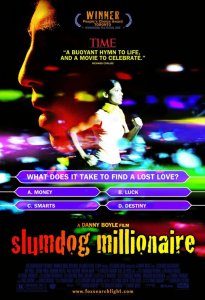 If there is one independent movie that seems to be picking up momentum this awards season, it’s Slumdog Millionaire. The film seems destined to break out into the mainstream, especially in a time where audiences could use a happy story given the ongoing news of economic downturns. Slumdog Millionaire is a highly spirited rags-to-riches tale that marries Hollywood and Bollywood into one fantastic product.
Jamal (Dev Patel) is an 18-year-old kid who grew up impoverished in India’s favellas. He’s also on the verge of winning 20 million rupees on the Indian version of the Who Wants to Be a Millionaire? Game show. The TV host reminds Jamal that lawyers and doctors have never gotten as far as he, a lowly “slumdog” from such humble origins. As each question emerges we discover more about Jamal’s life, from escaping a riot, touring India as a stowaway on a train, conning American tourists at the Taj Mahal, to his assistant work at a call center. Throughout Jamal’s life are two constants: Salim (Madhur Mittal) and Latika (Frieda Pinto). Salim is Jamal’s scheming older brother who has a loose sense of morals. He finds a life of crime as a suitable escape from poverty. Latika is a young orphan girl that Jamal befriended as a child. He declared that she was the “third Musketeer” in their group and has always sworn to love her. This is complicated because Salim’s crime boss wants Latika for a prize, and Salim keeps his younger brother away from Latika. Ultimately, as an entire nation watches with baited breath, Jamal explains that he is appearing on TV because he knew that Latika, his love, would be watching somewhere.
 It’s like City of God and Forrest Gump had a baby that was raised by Oliver Twist. The film is given a dynamic energy thanks to director Danny Boyle’s exuberant camerawork and skillful style. Boyle is a director that knows how to make images jump and Slumdog feels like it is coursing with life. The feel-good fantasy nature of the rags-to-riches plot is offset by some pretty harrowing violence, and Boyle makes great pains to show the realities of living in squalor. At one point a very Fagin-esque local crime lord collects young orphans to be beggars and he has a foolproof scenario to make these kids sympathetic and thus big earners — he blinds them with hot liquid. Despite the fantastical elements, Slumdog is rated R for a reason and that’s because it does show the cruel reality of a life in the slums, granted it’s nowhere near as bleak and formidable as something like City of God. After all, the kid gets to win on a game show, though the movie does open with Jamal being tortured by the police. Boyle has a tremendously natural eye for crafting visuals that delight the senses; he can make his shot compositions feel interesting without ever truly calling attention to being flashy. The views of India are beautiful and fascinating. Plus, having a majority of the movie in a foreign dialect was appreciated (Boyle provides different color background for different character’s subtitles, a nice touch). There’s a magic feeling to the film that definitely takes hold of the audience, an uplift that channels smiles and gasps of joy. While I’ll still credit Millions as Boyle’s best film since Trainspotting, his work on Slumdog is deserving of praise. I don’t know if another director could have made a film with so many contradictory elements (feel-good flick with child prostitutes?) run so smoothly.
The movie is also given a brilliant story structure by screenwriter Simon Beaufoy (The Full Monty). The movie is built around a steady stream of flashbacks linked to the questions Jamal tackles on the game show. So the host will pose a question and then we’ll be treated to a 10-15-minute flashback to Jamal’s life to discover how he knows the answer. The approach is fresh and it reinforces the magical notion that Jamal’s life has all been leading up to this moment of glory. Beaufoy’s script smartly weaves many storylines together to give us an emerging sense of who Jamal truly is. He manages to write an uplifting and hopeful tale that stays clear from easy sentiment. Indeed, Slumdog is an accomplished feat of writing as well as direction. Working from the Indian novel Q&A, Beaufoy has written a modern-day fairy tale in the same fashion as the Brothers Grimm, which means he didn’t skimp on the unpleasantness and hardship. Yet Slumdog is able to find great human spirit amidst the squalor. I doubt I’ll see a climax more rousing and crowd-pleasing all year. Seriously, you’d have to have a pretty hard heart not to feel some excitement and jubilation in the closing moments.
 This unlikely fantasy is aided by sharp performances by a collection of actors. Jamal is an unassuming yet plucky underdog, and Patel nicely handles these elements. He’s a stringy kid but he carries himself with charm and fortitude. As he grows confident he spars with the combative TV host, and it’s fun to watch. Pinto is a swell looking beauty with a great smile but I wish the story had given her more to do as an actress. The young actors who play Jamal, Salim, and Latika as young children actually give the best performances.
And now after all my effusive talk comes the time where I must voice my minor reservations. First off, the structure is ingenious but having Jamal interrogated by the police after the fact seems unnecessary, plus it also tips off the audience from the beginning that this kid has already won it all, which sucks some of the tension out of the game show format. I really think the movie would have been better served just playing out the game show in real time instead. Also, it’s a bit too convenient that every one of the quiz questions triggers a memory in a linear fashion. Jamal can tell his life’s story from beginning to end, but the movie would have been more challenging and interesting if the quiz questions forced Jamal to bounce around in his own memory. That way the script would provide more mysteries that could lead to even more satisfying answers. The Millionaire game show also goes on a commercial break and Jamal is astoundingly allowed to leave and go to the bathroom after he knows one of the high-money questions. In the age of wireless Internet, no game show would ever allow the contestant to leave its sight. Finally, the movie is presented like a Dickensian fable told in chunks, which means I found it hard to fully embrace the central romance that drives Jamal. I will readily follow the romantic notion of locating your true love, however, I will feel more involved in that search if the combined time Jamal and Latika spent together was longer then like a week. Seriously, they see each other every few years for a moment and then are broken apart, only to find each other again for a few moments to be broken apart. She’s more a symbol than a fully translated character, though this did not stop me from rooting for a happy ending.
 Slumdog Millionaire is a thrilling, funny, and triumphant story that courses with lively electricity, thanks to the deft direction of Danny Boyle. This movie is enormously entertaining while still baring a social conscious about the plight of those impoverished, though I hope people don’t get the mistaken idea that all that character-building impoverished life styles will lead to future fortunes like Jamal. The movie is hopeful and uplifting while also balancing tense violence and improbable circumstances. While I’m not on board with the critics calling this the best film of 2008, it has some minor flaws in approach to storytelling and character, Slumdog Millionaire has all the right markings to be a crowd-pleasing sensation. After all, it is destiny. And that’s my final answer.
Nate’s Grade: A-


 nathanzoebl
You must be logged in to post a comment.