Blog Archives
Micmacs (2010)
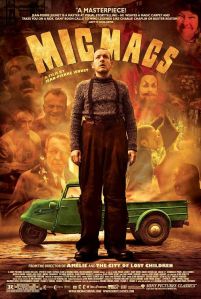 So what exactly does Micmacs even mean? A cursory search online brings me a few definitions: 1) a Native American Algonquian group living in Canada and upper New England, 2) the Algonquian language of the Micmac. That doesn’t exactly clear things up, especially considering that Mimacs is a French movie by the famed filmmaker Jean-Pierre Jeunet. An interview with the director has him explaining that the title is French slang for a mixture. That seems appropriate since the film is a mélange of the director’s other works, high on inventiveness and visual whimsy. Except the one thing Jeunet strangely left out this time was a reason to care amidst the high-powered shenanigans.
Bazil (Danny Boon) is a bit down on his luck. A landmine killed his father when Bazil was a child. He drifted through life, got a job at a video store, and then got a bullet in his brain thanks to a drive-by shootout. The doctors decided to leave the stray bullet inside or else Bazil will become catatonic. Bazil eventually is adopted by a batch of homeless misfits living in a junkyard. They accept Bazil and encourage him to seek vengeance against the warring arms dealers responsible for the land mind and stray bullet. Bazil and his colorful new family plot to antagonize the arms company CEOs. They come up with crazy schemes to then frame on the rival CEOs to escalate tensions. Bazil and crew intend to expose these men and their corporate crimes to the world.
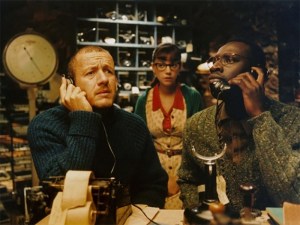 Micmacs succeeds where Rian Johnson’s Brother’s Bloom dangerously came close, and by that I mean that Micmacs overdoses on whimsy and I pronounced it clinically dead about an hour in. It’s too much; it’s just too much. Jeunet has always created movies that existed in rich, idiosyncratic worlds but those worlds always felt lush and lively and bursting with wonder. What saves a movie from whimsy is an emotional connection to the proceedings. 2001’s Amelie is a perfect example of cinematic “magic realism” but it’s also a moving and emotionally rewarding love story that transcends the plucky heroine. 2004’s A Very Long Engagement was a rapturous, old-fashioned love story with flights of fancy. Now, after a long six-year absence, Jeunet seems to have lost touch with the heart. There is no real emotional entry point for Micmacs. The protagonist is pretty much a blank. Yeah, you want him to get justice and you pull for the underdogs, but at no point did I care whatsoever for any character. Most of the junkyard characters are just ideas, walking-talking heist components (the human cannonball, the girl whose brain is good at math, the toy maker). Several characters barely exist except for their specific roles in Bazil’s schemes. There’s a romantic angle with the female contortionist (Julie Ferrier) and Bazil, but that comes off as less a function of the narrative and more of a desperate “Well, who else is gonna get together?” necessity. Jeunet has put together a movie that is all surface and no polish. Sure, the movie is intermittently entertaining and has plenty of imagination, but Micmacs is without a doubt the least involving and least accomplished film from a man responsible for a fantastic output.
The tone of the film seems to hew to something like a silent movie, which might explain why all the older members in my audience were constantly giggling while I just occasionally snickered under my breath. The comedy never rises above the chuckle level. There’s plenty of controlled wackiness, nothing gets too out of hand or edgy despite the fact that the plot revolves around getting vengeance on arms dealers. I was expecting something a little darker than the cutesy oddballs that I got. The best and darkest moment in the film is when we see that one of the arms dealers collects body parts of dead celebrities (Marilyn Monroe’s molar, Mussolini’s eyeball). It’s an interesting quirk that actually reveals something about the dark heart of the antagonist. There should be more moments like this. The bullet in Bazil’s brain is barely referenced. I have no issues with whimsy when it doesn’t overwhelm the narrative, and that’s the problem with Micmacs. The story is merely the vehicle for the inventive hijinks. The story is suffocated by whimsy and visual energy, therefore there’s no room for character development. All that inventiveness takes center stage. If playfulness is all you seek in a movie, then Micmacs will likely satisfy. Jeunet still makes movies that nobody else does, but he’s fallen fall short of his own lofty standards.
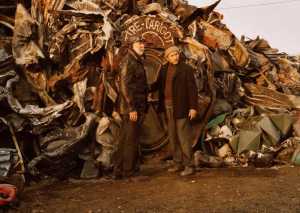 The movie moves along so quickly that it seems like every character just naturally intuits what must be done next, like they all have the screenplay in hand just off camera. Bazil is so quickly adopted by the junkyard gang. He so quickly discovers who is responsible for his life’s troubles. The schemes are so quickly thrown together. They aren’t even that complicated, mostly distracting and framing. The movie just feels like a spinning plate that has to keep moving or else everything will just break. I suppose Jeunet and his longtime co-writing collaborator Guillaume Laurant are trying to keep things busy so people won’t notice that they don’t genuinely care what happens.
This being a Jeunet film, of course it’s spectacular from a technical standpoint. Every frame of a Jeunet film can be used as a mural. His compositions delight the eye and the colorful cinematography by Tetsuo Negata (Splice) makes Paris seem like a dream city. The production design looks like it was taken directly from the Steampunk Architectural Digest magazine. You’ll never have to worry about the visual aesthetics or ingenuity of a Jeunet film. But there are plenty of artists that can master technical craft (you can find them in the world of commercials) but it takes something much more to marry technical precision in the service story and character. Micmacs is a strange film not because of plot, character, tone, or energy, but because Jeunet spent six years in absence and returned with a film that’s got plenty of style but no heart inside all that artifice.
Nate’s Grade: B-
Share this:

The Girl with the Dragon Tattoo (2010)
 Heating up the art house cinemas, The Girl with the Dragon Tattoo is two and a half hours, Swedish, in subtitles, and is absent any familiar faces, and audiences can’t seem to get enough. Based on the international best-selling novel, this independent thriller was the highest grossing European film for 2009 and deceased author Stieg Larsson’s two sequels, The Girl Who Played with Fire and The Girl Who Kicked the Hornet’s Nest (sounds like a lot of risky behavior for this girl) have also been made into movies with the same cast. So now that America is caught in the midst of Dragon mania, we all won’t have to wait long for the ongoing adventures of the journalist and the Gothic investigator. Both sequels are planned for release this summer, meaning that the entire trilogy will unwind in theaters over the course of only a few brief months. That’s one thing that has to please American audiences — instant gratification. For those unhip to the world of Lisbeth Salander, get ready to take notes because she’s likely to become an indie film icon, at least for an older, well-read demographic (think: your parents).
Mikael Blomkvist (Michael Nyqvist) is an investigative journalist sentenced to jail for 6 months after losing a libel case against a large shady corporation. Before he serves his prison sentence, Mikael is approached by a wealthy businessman, Henrik Vagner (Sven-Bertil Taube), convinced that his niece, Harriet, was murdered and her murderer is still taunting him 40 years later. Henrik Vagner lives with various other family members on a remote island. The mysterious clan has some serious skeletons in their closet, and Henrik believes ones of his family members, apart of the powerful Vagner Group, is guilty. Mikael takes refuge on the island and begins to comb over old police documents looking for any overlooked clues. Meanwhile, Lisbeth Salander (Noomi Rapace) inserts herself into the case. She’s an expert computer hacker and hired by Henrik Vagner to compile a background check of Mikael. But her interest did not end with her assignment. She has hacked into Mikael’s computer and furtively spies on Mikael’s progress. She e-mails him some key breaks in the case and joins Mikael on the island. Together they make rapid progress finding out what happened to Harriet all those years ago, and a serial killer makes note of their encroaching progress.
 Thankfully, The Girl with the Dragon Tattoo is a thriller that respects its audience’s intellect by not having to spell out every damn detail, and people, there are a lot of damn details. While the movie feels complete, it still leaves much to the imagination to fill in character back-stories, connect the plot dots, and interpret all those silent glances and meditative stares (granted, it might all get filled in following two sequels). A prime example is when Mikael covets Lisbeth’s photographic memory, telling her what a terrific advantage that must be, and a small pensive look from Lisbeth says all we need. It’s enough to make us re-examine what we think we know concerning her background, and the rest of the movie follows this model. I also appreciated that every break in the case came from good detective work and not some swishy super computer stuff. Though Lisbeth is an expert hacker, nothing these characters do is out of the realm of reality unlike other tech-heavy detectives. The plot is tied in knots and we have all sorts of various suspects and angles. The central mystery needs to be interesting for this movie to work, and it is … after it gets into a second gear. A girl’s disappearance 40 years ago isn’t enough to grab you until the more sinister and sordid elements come out into the fray. It also hurts that there’s a clear disparity when it comes to character interest. Mikael isn’t a blah character by any means but he seems to serve as an expository device, the guy who uncovers the secrets and gets to be the helpless foil to Lisbeth. I suppose for maximum narrative effect a straight man would be required to be paired with Lisbeth.
Lisbeth is an unorthodox choice for a researcher given the fact that she’s pierced, punky, and full of attitude and ink, including a certain titular dragon tattoo. But she’s also fiercely intelligent, resourceful, intuitive, and wounded, which makes her a fairly fascinating character. She’s an exciting mystery of a character. She’s wounded and defensive but cavalier and intentionally confrontational at the same time, an exciting conflict. Her attitude is roughly, “So what if I dress as I do? So what if I have a healthy sexual appetite? So what if I am a woman? I demand to be treated with respect.” Lisbeth commands attention even though she feels uncomfortable being gazed at. She’s more than some female fantasy protagonist, though a punky, bisexual ass-kicking gal will fit the bill for some, she is a full-bodied character and a terrific break from the traditional investigative heroes of mysteries.
 I asked myself midway through if the aesthetics were standing in for character; if you stripped away all that punk rock glamour and the shock value of a “Goth PI” than would there be anything compelling left (I was sort of thinking of the Gothic lab tech on America’s quizzically #1 TV show of the moment, the alphabet soup-friendly NCIS)? The answer, I found, was a resounding yes. There’s much more to this girl than a dragon tattoo and a spiked collar. Rapace doesn’t let the outfits overwhelm her. There’s a certain joyful recklessness to her character hidden beneath a veneer of steely coolness. Rapace has to play many different elements through a specific prism of emotional reserve, which makes her character, and her performance, less showy. It makes for a very good performance but ultimately leaves the final judgment of Rapace in question. Despite the international acclaim, Lisbeth isn’t exactly a star-making role. Yet, at least.
The story is awash in details, which is both a positive and negative reflection of the screenplay. There’s likely too many plot details for one screenplay and several elements feel like they may be integral when they really turn out to be incidental, like Nazi ancestry and the lone bridge off the island. Don’t get me all excited with Nazi ancestry and then have it become incidental to the plot. Nonetheless, it takes a good deal of time to process and familiarize all the numerous expository groundwork of the case, and time is what The Girl with the Dragon Tattoo has to offer. At 150 minutes, the movie follows a pretty languid pace and doesn’t get moving until an hour in when our two leads join forces. Echoing that deliberate sense of pacing are the sparse and snowy landscapes of Sweden communicating isolation and looming danger. I can pretty much guarantee that the Hollywood adaptation in the works will not be nearly as leisurely with its pacing. The film’s resolution is very drawn out but that’s due to the many niggling plot threads that need to be attended to. It makes for a satisfying albeit mildly exhausting conclusion.
 The book’s original title was “Men Who Hate Women” and that seems apt given what occurs on screen. Sure there’s a serial murderer on the loose but that’s par for the course. Even the grisly ritualistic killing stuff. But Lisbeth encounters a lot of malice and hostile male aggression, some of it very sickening. There’s a startlingly extended rape sequence, followed by some sadistic, if justifiable, revenge. It all contributes to an overall tone of queasy misogyny that seems to waver between intentional and unintentional. I’m not sure tone-wise whether the movie ever creeps into unsettling voyeurism at the behest of women in explicit sexual peril, but it certainly is a distraction. It can get pretty hard to watch at times in this disturbing Swedish thriller. I hope the eventual sequels don’t follow this same queasy, upsetting tone but I also worry that this may be unfortunately part of the books/movies appeal.
The Girl with the Dragon Tattoo is an arresting and entertaining thriller that occasionally ducks a little too low into the gutter for my tastes (I’m really taken aback at how rape-heavy it is). The mystery works, though it’s more complicated thanks to an excess of detail and not necessarily a complex narrative. The characters, in particular Lisbeth Salander, are what make this movie work. Lisbeth is a captivating lead character and only promises to get more interesting in those future sequels. In many ways, this is a mystery for grown-ups, not just in content but also in approach, with the relaxed pace, subtlety, and moral ambiguity. Having never read the books, I can now see what all the fuss is about, and most of it is warranted. Still, I’m holding out my final judgment until those other two editions of the Adventures of Lisbeth and Crew hit theaters. The movie adaptation of The Girl with the Dragon Tattoo is an exciting opening entry into the world of Lisbeth Salander, international woman of extreme ass kicking in fine fashion to boot.
Nate’s Grade: B+
Share this:

A Prophet (2009)
 France’s entry for the Best Foreign Film Oscar is like a much more realistic version of HBO’s soapy prison drama, Oz, for better and worse. We follow a young prisoner who gets caught up in the power dynamics of the many warring factions within the pokey. This is a dense, slow-burning drama that hooks you early but then seems to stall. Early on, our lead character is given an ultimatum by a Corsican boss: murder an informant held in the jail or die himself. It’s a turbulent moral struggle with definite intrigue as he considers his dwindling options of escape and practices a routine to slit a man’s throat to save his own. After that A Prophet introduces a stream of characters inside and out of prison and it gets more complicated. The film values realism but it means that the characters aren’t as colorful, and therefore memorable or interesting, as they would be in similar crime capers. It makes it hard to remember who is who and why exactly they’re important. The story follows the steady ascent of our lead from nascent to criminal boss but it all plays out as a series of small power plays with little grand gestures. This is not Scarface at all. There’s little action, scant suspense, but mostly the movie deals with the minutia of climbing the criminal underworld. It’s like the filmmakers want to impress you with the homework they did in sociology. A bland lead and an overabundance of procedural details blunts the film’s entertainment quality. I appreciate gritty realism but after a while I’d sacrifice some of that realism for some more engaging characters.
Nate’s Grade: B+
Share this:

The White Ribbon (2009)
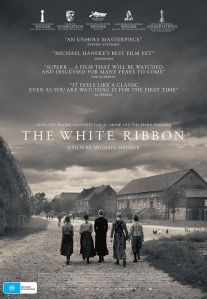 After all the awards and hype, I’m left fairly unmoved. I think I’m just not a fan of the director; I disliked Funny Games, disliked The Piano Teacher, and think Cache is vastly overrated. Michael Haneke is just not for me, and The White Ribbon is further proof of this fact. This is two and half-hours of incidents. Supposedly, since its victory at the 2009 Cannes Film Festival, this movie was dubbed as a case study examining the beginnings of antisemitism as a small German town undergoes a series of mysterious violent assaults and vandalism. I don’t know how in the world this explores any sort of psychological group think to later clarify Germany’s willingness to accept Hitler’s demands. All this movie does is show yet another example of teenagers rebelling. In typical Haneke fashion, characters can be unbelievably cruel to one another at the flick of a switch. Nothing really adds up and the pacing is so mind-numbingly deliberate to showcase the world of pre-World War I Germany. So when people leave the room we watch them walk off screen, hear their off screen noises, then they return and go off screen again and we can repeat the same jolly waiting game. I understand the artistic thought behind it, but I’d be much more forgiving if Haneke had developed a story and some characters worthy to wait for. This is a plodding and conceited exercise that reveals next to nothing about the human condition for cruelty, because, chiefly, you don’t really believe that these people exist nor do you care.
Nate’s Grade: C
Share this:

Sin Nombre (2009)
 Part immigrant drama and part crime thriller, this stirring film is one of the rare instances where I was begging it to be longer. Writer/director Cary Fukunaga intertwines two tales, a southern Mexican family riding atop a train car to reach the U.S. border and the moral journey of a gang member who turns on his brothers during a crisis of conscious. Everybody is on the run, from the border patrols to the blood-thirsty gang members seeking vengeance. Fukunaga gives this tale startling realism without diverting to self-consciously docu-drama camerawork. I was fascinated by the details of life atop a train, the determination of these family members for a better life, and I was thrilled with the many near misses and escapes. Sin Nombre is such an accomplished movie that it’s hard to believe that it is Fukunaga’s first feature film. It mixes social commentary with film noir, an unlikely romance and plenty of naturalistic performances. The cinematography is gorgeous and crisp, beautifully showcasing the squalor and arresting countryside. My one complaint is that the movie gets into a new gear of added conflict, and then it quickly comes to an end at an all too brief 96 minutes. I really could have done with another 20-30 minutes of our main characters on the run for their lives. Sin Nombre roughly translates to “the nameless” and I can all but assure you that Fukunaga is a filmmaker who will most definitely not remain nameless.
Nate?s Grade: A-
Share this:

Waltz with Bashir (2008)
 A mix between animation, documentary, and war drama, this Israeli film is something uniquely different and remarkable. Filmmaker Ari Folman interviews fellow veteran servicemen from Israel’s 1982 invasion of Lebanon in hopes of jogging his memory. He has blocked out the painful memories of war but his mind is reawakened as he reexamines the truth about the conflict and eventual massacre of Lebanese Arabs. Folman utilizes a rotoscope style of animation, which gives it a heightened reality and an intoxicating painterly beauty. He also takes advantage of the fact that atrocities can be easier to stomach when presented through the barrier of tasteful animation. However, it will be hard to keep from being affected (a scene of dying horses got to me bad). The realms of reality, fantasy, nightmare, and memory can crash together in fascinating ways, and eventually the movie transforms outright into a full-fledged documentary that melts away any last obstacle of empathy, ending with real disturbing footage of the massacre’s aftermath. Waltz with Bashir does not come with an agenda in tow, which allows the movie to explore the ambiguities of being young, nationalistic, confused, and armed in a hostile land. Folman is trying to peel away at the unbiased truth of the matter and cleanse his curiosity and, perhaps, his conscience. His filmic journey to that elusive and painful truth is a movie that crosses cultures and redefines what a documentary can be.
Nate’s Grade: A
Share this:

Tell No One (2008)
 Now this is a thriller made with surgical precision. This French film traces a doctor trying to uncover the mysterious murder of his wife, who may be alive after all. The doc needs to stay one step ahead of the police, who still think he’s responsible for his wife’s murder, and he has to also watch out for other shady figures who may be responsible for his wife’s disappearance. This engrossing thriller is character-based and while the twists and turns could induce whiplash, nothing feels totally out of place or unbelievable. This is a movie that holds up upon reflection. All the pieces fit together. Tell No One is exciting, intellectually stimulating, and it keeps you guessing, and yet the movie has a deep emotional core and resonates with palpable feeling. This is a terrific movie that should appeal to just about everybody with a pulse.
Nate’s Grade: A
Share this:

Gomorrah (2008)
 In the Bible, God promised not to obliterate the town of Gomorrah if Abraham could find a righteous man. That didn’t work out so well. This stirring Italian crime drama explores the long-reach of the Camorra crime syndicate stationed in Naples. The oldest Italian criminal organization is larger than the mafia, and the film’s four overlapping narrative threads showcase how the Camorra has a grip on every industry. The usual criminal enterprises are there, from drug trafficking to hired murders, but the organization is also deeply involved in the fashion industry as well as toxic dumping; in a perfect metaphor for the entire film, the Camorra is profiting by burying toxic death just below the surface. The objective docu-drama style lends disturbing reality to the ordeal, though the screenwriting too often feels like a pumped-up “true crime” novel – there’s far more emphasis on the minute details than the people. The movie makes empathy nearly impossible, not that this is necessarily a stinging detriment. The movie steers away from the excitement of violence and instead the death is merciless and swift and unexpected. Gomorrah strips away all the romantic notions involved with the gangster lifestyle; the two teenage gangster wannabes who quote Tony Montana are in for a rude awakening by the established toughs. The movie can be punishing and bleak but it’s always fascinating and told with factual backing that makes it spooky. It may not be as powerful or intense as 2002’s City of God but this is certainly one movie that can be punishing and bleak but it’s always fascinating.
Nate’s Grade: A-
Share this:

Let the Right One In (2008)
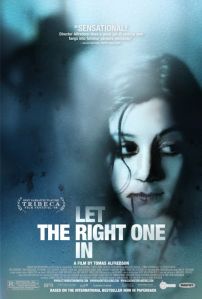 This is a pre-teen vampire love story that is miles away from Twilight folks; it’s solemn, mature, stark, violent, tense, and astoundingly ambiguous. Director Tomas Alfredson pares down the emotions and the entire film takes on a very reserved and curious atmosphere, which I feel heightens the sense of wonder and dread about a supernatural romance. The relationship between 12-year-old Oskar (Kare Hedebrant) and 12-year-old looking vampire girl Elie (Lina Leandersson) is entirely believable and constantly intriguing, as key information is doled out like breadcrumbs. Oskar is negotiating puberty and Elie is well aware of what awaits. The movie works as an example of methodical horror where emphasis is placed upon anticipation and the imagination. The climax at a community pool is one of the best film finishes of the year. I was a tense ball of nerves, and I love the movie’s closing shot. Even better, the movie works as an intriguing and intricate drama about human relationships. I can revisit Let the Right One In and dub it an unconventional and moving romance. Or I can revisit the film and dub it a melancholy examination of a manipulative and parasitic relationship, as Oskar might be doomed to a fated life like Elie’s former guardian. I can keep revisiting this Swedish horror film and discover more to discuss and diagram each time. And I didn’t need a single scene where the vampires played super hero baseball games.
Nate’s Grade: A-
Share this:

Reprise (2008)
 This very New Wave-styled Norwegian film manages to be thoughtful and intelligent, stylish without being vapid, touching, and it brilliantly captures the exuberance of youth on the cusp of adapting into maturity. Reprise follows two best friends and aspiring writers; Phillip finds success immediately but cannot handle it, and Erik must fight through rejections. Director/co-writer Joachim Trier (cousin to Lars) has given the film a hypnotic triptych narrative structure, meaning there are flashbacks, flash forwards, flashbacks within flashbacks, and the viewer is best advised to just succumb to the thrills of the narrative and sort it all out later. The structure made me feel totally immersed in the lives of this small unit of 20-somethings. You get a lifetime of detail thanks to the tangential narrative structure and the help of an occasional narrator. The film has a remarkably deft touch when it comes to crafting realistic characters; the pangs of uncertainty, jealousy, and insecurity all ring true without being trite or obvious. But the movie never gets dour or pretentious as it covers weighty topics. The movie also has an indelible energy that is hard to ignore. Reprise is playfully edited and constantly moving, sometimes forward, sometimes backwards, sometimes telling us a possible scenario that sounds better than reality. I found several small moments to be provocative, like Phillip trying to replicate the happy memories of time and place by trying to re-stage a photo of his girlfriend with his girlfriend (a lovely Viktoria Winge). Reprise is full of small tender moments that speak volumes. This is a terrific film brimming with life and verve and clearly targets Trier as an inspiring filmmaker to watch.
Nate’s Grade: A


 nathanzoebl
You must be logged in to post a comment.