Blog Archives
The Only Living Boy in New York (2017)
 The Only Living Boy in New York may have made me hate New York. I was rolling my eyes at about every moment of this movie, not just because it wads cliché, not just because it confused the cliché with transcendent and relatable commentary, not just because the characters were aggressively loathsome and inauthentic, and not because it appears to be someone’s idea of Graduate Lite (though, yes, these are all contributing factors). It’s because the movie takes the easy way out at every route and wants to be congratulated for its artistic integrity.
Thomas (Callum Turner) is a twenty-something who feels that New York City has lost what made it special. He’s drifting through life, thinking about becoming a writer, and also trying to romance his best friend Mimi (Kiersey Clemons). His mother (Cynthia Nixon) self-medicates via dinner parties. His father (Pierce Brosnan) has a different approach, namely sleeping with another woman, Johanna (Kate Beckinsale). Thomas follows Johanna and makes his presence known to her. He convinces himself he’s falling in love with her and impulsively chases her as a romantic option as well.
 I think the movie wants me to be charmed by its male lead, the young protagonist that looks like a lanky Richard Gere. This twerp made me so angry and he pretty much embodied a creepy blend of entitlement. He’s tired of being in the friend zone with Mimi, but he keeps pushing, sneaking unauthorized kisses, and trying to wear down her defenses after she’s told him no. She’s annoyed that her friendship is by itself not good enough for him, and even though they had one “magic night,” that he won’t accept her repeated stances about not wanting to be together romantically. But what’s a woman’s ability to choose matter to Thomas, who we’re constantly told from every other character in this stupid movie, is clever, bright, good, virtuous, and a prized talent in the making. The movie never shows you these things, never provides evidence of his talents or even his virtues, and so it becomes another series of empty gestures. He’s just so captivating that all the women of New York can’t help themselves around him. This wouldn’t feel so tone deaf and backwards if the film did a better job of making Thomas feel like a living, breathing human being rather than some misguided, coming-of-age hipster creep.
The premise here has promise, a wayward son who ends up having an affair with his father’s mistress. That could work and devise plenty of palpable dramatic tension. Except because we never get to know Thomas beyond a superficial level, the affair only feels like another conquest of entitlement. Even a more interesting subtext, punishing his father for putting their family dynamic at risk, is only kept at a distance. What does Thomas learn about himself, his father, Johanna, or the world through his affair? If you cannot come up with a good answer then that means your plot point is lacking substance. Perhaps they just like the danger or the attention of one another, and yes Beckinsale (pick an Underworld movie) is an attractive woman so that’s a plus for a horny young lad. Most frustratingly, nothing seems to be pressed by this affair. It pushes some eventual third act confrontations but Thomas and Johanna’s tryst, for lack of a better term, just kind of lies there. It doesn’t do much, which is strange considering what it involves. It feels like its real purpose is to engineer jealousy from Mimi, which is gross. Johanna is never more than another trophy for the most blithe boy in New York.
The drama is pitched to a level that feels like it dances into self-parody, except it plays everything so unrelentingly serious. The narration begins by calling out life moments pulled from movie watching, but then it presents these very moments without any ounce of satire. We open with a New York dinner party where the attendees lament how the city has lost its soul (“The only soul left is Soul Cycle,” someone says like the worst 1980s stand-up comedian). Oh no, CBGB’s closed down. Oh no, there are Starbucks on multiple corners. Oh no, a city of ten million plus people is now only a commercialized hell, worry the rich elites from their ivory towers and their faulty memories of New York City being more pure when it was older. Not one character feels like an actual human being in this screenplay by Allan Loeb (Collateral Beauty). This is the kind of elitist, out-of-touch, artificial, self-involved characterization of New Yorkers that hacky conservative writers like to cling to when criticizing their big city targets.
 The actors do relatively fine work with what they’re given, though special mention to Brosnan who tries his hardest to imbue notes of complexity in a character that, for 90 percent of the movie, is set up as a snide and disapproving patriarch. I don’t want to give up on Turner (Assassin’s Creed) as an actor because the part did him no favors. Mostly I just felt sorry for them. Cynthia Nixon deserves better. The charming Kiersey Clemons (Dope) deserves better. Jeff Bridges is an executive producer, so he deserves what he gets as an alcoholic author/mentor with an out-of-nowhere ending that feels pulled from a soap opera. These characters are powerfully boring, shallow, and unappealing.
At only 88 minutes long, The Only Living Boy in New York still feels punishing in length, protracted, and not worth the overall effort. Even the title makes me irritable. It’s a reference to the Simon & Garfunkel song that you better believe will get played, one more desperate attempt to glom onto the legacy of The Graduate. The title refers to Thomas, our entitled hipster of a lead, but does that mean that he’s the only one who really feels things, man, because the rest of us are just dead to the world, living our lives, and this hip young man just sees through all the nonsense of the day-to-day and, man, if only we could give him the platform he so rightly deserves then we’d all be better off. I wanted the cameraman to abandon the film and run a few corners and join a new set (it’s New York City, so by the law of averages, there has to be another film shoot a few blocks away). The Only Living Boy in New York is insufferable, haughty, pretentious, privileged navel-gazing masquerading as deep thought; it is smug New York hipster twaddle.
Nate’s Grade: D+
Share this:

Fences (2016)
 There’s something about plays turned into movies that bring out the best in actors. Usually they provide meaty characters with flaws and big personalities, which lend themselves to big performances that touch upon every emotion in an actor’s kit. Fences is based upon August Wilson’s Tony-winning play set in 1950s Pittsburgh. It follows the fractious household under the indomitable influence of Troy Maxson (Denzel Washington, also serving as director). He’s a complex man prone to bold protestations and morally righteous fury, but he’s also deeply imperfect, hypocritical, and consumed with self-doubt over whether or not he has done right by his family. He’s a man trying to still assess his place in the world and what is owed. Troy’s older brother (Mykelti Williamson) has been mentally incapacitated from his war service and Troy has been living off of his brother’s wages. Troy’s oldest son doesn’t feel like he ever had a father, Troy’s youngest son wants to devote a future to sports, which Troy adamantly refuses, still nursing a grudge over his failed potential that was never capitalized in his mind. Then there’s Troy’s wife Rose (Viola Davis) who tries to keep her blended family together though Troy’s actions will test the boundaries of her devotion and affection. As expected, the performances are outstanding, lead by Washington and Davis reprising their Tony-winning roles. When these two sink into roles worthy of their caliber, it’s a pleasure just to sit back and watch the high-class mastery. Washington lights up the screen with the overwhelming power of his performance; you feel like your ears are pinned back by the sheer volcanic strength of his acting. Davis has her moments and she tears your heart out when she lets loose on a life of compromises to sustain her husband. The characters are so multi-layered with such plentiful history and generational conflicts. Every actor gets his or her moment to shine and do an excellent job under Washington’s direction. The movie is little more than a filmed version of the stage play, and the pacing is a bit loquacious for being almost two and a half hours, but Fences rises on the sheer power of its performances with expert actors giving all of their considerable skill to bring these fascinating people to vivid life.
Nate’s Grade: B+
Share this:

Little Boy (2015)
 I was expecting to bury Little Boy in an avalanche of negativity once I found out a late plot point that made my jaw drop. This inspirational Christian independent film is set during World War II and features a pint-sized moppet, Pepper (Jakob Salvati), whose only real friend is his father (Michael Rapaport), who is now serving in the fight in the Pacific. He’s told that through the power of belief he can accomplish great things, and well, he really wants his dad to come home. So through the power of belief he causes… the dropping of the atomic bomb (WWII aficionados will recognize the nickname of the bomb). I was waiting for the moment and amping my sense of dread and moral outrage. A funny thing happened on the way to a nuclear bomb detonation, and that is that Little Boy is a fairly agreeable and effective family film that conveys a message with a welcomed degree of ambiguity and complexity and tolerance. This is a Christian-themed film about the power of belief but at no point does it make explicit whether it’s coincidence or the power of Pepper channeling God. Part of Pepper’s list of good deeds given to him by a priest (Tom Wilkinson) is to befriend a Japanese neighbor who returned home from an internment camp. The movie shows how casual these small-town folk indulge in racism and bullying. The Japanese man is also an atheist and I was legitimately astonished that the movie never makes a judgment about this. He’s treated as a complex man with his own system of thinking, and he’s not viewed as lesser or wayward because of his lack of belief in a higher power. Little Boy is no God’s Not Dead. The melodrama is well paced, the acting is solid if a bit heavy on long bouts of weeping, and the movie undercuts what normally would be the inspirational apexes with harsher reality. The bomb is dropped, and Pepper is initially celebrating until he discovers the total horror of Hiroshima. His “wish” may have even backfired with his father getting further punishment in a POW camp. While I still find the development tacky, I have to reluctantly credit the filmmakers for refusing to pander in a style that removes the complexity and ambiguity of real life. It’s still a movie and it still has a rather predictable albeit emotionally earned ending, but Little Boy might just be one of the biggest surprises of this year for me at the movies.
Nate’s Grade: C+
Share this:

Nebraska (2013)
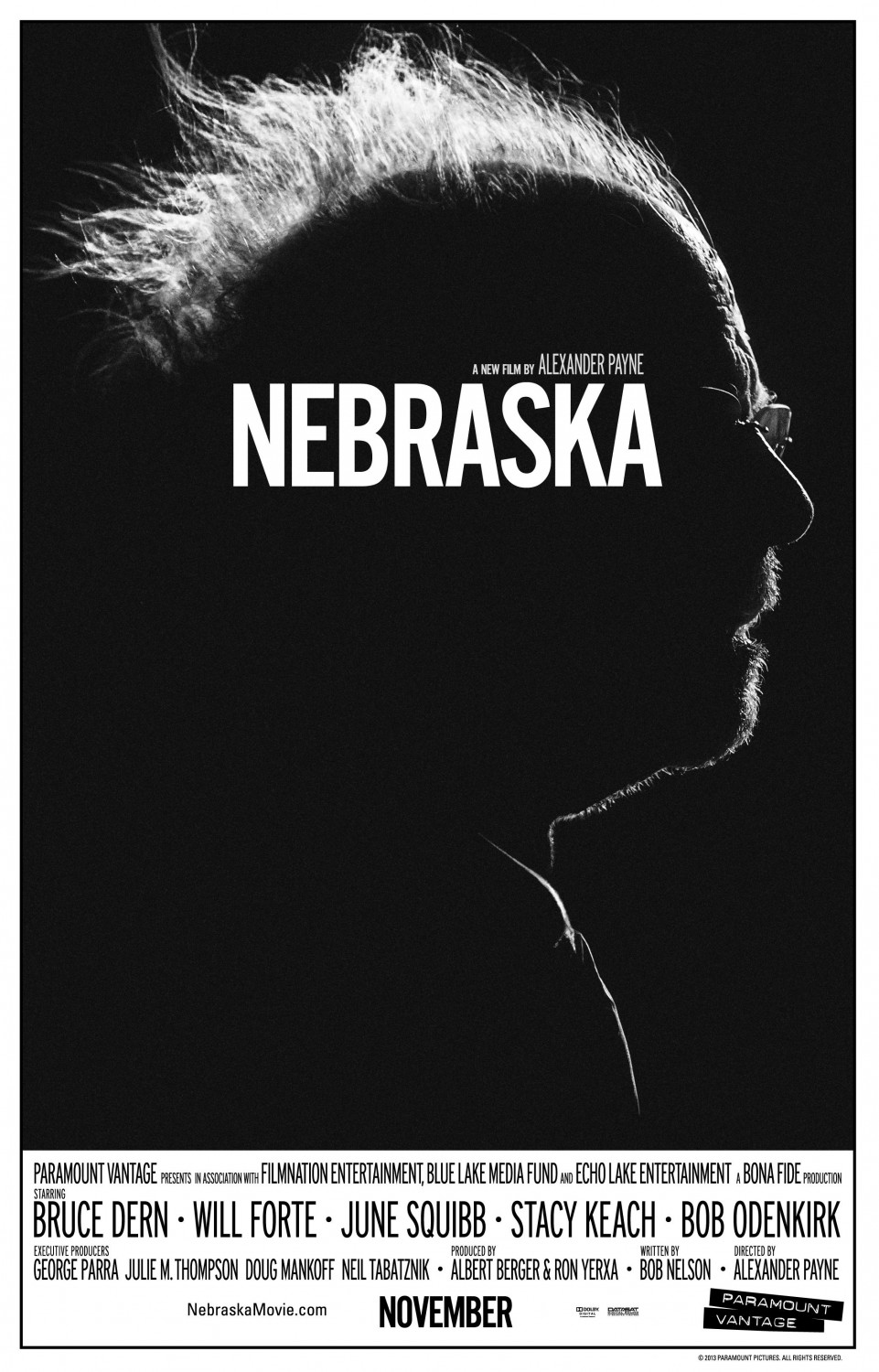 Nebraska is a slow burn, wryly-funny character study of understated proportions, highlighting Midwestern culture rarely given its big screen due. So, in essence, it’s an Alexander Payne movie.
Woody Grant (Bruce Dern) is an elderly man convinced he has won a million dollars and all he needs to do is travel to Lincoln, Nebraska to claim his loot. It’s one of those mass mailings really meant to get people to buy magazine subscriptions, but Woody will not be stopped, sneaking out to walk all the way to Nebraska from his home in Billings, Montana. David (Will Forte) is in a rut himself. He’s recently been dumped, his job is going nowhere, and his father refuses to accept his million dollars isn’t real. There’s a question of how lucid Woody is, and so to placate his old man, David decides to drive his father to pick up his winnings, to humor him before his mind may be gone for good.
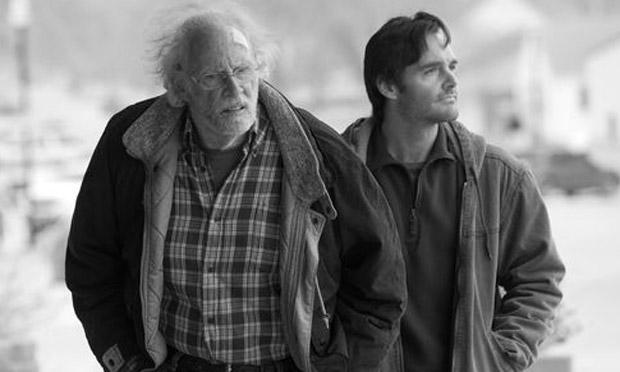 Despite the overtly sitcom machinations of the inciting incident, which even the characters dismiss, the film is really a drama about the relationship between a father and son and the culmination of our life choices. Woody and David are not close by any conventional means but over the course of their road trip, David begins to see his father in a different light; the old wounds are not forgotten, but David is learning about who his father is through others. He’s been so mad at his father for so long that it was the only identity he had for the man. Now in his deteriorating mental state and physical fragility, his father has a sense of vulnerability that brings about decidedly mixed emotions. In his fragile state, is he the same man or at least the same man David remembers? Then there are all the family revelations springing out from the situation. With a genuine millionaire in their midst, the family is coming out of the woodwork clamoring for their own pieces for all the unpaid assistance they’ve given Woody over the years. Initially, it makes Woody look like he’s been stuck trying to find his footing his whole life, as we learn about the lingering post-traumatic stress effects from his war service. Was he lazy, undiagnosed PTSD, or, as another character surmises, too ashamed to say no when others asked for help, and so he was taken advantage of in the guise of assistance from unscrupulous friends and family. The question remains who is Woody?
This is one of those observational slice-of-life films, and your enjoyment of it will depend on your threshold for the taciturn types. These are the strong silent types who keep most of their feelings to themselves. There’s a very funny sequence where Woody and his aged brothers have gathered around a TV, and to listen to the dry mostly car-related conversation bounce back and forth like a dead, floating wiffle ball, is a great comic moment but also a nice insight into an older generation and their communication. Given the perspective of the film, it’s hard to deduce whether the plainspoken people are being satirized or whether it’s a loving send-up of a specific culture. With Payne’s involvement, I lean more on the affectionate tweaking rather than a mean-spirited ridiculing of small town folk and their small town ways. There are funny situations, like David and Ross teaming up for some misplaced justice, and there are characters more broadly drawn for laughs, particularly Woody’s wife (June Squibb), but the overall interaction of the characters, their speaking vernacular, and how they viewed themselves, that is what made me laugh the most and appreciate the script. You feel like you’re dropping in on these people’s lives; every character feels like they could be a real person, not a stereotype. And boy does money really bring out the worst in people.
With Woody and his son visiting his old haunts, the movie inevitably becomes a reflection of a man taking stock of his life, regarding the choices he made and did not make. The pit stop in town opens up the character and David learns far more about his father, with old girlfriends, old business partners, and old rivals. What I appreciated further is that Nebraska doesn’t try and soften Woody; he’s not going to be some old curmudgeon who over the course of 90 minutes has his icy heart thaw and comes to realize the errors of his ways. Nope. Our views on the old man may soften when we get a fuller picture of who he is ad the life he’s lead, but the man himself is the same. He’s readily belittled, insulted, looked down upon, even by his own family members, especially his sassy wife. It’s easy for him to retreat into alcohol and wonder what if. As the family picture broadens and becomes more clear, the film approaches simply yet touching revelations about the family and the nature of legacy. There’s a father/son examination, but there’s also the discussion of what to do when your parents become too ill to take care of themselves. It’s not exactly The Savages, but there’s a circling sense of burdensome decision-making that provides an extra level of pathos to the sitcom setup. By the end, Nebraska squeezes out some earned sentiment without losing its edge or sense of identity. There’s a lot more going on then just some send-up of rubes.
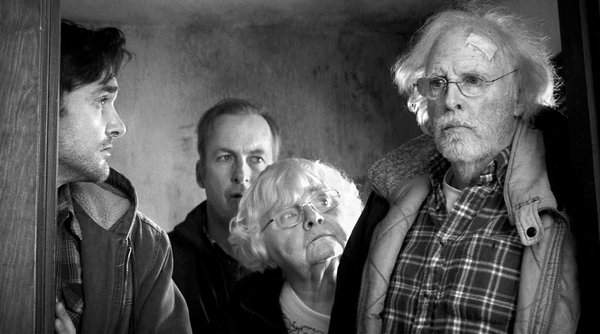 People have been raving about Dern (TV’s Big Love, Django Unchained) ever since the film’s Cannes premier, where the man earned top acting honors. The man deserves every positive words penned. He’s simply fantastic. The character vacillates between outward hostility, spacing out, and general Midwestern emotional reserve, and Dern is able to sell you on every emotional beat without breaking character. He’s unrepentant and demands to be taken for who he is, and his matter-of-fact bluntness has a certain charm to it, like when he admits to David that he never had any plans for kids. He just liked to “screw” and their mother was a Catholic (“You do the math”). I even appreciate that Woody would use the term “screw,” which seems more appropriate. As a two-man show, it’s a shame that Forte (TV’s 30 Rock, The LEGO Movie) doesn’t exhibit the dramatic chops to keep up with his onscreen pop. It’s nice to see him attempt something so different but his limitations are too evident; it’s just another gear that’s not present. At no point would I call Forte’s performance bad but he’s just unable to keep up. Squibb (About Schmidt, Meet Joe Black) is a hoot though the character seems to be permanently stuck in “wacky” mode. She’ll crack you up with her unrestrained commentary, but you may wonder if there’s any more to this character than saying outrageous, curt comments.
This was the last Best Picture nominee I’d failed to catch up with, and while it’s entertaining, funny, and unexpectedly touching thanks to terrific acting and a sharp script, but it also might be the weakest Alexander Payne film yet. This is the first film that the Oscar-winning director hasn’t written himself. Bob Nelson’s screenplay may never have even been glanced over by Payne had it not been for the state of its title (Payne’s films general take place in Omaha). It’s got Payne’s stamp, as would any film he directs, but it also feels like it’s missing something ephemeral, not to get too pretentious. This is a quality study of a cracked group of characters that, upon further review, aren’t as cracked as we may think. They’re just flawed people trying to get along as best they can. Even amidst the snide and antagonistic conversations, there’s gentleness here about the value of family that resonates above the din of the shouting. By film’s end, what started as a cockeyed sitcom transforms into a film that has more meaning and emotion, never betraying its guarded sense of self. When I say the weakest Payne film, this is not an insult but merely an observation. Even the weakest Alexander Payne film is going to be so much better than just about everything out there.
Nate’s Grade: A-
Share this:

The Place Beyond the Pines (2013)
 Ambitious filmmaking is welcome, but usually ambition leads somewhere, which is the main problem with co-writer and director Derek Cianfrance’s unwieldy 140-minute multi-generational crime drama, The Place Beyond the Pines. First we watch Luke (Ryan Gosling) as a traveling motorcyclist enter a life of crime to support his infant son. Next the focus shifts to Avery (Bradley Cooper) as a cop with a conscience running into corruption on the force. Last, we jump ahead into the future and watch the dramatic irony unfold as the children of Avery and Luke interact, waiting for them to learn their paternal connection. I believe Cianfrance (Blue Valentine) and his team was attempting to tell a meditative, searching drama about children paying for the sins of their fathers, the lingering fallout of bad decisions and moral compromises. Except that’s not this film. By the end of the movie, while some secrets have been laid bare, there really aren’t any significant consequences. The film does an excellent job of maintaining a sense of dread, but it doesn’t come to anything larger or thought provoking. The entire structure of this film is geared toward a tragic accumulation, but it just doesn’t materialize. That’s a shame because it’s got great acting through and through, though I have grown weary of Gosling’s taciturn antihero routine that seems like a rut now. Avery’s portion of the plot was the most interesting and anxiety-inducing, but I found the movie interesting at every turn. The characters are given pockets of nuance and ambiguity as they traverse similar paths of desperation and conciliation. The Place Beyond the Pines is a perfectly good movie, albeit disjointed, that cannot amount to the larger thematic impact it yearns for.
Nate’s Grade: B-
Share this:

After Earth (2013)
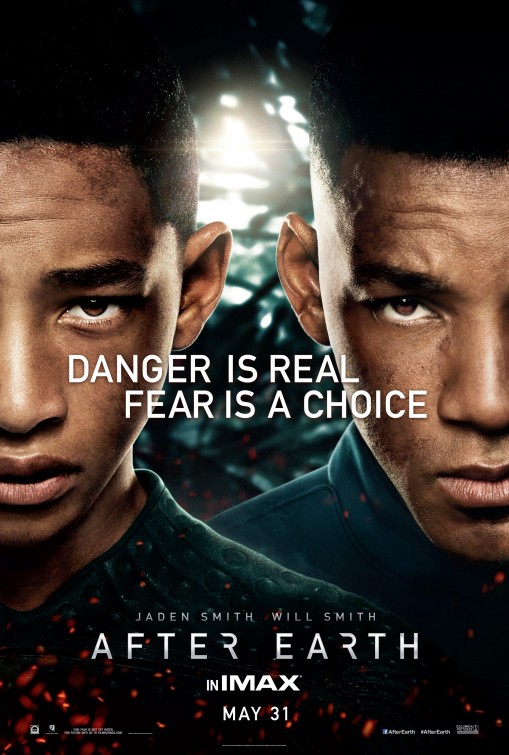 Rare is the movie that just seems to fail at every level of filmmaking, from writing to direction to pacing to casting to production design to logic to, well, you name it (perhaps the craft services were the exception to the rule). Director M. Night Shyamalan’s After Earth is one of those exceptional, big-budget passion project failures that just mystify on every account, making you scratch your head and wonder who could possibly be passionate about something this utterly terrible? I’m reminded of John Travolta’s 2000 sci-fi Scientology-ode, Battlefield Earth, for a comparison that comes close to approaching After Earth’s star-powered ineptitude (this movie also has plenty of vague Scientology references as well). While I doubt this will kill anyone’s careers associated, though it probably eliminates some good will for the Smith clan, it definitely piles more dirt on the grave that was Shyamalan’s film career. Enough preface, let’s get into the meat of why After Earth is one of the worst sci-fi films in years.
In a sloppy bit of exposition, we’re told that humans left planet Earth after we made it too unsustainable. The human race then colonized an alien world except that the indigenous aliens weren’t too happy about this. The aliens made a space monster, known as an Ursa, which would track and kill human beings by sniffing out their fear pheromones. Cypher Raige (Will Smith) rises in the ranks of the Ranger corps because he has the unique ability to “ghost.” Because the man does not register fear he is able to sneak around the Ursa as if invisible. His relationship with his teenage son, Kitai (Jaden Smith), is strained at best. Dad has been gone a long time and has high standards for his boy; the kid has to refer to him as “sir” even at the dinner table. Father and son are traveling through space when their ship crash-lands on good old Earth. Cypher’s legs are broken and he entrusts his son to make the trek to send out the distress call. The dangers of Earth, we’re told, have only magnified since humans left, and the Ursa onboard their ship has escaped.
Oh boy, where to even start with this one?
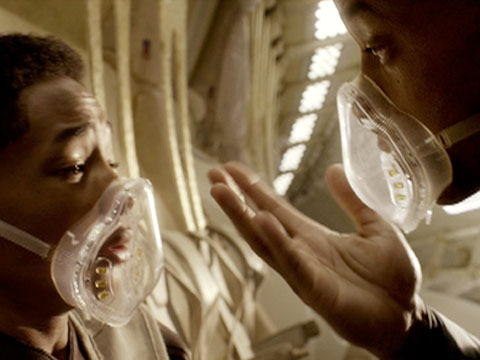 I’ve got a great idea, let’s take one of the world’s most charismatic actors and then turn him into a stone-faced hardass, terse with words of encouragement, and mostly sidelined so that his son can go on his stupid hero’s journey. I suppose Smith deserves some credit for stepping outside his comfort zone to play against type, but that praise only matters when the portrayal works. Smith is arguably miscast in his own passion project. That’s because this was really a $130 million dollar birthday present to his son, trying to use dad’s star power to establish Jaden as a star. It’s less a movie and more like a product launch. On its face, I don’t really have an issue with this. Nepotism has been alive and well in Hollywood for over 100 years and those in power have been producing vanity vehicles for their beloved for even longer. What I chafe at is that the finished product is so lacking and unconvincing. Jaden was cute in 2010’s The Karate Kid remake, a movie that was far better than it ever should have been. Unfortunately, After Earth came at that special time in his life known as puberty, so he gets his lanky, squeaky-voiced, awkward growth stage forever captured on film. Thus when he gets into a huff, squeals at his dad, and then become the world’s most improbable super warrior by film’s end, it mostly brings about snickers. You don’t buy a second of this character’s ascent to hero.
Let’s tackle the ultimate elephant in the room here, namely the involvement of Shyamalan. This is his first project he didn’t conceive; Smith himself came up with the story and personally hired Shyamalan. Who deserves more of the blame? There’s a reason why the marketing for After Earth has not breathed a word about Shyamalan’s involvement. In my theater, when the end credits appeared and it opened with Shyamalan’s director credit, the guy behind me remarked, “Well, that figures.” His sense of dissatisfaction now had a tangible culprit. It’s almost become a joke how much of a critical punching bag Shyamalan has become as a filmmaker. The man has genuine talent but it’s five duds in a row (I am counting The Village) and not even the world’s most bankable star could have saved this movie. As anyone who witnessed the atrocious Last Airbender can attest, Shyamalan is not a filmmaker who works well with a big special effects canvas. I’d suggest that Shyamalan, besides taking some time off, which may be a self-prescribed death sentence in Hollywood, find a smaller project to foster, perhaps something more personal and intimate. Nobody except the sadistic enjoys watching once-promising talents keep hitting a brick wall. Then again, people also dislike having to pay for terrible movies, especially when the director of said terrible movies keeps getting the opportunity to deliver more disappointment.
The plot, which Shyamalan is credited as a co-writer for, is so dull that I found myself almost falling asleep. You would think father and son surviving crash on a hostile alien world would be packed with survival thrills and excitement. You’d be wrong. It’s as if Shyamalan takes a page from Smith’s ranger character, and just goes about its business in the most thankless, ho-hum, undeterred manner. When we have characters that don’t react to the danger they’re in it has the misfortune of feeling less real, less urgent, and less dangerous. This was a problem with The Matrix films when Neo became a super being because then the stakes evaporated. It’s hard to sympathize with characters that don’t reflect the reality of their setting. With that said, so much of this script is just Kitai running off and running into different animals. He meets baboons. He meets a tiger. He meets an eagle. He meets a slug. Scintillating stuff. Such ambition. If this is what the execution was going to be like, why didn’t Smith and Shyamalan just make the planet an actual alien world? It would certainly open up the storytelling options. Or they could have gone in the opposite direction, setting this survival tale on a modern Earth. That would probably have made it much more relatable and resonant and also far cheaper.
 The character back-story is also woefully familiar and just as ineffective. Before it even happened, I knew that there would have to be some tragic personal history so that Kitai could overcome his past. We’re given some cringe-worthy moments of flashbacks to the family’s happier times, when Kitai’s older sister Senshi (Zoe Kravitz) was still alive. It’s a plodding and contrived plot device for the father to preposterously blame his son for, who was like seven years old at the time. I kid you not, during one of these oh-so-necessary flashbacks, Senshi tells dad she got a copy of Moby Dick and a boy let her hold it. Dad doesn’t get it, though I don’t know if this is meant to be some lame sex joke. This back-story is ladled in with no real logical connection to events. All of a sudden, Cypher will be thinking about his broken leg and then, whoosh, we’re thinking about Moby Dick.
There’s also the issue of its tenuous grasp on reality. I know this quality is a give-and-take depending upon the tone of the sci-fi film, but After Earth is so drearily self-serious that it becomes even more unbearable when it so clearly conflicts with credulity. This movie’s big message that it pounds into your head repeatedly is that fear is a choice, fear is not real, and that fear is a hindrance for mankind’s progress. This is nonsense. Fear is what kept our ancestors alive rather than trying to play with larger predators. Fearlessness is a great way for your species to end. You know an animal without fear? Lemmings. The fact that the movie has to literalize this conflict in the form of a fear-smelling alien monster is just beyond absurd. Let’s keep this literalizing-of-theme going; maybe next the aliens will fashion a monster that smells intolerance or illiteracy. Why are these aliens even genetically creating a monster to do their dirty work? If they have the superior scientific prowess to create a gnarly beast, I’m pretty sure they can take care of mankind. On top of this assertion, why would you make a beast that is effectively blind and only reliant upon one sense and then you limit that one sense to “fear”? Why not just have the alien monster smell human beings? That seems to make a lot more sense.
What also buggers my mind is the fact that, according to After Earth, everything on the planet has evolved to kill humans. First, I don’t think substantial leaps in evolution work in meager thousand-year spans; secondly, these evolved creatures are really just slightly larger versions of familiar animals, which doesn’t really make much sense either; and lastly, if humans have been off planet for a thousand years, how did these animals evolve to kill something they no longer have any interaction with? Then there’s the fact that the Earth drops rapidly into freezing temperatures overnight, for no good reason. How do all those plants survive? As an extension, Kitai’s super suit is just a prime example of a poorly developed idea that just as easily could have been abandoned. He has a special leotard that changes to his environment. We’ll watch it change colors though we’re never given any worthwhile reason why this is happening. However, Kitai’s suit will not shield him from Earth’s sudden temperature drops. So he’s wearing this super suit that adjusts to his environment… except temperature? If you’re going to present something all super scientific and then give it such obvious limitations, then you never should have introduced it in the first place. This is an ongoing theme with the film.
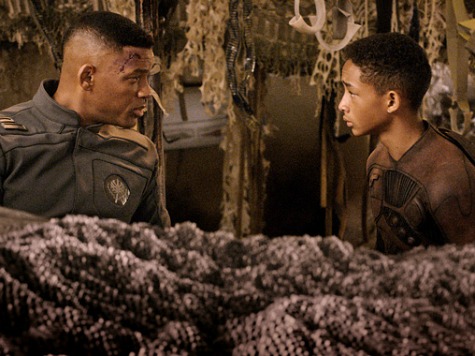 Then there are just nit-picky things like my total distaste for the production design of this movie. The spaceships look so chintzy. They have plastic flaps separating sections, like what you’d see in an office building when there’s construction. The spaceship interiors, as well as home interiors, also look like some bizarre mix of honeycomb and bamboo. I’m all for thinking outside the box when it comes to futuristic design, but this is just stupid. One of the great possibilities of sci-fi is to capture our imagination with out-of-this-world visuals, the unfamiliar, the spectacle of the alien. If your spectacle is good enough, it can even save a so-so movie, like last year’s Prometheus. Being stuck on Earth, only slightly different, emphasis on slightly, fails to deliver anything visually that will captivate an audience too often settling into boredom. Apparently After Earth looks pretty much like Earth except for Mount Doom popping up. The special effects are also lackluster and the score by James Newton Howard will try and trick you at every turn into thinking what’s happening onscreen is a lot more interesting than it is.
If you value your entertainment, please ignore After Earth. It doesn’t even work from a derisive enjoyment angle. The movie is lethargic and unimaginative to its core. It’s predictable at every turn and underwhelming throughout. The plot consists of the most boring father-son team in recent memory and a hero’s journey that feels false at every step. This big-budget star vehicle doesn’t work when its star doesn’t have the intangibles to be a star, nor does it help when the story is so poorly developed. The science feels boneheaded, the characters are dreary, the pacing sluggish, the spectacle clipped, and the world building to be bland. The shame is that this premise, even this exact same premise on a future Earth, could have easily worked as a suspense thriller. Smith seemed more interested in building an After Earth enterprise, since companion books were commissioned, and extending the reach of the Smith family empire. Making a good movie, it seems, was secondary. Being fearless also has its disadvantages.
Nate’s Grade: D
Share this:

49 Up (2006)
 In 1964, filmmaker Michael Apted (Coal Miner’s Daughter, Gorillas in the Mist) interviewed 14 seven-year-old kids from different British backgrounds asking them about their futures. The half-hour TV special by Granada was called 7 Up and it aimed to show the world where the future politicians and doctors and trash collectors would begin. Every seven years since, Apted has returned to those same kids and peaked in on their lives, chronicling their lives. It’s one of the most famous documentary series in history. Thanks to the virtues of Netflix’s streaming service, I was able to watch six of the seven movies in the Up anthology (sorry 35 Up, the lone film not available for streaming). I spent the next twelve hours watching the lives of 14 complete strangers from childhood to middle age, and by the end they didn’t feel like strangers any more. They felt, weirdly, like family. And that’s the true appeal of the ongoing series: you are watching the evolution of human beings. It’s not everybody that gets a visual scrapbook of their life that’s viewed by millions worldwide.
 Finally, after many hours, 49 Up is the first in the anthology to address the ideas of selective editing and building storylines to suit the “characters.” Long before reality television smoothed away life’s edges to make everybody fit into archetypes, Apted positioned the Up series as his thesis on class struggle. He purposely selected a cross-section of English schoolchildren from private schools and public schools and even two from a boy’s school for orphans. You can see it at 14, 21, and 28 how Apted sticks to his same line of questioning about class advantages and disadvantages, peppering his subjects with questions about what they didn’t have and then showing their current situations in a specific manner to make the audience feel a specific emotion. It’s not deliberately diabolical or partisan but the class warfare ideology certainly can chafe. Do the kids at the top still get all the perks? Are the kids at the bottom suffering with limited opportunities? Has anybody transcended class? Apted starts attributing achievements by the upper class boys as part of their upper class advantages and not due to their hard work, dedication, or talent, which they have every right to complain about. John complains at 21 that when, at seven, they declare their education ambitions, and Apted follows it up with narration, “John did attend such and such,” that it creates the illusion that everything has been handed to them. The hard work and long hours are not shown, and fair point. A few of his subjects actually begin to challenge Apted over his perceptions. Suzy takes aim at his line of questioning, hinting at her life’s disappointments, and fights back, accusing Apted of trapping her into a small narrative box. She even brings up another heated conversation in the history of the series, when Apted questioned whether Suzy, at 21, had experienced enough of life to settle down (she eventually divorced years later). You witness her youthful indignation and she remarks, with some resignation, that Apted is free to edit this outburst as he will and she is helpless (obviously Apted kept this in). It’s the first time I’ve seen the stars of Up contest their onscreen portrayals.
It is also with 49 Up that the film series starts to finally reflect. Part of that comes with living half a century, and many of the 12 on camera subjects are now at an age where they have grandchildren and are setting up retirement (I wonder what the economic meltdown of 2008 did for those plans). They can reflect about the accomplishments of their lives, the past dreams captured on camera that never came true, the marriages that dissolved, the joys and struggles of rearing children, the pains of burying parents, etc. They seem to be at that stopping point where they can take stock of a life lived. On top of that, the participants now begin to reflect on what being apart of the Up series has meant to them. It certainly shapes public opinion about who they are as people, and Apted gropes for any new info to connect with the prior material in the earlier movies.
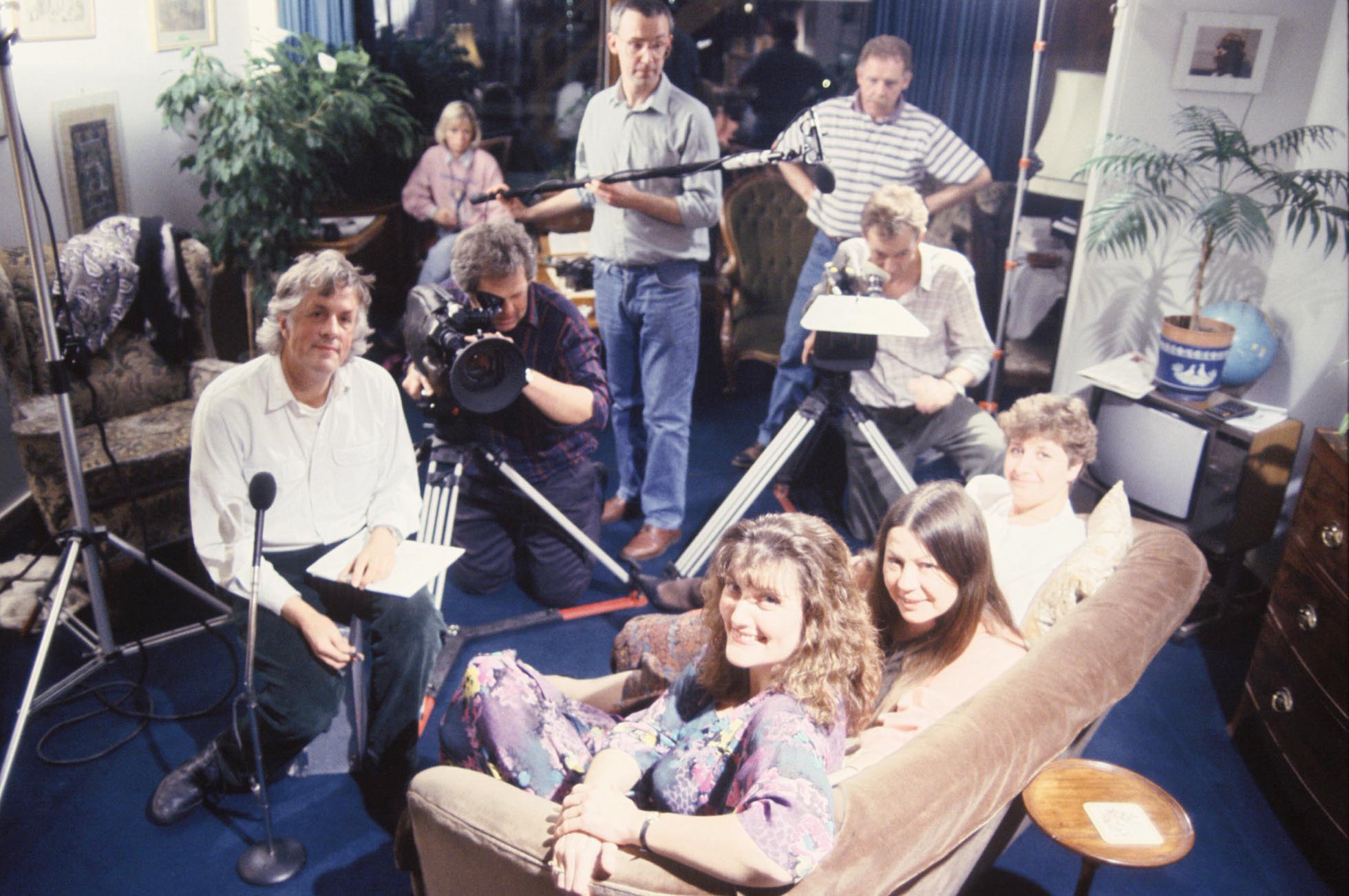 Perhaps Apted feels like he has to keep flogging his class thesis because most of his subjects are pretty regular, i.e. boring, people. They’ve lived lives of modesty and hardship and persevered, but they’re at heart no more interesting than your neighbors. The problem with selecting a bunch of seven-year-olds you plan to follow for the rest of their lives is that you have no clue what will happen. The narrative is completely up in the air. This is why Apted, early on in the series, sticks doggedly to his class thesis to provide some sort of framework he can revisit every seven years. That’s why the series starts to become something of an echo chamber. The exact same sound bytes get used over and over again, trying to find new relevancy. The adults get forever defined, and continuously redefined, by something they said at seven years old, like Neil’s worry that a wife would force him to eat greens and he “don’t like greens” (I’m in the same boat, kid). The echo chamber effect is even more obvious if you watch the Up series in a row. You will start to memorize the childhood catch phrase of everybody and then watch the same clips recycled from 7 to 42. Each is like a little stepping-stone to the present. When viewed as a whole, the series can almost come across as facile. Apted doesn’t probe very deep into his subjects and their lives, mainly sticking to the Life’s Checklist of Accomplishments of Being an Adult: school, job, spouse, family. Personally, I hate how we become defined by a profession. That seems to be the second question that rolls off our tongues when we meet a stranger: “Who are you and what do you do?” What do we do? That’s a loaded question and I object to the idea that our job is the only relevant thing that we “do.” But that’s just my hang-up, I suppose. Apted also lets his subjects reveal the biggest changes in their lives, meaning that if somebody doesn’t want to broach a topic then it gets left unanswered. It can get frustrating and makes for some opaque follow-up visits.
Not every participant is thankful for the Up series. In fact, many of them are wary and somewhat disdainful of participating. Every seven years these people have to rehash their life’s highs and lows, boil them down into a package, and then have it picked over by Apted and his leaning questions, stirring drama anew. It’s easy to see why this becomes a difficult and challenging experience for most, something akin to a cross-examination about your life. So why do most of the 14 return every seven years? Is it the secret hunger for fame? John Brisby ducked out of the Up series after the third installment, upset that he had been made into the series villain through editing. He came across pompous and like a prototypical “old money” sort who lived in a small privileged world (fox hunting!) and reinforced Apted’s thesis on class advantages. Of course his interviews didn’t help him, but I’ll give the guy the benefit of the doubt. I’d hate for everything I said when I was 14 and 21 to follow me for the rest of my life. Well, in 35 Up, John returned, though begrudgingly. He had a reason. His wife and he had begun a charity to raise funds to help the beleaguered educational state of Belarus, a country where John’s family once resided. In 49 Up, he travels once again to that ancestral country and he remarks, somewhat graciously, that it was directly because of exposure on the Up series that donations increased and the kids in Belarus today have books and school buildings and dedicated educators. John made the most of his fame and directed it to a worthy cause. Plus, it doesn’t hurt that John’s passionate desire to help Belarus (his wife is the daughter of an ambassador to the country) feels like the “character” of John has matured.
 Is there any sense of privacy when you know that cameras will be regularly scheduled to appear? There’s this enormous pressure to continue with the Up series, I imagine. But whom do these lives belong to? They were chosen by school officials and Granada at age seven, so they never really had much of a say in what has turned into a lifelong commitment. It seems that the world has a sense of ownership over these 14 individuals’ lives, an ownership that they never granted permission. They must feel an enormous obligation to keep informing the public about their lives, much like a nagging relative. We are a nosy, intrusive lot, human beings are. And I must say that I personally feel weirdly paternal about them. I feel happiness when they too reach happiness through whatever means. I was smiling from ear to ear when Nick, who at 14 was so shy and awkward, became a wonderfully charismatic, articulate, thoughtful, and rather handsome 21-year-old man (he looked strikingly similar to Andy Samberg). I feel despair as well when marriages don’t work out or once secure jobs vanish. Watching the Up series is like watching the evolution of a human being through time-lapse photography; it’s voyeuristic but at the same time it’s like having an extended surrogate family that requires no commitment. We can watch people grow up, mature, gain wisdom, and without anything more than the click of a button. We can watch hairlines get thinner, faces get larger, bodies get saggy, wrinkles multiply, all while playing the visual game of connecting the current iteration of participants with their past selves. We have these 14 people’s lives at our disposal for entertainment.
The Up series aren’t individually great documentaries. In fact, they’re pretty plain and not fairly insightful. As a whole, they present a fascinating document of the human experience and make for a great way to spend a rainy day. You can’t help but reflect on your own life after watching several of the Up movies, and curiously wonder what you have done with your own life at various intervals. As of this writing, all 14 original participants are still alive, which is somewhat amazing in itself. It will be morbidly interesting to see how the film series carries on after one or more of the participants pass away. Millions around the world will mourn what otherwise would have been a normal stranger passing. It’s probably selfish to keep hoping for future installments, and for the participants to keep updating me about their personal lives, but after a 45-plus year investment for some, it’s hard not to feel a sense of attachment to these people.
Nate’s Grade: B
Series Grade: A-
Share this:

The Namesake (2007)

Extremely heartfelt, this cross-generational family drama runs aground on some familiar territory but is boasted by strong acting. Whenever the film’s focus falls to the arranged married couple settling into a new country and a new relationship, that is when The Namesake is the most affecting and interesting. Too much time is spent on Gogol (Kal Penn) as their son who has completely embraced American culture and throws off his Indian roots. Of course he comes around in his opinion but his character never feels fully formed or completely believable, more like a composite of a prodigal son. Director Mira Nair has an obvious personal attachment to this tale of an Indian family trying to make their way in the U.S. of A, and she never misses her mark when dealing with the intensely decent and selfless father and his love for his wife. It’s a shame then that the movie shifts too much focus at the halfway point onto Gogol. The Namesake is touching and entertaining that’s a cut above thanks to sensitive performances.
Nate’s Grade: B+
Share this:

Before the Devil Knows You’re Dead (2007)
 Sidney Lumet is 83 years old and still directing movies, God love him. The man is behind cinematic milestones and classics like The Pawnbroker, Serpico, Dog Day Afternoon, Network, and 12 Angry Men, which goes back all the way to 1957 – 50 freaking years ago! The longevity of this man is admirable. He hasn’t pulled together a compelling film in some time, but Before the Devil Knows You’re Dead is a stirring, character-driven crime drama that reveals itself to be a first-rate melodrama.
The film is anchored by two huge performances by Philip Seymour Hoffman and Ethan Hawke, playing a pair of brothers both on hard times. Hoffman’s character, Andy, has been living well outside his means to keep up appearances and to sate his taste for a local heroin den. He’s in charge of company payroll and an internal review just discovered a pair of terminated employees still drawing checks, the source of Andy’s cash to pay for his lavish lifestyle. Hawke’s character, Hank, is behind on child support and belittled by his ex-wife. He’s having a hard time even finding the dough to pay the 100 bucks for his daughter to go see The Lion King in New York City. Andy hatches a scheme to solve both their money woes: they’re going to knock over a mom-and-pop jewelry store. It just so happens that the store belongs to Andy and Hank’s mom (Rosemary Harris) and pop (Albert Finney). The plan goes hopelessly awry and both brothers feel intense pressure in the aftermath.
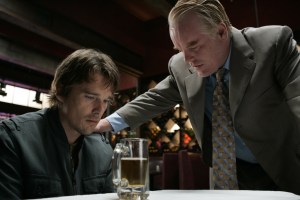 Lumet and debut screenwriter Kelly Masterson really know how to ratchet up the suspense. The nonlinear timeframe keeps the audience on its toes and continuously rewriting what we think we know. Unlike movies like Babel and 21 Grams, the plot is actually assisted by skipping around time and telling the story out of order. We get the basics and then the details begin to take shape, but because of the prior knowledge the film packs an increasing sense of dread that builds in intensity. As the brothers sink lower trying to cover their misdeeds, Lumet and Masterson crank up the tension to a peak. The knotted and twisty narrative exposes the fragile dynamic of this family and keeps the audience alert and hungry for more.
Hoffman is at his sleazy, duplicitous best with this performance. His character is a man accustomed to getting what he wants and he knows all the manipulative tricks to get there, be it bullying or cajoling. He’s a pusher with so much anger and desperation just below the surface. Andy never feels respected or loved by his father, and he has a great scene where he breaks down in a fit of rage and tears in response to his father apologizing for the bad upbringing. Hoffman imbues great emotional complexity to a man whose world is crashing down. It is enthralling to watch.
Not to be outdone, Hawke puts forth his finest effort of his career. He’s the baby of one very corrosive family; he misplaces trust and admiration in his big brother. Hank isn’t the sharpest tool in the shed but he has a distinct weariness to his worries, living day-to-day with the knowledge that the world sees him as a loser or a screw-up, losing the respect of his own daughter. When things go bad he unravels rapidly while still holding to his secrets. It’s a performance brimming with nervous anxiety, mounting regret, and self-effacement.
 The secondary characters don’t get nearly the attention and consideration. Marisa Tomei is more a plot device than a character; she’s Andy’s wife but has been having an ongoing affair with the more nurturing Hank. She spends most of her scenes in some form of undress and feels more like another notch in the complicated relationship between the brothers.
Finney is fine with a rather small role that merely requires him to be aghast or incredulous with the slow police work. I don’t know if a suitable Finney performance can compensate for a staggering leap of character late in the movie, but I suppose I’d rather have any Albert Finney performance in a movie than none at all. Before the Devil places Finney’s character on a perch and just doesn’t give him much outside of his own dawning realization of who was responsible for the botched robbery.
Before the Devil Knows You’re Dead is a gripping family tragedy that takes on a Shakespearean quality as it comes to a somber, chilling close. The wordy titles comes from an Irish drinking toast that states, “May you have food and raiment, a soft pillow for your head; may you be 40 years in heaven, before the devil knows you’re dead.” The message declares the inescapable consequences of our actions. This is a film about the disfiguration of one family; it’s bleak, tragic, but whole-heartedly entertaining and extremely focused in its aims. Lumet has returned to smashing form and reminds an audience that there’s still plenty of vigor left in this 83-year-old director.
Nate’s Grade: B+
Share this:

3:10 to Yuma (2007)
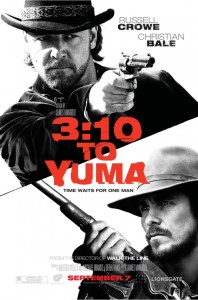 The Western used to dominate the pop culture landscape. In the 1950s, you had John Ford and Gary Cooper in a different dustup practically every week at the cinema, and the TV lineup was wall-to-wall cowboys, Indians, horses, and damsel retrieval. The Western has become rather inactive since its cultural heyday and now resides on the outskirts of movie land, idly chatting with Screwball Comedy and Busby Berkley Musicals about how good they had it back then (yes, I have just personified genres). With that said, director James Mangold (Walk the Line) has remade the 1957 John Ford film 3:10 to Yuma for a modern movie-going audience. The film has to work extra hard just to overcome the prejudices of a dormant genre, but fortunately 3:10 to Yuma is a rousing drama that could have knocked ’em dead way back when.
Dan (Christian Bale) is a wounded Civil War veteran trying to eek out a living in Arizona. He cannot grow any crops because of drought conditions, is behind on his payments, and his teen son has no respect for dear old one-footed dad. To keep his family financially afloat, Dan agrees to help transport notorious outlaw Ben Wade (Russell Crowe) to his date with justice.. It’s three days to ride across Arizona and get Wade onto the 3:10 train to Yuma prison, and along the way the posse is beset by unexpected setbacks and Wade’s gang hot on their heels to save their imprisoned leader.
 This is no deconstructionist Western or a modern revisionist Western, no this is an old-fashioned Western and Mangold embraces the genre staples instead of steering away from them (runaway stagecoaches, high-noon showdowns, ineffective lawmen, saloon girls). There’s a reverence for the genre and Mangold makes sure the audience soaks up the dusty details of frontier life with lots of revealing close-ups. You can practically taste the earth these men are caked in. The script is filled with plenty of surprises along the way as Ben keeps regaining the upper hand even as he’s outnumbered and in shackles. The story benefits greatly from really opening up and exploring in depth whom Dan and Ben are and what makes them this way. 3:10 to Yuma does not paint in broad strokes and dwells in a lot of grey, which presents opportunities for the actors to work their magic.
At the heart of the film is the moral battle between Ben and Dan, and both actors rise to the occasion. Crowe’s name is all but a guarantee for a quality performance and he shows an array of seemingly contradictory elements to Ben Wade. He has roguish charm and swagger, but then in an instant you can feel the intense glare of hatred in his eyes, and the scary calm in his voice, and you realize that this man is a caged tiger always stalking his prey. He can erupt in sudden and vicious violence and then fall back into a conscienceless laugh. He has moments that seem like empathy and kindness, but then you realize every seemingly kind gesture has a hidden meaning that links back to Ben’s own benefit. Crowe is magnificent and plays around with audience expectations to keep us jumping back and forth between liking the sly brute and fearing him.
Bale is equally as good as a martyr for his moral principles. He sticks to his ethical convictions no matter the hardships and temptations to take an easy way out. The painful lengths Dan goes to protect his family produce several touching exchanges and add substantial meat to a character that very easily could have been drawn as a simplistic do-gooder. Bale sells every moment with commendable authenticity.
 The rest of the supporting cast -Gretchen Mol, Alan Tudyk, a near unrecognizable Peter Fonda- add strong contributions to the movie, but none more memorable than Ben Foster. As Ben Wade’s sadistic right hand man, Foster displays a sick brand of hero worship and homicidal insanity. He’s an unpredictable and menacing figure and Foster magnifies these qualities to frightening realization. These excellent actors make 3:10 to Yuma more than throwback; it reminds you how great Westerns can be with the right actors and devotion to characters.
The only marks against 3:10 to Yuma occur during its climax. Things escalate immensely into a wild shoot-out that racks up a massive body count. While exciting, the sequence feels at odds with the intimate moral struggle between these two men. I’m also unsure about whatever prompted some eleventh hour motivational change for one key character. The ending is unnecessarily dark and will surely leave most audiences with a bad taste in their mouth to exit upon. Maybe it’s just the recent bout of films that I’ve been watching, but I’m starting to get tired of movies that are convinced that a pointlessly tragic ending somehow makes their story more meaningful (The Painted Veil, my wife is still upset with you, novel adaptation or not). A happy ending has long been perceived as a trite Hollywood cliché, but now I wonder of the pendulum has swung too far the other way so that conventional thinking says an audience has to be left wanting more or dissatisfied for a movie to attain higher artistic credibility. This is, of course, utter nonsense. A movie ending need only be appropriate for the scope of its story, but then again it doesn’t have to strive for forced wisdom delivered by unnecessary tragedy.
3:10 to Yuma is a hard-charging, stoic, classic American Western of the old guard with a bit more blood and profanity mixed in for a modern public. Despite a small handful of missteps toward the end, this is an engaging and often gripping morality tale catapulted by two strong performances from foreign-born actors showing Americans how the West was done right. Let 3:10 to Yuma stand as proof that any genre, no matter how outdated, can succeed as long as the filmmakers place care with character and treat the audience with a modicum of respect.
Nate’s Grade: B+


 nathanzoebl
You must be logged in to post a comment.